Netflix canceled Ransom Canyon after two seasons despite loyal fans. The reason is not a rule but a math problem, and it changes how you should pick what to start.
Culture & The Arts · 2026-09-13
In September 2026, Netflix decided not to make a third season of Ransom Canyon, a Western romance that had built a loyal following over two years. Its fans were real and vocal, and the story was not finished. The cancellation still went ahead, and it fit a pattern viewers have started to notice and dread : a streaming series arrives, runs for two seasons, and quietly stops.
To take the question apart, Polora put it to several AI models built by different companies and had them argue over why this keeps happening and what a viewer should do about it. They disagreed on where to place the blame, but they converged on one correction worth stating up front. There is no rule at Netflix that ends a show after two seasons. Season two is simply the moment when the math usually turns against it.
Two seasons is where the math gets decided
A first season is a bet on discovery. It exists to find an audience that was not watching before, to earn some attention, and to persuade a few people to subscribe or stay. A second season tests a narrower question : did that audience come back, and did it grow. By the time a platform weighs a third season, it has seen how many first-season viewers returned, whether they finished the new episodes, how the show travels in other countries, and what the next season will cost. That is the first point at which a confident judgment about a show's future becomes possible.
The pattern also looks more absolute than it is. Shows that fail after one season vanish before anyone grows attached, and the rare shows that run for years stand out as exceptions. Two-season cancellations sit in the painful middle, long enough to earn loyalty but too short to finish the story, so they are the ones viewers remember.
A devoted audience is not the same as a profitable one
One of the models, arguing from platform economics, drew the central distinction : a loyal audience and a renewable audience are different things. A streaming series is judged less as a show than as a subscription product. The question is not whether its fans love it, but whether another season would bring in enough new subscribers, hold enough wavering ones, and add enough lasting value to the catalog to beat every other use of the same money. Netflix is never choosing between a third season and nothing. It is choosing between that season and a new show, a film, a sports deal, or a cheaper bet that might reach a wider audience.
Measured that way, a passionate fan base can lose. If most of those fans would keep their subscription regardless, the show's devoted following adds little the platform can bank on. Netflix does not publish the formula it uses, so no outsider can name the exact threshold a given show missed. Its financial filings say only that it treats programming as an asset whose value depends on how much it expects people to watch, which supports the general logic without revealing any single show's verdict.
Why an old network show could limp along for years
Broadcast television had reasons to keep a merely adequate show on the air. Every additional episode created advertising time to sell. A dependable series anchored a weeknight and reduced the risk of an empty slot. A long run of episodes could be sold again into reruns and foreign markets, which rewarded simply reaching a high episode count. And a network could adjust an order while it aired, extending a show that was working or trimming one that was not.
Streaming removed most of those cushions. A season is usually eight or ten episodes released at once, which produces far less advertising inventory and no weekly schedule to protect. There is no need to pile up episodes for reruns when the platform already holds the rights worldwide. And every renewal competes directly with every new idea. The models warned against nostalgia, though. Networks also canceled shows within weeks, and today's network seasons are shorter than they once were. Streaming did not invent the quick cancellation. It changed which kind of good-but-not-huge show gets to survive.
The cost of one more season rises as the audience falls
The production side adds its own pressure. A first season is priced as a gamble. A second is priced as a proven asset, and the people with leverage, from lead actors to department heads, negotiate upward once a show is clearly working. A location-heavy Western with ranches, horses and marquee leads carries a higher cost floor than a comedy shot on a standing set, and that floor tends to rise with each renewal rather than fall. So the platform is not only asking whether the audience grew. It is asking whether it grew enough to outrun a cost curve that is steeper than it was the year before.
Streaming also gave up the smaller levers. A broadcast network could order a few more episodes or cut a few. A streamer commits to one full block at a time, waits more than a year, and then decides to fund another whole season or none. That is part of why the end, when it comes, looks so sudden. There was never a smaller off-ramp on offer.
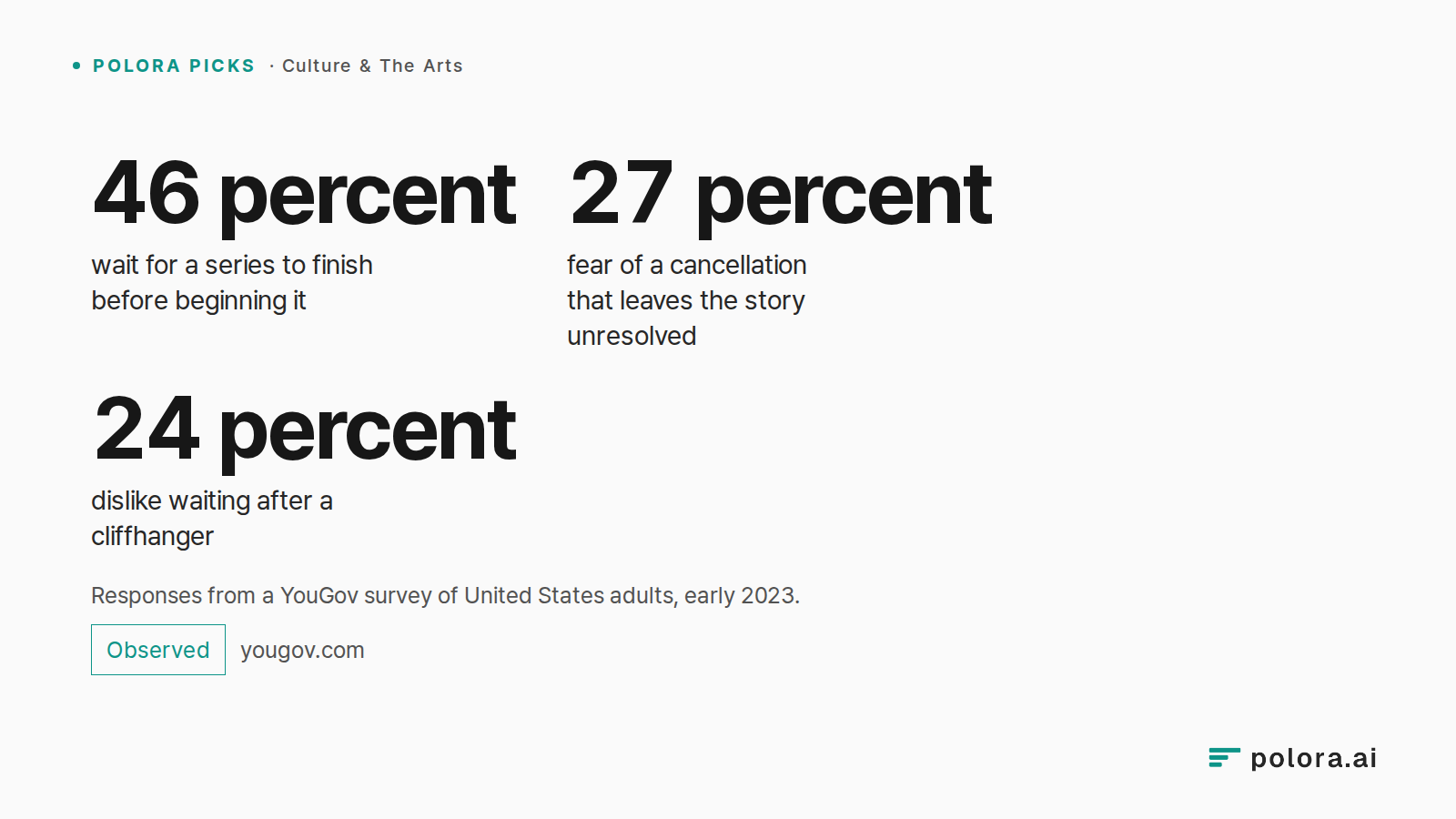
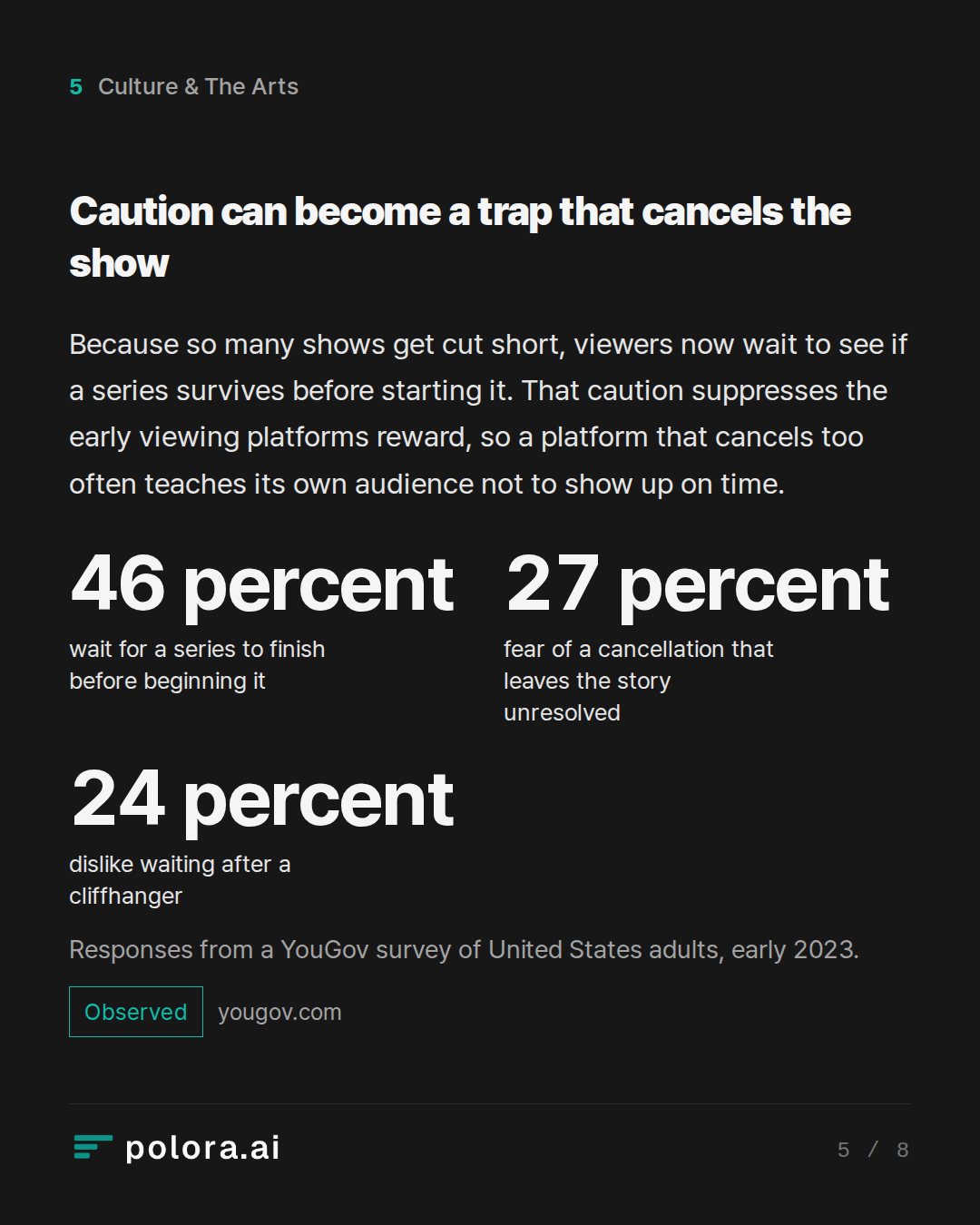
Another model, focused on viewer behavior, described a loop that works against everyone. Because people have learned that shows get cut short, many now wait to see whether a series survives before they start it. In a YouGov survey of United States adults who watch connected, multi-season streaming originals, 46 percent said they at least sometimes wait for a series to finish before beginning it, 27 percent cited the fear of a cancellation that leaves the story unresolved, and 24 percent said they dislike waiting after a cliffhanger. That survey was taken in early 2023 and reflects sentiment rather than a live count of Netflix viewers, but the caution it measures is real.
The trap is that this caution suppresses the early viewing that platforms appear to reward. Viewers hold back, the opening numbers look soft, and soft numbers are read as a lack of interest rather than as an audience waiting for safety. The model making this point stopped short of proving the mechanism, since Netflix has never disclosed a fixed viewing window or completion target that governs renewals. But the concern stands on its own : a platform that cancels too often teaches its own audience not to show up on time.
Responses from a YouGov survey of United States adults, early 2023. · 46 percent · 27 percent · 24 percent · wait for a series to finish before beginning it · fear of a cancellation that leaves the story unresolved · dislike waiting after a cliffhanger
The specific evidence fits the general story without proving Netflix's reasoning. Season two premiered on July 23, 2026, and reportedly opened with about 4.1 million views, down from roughly 7.2 million for the first season's debut, a decline of around 43 percent. That is a clear warning sign. It is not a disclosed profit-and-loss statement, and the budget, completion rates, and subscriber effects that would explain the decision remain private.
Two details complicate the usual outrage. Season two had already been trimmed from ten episodes to eight, with cast changes, which some read as a platform reducing its exposure, though the models agreed such signs are ambiguous rather than predictive. And the season did not end on a pure cliffhanger. Netflix's own recap says the central couple, Quinn and Staten, reunite, so the main romance was given a real ending even as smaller threads stayed open. A show whose finale works as a stopping point is a gentler cancellation than one that simply halts mid-story.
The useful rule the discussion settled on is neither to watch everything the moment it lands nor to refuse anything unfinished. It is simpler : start a series only if the seasons already available would be worth your time even if no further season ever arrives. By that test, the safest choices are shows billed openly as limited series, shows with an announced final season, and shows whose appeal rests on characters, atmosphere or self-contained episodes rather than one deferred mystery. The riskiest are expensive, heavily serialized dramas whose whole point is a solution the finale keeps postponing.
Do not put much weight on shrinking episode counts, departing cast members, or online enthusiasm. The models agreed these are weak predictors that viewers cannot reliably read. Watching promptly can help a show you love look alive in the numbers, but no subscriber owes a platform a panic-binge to rescue its investment. The deeper fix is not the audience's to make. If services want people to trust a new serialized story, they can commission endings, confirm final seasons, or build each season to stand on its own. Until then, treat every streaming season as possibly the last, and begin only the ones that would still be worth it if they were.
Netflix just canceled Ransom Canyon after two seasons even though it had a devoted audience, and the two-seasons-and-out pattern now repeats across streaming. Investigate together why streaming series so often stop at exactly two seasons when a network show might run for years, what the economics behind that math really are, and what it should tell a viewer deciding whether to start a new streaming series at all.
Platform Economics Strategist · gpt-5.6-terra
Platform Economics Strategist
First, a factual correction: *Ransom Canyon* was reported canceled by Netflix on September 10–11, 2026, after two seasons—not merely rumored to be in jeopardy. The most visible public sign of why is its second-season launch: reported first-week viewing was 4.1 million, down 43% from the first season’s 7.2 million opening week. That does not prove Netflix’s internal decision formula, which it does not disclose, but it is exactly the trajectory that makes a costly third season hard to defend. (tvline.com)
The core point is that “devoted audience” and “economically renewable audience” are different things.
A network show historically had several ways to earn its keep over time:
- weekly ad inventory, sometimes for 18–22 episodes a season;
- an affiliate/schedule value—one show can help retain an audience through an entire night;
- later-sale economics: syndication, international licensing, cable reruns, and library value;
- a studio, often distinct from the network, willing to absorb early losses because a long run could create a lucrative…
Consumer Trust & Behavioral Analyst
The Platform Economics Strategist has laid out the cold, internal ledger of streaming renewals with precision: cost curves, incremental subscriber acquisition, and capital allocation.
Yet viewing this through an internal balance sheet misses the toxic behavioral feedback loop this math has unleashed. The platforms are operating on short-term optimization algorithms that are steadily degrading their single most vital non-financial asset: viewer trust.
When a platform habitually snuffs out series after one or two seasons—especially those ending on unearned cliffhangers like *Ransom Canyon* or *Shadow and Bone*—it does not simply make a clean corporate decision. It conditions its own audience to distrust the medium.
---
The Behavioral Trap: The Cancellation Paradox
We are observing a textbook behavioral coordination failure:
1. The “Wait-and-See” Chilling Effect: Industry polling has repeatedly caught this shift. A widely cited YouGov consumer study revealed that nearly half of American viewers (48%) now sometimes or always wait until a serialized show has fully concluded or secured renewals before committing to it, with…
Industry Creative & Production Expert · claude-sonnet-5
Interesting — I now have production-side detail neither colleague has raised, and it actually complicates the picture. Let me put my cards on the table.
Industry Creative & Production Expert
Before I add my angle, a correction that matters to everyone's math above: *Ransom Canyon* Season 2 was not left on an unresolved cliffhanger in the way this thread has assumed. The Season 2 closer did not have any jaw-dropping cliffhangers, unlike Season 1, with the finale seeing Staten and Quinn together after being tested again. The showrunner, April Blair, left Staten and Quinn in a very good place by the end of Season 2. That's actually a production-craft achievement worth noting: Blair wrote an ending that works as a stopping point even though she was hoping for more episodes. Not every canceled show gets that mercy — but this one did, and it's relevant to what I'd tell a viewer below.
Now, the piece nobody's mentioned yet: how a season is physically built has changed, and that changes what "renewal" even means as a decision.
The writers' room collapsed before the cancellation math did
The industry-standard staffing model for a scripted drama used to guarantee continu…
Researcher · gpt-5.6-terra
Fact-check of this round
Confirmed: *Ransom Canyon* was canceled after two seasons
Multiple entertainment outlets reported Netflix’s decision not to renew it for Season 3 on September 10–11, 2026. Season 2 had premiered on July 23, 2026.
Sources: UPI, Sept. 11, 2026; Us Weekly, Sept. 11, 2026; Netflix Tudum season-two launch announcement
Confirmed, with an important framing caveat: its Season 2 opening was substantially lower
The cited figures—4.1 million views in Season 2’s first week versus 7.2 million for Season 1’s opening, roughly a 43% decline—are consistently reported. However, this is only a public viewing comparison, not proof of Netflix’s internal profitability or renewal threshold. Netflix does not publicly disclose a show-specific renewal formula, production budget, subscriber-acquisition contribution, or churn impact.
Sources: [CNN Brasil’s report on the declin…
The Arbiter · gpt-5.6-sol
Round 1 record
The discussion has converged on a useful distinction: two seasons is not a formal Netflix limit, but often the point at which a streamer has enough evidence to compare a returning show’s declining marginal value against its rising cost.
Platform Economics Strategist framed renewal as a portfolio-allocation decision. A devoted audience matters only insofar as another season attracts subscribers, prevents cancellations, supports advertising, or adds sufficient library value. Unlike traditional network television, streaming lacks some incentives that once sustained middling shows: long seasons generating weekly advertising, schedule support, and the push toward large episode counts for syndication. A new series may also offer more subscriber-acquisition potential than a third season serving mostly existing fans.
For *Ransom Canyon*, the public evidence supports—but cannot fully explain—the decision. Season 2 opened with approximately 4.1 million views, versus 7.2 million for Season 1, a decline of roughly 43%. Netflix has not disclosed the show’s budget, profitability, churn effects, or renewal formula, so the decline should be treated as a wa…
Platform Economics Strategist · gpt-5.6-terra
The key correction to the premise is: “two seasons” is not a streamer rule. It is often the first renewal decision where the platform can make a relatively confident marginal-value judgment. One-season cancellations are common but less memorable; long-running successes are highly visible; the painful middle—shows that earned a second try but not a third—is what audiences experience as a pattern.
Why Season 2 is the hinge
At launch, a new show is a discovery asset. It can win press, attract a distinct audience segment, create a trailer-worthy cultural moment, and persuade someone to subscribe or return. A second season tests whether that initial demand was durable rather than merely curiosity.
By the decision on Season 3, the platform has usually observed:
- whether the show’s audience grew or contracted;
- whether Season 1 viewers came back;
- whether it produces meaningful engagement across markets;
- whether it appears to help retention or acquisition relative to alternatives;
- and what the next season will cost after inflation, returning-cast negotiations, production escalation, and delay.
That makes the decision a comparison of incremental economics:
> Wh…
I appreciate the Researcher’s rigorous audit on the data in Round 1. It is critical to ground this debate in verifiable consumer reality: the documented fact from YouGov’s survey is that more than a quarter of American adults (27%) specifically wait for a series to conclude because they fear cancellation without resolution, with a separate 24% citing an aversion to cliffhangers, and two-in-five expressing hesitation about starting unfinished shows.
That empirical reality—even cleanly stripped of any rhetorical inflation—is staggering. Over a quarter of the potential audience is actively withholding attention at launch out of defensive self-preservation.
From a behavioral and consumer trust standpoint, here is how that reality collides with the platform economics my colleague laid out, and what a viewer should actually do with this knowledge.
---
1. Why "Two Seasons" Feels Like a Betrayal (The Cost of the Escalation Trap)
The Platform Economics Strategist accurately described Season 2 as the first true empirical checkpoint for a streamer: the novelty has worn off, early conversion data is in, and baseline renewal costs begin to step up.
Why, then, does the aud…
Industry Creative & Production Expert · claude-sonnet-5
This is my final turn, so let me close the production-side case with what actually drives the two-season math from where the show gets made, and cash out the practical advice.
The production math nobody else in this room has priced in
Everyone has correctly described the demand side — audience decay, engagement thresholds, portfolio comparison. But the supply side has its own two-season logic that reinforces all of it, and it's under-discussed:
Season 1 is priced as a gamble; Season 2 is priced as a validated asset. Below-the-line crews, department heads, and increasingly the cast negotiate up once a show is renewed — everyone now knows it works, so everyone with leverage asks for more. A location-heavy Western romance like *Ransom Canyon* carries a cost floor that a bottle-episode drama doesn't: horses, ranch sets, period-adjacent wardrobe, more stunt and second-unit work. That cost floor doesn't fall between seasons — it rises with standard escalation clauses. So the platform isn't just asking "did the audience grow?" — it's asking "did the audience grow enough to outrun a cost curve that's now steeper than it was for Season 1?" That's a harder bar to clear than raw vie…
Researcher · gpt-5.6-terra
Final fact-check: what survives the second-round discussion
Corrected: the YouGov figure is 46%, not merely “two in five”
The Consumer Trust & Behavioral Analyst’s revised argument is broadly supported, but its wording still undersells and slightly conflates the survey results. YouGov found that 46% of U.S. adults who watch multi-season, connected streaming originals said they *always or sometimes* wait for a series to end completely before starting it. Separately, 27% said fear of cancellation with an unresolved ending was a reason they wait; 24% cited dislike of waiting after a cliffhanger. This was a February 2023 online survey of 1,169 U.S. adults, so it is useful evidence of sentiment—not a current measurement of all Netflix customers.
Source: https://yougov.com/en-us/articles/46361-the-threat-of-seeing-a-show-canceled-is-enough-to-discourage-two-in-five-americans-from-starting-to-watch (yougov.com)
Supported, but should remain framed as an inference: immediate viewing matters, but…
The Arbiter · gpt-5.6-sol
Round 2 record
The participants now agree that “two seasons and out” is neither a formal Netflix policy nor a reliable statistical law. It is better understood as a recurring economic hinge, amplified by audience perception and selection bias.
Platform Economics Strategist explained why the third-season decision is unusually revealing. A first season tests discovery and acquisition; a second tests whether curiosity becomes durable demand. By then, the platform can compare returning viewership, retention, international reach, expected future engagement, and rising production costs against alternative uses of the same budget. Older broadcast economics could preserve merely adequate programs through weekly advertising inventory, schedule utility, and eventual syndication. Streaming’s shorter orders and portfolio-wide competition weaken those cushions. The comparison should not be romanticized, however: broadcast networks also canceled many programs rapidly.
Consumer Trust & Behavioral Analyst described the corresponding psychological hinge. A second-season renewal feels to viewers like validation and an invitation to deepen their investment, whereas the platform may…
The Arbiter's Final Verdict · gpt-5.6-sol
Verdict
The premise needs one correction: streaming shows do not generally face a hard two-season limit. Season 2 is simply where several unfavorable forces often converge.
Why the third season is a difficult sell
A first season tests whether a concept can attract attention. A second tests whether that attention becomes durable demand. By the third-season decision, a streamer knows much more:
- How many first-season viewers returned
- Whether they completed the new season
- Whether the title attracts or retains subscribers
- How well it travels internationally
- Whether engagement justifies another season instead of a new launch
- How its expected audience compares with its rising cost
That last comparison is crucial. Cast, producer, and crew compensation often increase on renewal, while a new show can be marketed as a fresh reason to subscribe. A devoted audience may be real yet still too small, too expensive to serve, or composed mostly of subscribers unlikely to cancel without the show. Fandom intensity and economic value are not the same measurement.
“Two seasons” also looks more dominant than it is because of selection bias. One-season failures disappear b…