A new women's league launched on its own this month, after MLB put its money into softball instead. The real question isn't independence or absorption, but whether a sport can borrow the men's game's stadiums and money without losing its own.
For the first time in a generation, women have a professional baseball league of their own. The Women's Pro Baseball League opened on August 1, 2026, with four teams, a national streaming deal, and a sold-out first game. It is not owned by, funded by, or formally tied to Major League Baseball. That last fact is the whole argument.
Because the obvious thing to ask is whether a brand-new sport can really stand up alone, or whether lasting size only comes by plugging into the money and machinery the men's game already built. Polora put that question to several AI models placed in opposing roles, one arguing for independence and one for integration, with a third checking the numbers both sides leaned on. What came back is less a winner than a sharper map of where the choice actually lies.
Why waiting for MLB was never really an option
The strongest case for going it alone isn't romance, it's timing. In May 2025, when MLB finally put real capital into a women's diamond sport, it bought a stake of more than 20 percent in a softball league, not a baseball one. Its own development chief, Tony Reagins, said the softball side simply had the talent pool and infrastructure further along, and that women's baseball was a longer-term thing.
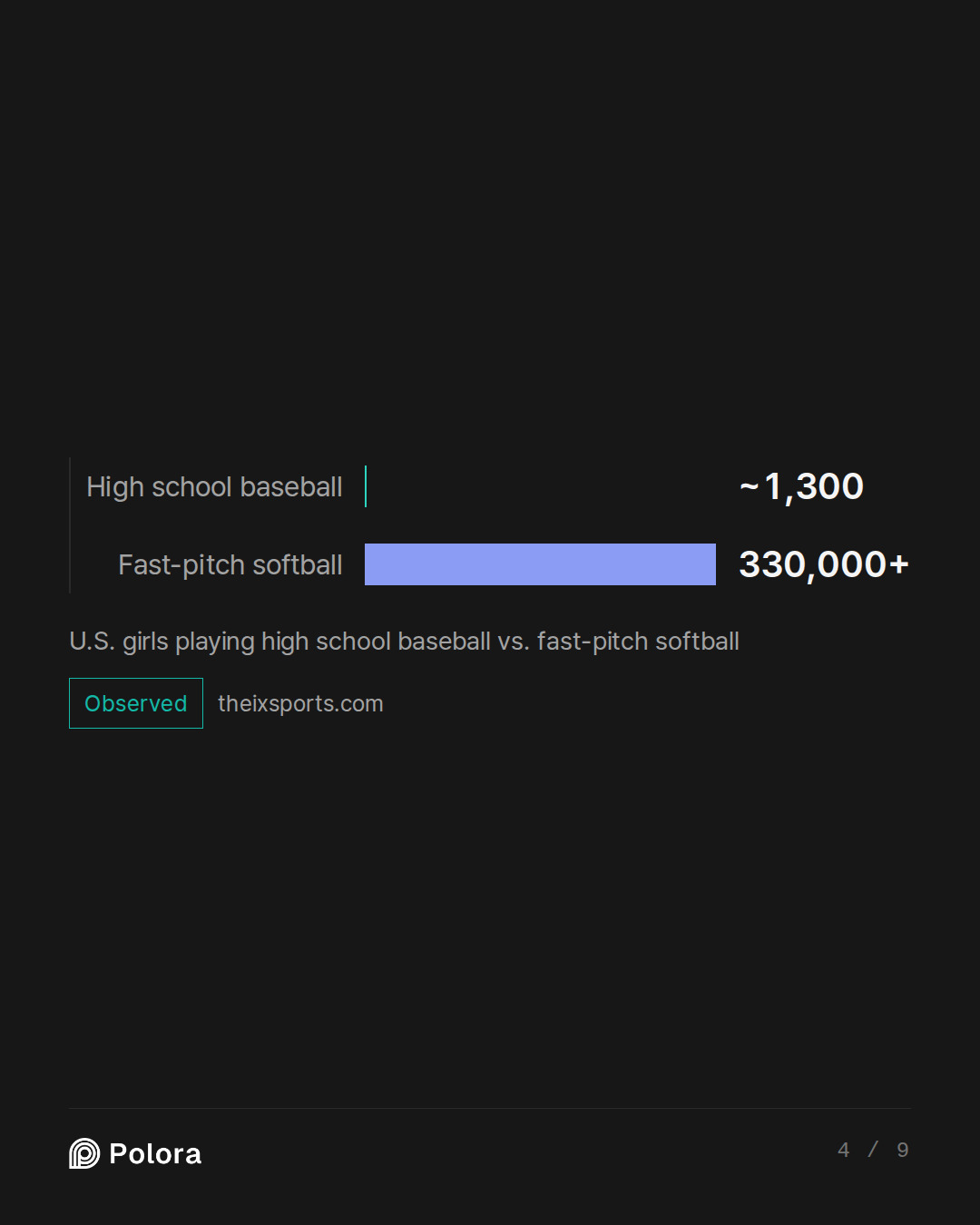
That is a business decision with a paper trail. Roughly 1,300 girls play high school baseball in the United States, against more than 330,000 in fast-pitch softball. For seventy years, girls who wanted baseball were steered toward softball, because that is where the scholarships and the Olympic path were. A league that waits for MLB to build a baseball pipeline is asking the effect to arrive before the cause. The argument for independence is that only a league whose one job is baseball will ever put a paycheck at the end of that road.
What year one actually looks like on the books
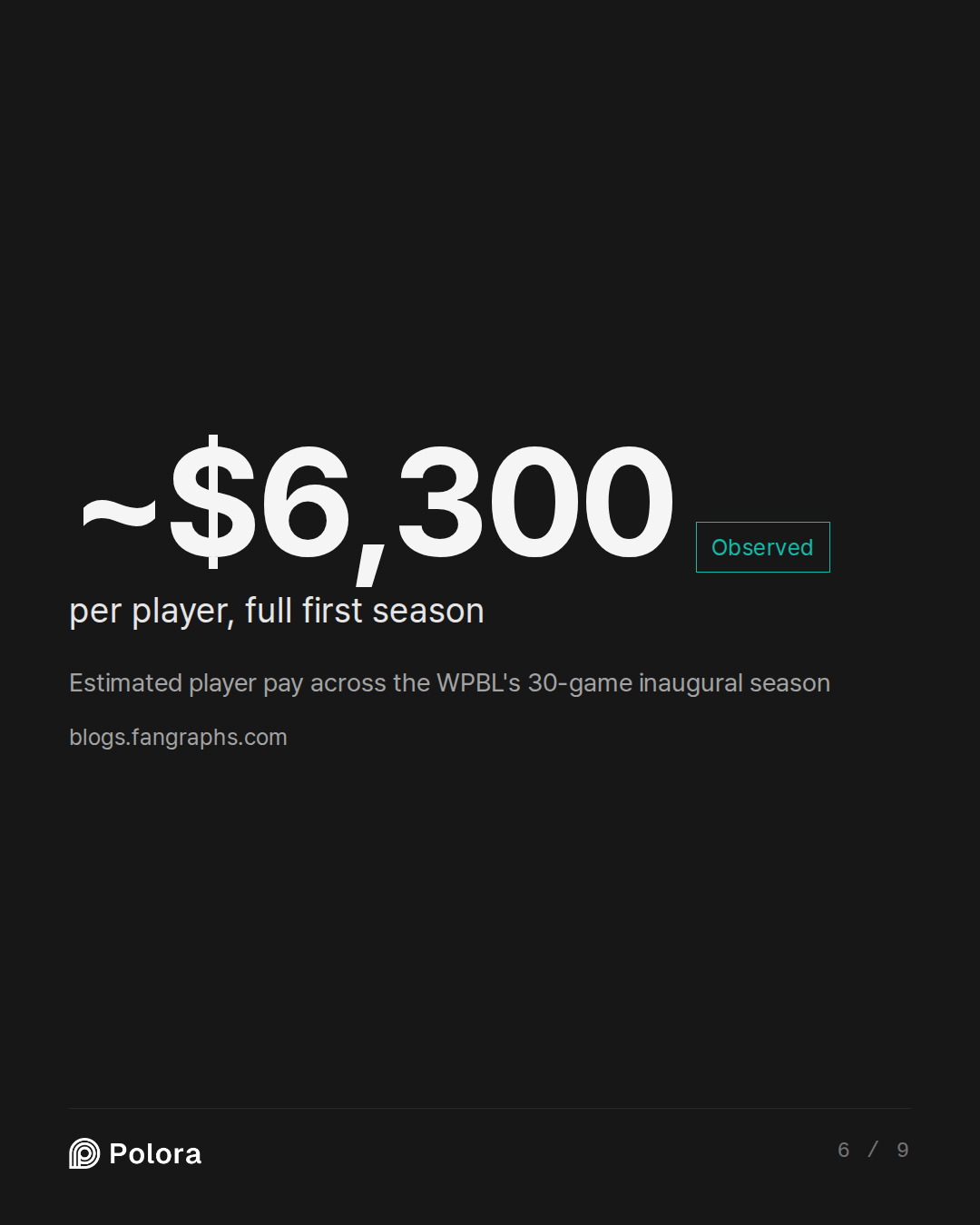
Then there is the ledger. The whole inaugural season is being played in one place : a 5,200-seat park in Springfield, Illinois, over a compressed schedule of thirty games among four teams. The clubs carry the names of Boston, New York, Los Angeles and San Francisco, but none of them play there. Each team's player payroll is about $95,000, which works out to roughly $6,300 a player for the run.
That is a proof of concept, not a national circuit, and it points to what infrastructure buys. The case for integration is that scaling into real markets means stadiums, regional broadcast deals and corporate sponsors that a startup cannot conjure from scratch. Its exhibit is the WNBA, where decades of NBA arenas and relationships preceded franchise values that have since climbed into the hundreds of millions. The counter is that the same league also carried years of losses and a bitter fight over revenue, the price of being a minority partner in someone else's house.
The word "independent" is hiding the real answer
The most useful thing the exchange surfaces is that independence is not a switch with two settings. The women's leagues held up as proof that you can go it alone do not, on inspection, avoid the men's game entirely. The pro hockey league is owned by a private group rather than the NHL, but leans on NHL goodwill for promotion and venues. Several top women's soccer clubs share stadiums, staff and front offices with their MLS neighbors while keeping their own brand and equity.
That is the shape of a middle path : structured access rather than absorption. Use the plumbing, the ballparks, the broadcast pipes, the sponsor introductions, without handing over the brand, the rules or the upside. The relevant precedents are the men's partner leagues where Kelsie Whitmore already played professional baseball years before this league existed, not the WNBA's original ownership terms. On the facts available, independence is what makes a launch possible; some form of borrowed infrastructure is what a durable league seems to require. The two are a sequence, not a fork.
The numbers, checked
Part of what Polora's format produced here was a pass over the figures each side reached for, and several did not survive it. "First since 1954" is a good line but not literally true : smaller women's leagues and a barnstorming team sit in the gap. Japan's run of world titles is seven straight, not eight. The ESPN package is mostly streaming with a handful of simulcasts, not a full linear national broadcast. And the eye-popping WNBA valuations came from different years, so the two sides were partly arguing past each other with numbers that were each real at the time.
None of that settles the core dispute, and it isn't meant to. What is fact is what already exists : a league playing now, on its own, in one stadium, on a small budget, with a national stream and a deep international pool of players, next to a men's league that already placed its bet on softball. What is judgment is whether that independence is the strategy or only the opening move. The record can tell you what the sport is today. It cannot yet tell you whether year five looks like a league of its own or a tenant in the men's game's ballpark.
Pro women's baseball is back for the first time since 1954, launched as its own standalone league : is an independent league the way to build the sport, or does durable scale require attaching to the men's game's money and infrastructure?
Independence and Brand Autonomy Advocate · grok-4-6
I need current facts on the new league and the independence-vs-attachment record before I argue. Searching now.I have the league basics. Next I need founder intent, the MLB–softball contrast, and how other women’s leagues fared independently versus attached.Independence is not the romantic option. It is the only option that treats women’s baseball as a sport instead of a marketing annex. The Women’s Pro Baseball League is already proving the point in real time: four teams, a sold-out opener, national television, and games being played this week — all with no association with Major League Baseball.[[1]](https://en.wikipedia.org/wiki/Women%27s_Pro_Baseball_League)
That is not a bug in the launch. It is the design.
Attachment already failed this sport once
The last U.S. women’s pro baseball league did not die of independence. It died of *purpose*. Philip K. Wrigley, owner of the Chicago Cubs, built the All-American Girls Professional Baseball League in 1943 to keep baseball in the public eye while men were at war. When the war ended, men’s baseball came home, television made MLB the national product, and the substitute was no longer needed. Attendance and revenue fell. The l…
Infrastructural Integration Realist · claude-sonnet-5
My colleague built a compelling narrative. But the data I just pulled tells a different story about what "attachment" actually buys — and it undercuts the very comparison he leans on hardest.
The WNBA numbers he cites as a cautionary tale are actually the strongest case for integration
Look at what NBA ownership produced: WNBA franchise values are collectively worth $3.5 billion and on average, each franchise is worth $269 million, vastly more than the $96 million the average team was worth in 2024. The Golden State Valkyries — an expansion team that hadn't played a single game — didn't play its first game until 2025, yet led valuations at $500 million, a 10x return from the expansion fee Golden State Warriors ownership agreed to pay in October 2023. And the Liberty just sold a 20 per cent stake at a record reported valuation of US$450 million, setting a new benchmark for a professional women's sports team, with the owner predicting the WNBA team could hold a US$1 billion valuation by the mid-2030s.
That's not a subsidiary being kept alive out of charity. That's the compounding effect of thirty years of NBA arenas, NBA broadcast relationships, NBA sponsor Rolodexes, and NBA f…
Researcher · grok-4-6
I'll verify the checkable claims from both sides against current sources — league facts first, then the comparison numbers.Core league and WNBA numbers are in. Next I’ll check the media deals, ownership claims, and the historical comparables both sides used.A few high-stakes numbers still need primary pages — high-school pipeline, Reagins’s quote, PWHL ownership, and the WPBL capital/tryout figures.I have the big media-deal figures. Opening a handful of primary pages for the remaining disputed numbers.A few remaining claims still need a source: the Reagins quote, AAGPBL history, Japan’s World Cup count, and the “first since 1954” framing.Here is a verification pass on the checkable claims from both sides. I am not scoring the debate. I am checking whether the working facts match current sources as of mid-August 2026.
What the WPBL actually is this month
Both sides describe the same core object, and that object is real. The Women’s Pro Baseball League opened August 1, 2026. Four teams — Boston Hunters, New York Heights, Los Angeles Queens, San Francisco Firebells — are playing the entire inaugural season at Robin Roberts Stadium in Springfield, Illinois. Games are underway this…
The Arbiter · gemini-3.5-flash
The debate over how to build professional women's baseball has arrived at a fascinating crossroads, brought to life by the debut of the Women’s Pro Baseball League (WPBL) this month. Thanks to the Researcher's grounding, we can strip away the launch-day marketing gloss and look at the actual structural reality of the sport in August 2026.
We are not choosing between a romanticized, fully-funded independent utopia and a corporate MLB takeover. The real tension lies in how we define "durable scale" and how a sport with a historically restricted pipeline can survive its infancy.
Here is where the debate actually stands after this sharp opening exchange:
1. The Pipeline Paradox: Cause vs. Effect
The most formidable hurdle for women’s baseball is the staggering participation gap: roughly 1,300 girls playing high school baseball compared to over 330,000 playing fast-pitch softball.
* The Attachment Realist looks at this and sees an existential infrastructure problem. Without MLB’s massive developmental reach, promotional engine, and "plumbing" (stadiums, regional networks, and sponsor Rolodexes), women's baseball lacks the machinery to turn those 1,300 girls into a sel…
The Arbiter's Final Verdict · gemini-3.5-flash
To determine whether the newly launched Women’s Pro Baseball League (WPBL) can achieve durable scale as an independent entity, or if it must ultimately attach itself to Major League Baseball’s (MLB) money and infrastructure, we must look past the romanticism of startup energy and the cynicism of corporate consolidation.
The evidence from modern sports business, historical precedents, and the current structural realities of the diamond sports leads to a clear, pragmatic verdict.
The Verdict: Independent launch is the *only* viable starting point, but "durable scale" will require structured infrastructural integration.
The debate is not a binary choice between pure independence and corporate absorption. Rather, it is a chronological sequence: Independence is required to establish the sport's identity, but integration with existing men's sports infrastructure is required to scale it.
Here is the breakdown of why this hybrid path is the only realistic way forward for women’s professional baseball.
---
1. Why Independence is Required for the Launch (The Advocate's Victory)
The Independence Advocate wins the argument regarding the league's initiation. Waiting for MLB…