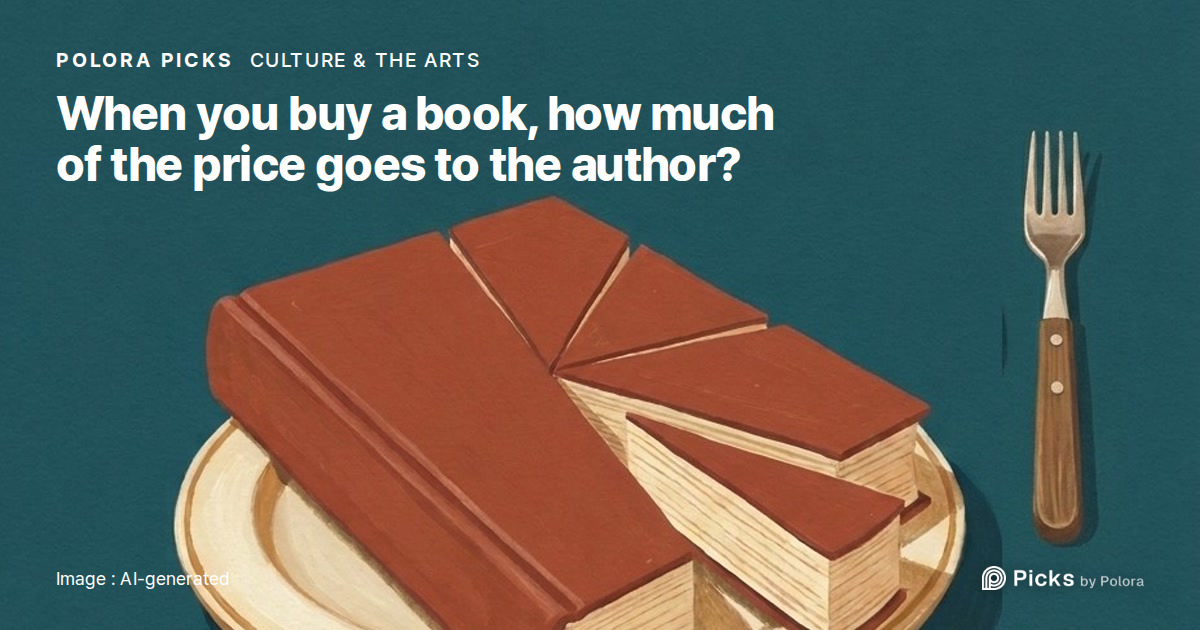
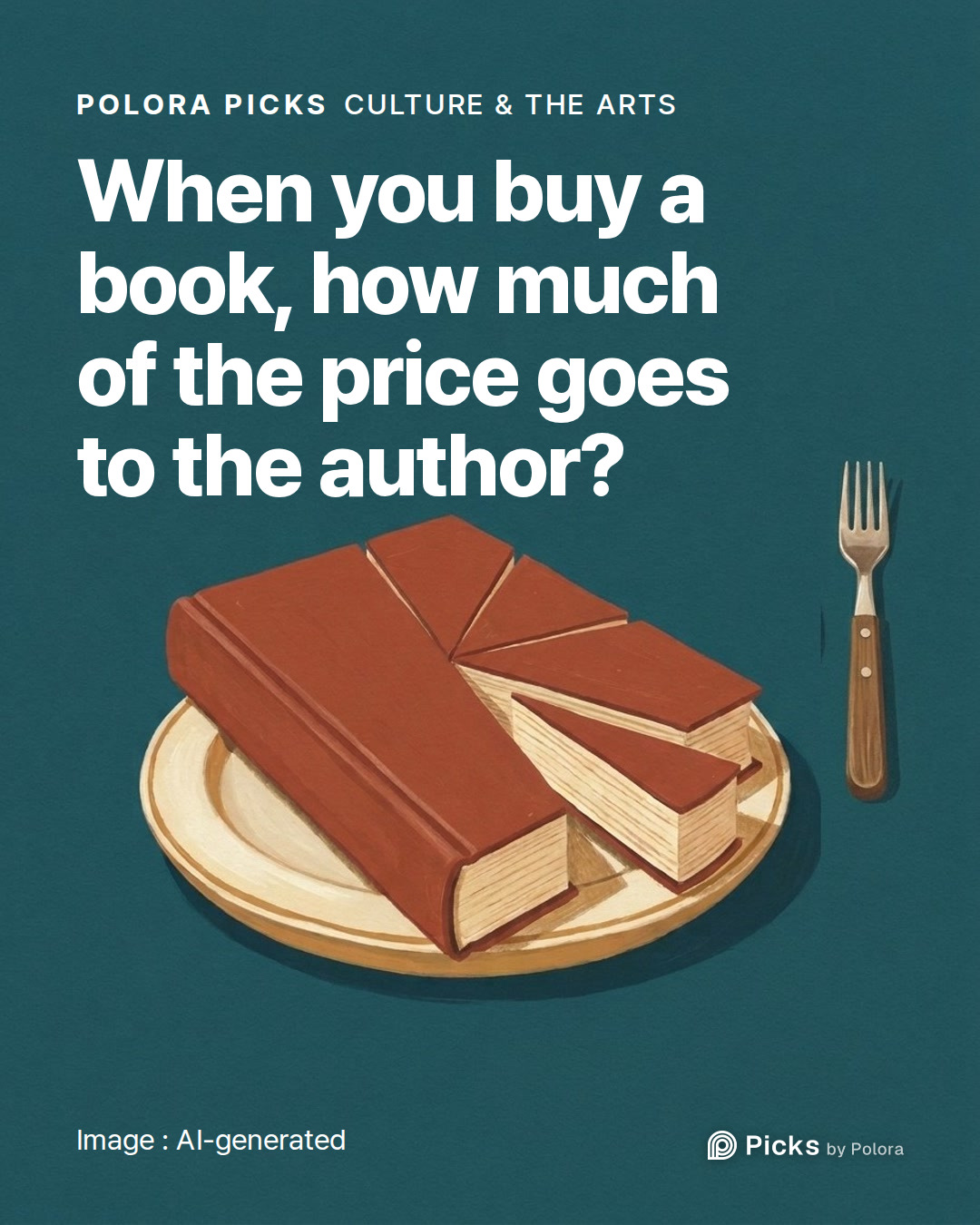
When you buy a book, how much of the price goes to the author?

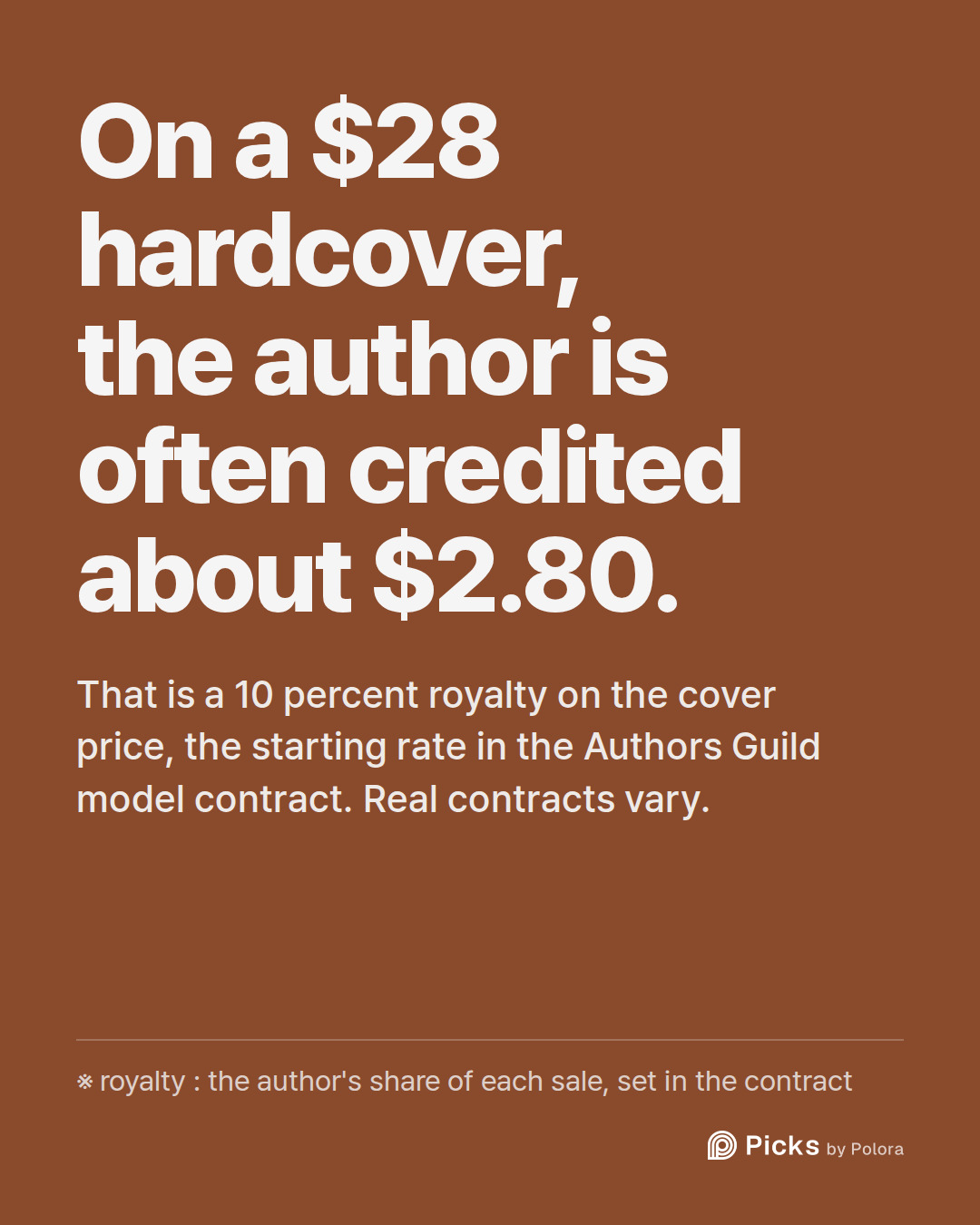
On a new hardcover, often 10 to 15 percent of the cover price, about $2.80 on a $28 book, and less under contracts counted on what the publisher receives. That share first counts against the author's advance.

Culture & The Arts · 2026-11-05

Who gets what when you pay $28 for a hardcover

Take a new hardcover with $28 printed on the jacket. That is an example price, chosen to make the arithmetic easy to follow. The largest single part of the money never leaves the shop. Publishers sell books to shops at a discount from the cover price. Distributor guides put that discount at roughly 40 to 55 percent, with 55 percent the figure physical bookstores usually expect, though terms vary by shop and by order. The fantasy author Brandon Sanderson, in an estimate he posted in 2007, described a $25 hardcover this way : about $14 reaches the publisher, about $3 goes to the author, and after printing and shipping the publisher has roughly $7 left. He presents those figures as a rough illustration, not as an accounting.

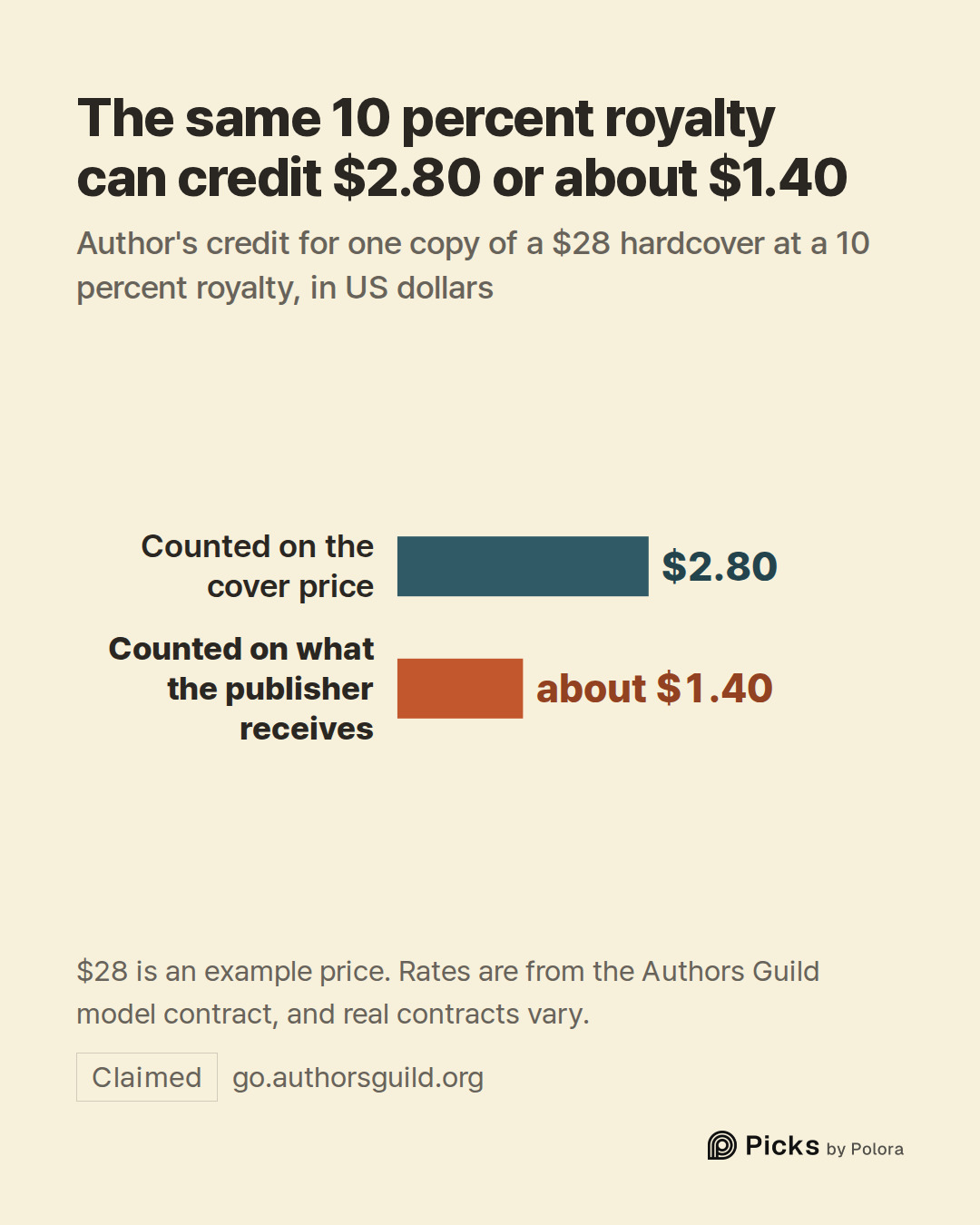
The author's part is set in the contract, not at the till. The Authors Guild, the main US writers' organization, publishes a model contract. Its list-price version sets hardcover royalties at 10 percent of the retail price on the first 5,000 copies, 12.5 percent on the next 5,000 and 15 percent after that. On a $28 book, the first of those rates is $2.80. For trade paperbacks the same version gives 7.5 percent of the cover price. The Guild also offers a second version that applies the same percentages to what the publisher actually receives, which it says is often about half the list price. Under that version, the same 10 percent on a $28 book would credit roughly $1.40. Real contracts are negotiated one at a time and differ by publisher, format and country, so these figures are reference points, not a rule.

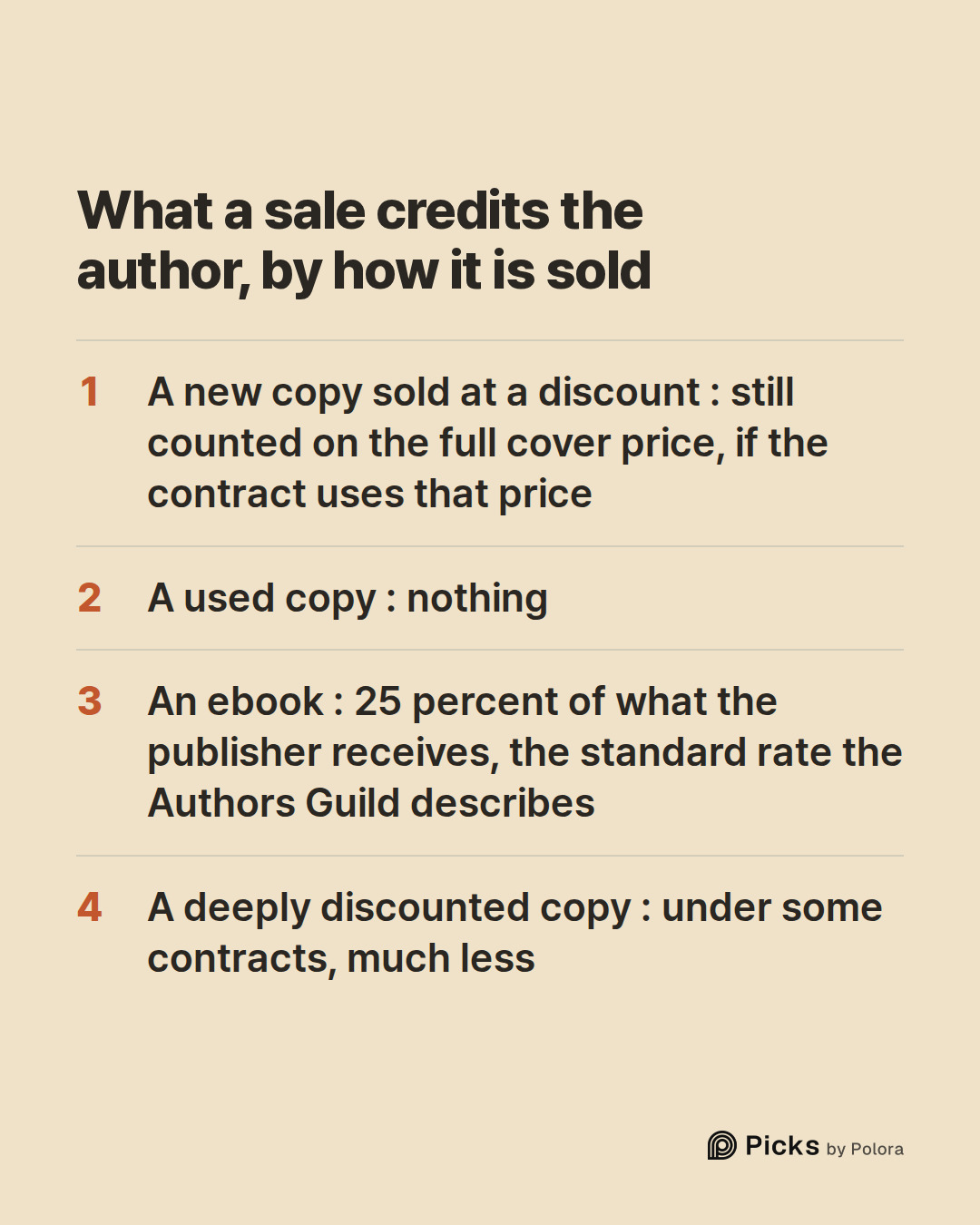
One detail surprises most buyers. Under a list-price contract, the royalty on an ordinary sale is counted on the cover price, not on what you paid. The author Brian McClellan explains that if a shop sells his $26 book for $18, his royalty is still worked out on $26. A used copy pays the author nothing.
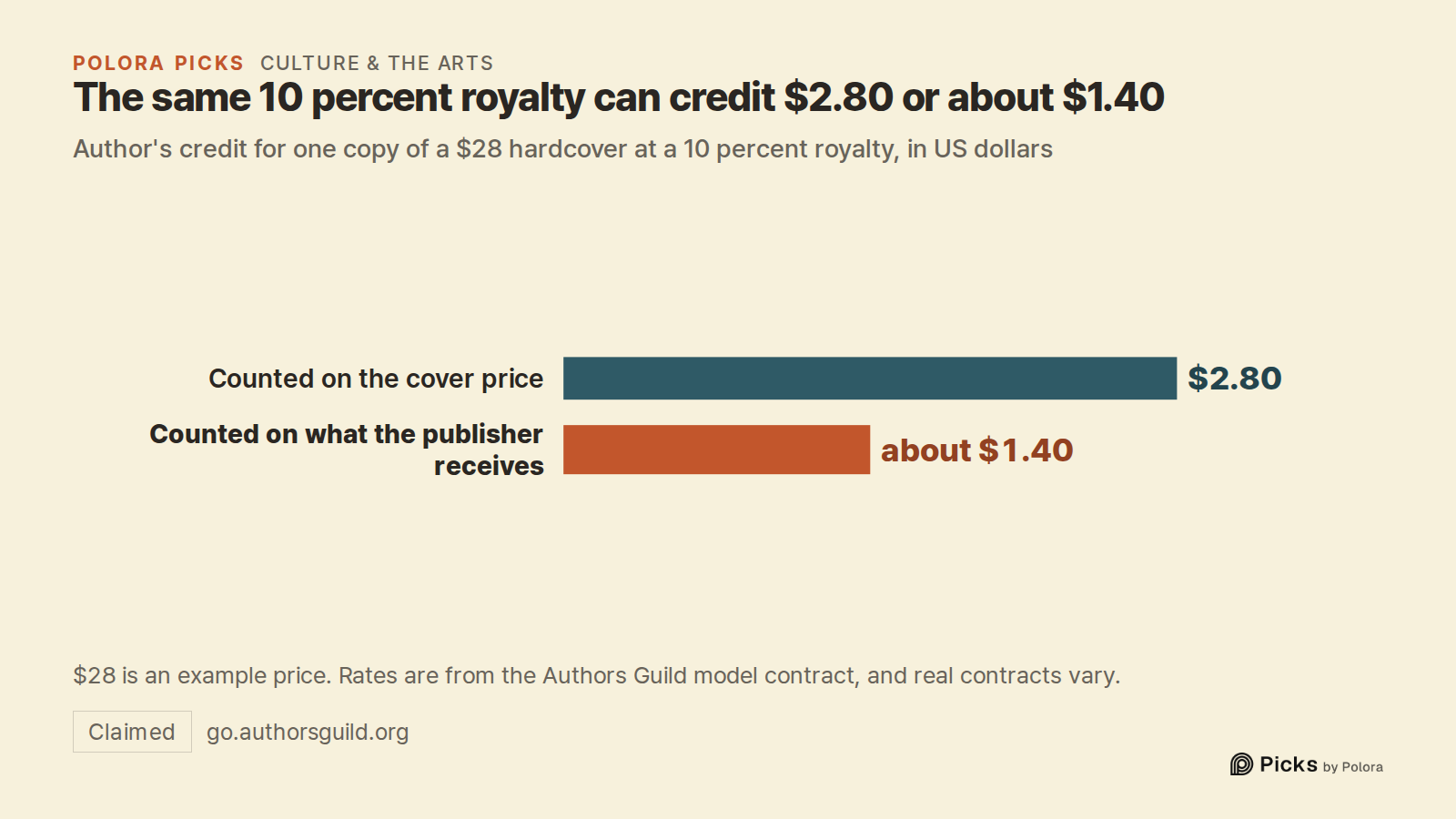
The same 10 percent royalty can credit $2.80 or about $1.40 · Author's credit for one copy of a $28 hardcover at a 10 percent royalty, in US dollars · Counted on the cover price · Counted on what the publisher receives · $2.80 · about $1.40 · $28 is an example price. Rates are from the Authors Guild
Author's credit for one copy of a $28 hardcover at a 10 percent royalty, in US dollars

The author's royalty is a credit against the advance, not a payment

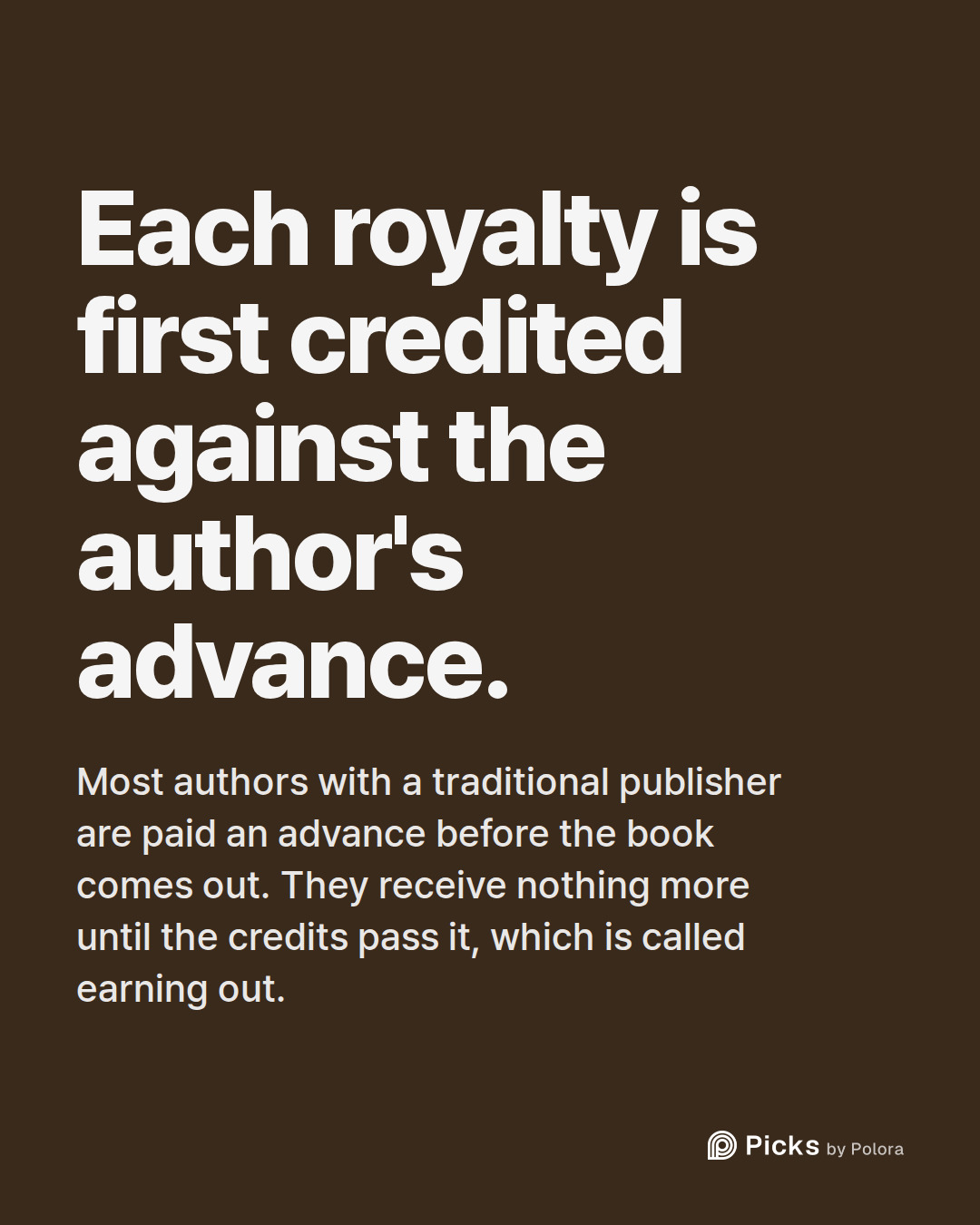
Most authors with a traditional publisher are paid an advance before the book comes out. The word is short for an advance on royalties, and it is not extra money on top of what the book later earns. Every royalty the book earns is credited against the advance. The author receives nothing more until those credits add up to more than the advance, which is called earning out.

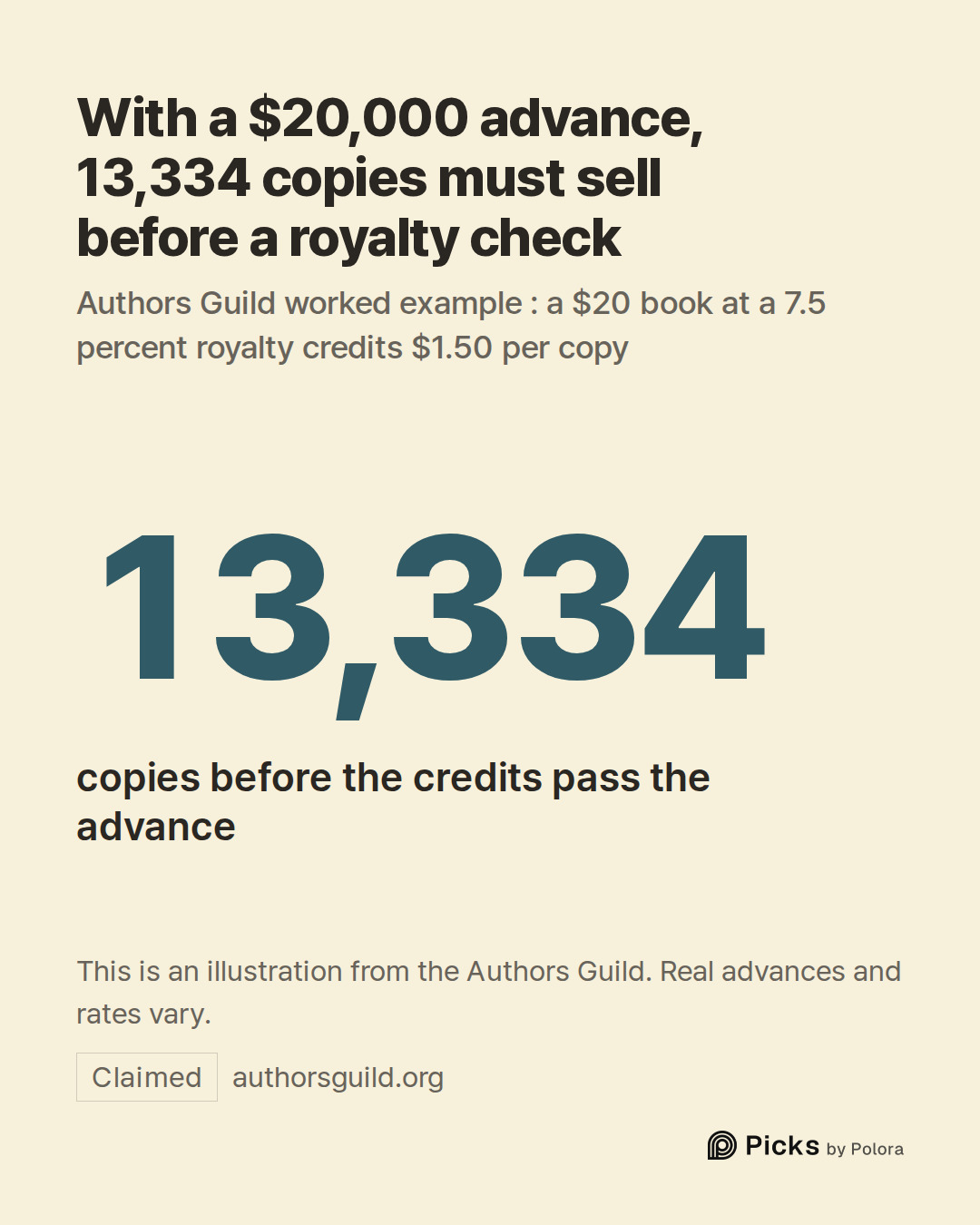
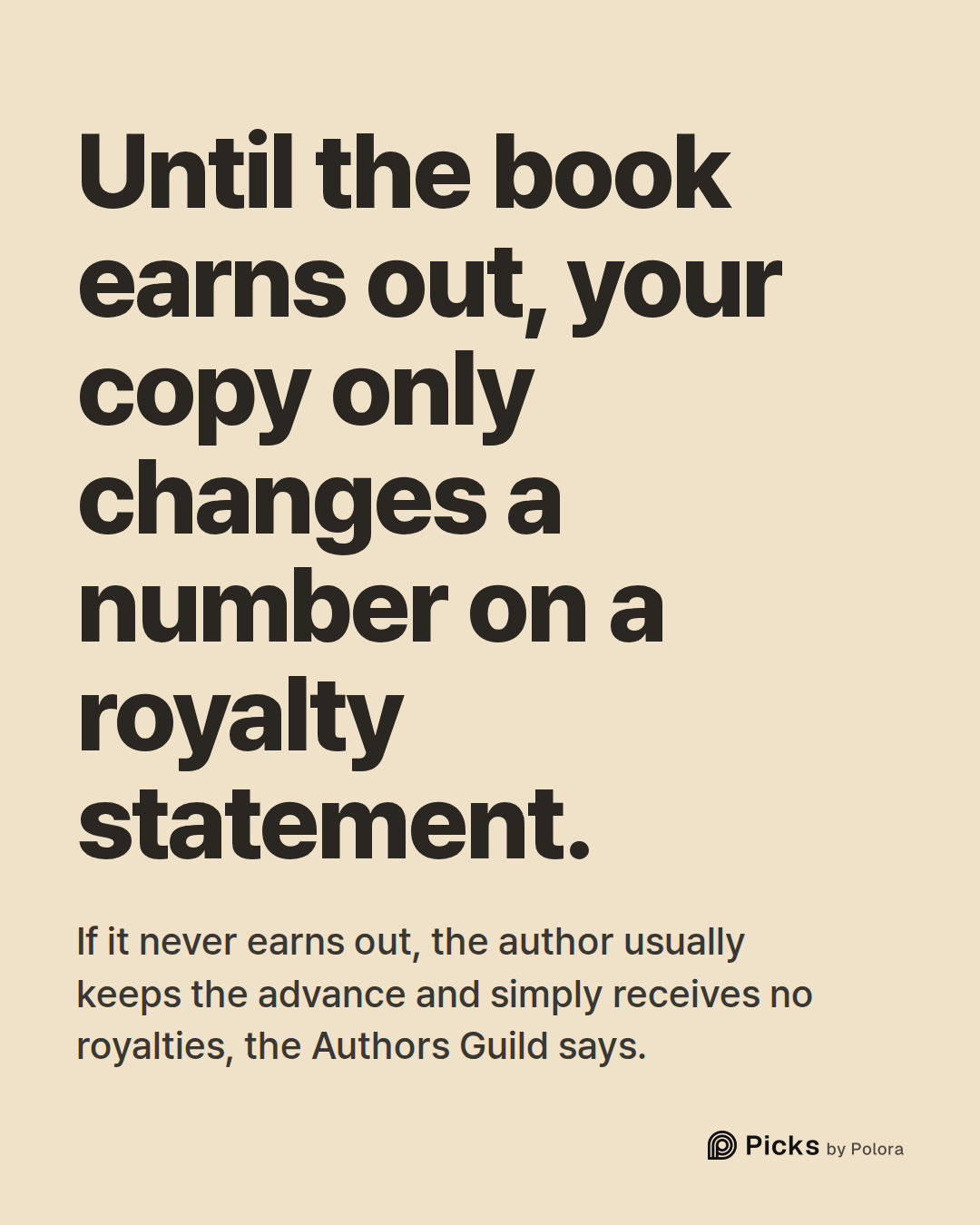
The Authors Guild gives a worked example. A book sells for $20 and the author's royalty is 7.5 percent, so each copy credits $1.50. With a $20,000 advance, the book has to sell 13,334 copies before the credits pass the advance and the author can see a royalty check. Until then, the copy you just bought only changes a number on a royalty statement and adds nothing to what the author is paid.

If the author has a literary agent, the agent's commission comes out of the author's share. The Guild says agents generally take 15 percent on US deals, and 20 percent on foreign rights when a second agent is involved. The money usually goes from the publisher to the agency, which keeps its commission and passes the remaining 85 percent to the author.
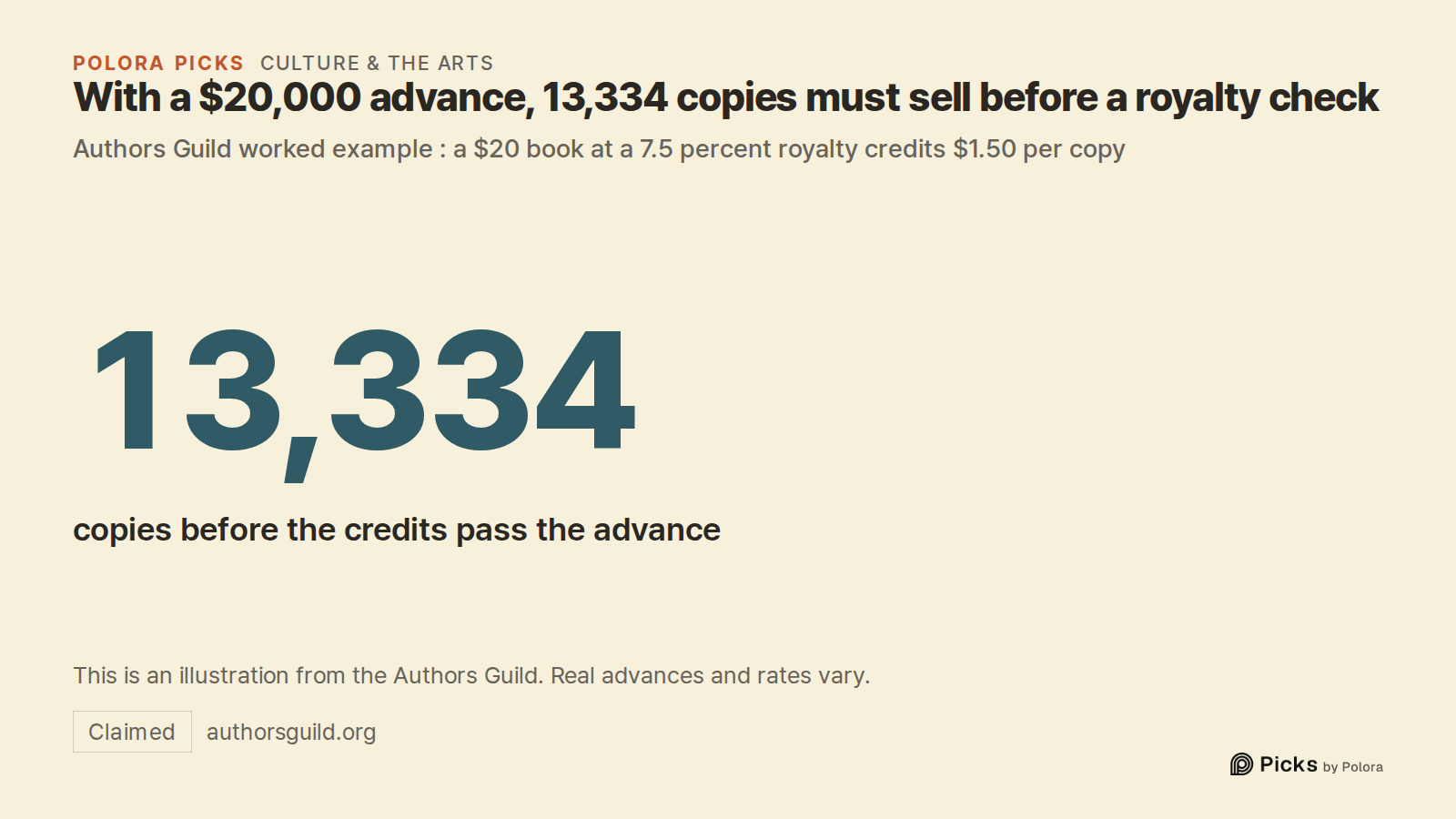
With a $20,000 advance, 13,334 copies must sell before a royalty check · Authors Guild worked example : a $20 book at a 7.5 percent royalty credits $1.50 per copy · 13,334 · copies before the credits pass the advance · This is an illustration from the Authors Guild. Real advances and rates vary.
Authors Guild worked example : a $20 book at a 7.5 percent royalty credits $1.50 per copy

A book that never earns out is not a debt

If the credits never catch up, the author usually keeps the advance. The Authors Guild says that in most cases an unearned advance is not paid back in cash ; the author simply receives no royalties. Repayment comes up when the contract is broken, for example when the manuscript is never delivered.

A book that does not earn out has not necessarily lost the publisher money either. The literary agent Steve Laube works through an illustrative example of a book selling 10,000 copies under two different royalty arrangements. In his figures, the version that fails to earn out leaves the publisher $5,000 in profit, against $4,600 for the version that does earn out. It is a calculation, not a measured result, but it shows the point : the advance works like a fixed price paid for the book, and the royalty terms decide how the later money is shared.

How many books never earn out is often repeated but rarely sourced. A figure of 7 in 10 titles circulates, and Laube points out that it was published without a source. What can safely be said is that the system often lets a sale go by without adding anything to the author's income.
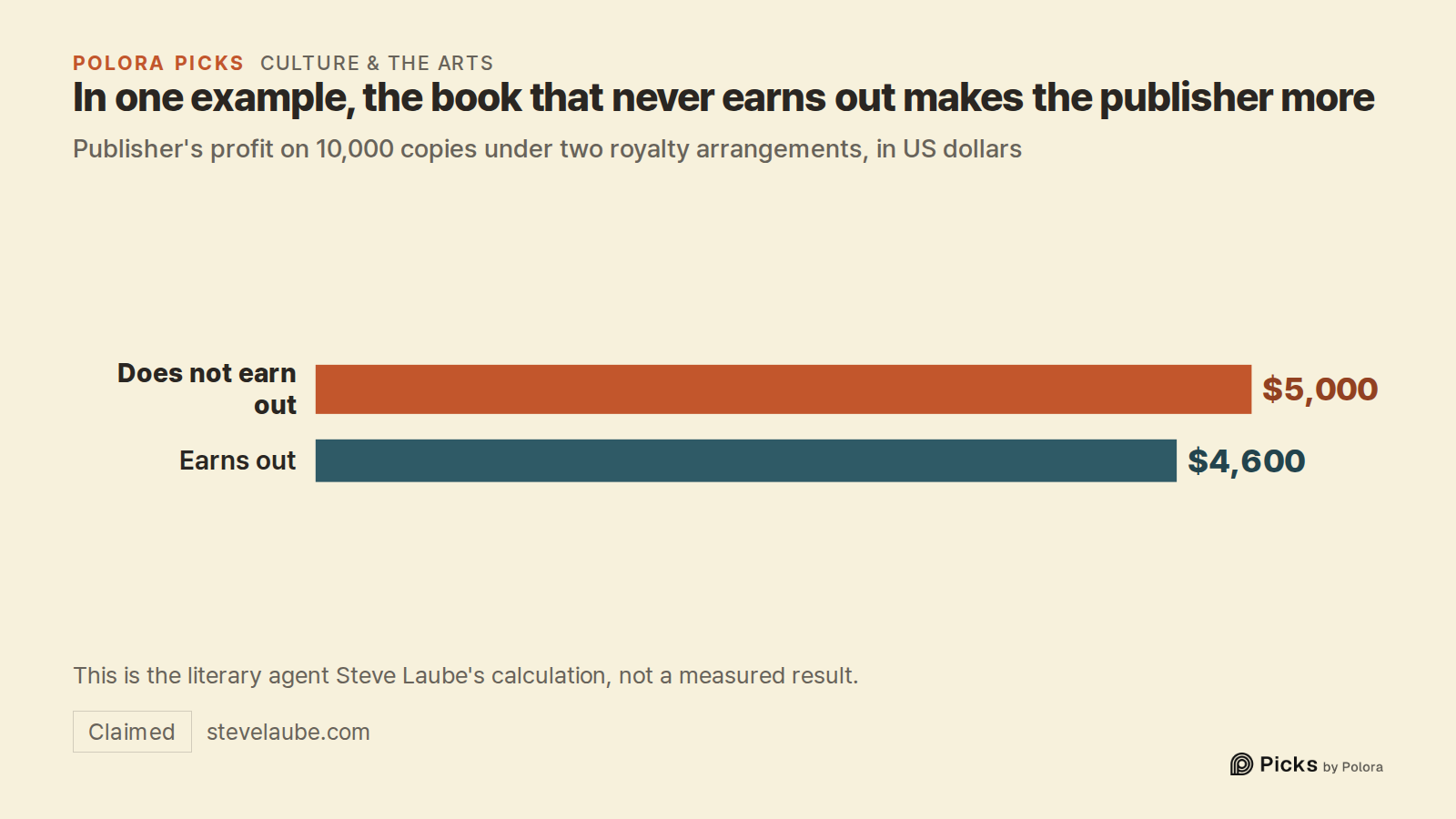
In one example, the book that never earns out makes the publisher more · Publisher's profit on 10,000 copies under two royalty arrangements, in US dollars · Does not earn out · Earns out · $5,000 · $4,600 · This is the literary agent Steve Laube's calculation, not a measured result.
Publisher's profit on 10,000 copies under two royalty arrangements, in US dollars

Ebooks and deep discounts can shrink the author's share

Not every royalty is counted on the cover price. For ebooks, the Authors Guild describes 25 percent of the publisher's net receipts as the current standard rate. Net receipts are the money the publisher actually takes in after the retailer's share. The Guild's model contract uses the same 25 percent of net for digital audiobooks. For print, the second version of the Guild's model contract, meant for many small and medium-sized publishers, also counts royalties on net receipts.

Some contracts also change how the royalty is counted when a book is sold at a very deep discount. The Guild's own model contract keeps this narrow : a reduced royalty applies only to certain bulk orders outside the ordinary US book trade, at discounts above 56 percent, and even then it never drops below two-thirds of the normal rate. Other contracts go further. In 2015 the Guild described clauses in some contracts that move the royalty from list price to net receipts on deeply discounted sales. In its example, a $10 book sold at a 56 percent discount brings the publisher $4.40, and a 15 percent royalty on that credits the author about $0.66 instead of the $1.50 it would credit on the cover price. The Australian Society of Authors describes the same kind of high-discount clause in Australian contracts.

So the 10 to 15 percent applies to an ordinary hardcover sale under a contract counted on the cover price. A heavily discounted copy, or a contract counted on net receipts, can credit the author much less than 10 percent of the cover price.
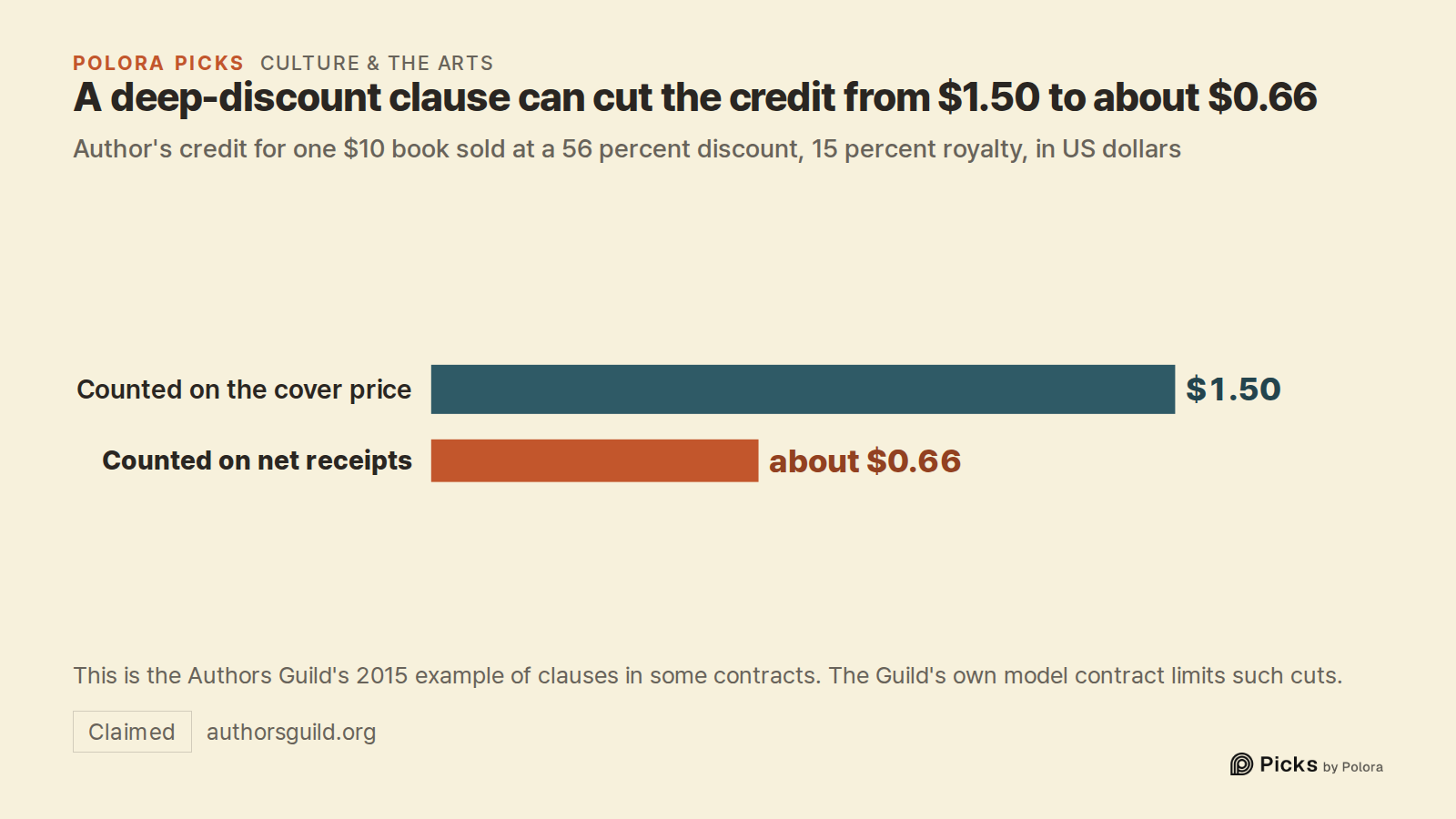
A deep-discount clause can cut the credit from $1.50 to about $0.66 · Author's credit for one $10 book sold at a 56 percent discount, 15 percent royalty, in US dollars · Counted on the cover price · Counted on net receipts · $1.50 · about $0.66 · This is the Authors Guild's 2015 example of clauses i
Author's credit for one $10 book sold at a 56 percent discount, 15 percent royalty, in US dollars

What authors earn from books, as a group

Together, these rules leave most writers with modest incomes. The Authors Guild's 2023 survey asked 5,699 published US authors about their 2022 income. Book income counted advances, royalties and fees for rights. The median was $2,000 across all respondents, part-time authors included, and $10,000 for full-time authors.

In the UK, the Authors' Licensing and Collecting Society commissioned a survey carried out at the University of Glasgow. For authors whose main job is writing, meaning those who spend at least half their working time on it, it found median earnings of £7,000 from self-employed writing. The survey asked about the 2019/20 and 2020/21 tax years.

The two surveys asked different groups different questions about different years, so they cannot be read as one trend. A median also describes a group, not any one writer. Some authors earn far more, and many earn less.
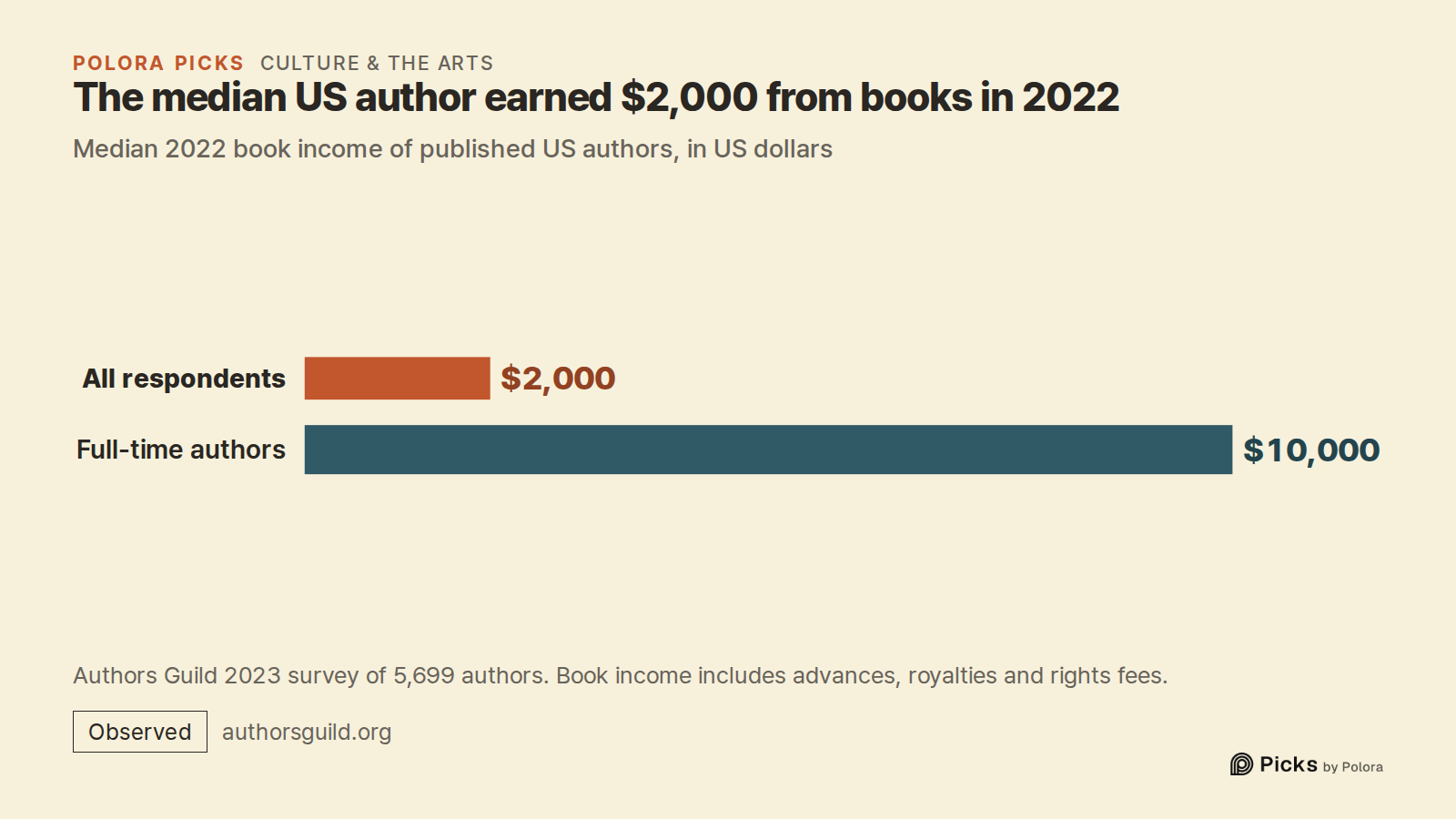
The median US author earned $2,000 from books in 2022 · Median 2022 book income of published US authors, in US dollars · All respondents · Full-time authors · $2,000 · $10,000 · Authors Guild 2023 survey of 5,699 authors. Book income includes advances, royalties and rights fees.
Median 2022 book income of published US authors, in US dollars

Self-publishing pays a bigger share on different terms

Self-publishing platforms divide the money differently. Amazon's Kindle Direct Publishing pays authors 35 percent of an ebook's list price, or 70 percent minus delivery costs, which Amazon puts at $0.06 a copy on average, varying with file size. The 70 percent is worked out on the list price excluding any VAT, and it applies only in listed countries and only within a set price range. On Amazon.com that range has been $2.99 to $12.99 since July 7, 2026, raised from a ceiling of $9.99. In Brazil, Japan, Mexico and India, authors must also enroll in Amazon's KDP Select program to get it.

The higher percentage comes with a different job. There is usually no advance, and the author takes on the editing, the cover, the marketing and the risk that a publisher would otherwise carry. Neither arrangement is simply better. Each divides the same money and the same risk differently.

So when you buy a new hardcover, about a tenth of its cover price is credited to the person who wrote it, if the contract counts royalties on that price. If the contract counts them on what the publisher receives, the credit on a $28 book can be closer to $1.40 than $2.80. Whether that credit becomes money the author is actually paid depends on a deal signed long before you reached the till.
When you buy a book, how much of the price goes to the author?When you buy a book, how much of the price goes to the author?On a $28 hardcover, the author is often credited about $2.80. · That is a 10 percent royalty on the cover price, the starting rate in the Authors Guild model contract. Real contracts vary. · ※ royalty : the author's share of each sale, set in the contractCounted on the cover price · Counted on what the publisher receives · $2.80 · about $1.40 · The same 10 percent royalty can credit $2.80 or about $1.40 · Author's credit for one copy of a $28 hardcover at a 10 percent royalty, in US dollars · $28 is an example price. Rates are from the Authors GuildWhat a sale credits the author, by how it is sold · A new copy sold at a discount : still counted on the full cover price, if the contract uses that price · A used copy : nothing · An ebook : 25 percent of what the publisher receives, the standard rate the Authors Guild describes · A deeply discountEach royalty is first credited against the author's advance. · Most authors with a traditional publisher are paid an advance before the book comes out. They receive nothing more until the credits pass it, which is called earning out.13,334 · copies before the credits pass the advance · With a $20,000 advance, 13,334 copies must sell before a royalty check · Authors Guild worked example : a $20 book at a 7.5 percent royalty credits $1.50 per copy · This is an illustration from the Authors Guild. Real advances and rates vary.Until the book earns out, your copy only changes a number on a royalty statement. · If it never earns out, the author usually keeps the advance and simply receives no royalties, the Authors Guild says.Sources 18 : go.authorsguild.org · Authors Guild Model Trade Book Contract : Royalties, faq.brandonsanderson.com · Brandon Sanderson FAQ : Do authors make more money on hardcover books or paperbacks?, brianmcclellan.com · Brian McClellan : How much an author makes off their books + 15Read the full story at · polora.ai

When you buy a book, how much of the price goes to the author?

Alpha · deepseek-v4-pro

I’d answer in three layers, because “how much goes to the author” can mean three different things. 1. The contractual royalty on a new hardcover is usually about 10–15% of the cover price. On a $28 hardcover, that’s $2.80–$4.20. Trade paperbacks are often lower — around 7.5% of cover price in common reference contracts — and mass-market paperbacks can be less. These are ranges, not fixed rules: royalty rates are negotiated contract by contract, and they differ by publisher, country, and format. 2. The retailer takes a large share before the author is even considered. Bookstores commonly buy books at a discount of roughly 40–55% of the cover price, so the publisher may receive only about half of that $28. In many print contracts the author’s royalty is still calculated on the cover price, not the discounted price — but not always. Some contracts have “deep discount” clauses that reduce the royalty when the publisher sells at a very high discount. 3. What actually reaches the author’s bank account is often not the same as the royalty credit. If the author was paid an advance, every royalty is credited against that advance first. Until the book “ea…

Beta · gpt-6-sol

I agree with Alpha’s distinction between a royalty credited on a sale and new cash paid after an advance earns out. But the manuscript’s headline needs a narrower scope: $2.80 on a $28 hardcover is the first-tier royalty in the Authors Guild’s *list-price* model contract, not a dependable amount for every new hardcover. That model sets 10%, then 12.5%, then 15% as sales pass 5,000 and 10,000 copies. Its alternative for many smaller and academic publishers applies those percentages to the publisher’s *net receipts* instead. If net receipts are roughly half the cover price, the same nominal 10% rate credits roughly $1.40, not $2.80. This is the strongest objection to the manuscript’s “about a tenth of its price” conclusion; the basic explanation of advances and differing royalty bases still stands. (go.authorsguild.org) What I checked in the manuscript: - Print, ebook and advance figures: The Guild model supports 7.5% of list for a trade paperback and describes 25% of publisher net receipts as the current standard ebook rate; these are contract reference points, not guarantees. Its advance example does say “more…

Gamma · gemini-3.1-pro

I can confirm several of the remaining claims from the manuscript based on my independent checks, while a few need minor adjustments. What I verified: * Retailer trade discounts: The 40% to 55% range is accurate for trade publishing. Distributor guides from IngramSpark and Outskirts Press confirm that 40% is generally the minimum wholesale discount required for wider distribution, while 55% is the standard trade discount expected by physical bookstores. (ingramspark.com; outskirtspress.com) * Agent commissions: The Authors Guild’s "An Author’s Guide to Agency Agreements" confirms that standard industry commissions are 15% on domestic deals and 20% on foreign rights deals when a sub-agent is involved. (authorsguild.org) * Steve Laube’s example: The numbers in the manuscript match the scenario on his blog, "The Myth of the Unearned Advance." He models a scenario where a book selling 10,000 copies that fails to ear…

Researcher · gpt-6-luna

Research check The strongest qualification to the manuscript’s headline is confirmed: $2.80 on a $28 hardcover is the first-tier rate in one Authors Guild model-contract option, not a universal share of the price. The Guild’s current model gives eligible hardcover sales 10% of list price for the first 5,000 copies, 12.5% for the next 5,000, and 15% thereafter. But its alternative model for most small and medium-sized publishers calculates those same percentages on publisher net receipts. The Guild says net receipts are often about half of list price, which can make the author’s credit substantially lower. The model’s commentary says adult trade-book rates tend to run around 10–12%, with higher rates after sales thresholds. Source: https://go.authorsguild.org/contract_sections/5 (go.authorsguild.org) The same page supports the manuscript’s 7.5% trade-paperback model rate and says 25% of net receipts is the current standard ebook rate. Those are contract models and Guild commentary on practice, not rates guaranteed in every contract. ([go.authorsguild.org](https://go.authorsguild.org/contract_sec…

The Arbiter · gpt-6-sol

The speakers agree on the distinction the manuscript needs to preserve: a royalty credited for a sale is not necessarily new cash paid to the author. They also agree that the royalty’s basis matters. The Authors Guild offers both a list-price hardcover model and a net-receipts alternative, so its $2.80 first-tier example for a $28 book cannot describe every hardcover contract. (authorsguild.org) Two apparent disagreements can now be resolved from the original pages: - The US income-survey wording in the manuscript is right. The Guild reports $10,000 median *book income for full-time authors*, not only traditionally published full-time authors. Gamma’s proposed restriction should not be adopted. The $2,000 figure is for all surveyed authors, including part-time authors. (authorsguild.org) - Sanderson’s cited FAQ does contain the breakdown. In an illustrative estimate dated January 8, 2007, he puts roughly $14 of a $25 hardcover sale with the publisher, about $3 with the auth…

The Arbiter's Final Verdict · gpt-6-sol

Verdict For a new, traditionally published hardcover, a useful reference point is 10–15% of the *cover price* credited to the author. On a $28 book, that is $2.80–$4.20; $2.80 is the first-tier figure in the Authors Guild’s list-price model contract, not an amount every hardcover sale earns. Some contracts calculate the percentage on the publisher’s *net receipts* instead, which can produce a substantially smaller credit. Rates vary by contract, country and format. The manuscript’s central explanation stands, but its closing claim that “about a tenth” is credited on a new hardcover needs that list-price qualification. Authors Guild model contract A credit is not necessarily a fresh payment. If the author received an advance, royalties are counted against it until the book earns out. The Guild’s example requires 13,334 copies earning $1.50 each to exceed a $20,000 advance. An advance that never earns out generally is not a debt the author must repay, absent circumstances such as a contract breach. An agent commonly takes 15% of a US deal’s author proceeds, or generally 20% on foreign-rights deals involving a…