Why does a tire company decide which restaurants get Michelin stars?

Because Michelin started the guide in 1900 to get French drivers on the road and wearing out tires, and never let it go. Today, in many newer places, tourism boards help pay for the guide to come, after Michelin judges the local dining worth a look. Michelin says the stars themselves are not for sale.

Culture & The Arts · 2026-10-07

A restaurant guide that began as a reason to drive

The most famous restaurant rating in the world carries the name of a tire maker. That is not a coincidence or a licensing deal. The guide was a tire company's idea from the start, and it still belongs to that company.

In 1900 there were fewer than 3,000 cars in France. The brothers André and Édouard Michelin, who made tires in Clermont-Ferrand, needed people to drive more. So they gave drivers a free book telling them, in André's words, where to fill the tank, repair the car, sleep and eat. More driving meant more worn tires, and more worn tires meant more sales. That was the bet, as CNN's account of the guide's history puts it. The same account notes there is no evidence the guide actually raised tire sales.

The book stayed free until 1920. Michelin's own explanation for why it began charging, which the company itself calls an anecdote, is that André found copies propping up a workbench in a garage. Stars came later. The guide gave its first single stars in 1926 and moved to the one-to-three scale in 1931.

Does the guide make Michelin money?

Nobody outside Michelin knows. The company's published financial results do not show the guide's results separately. The figure most often cited is old and secondhand : in 2011 the Financial Times reported, as relayed by Toronto Life, that the guides were losing about $24 million a year. It says nothing about the guide's finances today.

So the honest answer to why a tire company still runs it is the one it started with. The guide was a way to put the Michelin name in front of people who travel. Whether it pays for itself today is not something the company's published results show.

How a star is decided, in Michelin's own words

Michelin says its stars are decided only by its inspectors, who are full-time employees with backgrounds in restaurants and hotels. They book under assumed names, eat like any other customer and pay the bill in full. Each one eats more than 250 anonymous meals a year, and a restaurant is visited as many times as it takes before a decision.

The company names five criteria : the quality of the ingredients, the harmony of flavors, mastery of technique, the chef's personality coming through in the food, and consistency across the menu and over time. Michelin also states that inclusion in the guide is free of charge, and restaurants can ask to be visited. Asking does not guarantee a visit, and all of this is Michelin's description of its own process, not an outside audit of it.

Who pays for the inspectors to come to town

Restaurants do not pay. But in many of the places Michelin has added in the last decade, someone else has helped : the local or national tourism board, paying Michelin to bring the guide there.

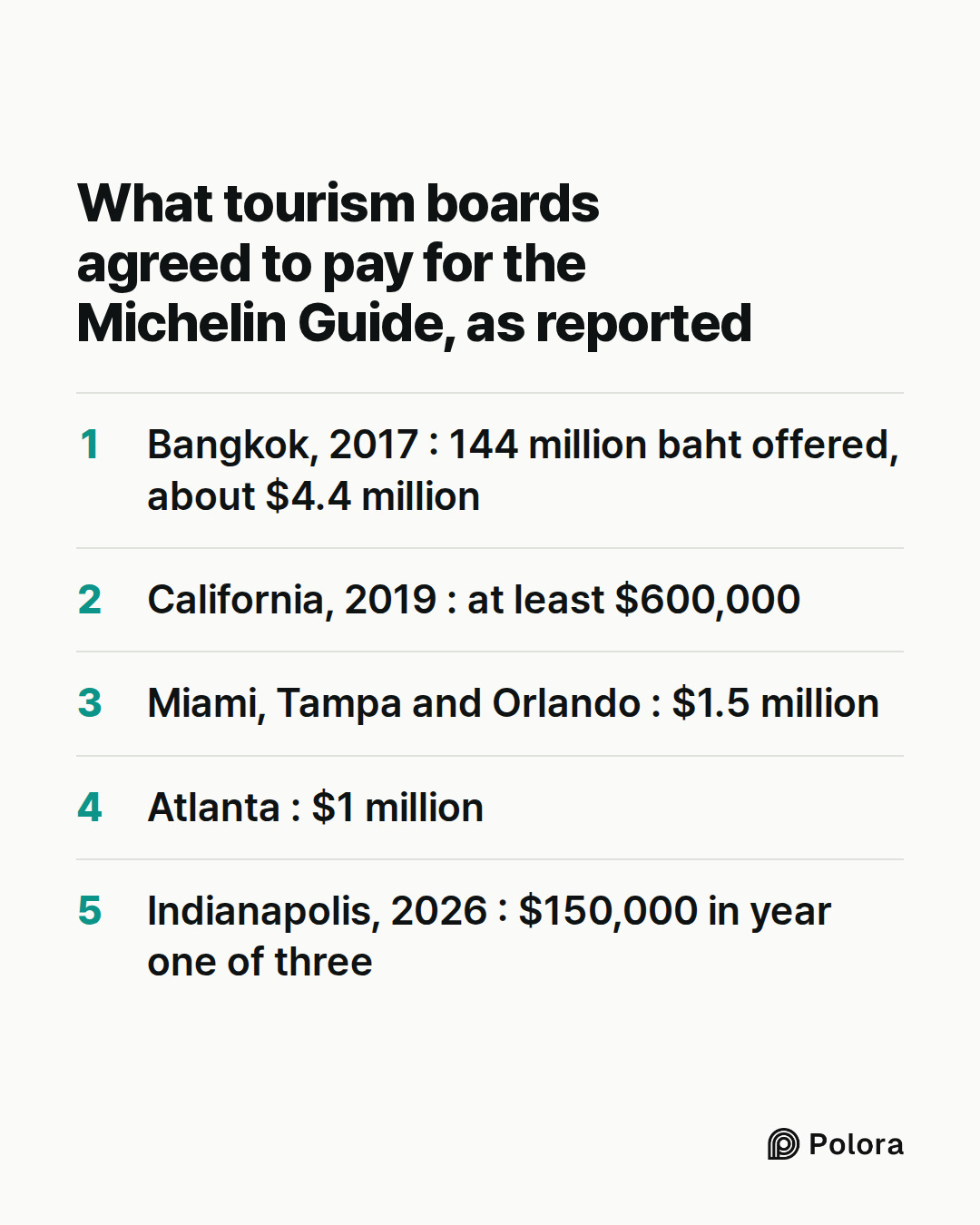
The Washington Post reported in 2017 that the Seoul guide, first published in 2016, was commissioned by Korea's tourism organization under a contract worth 3.2 billion won over several years, more than $1 million. The Korea Times, relaying a Korean lawmaker's account, gave a different figure, about 2 billion won through 2020. The tourism organization did not disclose the amount, so neither figure is confirmed. CNN reported that Thailand's tourism authority offered a 144 million baht partnership, about $4.4 million, to bring the guide to Bangkok in 2017, under a deal reported to run for five years.

The first deal in the United States came in 2019, when Visit California paid at least $600,000 to take the guide beyond the Bay Area to the whole state. The board said the money would underwrite the cost of expanding the presence of Michelin inspectors. Since then, Axios has reported, tourism boards in Miami, Tampa and Orlando agreed to pay $1.5 million, and Atlanta $1 million. Colorado's state tourism office committed a sum Axios put at $300,000, while local boards such as Denver, Boulder and Aspen paid separately, between $70,000 and $100,000 each. For Texas, Axios gave $900,000, but a Texas visitor bureau's board records describe the state and five of its cities sharing $2.7 million over three years. In 2026 Visit Indy said it was paying $150,000 in the first year of a three-year deal for the new Great Lakes guide.

Michelin rarely discusses the terms. A company spokesperson told Axios she could not, citing competitive reasons.
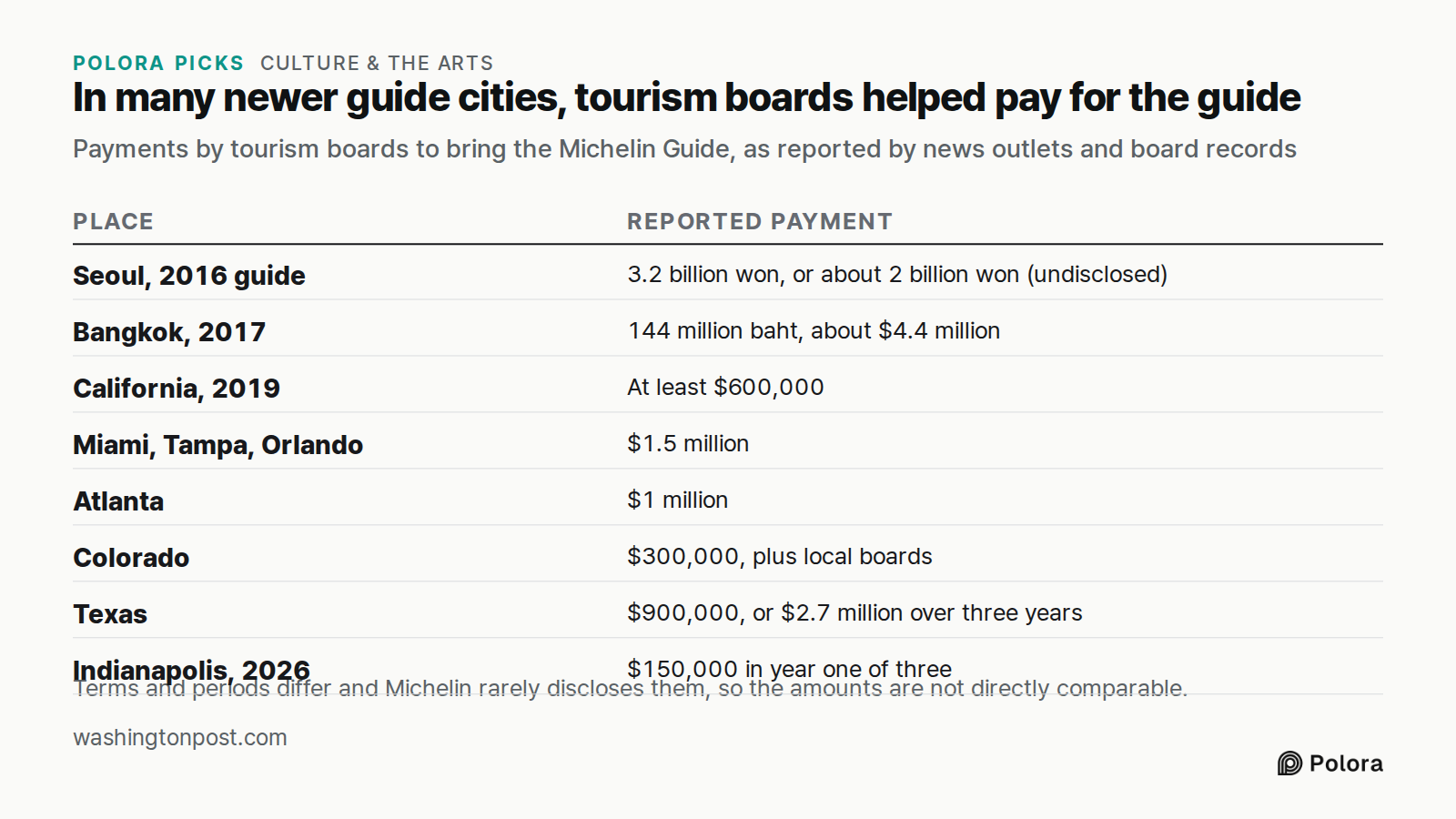
In many newer guide cities, tourism boards helped pay for the guide · Payments by tourism boards to bring the Michelin Guide, as reported by news outlets and board records · Place · Reported payment · Seoul, 2016 guide · Bangkok, 2017 · California, 2019 · Miami, Tampa, Orlando · Atlanta · Colorado ·
Payments by tourism boards to bring the Michelin Guide, as reported by news outlets and board records

What a tourism board says it is buying

The boards are open about the reason. Visit Indy said it was paying "to ensure the guide launches, giving our local restaurants the opportunity to be reviewed," and called it an investment in attracting visitors. In other words, the money helps put a place on Michelin's map, with a chance at a verdict. It does not come with the verdict.

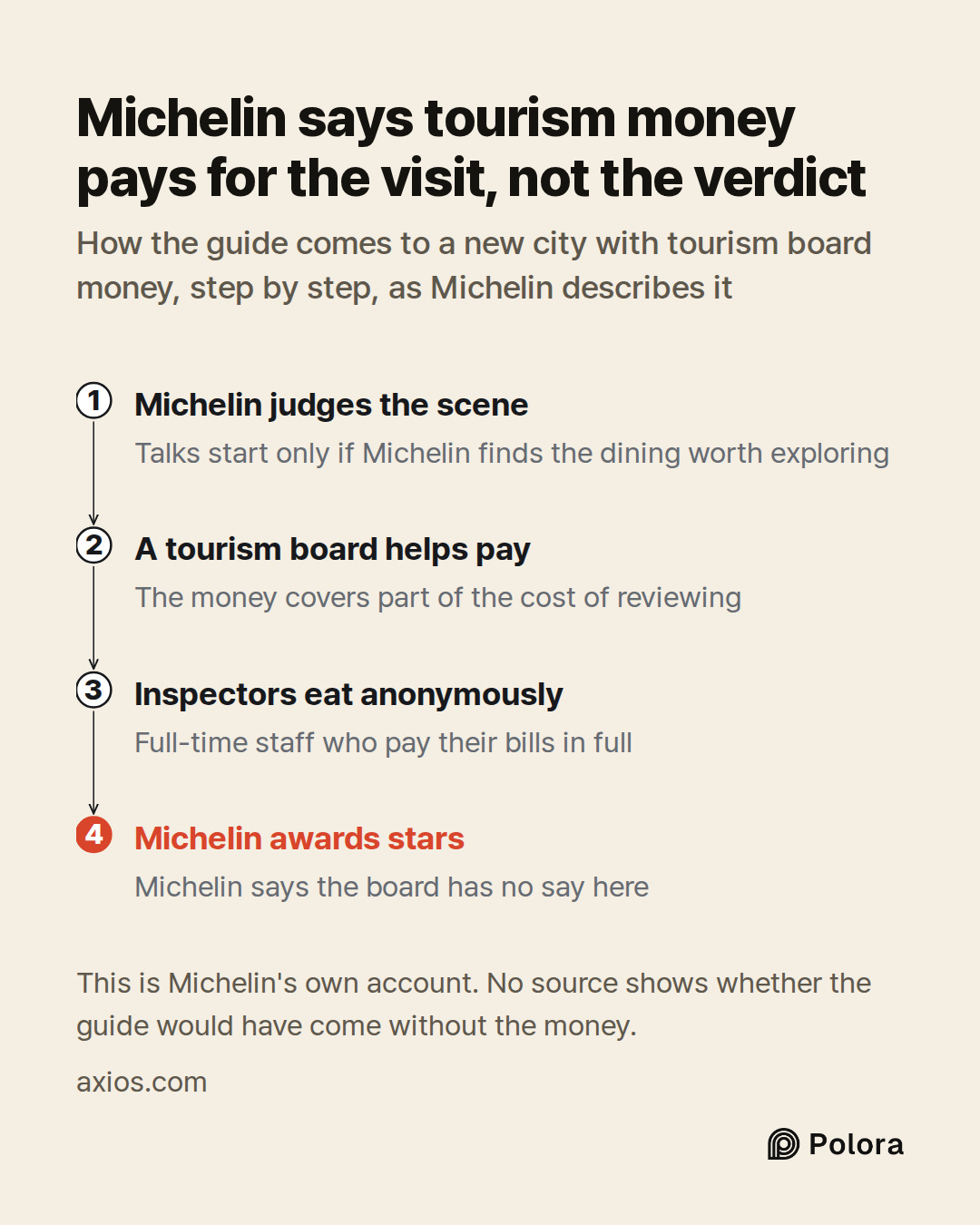
Nor does the money start the process on its own. In a statement reported by Axios, Michelin said it does not begin partnership talks unless it judges an area's dining scene developed enough to explore. So a board is not buying a first look from nothing. It is helping pay to publish and widen coverage of a place Michelin has already judged worth exploring. No source on the record shows whether Michelin would have come anyway without the money, or come as soon.

Michelin describes the arrangement from its side too. Its guide director told The New York Times, as Axios reported, that the partnership money helps offset the cost of the review process. Sending inspectors to eat anonymously and repeatedly in a new city is expensive, and in these places the city's tourism board covers part of that bill.
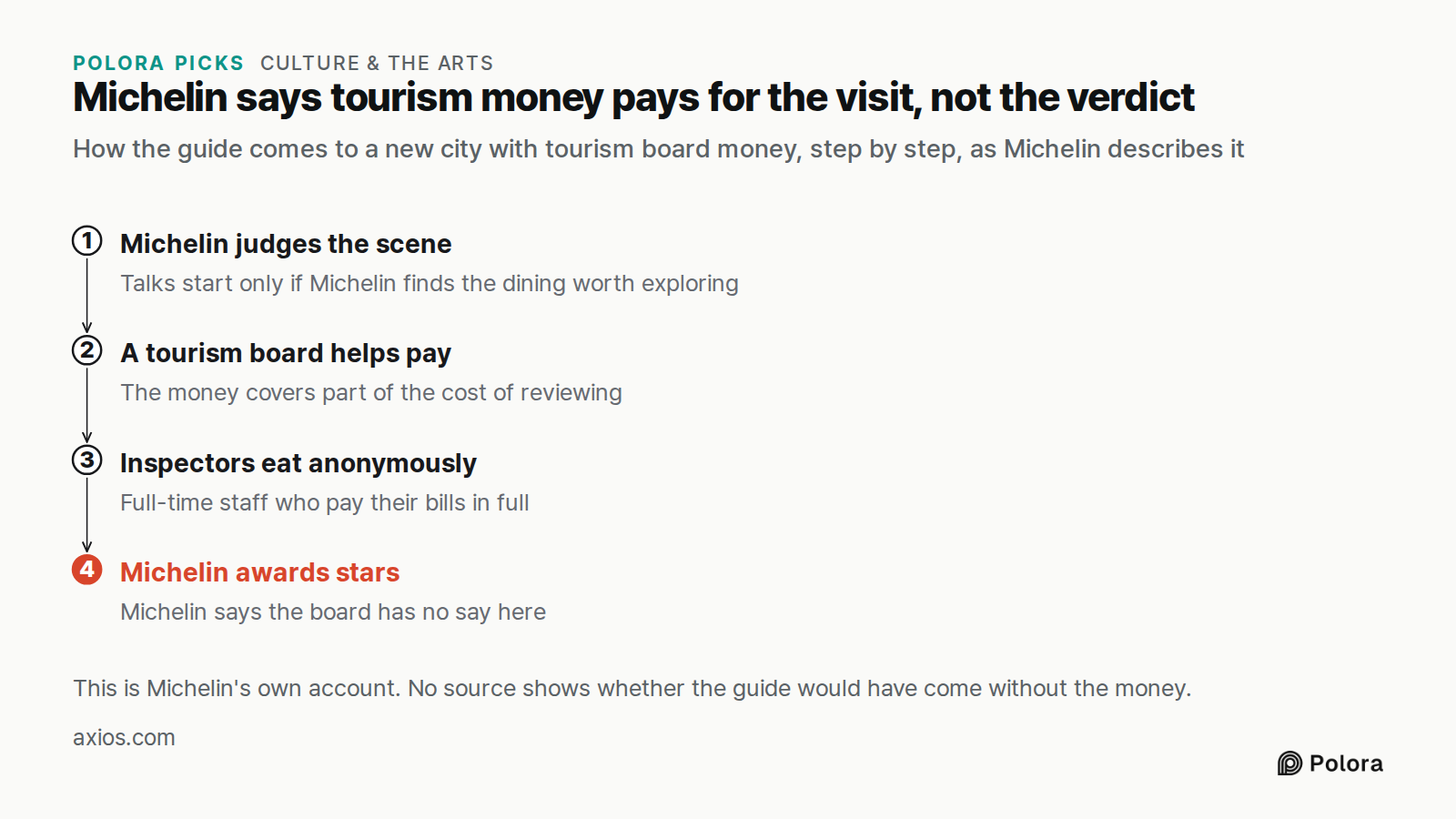
Michelin says tourism money pays for the visit, not the verdict · How the guide comes to a new city with tourism board money, step by step, as Michelin describes it · Michelin judges the scene · A tourism board helps pay · Inspectors eat anonymously · Michelin awards stars · Talks start only if Mich
How the guide comes to a new city with tourism board money, step by step, as Michelin describes it

A place can say no, and some guides were never paid for

Not every board signs. In 2025 Virginia's tourism office told Axios it had turned down a deal that would have cost $360,000, or $120,000 a year for three years, to join Michelin's new American South guide, citing the responsible use of taxpayer money. The states that did join that guide committed a combined $1.65 million a year for three years. A few Virginia restaurants near Washington are still covered, as part of the Washington guide.

And the guide's oldest American editions did not start this way. According to The Washington Post in 2017, the guides to New York, Chicago, Washington and San Francisco received no sponsorship from tourism agencies. Michelin's first US guide, for New York, came out in 2005, more than a decade before the first paid American deal.

Michelin says the money stops at the inspectors' door

Michelin's answer to the obvious worry has been the same for years. In 2019 its international director, Gwendal Poullennec, said tourism board involvement "does not bear any influence whatsoever regarding the inspectors' judgments for the restaurants in the selection, or the star awards," and compared the arrangement to the wall between editorial and advertising at a newspaper. In 2017 a Michelin executive told The Washington Post that the sponsorship deals were handled by a separate team from the inspectors.

Reporters have raised the question many times. None of the reporting cited here documents a star given in exchange for money, though that is a finding about this reporting, not proof that influence is impossible. What it documents is narrower : in many newer places, whether and when a city's restaurants are covered has depended in part on a tourism board agreeing to help pay, once Michelin judged the place worth exploring. That is Michelin's own description, not an accusation.

The question to ask of any Michelin map

So a tire company decides which restaurants get stars because a tire company built the guide, to send drivers down the road, and has kept it ever since. What has changed is who helps pay for the trip. In many newer cities a tourism board covers part of the cost of the guide coming, after Michelin has judged the place worth a look. The stars are still, by every account on the record, Michelin's call.

That changes how to read a map full of stars. A city with no stars may not have been judged and found wanting. It may simply sit outside the guide's coverage. Before comparing two cities, it is worth asking whether the guide covers both, and whether a tourism board helped pay for it to come.
Why does a tire company decide which restaurants get Michelin stars?Why does a tire company decide which restaurants get Michelin stars?Michelin started the guide in 1900 to get drivers wearing out tires. · It still belongs to the tire company. There is no evidence it actually raised tire sales.In many newer guide cities, a tourism board helped pay Michelin to come. · Restaurants do not pay. Michelin says it starts talks only where it judges the dining worth exploring.What tourism boards agreed to pay for the Michelin Guide, as reported · Bangkok, 2017 : 144 million baht offered, about $4.4 million · California, 2019 : at least $600,000 · Miami, Tampa and Orlando : $1.5 million · Atlanta : $1 million · Indianapolis, 2026 : $150,000 in year one of threeMichelin judges the scene · A tourism board helps pay · Inspectors eat anonymously · Michelin awards stars · Talks start only if Michelin finds the dining worth exploring · The money covers part of the cost of reviewing · Full-time staff who pay their bills in full · Michelin says the board has no sMichelin says tourism board money has no influence on the stars. · None of the reporting cited in the article documents a star given for money. That is a finding about this reporting, not proof that influence is impossible.A city with no stars may not have been judged at all. · It may simply sit outside the guide's coverage. Before comparing two cities, ask whether the guide covers both, and whether a tourism board helped pay for it to come.Sources 16 : guide.michelin.com · Michelin Guide : About us, edition.cnn.com · CNN : The history of the Michelin Guide, en.wikipedia.org · Wikipedia : Michelin Guide + 13Read the full story at · polora.ai

Why does a tire company decide which restaurants get Michelin stars?

Alpha · claude-sonnet-5

Here's my read on the manuscript, claim by claim. Origin story — solid, confirmed. The core history checks out exactly as written. In 1900, there were fewer than 3,000 cars on the roads of France, and tyre manufacturers Édouard and André Michelin published a guide for French motorists, distributing nearly 35,000 copies of the free first edition. The founding motive is not a stretch — it's Michelin's own account and Wikipedia's, converging. Good. The $24M loss figure — flag as stale, not wrong. This is an old, single-sourced number, correctly labeled as such in the manuscript. I'd keep it but stress its age more plainly in the final text rather than let it stand as "the" public figure. Korea's $1M+ contract figure — needs a correction, and this matters. The manuscript's $1M+ figure traces to the Washington Post piece: one Korean outlet reported the Korea Tourism Organization paying 400 million won a year for four years, and the contract specifies a total of 3.2 billion won over several years — more than $1 million. But Korea Times, reporting the same contract via the same local politician's allegation, gives a different total: the contract between the two requires the…

Beta · gpt-6-sol

The manuscript’s premise stands: Michelin created the guide to encourage motoring, still publishes it, and says its inspectors—not tourism sponsors—award stars. But the piece is too certain about how a place gets onto the map and about several contract totals. I would publish only after separating documented payments, Michelin’s account of its process, and conclusions the evidence cannot establish. - Origins and ownership: supported. Michelin says the brothers devised the guide for motorists when France had fewer than 3,000 cars, hoping to encourage travel, car sales and tire purchases. Its history confirms that the guide was free until 1920, first awarded single stars in 1926, and introduced the expanded hierarchy five years later. Michelin itself calls the workbench episode an *anecdote*; the draft correctly presents it as a story, not a verified event. The original sales strategy is documented as an intention, not proof that the guide increased tire sales. Addresses: https://guide.michelin.com/en/about-us and https://guide.michelin.com/en/about-the-michelin-company. (guide.michelin.com) - Today’s inspect…

Gamma · gemini-3.1-pro

Here is my read on the remaining claims and the overall manuscript, building on what Alpha and Beta have already established. The Thailand contract term — confirmed. The manuscript notes the 144 million baht (about $4.4 million) partnership from Thailand’s tourism authority in 2017, but the research brief asked to confirm the length of the deal. I can confirm this was a five-year contract to fund the guide's creation and expansion in Thailand, starting with Bangkok. (Address: https://thepeakmagazine.com.sg/gourmet/michelin-guide-bangkok-good-or-bad/) The timeline of the early Guide — confirmed. The manuscript states the guide was free until 1920, introduced single stars in 1926, and expanded to the one-to-three scale in 1931. This exact sequence is widely documented in historical summaries of the Michelin Guide, including Wikipedia's and CNN's. (Address: https://edition.cnn.com/2024/02/10/business/michelin-guide-history/index.html) The $24 million loss figure — confirmed as the accepted public estimate, though dated. Beta is right that Michelin does not break out the Guide's financials in its current annual reports. However, the 2011 *Financial Times* report est…

Researcher · gemini-3-7-flash

Ground Truth Verification & Claim-by-Claim Findings 1. Founding Motive, Initial Distribution, and Star Timeline * Claims: Free 1900 guide intended to encourage driving and wear out tires in an era with <3,000 cars in France; free until 1920 (workbench anecdote); single stars in 1926; 1–3 star scale introduced in 1931. * Status: Supported. * Details: Michelin corporate and guide histories confirm that André and Édouard Michelin published the first guide in 1900 when there were under 3,000 cars in France, distributing roughly 35,000 copies. Michelin itself treats the workbench story as an informal company anecdote rather than an audited historical fact. The chronological milestones (charging starting in 1920, first stars in 1926, 1–3 hierarchy in 1931) match the historical record. * Sources: * Michelin Guide: About Us * CNN Business: The Michelin Guide History (Feb 2024) --- 2. Guide Profitability & The $24 Million Loss Figure * Claims: Results are not reported separately; only public figure is a 2011 *Financial Times*…

The Arbiter · gpt-6-sol

Round record for the editor: Alpha, Beta, Gamma and the Researcher agree that the manuscript’s central premise stands. Michelin created the guide to encourage motoring and still controls its stars; documented tourism partnerships help fund coverage, but the sources examined do not document a payment for a particular star. The distinction between paying for regional coverage and buying a rating must remain explicit. - Origins and ownership: All four found support for the 1900 founding purpose, fewer than 3,000 cars in France, free distribution until 1920, first single stars in 1926 and the expanded star scale in 1931. Michelin itself calls the workbench episode an anecdote. Its account establishes an intended tire-sales benefit, not that the guide actually increased sales. Michelin’s own history is available at https://guide.michelin.com/en/about-us. (guide.michelin.com) - Inspectors and stars: Beta and the Researcher found that the manuscript accurately describes Michelin’s *stated* anonymous-inspection process, five food criteria and free restaurant inclusion. Those are company descriptions, not an in…

The Arbiter's Final Verdict · gpt-6-sol

Because Michelin created the guide and still runs it. In 1900, the tire-making brothers André and Édouard Michelin gave French motorists a free guide to places to refuel, repair a car, sleep and eat. Encouraging travel was intended to help sell tires. That explains why a tire company entered restaurant publishing; it does not prove the guide increased tire sales. Michelin later began charging for the guide in 1920, awarded its first single stars in 1926 and introduced the one-to-three-star scale in 1931. Michelin presents the often-told workbench explanation for charging as an anecdote, not independently established fact. Michelin’s history; CNN’s history. The manuscript’s central premise stands, but its account of modern funding needs a distinction. Michelin says its anonymous, full-time inspectors decide stars using five food-focused criteria; restaurants do not pay to be included. These are Michelin’s stated procedures, not an independent audit of every inspection. Tourism agencies *have* paid for regional guide partnerships. Such payments can h…