The book that sold the most and still ranked seventh
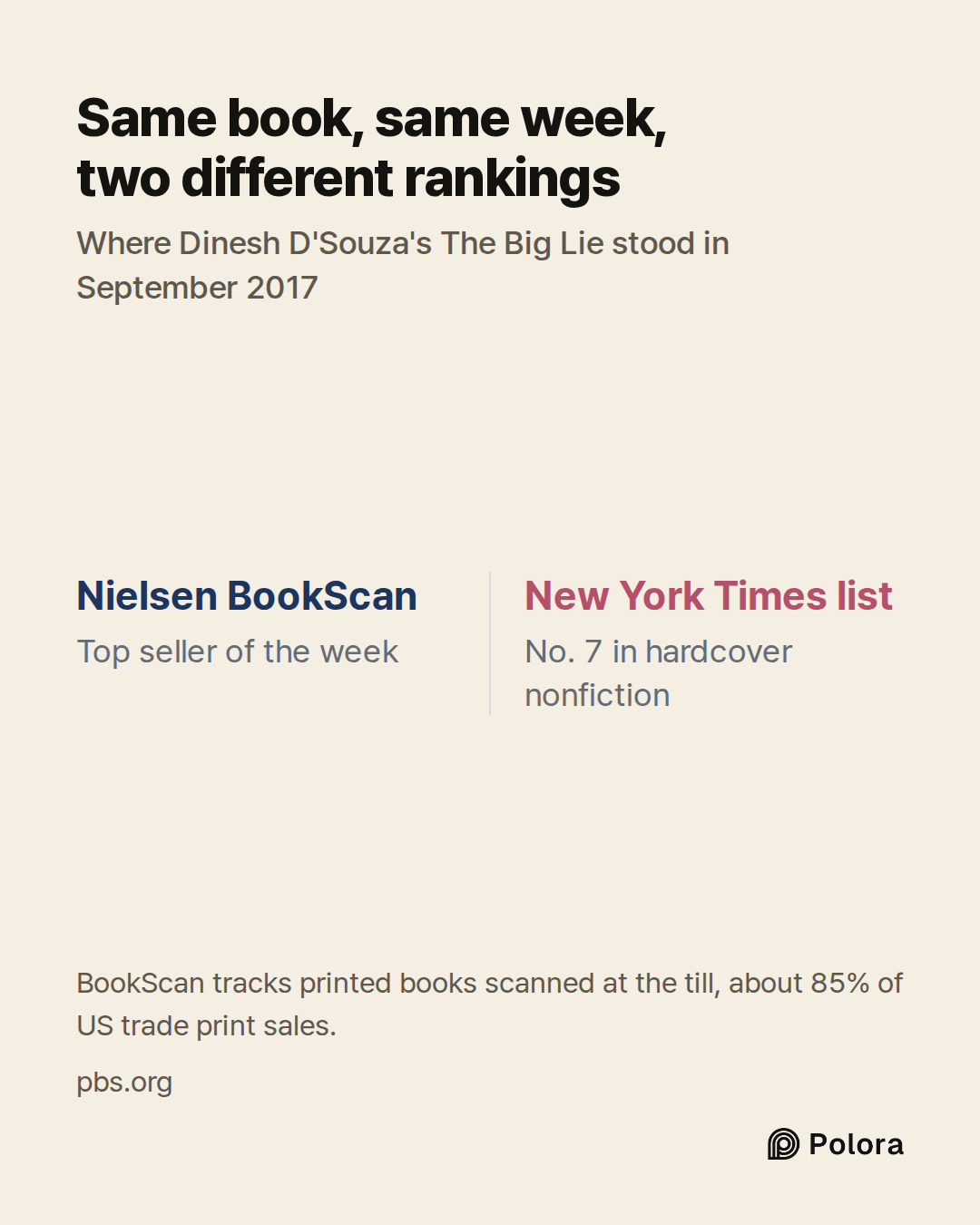
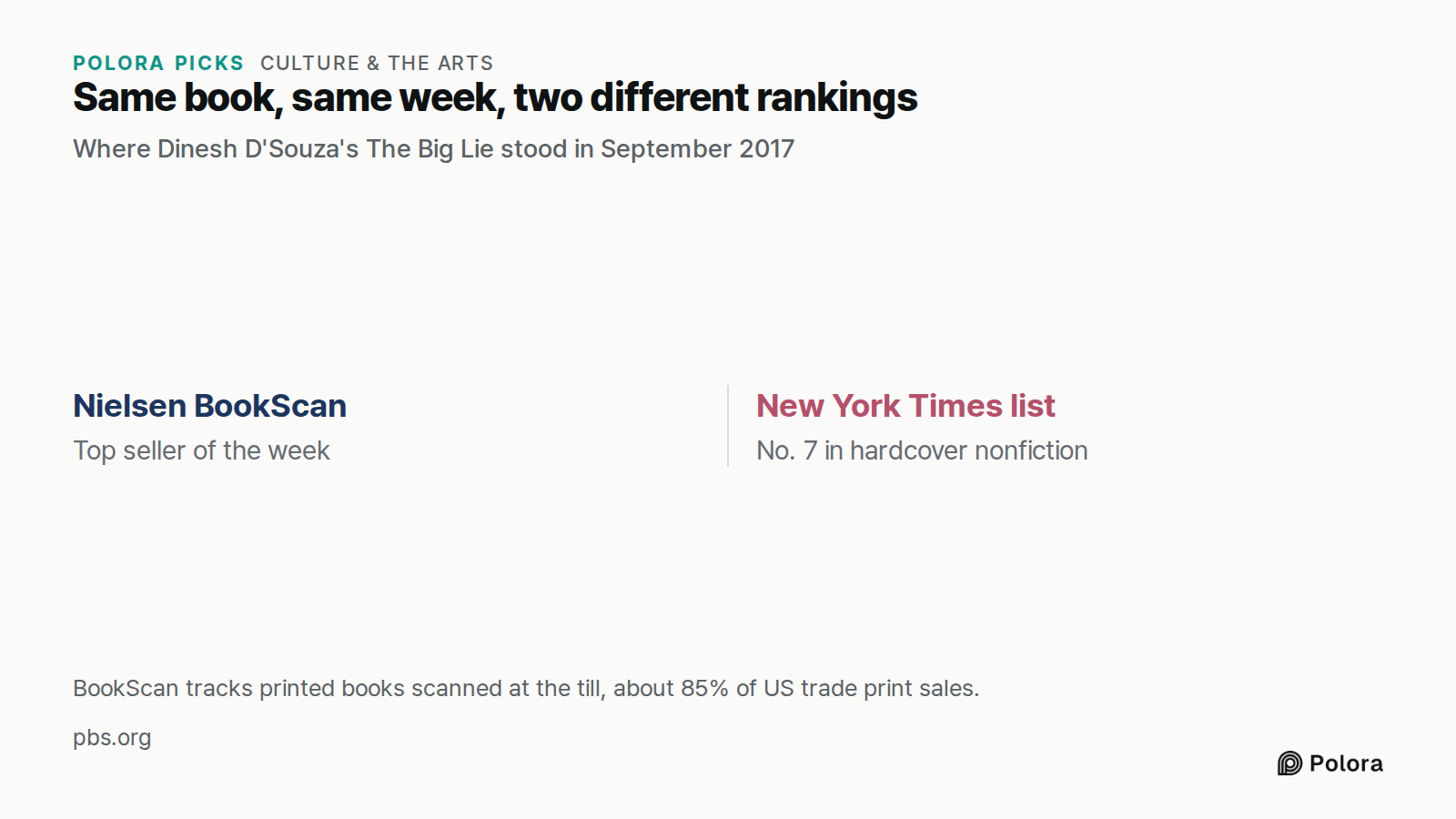
In September 2017, Nielsen BookScan had Dinesh D'Souza's The Big Lie as its top seller of the week. BookScan is a service that tracks printed books as they are scanned at the till, across roughly 85 percent of US trade print sales. On The New York Times hardcover nonfiction list that same week, the book sat at No. 7. Its publisher, Regnery, told its authors it would stop using the Times list. The Times answered that authors' political views have no bearing on its rankings.
Most people would expect that gap to be impossible. A cover that says "New York Times bestseller" seems to mean the book sold more copies than the others that week. It does not quite mean that. The Times list is built from sales, but the sales come from stores the Times will not name. They are adjusted by a formula it does not publish, under rules its own staff apply. Two lists can measure the same week and come out in different orders.
What the Times says goes into its list
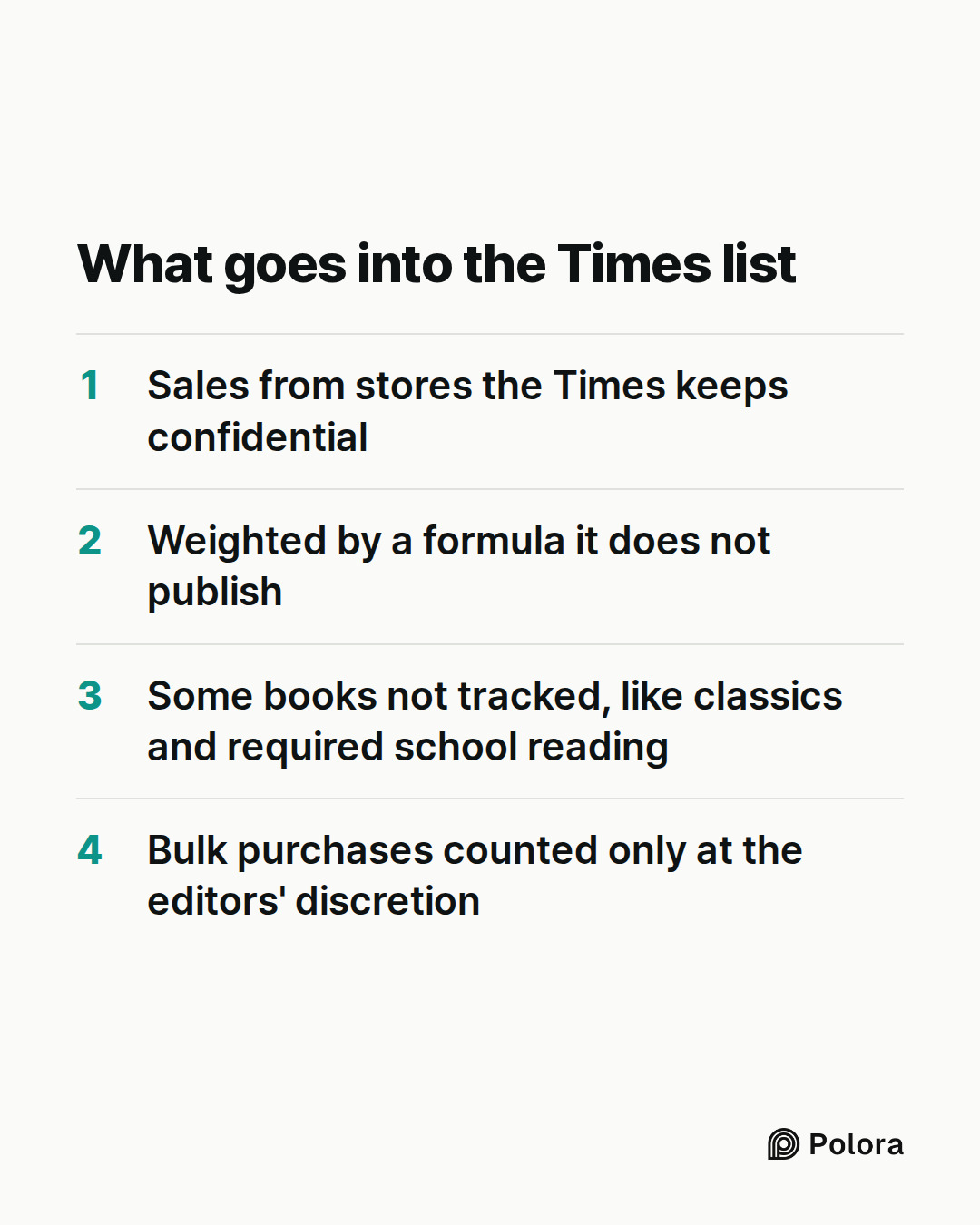
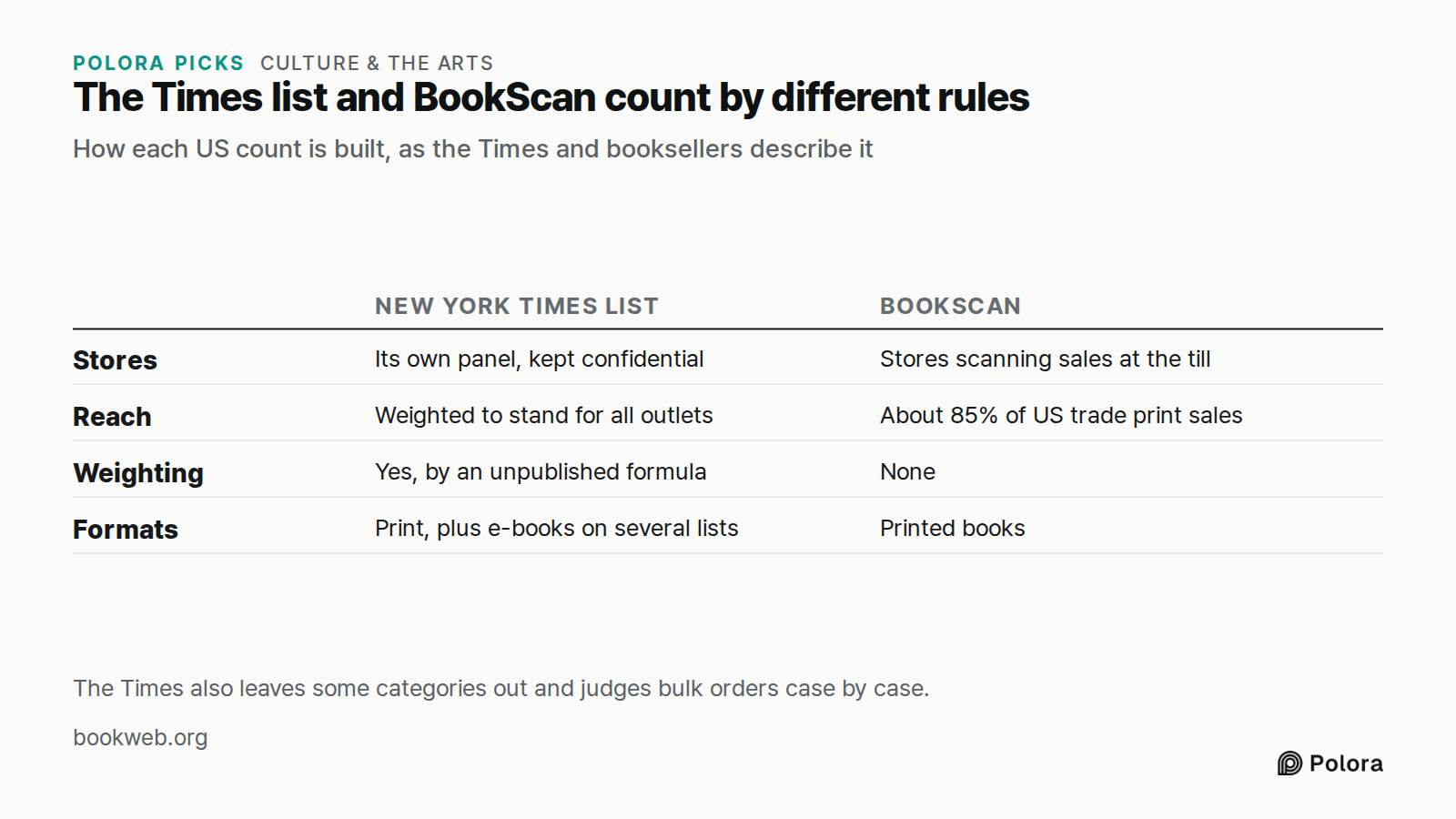
The Times publishes a short description of its method. Rankings reflect unit sales reported "on a confidential basis" by vendors. These include national and local chains, many hundreds of independent bookstores, online retailers, supermarkets, university and gift stores, big-box stores and newsstands. The stores' identities and their figures are protected by non-disclosure agreements. The sales are then "statistically weighted to represent and accurately reflect all outlets proportionally nationwide."
Some books are not tracked at all. Among the categories the Times says it does not actively follow are perennial sellers, required classroom reading, textbooks, reference and test preparation guides, workbooks, crossword puzzles, and e-books sold by only one retailer. A classic that sells steadily every week, or a novel assigned in schools, falls outside the count however well it sells.
Two smaller details matter too. An asterisk means a book's sales are "barely distinguishable" from the book above it. And the Times says the lists are compiled by a Best-Seller Lists Desk in its news department, kept separate from its opinion, advertising and business sides.
What the Times keeps secret, and why
The Times does not say which stores report, how much each one counts, or what its internal guidelines are, and that is the part that decides rankings. Gregory Cowles, an editor at the Times's Book Review, was quoted as saying the method is kept secret "both to protect our product and to make sure people can't try to rig the system." He added that even the Book Review does not know the precise methods.
The secrecy has a logic. If you knew which stores count, you could buy copies at exactly those stores. The cost is that nobody outside the Times can check a single ranking.
The 1983 lawsuit that is often retold wrongly
In 1983 the novelist William Peter Blatty sued the Times. He said his novel Legion had sold enough copies to make the list and had been left off. At the time the list said it was "based on computer-processed sales figures from about 2,000 bookstores in every region of the United States." Blatty argued the Times was falsely presenting the list as an objective and accurate count of sales.
Secondary accounts of the case say the Times argued that the list was editorial content rather than a mathematically objective count. The Times won. But the California Supreme Court, deciding in December 1986, did not rule that the list is editorial, and it did not find that Blatty's sales would have qualified. It ruled on narrower First Amendment grounds : the list was not "of and concerning" Blatty, so he could not sue over it. The popular version, that a court declared the list an opinion, goes further than the ruling did.
Two honest counts can still disagree
In the US, BookScan is now run by the research firm Circana. It counts printed books scanned at the point of sale across about 85 percent of US trade print sales. It does not weight stores. But it is not a complete count either : the rest of print sales, and other formats, fall outside it.
The Times list differs on almost every point. It uses its own panel of stores, adds e-books on several lists, weights the results, leaves whole categories out, and judges bulk orders case by case. Any one of these can move a book up or down. Because the method is not public, no one outside the Times can say which of them put The Big Lie at No. 7. The gap shows that the two lists measure different sales under different rules. It cannot show which rule caused it.
What the small dagger next to a title means
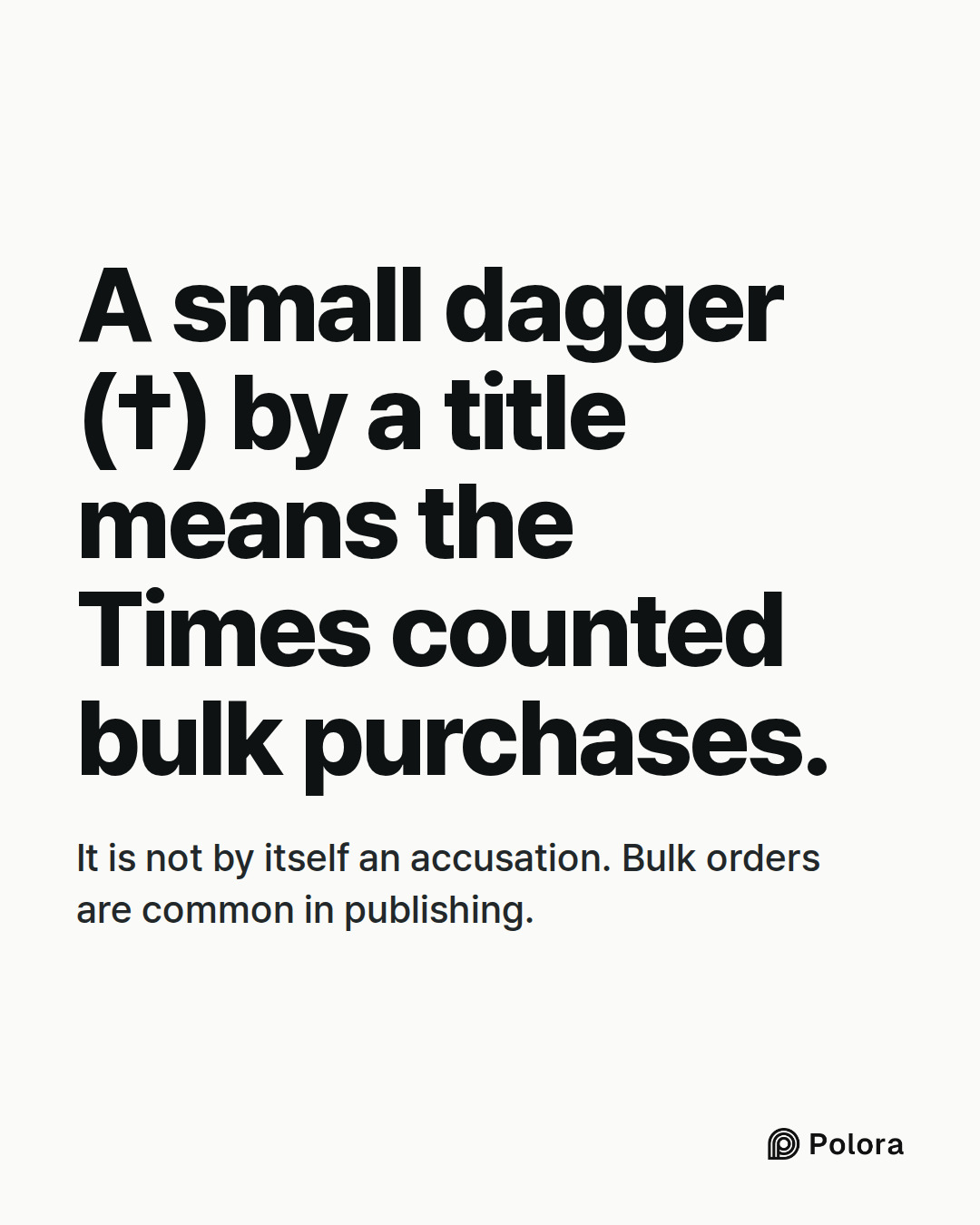
Sometimes a title on the list carries a small dagger (†). The Times says it counts bulk purchases by institutions, groups or special interests only at its editors' discretion, after its own checks. When it does count them, the dagger appears. The mark does not say how many ordinary sales the book had, or whether those alone would have put it on the list.
The mark dates from 1995, after the two authors of a business book, The Discipline of Market Leaders, were reported to have bought large numbers of their own book. It is not by itself an accusation. Bulk orders are common in publishing, and a Times spokesperson told Fortune the dagger appears regularly on its hardcover nonfiction, advice and business lists.
The best-known recent case is Donald Trump Jr.'s Triggered, which reached No. 1 on the nonfiction list in November 2019 with a dagger. Filings with the Federal Election Commission showed the Republican National Committee spent $94,800 on copies a week before release. On CNN in December 2019, Brian Stelter said the book would still have been No. 1 without the bulk purchases. That was his assessment ; with the Times's method undisclosed, no one outside can recalculate the ranking to confirm it.
When bulk buying is made to look like ordinary readers
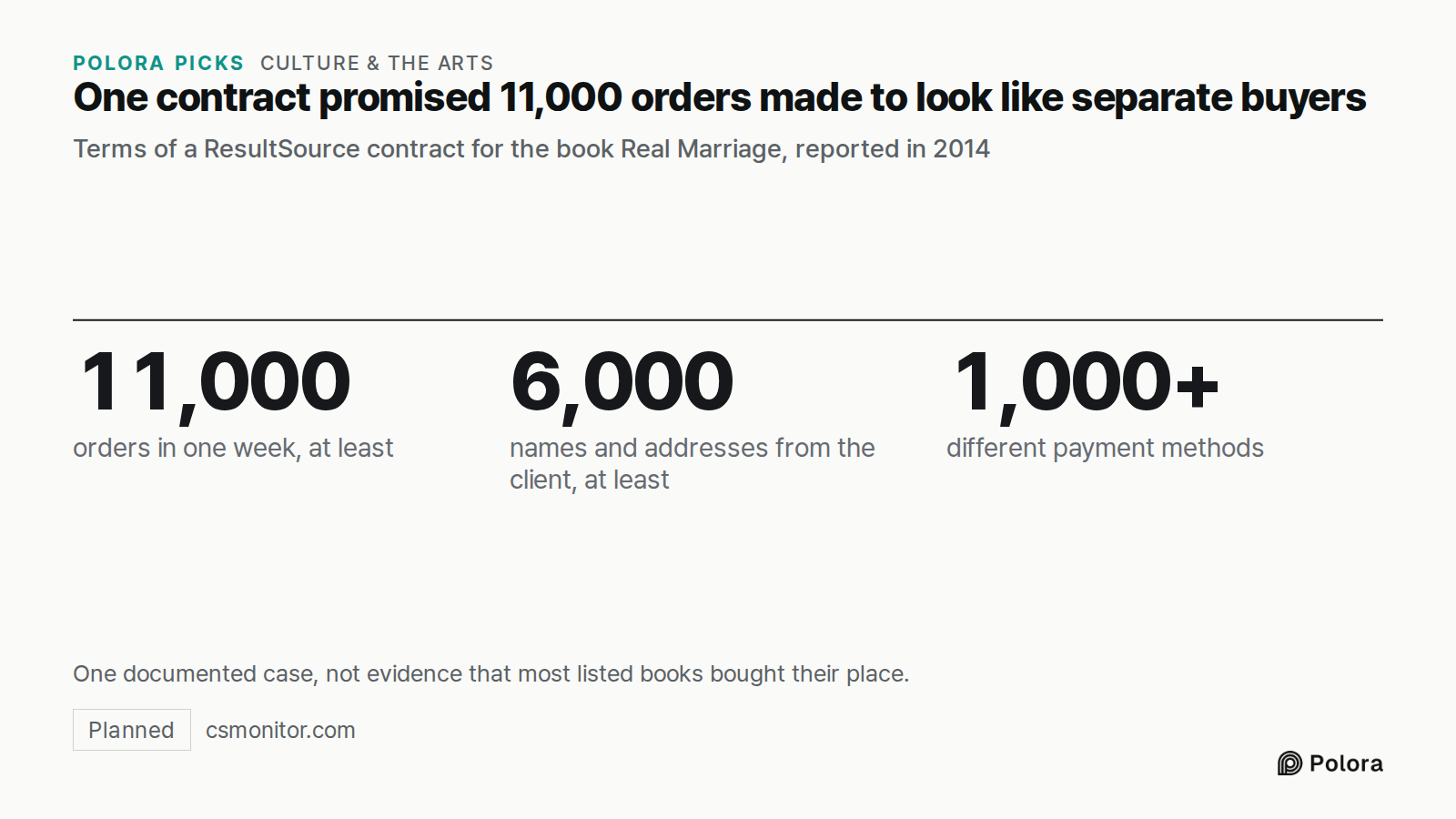
The dagger catches bulk orders the Times can see. The harder problem is bulk buying split up to look like thousands of separate customers. A marketing firm called ResultSource sold this as a service. One of its contracts, reported in 2014, promised at least 11,000 orders in a single week. It asked the client for at least 6,000 names and addresses, and noted that the firm used more than 1,000 different payment methods. The book in that contract, the pastor Mark Driscoll's Real Marriage, reached No. 1 on the Times advice list in January 2012. It was off the list the following week and later reappeared briefly at No. 12.
In August 2017 a little-known young adult novel, Handbook for Mortals, opened at No. 1 on the Times list. Booksellers and writers online pointed to unusual orders. Within a day the Times removed it, saying that after "investigating the inconsistencies" its sales "did not meet our criteria for inclusion." The author denied trying to game the list.
The Times itself has acknowledged on the record that attempts to game the list happen. These are individual, documented cases, not evidence that most listed books bought their place. They do show why the Times keeps its stores secret, and why the list depends on the Times's judgment as well as on sales.
- Christian Science Monitor : Pastor reportedly buys his way onto New York Times bestseller list
- Christianity Today : Did Mark Driscoll's Real Marriage earn NYT bestseller status?
- Book Riot : Buying books onto the bestseller list
- Wikipedia : Handbook for Mortals
- WLRN / NPR : Here's how the NYT crafts bestseller lists, and how authors try to game them
How bestseller lists work in Germany, Britain and Japan
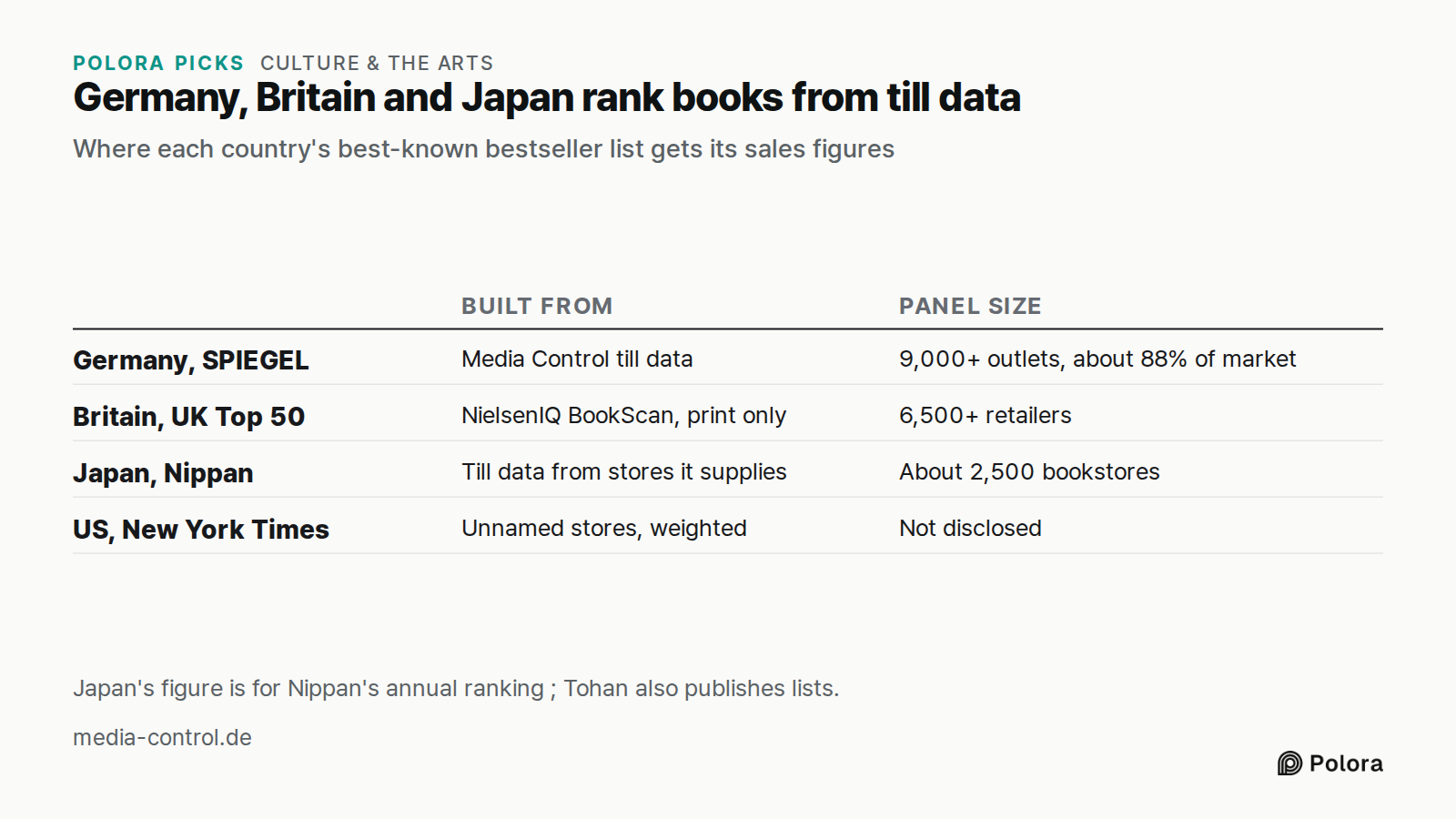
The best-known lists in these three countries are built more directly from till data. Germany's SPIEGEL bestseller lists are drawn from the till data of a retail panel run by Media Control. The panel covers more than 9,000 outlets and about 88 percent of the market.
In Britain, the Official UK Top 50 and The Sunday Times charts both come from NielsenIQ BookScan, which collects sales at the point of sale from more than 6,500 retailers. It counts printed books only.
In Japan, the familiar weekly and annual lists come from the two big book wholesalers, Tohan and Nippan. Nippan's annual ranking is built from the till data of about 2,500 bookstores it supplies.
What "New York Times bestseller" actually tells you
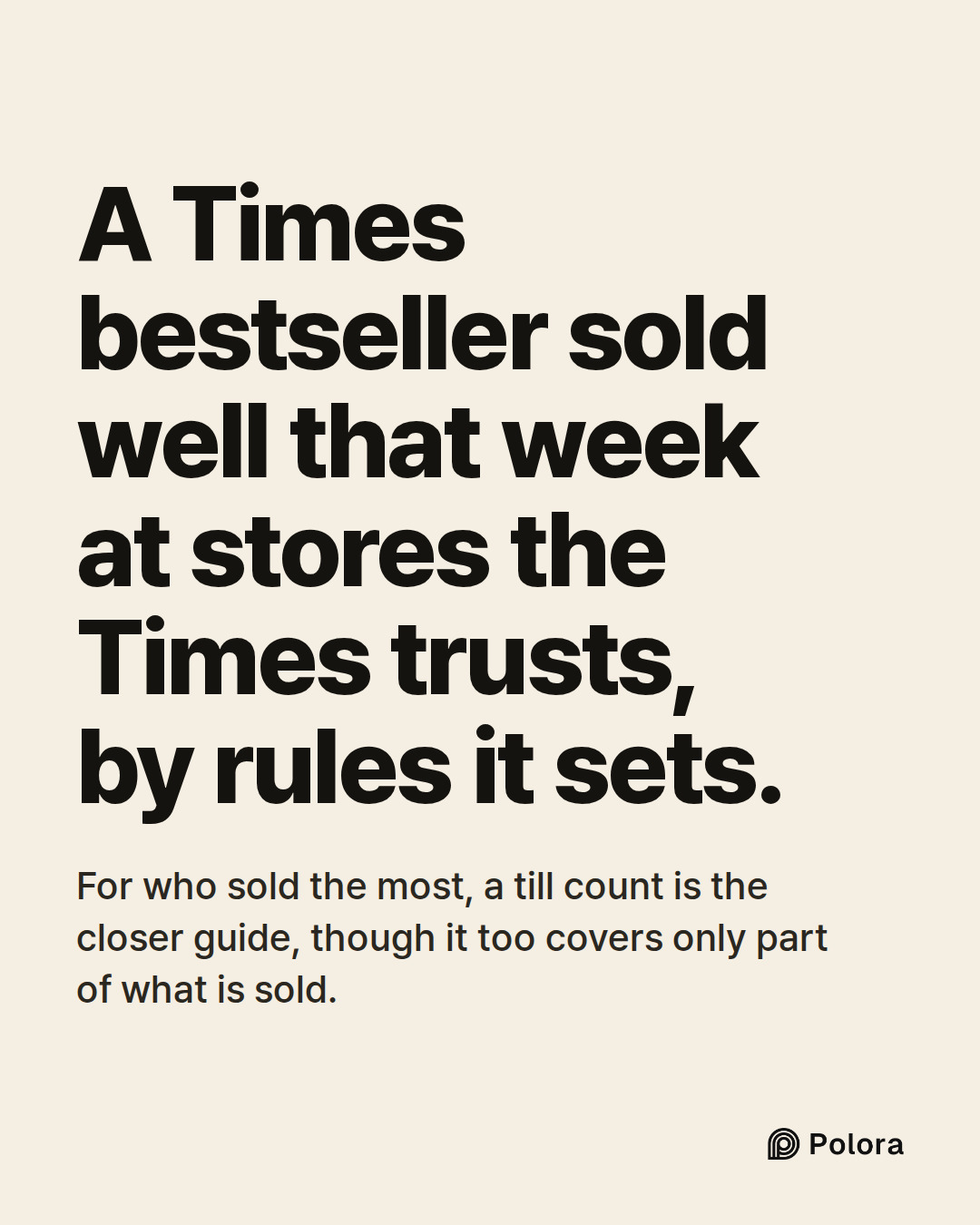
It tells you a book sold well that week at stores the Times trusts, by rules the Times sets. It also tells you the Times's editors were satisfied the sales were what they appeared to be. It does not tell you the book sold the most copies. For that, a till count is the closer guide, though it too covers only part of what is sold. The German, British and Japanese lists described above are built that way.