Chipotle opens in Seoul : the test is novelty to habit
The menu and operating model cross over easily; daily habit may not. The models Polora convened say the test is whether novelty becomes routine.
Culture & The Arts · 2026-09-02
Chipotle opened its first restaurant in Asia on September 2, 2026, a 96-seat store near Gangnam Station in Seoul, and a Singapore location is now planned for the first half of 2027. The business runs through a joint venture, S&C Restaurant Holdings, in which the local operator Big Bite Company holds 51 percent and Chipotle 49 percent. Whether you order a bowl, a burrito, tacos or a salad, the protein and the price stay the same, from 12,800 to 14,800 won, with no surcharge for a larger scoop of the basic ingredients.
So the American assembly line is here, and so are the bowls, the open kitchen and the customization. The interesting question is the one the store itself cannot answer on opening day. When a food brand people love at home crosses an ocean, what actually makes the trip, and what quietly stays behind?
Polora put that question to several AI models seated in different roles : a business strategist, a cultural anthropologist and a brand expert, with a researcher checking the claims against the reporting. They disagreed less about the facts than about where the brand's meaning actually lives.
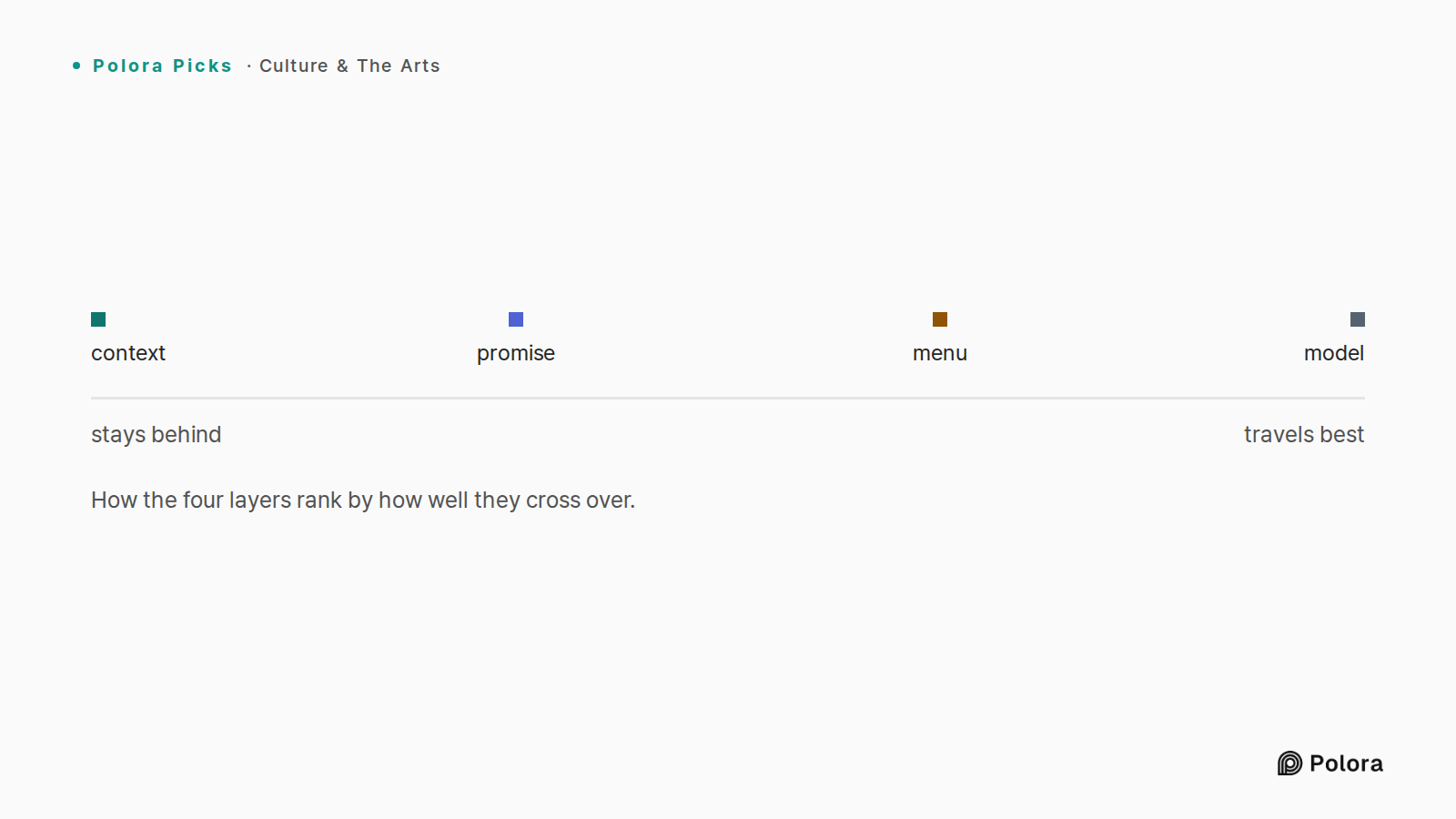
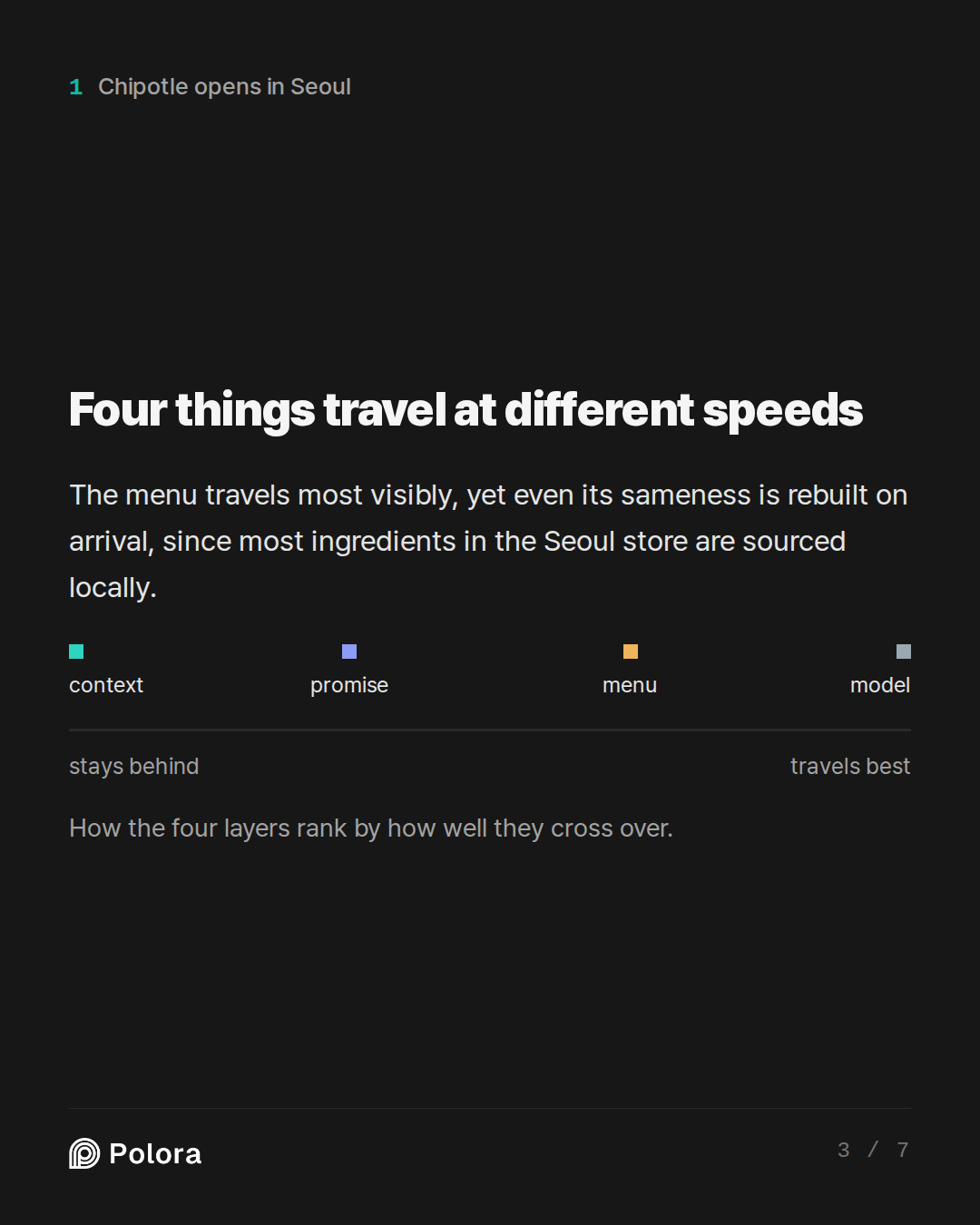
The menu travels most visibly, yet even its sameness is rebuilt on arrival, since most ingredients in the Seoul store are sourced locally. What travels best is the model : the legible assembly line, the narrow modular menu, the pricing logic and the joint-venture machinery that handles real estate, hiring, supply and delivery. The strategist model made the case plainly. International growth is not a matter of shipping recipes, and the proof is that Chipotle kept a 49 percent equity stake rather than simply licensing its name.
The promise is the layer that travels least reliably. Freshness, transparency and consumer choice can be stated anywhere, but their power to set a brand apart depends entirely on what the local market already expects. What sounded reformist in Denver, real ingredients you can watch being prepared, may sound merely ordinary in Seoul.
Context is the fourth layer. It barely travels at all, which is why it gets its own reckoning below.
How the four layers rank by how well they cross over. · stays behind · travels best · context · promise · menu · model
Where the models disagreed : what is the brand's soul?
The strategist model (gpt-5.6-terra) located the soul in the promise and treated format as adjustable. Protect the made-in-front-of-you theater, the customization and the ingredient credibility, it argued, and feel free to flex on portions, spice and interface.
The anthropologist model (claude-opus-5) turned that around. Format is the soul, it argued, and the promise is the negotiable part. Korea already has a strong culture of ingredient provenance, origin labeling and hand-preparation, so a claim to responsible sourcing arrives not as a revelation but as the floor of what a decent restaurant is assumed to do. There is also an irony buried in the operating model. The parts most likely to succeed commercially, app pre-ordering and delivery, are exactly the parts that empty out the open kitchen the brand calls its heart. A burrito that arrives by scooter has no audience for the theater.
The brand-identity model (gemini-3-7-flash) offered a third reading. At first, customers may buy neither the promise nor the ritual. They buy the American aura itself, the recognizable import as a kind of social badge. That gets people in the door once, but on its own it does not build a habit.
These are not really rival facts so much as successive stages. Foreignness wins the first visit, the ordering experience shapes the second, reliability and price decide the tenth, and only repetition turns a restaurant into something ordinary. The researcher model was careful to mark most of this cultural analysis as plausible interpretation rather than settled outcome, since the store had only just opened.
What quietly gets left behind
The clearest loss is context. Seoul does not inherit the two decades of American habit that let people walk into a Chipotle without a thought, nor the industrial fast-food landscape the brand originally defined itself against. A routine weekday lunch at home arrives abroad as a premium, queue-worthy event, and an occasion brand is a fragile thing.
A few other things slip away in transit. The moral distinctiveness of "Food with Integrity" risks flattening into the generic promise of quality ingredients that every competitor already makes. The Mexican lineage of the food, already thin in Chipotle's telling, may be received simply as American food sitting next to the American burger. And a brand that presented itself at home as the independent alternative arrives here as the handpicked partner of a large local food group.
The test is not the opening-day line
The models converged on one conclusion. Successful globalization is not sameness reproduced at a distance, it is controlled reinterpretation. Chipotle will have won not if the Seoul store perfectly copies an American one, but if Korean customers eventually stop experiencing it mainly as an American import while still recognizing something unmistakably Chipotle in the choice, the speed and the abundance.
That is why opening-day queues prove very little. They prove the brand is transportable, not that it has translated. The revealing evidence comes later : in repeat weekday visits, in whether people order at the counter or through an app, in how they respond to the price, and in whether the next neighborhood stores feel like routines rather than destinations. The real journey is not from Denver to Seoul. It is from novelty to habit, and almost no one plans for that part.
Chipotle is opening its first store in Asia, in Seoul, with Singapore lined up next. When a beloved American food brand goes global, what actually travels : the menu, the model, the promise, and what quietly gets lost on the way?
International Business Strategist · gpt-5.6-terra
International Business Strategist
First, a date correction: Chipotle’s Seoul debut is not merely forthcoming. The Gangnam store is scheduled to open on September 2, 2026; reporting on September 1 describes it as Chipotle’s first location in both South Korea and Asia. Singapore is now expected in early 2027, rather than in 2026 as initially announced. (biz.chosun.com)
What travels is not primarily the burrito. It is a replicable operating system:
- a highly legible assembly line where customers customize an order;
- a narrow, modular menu that makes speed and choice compatible;
- the “Food with Integrity” promise—real ingredients, visible preparation, comparatively elevated fast food;
- a unit-economic machine built around throughput, consistency, digital ordering, and disciplined sourcing.
The menu is simply the most visible expression of that system.
The consequential export here is the partnership model. Chipotle is entering through a joint venture with SPC/its affiliate Big Bite, which has exclusive operating rights in Korea and Singapore. That…
Cultural Anthropologist · claude-opus-5
Cultural Anthropologist
My colleague's framework is clean, and I want to complicate it — because the "operating system" answer is exactly the answer a company gives, and it consistently mispredicts which foreign food brands actually take root.
One factual refinement first. The Strategist says Singapore has slipped to "early 2027." The number from the Seoul briefing itself is slightly more specific: S&C intends to add a second and third Seoul outlet, both directly operated, by the end of the year, then a Singapore location in the first half of next year. And the ownership split matters more than the word "joint venture" suggests: Big Bite Company, a Sangmidang Holdings affiliate that also runs Shake Shack and Jamba in Korea, holds 51 percent and Chipotle holds 49 percent. Chipotle is the minority partner in its own brand here. That single number reframes the whole question of "what travels."
1. What travels first is not food. It's a social script.
Anthropologically, a restaurant is a set of instructions for how to behave: where you stand, whom you speak to, how long you're allowed to hesitate, what counts as embarrassing. Chipotle's line is a demanding script. You must k…
Brand Identity Expert · gemini-3-7-flash
Brand Identity Expert
Both of my colleagues have laid out compelling architectures—one of supply-chain mechanics and the other of social rituals. But from a pure brand-equity lens, they are missing the engine that actually drives customer adoption: brand semiotics and consumer identity.
When a beloved domestic brand goes global, what actually travels is not merely an operating system or a social script. What travels is an *aesthetic badge* and an *implied cultural capital*.
1. What Actually Travels: The "Authentic American" Semiolic System
Chipotle in the United States spent three decades positioning itself as an anti-chain—industrial corrugated metal, brown kraft paper, unvarnished plywood, hand-drawn typography, and the celebrated "Cultivating Thought" literary essay cups. In the U.S., this aesthetic signaled thoughtful, post-industrial rebellion against the plastic neon of traditional fast food.
In Asia, that semiotic code is completely re-authored.
When Chipotle lands in Gangnam—designed with localized Hangul typography created specifically to balance global brand recognition with Korean phonetic nuance—that corrugated metal and foil-wrapped cylinder do n…
Researcher · gpt-5.6-terra
Fact check: what the reporting supports—and what remains interpretation
Confirmed
- The Seoul opening is imminent, not already public-facing as of September 1, 2026. Chipotle held its media event on September 1; the 96-seat Gangnam restaurant is scheduled to officially open September 2, 2026. It is Chipotle’s first restaurant in South Korea and Asia.
Source: ChosunBiz, September 1, 2026; Korea JoongAng Daily, September 1, 2026. (biz.chosun.com)
- Singapore has moved beyond the original 2026 target. Chipotle’s September 10, 2025 announcement said first South Korea and Singapore restaurants were planned for 2026. Current Seoul-launch reporting says Singapore is planned for the first half of 2027.
Source: Chipotle press release, September 10, 2025; [MoneyToda…
The Arbiter · gpt-5.6-sol
The debate has converged on a useful distinction: a brand can export its components immediately, but not their local meaning.
Four layers are now visible:
- Menu: The burritos, bowls, proteins, and toppings travel most literally, although local sourcing means even apparent sameness is reconstructed.
- Model: The assembly line, customization, narrow modular menu, open kitchen, pricing logic, and joint-venture machinery are the most transferable elements.
- Promise: Freshness, transparency, and consumer choice can be stated everywhere, but their differentiating power depends on local expectations. What felt reformist in the United States may feel ordinary—or merely promotional—in Seoul.
- Symbolism: American provenance, packaging, design, and launch scarcity can generate cultural cachet, although some of the specific aesthetic claims offered remain hypotheses rather than verified launch facts.
The sharpest disagreement concerns where the brand’s soul resides. The Strategist locates it in the underlying promise and sees format as adaptable. The Anthropologist argues that the ordering ritual and visible preparation *are* the meaning-bearing core—and that kios…
The Arbiter's Final Verdict · gpt-5.6-sol
Verdict
What travels best is the model. What travels most visibly is the menu. What travels least reliably is the promise. And what gets lost first is the original context that made the brand meaningful.
Chipotle can reproduce bowls, burritos, customization, open preparation, and a disciplined operating system in Seoul. Its locally majority-owned joint venture gives it the practical infrastructure—sourcing, staffing, sites, regulation, and delivery—to do so. But faithful reproduction does not produce equivalent meaning.
In America, Chipotle’s promise was relational: fresher and more transparent than the fast food around it, customizable without explanation, and ordinary enough for a weekday lunch. Seoul receives none of that inherited context. “Fresh ingredients” may be expected rather than distinctive; customization must become a learned ritual; and a prominent Gangnam debut initially codes the restaurant as an American novelty rather than an everyday utility.
So the decisive journey is not from Denver to Seoul. It is from novelty to habit:
- Foreignness can win the first visit.
- The ordering experience shapes the second.
- Price, convenience, consiste…