Do radio stations in the US pay the singers whose songs they play?
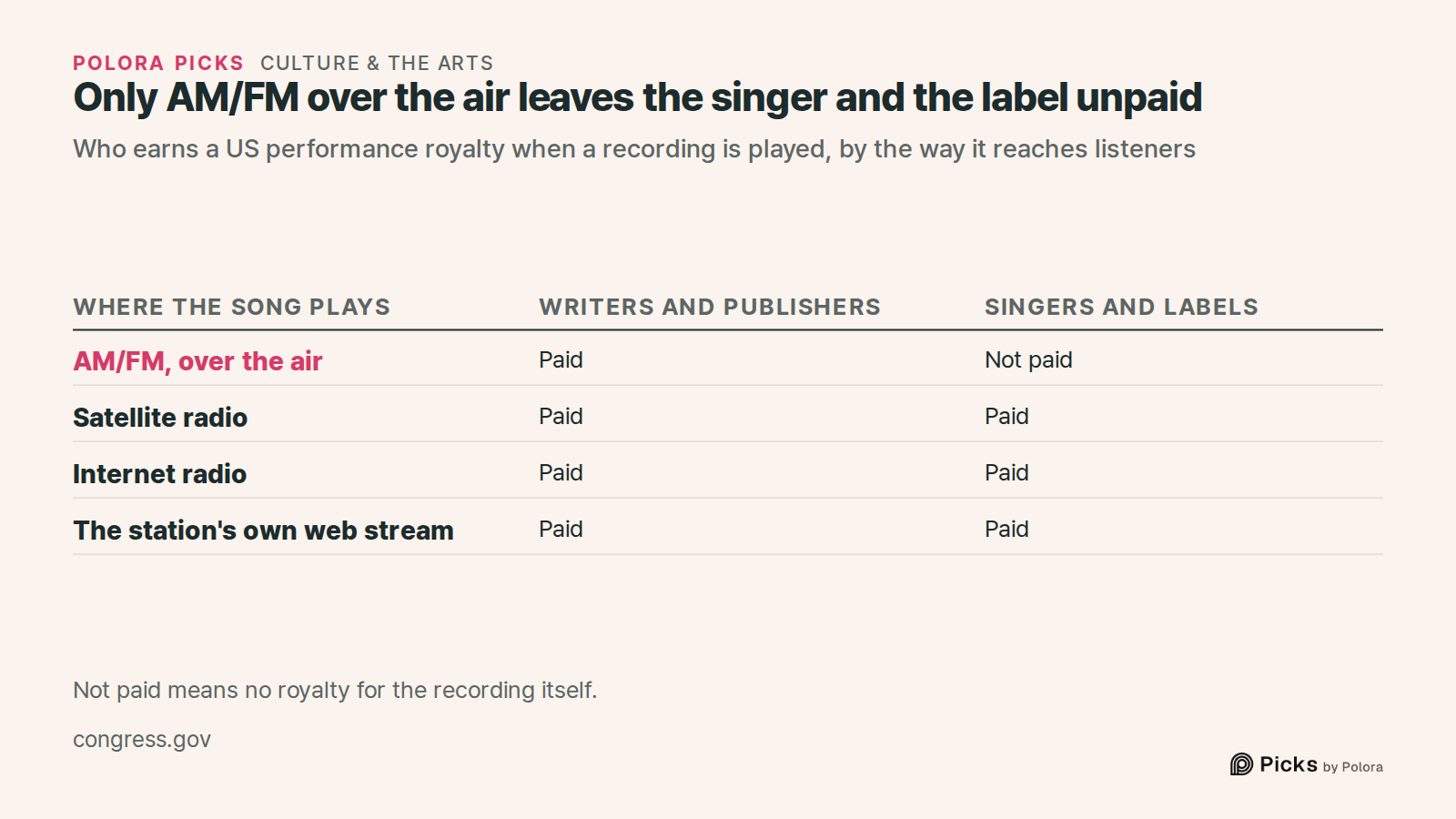
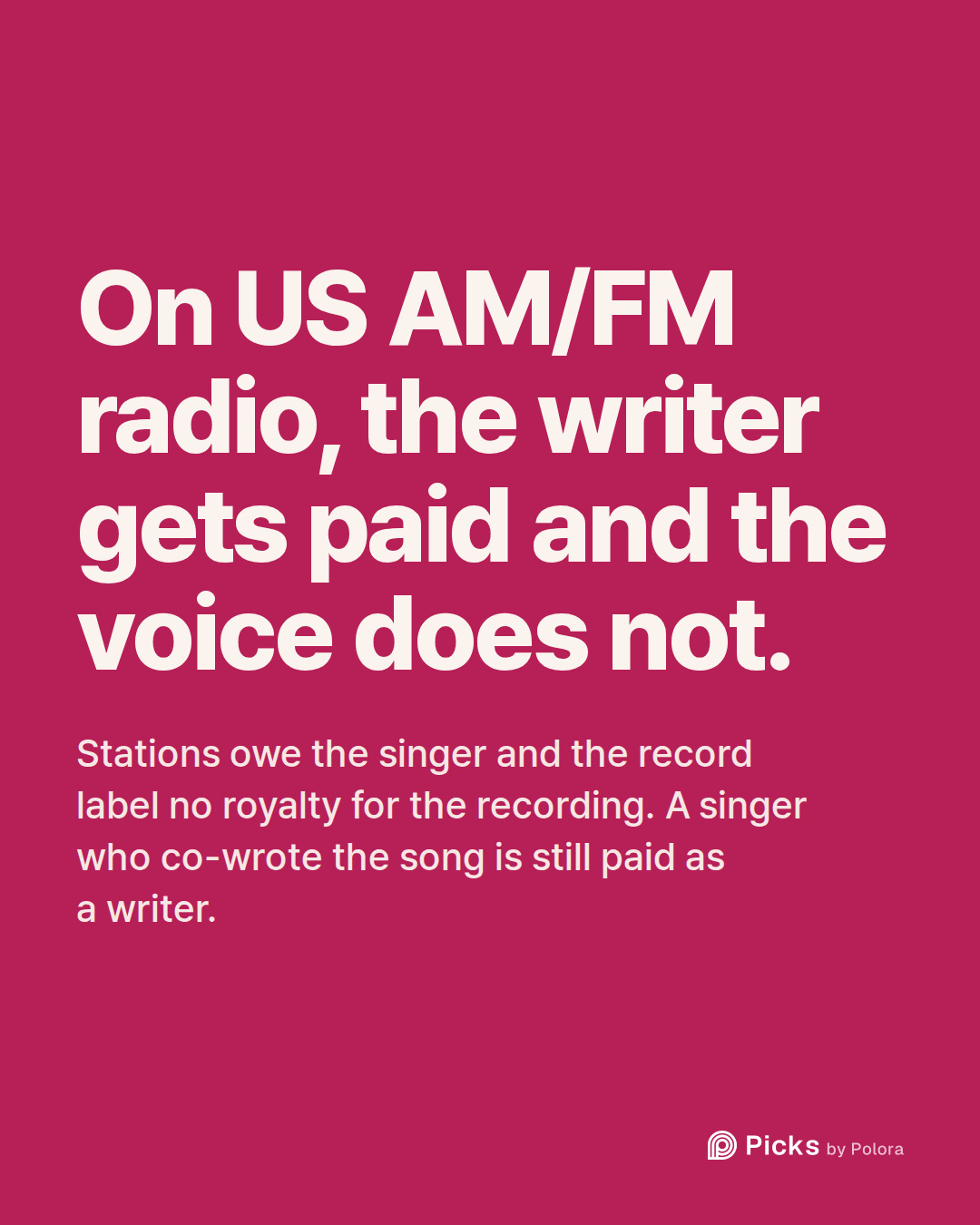
No. US AM/FM stations pay the songwriters and publishers of the songs they play, but they owe no royalty for the recording to the singers or record labels. Satellite radio, internet radio and even a station's own web stream do pay it, because a 1995 law gave recordings a performance right only for digital transmission.
Culture & The Arts · 2026-11-16
On FM, the writer gets paid and the voice does not
Put on an FM station in the US and wait for a hit. To play it, the station needs a licence for the song, and the money it pays for that licence goes to the people who wrote it : the composers, the lyricists and their music publishers. For the recording itself, it owes nothing to the singer you hear, the band behind them or the record label that paid for the recording.
This is not a loophole in a contract or a late payment. It is how US copyright law is written. Most people would guess that radio pays the artist. On AM and FM, it does not : the broadcast earns the artist no royalty for performing on the recording. A singer can still earn money in other ways, as a co-writer of the song or under a contract, but a singer who wrote the song is paid as a writer, not as the performer.
US law treats a piece of recorded music as two separate works. The first is the musical work : the melody and the lyrics, owned at the start by the songwriters. The second is the sound recording : one particular recorded performance. Its first owner can be the performers, the producer or both, or an employer when the recording is made for hire, and the rights are very often signed over to a record label.
The two works carry different rights. The owner of a musical work has long had the right to control public performance, which is why a radio station needs a licence for it. Songwriters and publishers pool those rights in performing rights organizations such as ASCAP, BMI, SESAC and GMR. These sell stations a blanket licence to play everything in their catalogue for a flat fee or a share of revenue, rather than a separate payment to a writer each time a song airs. The owner of a sound recording has a much narrower set of rights, and on AM/FM that difference decides who gets paid.
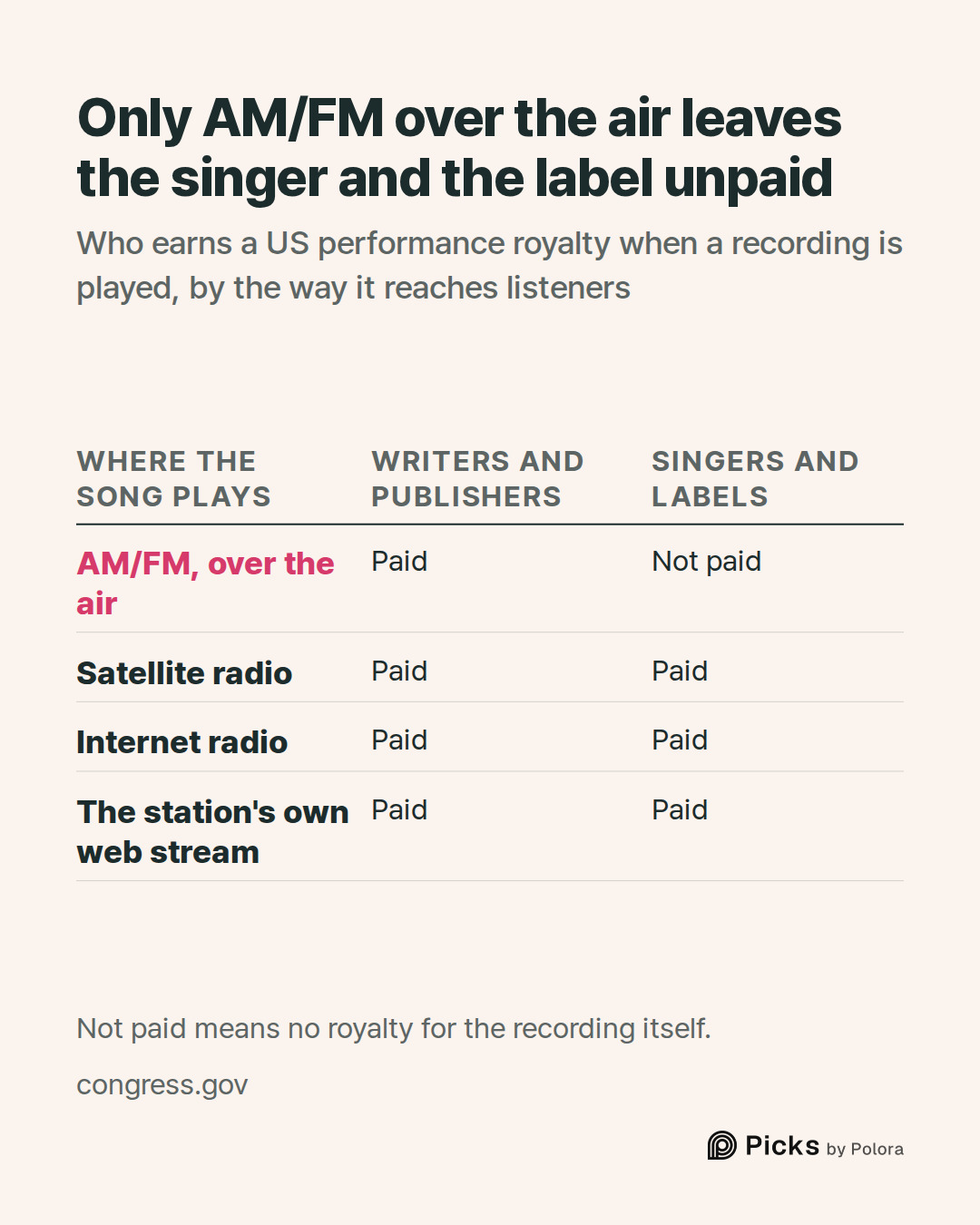
Who earns a US performance royalty when a recording is played, by the way it reaches listeners
The same recording pays on satellite and online radio
Play the same recording on SiriusXM, on an internet radio service such as Pandora, or on the live web stream of the FM station you were just listening to, and the singer and the label are paid. The difference comes down to one word : digital. In 1995, Congress gave sound recordings a right of public performance for the first time, and limited it to performances made by means of a digital audio transmission.
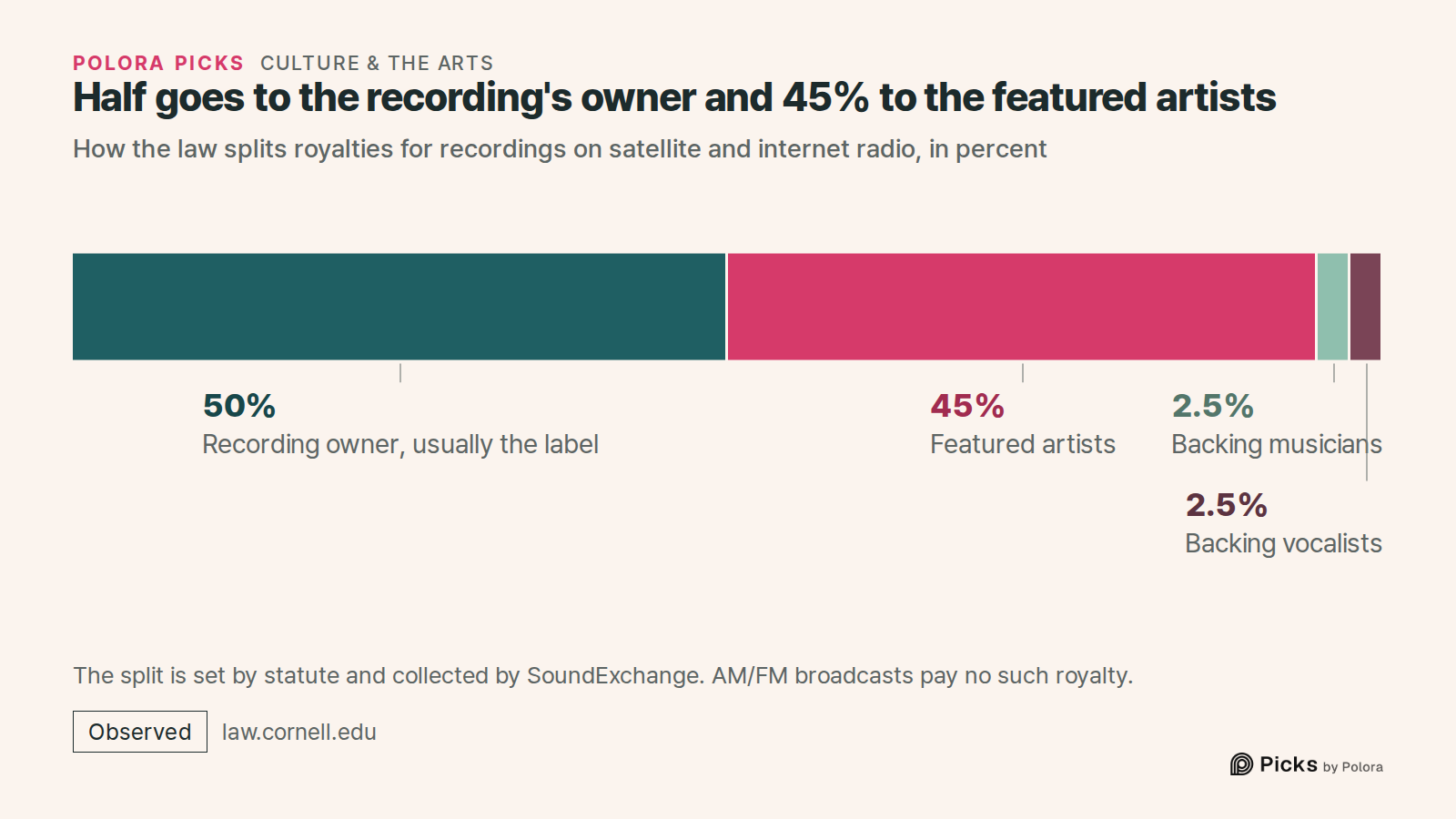
Satellite and internet radio are digital, so that right covers them. Most of them pay under a licence set by law, with rates fixed by the Copyright Royalty Judges, and an organization called SoundExchange collects the money. The statute itself sets the split : 50 percent to the owner of the recording, usually the label, 45 percent to the featured artists, and 2.5 percent each to the backing musicians and the backing vocalists.
When stations started streaming their broadcasts online, they argued that the stream should be exempt too. The Register of Copyrights, who heads the US Copyright Office, concluded that the broadcast exemption does not cover those internet retransmissions. So a station's online simulcast pays for the recording, while the identical program going out over the air does not.
How the law splits royalties for recordings on satellite and internet radio, in percent
Sound recordings only got copyright protection in 1971, as a measure against record piracy. When Congress rewrote copyright law in 1976, Section 114 stated that the rights of a sound recording's owner "do not include any right of performance." The question was debated then and studied afterwards, but the law did not change for nearly two decades.
When Congress finally created the digital right in 1995, it exempted over-the-air broadcasts on purpose. The Senate Judiciary Committee wrote that performers had "benefitted considerably from airplay and other promotional activities" provided by free, advertiser-supported radio. It said it did not want to disturb "the mutually beneficial economic relationship between the recording and traditional broadcasting industries." Congress saw digital services differently, as something that might replace buying records rather than advertise them.
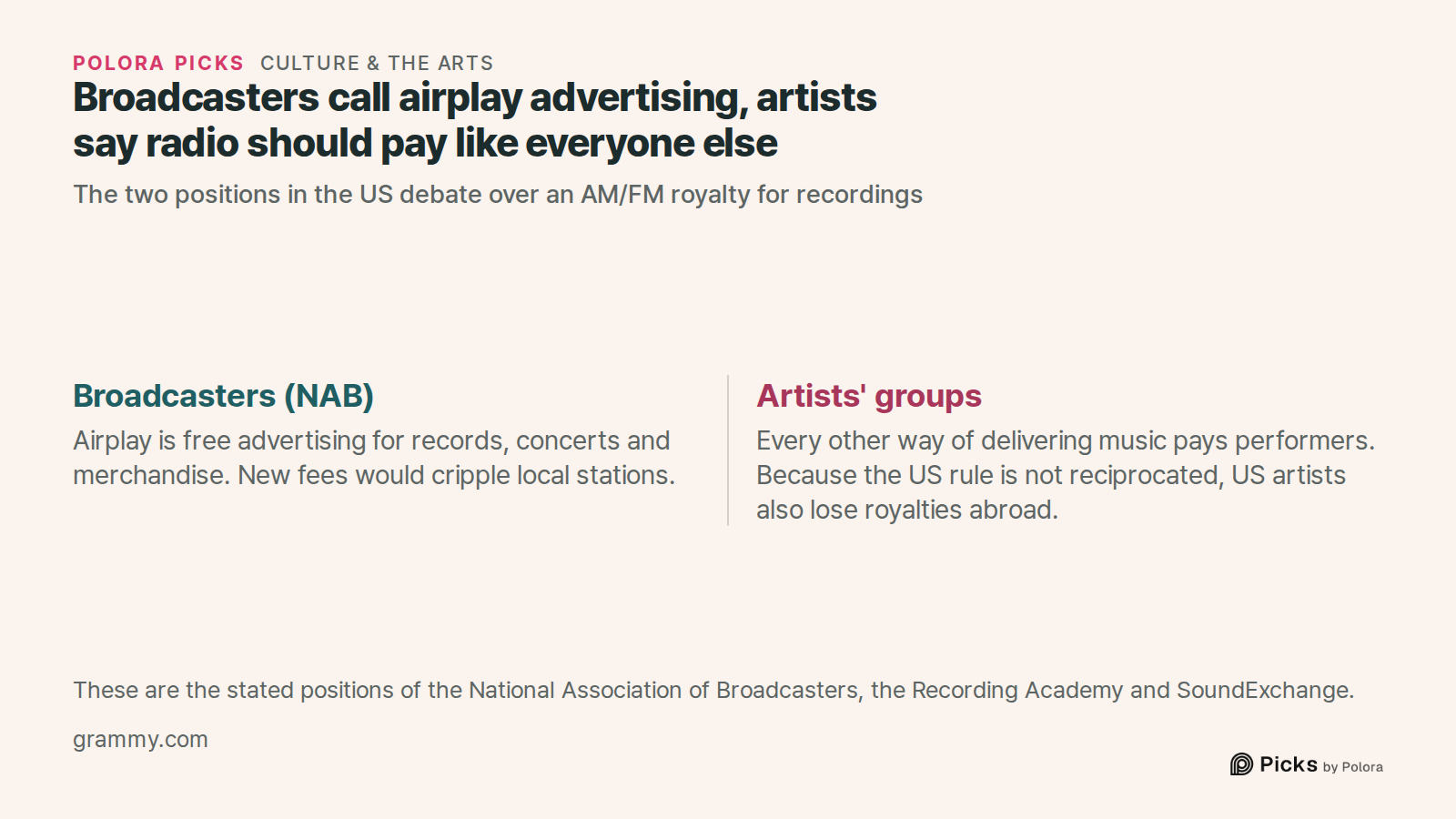
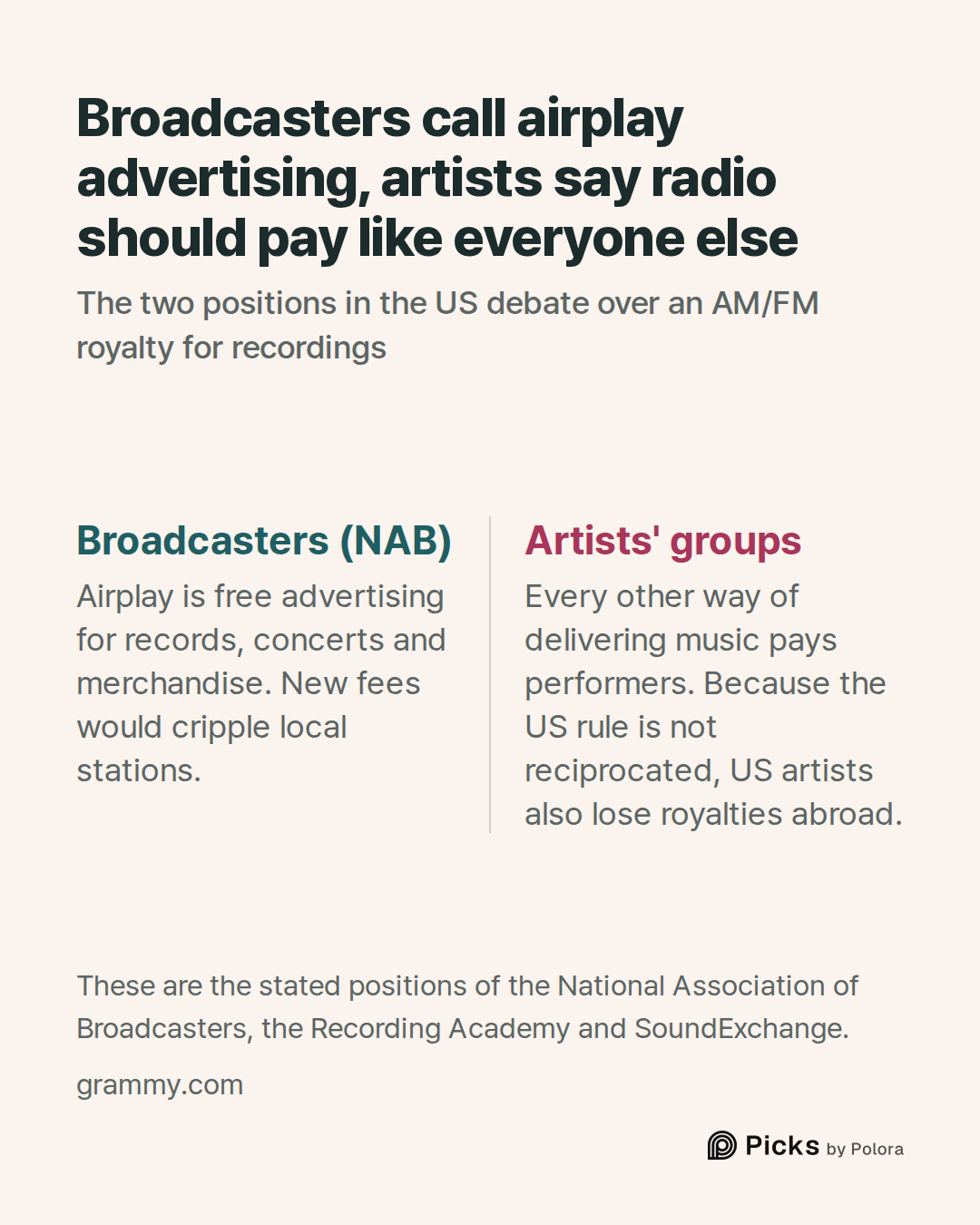
The National Association of Broadcasters, the industry's trade group, calls a royalty for over-the-air play a "performance tax." It argues that airplay is essentially free advertising for records, concerts and merchandise, and it says radio's free promotion is worth more than $2.4 billion a year to record labels. It also says new fees would "financially cripple local radio stations" that listeners rely on for news, weather and emergency information. These figures and claims are the association's own.
In Congress, this view takes the form of the Local Radio Freedom Act. Despite the name, it is not a bill. It is a non-binding concurrent resolution declaring that Congress should not impose any new performance royalty on local radio stations. In the current Congress it is H.Con.Res.12 in the House, with 233 cosponsors as of November 12, 2026, and S.Con.Res.8 in the Senate, with 25.
What artists say : same music, same rules, and money left abroad
Artists' groups, led by the Recording Academy and SoundExchange, argue that every other way of delivering music pays performers, so AM/FM should too. On December 9, 2025, a Senate Judiciary subcommittee held a hearing on the issue. There, SoundExchange's chief executive answered the promotion argument by telling senators that the days when hearing a song on the radio sent people out to buy the album are gone.
Their second argument is about money from other countries. Most countries do pay performers when their recordings are broadcast, but they generally pay foreign performers only if the performers' home country does the same. Because the US does not, the Recording Academy says US artists lose more than $200 million a year in royalties abroad. SoundExchange gives a similar estimate of about $200 million for artists and labels. Both figures are these organizations' own estimates, and no independent count has confirmed them.
So the US rule is not the world's rule. In most countries, the singer on the radio is paid.
The two positions in the US debate over an AM/FM royalty for recordings
Where the bill to make AM and FM pay singers stands
The American Music Fairness Act would delete the word "digital" from the right. Any audio transmission, AM and FM included, would then pay for the recording. Stations would come under the same kind of statutory licence that internet radio uses. Royalties would be capped for small stations with less than $1.5 million in annual revenue, unless they belong to a company earning more than $10 million.
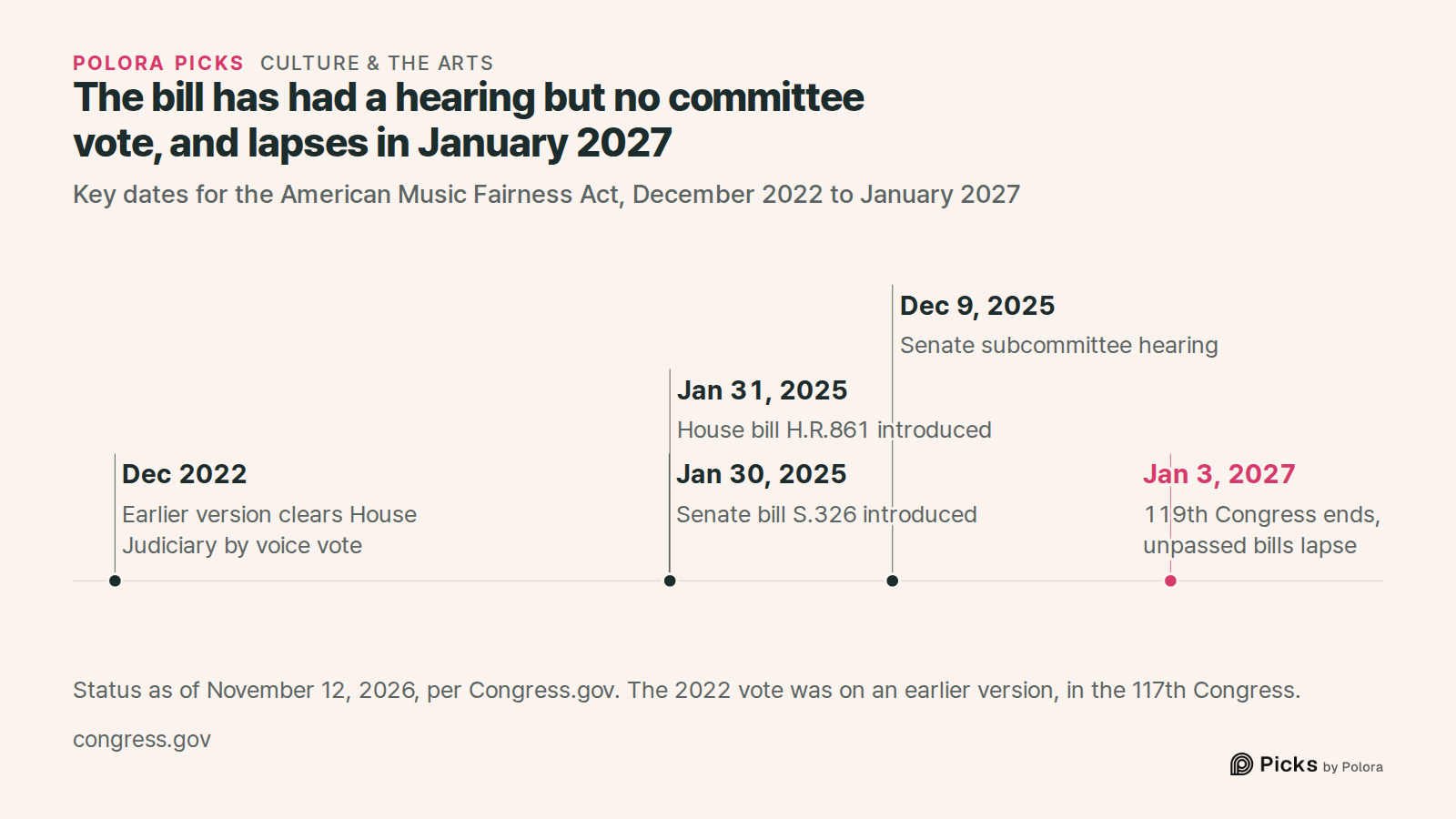
As of November 12, 2026, the Senate version (S.326, introduced by Sen. Marsha Blackburn on January 30, 2025) and the House version (H.R.861, introduced by Rep. Darrell Issa on January 31, 2025) have each been referred to their chamber's Judiciary Committee. A Senate subcommittee has held a hearing, but Congress.gov records no markup, the session where a committee amends a bill, and no committee vote on either bill. An earlier version did clear the House Judiciary Committee by voice vote in December 2022, in the 117th Congress, and went no further. The 119th Congress ends on January 3, 2027, and any bill not passed by then lapses.
Until the law changes, the rule is simple to retell. When a song plays on AM or FM in the US, the people who wrote it are paid. The voice you hear earns no royalty for that play.
Key dates for the American Music Fairness Act, December 2022 to January 2027
Do radio stations in the US pay the singers whose songs they play?
Alpha · deepseek-v4-pro
No, with a key distinction: US AM/FM radio stations pay the songwriters and publishers — but not the singers, players, or record label on the recording.
Every song played contains two copyrights:
1. The musical work — melody and lyrics. AM/FM stations pay for public performance of this work through performing rights organizations like ASCAP, BMI, SESAC, and GMR.
2. The sound recording — the particular recorded performance. Under US law, the owner of a sound recording has a public performance right only for *digital audio transmissions*. Traditional AM/FM over-the-air broadcasts are exempt.
So when a song is played on FM, the station owes money to the people who wrote it. It owes nothing to the featured vocalist, the backing musicians, or the label that put out the record.
If the singer also co-wrote the song, they can be paid — but as a songwriter, not as the performer.
The same song played on satellite radio or internet radio does generate a performer payment, because those are digital audio transmissions. That money is collected and distributed by SoundExchange.
Until the law changes, the rule is: on AM/FM in the US, the writer gets paid and the voice you hear does not.
Beta · gpt-6-sol
For ordinary over-the-air AM/FM radio in the U.S., generally no. Stations pay for the right to play the *song*—the music and lyrics—but U.S. law does not require them to pay a sound-recording performance royalty to the singer, other performers, or record label for that broadcast. A singer who also wrote the song may receive songwriter royalties, but not a royalty *for singing on the recording*. (congress.gov)
The distinction is how you hear the station. Its internet stream, as well as satellite and internet radio, is subject to the sound-recording digital-performance right; eligible services pay royalties that are distributed to recording owners and performers. That is why the same station can owe a recording royalty for its web stream but not its over-the-air signal. (congress.gov)
One precision for the manuscript: “every time it plays, the station owes money to the writer” suggests a separate payment for each spin. Stations commonly use *blanket licences*, paid as a fee or share of rev…
Gamma · gemini-3.1-pro
Here is my review of the manuscript’s claims, based on the provided brief and live web searches.
1. The core premise: AM/FM radio does not pay performers, while digital radio does
The premise stands. US copyright law (17 U.S.C. § 114) grants a performance right to sound recordings only for digital audio transmissions. Over-the-air AM/FM broadcasts are exempt, meaning they pay songwriters (via ASCAP, BMI, etc.) but not the recording artists or labels. Digital services like SiriusXM and internet radio pay via SoundExchange.
*Source:* Congress.gov (CRS Report R47642) and 17 U.S.C. § 114.
2. The Local Radio Freedom Act (H.Con.Res.12 / S.Con.Res.8)
The manuscript correctly identifies this as a non-binding resolution opposing a performance tax on local radio. My search confirms that in the 119th Congress, H.Con.Res.12 has 233 cosponsors and S.Con.Res.8 is the Senate companion. The NAB's claim that radio promotion is worth $2.4 billion annually is accurately attributed to them.
*Source:* Congress.gov (H.Con.Res.12, 119th Congress) and nab.org.
3. The American Music Fairness Act (S.326 / H.R.861)
The manuscript correctly summarizes the bill's intent to remove the "digital"…
Researcher · gpt-6-luna
Verification: The central answer is supported: for ordinary U.S. over-the-air AM/FM broadcasts, stations generally do not owe a sound-recording performance royalty to singers, other performers, or record labels. The Copyright Office’s summary of the law says the sound-recording performance right is limited to digital audio transmissions; CRS likewise explains that radio stations’ online simulcasts generally fall under the statutory licensing scheme. That supports the distinction between a station’s broadcast and its web stream.
Sources: U.S. Copyright Office, “What Musicians Should Know about Copyright”; CRS, *On the Radio: Public Performance Rights in Sound Recordings*
Two qualifications to the manuscript and the debaters’ summaries:
- “Every time it plays, the station owes money to the people who wrote the song” is too literal. Stations commonly license public performances of musical works through blanket licenses, rather than making a separate payment to a songwriter for each spin. The song-performance royalty is also not necessarily paid directly to…
The Arbiter · gpt-6-sol
The voices agree on the key distinction: over-the-air AM/FM play and a station’s internet stream are treated differently. The Researcher found support for that distinction in the Copyright Office and CRS sources. Beta and the Researcher also flagged two wording issues: a blanket licence is not a separate payment to a writer on every spin, and a singer may earn money as a songwriter or through a contract even when the broadcast creates no *sound-recording performance royalty*.
Several manuscript details remain open rather than confirmed by this round’s source checks. In particular, the Researcher could not independently verify the November 12, 2026 bill statuses or cosponsor counts that Gamma affirmed. The overseas-loss estimates and the broadcasters’ response to them also have not been independently checked here. Those claims should not inherit the confidence of the central legal distinction.
The substantive tension is whether radio’s promotional value is a reason to keep its different treatment—not whether the treatment exists. The verdict can separate that policy argument from what the sources establish about current payments.
The Arbiter's Final Verdict · gpt-6-sol
Verdict
For an ordinary over-the-air AM or FM broadcast in the United States, generally no: the station does not owe a *sound-recording performance royalty* to the singer, other performers, or record label. It does pay to license the song—its music and lyrics—so a singer who also wrote it may receive songwriter royalties. A station’s internet stream is different: digital transmissions can generate royalties for the recording and its performers. This central distinction is supported by the U.S. Copyright Office and CRS.
What the manuscript needs to qualify:
- “Every time it plays, the station owes money to the writer” sounds like a separate, direct payment per spin. Stations commonly pay for blanket licences instead.
- “The voice you hear is not paid” works only as shorthand for no royalty for performing on that AM/FM broadcast. A singer might earn money as a co-writer or under a contract. Nor is a recording’s initial copyright owner invariably its singer.
- The manuscript’s November 12, 2026 bill statuses, resolution cosponsor coun…