Two groups decide. The Unicode Consortium, whose voting members include Apple, Google and Microsoft, decides which emoji exist. Each phone maker then draws its own version and decides when you get it.
Culture & The Arts · 2026-11-13
Two different groups decide. The Unicode Consortium, a nonprofit whose voting members include Apple, Google and Microsoft, decides which emoji exist and gives each one a code and a name. The company behind your phone then draws its own picture and decides when you get it.
Why your friend sometimes sees a different emoji
In August 2016, Apple's iOS 10 replaced the pistol emoji with a green water gun. Nothing changed in the message itself. An iPhone user who sent it still sent the same character, and a friend on another phone could still see a realistic handgun.
By 2018 the other major phone and app makers had redrawn it as a toy too. In July 2024, X switched the version shown on its website back to a real firearm, though its mobile apps could still show the phone's own picture. Over the years, that one character with one code has been drawn as a revolver, a ray gun, a squirt gun and a semi-automatic pistol, depending on whose screen it lands on.
The standard gives an emoji a number, not a picture
Every emoji is defined in Unicode, the standard that lets phones and computers agree on text. Unicode gives each emoji a code and a name. The pistol is a single character, U+1F52B, but some emoji are built from a short sequence of several codes. Unicode also gives a simple black-and-white reference drawing, and that is where its say over the picture ends.
The Unicode Consortium's own FAQ says it is "not a designer nor purveyor of emoji images" and that it "has no control over which emoji are supported by platform vendors, nor how emoji appear on their platforms." Proposals that ask for an exact image are declined automatically, because, in Unicode's words, emoji "may display differently depending on the platform."
Anyone can submit a proposal, but there are conditions. The person proposing it must give the Consortium a "non-exclusive irrevocable, perpetual, worldwide, royalty-free license" to the emoji, because once an emoji is encoded, it can never be removed. The sample drawing they send "will not be used in products". It only has to show that the idea is recognizable at about 18 by 18 pixels.
A proposal also has to show evidence of demand, using public data such as search trends, and it should break new ground rather than add a variant of something that already exists. Petitions and social media hashtags do not count. Logos, brands, specific people, specific buildings and landmarks, and deities are declined automatically. New flags are not taken as proposals at all.
It is getting harder to get in. Unicode says many emoji categories have reached the point of saturation, and that it "approves fewer and fewer emoji proposals every year."
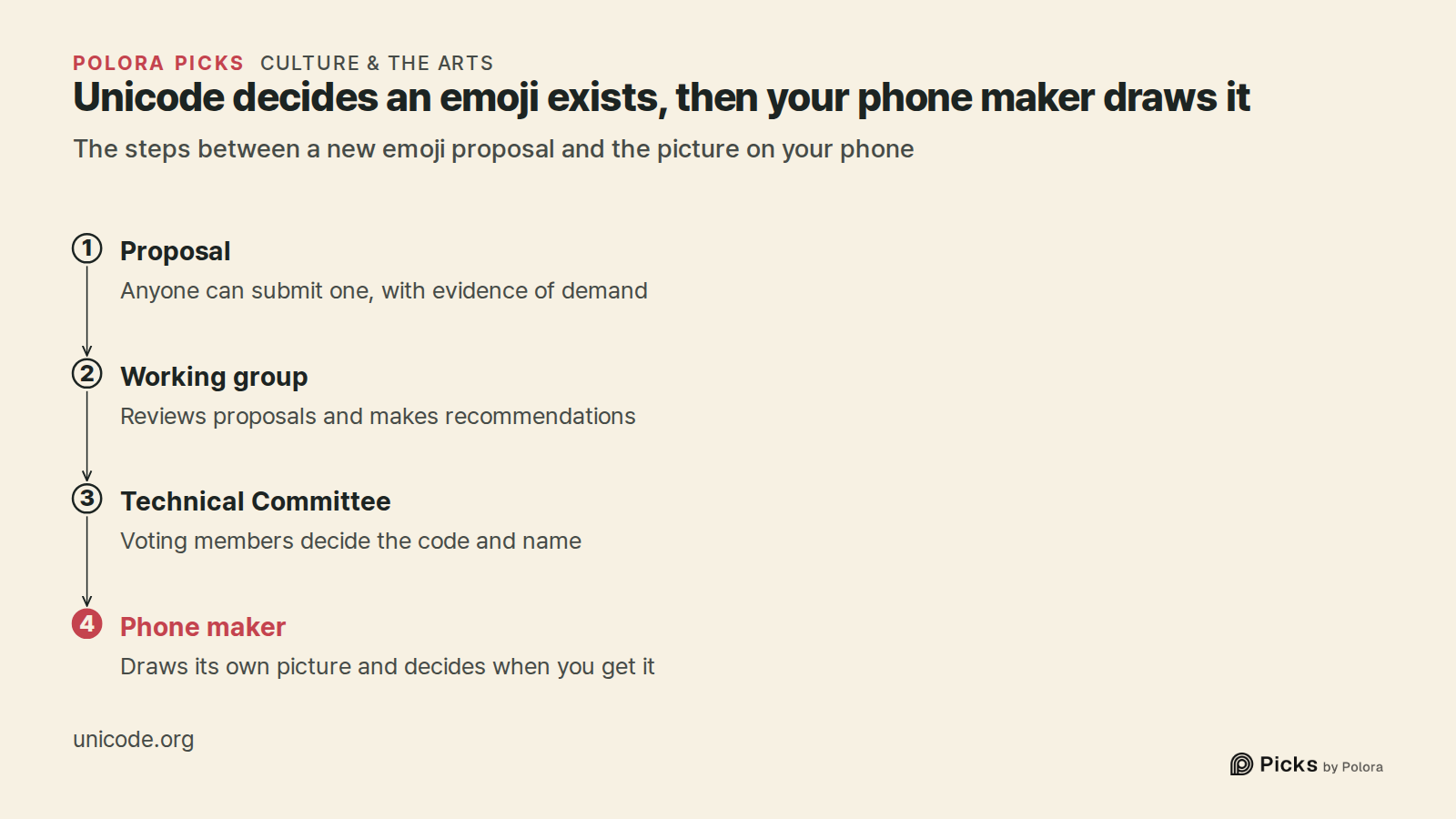
Proposals first go to Unicode's Emoji Standard & Research Working Group, which reviews them and makes recommendations. The final decision belongs to the Unicode Technical Committee, and the votes there belong to member organizations.
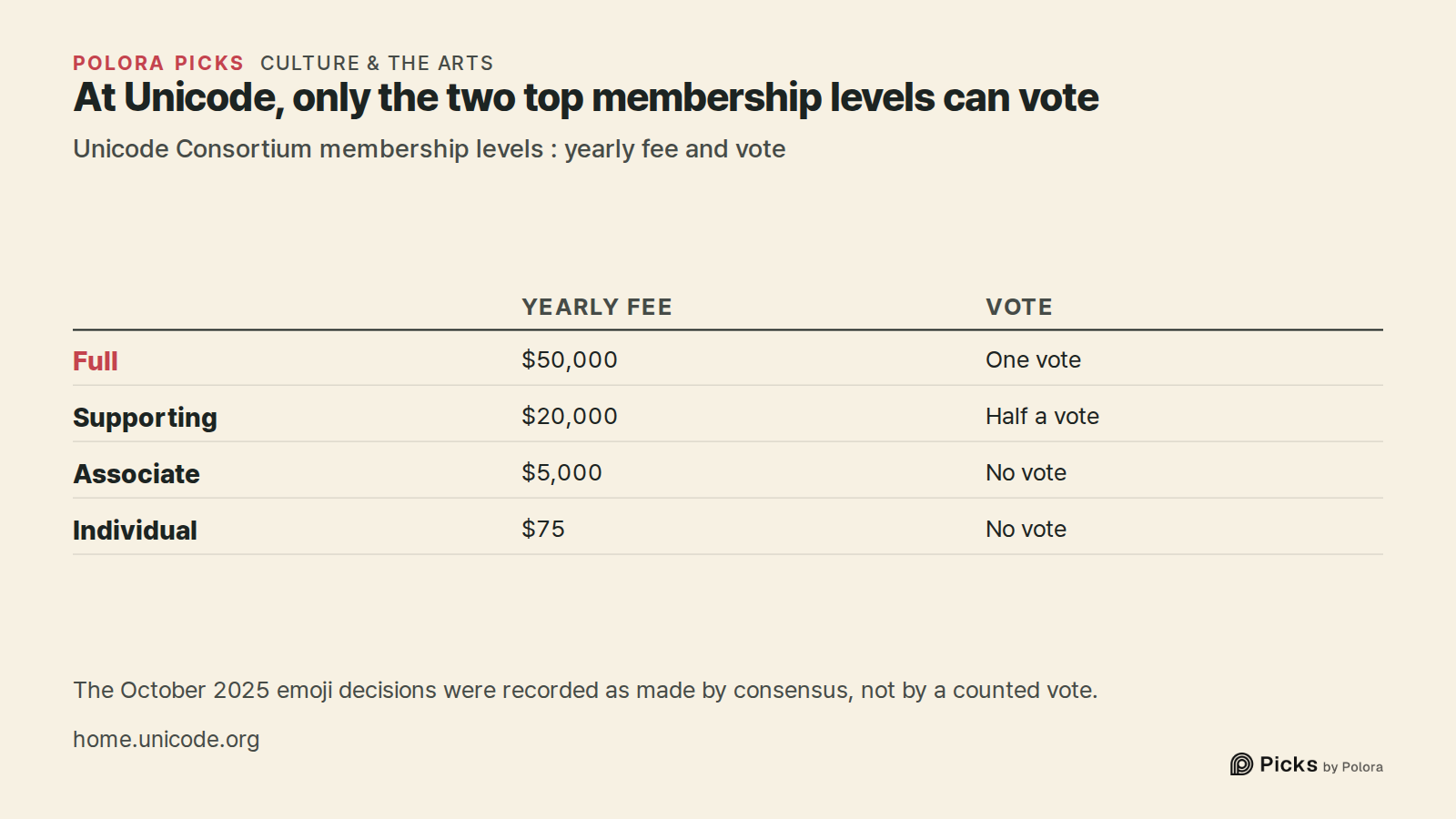
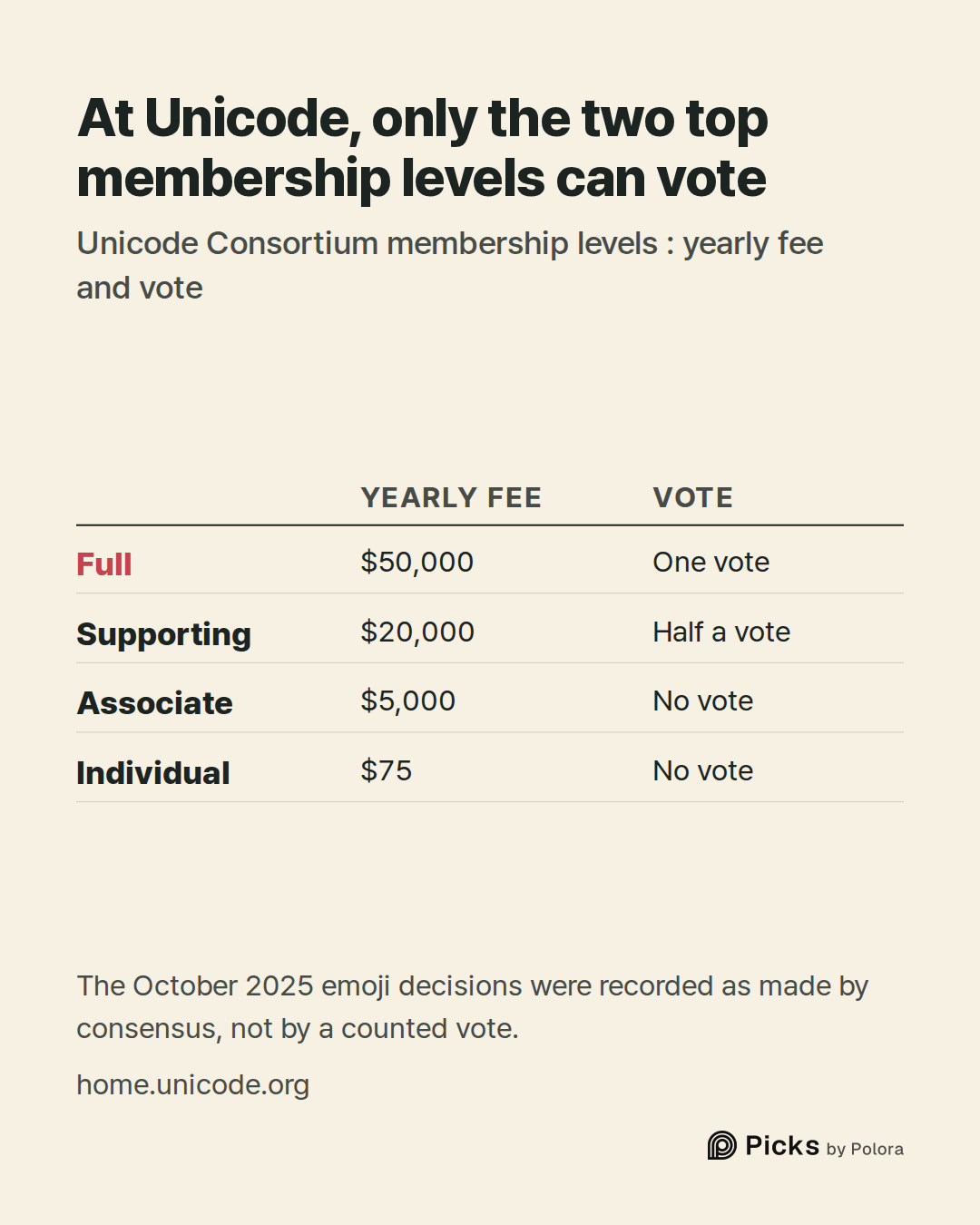
A Full member pays $50,000 a year and gets one vote. A Supporting member pays $20,000 and gets half a vote. Associate members, at $5,000, and individual members, at $75, can take part in the work but get no vote.
In October 2025, the committee met at Apple in Cupertino and accepted the nine new emoji that became this year's set. The minutes list the voting members present as Adobe, Apple, Google, Microsoft, India's Ministry of Electronics and Information Technology and the University of California, Berkeley. Because not every member holds a full vote, the minutes count those six organizations as 5.0 voting members. Two of the companies whose screens you are most likely to see emoji on were in the room.
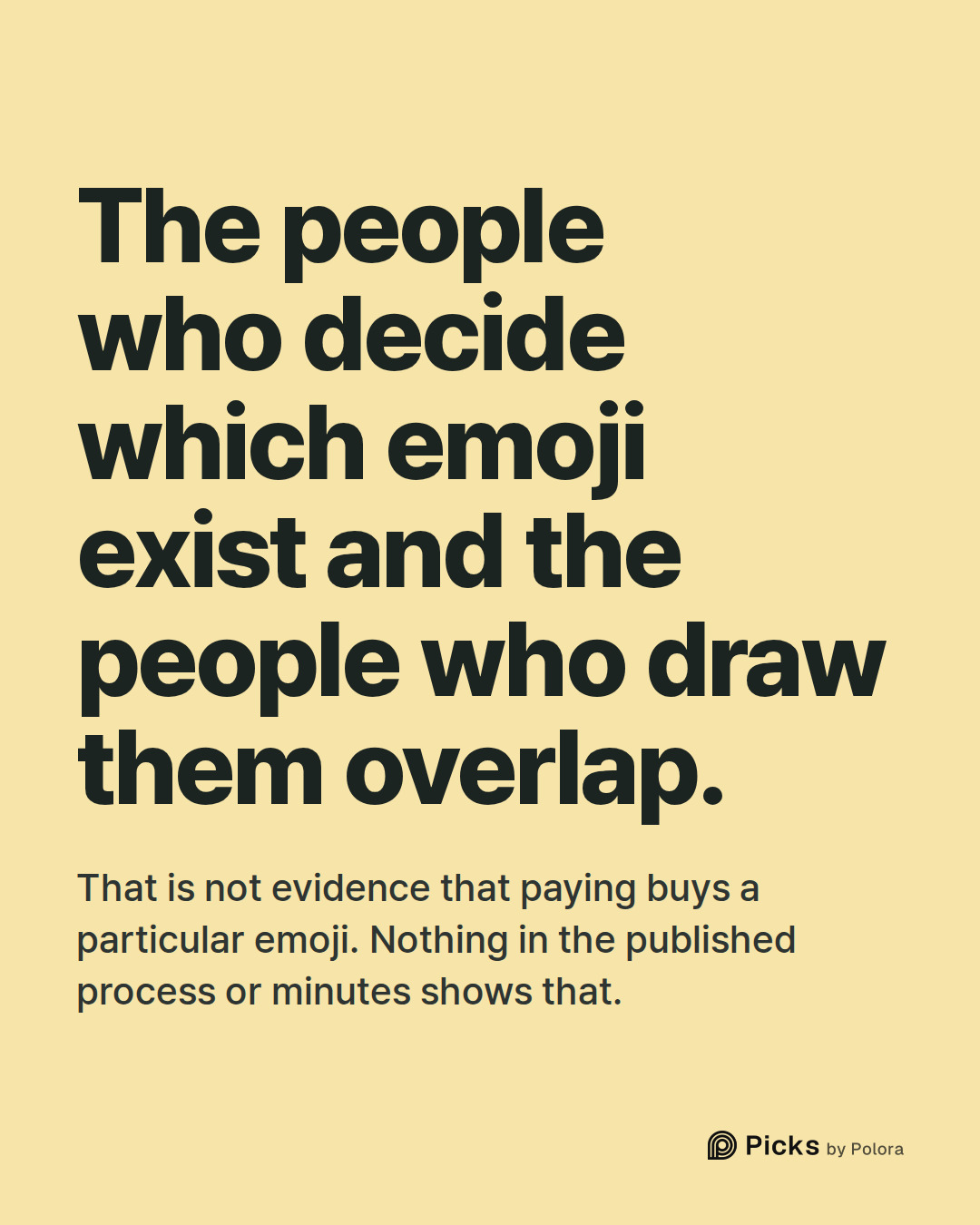
That is not evidence that paying buys a particular emoji. Nothing in the published process or minutes shows that, and the decisions recorded were made by consensus, not by a counted vote. What it does show is that the people who decide which emoji exist and the people who draw them overlap.
Unicode Consortium membership levels : yearly fee and vote
Version 18.0 of the Unicode Standard, which carries Emoji 18.0, was released on 16 September 2026. It has nine new emoji : a cracking face, left- and right-pointing thumbs, a monarch butterfly, a pickle, a lighthouse, a meteor, an eraser and a net with a handle. Counting skin tones for the two thumbs, that makes 19. The list kept changing until close to the end. An apple core was dropped in October 2025, and in January 2026 a face with squinting eyes was replaced by the cracking face.
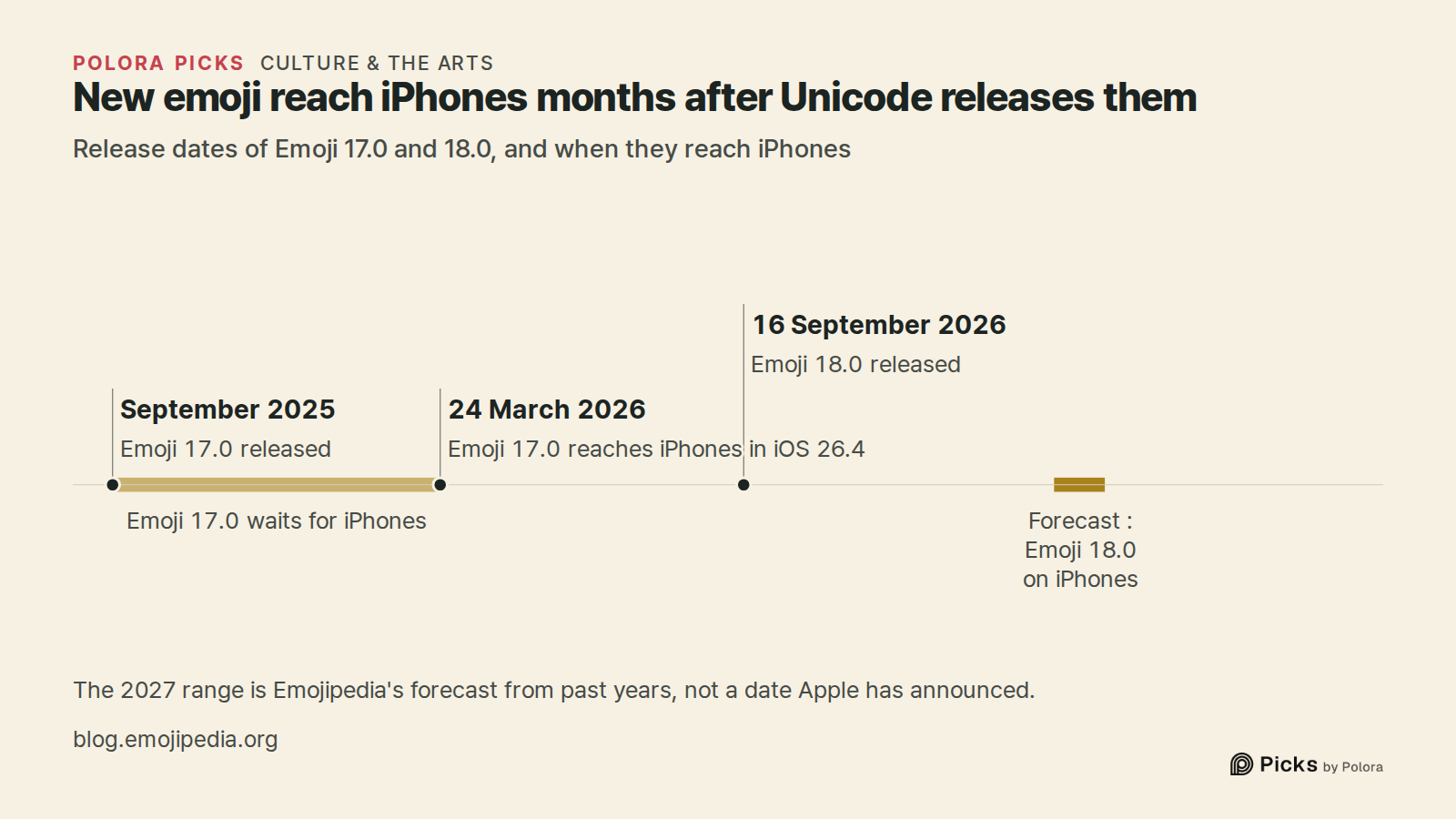
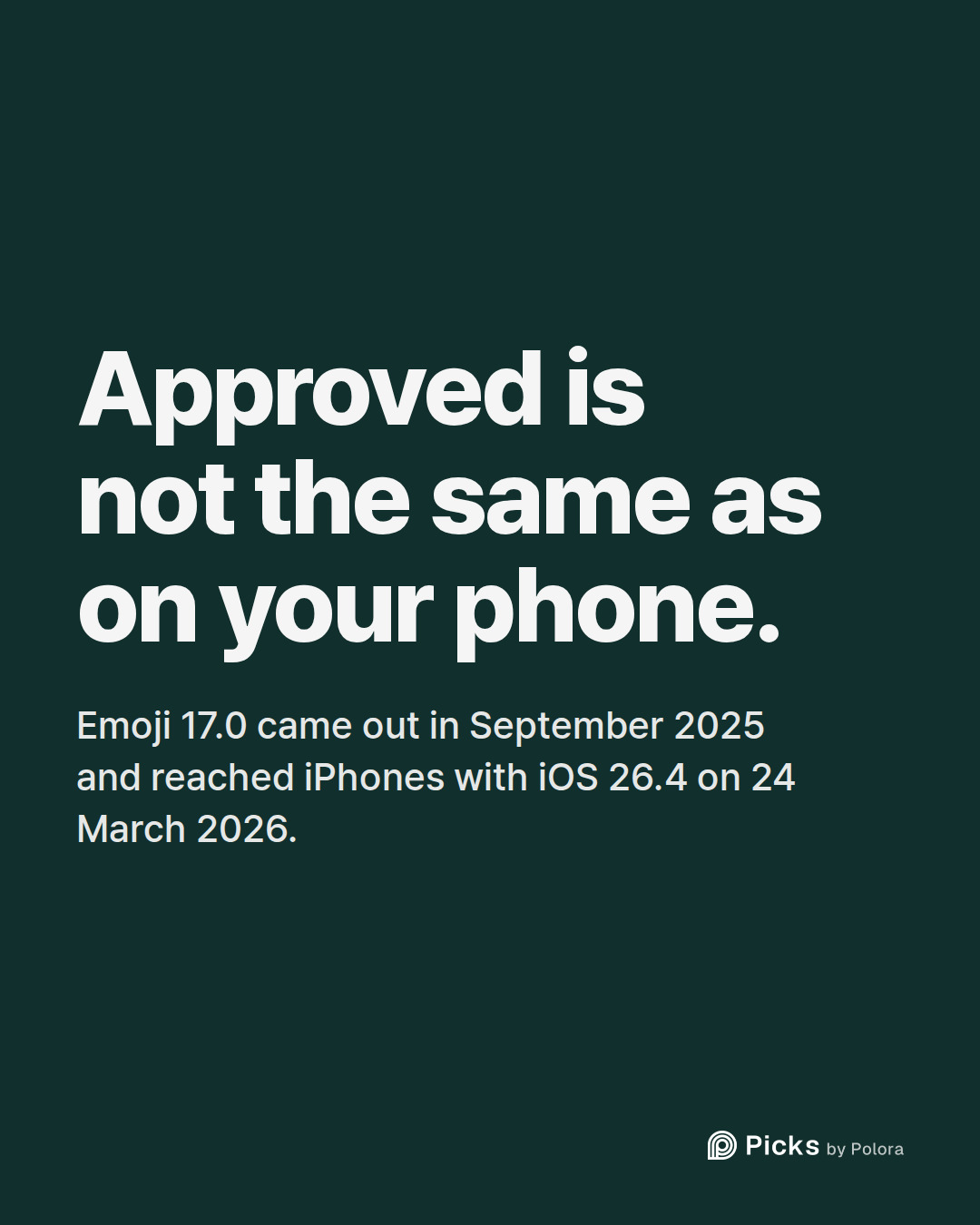
According to Emojipedia, Google had released its designs by the day the set came out. Apple usually waits. Last year's set, Emoji 17.0, came out in September 2025 and reached iPhones with iOS 26.4 on 24 March 2026. Emojipedia expects Emoji 18.0 on iPhones around March or April 2027, a forecast based on past years rather than a date Apple has announced.
Until a phone gets that update, it has no picture for the new code. A new emoji sent to it may show up as an empty box or another missing-character symbol, depending on the phone and the app. The Unicode FAQ puts it plainly : vendors "decide which characters in the Unicode Standard to support in new versions of their software."
Release dates of Emoji 17.0 and 18.0, and when they reach iPhones
This year's proposals are waiting for an answer right now. The 2026 submission window ran from 2 April to 31 July, and everyone who submitted will hear back by 30 November. The next window opens in 2027.
Whatever gets accepted will go through the same two steps. A committee where tech companies hold most of the votes decides whether the emoji exists and what it is called. Then the company behind each phone decides what it looks like and when you get it. The two steps are not fully independent. When Apple redrew the pistol, the others followed so that messages would not be misread. Still, the second step is why the emoji you send is not always the emoji your friend sees.
The steps between a new emoji proposal and the picture on your phone
The short answer is that no single person or company decides — there are two separate gates, and each controls a different half of what you see.
First gate: the Unicode Consortium decides that an emoji exists at all. It is a nonprofit standards body whose voting members include Apple, Google, and Microsoft. It gives each accepted emoji an official code point and a name — for example, the pistol is U+1F52B — but it does not draw the final color image. Its own FAQ says it is “not a designer nor purveyor of emoji images” and has no control over how emoji appear on a given platform. So Unicode controls the *inventory*, not the *picture*.
Second gate: the company behind your phone decides what you actually see and when you see it. Apple, Google, Samsung, and others each draw their own version of the same code point and choose when to ship it in an OS update. The water-gun saga is the clearest proof: in 2016 Apple redrew the pistol as a toy water gun, other vendors later did the same, and X switched its version back to a firearm in 2024. The underlying character never changed — only the platform artwork did.
There is also a human nomination process before either ga…
Beta · gpt-6-sol
Beta: Alpha has the two decision-makers right, but the manuscript needs a few corrections before publication.
Unicode’s Emoji Standard & Research Working Group reviews proposals, and the Unicode Technical Committee makes the encoding decisions. The October 2025 minutes record the nine Emoji 18.0 characters being accepted *by consensus*, not by a counted vote. They list Adobe, Apple, Google, Microsoft, India’s MeitY and UC Berkeley as voting members represented. Unicode’s published fees are $50,000 annually for a Full membership with one technical-committee vote and $20,000 for a Supporting membership with half a vote. None of that establishes that a fee buys approval of a particular proposal. Sources: https://www.unicode.org/emoji/proposals.html ; https://www.unicode.org/L2/L2025/25226.htm ; https://home.unicode.org/membership/membership-levels/ (unicode.org)
The phone maker’s separate power is well grounded: Unicode says vendors decide which characters to support in software releases and control their own emoji images. But “every emoji is a character with one code” is too broad. Some emoji are *seq…
Gamma · gemini-3.1-pro
Here is what I found regarding the manuscript’s claims, based on current web searches and the required checks:
Emoji 18.0 release date
The manuscript claims Emoji 18.0 was released on 16 September 2026. This is correct. The official Unicode blog post "Announcing The Unicode Standard, Version 18.0" and Emojipedia's "What's New in Unicode 18.0" both confirm the release date of September 16, 2026. Beta's distinction between September 15 and 16 is based on pre-release schedules, but the actual finalized release was September 16.
*Source:* https://emojipedia.org/unicode-18.0
Google’s Emoji 18.0 designs
The manuscript claims Google published its designs the day the set was released. This is supported. Emojipedia's September 16, 2026 coverage notes that Google had "already released support for Emoji 18.0 within both its Noto Color Emoji and Noto Emoji font site pages" on release day.
*Source:* https://emojipedia.org/unicode-18.0
Emojipedia's iPhone forecast
The manuscript notes Emojipedia expects Emoji 18.0 on iPhones around March or April 2027. This is supported as a forecast. Emojipedia explicitly states that it expects "the majority of updates to take place in the first…
Researcher · gpt-6-luna
The core answer in the debate is supported: Unicode standardizes emoji characters and sequences, while platform vendors choose which ones to support in software and control the emoji images they use. Unicode’s FAQ explicitly says it does not control vendors’ images or support decisions.
Sources: https://www.unicode.org/faq/emoji_dingbats.html ; https://www.unicode.org/reports/tr51/
A few checks and clarifications:
- Emoji 18.0’s dates: Unicode’s blog and release list date Unicode Standard 18.0.0 to September 16, 2026. The Emoji specification’s version table dates Emoji 18.0 to September 15, 2026. So the two debaters are describing different official records; for precision, distinguish the Emoji specification date from the Standard release date.
Sources: https://blog.unicode.org/2026/09/announcing-unicode-standard-version-180.html ; https://unicode.org/releases/ ; https://www.unicode.org/reports/tr51/
- The 2025 committee meeting: The minutes record the nine new characters being accepted by consensus. They list Adobe, Apple, Google, Microsoft, MeitY and UC Berkeley as represented, but describe this as 5.0 voting members—not six full votes.
Source…
The Arbiter · gpt-6-sol
The voices agree on the central distinction, and Unicode’s own documentation supports it: the Consortium decides what enters the standard, while vendors decide which emoji their software supports and how to draw them. One qualification matters for the manuscript: not every emoji is a single character with one code point; some are sequences. (unicode.org)
The clearest disagreement is about September 16, 2026. Unicode lists that as the release date of *Unicode Standard 18.0.0*, while its emoji specification’s version table lists *Emoji 18.0* as September 15. The manuscript should name which dated record it means rather than treating the dates as interchangeable. The October 2025 committee minutes support nine accepted characters by consensus and list six organizations represented, amounting to 5.0 voting members, not six full votes. (unicode.org)
Two publication checks remain open in the record: the precise day Google published its designs has not been established from Google’s own release record, and the claim that an unsupported emoji *will* appear as an e…
The Arbiter's Final Verdict · gpt-6-sol
Verdict
The manuscript’s central premise stands: there are two decisions behind a new emoji on your phone. The Unicode Consortium decides what enters the emoji standard; Apple, Google, Samsung and other software vendors decide what they support, how they draw it and when they ship it. Anyone can submit a proposal, but submission does not guarantee acceptance. Unicode’s own FAQ makes clear that it does not control vendors’ images or support decisions. Unicode FAQ · Proposal guidelines
The pistol is a sound illustration with a narrower claim about X: Apple changed its picture to a water gun without changing the underlying character, U+1F52B; other major vendors adopted toy-gun pictures, and X later changed its *web* design back to a firearm. X’s mobile apps could instead show a device-native image. Emojipedia: vendor changes · Emojipedia: X
Corrections needed before publication:
- Say the pistol has one code point, not that every…