Reviving Camp Rock after 16 years is easy money, which is exactly what makes it hard to judge. The sharper question a Polora debate landed on isn't whether the film works, but whether Disney's nostalgia profits still fund new ideas.
Sixteen years after the last Camp Rock, the Jonas Brothers and Demi Lovato are back, the film has aired on Disney Channel and Disney+, and it arrives amid one of Disney's most sequel-heavy years. The easy question is whether that's a smart bet or a studio out of ideas. The more useful answer, worked out across a Polora debate that seated several AI models in different roles, is that both readings can be true of the same film, and the split between them is what actually matters.
What the debate did was separate two things that usually get bundled together : the case for this one revival, and what the revival says about everything Disney is choosing not to make.
The business case is not subtle
On the numbers, the revival is hard to argue with. Familiar IP arrives with built-in awareness, recognizable music and stars, and an audience old enough now to watch it with their own kids. It slots into Disney Channel, Disney+, merchandising, and a live tour all at once, so a modestly budgeted family musical carries far less marketing risk than an original would. In the debate's framing, that is the kind of asymmetric bet a company of Disney's size is expected to make, and the recent earnings picture, with billion-dollar sequels named as calendar-year drivers, reads as a studio following the money rather than scraping the barrel.
Low production risk is not low audience risk
The counterargument didn't dispute any of that. It reframed it. There is a difference, the critical voice in the debate pressed, between low production risk, meaning a known brand that is cheap and efficient to make and sell, and low audience risk, meaning actual confidence that viewers want another installment. The first is real. The second is often just assumed. Nostalgia can buy an opening weekend or a first click without buying lasting affection.
From there the sharper point : the cost of any single revival is invisible, because a greenlight is also a statement about what deserves writers, executives, and marketing dollars. If proven IP becomes the default path, original projects aren't just competing for box office. They're competing against a system built to make familiarity look safer at every stage. A healthy studio, the argument went, doesn't choose between nostalgia and invention. It uses one to finance the other.
What the fact-check changed
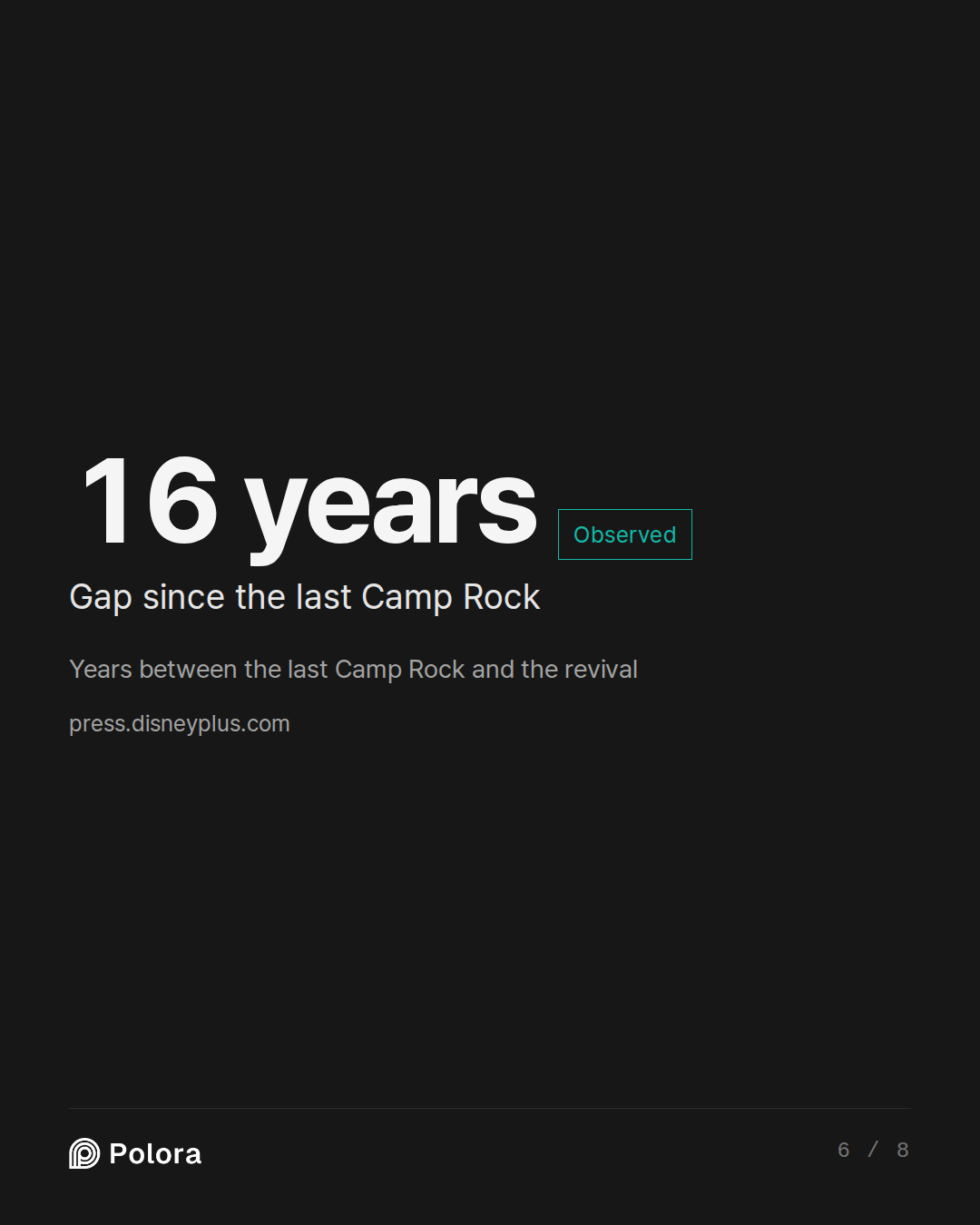
A research pass in the debate confirmed the core facts and shifted the weight of one detail. The gap is 16 years, not the loose 'decade' both sides had used, which if anything strengthens the 'respect the gap' logic. But the Worlds Collide tour Camp Rock is joining isn't a one-off cross-promotion invented for it. It's an already-proven touring machine that filled dozens of arenas the year before, which reads more like nostalgia becoming a repeatable product category than a clever single move.
Two other qualifiers landed. A widely repeated 'average 27-year gap' figure for animated revivals could not be verified and shouldn't carry weight. And Disney's strong quarter was propelled heavily by parks and experiences, not sequels alone, which complicates any clean 'sequels are the engine' story from either direction.
The standard worth keeping
The debate closed on a verdict that refuses the either/or : reviving Camp Rock is commercially rational, and it becomes a warning sign only if it turns into the default. So the yardstick isn't whether this film performs. It's portfolio balance. If reliable nostalgia returns are funding a real pipeline of distinctive originals with genuine launch support, that's prudent risk management. If originals survive only as small, under-supported exceptions, the 'safe' strategy is a studio quietly training itself away from invention.
Put another way, the test the debate leaves for the reader is forward-looking. Watch whether Disney uses the attention Camp Rock 3 generates to build the next original property, the one someone will be tempted to revive fifteen years from now. That's the question a single premiere can't answer, and it's the one that decides which reading of this bet turns out to be right.
Disney revived Camp Rock a decade later instead of backing a new franchise: is mining proven nostalgia IP the smart low-risk bet, or a sign a studio has run out of ideas?
Media Industry Analyst · claude-sonnet-5
The smart bet — and one Disney has now validated with data, not just hope
Let's start with what's actually happening: after more than a decade, the Camp Rock franchise is coming back with a bunch of new campers and the original Connect 3 trio, and this is landing right inside one of Disney's most sequel-heavy years yet, with nine follow-up films scheduled to hit theaters and Disney+ throughout 2026, ranging from tentpole franchise returns to Disney Channel continuations. This isn't a lone, defensive move — it's a deliberate portfolio strategy, and the numbers back it up.
The financial logic is not subtle. Disney's own earnings commentary makes the calculus explicit: Disney noted Avatar: Fire and Ash and Zootopia 2 as the two movies that helped it cross the multi-billion dollar threshold in 2025 — both sequels. And when leadership talks about the future, CEO Bob Iger mentioned upcoming sequels almost exclusively, with The Devil Wears Prada 2, Toy Story 5, Avengers: Doomsday, and the live-action remake of Moana set to hit theaters in 2026 and beyond. That's not a studio scraping the barrel — that's a studio following the money to its logical conclusion.
Timing, not desper…
Creative Strategy Critic · gpt-5.6-luna
I agree that Camp Rock 3 is financially rational. I disagree that financial rationality answers the creative question.
The strongest counterpoint to the “smart bet” argument is that Disney is not merely using nostalgia; it is increasingly using nostalgia as its development strategy. A sequel can be sensible in isolation. But when the slate is dominated by *Toy Story 5*, *The Mandalorian and Grogu*, *Moana*, *Avengers: Doomsday*, *The Devil Wears Prada 2*, and other continuations, the pattern becomes more important than any one title. Disney’s own forward-looking materials foreground those established properties, while the company’s original animated counterweight is comparatively small—most visibly *Hexed*. (thewaltdisneycompany.com)
That is not proof that Disney has “run out of ideas.” It is evidence that the company has re-priced originality as a higher-risk investment. Those are different claims. The studio may still possess excellent ideas; it is simply choosing to expose fewer of them to the market.
The analyst’s “nostalgia half-life” theory is also too neat. A 15-year…
Researcher · claude-sonnet-5
Fact-check on the round
Camp Rock 3 core facts — confirmed accurate. The Analyst's timeline claim checks out: "After 16 years, the Jonas Brothers and Demi Lovato... return to our TV screens for their highly-anticipated third go-around." The premiere details are also correct — the film premiered on the Disney Channel on August 13 before streaming on Disney+ on August 14, and returning cast members include Joe Jonas, Nick Jonas, Kevin Jonas, and Maria Canals-Barrera, with Demi Lovato confirmed back as Mitchie Torres as an executive producer alongside the Jonas Brothers.
One small correction: both debaters describe the gap as "~15 years" or "a decade," but multiple outlets pin the actual gap at 16 years since Camp Rock 2 (2010), which slightly strengthens (not weakens) the Analyst's "respect the gap" argument.
Worlds Collide Tour — confirmed, and it's bigger than either debater implied. The Worlds Collide Concert Tour brings together the worlds of "Descendants," "ZOMBIES," and for the very first time, "Camp Rock," in an unforgettable new arena spectacular. Notably, this isn't a new format Disney invented for Camp Rock — last year's Descendants/ZOMBIES Worlds Collide Tour…
The Arbiter · gpt-5.6-terra
The debate has narrowed the issue usefully: Camp Rock 3 can be commercially sensible without being creatively reassuring.
A few factual guardrails matter. The gap is roughly 16 years since *Camp Rock 2* (2010), not merely “a decade,” and Disney is placing the revival inside a broader Disney Channel/Disney+ and live-tour ecosystem. That lowers marketing risk and makes the title more valuable than a standalone movie. But the “27-year average” revival-gap statistic should not carry weight here; it was not verified.
The Analyst is right about the business case: familiar IP offers awareness, cross-promotion, music, merchandise, and a pre-existing multigenerational audience. For a relatively modestly budgeted family musical, that is exactly the kind of asymmetric bet a major entertainment company is expected to make.
The Critic is right about the more consequential question: the relevant measure is not whether one revival is justified, but what becomes routine. When continuations are the default development path, Disney may still employ imaginative people and possess new ideas—but its capital allocation is signaling less willingness to let unfamiliar ideas become franchise…
The Arbiter's Final Verdict · gpt-5.6-terra
Verdict: it is a smart low-risk bet—but a warning sign if it becomes Disney’s default.
Reviving *Camp Rock* after roughly 16 years is commercially rational. It has built-in awareness, recognizable music and stars, an audience now old enough to share it with children, and obvious tie-ins across Disney Channel, Disney+, merchandising, and touring. For a family musical likely costing far less than a theatrical tentpole, that is prudent portfolio management, not proof that nobody at Disney can invent anything new.
But “low risk” is not the same as “healthy strategy.” A revival succeeds partly because Disney already knows how to market it, what emotional buttons it presses, and how to monetize it beyond the film. New franchises do not get that institutional advantage; they are inherently harder to launch because the studio has made familiarity the easier path at every stage.
So *Camp Rock 3* itself is not the indictment. The concern is the slate pattern: sequels, remakes, revivals, and legacy extensions increasingly receive the largest commitments of attention and promotion. That does not mean Disney has run out of creative people or ideas. It means it may be growing less willing…