The calorie number on the pack was probably never measured
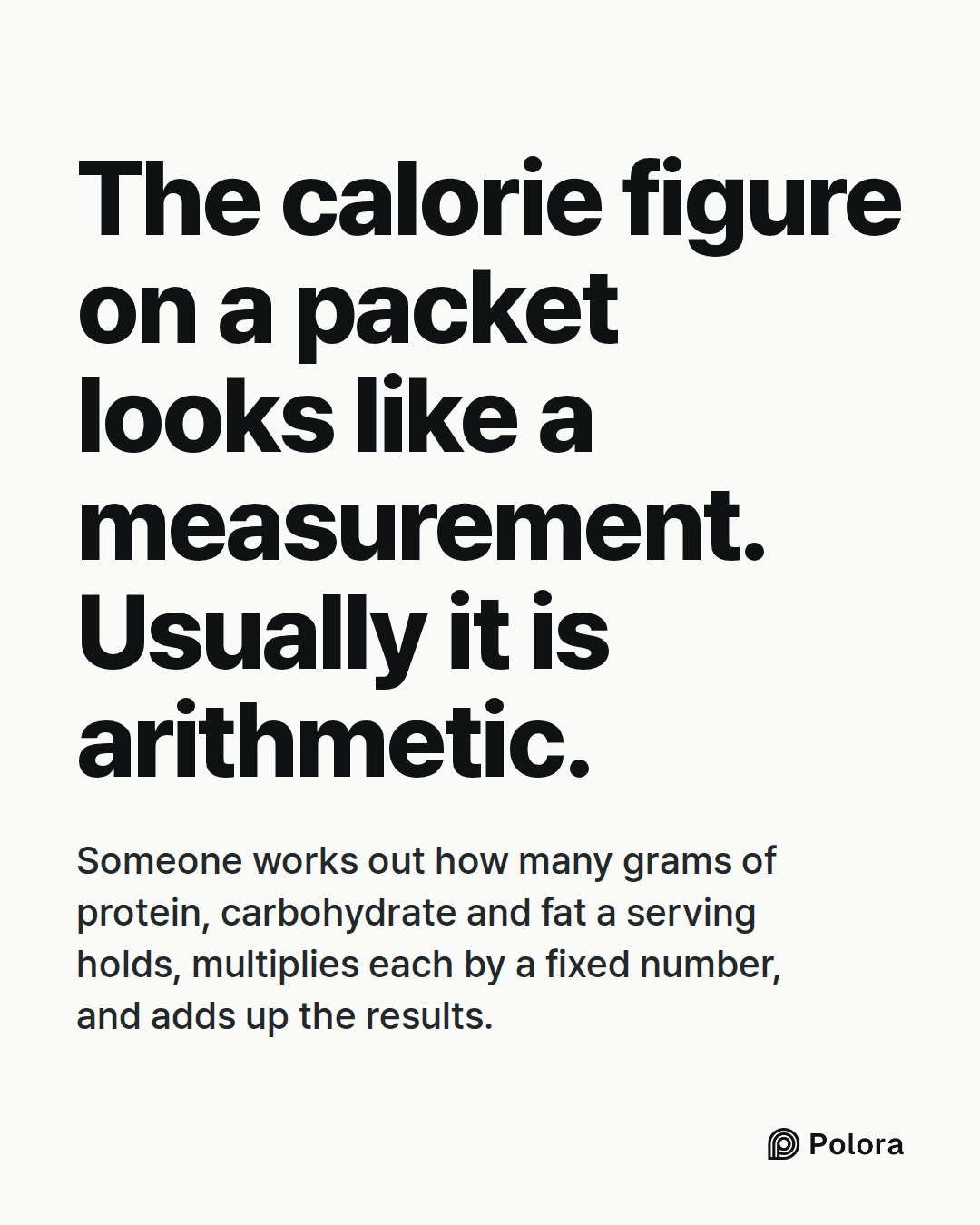
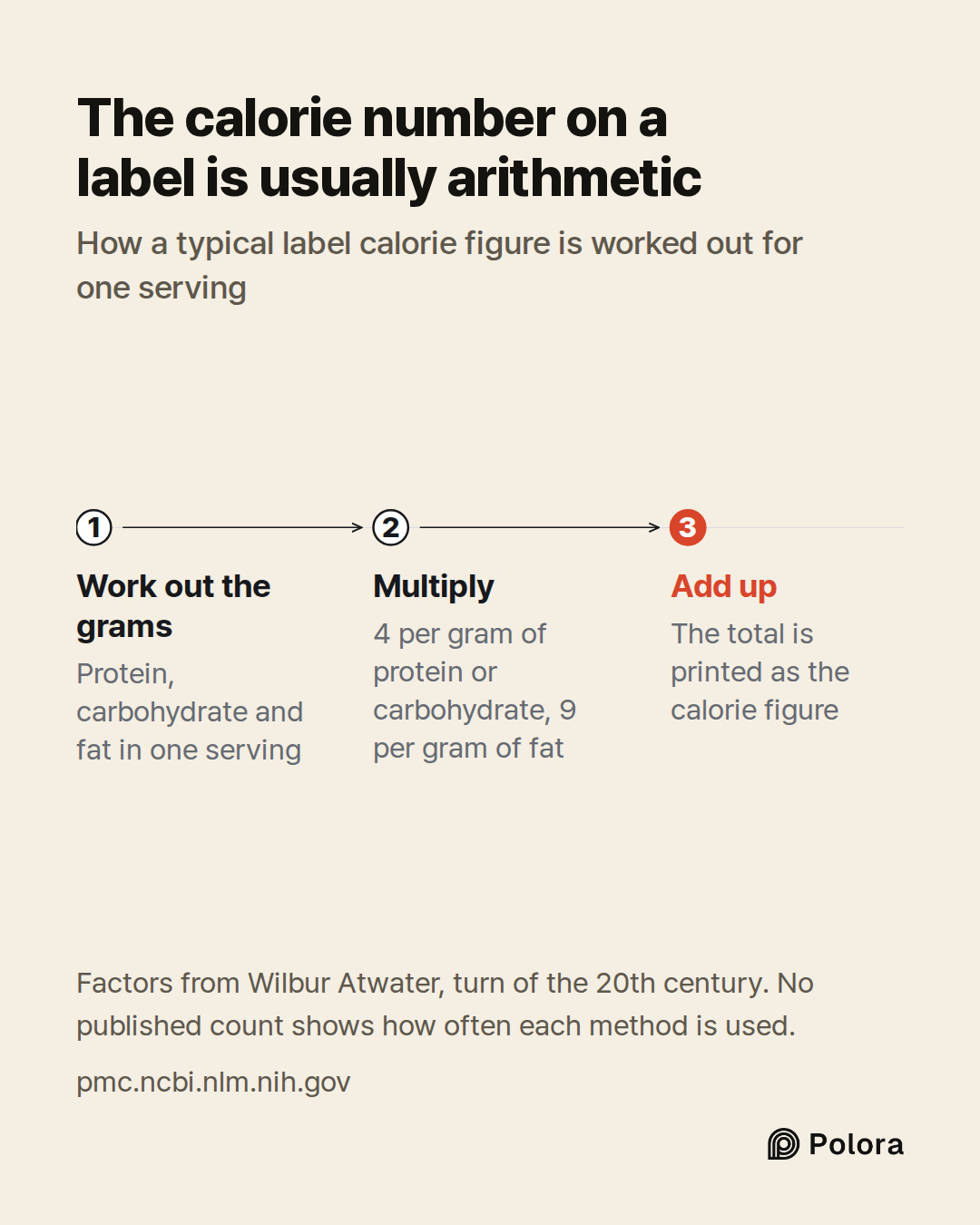
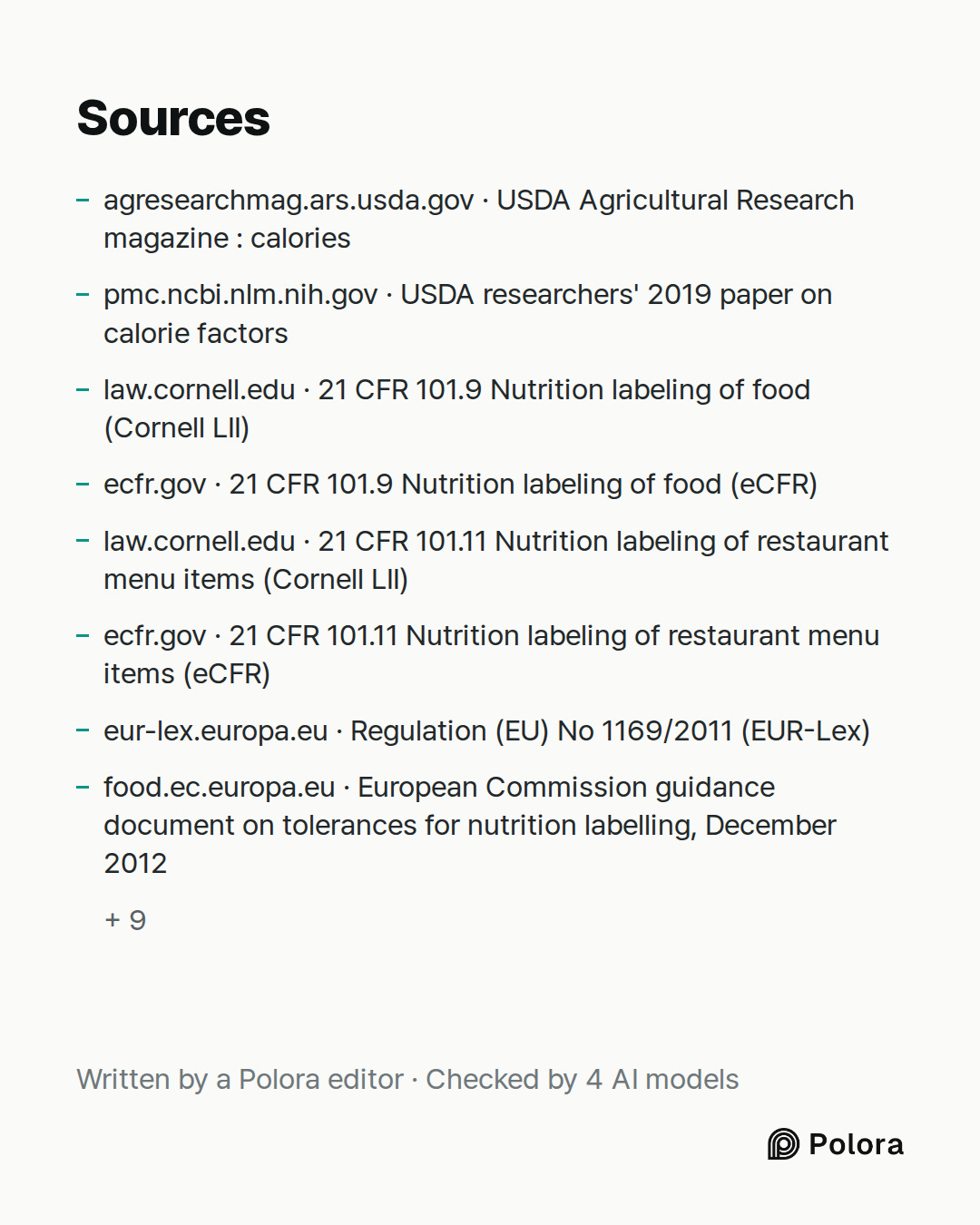
The calorie figure on a packet looks like a measurement. Usually it is arithmetic. Someone works out how many grams of protein, carbohydrate and fat a serving holds, multiplies each by a fixed number, and adds up the results.
The fixed numbers are 4 calories for each gram of protein, 4 for each gram of carbohydrate and 9 for each gram of fat. They come from Wilbur Atwater, an American chemist working around the turn of the 20th century. He fed a mixed diet to a small group of volunteers and measured how much of its energy their bodies kept. A 2019 paper by US Department of Agriculture researchers describes them this way : for over 100 years, these factors have been used to calculate the calorie value typically found on food labels.
Food can also be burned in a sealed steel chamber called a bomb calorimeter, which measures its energy directly. US rules allow that method, as long as 1.25 calories is subtracted for each gram of protein, because the body does not fully use protein. This is one of six ways the rule lists for working out calories. The other five are all ways of calculating, and one of them gives the factors for sugar alcohols.
No published figure shows how many manufacturers use each method. The word "usually" rests on how researchers describe common practice, not on a count.
In the US, a label can say 20 percent too little and still be legal
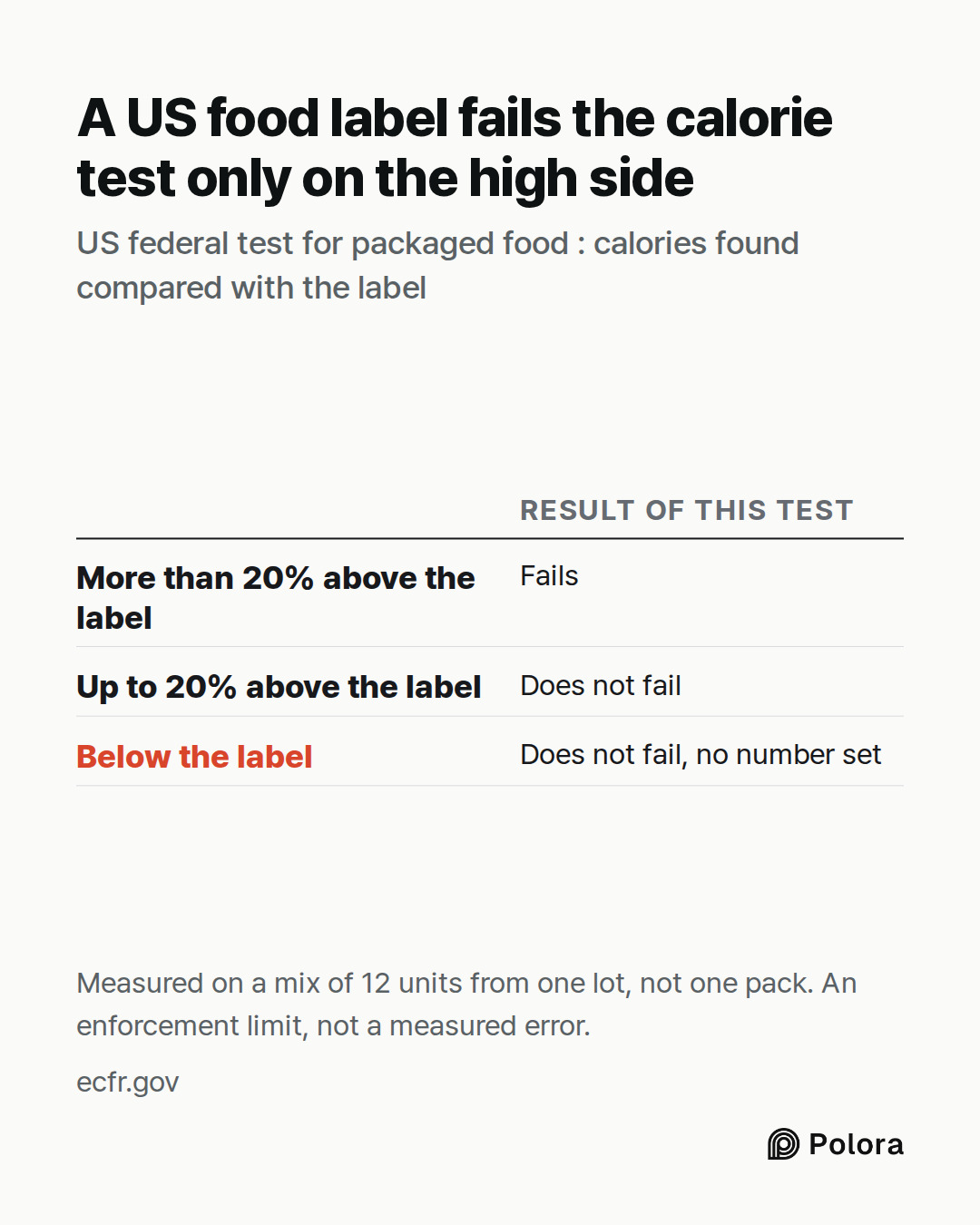
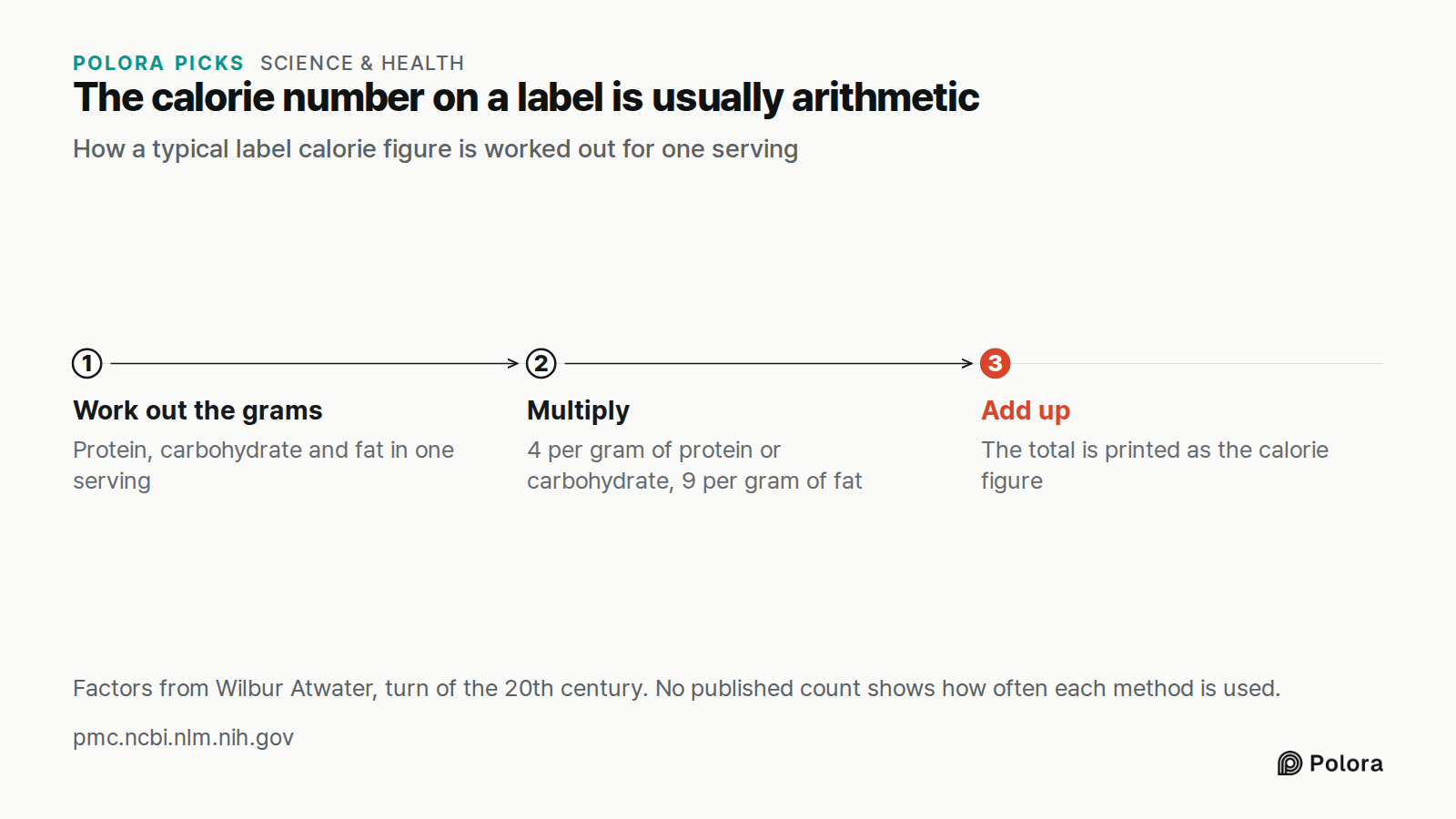
The US federal rule for packaged food sets its own test for calories. A product fails that test when the amount found is more than 20 percent above the amount on the label.
That test does not use a single pack. Inspectors take 12 units from one production lot, each from a different randomly chosen shipping case, mix them, and measure the mix. The rule judges the average of a batch, so it promises nothing about any one pack.
The limit applies in one direction only. Fewer calories than the label declares does not fail this test. The same section says that "reasonable deficiencies" in calories are acceptable within good manufacturing practice, and it gives no number.
The 20 percent is a limit for enforcement. It is not a measured error. It does not mean labels are usually off by that much, and it is not the only labeling rule a product has to meet.
Restaurant menus fall under a separate rule. It asks restaurants to have a "reasonable basis" for their calorie figures, such as nutrient databases, cookbooks or laboratory analysis, and to take reasonable steps so that the food served matches that basis. It sets no percentage tolerance.
In Europe, the calorie figure has to be calculated
In the European Union, the label's energy value is not just usually calculated. The law requires it. Article 31 of the EU's food information regulation says the energy value shall be calculated using the conversion factors in its Annex XIV, and UK government guidance on the regulation says the same. That list gives the same 4, 4 and 9 for protein, carbohydrate and fat, and also covers fibre, alcohol and a few other ingredients. The amounts of those nutrients can come from analysis of the food, from the values of its ingredients or from accepted data.
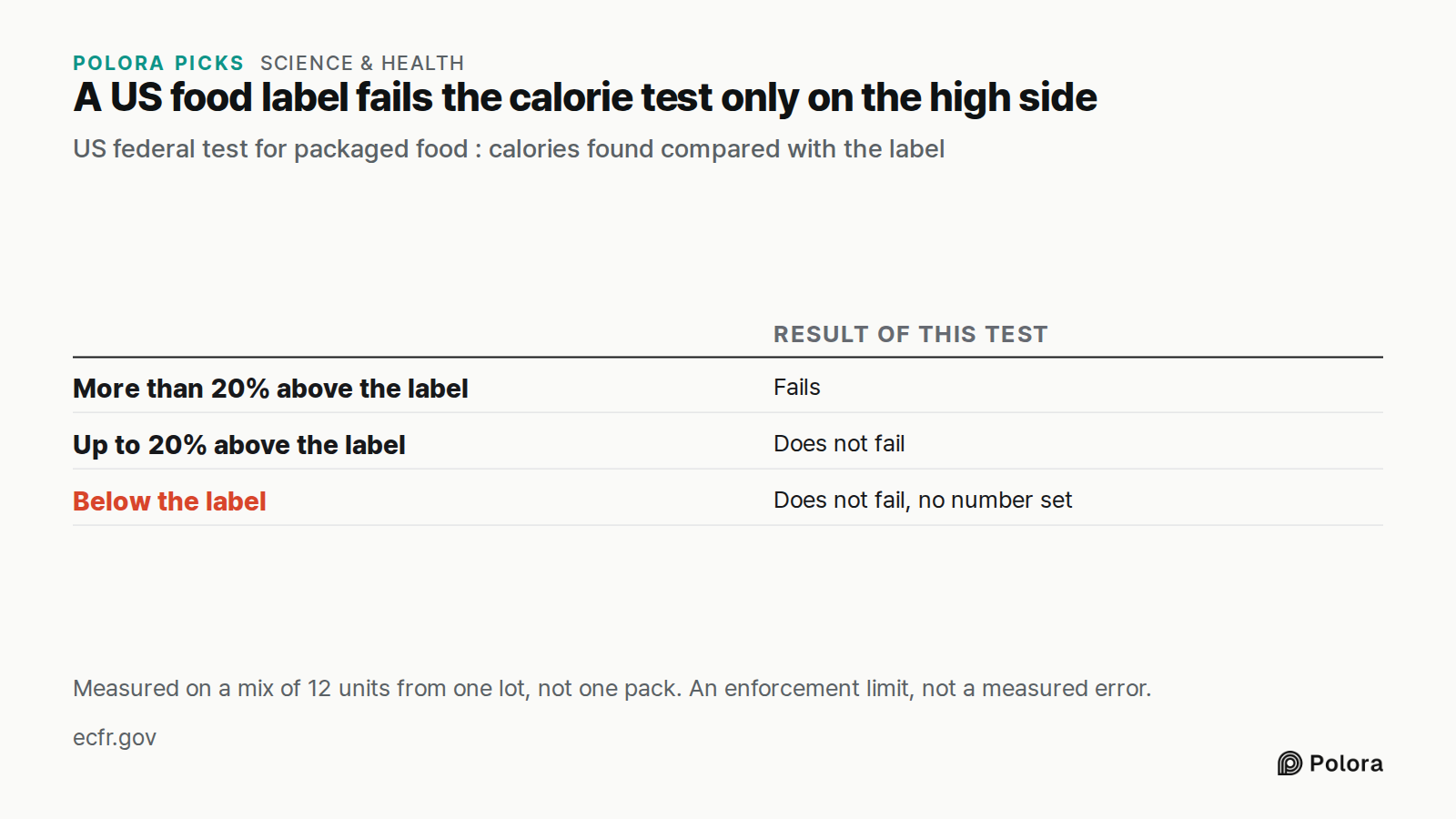
How far the nutrients themselves may drift is set by a guidance document agreed in December 2012 between the European Commission and the member states. The document says it has no formal legal status. Even so, member states are told to take its tolerances into account in their official checks. For fat between 10 and 40 grams per 100 grams, it allows 20 percent either way. Below 10 grams, the margin is 1.5 grams either way, and above 40 grams it is 8 grams either way. Carbohydrate, sugars and protein follow the same three bands, with 2 grams at the low end. The guidance treats declared values as averages, and it warns against deviations large enough to mislead consumers.
The tolerance table has no row for energy. Each nutrient has its own range, and calories themselves have none. Because the calorie figure is calculated from the nutrients, it in effect follows their ranges. The guidance does not say this. It follows from how the figure is calculated.
When researchers burned restaurant food, the averages held and single dishes did not
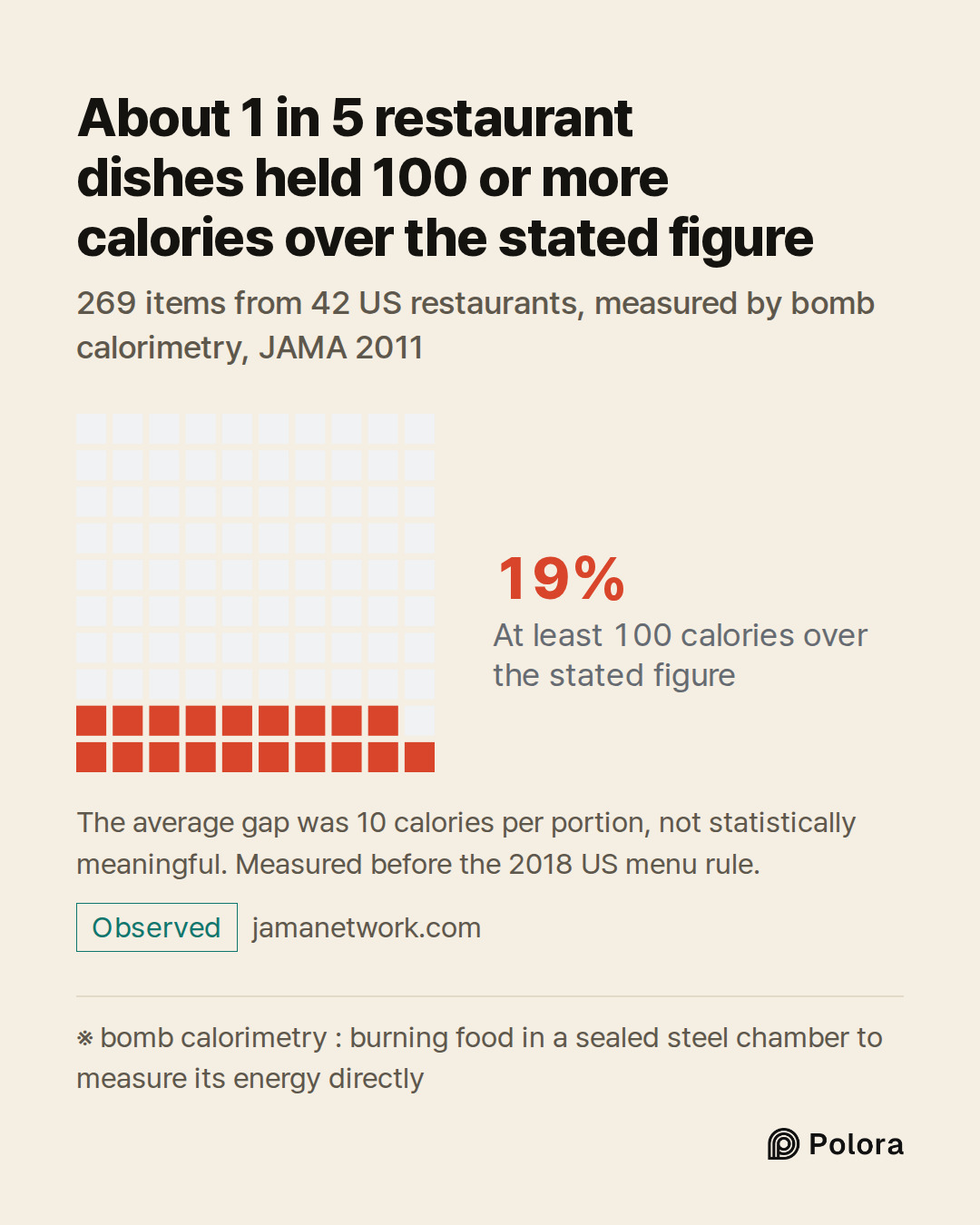
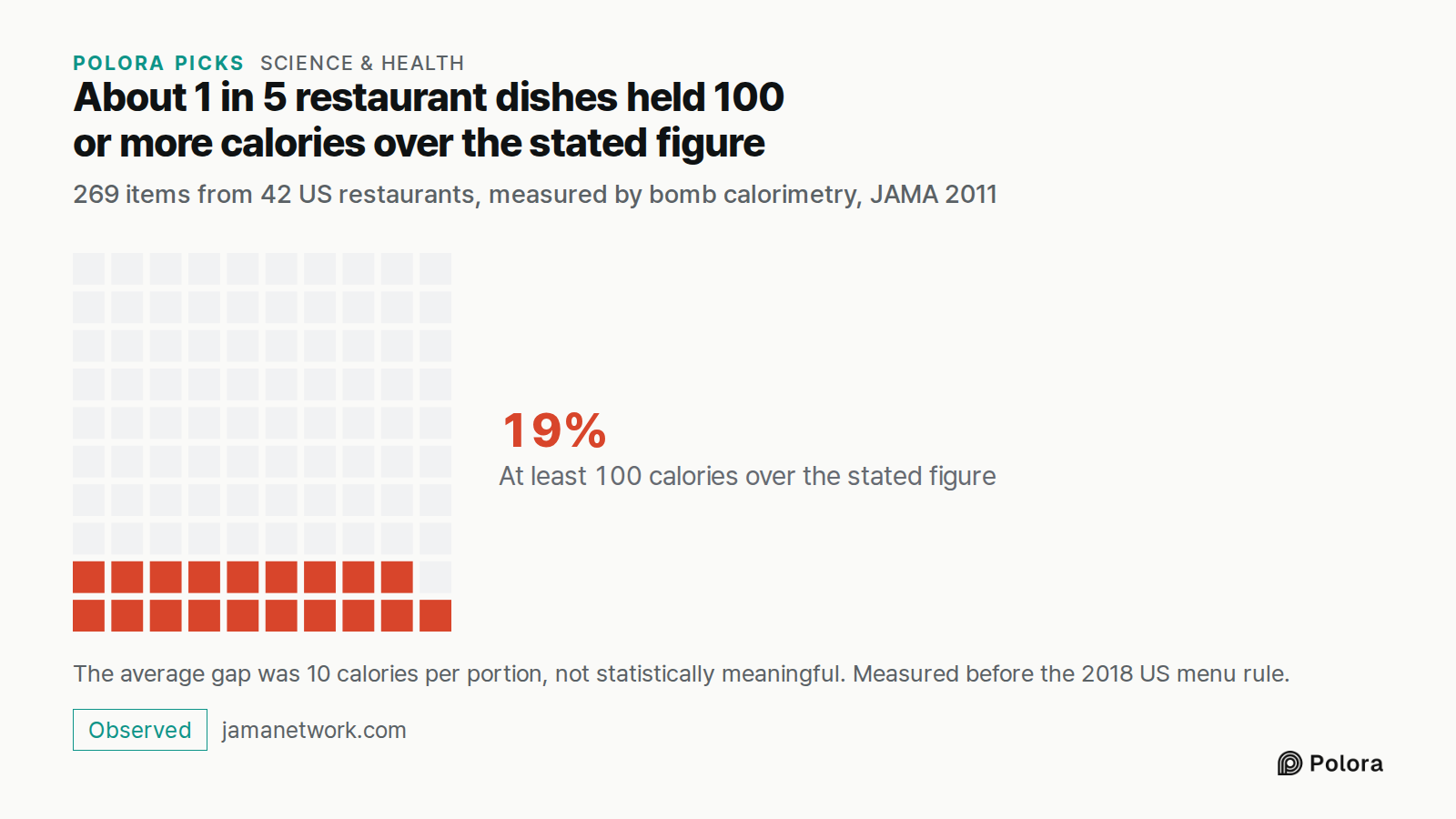
A team at Tufts University bought 269 food items from 42 restaurants in Massachusetts, Arkansas and Indiana and measured them by bomb calorimetry. On average, the measured energy was 10 calories per portion higher than the stated figure. That gap was too small to be statistically meaningful. But 19 percent of the items held at least 100 calories more than stated. The results were published in JAMA in 2011.
An earlier, smaller study by the same team, published in 2010, looked at foods sold as lower in calories : 29 restaurant dishes and 10 supermarket frozen meals from the Boston area. The restaurant foods measured 18 percent above their stated values on average, and the frozen meals 8 percent. Results varied so widely between items that these averages did not reach statistical significance. The authors linked the frozen meals' smaller gap to FDA oversight of packaged labels. They also found that part of the restaurant gap came from servings larger than the portion the restaurants had described.
Both studies came before the federal menu calorie rule. That rule was published in December 2014, and restaurants had to comply from May 2018.
A separate study of 24 packaged snack products found that, once serving weight was accounted for, the median estimated energy the body could use was 4.3 percent above the label.
These are samples of US restaurant and shop food, measured in different ways and reported with different statistics, and the restaurant samples are more than a decade old. They show what was found in those foods. They do not show how far labels in general are off.
- Urban et al., accuracy of stated energy contents of restaurant foods, JAMA 2011
- Urban et al. 2010, restaurant foods and frozen meals (PMC)
- Tufts Now : study examines calorie information in restaurants and packaged foods
- Study of energy in packaged snack foods, Obesity
- Federal Register : menu labeling compliance date
For whole nuts, the formula itself gives too many calories
Everything above asks whether a food matches the figure stated for it. USDA researchers asked whether the formula itself is right. Volunteers ate controlled diets with and without a particular nut, and the researchers measured how much energy the volunteers' bodies actually kept.
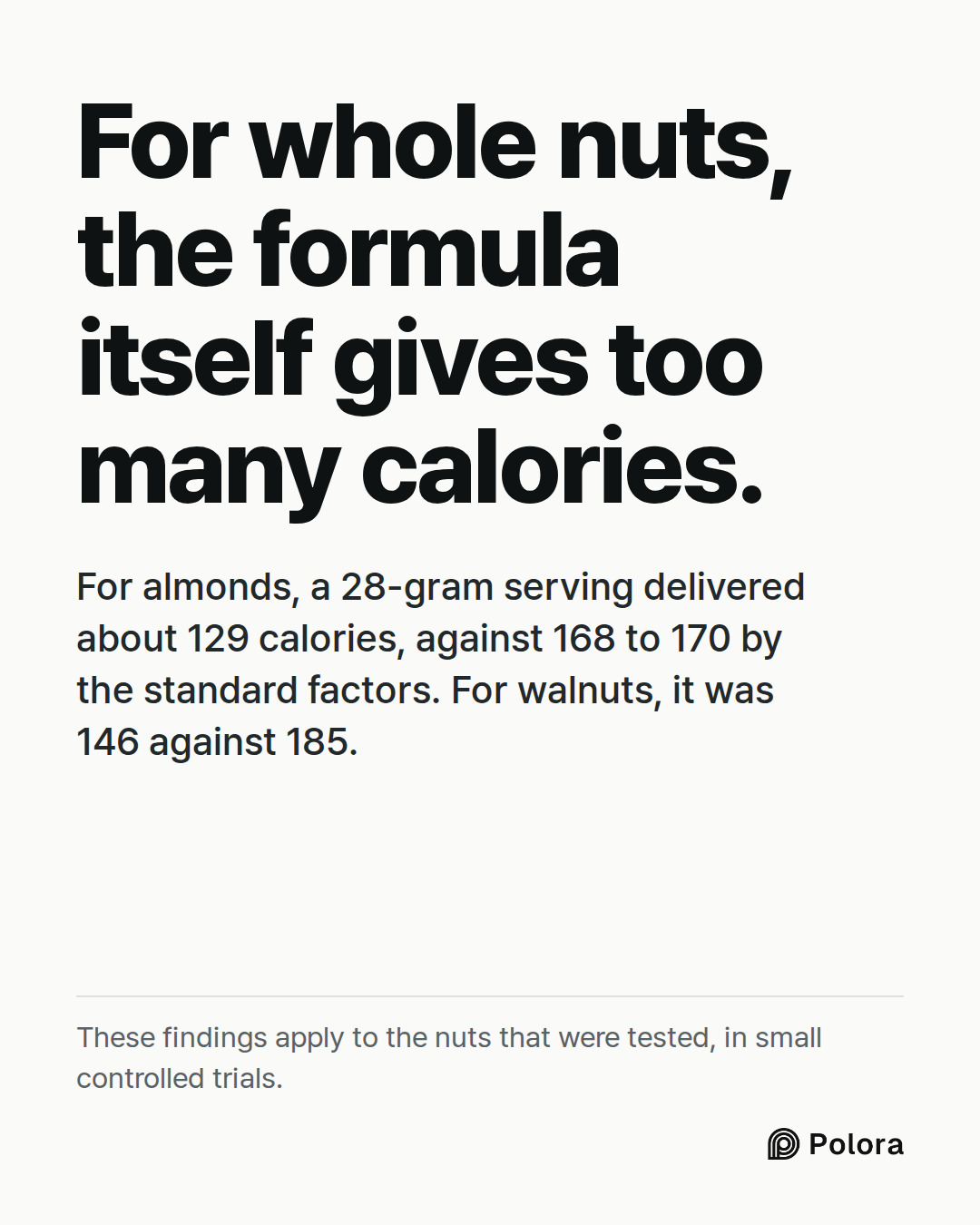
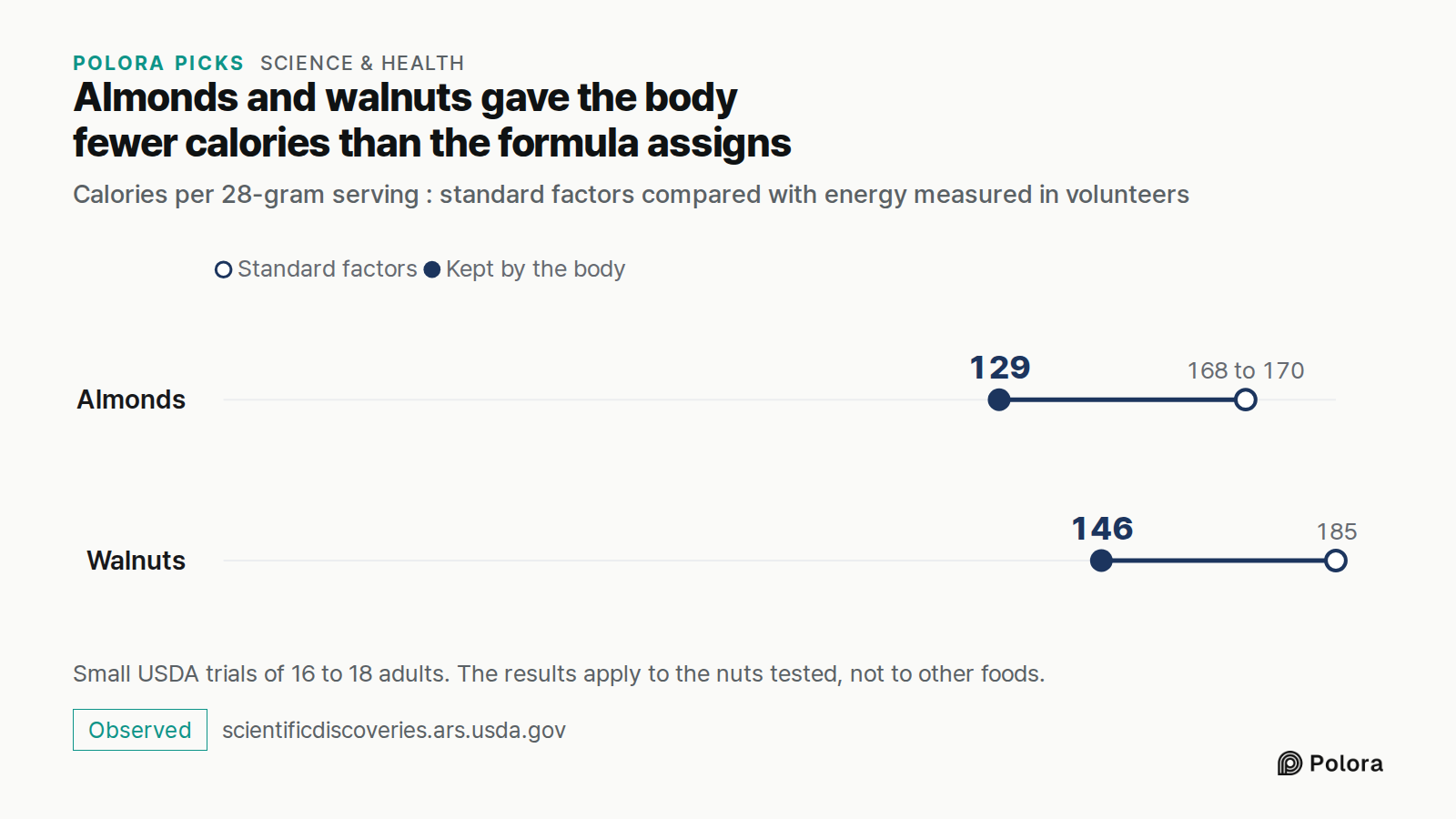
For almonds, a 28-gram serving delivered about 129 calories, against 168 to 170 by the standard factors. For walnuts, it was 146 against 185. Cashews came out at 137 calories per serving, 16 percent below what labels typically show. Pistachios were about 5 percent lower. Each trial had between 16 and 18 adults.
The researchers explain the gap as fat from the nuts that the body did not fully absorb. Processing changed the result too. One almond trial compared its results with Atwater's specific factors for almonds rather than the general 4, 4 and 9. Against those, whole natural almonds were overestimated by 25 percent, whole roasted almonds by 19 percent, and chopped roasted almonds by 17 percent.
These findings apply to the nuts that were tested, in small controlled trials. They do not show that the factors are wrong for other foods.
- USDA ARS : going nuts over calories
- USDA researchers' 2019 paper on calorie factors
- USDA Agricultural Research magazine : calories
- Gebauer et al., effect of almond processing on metabolizable energy, Food & Function 2016
- Baer et al., measured energy value of pistachios in the human diet, British Journal of Nutrition
What the calorie number on a label really is
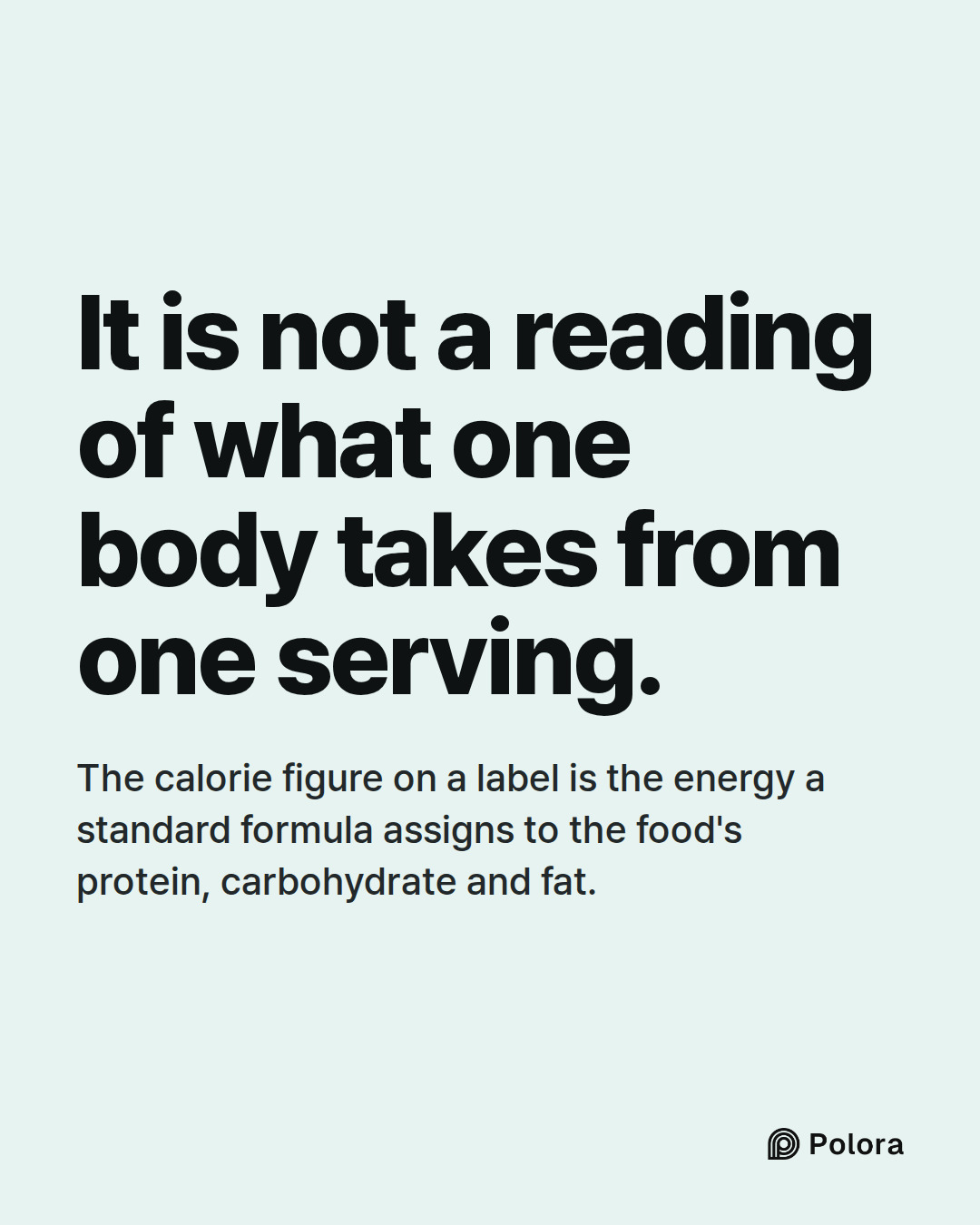
The calorie figure on a label is the energy a standard formula assigns to the food's protein, carbohydrate and fat. It has to fall within a legal range, and in the US that range is stricter on one side than the other. It is not a reading of what one body takes from one serving.
Atwater built his factors from a mixed diet, an average over many foods eaten together. A label applies that average to one food at a time. Where researchers checked, restaurant food matched its stated calories on average, with large misses on single dishes, and some whole nuts gave the body less energy than the formula assigns to them.
A legal limit, a gap found in one study and the energy one body absorbs answer three different questions. None of the evidence here supports a single figure for how far labels are off.