Why is dengue spreading in Florida, and what can spraying do about it?
Not as a routine mainland disease, but as concentrated local outbreaks where its mosquito is already established. Hillsborough County near Tampa declared a seven-day emergency on September 24, 2026 after locally acquired dengue cases passed 170, most of the state's total, and a resident died. The drivers overlap : an urban mosquito that lives in Florida year-round, travelers arriving from large epidemics elsewhere, warm weather that speeds the virus inside the insect, and dense neighborhoods full of small water containers. Spraying, larviciding and traps can slow an outbreak and map it, but they cannot reach every hidden breeding site or resting mosquito, and the emergency order itself mainly speeds funding and logistics. Health authorities, not the article, recommend using repellent, covering skin, keeping screens intact and draining standing water.
Science & Health · 2026-09-27
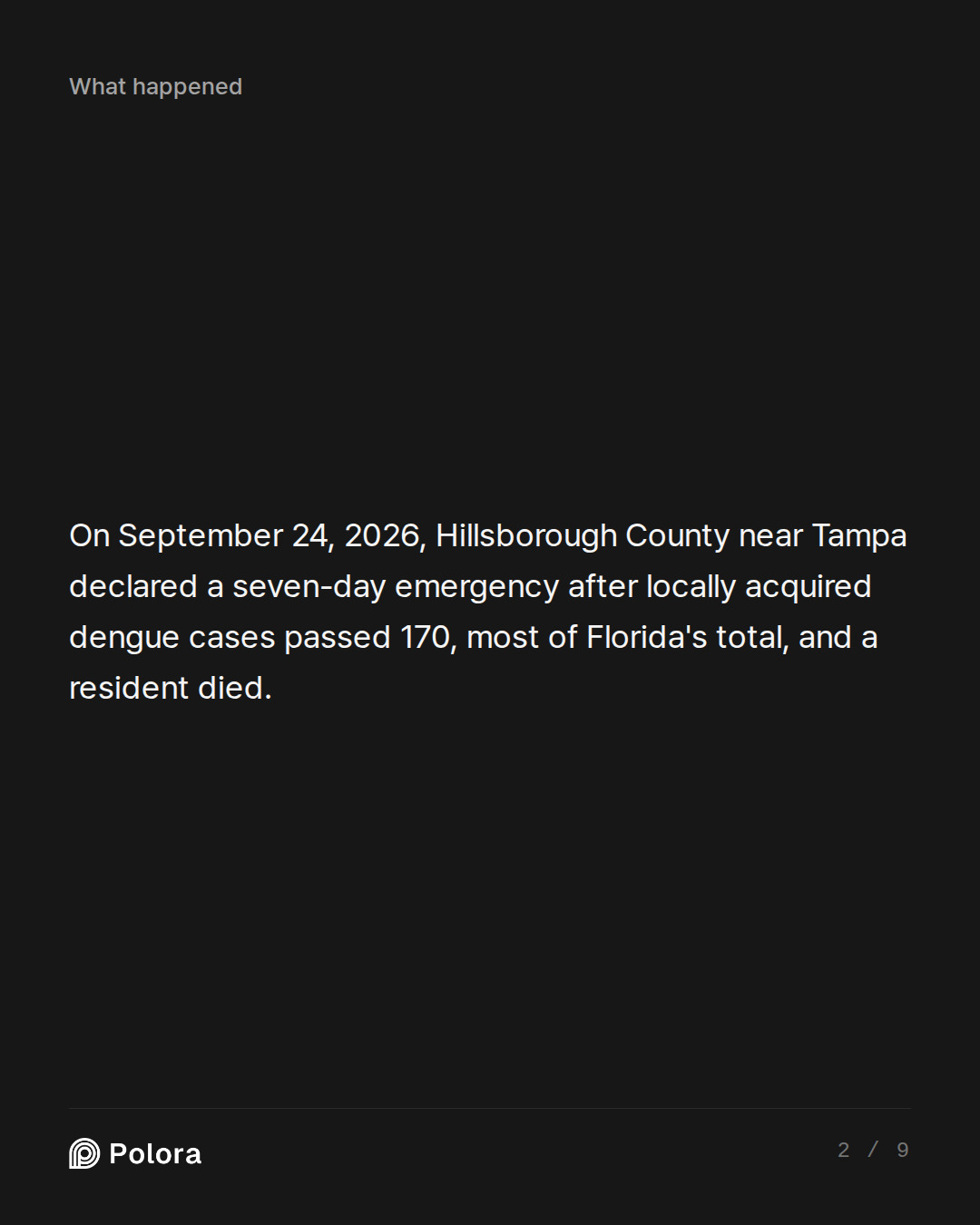
On September 24, 2026, Hillsborough County, the Florida county that contains Tampa, declared a seven-day local state of emergency over dengue fever. By that date it had logged more than 170 locally acquired cases, most of the roughly 190 recorded across the entire state, and a resident in their eighties had died. Locally acquired is the phrase that carries the weight here : these people caught the virus in Florida, not while traveling somewhere tropical.
That reads like a tropical disease arriving on the mainland to stay. It is more precise, and more useful, to see it as a large outbreak in one place where the conditions happened to line up. Polora put the question to several AI models built by different companies and had them work through it together, and they converged on that reading rather than on the idea that dengue has become an everyday hazard across the United States.
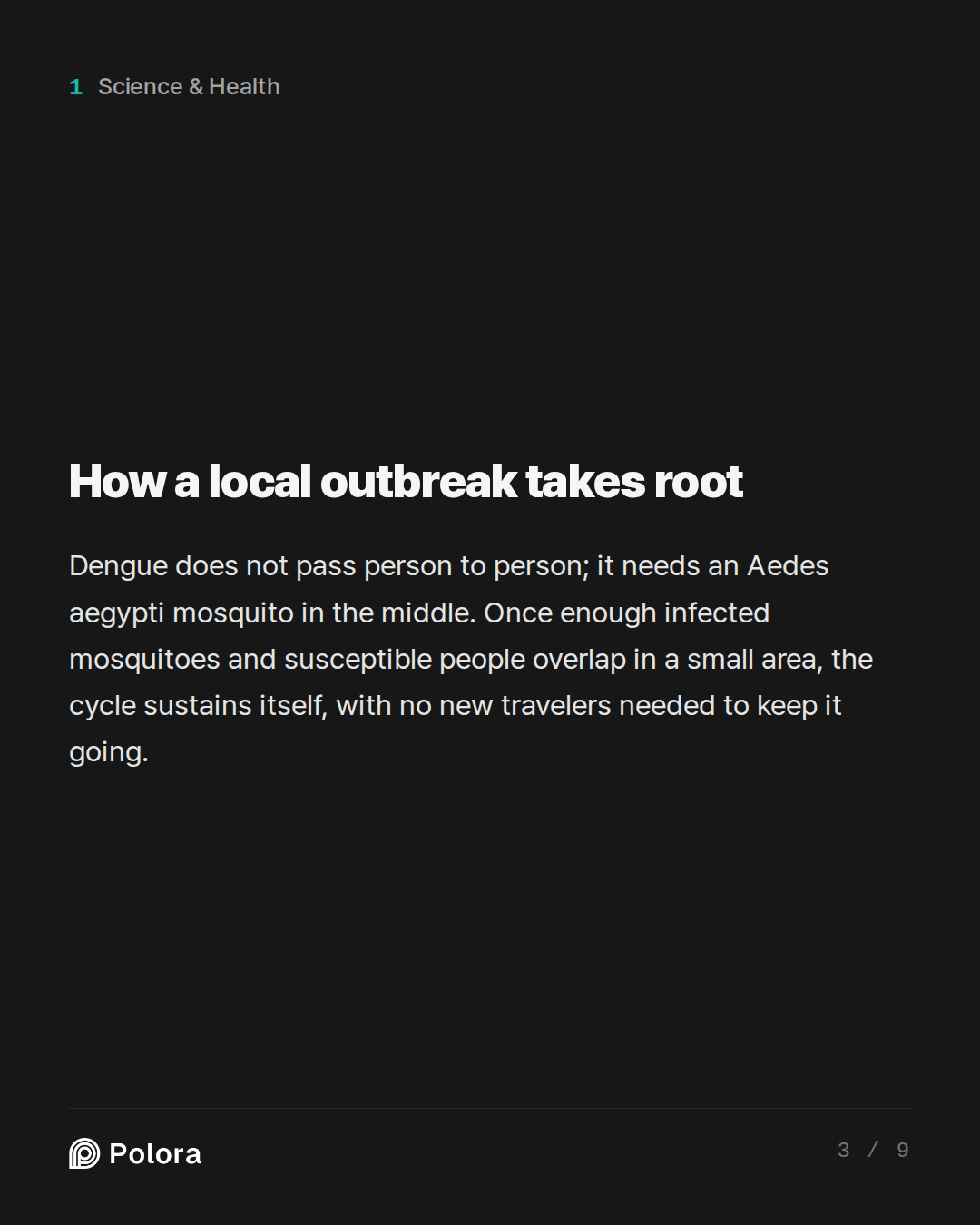
Dengue does not pass from person to person by touch or breath. It needs a mosquito in the middle. Someone with the virus in their blood, often a traveler returning from a region with a large outbreak, is bitten by a local Aedes aegypti mosquito. The virus multiplies inside the insect for several days, reaches its salivary glands, and can then pass to the next person it bites. Once enough infected mosquitoes and susceptible people overlap in a small area, the cycle sustains itself, with no new travelers needed to keep it going.
This particular mosquito is built for city life. It breeds in tiny pockets of clean water near homes, in plant saucers, discarded tires, gutters and buckets, bites during the day, and often rests indoors. It is also hard to count. Because most dengue infections are mild or produce no symptoms at all, the official tally is understood to sit below the true number of people infected.
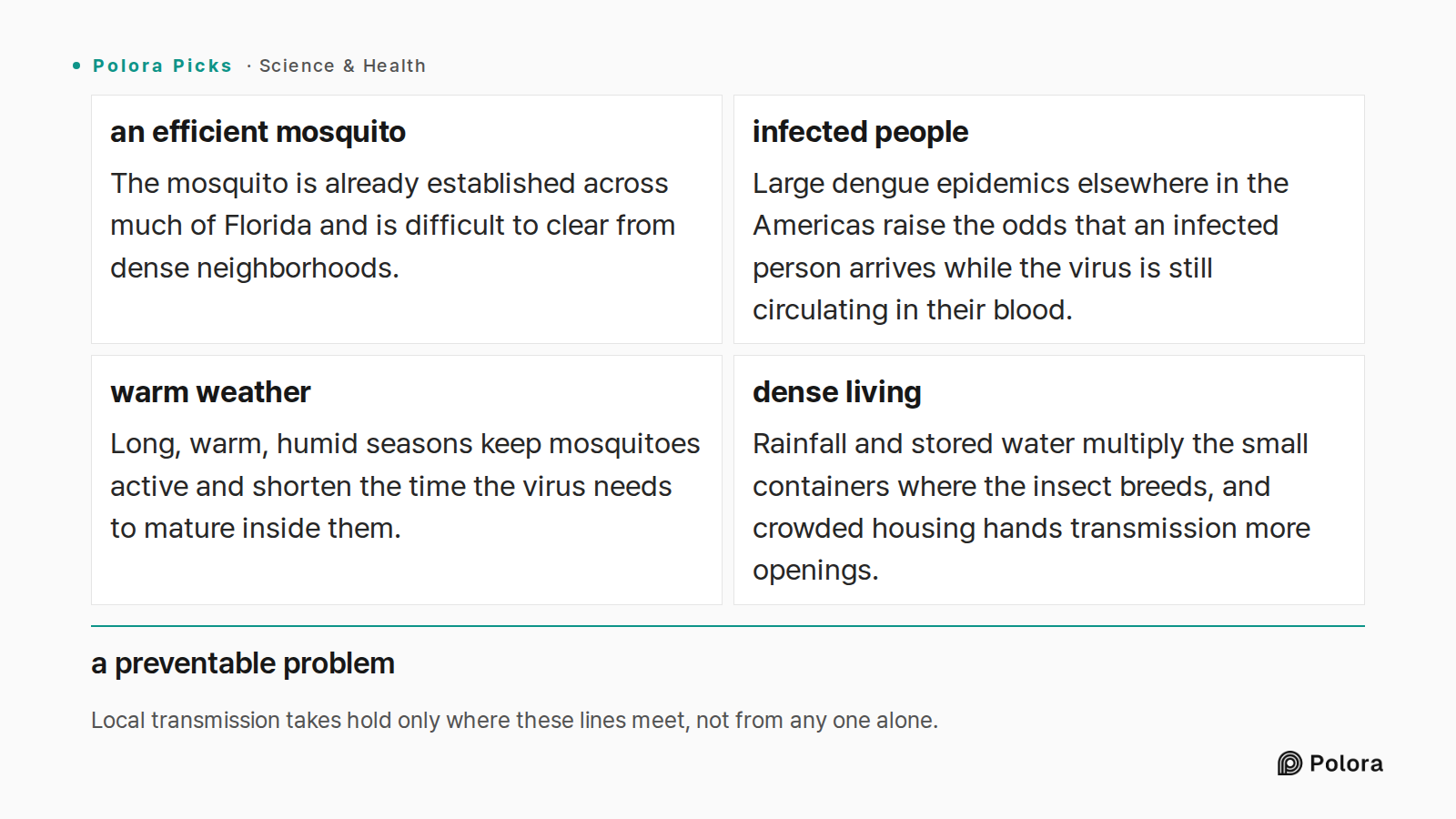
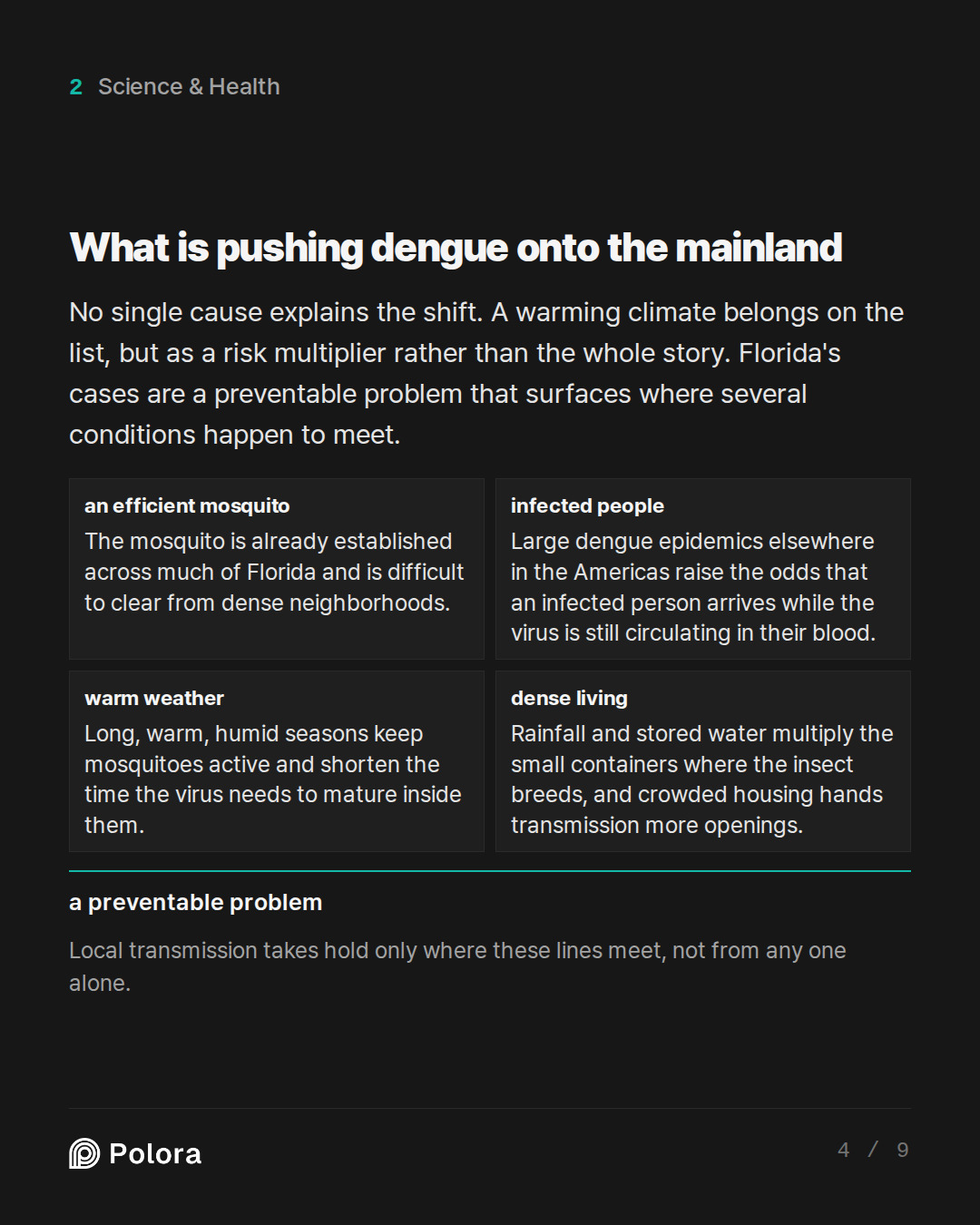
No single cause explains the shift. The models pointed to several factors reinforcing one another. The mosquito is already established across much of Florida and is difficult to clear from dense neighborhoods. Large dengue epidemics elsewhere in the Americas raise the odds that an infected person arrives while the virus is still circulating in their blood. Long, warm, humid seasons keep mosquitoes active and shorten the time the virus needs to mature inside them. Rainfall and stored water multiply the small containers where the insect breeds, and crowded housing hands transmission more openings.
A warming climate belongs on that list, but as a risk multiplier rather than the whole story. It widens the range of places and months where transmission is biologically possible, yet whether that possibility becomes an outbreak still turns on travel, housing, water management and mosquito control. Seen this way, Florida's cases are less a tropical disease marching north and more a preventable problem that surfaces where an efficient mosquito, infected people, warm weather and dense living all meet.
Local transmission takes hold only where these lines meet, not from any one alone. · an efficient mosquito · infected people · warm weather · dense living · The mosquito is already established across much of Florida and is difficult to clear from dense neighborhoods. · Large dengue epidemics elsewhe
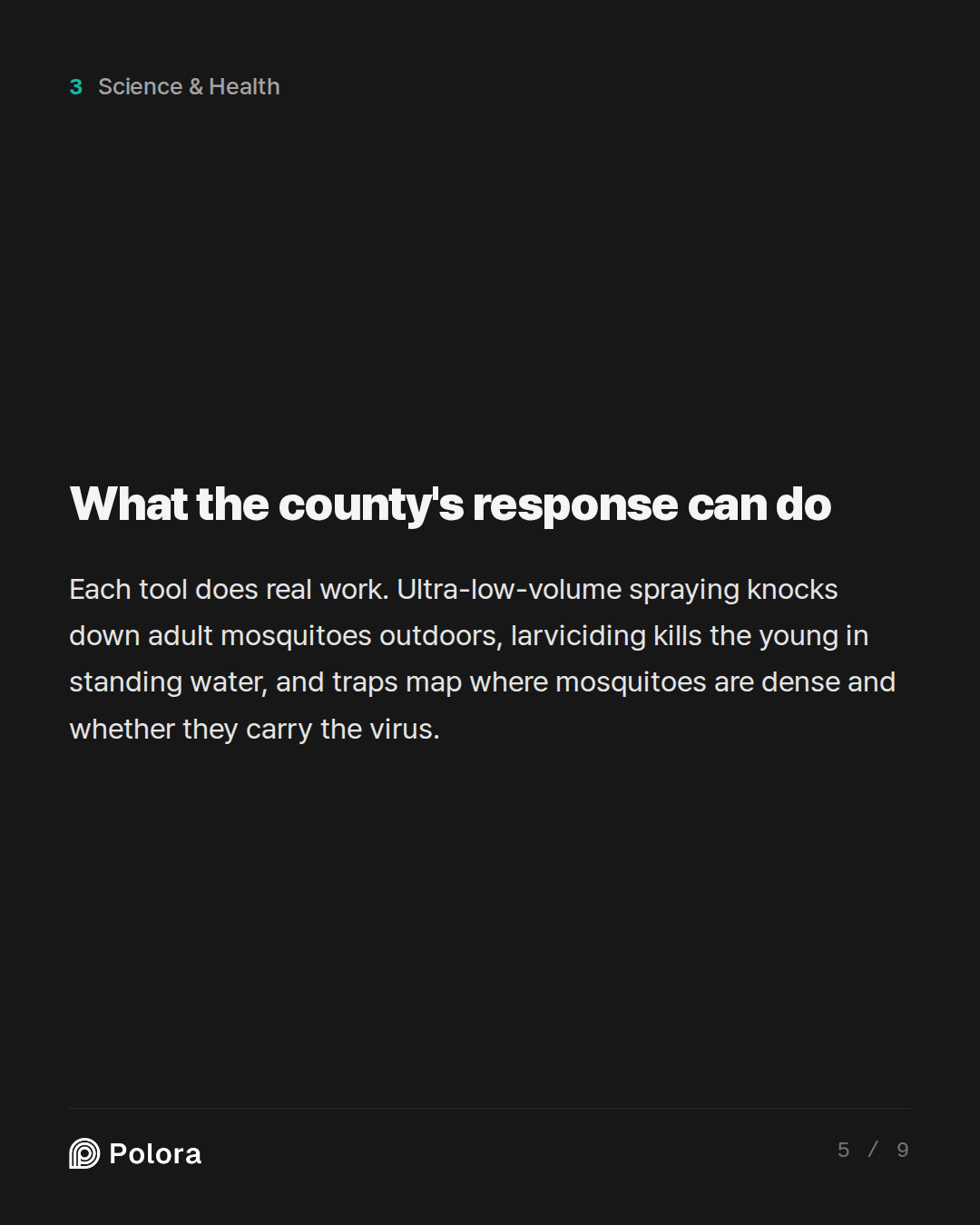
What the county's response can do
Each tool does real work. Aerial and truck-mounted ultra-low-volume spraying releases a fine insecticide mist that can quickly knock down adult mosquitoes flying outdoors and blunt transmission during the sharpest phase of an outbreak. Larviciding treats standing water to kill young mosquitoes before they can fly and bite. Traps such as the BG-Sentinel let officials measure where mosquitoes are dense, find hot spots, and confirm whether the virus is circulating in the insects themselves. Public alerts push residents and clinicians to take dengue seriously, test earlier and clear breeding sites.
※ ultra-low-volume spraying : a method that puts out insecticide as a very fine mist of tiny droplets, using a small amount of chemical to reach flying mosquitoes across a wide area.
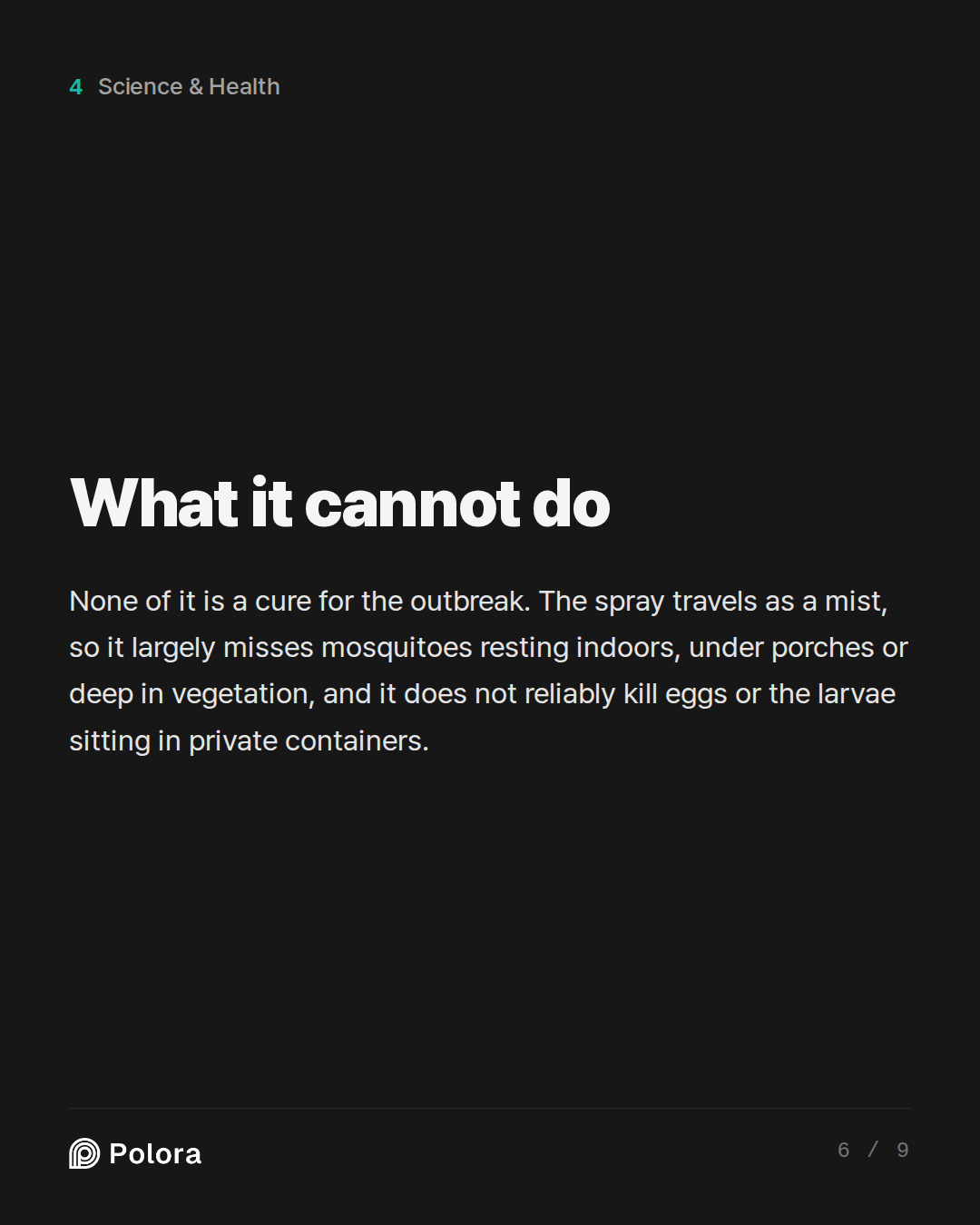
None of it is a cure for the outbreak. The spray travels as a mist, so it largely misses mosquitoes resting indoors, under porches or deep in vegetation, and it does not reliably kill eggs or the larvae sitting in private containers. Fresh adults keep emerging from breeding sites no spray pass ever reached. Traps are for watching, not clearing : a trap network never removes enough mosquitoes to end an outbreak on its own. Alerts raise awareness but do not empty a single bucket.
The emergency declaration itself is often misread. It is mainly an administrative lever. It speeds procurement, frees personnel and equipment, and opens a route to reimbursement for response costs. It runs for seven days unless extended or rescinded. It kills no mosquitoes. The participants' shared conclusion was that the response only works as layers stacked together : surveillance, targeted spraying, draining standing water, alert clinicians and cooperating residents.
The personal advice here comes from Florida health authorities and the CDC, not from this article, and they frame it around a simple pair of words, drain and cover. They ask residents to drain or manage standing water around the home each week, since the mosquito breeds in small containers rather than swamps. They advise using an EPA-registered insect repellent, such as one containing DEET or picaridin, exactly as its label directs, and wearing clothing that covers exposed skin when practical. They recommend keeping doors shut and window screens intact so the mosquito stays outside.
They also urge anyone with a sudden high fever, severe headache, pain behind the eyes, muscle or joint pain, rash or vomiting to seek medical care and to mention possible mosquito exposure, so that dengue is considered rather than overlooked.
The honest summary is that dengue's mainland risk is real but uneven. Florida's mosquitoes and its steady flow of international travel can sustain local transmission, and a warming climate makes more such episodes plausible over time. What the Hillsborough outbreak does not show is dengue turning into an everyday danger everywhere in the country.
For a reader far from Tampa, the useful lesson is where the risk actually lives. It concentrates in specific places where the right mosquito is established and the virus keeps arriving. There, control can slow an outbreak but cannot switch it off, which means the work that prevents the next one is the unglamorous kind, done between emergencies as much as during them.
Hillsborough County, Florida declared a seven-day state of emergency on September 24 after locally acquired dengue cases passed 170, the highest in the state, around the same time Florida recorded a dengue death. Explain, for a general reader, how a mosquito-borne disease long thought of as tropical is now taking hold on the US mainland, what is driving the shift, and what the county's response (aerial and ground spraying, trapping, alerts) can and cannot do. Present any personal precautions strictly as what health authorities recommend, not as instructions from the article.
Epidemiological Analyst · gemini-3-8-flash
The Mechanics of Local Transmission: How Dengue Takes Root
For decades, dengue virus in the continental United States was primarily understood as an "imported" illness—contracted by international travelers visiting endemic zones in Latin America, the Caribbean, or Southeast Asia, and diagnosed upon their return. The situation in Hillsborough County, Florida—where an executive declaration established a local state of emergency on September 24 following more than 170 locally acquired cases and the confirmed death of an 80-year-old resident—represents an epidemiological transition from isolated travel cases to sustained local transmission.
Sustained local transmission requires a precise biological triad:
1. Sufficient viral introduction: Repeated importation of the virus by infected humans returning from regions with surging epidemics.
2. Competent vector populations: Dense populations of *Aedes aegypti* (the primary vector) and *Aedes albopictus* (the Asian tiger mosquito).
3. The extrinsic incubation cycle: When a female *Aedes* mosquito bites an infected human during their viremic phase, the virus must replicate within the insect's midgut, disseminate through its…
Public Health Communications Specialist · gpt-5.6-terra
The analyst’s biological explanation is broadly sound. My communication caution is that this should be framed as a serious, unusually large local outbreak—not evidence that dengue has suddenly become routine everywhere in the continental United States.
On September 24, 2026, Hillsborough County declared a local emergency effective that day; under Florida law and the county’s order, it lasts up to seven days unless rescinded or extended. The declaration chiefly gives officials faster emergency-management authority and a route to seek reimbursement for eligible response costs—it is not, by itself, a disease-control measure. At that point, Florida’s reported locally acquired cases were concentrated overwhelmingly in Hillsborough: 170 of 190 statewide. (hcfl.gov)
How dengue becomes locally established
Dengue is not spread directly from casual person-to-person contact. The usual cycle is:
1. A person infected elsewhere—or already infected locally—has virus in their blood.
2. A local *Aedes* mosquito bites that person.
3. After the virus d…
Researcher · gemini-3-8-flash
Fact-Checking & Ground Truth Verification
Both debaters accurately convey the biology and local response, but examining the live record confirms the details of the local order, state case counts, and recent mortality findings.
---
1. Hillsborough Emergency Declaration and Timeline
* Claim: Hillsborough County Administrator Bonnie Wise declared a 7-day local state of emergency on September 24 under Chapter 252 of Florida Statutes. Neighboring counties (Pinellas and Pasco) enacted similar proactive emergency orders.
* Status: Confirmed. The executive order was signed September 24. Under Florida law, a county declaration lasts seven days unless extended or rescinded. The primary legal utility of this declaration is administrative expedience—authorizing emergency vector management operations, accelerating procurement, and positioning the municipality for potential federal or state disaster cost reimbursements.
* Source: Hillsborough County Government Newsroom; WUSF News.
---
2. Case Counts and Geographical Concentration
*…
The Arbiter · gpt-5.6-luna
Round summary
Both participants agree that Hillsborough County’s event is an unusually large, concentrated outbreak—not evidence that dengue has become routine throughout the continental United States.
- How local transmission works: The virus is generally introduced by an infected traveler or another infected person. A local *Aedes* mosquito bites that person, the virus multiplies inside the mosquito, and a later bite infects someone else. Repeated human–mosquito–human transmission can then continue locally. Asymptomatic or mild infections mean reported cases likely understate spread.
- Why the risk is increasing: The relevant factors are overlapping rather than a single cause: established *Aedes aegypti* populations adapted to urban neighborhoods; increased travel and large dengue epidemics elsewhere in the Americas; warm, humid conditions that support mosquito activity and can speed viral development; rainfall and abundant small water containers; and dense housing and water-management conditions. Warming is best described as a risk multiplier, not a complete explanation.
- What the county response can do: Aerial and truck-mounted ultra-low-volume spraying ca…
The Arbiter's Final Verdict · gpt-5.6-luna
Dengue is not becoming a permanent, uniformly widespread disease across the mainland United States, but conditions are making local outbreaks more plausible in places where its mosquito vectors are established. Hillsborough County’s September 2026 outbreak illustrates that change.
How local transmission begins
Dengue virus is usually introduced by someone infected elsewhere, often a traveler or a person arriving from an area experiencing a large outbreak. In Florida, an infected *Aedes aegypti* mosquito can bite that person, acquire the virus, and later transmit it to other people. If enough infected mosquitoes and susceptible people are present, transmission can continue locally without every case being travel-related.
The mosquitoes involved are well adapted to urban neighborhoods. They can breed in small amounts of water—such as containers, tires, gutters, and flowerpot saucers—and may rest in sheltered or indoor locations. Because dengue infections can be mild or asymptomatic, surveillance counts may not capture every infection.
Why the risk is increasing
Several factors reinforce one another:
- Established mosquito populations: *Aedes aegypti* is already…