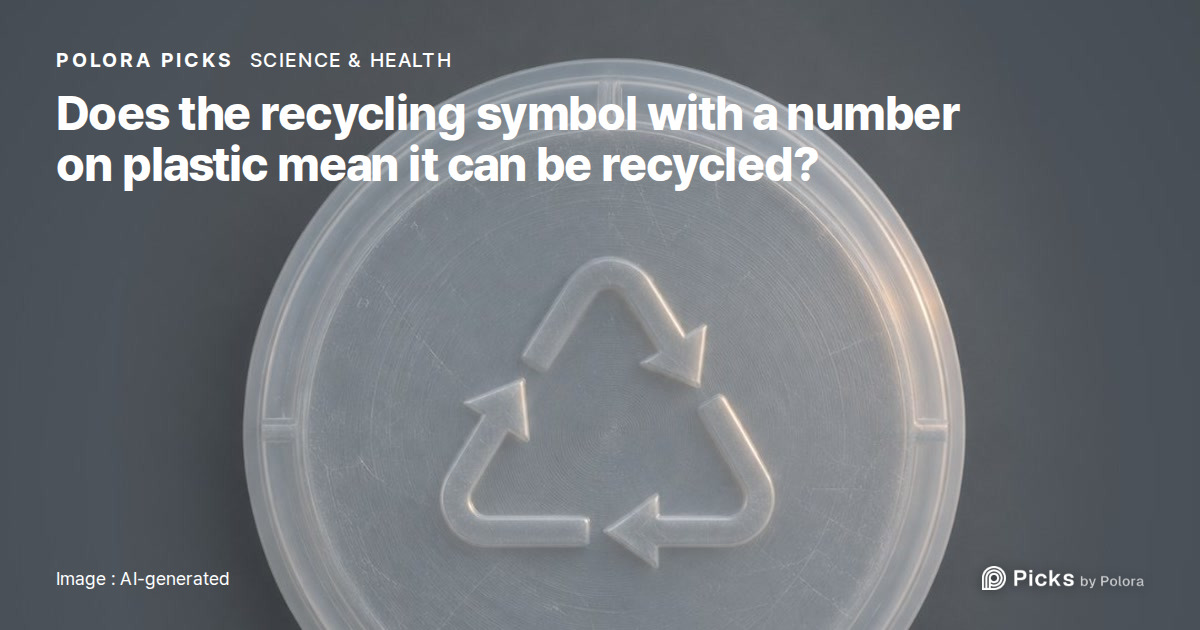
Does the recycling symbol with a number on plastic mean it can be recycled?

No. The number inside the little arrows only names the type of plastic, from 1 to 7. It says nothing about whether anyone will recycle the item. Even the most recycled US kinds, #1 drink bottles and #2 milk jugs, were recycled at about 29% in EPA's latest full count, for 2018.

Science & Health · 2026-11-13

The little arrows on plastic do not mean recyclable

Turn over a yogurt tub, a water bottle or a takeaway lid and you will usually find three arrows chasing each other around a number. Most people read it the way it looks : this goes in the recycling bin.

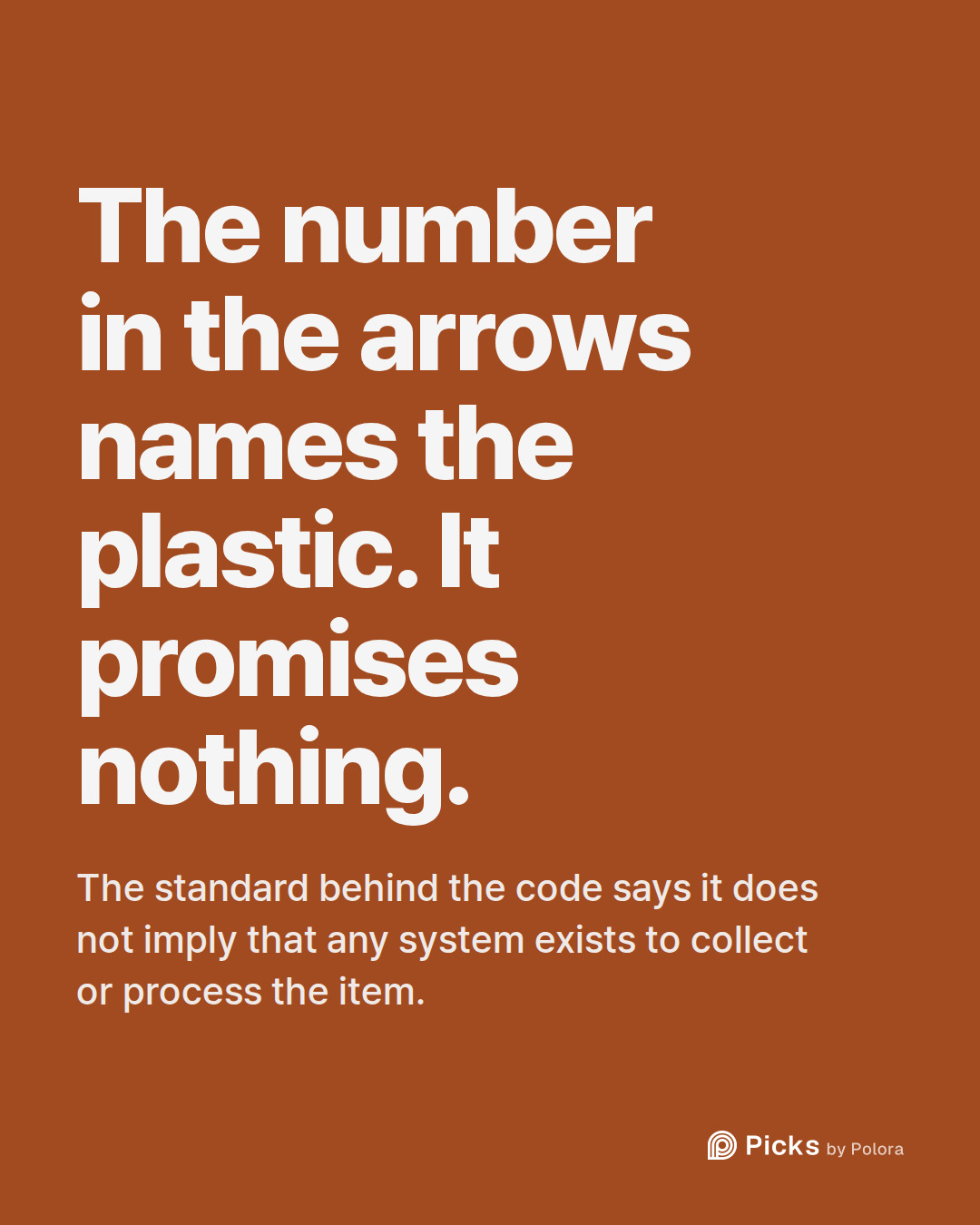
That is not what it says. The number tells you which kind of plastic the item is made of. That helps the people who sort plastic, but it promises nothing. The standard behind the code says it does not imply that any system exists to collect or process the item. Whether anyone collects that plastic, sorts it and turns it into something new is decided somewhere else entirely, by the plant your local collector sends it to and by whether someone will buy what comes out.

An industry label that borrowed the recycling loop

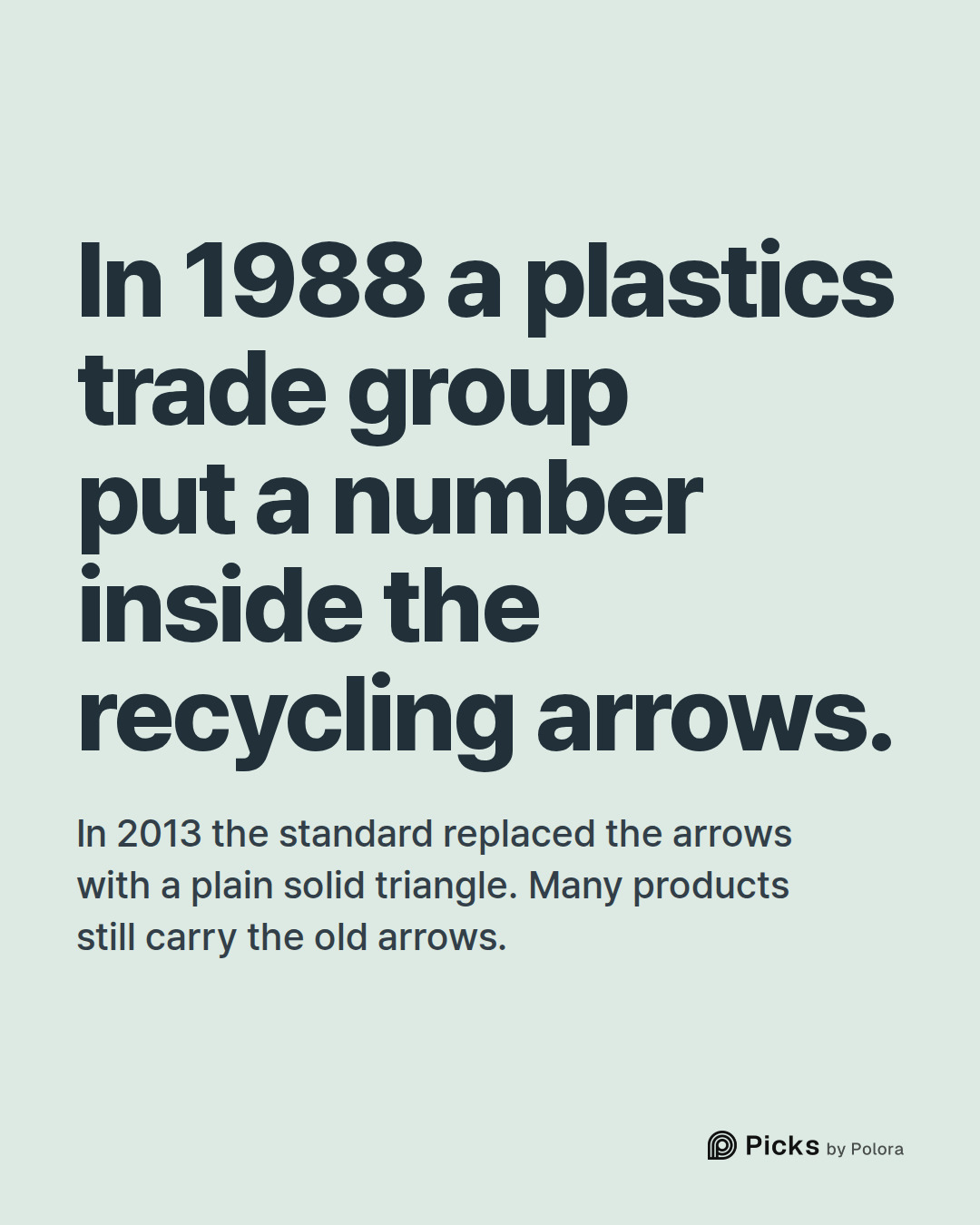
The code was created in 1988 by the Society of the Plastics Industry, a US trade group. Its stated aim was to make used plastic easier to recycle by telling sorters what each item was made of. To do that, it put a digit inside the three-arrow loop that people already knew as the recycling sign.

In 2008, ASTM International, a body that writes technical standards, took over the code, and it now lives in a standard called D7611. In 2013 a revision replaced the chasing arrows with a plain solid triangle, so that the code would stop suggesting recycling, the very confusion this article is about. The standard was revised again in July 2026. Many products still carry the old arrows, because the standard does not require existing moulds to be changed.

ASTM itself is clear about this. The code is there to identify what resin an item is made of, not to say whether the product is recyclable.

What the numbers 1 to 7 actually name

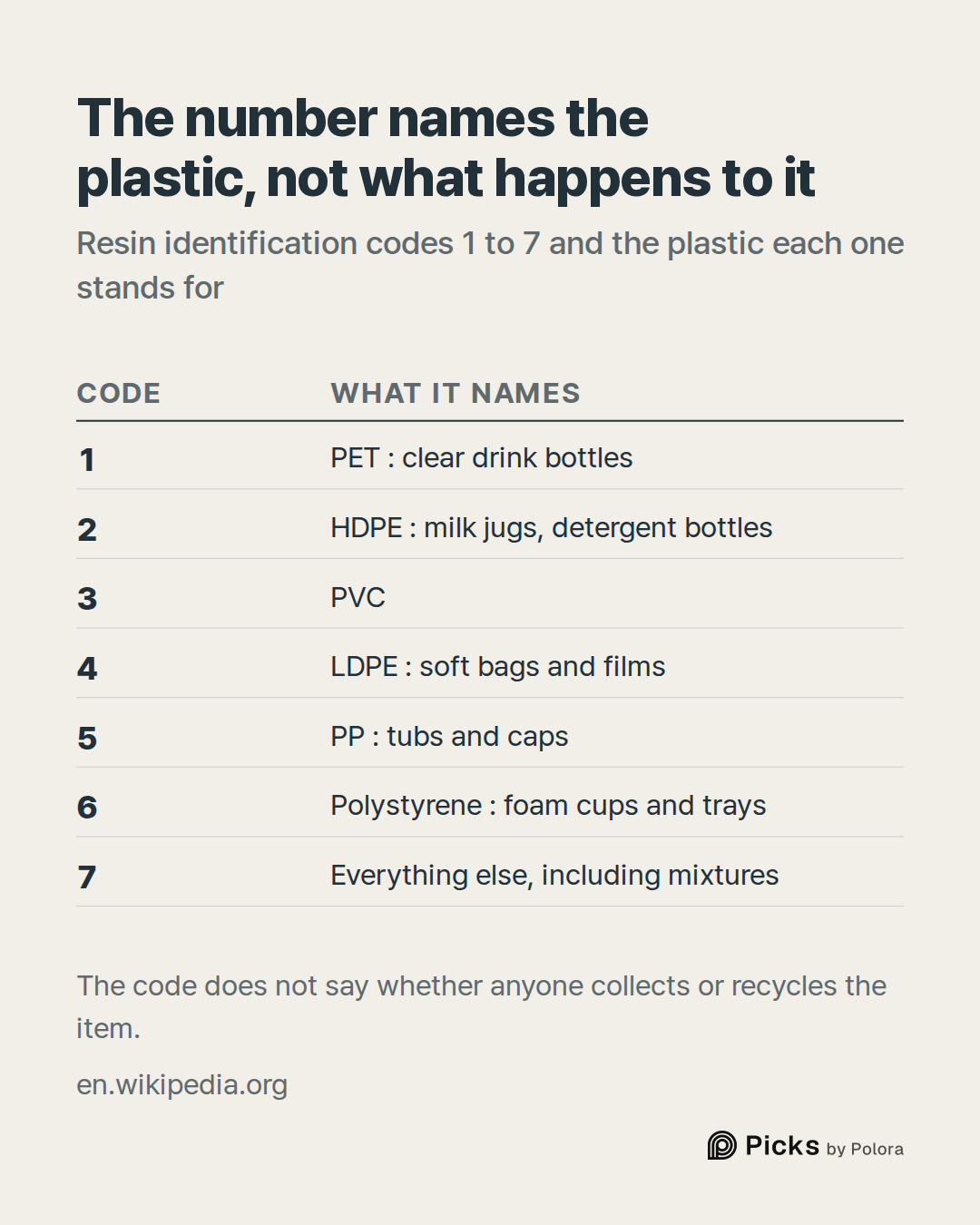
1 is PET, the clear plastic of most drink bottles. 2 is HDPE, the stiffer plastic of milk jugs and detergent bottles. 3 is PVC. 4 is LDPE, the soft plastic of bags and films. 5 is PP, common in tubs and caps. 6 is polystyrene, the foam of cups and trays. 7 means everything else, including mixtures.

So 7 is not a seventh kind of plastic. It is a drawer for whatever does not fit the first six, which is why on its own the number tells a sorting plant very little about what the item is.
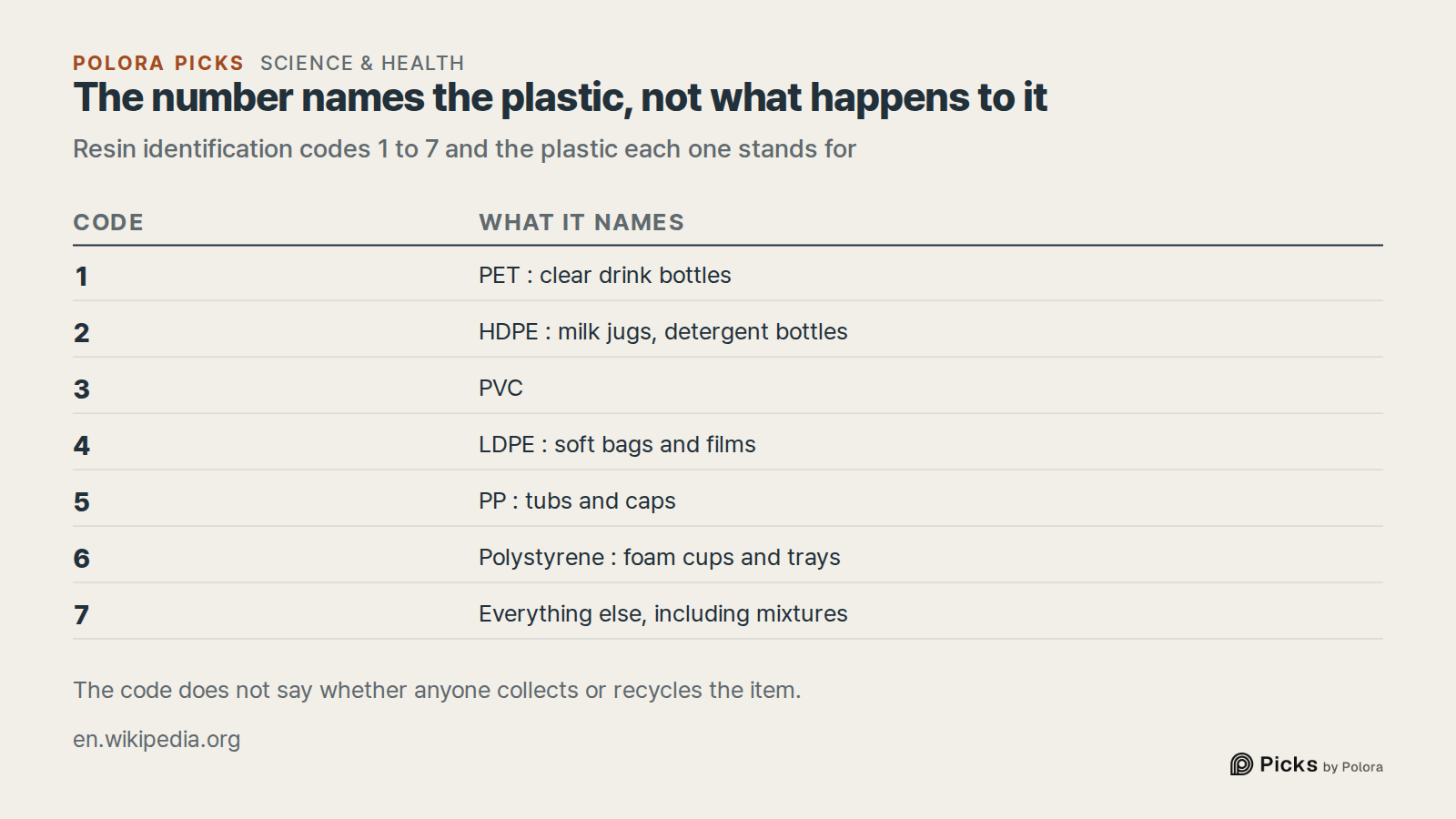
The number names the plastic, not what happens to it · Resin identification codes 1 to 7 and the plastic each one stands for · Code · What it names · 1 · 2 · 3 · 4 · 5 · 6 · 7 · PET : clear drink bottles · HDPE : milk jugs, detergent bottles · PVC · LDPE : soft bags and films · PP : tubs and caps ·
Resin identification codes 1 to 7 and the plastic each one stands for

Even the best-recycled plastics come back about three times in ten

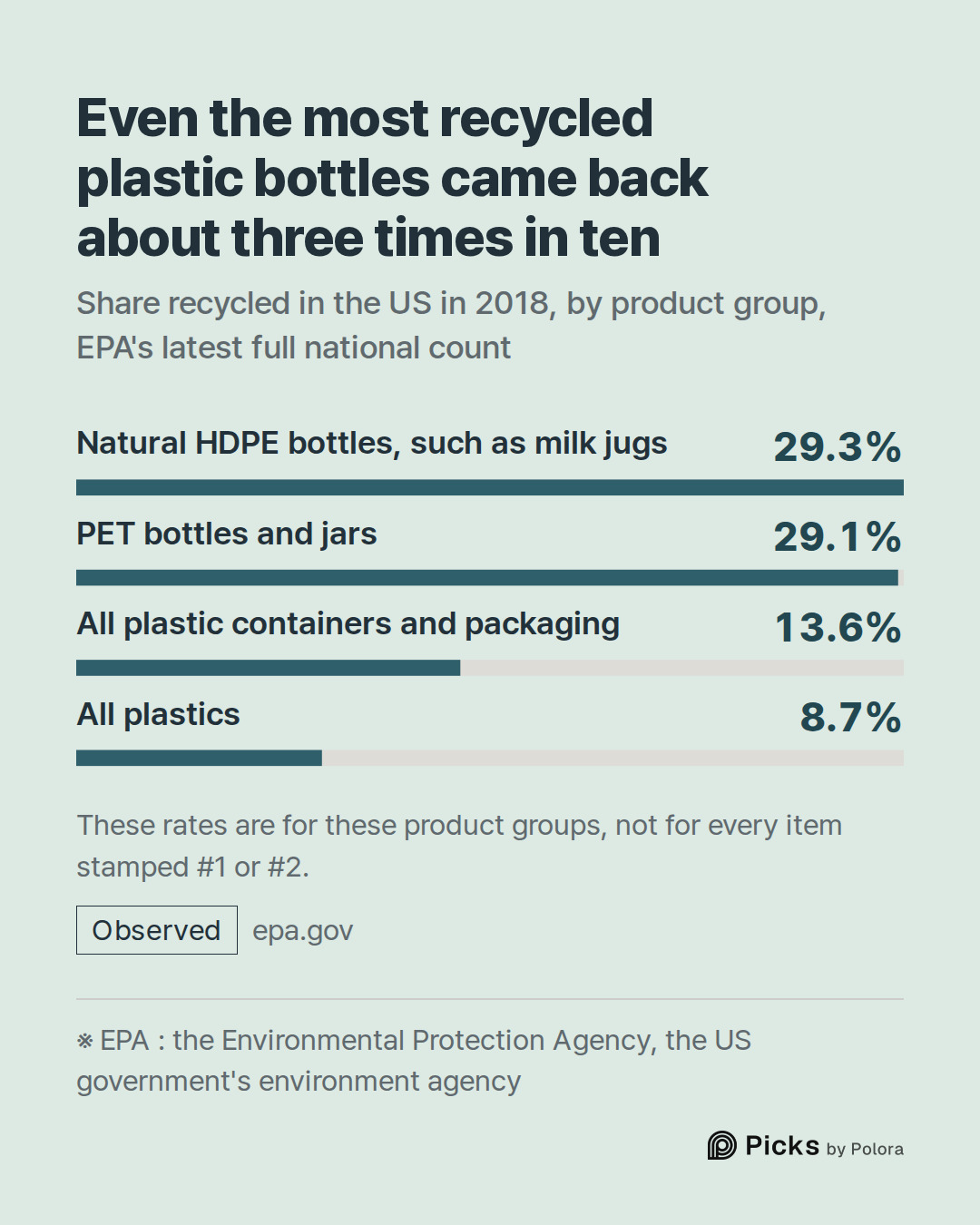
In the United States, the latest full national count by the Environmental Protection Agency (EPA) is for 2018. That year, 29.1% of PET bottles and jars and 29.3% of natural HDPE bottles, such as milk jugs, were recycled. For all plastic containers and packaging together the figure was 13.6%, and for all plastics 8.7%. These rates are for those product groups, not for every item stamped #1 or #2.

Other counts tell a similar story, though they count different things. NAPCOR, an industry group for PET, puts the share of US PET bottles collected for recycling at 32.5% in 2023, revised from an earlier 33.0%, and at 30.2% in 2024. Greenpeace USA, an advocacy group, estimated what is actually reprocessed and reported lower figures for 2021 : 20.9% for PET, 10.3% for HDPE, and less than 5% for each of the other types, #3 to #7. Its headline estimate was that about 5% of US household plastic waste was recycled that year. The recycling industry disputes how that figure was calculated.

The counts differ because they measure at different points : what is collected, what a reprocessor buys, what ends up as new material. They agree on the shape. #1 and #2 bottles are the plastics most often recycled, and still most of them are not. The rest rarely are.
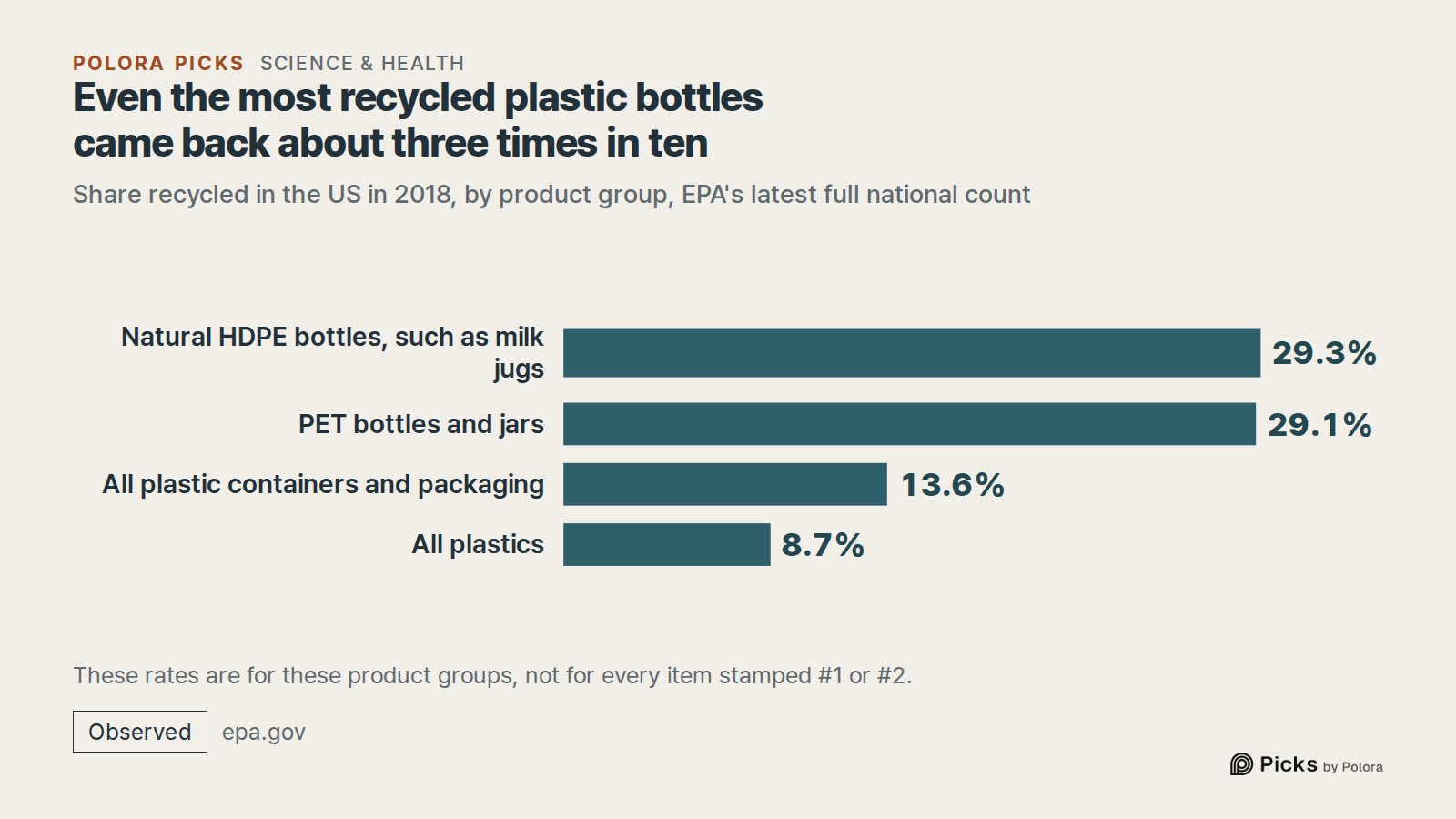
Even the most recycled plastic bottles came back about three times in ten · Share recycled in the US in 2018, by product group, EPA's latest full national count · Natural HDPE bottles, such as milk jugs · PET bottles and jars · All plastic containers and packaging · All plastics · 29.3% · 29.1% · 13
Share recycled in the US in 2018, by product group, EPA's latest full national count

Your town decides, not the number

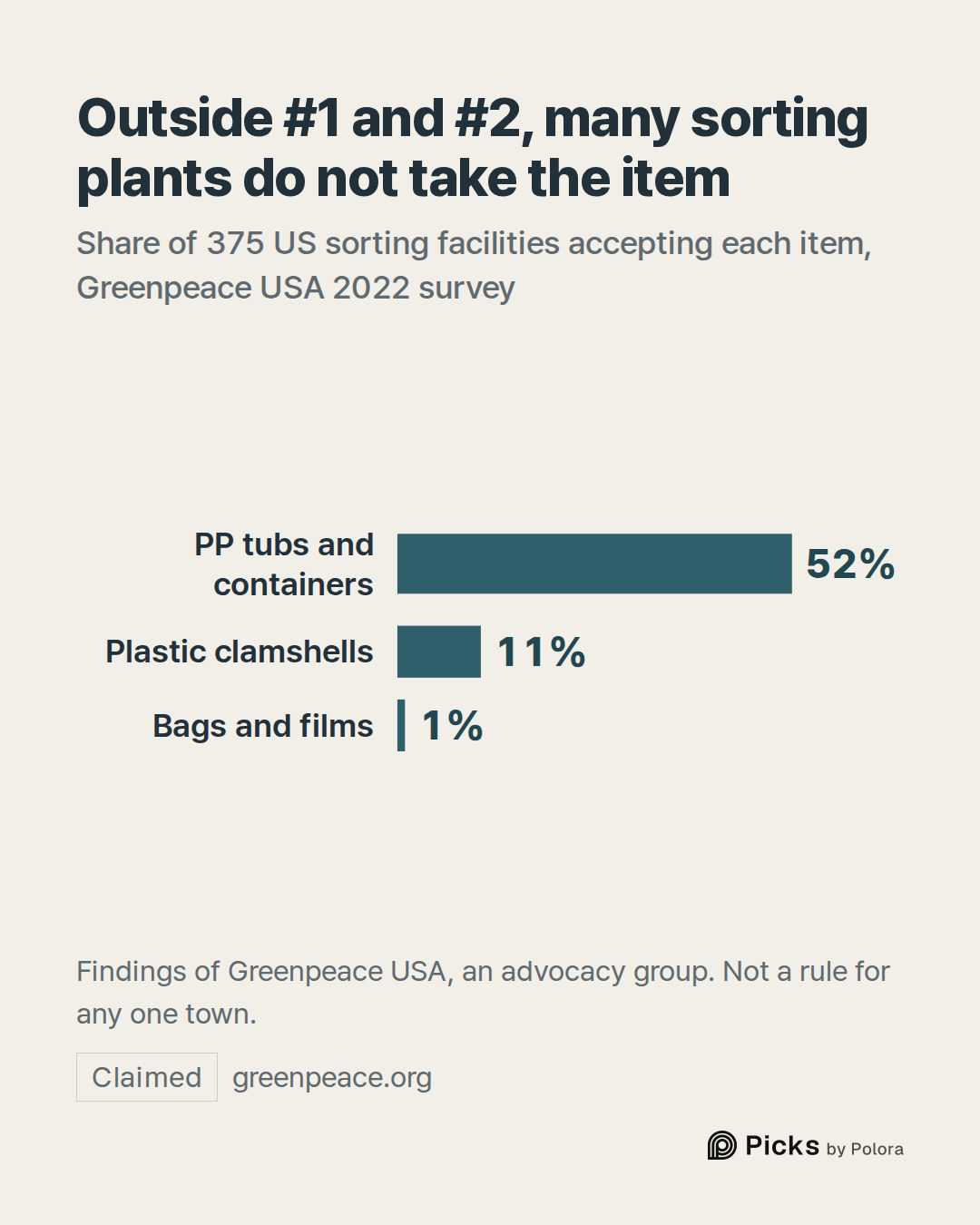
These are national averages. What happens to your tub depends on the sorting plant your collector uses, and plants differ. In Greenpeace's 2022 survey of 375 US sorting facilities, only #1 and #2 were widely accepted. PP tubs and containers were accepted at 52% of them, plastic clamshells at 11%, and bags and films at 1%. These are the survey's findings, not a rule for any one town.

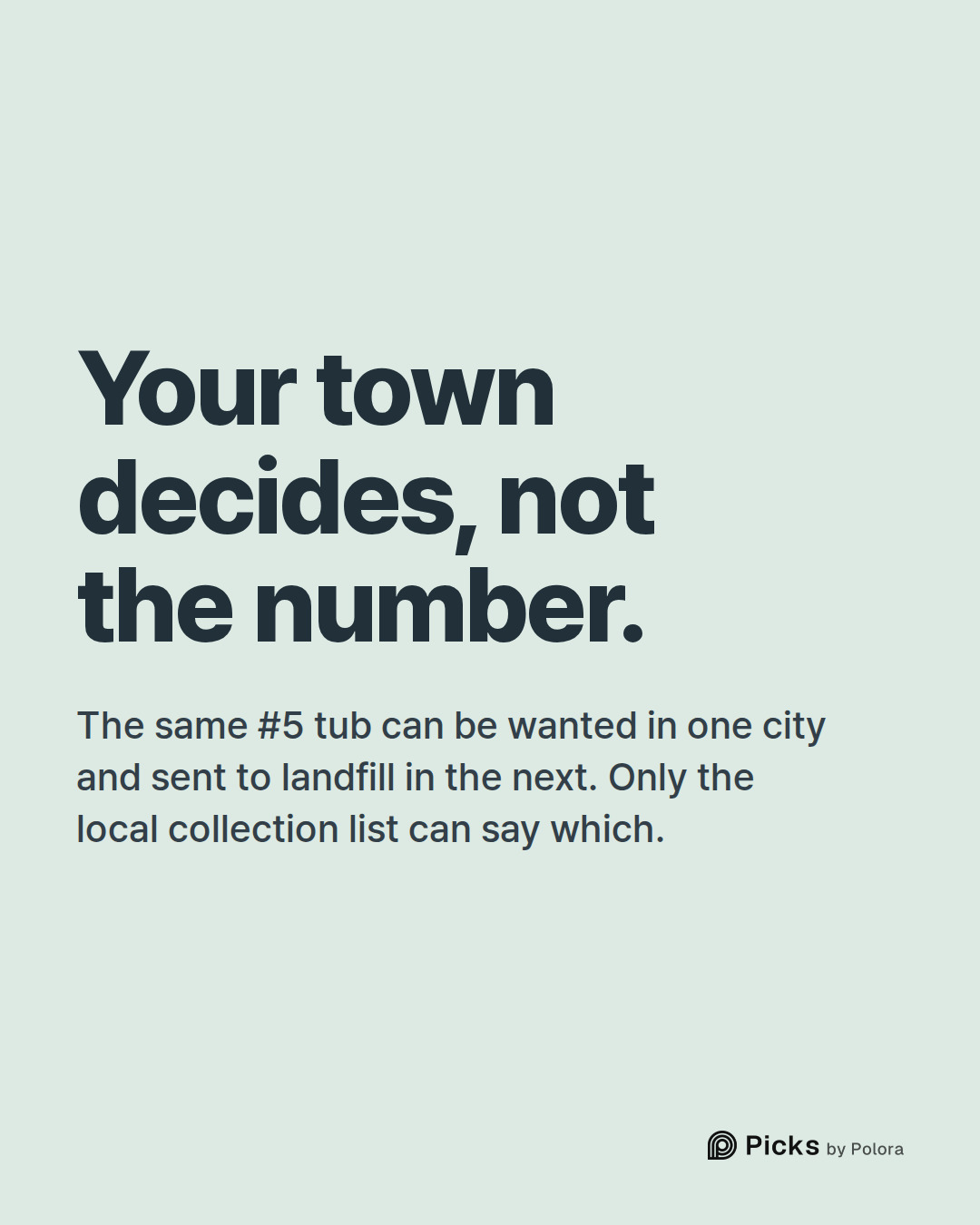
So the same #5 tub can be wanted in one city and sent to landfill in the next. Only the local collection list can say which, and it is worth reading for the kind of item, not only the number : a #1 bottle and a #1 tray need not end up in the same place.
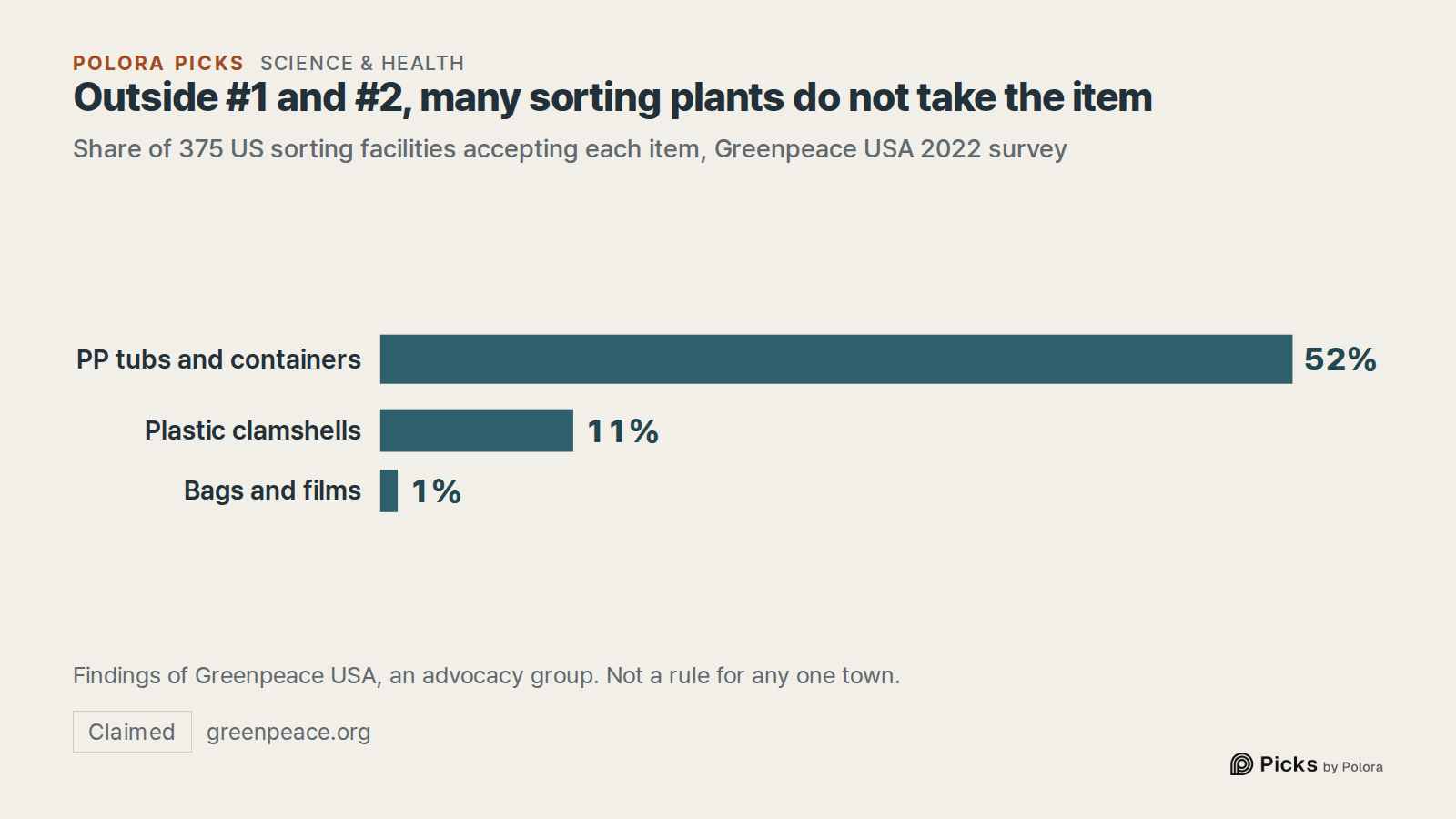
Outside #1 and #2, many sorting plants do not take the item · Share of 375 US sorting facilities accepting each item, Greenpeace USA 2022 survey · PP tubs and containers · Plastic clamshells · Bags and films · 52% · 11% · 1% · Findings of Greenpeace USA, an advocacy group. Not a rule for any one tow
Share of 375 US sorting facilities accepting each item, Greenpeace USA 2022 survey

California tried to tie the arrows to what is really recycled

In 2021 California passed a law known as SB 343. It allows the chasing arrows, or any other sign of recyclability, only on materials that are regularly collected and processed for recycling in the state. In practice, a material has to be collected by recycling programs that cover at least 60% of the state's population, and sorted by facilities that serve at least 60% of recycling programs statewide. A plastic item that misses that bar but must still show its resin code has to put the number inside a plain solid triangle instead of the arrows.

The state's recycling agency, CalRecycle, published the study that decides which materials qualify on 4 April 2025. That started the clock : the rules were to apply to products made after 4 October 2026. Before that date came, on 14 July 2026, a federal judge in San Diego issued a preliminary injunction that stops California's Attorney General from enforcing the law while a lawsuit by industry groups continues. The judge found the challengers likely to succeed in arguing that parts of the law are too vague and restrict speech more than needed. CalRecycle notes that the litigation may affect the deadline. The law is on hold, not repealed. In October 2026 the challengers asked to extend the case to SB 54, California's packaging law, and in the latest reports available for this article that request was still pending.

At the federal level, the Federal Trade Commission's Green Guides set the standard for calling a product recyclable, and the agency has been reviewing them since 2022. They say a plain "recyclable" claim is fair only when recycling facilities are available to a substantial majority of the consumers or communities where the item is sold, which the FTC sets at 60%. That is a rule about what a label may claim, not a measure of how much actually gets recycled.
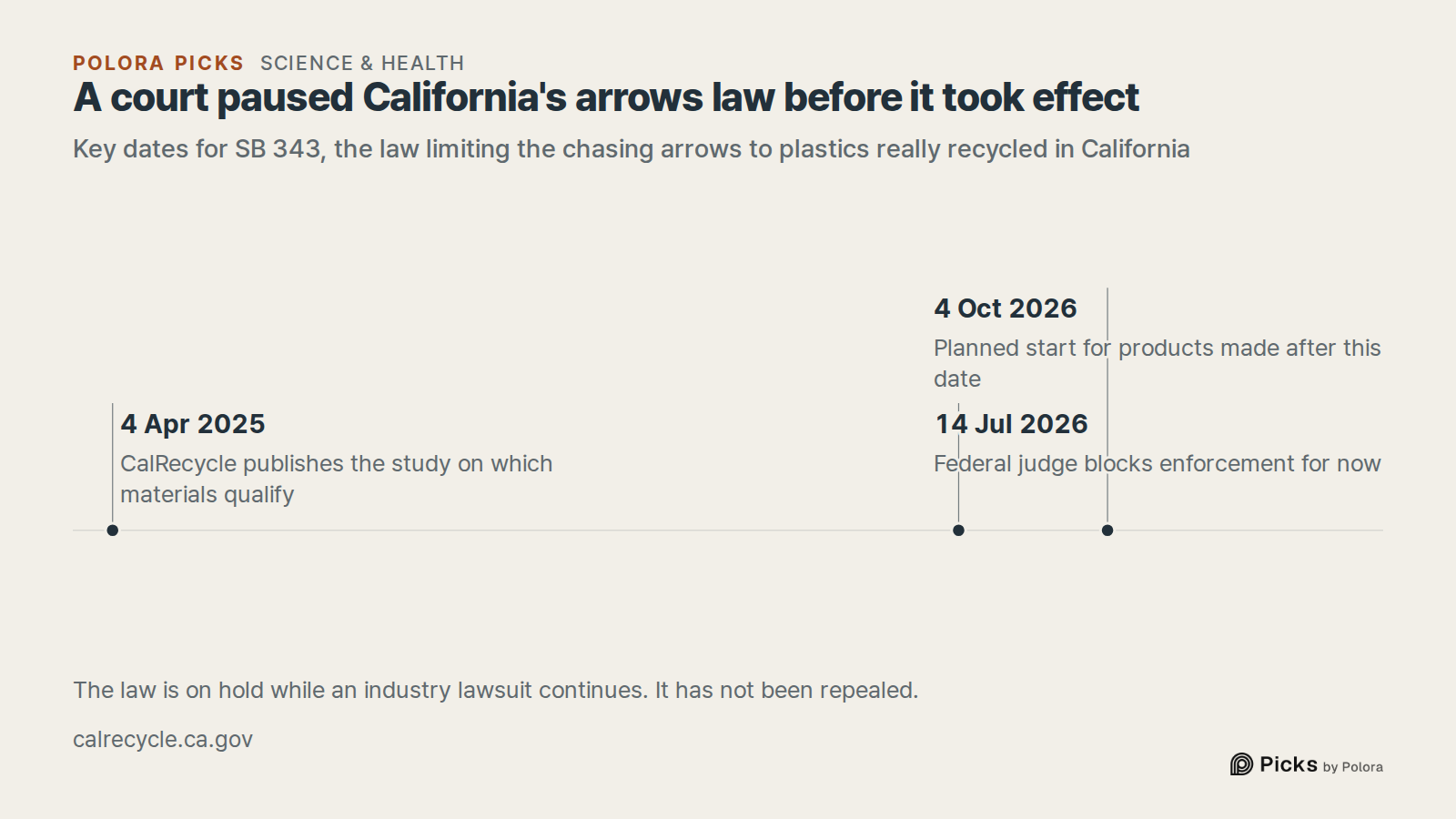
A court paused California's arrows law before it took effect · Key dates for SB 343, the law limiting the chasing arrows to plastics really recycled in California · 4 Apr 2025 · 14 Jul 2026 · 4 Oct 2026 · CalRecycle publishes the study on which materials qualify · Federal judge blocks enforcement fo
Key dates for SB 343, the law limiting the chasing arrows to plastics really recycled in California

The number is for the sorting plant

The arrows look like a promise, but the code was never one. It was a label for people who sort plastic, and it is useful to them, because it tells them what an item is made of. Whether that item gets a second life depends on what your collector accepts and what someone will pay for, and that changes from town to town and from year to year.

Next time someone says a container is recyclable because it has the arrows, you can tell them what the number actually says : which plastic it is, and nothing more.
Does the recycling symbol with a number on plastic mean it can be recycled?Does the recycling symbol with a number on plastic mean it can be recycled?The number in the arrows names the plastic. It promises nothing. · The standard behind the code says it does not imply that any system exists to collect or process the item.In 1988 a plastics trade group put a number inside the recycling arrows. · In 2013 the standard replaced the arrows with a plain solid triangle. Many products still carry the old arrows.Code · What it names · 1 · 2 · 3 · 4 · 5 · 6 · 7 · PET : clear drink bottles · HDPE : milk jugs, detergent bottles · PVC · LDPE : soft bags and films · PP : tubs and caps · Polystyrene : foam cups and trays · Everything else, including mixtures · The number names the plastic, not what happens to it※ EPA : the Environmental Protection Agency, the US government's environment agency · Natural HDPE bottles, such as milk jugs · PET bottles and jars · All plastic containers and packaging · All plastics · 29.3% · 29.1% · 13.6% · 8.7% · Even the most recycled plastic bottles came back about three timPP tubs and containers · Plastic clamshells · Bags and films · 52% · 11% · 1% · Outside #1 and #2, many sorting plants do not take the item · Share of 375 US sorting facilities accepting each item, Greenpeace USA 2022 survey · Findings of Greenpeace USA, an advocacy group. Not a rule for any one towYour town decides, not the number. · The same #5 tub can be wanted in one city and sent to landfill in the next. Only the local collection list can say which.Sources 18 : en.wikipedia.org · Resin identification code (Wikipedia), store.astm.org · ASTM D7611/D7611M, Standard practice for coding plastic manufactured articles for resin identification, newsroom.astm.org · ASTM plastics committee approves major revisions to resin identification code standard +Read the full story at · polora.ai

Does the recycling symbol with a number on plastic mean it can be recycled?

Alpha · deepseek-v4-pro

No — the number inside the recycling arrows does not mean the item can be recycled. It is a Resin Identification Code: it only names the type of plastic. - 1 = PET (drink bottles) - 2 = HDPE (milk jugs, detergent bottles) - 3 = PVC - 4 = LDPE (bags, films) - 5 = PP (tubs, caps) - 6 = PS (polystyrene) - 7 = other or mixed plastics The chasing-arrow loop around the number was a design choice from the plastics industry in 1988, and it has caused confusion ever since. ASTM later replaced the arrows with a solid triangle in the standard precisely to reduce the impression that the label promises recyclability. What actually decides recycling is your local collection program and sorting facility, plus whether anyone will buy the recovered material. Even the most commonly accepted plastics — #1 and #2 bottles — are recycled far less than most people assume. National figures are often around 29% for PET and HDPE bottles, and much lower for other resin types. So the practical rule is: read the number as “what plastic this is,” not “this can be recycled.”

Beta · gpt-6-sol

No. The number is a *Resin Identification Code*: it identifies the plastic, not a guarantee that the item will be collected or made into something new. ASTM says explicitly that the code does not imply that systems exist to process the item for reuse. The practical test is your local recycling program’s list for that kind of item—a #1 bottle and a #1 tray need not have the same destination. (store.astm.org) For the manuscript, the central premise stands, but I would make these corrections before publication: - Keep the EPA figures, with a qualification. EPA’s current page gives 29.1% for PET *bottles and jars*, 29.3% for natural-HDPE bottles and 8.7% for all plastics in 2018; its tables give 13.6% for plastic containers and packaging. An archived EPA page and archived tables instead give 26.8% for 2018 PET and 8.5% for all plastics. Say explicitly that the manuscript uses EPA’s *current revised figures*; do not silently treat the archived figures as corroboration. These are rates for different product groupings, not rates for every item bearing #1 or #2. ([epa.gov](https:/…

Gamma · gemini-3.1-pro

The core premise of the manuscript stands: the number inside the triangle on a plastic product is a Resin Identification Code (RIC), not a guarantee of recyclability. I checked several of the outstanding items requested at the end of the manuscript using live web searches. Here is what I found: * ASTM’s wording on recyclability: ASTM explicitly states that the RIC system "continues to be solely dedicated to identifying resin content, rather than product recyclability." The 2013 shift to the solid triangle was made specifically to decouple the code from the "recycling message" that the chasing arrows imply. (astm.org) * Meanings of codes 1 to 7: The standard definitions are 1 = PET, 2 = HDPE, 3 = PVC, 4 = LDPE, 5 = PP, 6 = PS, and 7 = Other (including multi-layer or mixed plastics). * ASTM D7611-26 revision: The July 2026 update (ASTM D7611/D7611M-26) did not change the fundamental definitions. Its most notable update was to Section 4.4, which clarifies the standard's application to new tooling and molds. ([ansi.org](https://blog.ansi.org/ast…

Researcher · gpt-6-luna

No—the number inside the symbol identifies the type of plastic, not whether your particular item can be recycled. Whether it’s accepted depends on local collection and sorting arrangements. A few checks on the claims above: - EPA’s 2018 figures check out on its current page: 29.1% for PET bottles and jars, 29.3% for natural-HDPE bottles, and 8.7% for all plastics. The archived EPA tables give the same 29.1% PET figure, so the manuscript’s suggested archived 26.8% PET figure was not supported by the archived table I found. These are rates for particular material categories—not every item marked #1 or #2. (epa.gov) - Greenpeace’s figures are in its 2022 report: it estimates reprocessing rates of 20.9% for PET and 10.3% for HDPE, and reports acceptance of PP tubs by 194 of 375 surveyed facilities. Those are Greenpeace’s estimates and survey findings; they should be presented as such, not as a universal measure of what happens locally. ([greenpeace.org](https://www.greenpeace.org/usa/wp-content/uploads/2022/10/GPUS_FinalReport_2022.pdf?utm_source=…

The Arbiter · gpt-6-sol

The voices agree on the key distinction: the number identifies a plastic resin; it does not, by itself, tell you whether a particular item will be accepted or recycled. ASTM’s standard explicitly says the code can aid recycling without implying that a system exists to process the item. (store.astm.org) The main qualification for the manuscript is what the percentages measure. EPA’s 2018 figures—29.1% for PET *bottles and jars*, 29.3% for natural-HDPE *bottles*, and 8.7% for plastics overall—do not describe every product marked #1 or #2, or predict what happens in a reader’s town. Beta and the Researcher also flag that collection, facility acceptance, and reprocessing figures should not be treated as interchangeable. (epa.gov) Two publication checks remain worth handling cautiously. Beta reports an archived-EPA discrepancy, while the Researcher did not reproduce it; the manuscript should identify the exact EPA table behind any comparison rather than assert a revision on that basis. And al…

The Arbiter's Final Verdict · gpt-6-sol

Verdict No. A number from 1 to 7 inside chasing arrows is a *resin identification code*: it identifies the plastic, not a guarantee that the item is accepted or will become new material. The code can help with sorting, so it is not meaningless to recycling. But a #1 bottle and a #1 tray may face different rules. Check your local program’s list for the type of item, not just its number. ASTM standard What the manuscript can—and cannot—say - The central premise stands. ASTM describes the code as identifying resin content rather than asserting product recyclability. ASTM’s 2013 announcement supports the account of replacing chasing arrows with a solid triangle to avoid conveying a recycling message. The record also supports the 1988 plastics-industry origin. The precise 2008 handover, however, was not independently established here. - The numbered-plastics list is broadly sound: 1 PET, 2 HDPE, 3 PVC, 4 LDPE, 5 PP, 6 PS, and 7 other. “Other” is a category, not one seventh resin. The claim that a…