A century of being overtaken
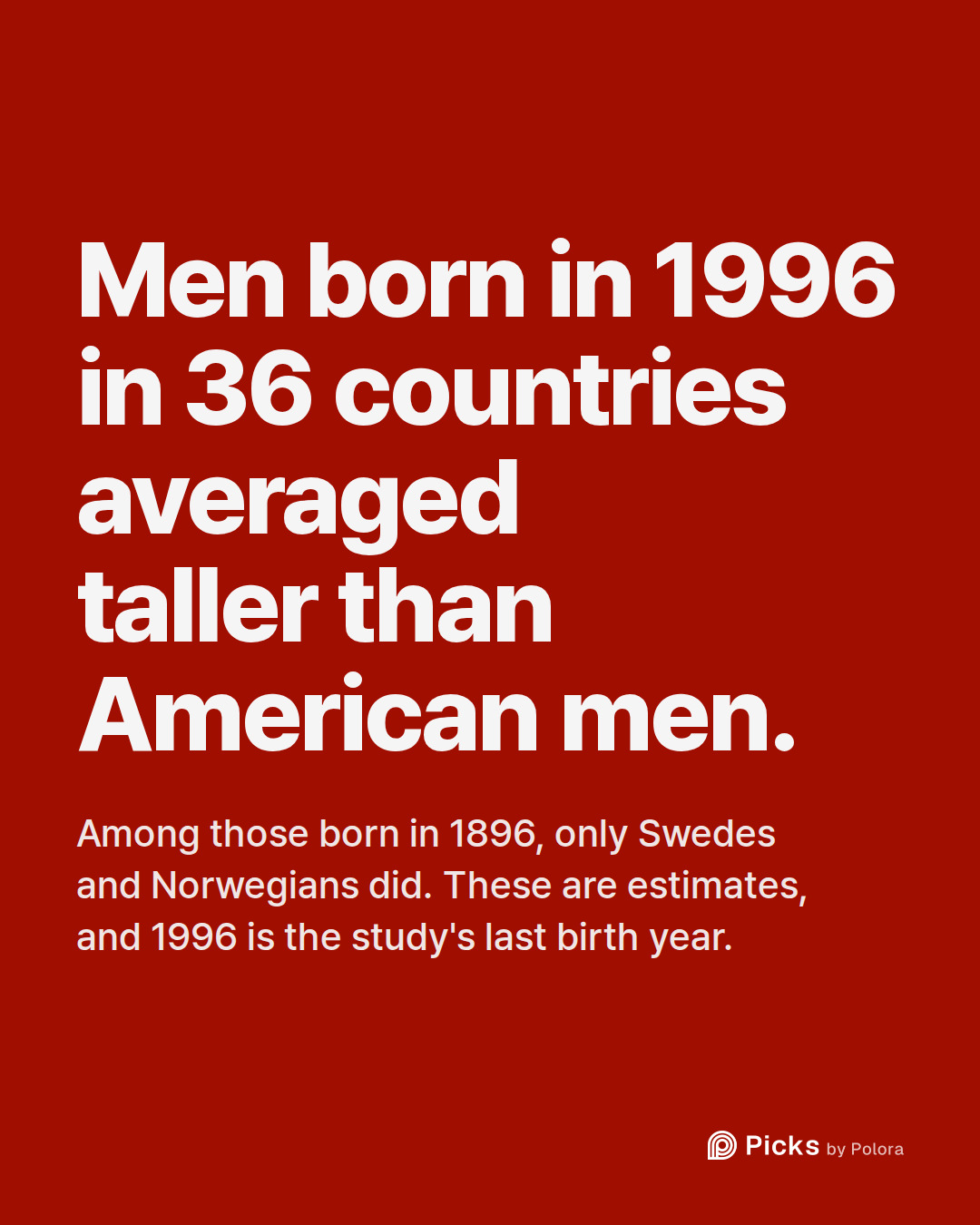
American men born in 1896 grew up to an estimated 171.1 centimetres on average, about 67 inches. That put them among the tallest men on Earth. Only Sweden and Norway had a higher estimated average, and their estimates sit so close to the American one that the order of the three is uncertain.
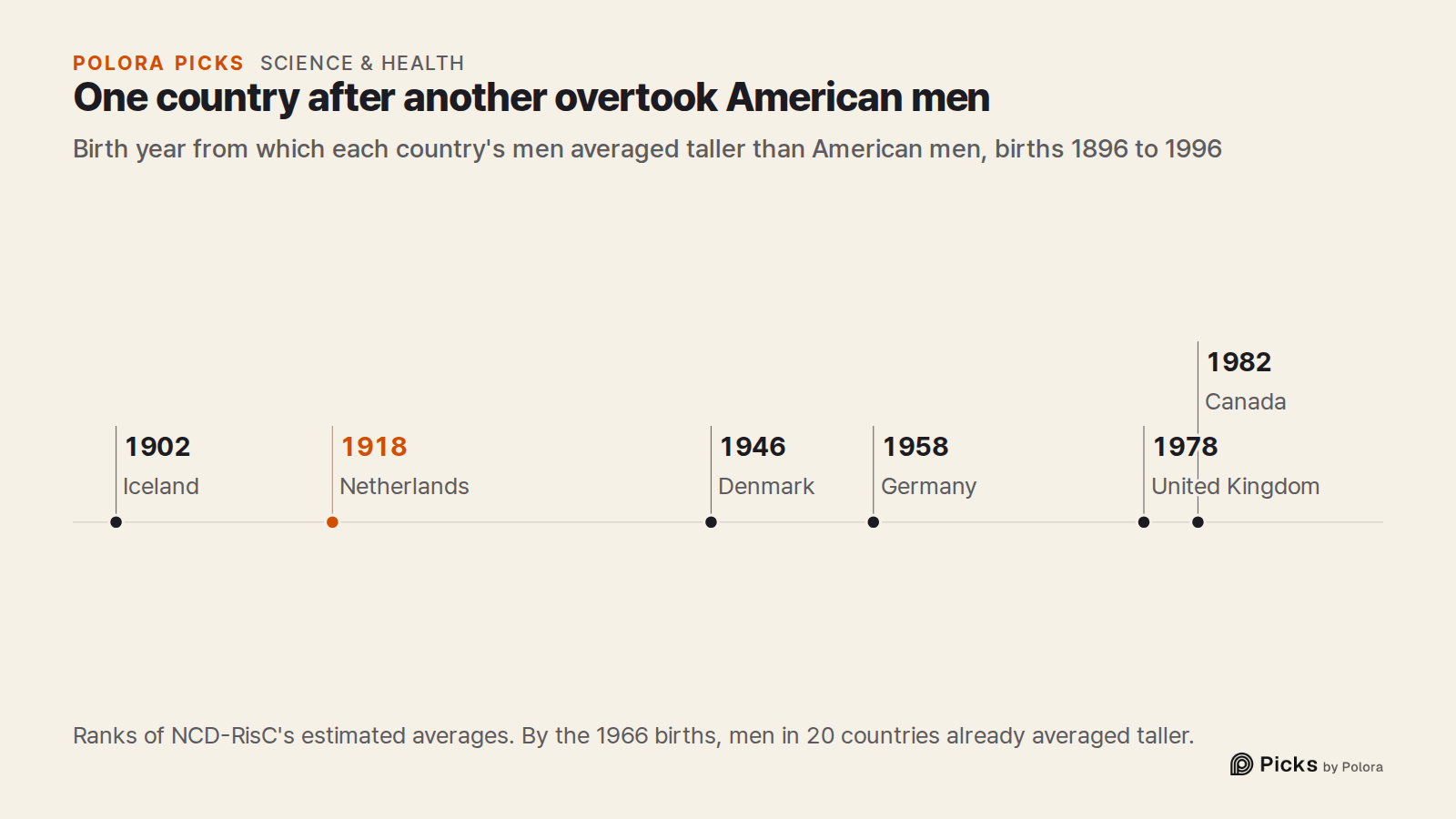
Then, one birth year at a time, other countries pulled ahead. Iceland was first, from the 1902 births, though the accompanying film leaves it out. The Netherlands followed from 1918, Denmark from 1946 and Germany from 1958, and each of them stayed ahead through the last birth year the study covers. Most of the slide came in the three decades after the Second World War. American men born in 1946 ranked 6th by estimated average. By the 1966 births, men in 20 countries already averaged taller, and American men born in 1976 ranked 30th.
The United Kingdom passed in 1978 and Canada in 1982. Now and then the rank won back a place, as it did for the 1985 births, but the slide went on. From the 1993 births on, American men ranked 37th.
Americans kept growing, then stalled
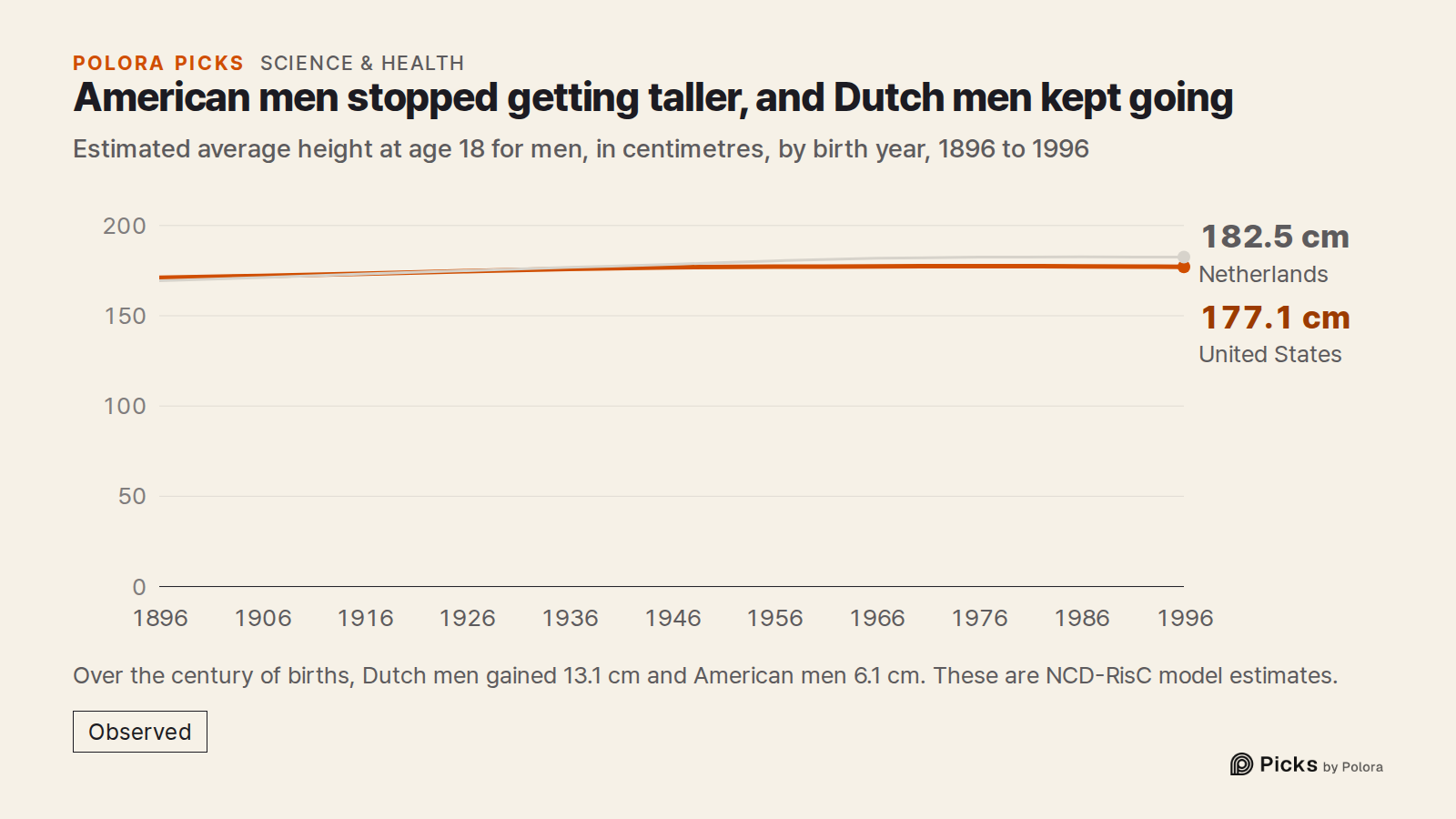
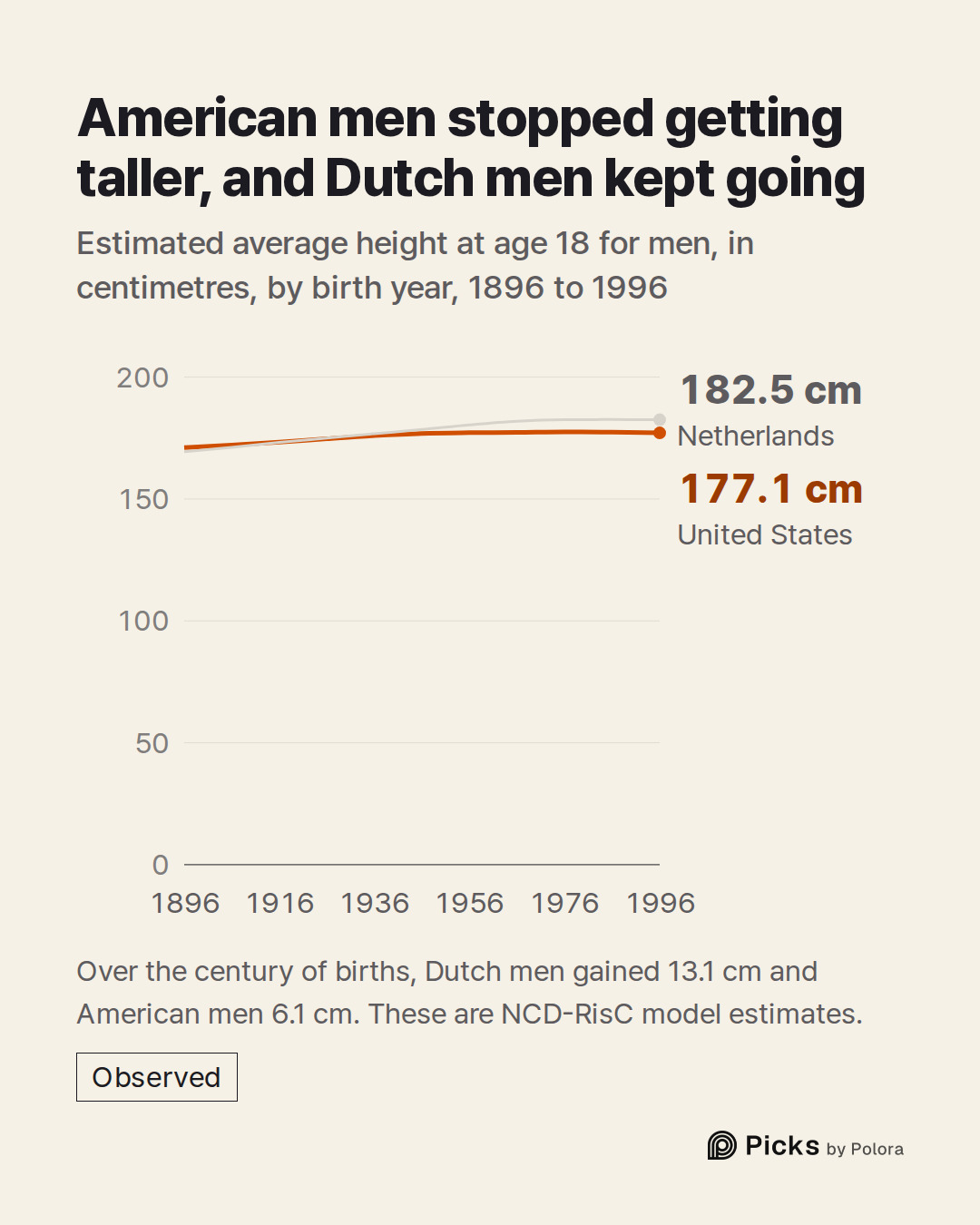
American men did keep getting taller for a while, then levelled off. Those born in 1950 averaged 177.1 centimetres. The peak was 177.5 centimetres, for men born in 1978. Men born in 1996 averaged 177.1 centimetres again, about 70 inches, a little below that peak. Over the full century of births that is a gain of 6.1 centimetres.
Dutch men gained 13.1 centimetres over the same century. Those born in 1896 averaged 169.4 centimetres, shorter than Americans, and ranked 12th. Those born in 1996 averaged 182.5 centimetres, about 72 inches, and ranked first in the world. Among men born in 1996, the Dutch averaged 5.4 centimetres more than Americans, about 2.1 inches.
The study, by the NCD Risk Factor Collaboration and published in eLife, puts it plainly. The United States "was one of the tallest nations a century ago but has now fallen behind its European counterparts after having had the smallest gain in height of any high-income country". The authors also note that, among the high-income Western countries where height stopped rising, the United States levelled off earliest.
Women followed the same path
The film shows only men, but American women slid too. Women born in the United States in 1896 averaged 158.5 centimetres and ranked 4th. Those born in 1996 averaged 163.5 centimetres and ranked 42nd, with 41 countries and territories ahead of them. The biggest gain of any country's women was in South Korea, at 20.2 centimetres over the century.
What these numbers are, and how firm the ranks are
The figures are estimates, not a single survey. The NCD Risk Factor Collaboration, a worldwide network of health researchers, pooled population studies that measured people's height rather than asking them. It then used a statistical model to estimate the average height at age 18 for everyone born in each year from 1896 to 1996, in 200 countries and territories. The model fills gaps from neighbouring years and similar countries, and it corrects for people losing height as they age, because those born early were mostly measured late in life.
So "born in 1996" is the latest point, not today. The data were published in 2016 and reach no further. The piece and the film use the copy on Our World in Data, and every value agrees with the collaboration's own download at the precision shown.
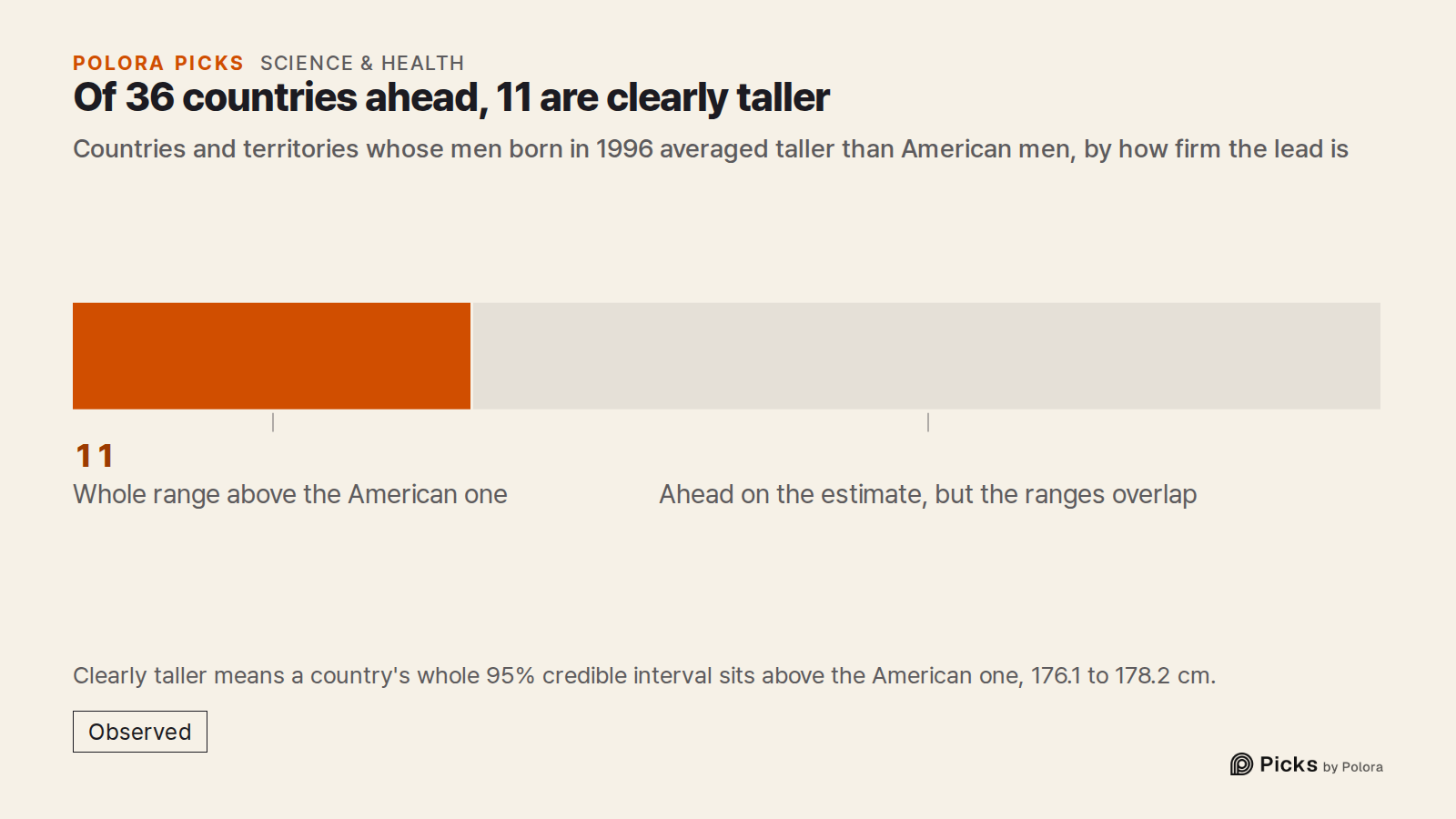
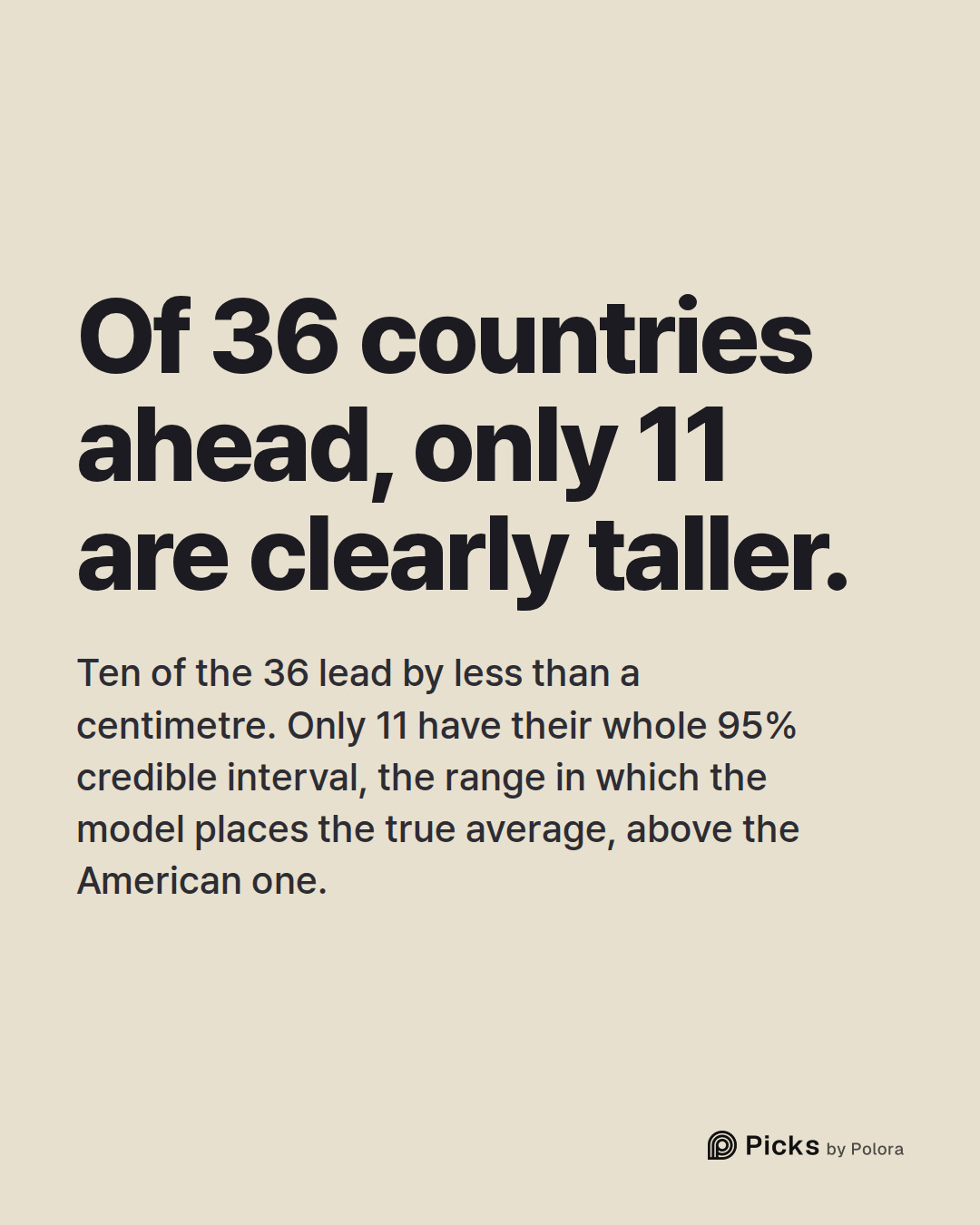
Each estimate comes with a 95% credible interval, the range in which the model places the true average, given the data. For American men born in 1996, that range runs from 176.1 to 178.2 centimetres. Ten of the 36 countries ahead lead by less than a centimetre, well within the uncertainty of the estimates. A strict test is to ask whose whole interval sits above the American one. Only 11 countries pass it : Belgium, Bosnia and Herzegovina, Croatia, Denmark, Estonia, Germany, Latvia, the Netherlands, Serbia, Slovenia and Sweden. "37th" is the rank of the estimated averages. The firm finding is that, among men born in 1996, those in a group of mostly European countries were clearly taller on average than American men.
Why it happened is still an open question
The study does not give a cause for the American stall. Its general point is that differences in height between countries are mostly not genetic. What matters most is growth before birth, and nutrition and infections in childhood and adolescence.
An obvious question is whether immigration explains it, since the study's American estimates do not separate people by origin. The economic historians John Komlos and Benjamin Lauderdale looked at that in 2007. They used a narrower group than the study above : adults born in the United States, non-Hispanic black and white, along with military records. They still found American height gains slowing by mid-century while Western and Northern Europe sped up. They put forward two possible explanations : American diets may be worse, or Europe's universal health care and social safety nets may give children a healthier start. In an earlier paper, Komlos and Marieluise Baur also pointed to greater social inequality in the United States. These are hypotheses the authors offer, not proven causes.

- NCD Risk Factor Collaboration (2016), "A century of trends in adult human height", eLife]
- NCD Risk Factor Collaboration, country estimates of height at age 18 by year of birth]
- Our World in Data, average height of men (data: NCD-RisC)]
- Our World in Data, average height of women (data: NCD-RisC)]
- Komlos and Lauderdale (2007), "The mysterious trend in American heights in the 20th century", Annals of Human Biology (PubMed abstract)]
- Komlos and Baur, "From the tallest to (one of) the fattest", University of Munich working paper (2003; published in Economics and Human Biology, 2004), abstract]





![Sources 6 : elifesciences.org · NCD Risk Factor Collaboration (2016), "A century of trends in adult human height", eLife], ncdrisc.org · NCD Risk Factor Collaboration, country estimates of height at age 18 by year of birth], ourworldindata.org · Our World in Data, average height of men (data: NCD-Ri](https://media.cdn.polora.ai/picks/2026/11/pickrun_3cb0ba9197dc4b3e/oBA5AcaS8U-yIfal-slide-08--why-did-american-men.jpg)