Why do supermarket bananas all taste the same?

Because nearly every banana sold across borders is a Cavendish, a seedless banana copied from a few closely related plants rather than grown from seed, and ripened on a similar schedule. That sameness is also why one soil fungus can threaten all of them.

Science & Health · 2026-11-16

Nearly every supermarket banana is a copy from one small group of plants

Most supermarkets in the world sell the same kind of banana, called Cavendish. It has three sets of chromosomes where most plants have two, so it is sterile and cannot be grown from seed.

So growers copy it. A new plant starts either as a shoot taken from the base of an existing one, called a sucker, or as a piece of plant tissue multiplied in a laboratory. Either way, the new plant is genetically a copy of its parent. You may see names on a box such as Grande Naine, Williams or Valery. These are not unrelated bananas. They are varieties within the Cavendish group : copies that turned out slightly different, for example in height, and were kept because they grew well. Strictly, then, Cavendish is a small group of closely related copies rather than one single plant.

That is the first half of the answer. A banana bought in Seoul, Paris or São Paulo tastes so alike because, for practical purposes, it comes from the same small group of copies.

Most of the world's bananas are not this banana

This is the part that surprises most people. Cavendish is not the world's banana. It is the world's exported banana.

In a review of the years up to 2002, the UN Food and Agriculture Organization (FAO) put Cavendish at about 43 percent of the world's banana production. The same review found that only about 11 percent of the world's harvest was traded between countries at all. ProMusa, an online reference on bananas, gives a later estimate for 2018. It puts Cavendish at 57 percent of world production that year, with Cavendish exports equal to about 16 percent of world production. FAO's current overview describes Cavendish as a little less than half of what is grown.

The estimates differ by period and method, but they agree on the shape. Cavendish is roughly half of what is grown. Most bananas of every kind are eaten in the country that grows them, and many of those are kinds a supermarket shopper never sees.

Across borders, the picture flips. In its account of the years up to 2002, FAO described virtually all exported bananas as Cavendish, and a 2017 paper in Nature Communications uses the same words, 'virtually all the export trade'. Figures of 95 or 99 percent are often quoted, but they come from secondary sources, not from a published count. 'Nearly all' is as precise as the evidence allows.
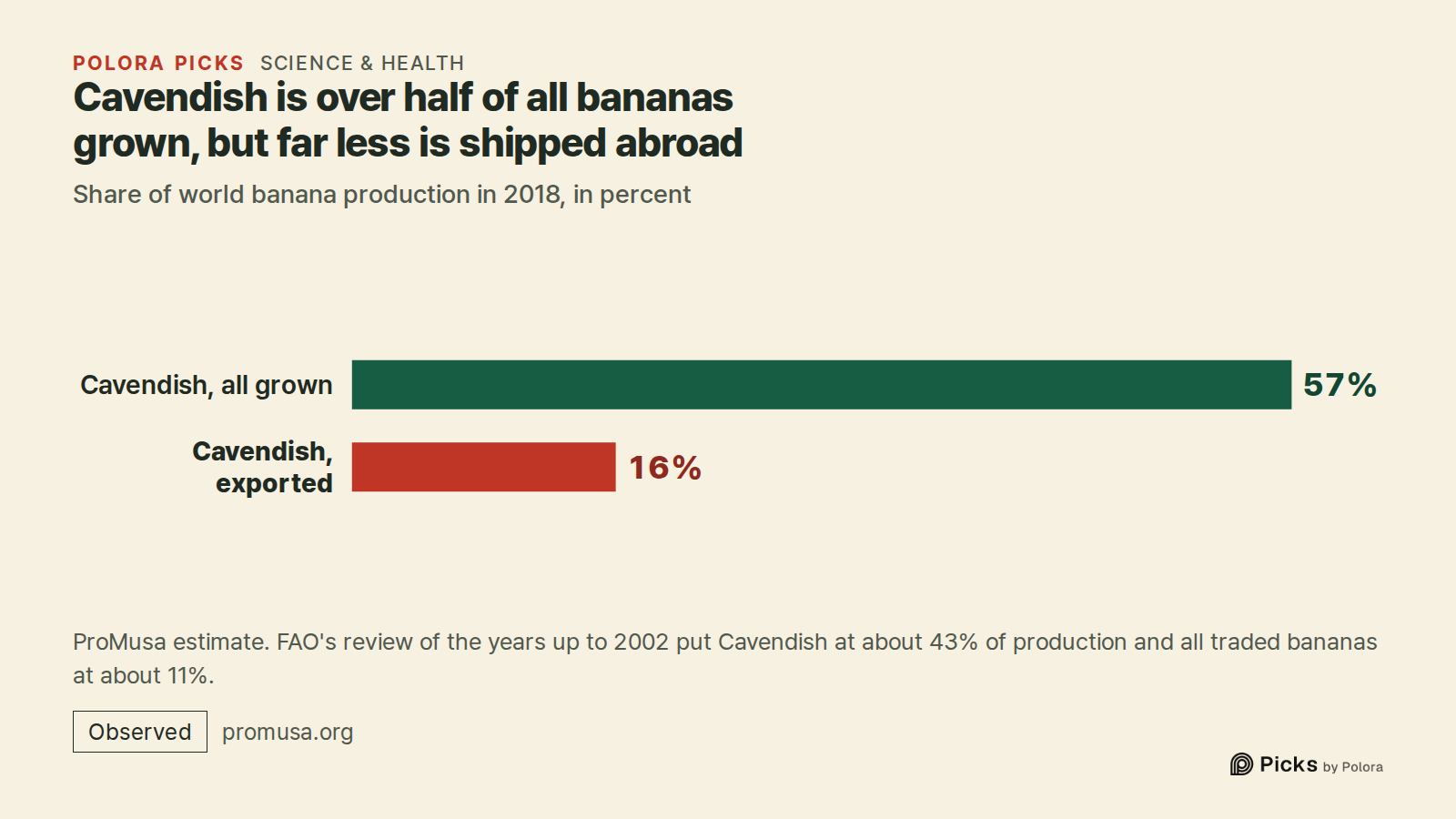
Cavendish is over half of all bananas grown, but far less is shipped abroad · Share of world banana production in 2018, in percent · Cavendish, all grown · Cavendish, exported · 57% · 16% · ProMusa estimate. FAO's review of the years up to 2002 put Cavendish at about 43% of production and all traded
Share of world banana production in 2018, in percent

Picked green, shipped cold, ripened on a timetable

Genes are only half of the sameness. Export bananas are cut while still green and hard. They travel in refrigerated containers at about 13 degrees Celsius, cold enough to hold ripening back. In the importing country they go into sealed ripening rooms, usually kept somewhere between 15 and 20 degrees ; one common schedule holds them at around 17 degrees. There a small dose of ethylene, a gas that ripening fruit gives off naturally, starts all of them ripening at once. On that schedule they leave for the shops three or four days later, at the colour the buyer ordered.

So the bananas on the shelf are not only copies from the same small group of plants. They have also made much the same journey, at similar temperatures, on a similar schedule. The trade makes ripening uniform on purpose, because only a fruit that ripens predictably can be sold across an ocean.

Alike is not identical, though. How mature the fruit was when it was cut still shapes its sugars, acids and aroma, so two Cavendish bananas can taste different. What the trade delivers is a banana that is unusually consistent, not one that is the same every time.
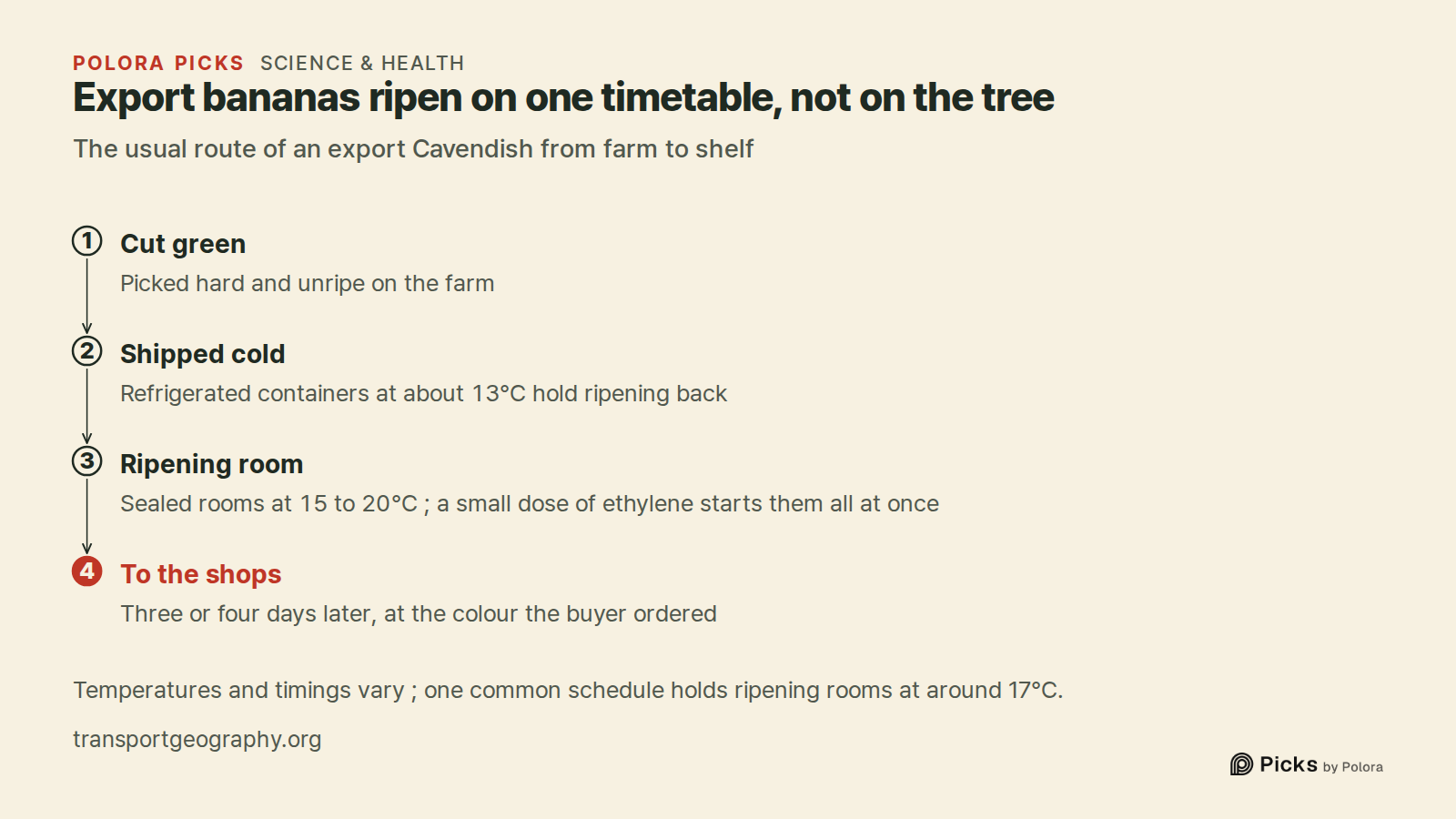
Export bananas ripen on one timetable, not on the tree · The usual route of an export Cavendish from farm to shelf · Cut green · Shipped cold · Ripening room · To the shops · Picked hard and unripe on the farm · Refrigerated containers at about 13°C hold ripening back · Sealed rooms at 15 to 20°C ;
The usual route of an export Cavendish from farm to shelf

A fungus has already driven out one export banana

For the first half of the twentieth century, the banana in Western shops was a different one, called Gros Michel. Traders liked it because it produced large bunches and had a peel that survived long journeys. It too was grown from copies.

Then a soil fungus spread through the plantations. The disease it causes is called Fusarium wilt, or Panama disease. Fungicides cannot control it and fumigation cannot clear it from the soil. It travels in infected planting material, soil and water, and an infected shoot can look healthy when it is planted somewhere new. Because Gros Michel was grown from copies, a weakness in one plant was a weakness shared across the plantations. Growers kept abandoning infected land for new land. In its account of Central America, ProMusa puts the abandoned plantations at more than 40,000 hectares.

The way out was a different banana. Cavendish resisted the strain that was killing Gros Michel, now called race 1. In the late 1950s, under pressure from cheaper bananas from Ecuador, Central American growers replanted their infested soils with Cavendish. That is how the trade came to sell the banana it sells today.

A new strain of the old banana fungus kills Cavendish

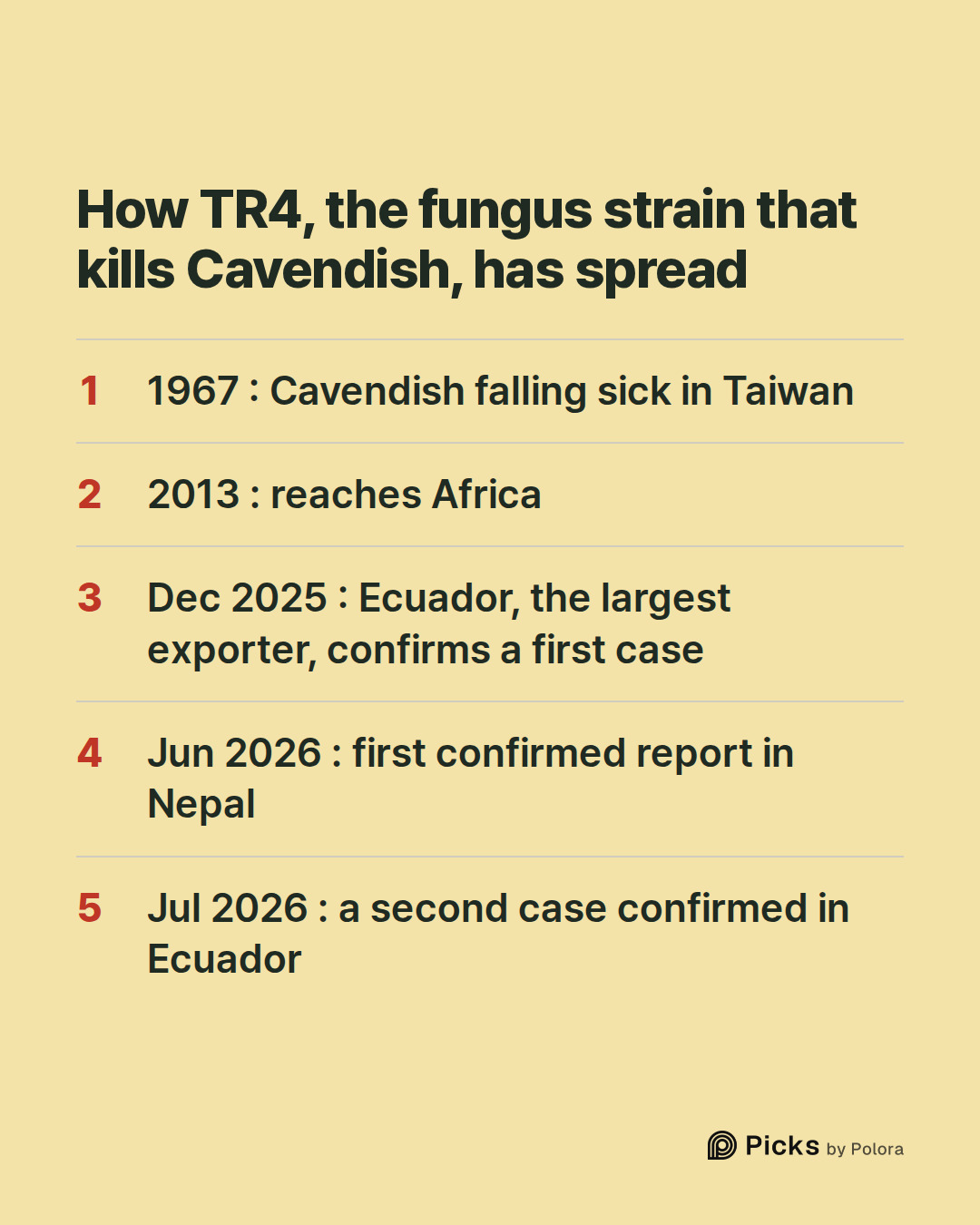
Cavendish plants in Taiwan were already falling sick by 1967. At the end of the 1980s, scientists studying Taiwanese samples identified the cause as a new strain of the same fungus, one that does kill Cavendish. It is called Tropical Race 4, or TR4. It spread through Asia, reached Africa in 2013 and has since been reported in more than 20 countries, by counts that change often.

The map changes from year to year. The first confirmed report of TR4 in Nepal appeared in the journal Plant Disease, online in June 2026 and then in its September 2026 issue. Ecuador, the world's largest banana exporter, confirmed its first case in December 2025, after a suspected outbreak in September, on a farm in El Oro province near the border with Peru. In July 2026 its plant health agency, Agrocalidad, confirmed a second case on a neighbouring farm.

The cases reported so far are a warning, not a collapse. Agrocalidad says it has isolated the area and tightened controls in the province and at the southern border. In an update on 3 November 2026 it described containment in El Oro as still under way, without giving a current count of affected farms. The number of cases may have changed since.
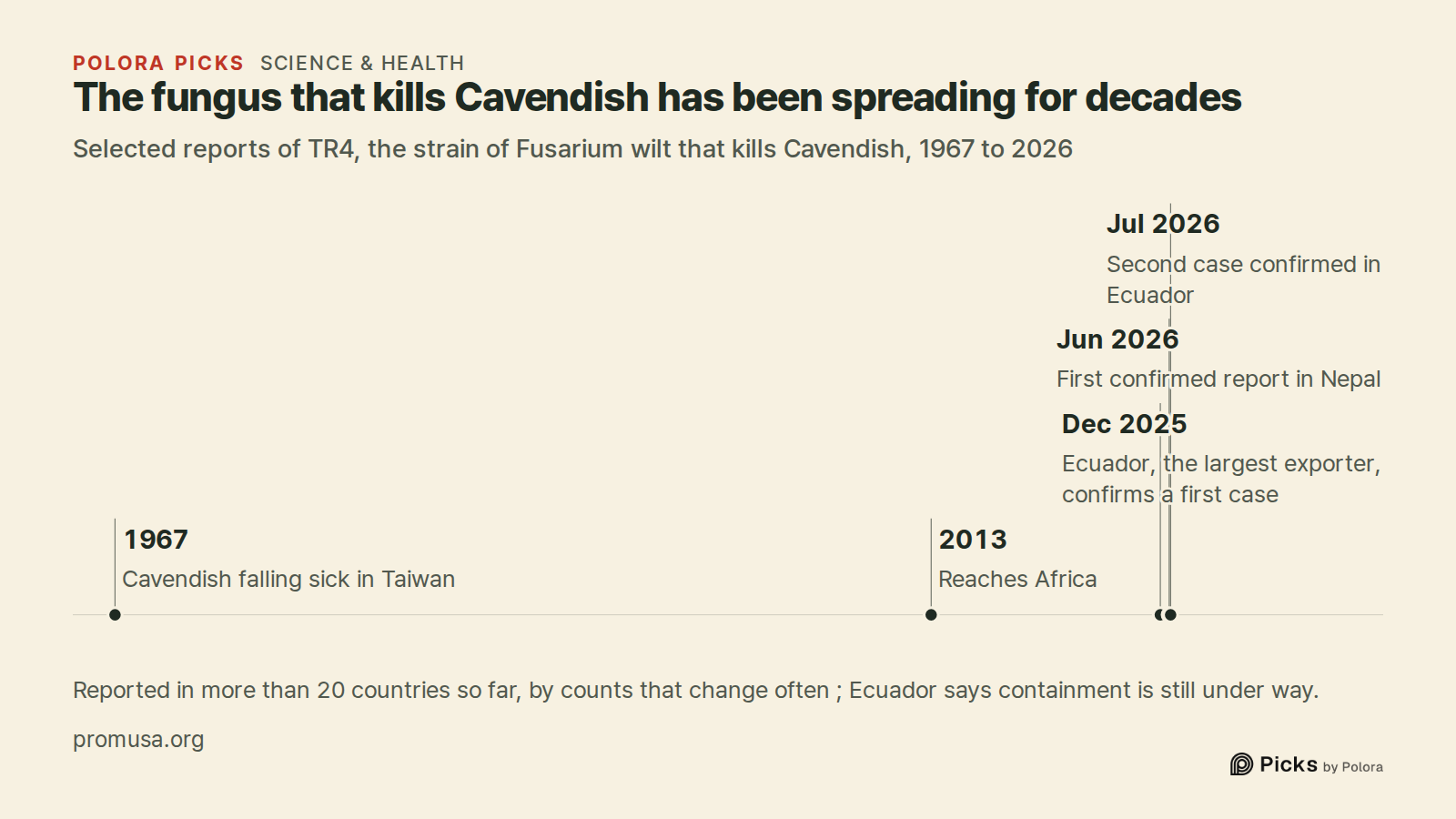
The fungus that kills Cavendish has been spreading for decades · Selected reports of TR4, the strain of Fusarium wilt that kills Cavendish, 1967 to 2026 · 1967 · 2013 · Dec 2025 · Jun 2026 · Jul 2026 · Cavendish falling sick in Taiwan · Reaches Africa · Ecuador, the largest exporter, confirms a firs
Selected reports of TR4, the strain of Fusarium wilt that kills Cavendish, 1967 to 2026

Why there is no ready replacement this time

Last time, a resistant banana already existed when the old one failed. This time the candidates are less certain.

One is Formosana, a Cavendish variant selected in Taiwan. In Taiwanese field trials it fell sick less often than the Cavendish it was compared with. In a three-year trial in Australia's Northern Territory, though, it proved as susceptible to TR4 as the ordinary Cavendish variety Williams. How well it holds up depends on where it is tested.

Another is QCAV-4, developed by Queensland University of Technology, which added a resistance gene from a wild banana to a Grande Naine Cavendish. In six years of field trials in the Northern Territory it proved highly resistant. In 2024 Australian regulators approved it for both growing and eating, the first approval of a genetically modified banana anywhere. At that time the university said it had no immediate plans to grow it commercially, and that it would be kept as a safety net in case the disease spread through Australian farms. It is also still a Cavendish : one plant, copied, with the resistance gene added, along with a marker gene used in the laboratory to pick out the modified plants.
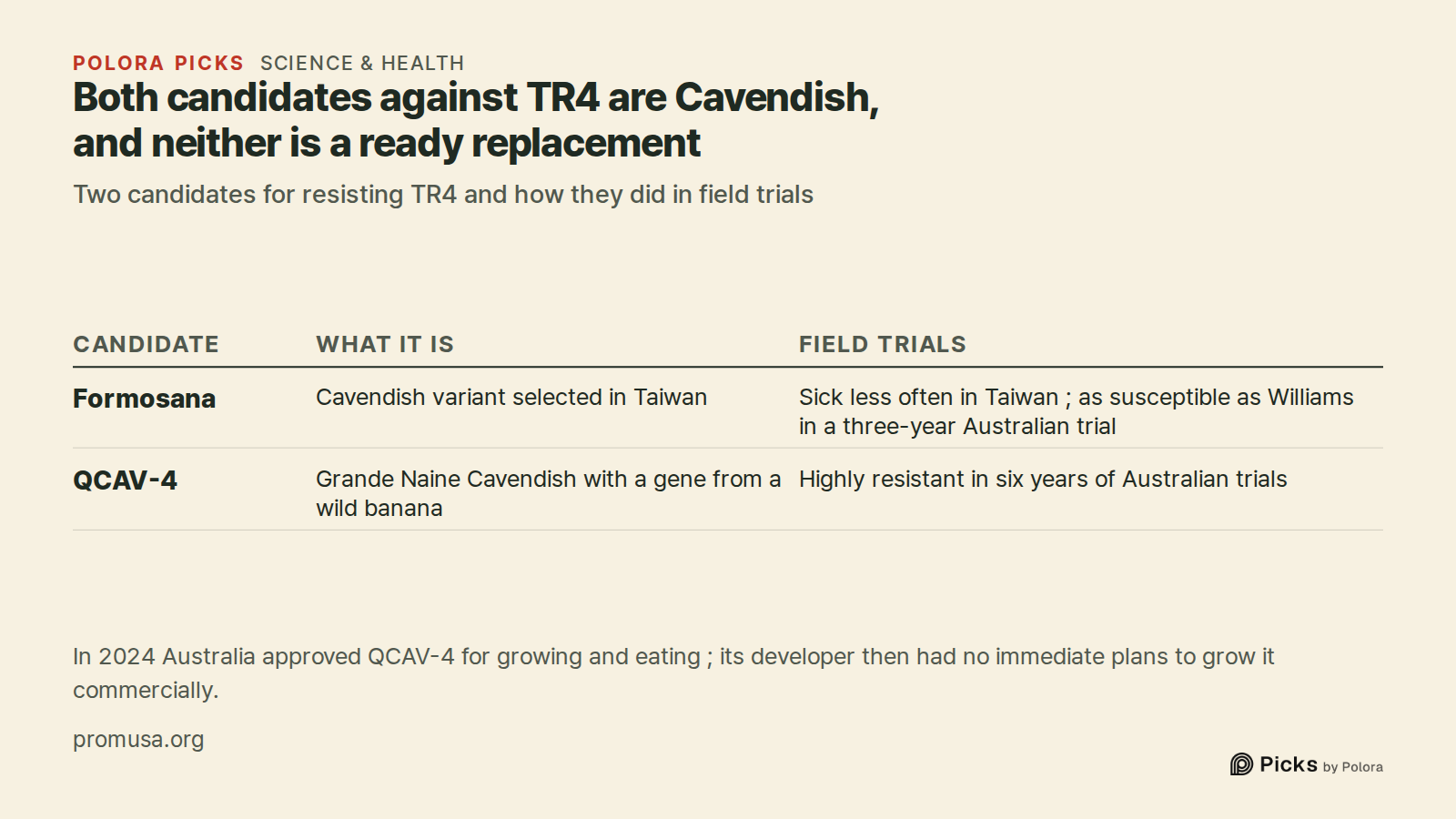
Both candidates against TR4 are Cavendish, and neither is a ready replacement · Two candidates for resisting TR4 and how they did in field trials · Candidate · What it is · Field trials · Formosana · QCAV-4 · Cavendish variant selected in Taiwan · Sick less often in Taiwan ; as susceptible as Willia
Two candidates for resisting TR4 and how they did in field trials

The same taste and the same weakness are one fact

Put the two halves together and the answer to the question is also a warning. Bananas taste so alike because the trade grows one small group of copies and handles them much the same way from field to shop. That same sameness is why a fungus that can kill one plant can sweep through a whole plantation.

None of this means bananas are about to disappear. Most of the world's bananas are other kinds, eaten where they are grown, and Gros Michel is still grown in places today. What it does mean is that the banana in your kitchen is a choice the trade made once, after a fungus forced its hand.
Why do supermarket bananas all taste the same?Why do supermarket bananas all taste the same?Nearly every supermarket banana is a copy from one small group of plants. · Export bananas are also picked green, shipped cold and ripened on a similar schedule.Cavendish is not the world's banana. It is the world's exported banana. · Most bananas are eaten in the country that grows them. Across borders, nearly all are Cavendish. · ※ Cavendish : the kind of banana most supermarkets in the world sellA fungus has already driven out one export banana. · Gros Michel, the banana in Western shops for the first half of the twentieth century, was also grown from copies. After Panama disease spread, growers replanted with Cavendish. · ※ Panama disease : another name for Fusarium wilt, a banana diseaseHow TR4, the fungus strain that kills Cavendish, has spread · 1967 : Cavendish falling sick in Taiwan · 2013 : reaches Africa · Dec 2025 : Ecuador, the largest exporter, confirms a first case · Jun 2026 : first confirmed report in Nepal · Jul 2026 : a second case confirmed in EcuadorThis time there is no ready replacement for the supermarket banana. · A genetically modified version of it, called QCAV-4, proved highly resistant in Australian trials, but in 2024 its developer had no immediate plans to grow it commercially.The same taste and the same weakness are one fact. · None of this means bananas are about to disappear. The banana in your kitchen is a choice the trade made once, after a fungus forced its hand.Sources 16 : promusa.org · ProMusa : Cavendish subgroup, fao.org · FAO : The World Banana Economy, 1985-2002, fao.org · FAO : Bananas overview + 13Read the full story at · polora.ai

Why do almost all supermarket bananas taste exactly the same?

Alpha · deepseek-v4-pro

Alex, the short answer is: supermarkets have, in effect, chosen one banana. Almost all exported dessert bananas are a single cultivar, Cavendish. It is a triploid — three sets of chromosomes instead of the usual two — which makes it sterile and seedless. So it cannot be grown from seed. Instead, each new plant is grown from a sucker cut from the base of an existing plant, or from tissue culture in a lab. The result is a clone: the plant in Seoul is genetically, for practical purposes, the same plant as the one in São Paulo. The names you sometimes see on boxes — Grande Naine, Williams, Valery — are not really different bananas. They are clonal selections of Cavendish that differ slightly in things like plant height or bunch shape, not in the fruit's fundamental character. Genes are only half of the answer. The other half is the supply chain. Export bananas are cut green and hard, then shipped cold at around 13°C to hold ripening back. At the destination they go into sealed rooms, where a small dose of ethylene starts them ripening on the same schedule. A few days later they leave for shops at the colour buyers ordered. So the bananas on the shelf are not just the same plant…

Beta · gpt-6-sol

Beta: Alex, the main answer holds: the bananas in many supermarkets taste alike because the export trade relies overwhelmingly on Cavendish bananas, then harvests them green and ripens them under controlled conditions. But “every banana is a copy of the same plant” is too literal. Cavendish is a *subgroup* containing clonal cultivars such as Grande Naine and Williams; mutations and selection have produced differences among them. “They taste exactly the same” also overstates what any supply chain can guarantee. (promusa.org) Here is what I could establish for the manuscript: - How much is Cavendish? FAO’s *The World Banana Economy, 1985–2002* does say “virtually all” exports were Cavendish, about 43% of world production was Cavendish, and 11% of the total harvest entered international trade. Those are historical figures, not a current export-share measurement. ProMusa gives 57% of production for 2018 and says *Cavendish exports amounted to 16% of global banana production*—not that 16% of Cavendish was exported. Its page treats Cavendish as several cultivars, not one unchanging genotype. I fou…

Gamma · gemini-3.1-pro

Gamma: Hello, Alex. Alpha and Beta have correctly laid out the basic mechanics of banana cloning and the export trade, but my reading of the requested sources uncovers a few specific inaccuracies in the manuscript that need correcting before publication. Here is what I found regarding the claims requested for verification: * Export Shares and FAO Data: I can confirm the FAO's historical data (up to 2002) puts Cavendish at about 43% of global production, with 11% of the total harvest entering international trade. As for the 99% Cavendish export figure, a widely cited primary source, Dale et al. (2017) in *Nature Communications* (Article 1496), states that Cavendish accounts for "over 40% of world production and virtually all the export trade." The exact "99%" figure appears in secondary literature citing Dale, rather than as a primary count within Dale's own paper. I also confirm via the FAO's *Banana Market Review* that Ecuador remains the world's largest banana exporter. (Sources: fao.org, nature.com/articles/s41467-017-01670-6) * Gros Michel Today: The manuscript is correct that Gros Michel has not disappeared. It is still grown by small-scale farmers and in reg…

Researcher · gpt-6-luna

Research check: Several key distinctions matter for the manuscript and the replies. - Cavendish is not one cultivar. ProMusa describes a Cavendish subgroup that includes cultivars such as Grande Naine and Williams. So “the same plant” is shorthand for a closely related group of clonal cultivars, not a claim that every exported banana is genetically identical. The FAO’s current overview says Cavendish makes up a little less than half of world production; the older figures of 43% and 11% are historical, not current estimates. Sources: ProMusa, Cavendish subgroup; FAO, bananas overview; FAO, *The World Banana Economy, 1985–2002*. - The Nepal report has two relevant dates. The *Plant Disease* issue lists it on September 15, 2026; a record for the paper gives June 4, 2026 as its online publication date. The manuscript can say it appeared online in June and in the September issue, rather than treating either date as the sole publication date. Sources: [Plant Disease, volu…

The Arbiter · gpt-6-sol

Round mediation for Alex: The voices agree on the main explanation: supermarket export bananas are predominantly Cavendish, and controlled harvesting, shipping and ripening make them more consistent. The important distinction is that Cavendish is a subgroup of closely related clonal cultivars, not one genetically identical plant worldwide. Growing conditions and harvest maturity can still change flavour, so “exactly the same” is stronger than the evidence supports. For the manuscript, the remaining issues are chiefly matters of precision: - Keep the production and trade figures dated. The FAO’s 43% Cavendish production and 11% internationally traded figures describe the period ending in 2002; they are not current measurements. No primary count established the exact 95% or 99% export claim in this round. - Do not turn a reported case count into a current total. Agrocalidad’s November 3, 2026 update describes continuing TR4 containment in El Oro but does not establish that Ecuador still has only two affected farms. ([agrocalidad.gob.ec](https://www.agrocalidad.gob.ec/agrocalidad-mantiene-firme-su-intervencion-en-el-quemado-con-acciones-sostenidas-para-contener-el-fo…

The Arbiter's Final Verdict · gpt-6-sol

Verdict: The premise stands for the familiar *export* banana, but “exactly the same” and “a copy of the same plant” are too strong. International supermarkets overwhelmingly stock bananas from the Cavendish subgroup. Its cultivars are propagated clonally, then generally picked green, shipped cool and ripened under controlled conditions. That combination makes their flavour unusually consistent—not identical across farms, harvests or ripeness levels. ProMusa; UC Davis. For publication, the manuscript’s explanation is sound if it says “closely related clonal cultivars,” not one worldwide genotype. Grande Naine and Williams are distinguishable Cavendish cultivars. The approximately 13°C shipping temperature is supported; 17°C and three to four days describe a possible ripening schedule, not a rule for every shipment. The strongest objection to the angle is that growing conditions and harvest maturity also affect flavour. ProMusa; UC Davis. The scale n…