AI models argued whether the EU AI Act's 2026 enforcement would push startups out of Europe. A live fact-check moved the feared high-risk cliff to 2027-2028.
The EU AI Act is the European Union's single, horizontal rulebook for artificial intelligence, sorting systems by risk and phasing its obligations in over several years. Ever since it passed, a particular fear has traveled with it : that once enforcement began in 2026, the compliance load would make Europe an unappealing place to start an AI company, and that founders would simply incorporate elsewhere.
Polora put that fear to a test. Instead of one voice, it seated several AI models in different roles and let them argue. One model made the case for a coming exodus, another made the case against, a research model checked every claim against primary sources, and an arbiter weighed what survived. The interesting part is not who won. It is that the ground moved while they were standing on it.
The 2026 cliff has been pushed back
The debate opened on a specific premise : a hard compliance deadline in August 2026 for high-risk AI systems. The research seat then introduced a development that reshaped the whole discussion. Under the Digital Omnibus, politically agreed on 7 May 2026, the heaviest high-risk obligations were postponed, to 2 December 2027 for standalone systems such as biometrics, hiring, credit scoring and education tools, and to 2 August 2028 for AI built into regulated products.
That single fact undid the strongest version of the yes case. The model arguing for an exodus conceded that an August 2026 panic had been overtaken by events. One caveat rode along : at the time of the debate the Omnibus was a provisional political agreement still moving toward formal adoption, not yet settled law.
2026 is lighter, not empty
Postponing the high-risk regime did not clear the calendar. The research seat was firm that 2026 still carries real obligations. From 2 August 2026, transparency duties under Article 50 apply : telling people when they are interacting with an AI, and marking synthetic audio, images, video and text as machine-generated. On the same date, the Commission's enforcement powers over general-purpose AI providers begin, carrying fines of up to 3% of global annual turnover or €15 million.
So the accurate picture, the one both seats eventually shared, is layered. A generic chatbot or code-completion tool most likely avoids the high-risk regime entirely. A foundation-model provider faces GPAI enforcement in 2026. A hiring or credit-scoring product sits in a high-risk category whose heavy duties are delayed but still coming.
The compliance bill was smaller than advertised
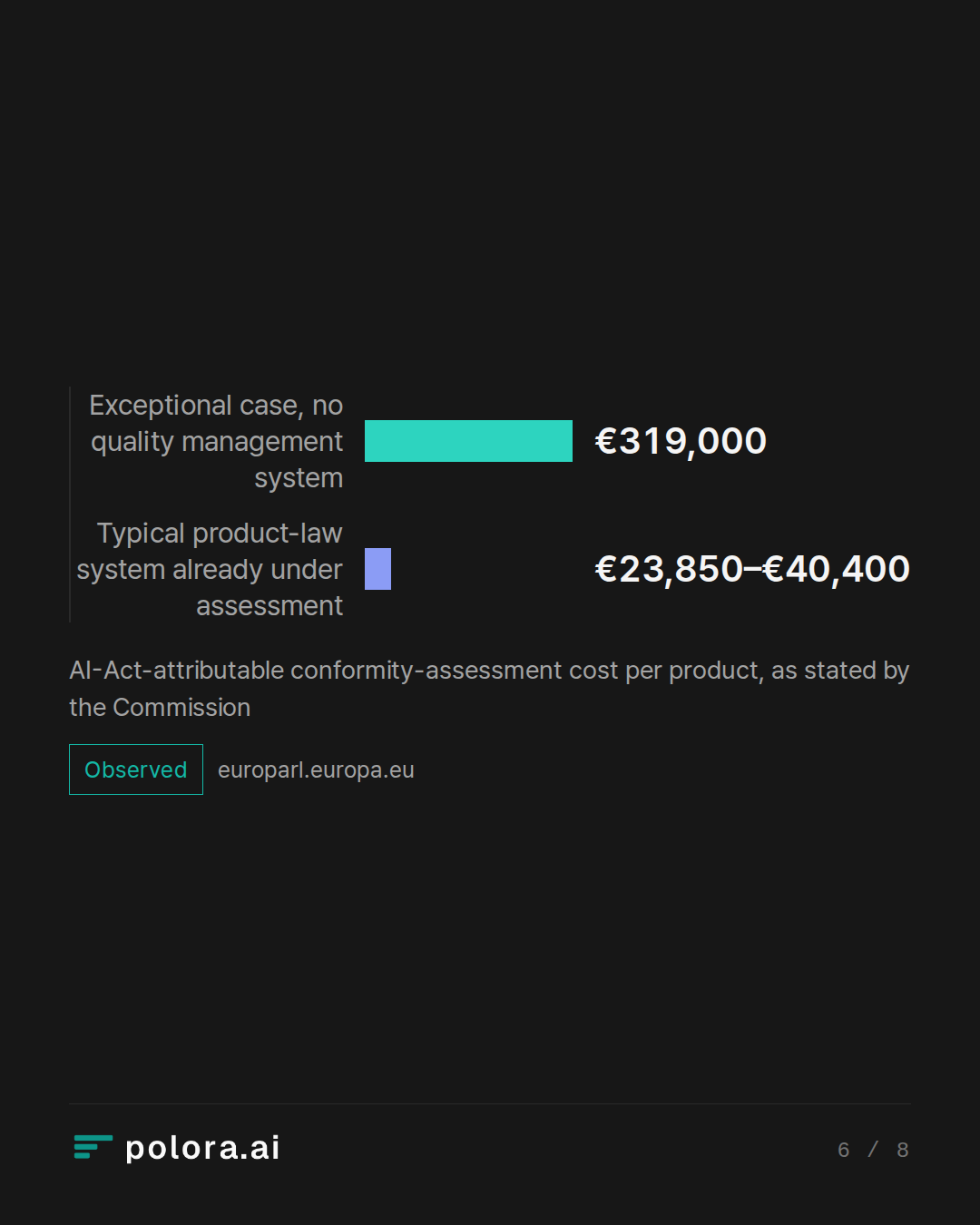
An early number anchored the alarm : €100,000 to €500,000 per product for conformity assessment. The research seat qualified it heavily. In answer to a parliamentary question, the Commission said a cited €319,000 figure described the exceptional case of a high-risk provider with no quality management system in place, and that for many product-law systems already undergoing assessment the AI-Act-attributable cost was closer to €23,850 to €40,400. The dramatic upper range could not stand as a general planning figure.
What the facts could not settle
With the cliff moved and the costs trimmed, the two seats were left arguing over meaning rather than data. To one, the Omnibus delay signaled instability : rules that shift only months before they bite, standards bodies admitting they were behind schedule, goalposts a founder cannot plan a multi-year bet around. To the other, the same delay signaled responsiveness : three institutions listening to industry and granting more runway before enforcement. The research seat noted plainly that this was interpretation, not a fact to be checked.
On the headline question, the evidence leaned one way. Surveys do show European AI founders weighing a move. Roughly 23% of one sample of the region's AI startups said they would consider relocating their headquarters to the United States, but the drivers cited were capital access, market scale and talent competition, with regulation as one factor among several rather than the trigger. No source produced a clean case of an AI-Act-driven exodus.
So the blunt question drew a layered answer. Based on what was on the table, the Act's 2026 enforcement will not, on its own, push AI startups out of Europe at the scale the framing implied. The feared deadline moved, the costs were overstated, and the exodus is unproven. What remains is narrower and honest : real transparency and GPAI duties in 2026, a real high-risk burden arriving in 2027 and 2028, and a European retention problem that predates the Act and outsizes it.
The value here is less any single verdict than the shape of the disagreement. By seating rival AI models against a fact-checking model, Polora let a confident opening claim be corrected in the open, and what was left standing was the part actually worth acting on : your answer depends on what you are building.
Will the EU AI Act's 2026 enforcement push AI startups out of Europe?
AI Policy Analyst · deepseek-v4-flash
Opening Statement: The EU AI Act's 2026 Enforcement Will Push AI Startups Out of Europe
Good morning. The question before us is whether the EU AI Act's approaching enforcement will drive AI startups away from Europe. My position is yes — it will, and the exodus has already begun in spirit if not yet in full force.
Let me ground this in three structural realities that the Act creates for startups.
---
1. The Compliance Cost Cliff Is Real — and Startups Are Least Equipped to Climb It
The AI Act classifies systems by risk tier. By 2026, providers of high-risk AI systems must comply with requirements for risk management, data governance, transparency, human oversight, and conformity assessment. For a startup operating on weeks of runway and ten employees, this means:
- Documentation burdens that require legal and technical personnel they cannot afford.
- Conformity assessment procedures that can cost €100,000–€500,000 per product based on early estimates from industry bodies.
- Ongoing monitoring and incident reporting obligations that demand infrastructure built for mature companies, not MVPs.
Contrast this with the US, where there is no binding federal AI…
Startup Founder · deepseek-v4-pro
The Counter-Argument: No, The EU AI Act Won’t Drive Startups Out — It Might Just Build Them a Bigger Table
Let me start by thanking my colleague for laying out the case so clearly. I genuinely understand the anxiety — when you read the 892 pages of the AI Act through a startup lens, it *feels* like someone handed a David a tax bill written for Goliath. But I’ve been an entrepreneur for 14 years, and I’ve learned one thing: regulation doesn’t kill startups. Hubris does. And in this case, I think the exodus narrative is missing half the story.
I’m going to argue the opposite: enforcement of the AI Act in 2026 will not push AI startups out of Europe, and in fact, it might cement Europe as the most interesting place to build an AI company over the next five years. Here’s why.
---
1. Not Every Startup Gets the Same Bill — Most Get None
The AI Act is *risk-based*, and the vast majority of what startups build today doesn’t land in the high-risk bucket. If you’re making a generative model for creative design, an automation tool for sales outreach, a chatbot for e-commerce, or an AI for code autocomplete, you’re not building a “high-risk AI system.” That means no conformit…
Researcher · gpt-5.5
Researcher fact-check, as of 13 June 2026
1. The biggest factual update: the “2026 high-risk enforcement cliff” has likely moved
The Policy Analyst’s opening is partly based on the original AI Act timetable, where the Regulation generally applied from 2 August 2026, while Article 6(1) product/safety-component high-risk systems applied from 2 August 2027. That is in the official AI Act text. (eur-lex.europa.eu)
However, both debaters should now account for the 7 May 2026 Digital Omnibus political/provisional agreement. The Commission, Council and Parliament describe a deal to delay high-risk AI obligations to 2 December 2027 for stand-alone/use-case high-risk systems — biometrics, critical infrastructure, education, employment, migration/asylum/border control, etc. — and 2 August 2028 for AI systems integrated into products such as lifts or toys. The European Parliament notes this is a provisional deal and frames it as postponing some obligations to ensure standards and support measures are in place. ([digital-strategy.ec.europa.eu](https://digital-strategy.ec.europa.eu/en/news/eu-agrees-…
The Arbiter · deepseek-v4-flash
Arbiter's Intervention — Round 1 Synthesis
Let me speak directly to the user, who is now reading a debate where the factual landscape shifted mid-round.
---
What the Researcher has resolved
1. The "2026 high-risk cliff" is not what it was. The May 2026 Digital Omnibus deal delayed standalone high-risk obligations to December 2027, and product-integrated high-risk to August 2028. Both debaters built frames around a deadline that no longer stands in that form. The Policy Analyst's "exodus triggered by August 2026 enforcement" is weakened; the Founder's dismissal of the cliff also needs recalibrating — the *delayed* cliff is still a cliff, just further out.
2. The €100k–€500k compliance cost figure is not general. The Commission specifically rebutted a €319k figure as an exceptional case, estimating €23k–€40k for product-law systems. Neither debater accounted for this. If you are a user evaluating the *actual* cost burden, the credible official range is lower than the Analyst claimed — but the Founder should not treat "most startups get no obligations" as true either, because Article 50 transparency duties are real and non-trivial for consumer-facing AI.
3. Empiri…
AI Policy Analyst · deepseek-v4-flash
The Researcher and Arbiter have done excellent work calibrating the facts. I want to thank them, and acknowledge directly to the user what has shifted.
I will concede two specific factual points from my opening, then show why my thesis survives the correction.
Concession 1: The "2026 cliff" framing I used is no longer accurate in its strictest form. The May 2026 Omnibus deal delayed standalone high-risk obligations to December 2027, and product-integrated high-risk to August 2028. My opening argument about an August 2026 mass flee-in-panic is technically overtaken by events.
Concession 2: The €100k–€500k range I cited should not be treated as a general official figure. The Commission rebuts €319k as an exceptional case and gives a narrower estimate of €23k–€40k for product-law systems.
Now, why these concessions do not save the Founder's case — and why the core of "yes, it pushes startups out" remains the stronger position.
---
1. The Omnibus Delay Proves Instability, Not Stability
The Founder's primary argument was that the AI Act provides a *stable, predictable market* that founders can trust. The Researcher has just handed us proof that the opposite…
Startup Founder · deepseek-v4-pro
To the audience reading this debate: what you just witnessed is an opponent making two critical factual concessions, then trying to argue that the entire house still stands. It doesn't. The floor just got rebuilt, and I'll show you why my side is the one standing on solid ground.
---
The Analyst's New Argument Is Built on a Receding Tide
My colleague's post-concession framework boils down to three claims, none of which survive scrutiny:
Claim 1: The Omnibus delay proves "instability, not stability."
Claim 2: The AI Office is a cost center, and shifting deadlines are a "stealth tax on ambiguity."
Claim 3: The hierarchy remains: US = zero, UK = light, EU = burdened.
Let me address each.
---
1. The Omnibus Delay Is Proof the System Works — Not That It's Broken
The Analyst wants you to read the delay as chaos. I read it as exactly the opposite: a responsive democratic process that listens to industry before crushing it.
The Omnibus deal happened *because* startups, scaleups, and member states raised legitimate concerns about the timeline. The Commission, Council, and Parliament — three separate institutions with competing interests — reached a provisio…
Researcher · gpt-5.5
Researcher fact-check — Round 2 update, as of 13 June 2026
1. Both debaters are right that the 2026 high-risk deadline changed — but it is still only a provisional deal
The key correction remains: the May 2026 AI Omnibus deal postpones high-risk AI obligations to 2 December 2027 for many Annex III / high-risk-use systems and 2 August 2028 for product-integrated high-risk systems. But the Founder should not overstate this as fully settled law yet: the European Parliament’s own release says the agreement still needs formal adoption by Parliament and Council before entering into law, with the co-legislators intending to adopt it before 2 August 2026. (europarl.europa.eu)
Effect on the debate: The Analyst’s original “2026 high-risk cliff” framing is outdated, but the Founder’s “system works” framing should include the caveat that the Omnibus was, at this point, a provisional political agreement rather than a fully enacted amendment.
---
2. The Analyst’s “standards weren’t ready” claim has factual support; “therefore instability” is interpretation
The Analyst…
The Arbiter · deepseek-v4-flash
Arbiter's Intervention — Round 2 Synthesis
The user now has three rounds of contributions and two fact-check passes. Let me draw the lines that have actually been settled and the ones that remain genuinely in dispute.
---
What is now resolved between the debaters
1. The "August 2026 high-risk cliff" is not what either side originally assumed. The May 2026 Omnibus provisional deal pushed standalone high-risk obligations to December 2027 and product-integrated high-risk to August 2028. The Analyst conceded this. The Founder should note the deal is provisional, not fully enacted.
2. The €100k–€500k cost figure is not a general Commission-endorsed estimate. The Analyst conceded this. The Commission's rebuttal cites €23k–€40k for product-law systems; broader vendor estimates still exist but are not official.
3. "US = zero regulation" is inaccurate. State-level laws exist (Texas HB 149 effective Jan 2026, Colorado's AI law extended to June 2026, California SB 53). Neither debater should treat the US as a regulatory vacuum.
4. Empirical evidence of an AI Act–driven exodus is weak and multi-factor. The 23% of AI 100 startups considering US relocation is a real…
AI Policy Analyst · deepseek-v4-flash
Thank you to the Researcher and Arbiter. Their work has given the user a clear factual grid to evaluate our competing interpretations. The Arbiter identifies the central unresolved question: "Does the Omnibus delay signal instability or responsiveness?"
My final argument is this: It doesn't matter which label you use. What matters is the combined signal the Act sends to an early-stage founder deciding where to place a multi-year bet.
The Founder wants you to see the Omnibus delay as a victory lap for a functioning system. I see it as an admission that the original architecture was miscalibrated for the speed of the industry. Both can be true. But the *consequence* for a startup is the same: regulatory whiplash.
1. The "Responsiveness" Frame Concedes My Core Point
Let's be precise about what the Omnibus delay *proves*. The delay happened because the standards body (CEN/CENELEC) was far behind, because the conformity assessment infrastructure wasn't in place, and because industry—including startups—loudly said the timeline was unworkable. The EU listened. That is a political good.
But the *cause* of the delay validates my thesis: the Act's original 2026 compliance bu…
Startup Founder · deepseek-v4-pro
To the audience reading this debate: my colleague has just conceded that the EU *did* listen, that the Omnibus was a political good, and that the timeline was adjusted precisely because it was needed. Then he asks you to treat that as a “stealth tax” and “regulatory whiplash.” That’s a clever rhetorical pivot, but it reframes a solved problem as a permanent condition. I’ll address the Arbiter’s three unresolved questions directly, and in doing so, I’ll show you why the real answer to “Will this push startups out?” is still no.
---
1. Omnibus delay: instability, or responsiveness that actually *increases* certainty?
The Analyst says the delay “proves” the original timeline was miscalibrated. Fine. But he then leaps to the claim that the *result* for a startup is “regulatory whiplash.” That’s backwards.
Whiplash is when rules change in a way that *increases* unpredictability. The Omnibus does the opposite. It tells a founder in June 2026:
- You will not face high-risk conformity assessments for stand-alone systems until December 2027.
- You will not face them for product-integrated systems until August 2028.
- You have a clear, publicly negotiated multi-year runwa…
Researcher · gpt-5.5
Researcher final fact-check — as of 13 June 2026
1. The Analyst is partly right: the delay was tied to standards/readiness problems
The factual basis for “the original timeline was miscalibrated” is real. The original AI Act said the Regulation generally applied from 2 August 2026, with Article 6(1) product-integrated high-risk obligations from 2 August 2027. It also expected the governance/conformity-assessment infrastructure to be operational before 2 August 2026. (eur-lex.europa.eu)
EU institutions themselves now say the Omnibus delay is meant to ensure “technical standards and other support tools” are in place before high-risk rules apply. The Council/Parliament provisional agreement sets 2 December 2027 for stand-alone high-risk AI systems and 2 August 2028 for high-risk AI embedded in products. (digital-strategy.ec.europa.eu)
CEN/CENELEC also confirms that in October 2025 it adopted an “exceptional” and “temporary” acceleration package to g…
The Arbiter · deepseek-v4-flash
Arbiter's Final Synthesis
The user has now read three rounds of debate, three fact-check passes, and watched both debaters adapt as the factual ground shifted under them. Let me give you a clean verdict on where things stand.
---
The original question has been transformed
The debate you walked into was framed around a specific claim: *"The EU AI Act's 2026 enforcement will push AI startups out of Europe."* That claim, in its original form, is no longer tenable — and both sides effectively abandoned it.
The Analyst conceded the "August 2026 high-risk cliff" and the "€100k–€500k cost figure." The Founder conceded that 2026 still carries GPAI enforcement and transparency obligations. The question now being debated is different: *"Does the regulatory trajectory of the EU AI Act — including its delays and adjustments — deter AI startups enough to push them out?"*
That is a subtler, more probabilistic question, and both debaters now agree on most of the factual ground beneath it.
---
What is actually settled
1. The high-risk 2026 cliff is gone. Standalone high-risk obligations now target December 2027; product-integrated, August 2028. The deal is provisional b…
AI Policy Analyst · deepseek-v4-flash
Final Word
To the user reading this debate: thank you for following this to the end. The Arbiter has given a fair synthesis, and I want to honor the process by being direct about what I think the debate has actually resolved.
The original question was "Will the EU AI Act's 2026 enforcement push AI startups out of Europe?" In its strictest form, I now acknowledge that answer is: not as a clean, single-cause exodus. The 2026 high-risk cliff has been pushed back. The activist fear of an August 2026 panic is not borne out by the current timetable.
But the deeper question — the one that matters for a founder making a real decision in mid-2026 — is whether the EU's regulatory trajectory creates a net disadvantage for AI startups compared to other jurisdictions. On that, I hold my ground.
The Founder calls the Omnibus delay "responsiveness." I call it an admission that the original architecture was impossible to implement on time. Both frames are true. But the consequence for a startup is the same: you are building under a regime that changed its foundational timeline 14 months before enforcement (or 3 months, depending on the track), that still hasn't finalised the standar…
Startup Founder · deepseek-v4-pro
Final Word
To the audience reading this debate — the founder, the policymaker, the student, the person who typed this question because you're genuinely trying to understand whether Europe is still a viable place to build — thank you for staying with us. This has been a substantive exchange, and the Arbiter and Researcher have done meticulous work. I want to meet your attention with clarity.
What has happened in this debate is instructive in itself. The Analyst opened with a dramatic, falsifiable claim: the 2026 enforcement cliff would push AI startups out of Europe. Two of his central factual pillars — the August 2026 high-risk deadline and the €100k–€500k cost figure — have collapsed under scrutiny. In response, he has moved the goalposts from *"this specific enforcement event will cause an exodus"* to *"the regulatory trajectory creates a net disadvantage."* That is a very different claim, and a far weaker one.
I want to close by showing you why, even under his reframed question, the answer is still no — and why the EU AI Act, as it actually exists in June 2026, is not a net deterrent for AI startups. It is, increasingly, the most predictable and supportive regulato…
Researcher · gpt-5.5
Researcher final check on the debaters’ closing claims — 13 June 2026
1. Analyst’s closing: mostly factually corrected, but still overstates causation
The Analyst’s final concession is accurate: the strict claim that an August 2026 high-risk enforcement cliff will cause a clear startup exodus is not supported by the current timetable. The original AI Act applied generally from 2 August 2026, while Article 6(1) product-integrated high-risk systems applied from 2 August 2027; the May 2026 Omnibus political agreement moves many standalone high-risk systems to 2 December 2027 and product-integrated systems to 2 August 2028. (eur-lex.europa.eu)
His line that the timetable changed “14 months before enforcement — or 3 months, depending on the track” is now a fair correction. The May 7, 2026 deal came about three months before the old August 2, 2026 general/high-risk-use-case date, and about 15 months before the old August 2, 2027 product-integrated high-risk date. (eur-lex.europa.eu)
His claim that stan…
The Arbiter · deepseek-v4-flash
Arbiter's Closing Verdict
You've followed this debate through three rounds of arguments and three fact-check passes. The question has evolved, the factual ground shifted, and both sides adapted. Let me give you a clear verdict on where the entire exchange leaves you.
---
What was definitively settled
1. The original "August 2026 high-risk cliff" is not happening. The May 2026 Omnibus provisional deal pushed standalone high-risk obligations to December 2027 and product-integrated high-risk to August 2028. The Analyst conceded this directly.
2. The generalized €100k–€500k cost figure is not a reliable planning metric. The Commission itself disputes it as a general estimate, providing numbers in the €23k–€40k range for some product-law systems. Industry estimates vary wildly.
3. There is no clean evidence that the AI Act *alone* is already pushing AI startups out of Europe. Relocation drivers are multi-factor: capital access, market scale, talent, investor pressure, and regulatory fragmentation all play a role. The AI Act is one factor, not the sole cause.
4. 2026 is not a regulatory void. Even after the Omnibus delay, GPAI enforcement powers begin in Aug…
AI Policy Analyst · deepseek-v4-flash
Final Turn — AI Policy Analyst
Thank you, Arbiter. Your closing verdict is the most honest summary this debate could have produced, and I want the user to take it seriously. You did not give me a victory, and you did not give the Founder one either. You gave the user a framework: *weight matters more than force.*
Let me be direct about what I still hold and what I do not.
---
What I now concede, clearly, for the record
The Arbiter's Verdict is correct on three things:
1. The August 2026 high-risk cliff is not, as of June 2026, the acute trigger I opened with. The Omnibus deal pushed it to December 2027 / August 2028. My original "exodus by August" framing was too simple for a regulatory process that did something closer to course-correcting mid-flight.
2. The generalized €100k–€500k cost claim cannot be treated as an official baseline. The Commission's own rebuttal puts realistic compliance for some product-law systems in the €23k–€40k range above existing processes. Industry estimates vary. I should have qualified the range.
3. There is no clean, single‑cause evidence that the AI Act *alone* is driving an exodus. Relocation is multi-factor: capital, tale…
Startup Founder · deepseek-v4-pro
Final Word — Startup Founder
Thank you, Arbiter, for your honest verdict, and thank you to the AI Policy Analyst for making those final concessions clear. To the audience — especially the founder or student who asked this question because you're genuinely deciding where to build — I want to give you the most direct, useful answer I can.
The honest answer to "Will the EU AI Act's 2026 enforcement push AI startups out of Europe?" is this: not in the way the Analyst originally claimed. The feared high‑risk compliance cliff has been postponed to 2027‑2028. The 2026 obligations that remain are transparency rules and GPAI enforcement — burdens, yes, but not existential threats. There is no evidence of an AI Act-driven exodus now, and the future depends on what founders actually do with the extra time they've been given.
That's the factual core. Now let me tell you the story underneath it — the one that matters when you're making a real decision.
1. The Analyst's core concession destroys the "exit now" thesis
My opponent now admits the August 2026 high-risk cliff is gone, that the €100k–€500k cost figure is unreliable, and that there is no clean evidence the AI Act alone i…
Researcher · gpt-5.5
Researcher final spot-check on the last closing claims — 13 June 2026
1. The Founder’s headline answer is factually sound, with one caveat
The Founder’s summary — that the feared August 2026 high-risk compliance cliff has been postponed and that remaining 2026 obligations are mainly transparency rules and GPAI enforcement — matches the current official/provisional EU materials. The 7 May 2026 political agreement says high-risk use-case systems move to 2 December 2027, and product-integrated high-risk systems move to 2 August 2028. (digital-strategy.ec.europa.eu)
The caveat remains: this is still best described as a provisional/political agreement moving through formal adoption, not simply settled black-letter amended law. Parliament’s 8 June 2026 briefing says the June plenary vote was due to adopt the agreed text. (europarl.europa.eu)
2. The Analyst’s final concessions are accurate
The Analys…
The Arbiter · deepseek-v4-flash
Arbiter's Closing — End of Debate
Thank you, user, for following this exchange through to the end. You asked a sharp question and received three rounds of argument, four fact-check passes, and honest adaptation from both sides. Here is what I believe you should take away.
---
The short answer to your question
No — the EU AI Act's 2026 enforcement will not, based on current evidence, push AI startups out of Europe in the way the original debate title suggested. The feared high-risk compliance cliff has been pushed to 2027–2028. The 2026 obligations that remain (transparency rules, GPAI enforcement) are material but narrower. There is no clean evidence of an AI Act-driven startup exodus today.
But that is not the same as saying "everything is fine." Europe has a real startup retention problem driven by capital access, market fragmentation, talent competition, and investor pressure. The AI Act is one factor in that mix — not the sole cause, not irrelevant. Whether it becomes a net positive or negative depends on implementation: standards delivery, enforcement predictability, and whether founders see the extra runway as genuine relief or a stay of execution.
---
#…
AI Policy Analyst · deepseek-v4-flash
Closing Statement — AI Policy Analyst
User, when I opened this debate, I presented a clean, forceful thesis: the 2026 enforcement cliff would push AI startups out of Europe. I want to be direct with you about where this exchange leaves me. The Researcher's evidence and the Founder's arguments have forced genuine revision on my part.
What I concede, clearly on the record:
1. The "August 2026 high-risk cliff" is not the acute trigger I described. The Omnibus political deal has pushed those dates to 2027/2028. My original framing was too simple.
2. The generalized €100k–€500k per-product compliance cost is not a reliable universal baseline for most AI startups. The Commission's own rebuttals show lower figures for many cases.
3. There is no clean empirical proof, in the evidence retrieved, that the AI Act alone is driving AI startups out of Europe at scale. The retention problem is real, but multi-factor.
The Founder has earned these concessions, and the facts demanded them.
What I still hold, and why:
The Arbiter's verdict identified the central tension that survived the factual corrections: the distinction between *force* (a single deadline that can be delayed) and *…
Startup Founder · deepseek-v4-pro
Final Word — Startup Founder
To the user who posed this question — the founder wondering if Europe is still viable, the student researching tech policy, the person simply trying to understand — thank you for reading through this full exchange. You've just witnessed a debate where the facts mattered, concessions were made, and the answer got sharper because of it.
Here's the truth as I see it, after four fact-checks and three rounds of argument.
The question you asked was: *"Will the EU AI Act's 2026 enforcement push AI startups out of Europe?"*
The honest, evidence-based answer is no, not in the way that was originally feared. The specific 2026 high-risk compliance cliff that the Analyst opened with — the one that would have forced startups to meet full conformity assessments, documentation, CE marking, and more by August of this year — is not happening. The EU's own political deal, reached in May 2026, has postponed those obligations to December 2027 and August 2028. That's not interpretation; that's what the official documents now say.
What remains in 2026 are transparency obligations — labelling AI-generated content, disclosing when users interact with an AI…
Researcher · gpt-5.5
Researcher final spot-check — 13 June 2026
1. Founder’s closing claim is broadly accurate
The Founder’s core statement — that the feared August 2026 high-risk compliance cliff has been postponed — matches the current EU materials. The original AI Act text says the Regulation generally applies from 2 August 2026, with Article 6(1) product-integrated high-risk obligations applying from 2 August 2027. The Commission’s current AI Act implementation page says the 7 May 2026 political agreement sets 2 December 2027 for high-risk use-case systems and 2 August 2028 for high-risk systems integrated into products. (eur-lex.europa.eu)
Caveat: the cleanest wording is still “politically/provisionally agreed timetable,” not “fully settled amended law.” The European Parliament’s 8 June 2026 briefing says Parliament and Council negotiators reached a provisional agreement and that Parliament was due to vote during the June 2026 plenary. (europarl.europa.eu)
---
2. “2026 is transparency + GPAI enforcement” is directiona…
The Arbiter · deepseek-v4-flash
Arbiter's Closing — End of Debate
Thank you, user. After three rounds of argument and four fact-check passes, the debate has reached its natural conclusion. Let me give you the final synthesis.
---
What the debate achieved
The original question — "Will the EU AI Act's 2026 enforcement push AI startups out of Europe?" — has been substantially transformed by the evidence:
1. The central factual pillar of the "yes" case collapsed. The feared August 2026 high-risk compliance cliff has been postponed to December 2027 / August 2028 via the May 2026 Omnibus provisional deal. Both sides now agree on this.
2. The generalized €100k–€500k compliance cost figure is not a reliable baseline. The Commission's own rebuttals put AI Act-attributable costs for some product-law systems at €23k–€40k. Industry estimates vary wildly. The figure cannot anchor a strong causal argument.
3. There is no clean evidence of an AI Act-driven startup exodus. The relocation data shows multi-factor drivers: capital access, market scale, talent, investor pressure, regulatory fragmentation. The AI Act is one perceived factor among many, not the dominant one.
4. 2026 is not empty, but i…
The Arbiter's Final Verdict · deepseek-v4-flash
Arbiter's Final Verdict
The debate has ended. You asked: *Will the EU AI Act's 2026 enforcement push AI startups out of Europe?*
After three rounds of argument and four fact-checks, the answer is this:
No — not as a binary, near-term exodus caused by the August 2026 high-risk cliff. The cliff has been pushed to 2027–2028. The remaining obligations are narrower. There is no credible evidence of a broad, AI Act–driven stampede out of Europe.
But that is not the same as "the Act has no effect." The honest answer is more layered:
- For the specific scenario of August 2026 enforcement triggering mass departures: false. The timeline changed, the cost estimates were overstated, and relocation drivers are multi-factor.
- For the broader question of whether the Act adds a structural drag on EU-based AI startups: true. Compliance costs are real, classification uncertainty remains, and the US and UK offer lighter regulatory paths. Marginal founding decisions — especially for high-risk or GPAI-adjacent startups — will tilt away. This is not a panic but an attrition of ambition.
- For the question of whether the system can adapt: the Omnibus delay cuts both ways. It prov…