A savings account pays 0.5%. The same bank earns 1.25% on spare cash
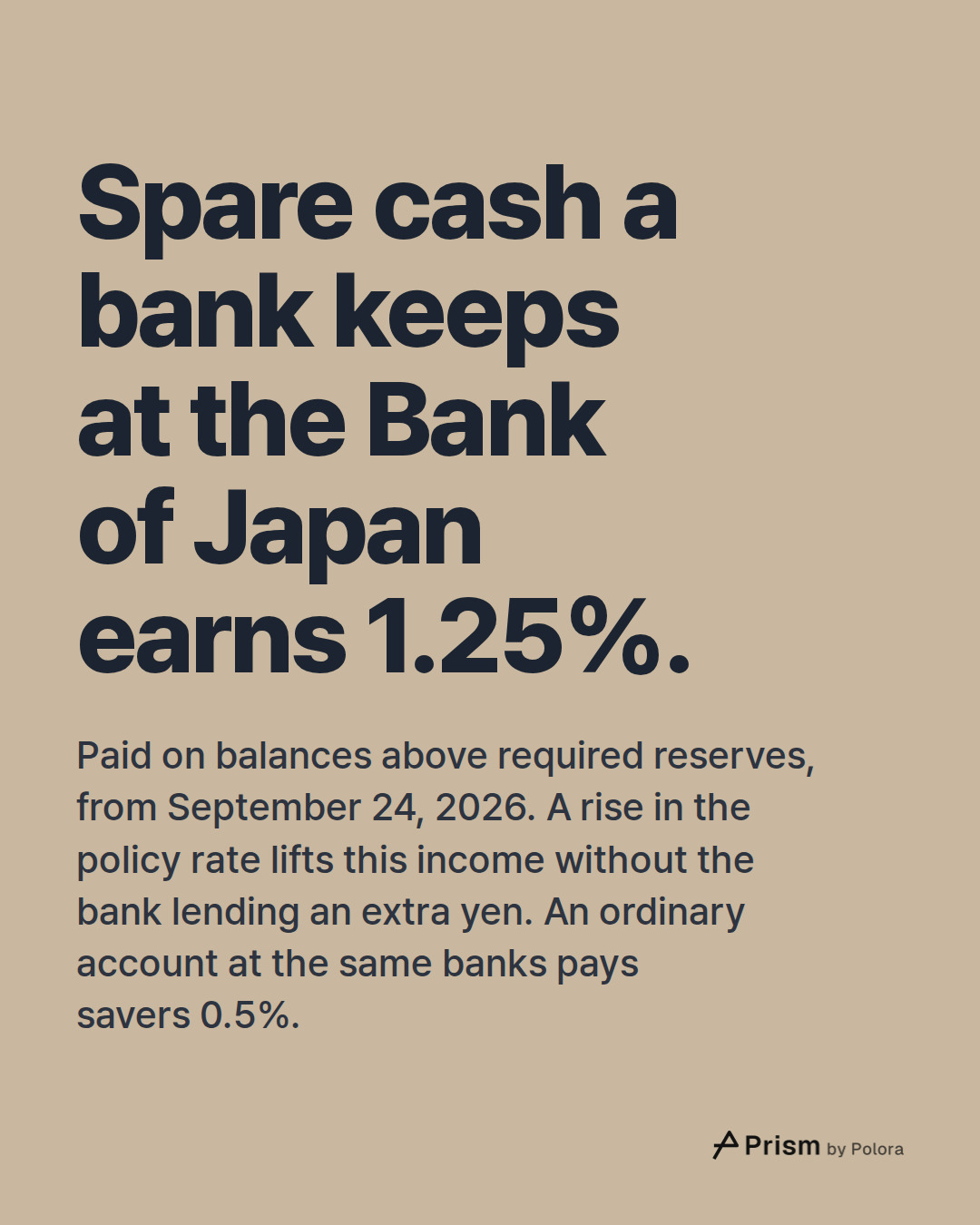
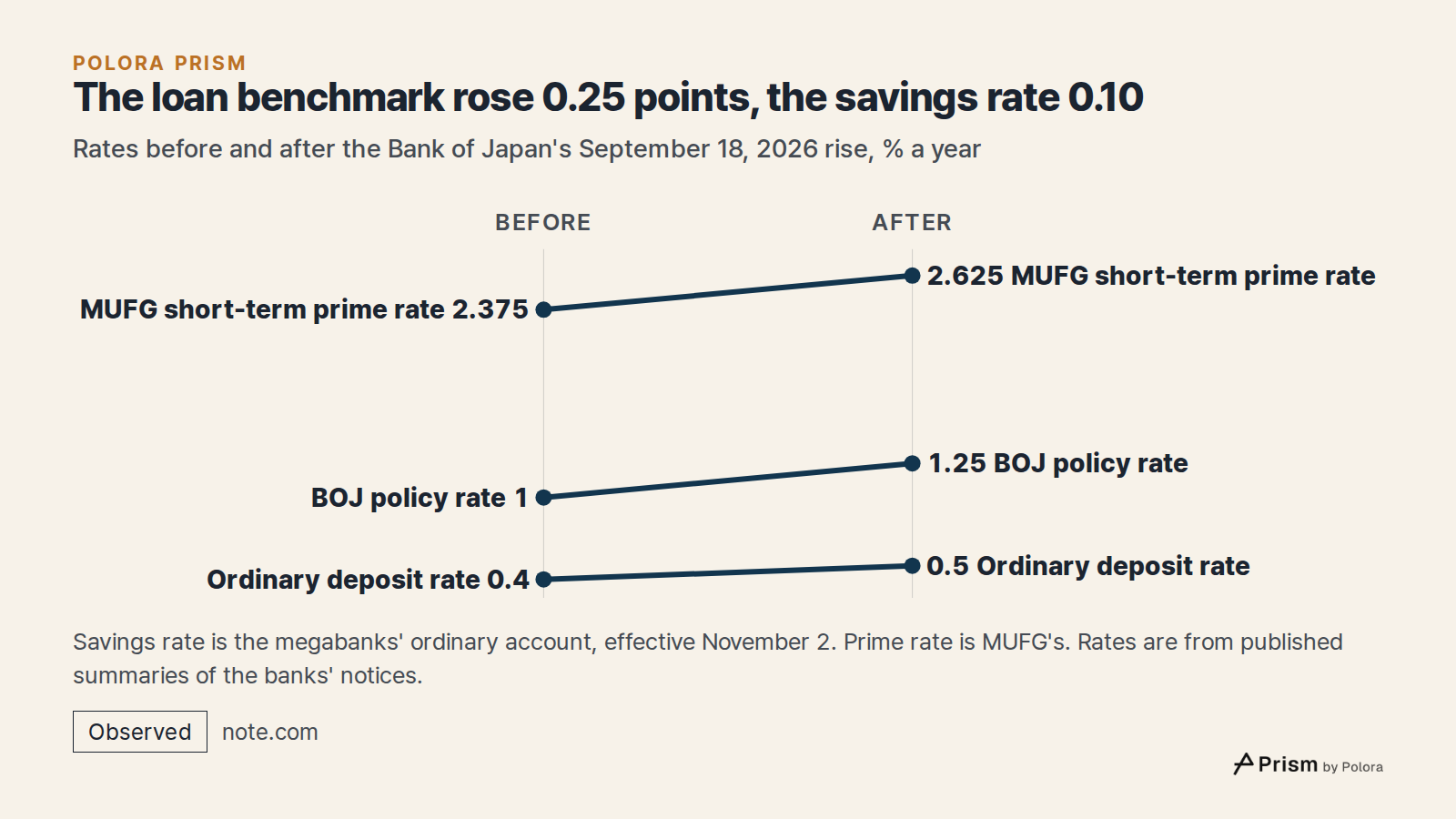
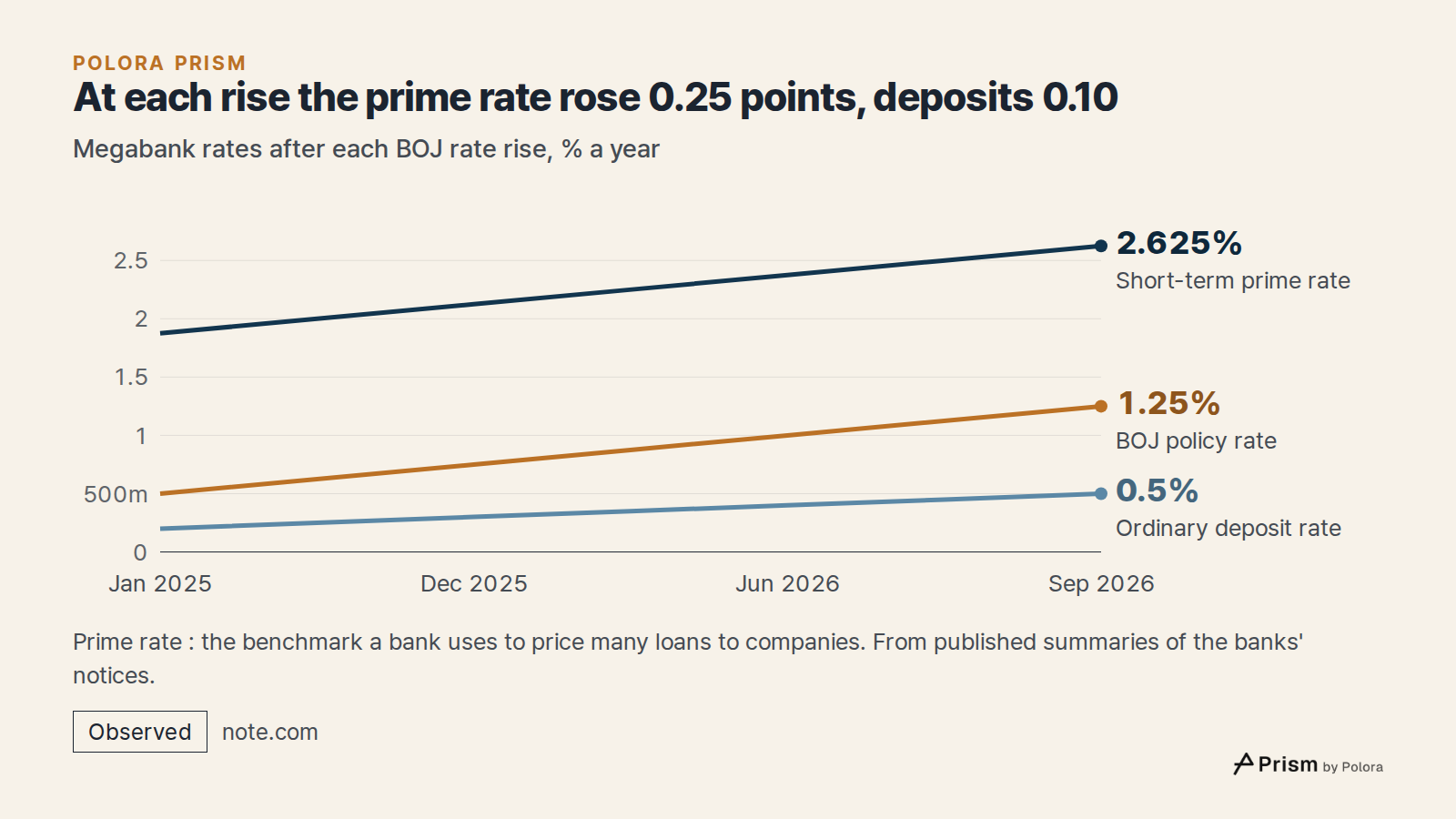
If you keep money in an ordinary account at one of Japan's three biggest banks, MUFG, Sumitomo Mitsui (SMFG) or Mizuho, it now earns 0.5% a year, according to published summaries of the banks' rate notices. That rate took effect on November 2, 2026, up from 0.4%. The banks announced it on September 18, the day the Bank of Japan (BOJ), the central bank, raised its policy rate from 1.0% to 1.25%.
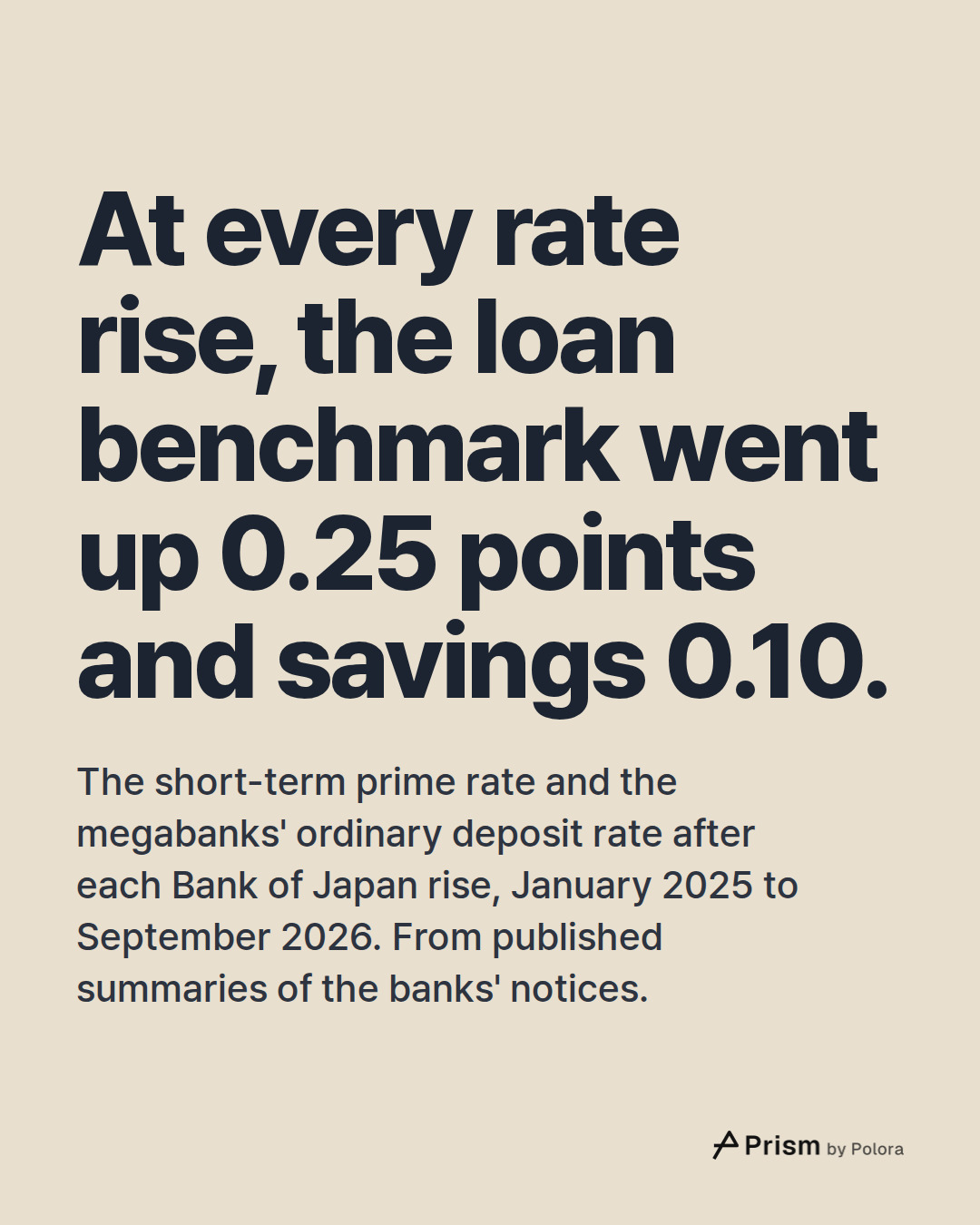
On the same day, MUFG also raised its short-term prime rate, the benchmark it uses to price many loans to companies and a reference point for variable-rate mortgages. That rate went from 2.375% to 2.625%. The deposit rate went up 0.10 points and the lending rate 0.25 points, two and a half times as much.
Those two numbers point to the main mechanism behind the record profits in the banks' latest filings. They do not explain all of those profits, and the profits come with conditions.
A bank's money moves at three different speeds
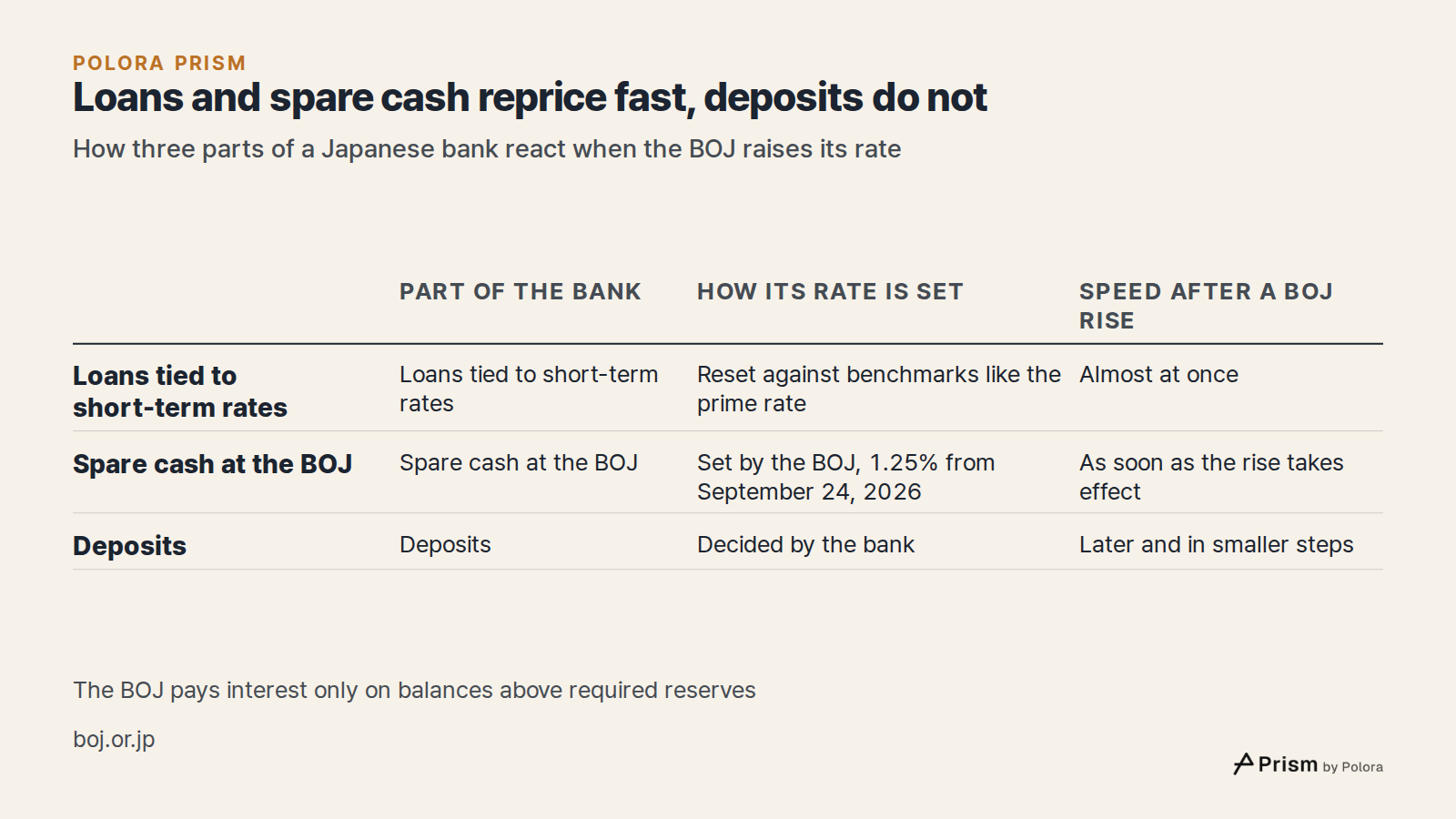
Think of a bank as three parts that react to a rate rise at different speeds.
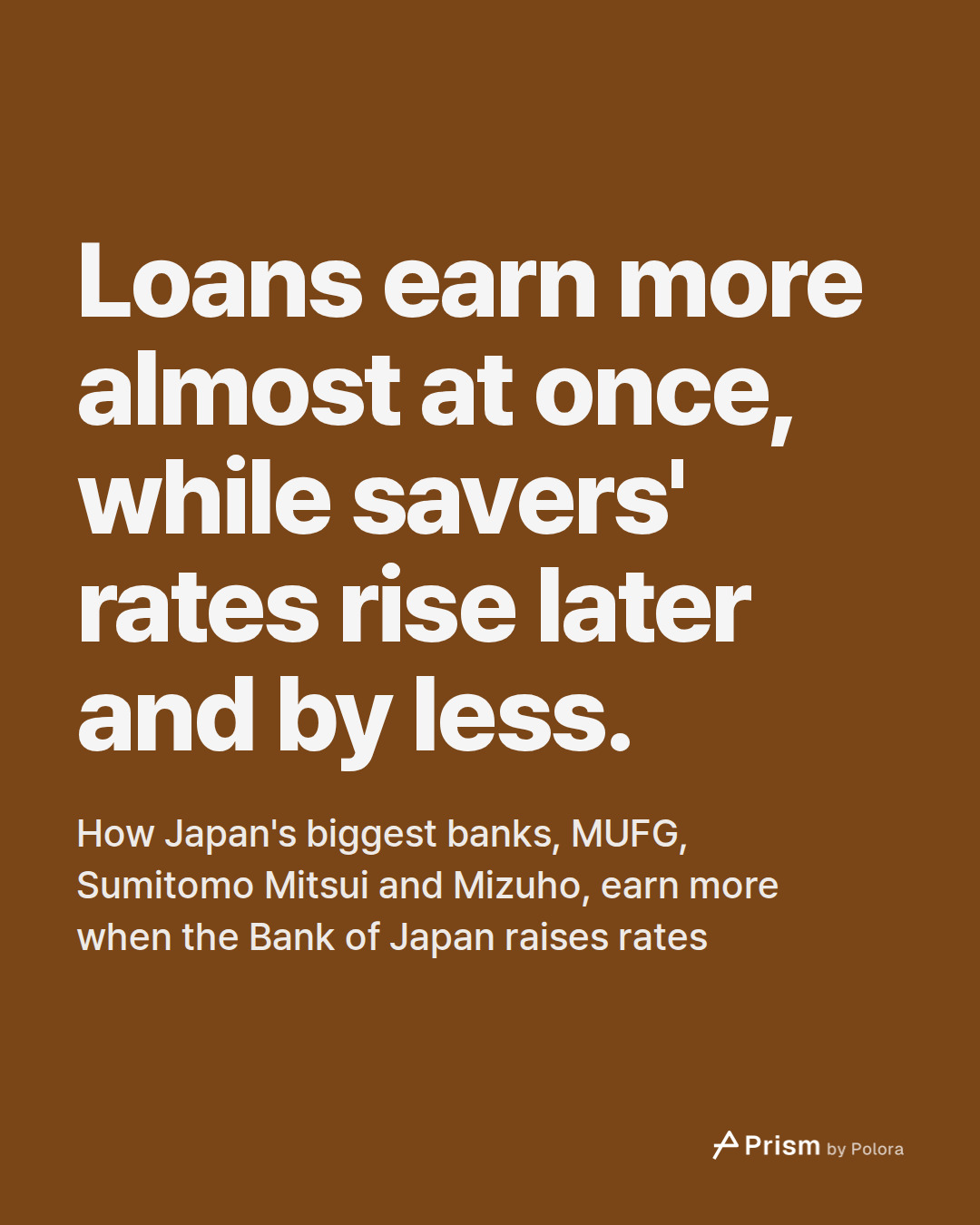
The first is loans tied to short-term rates. Their interest is reset against benchmarks like the prime rate, so when the BOJ moves, those loans start paying more almost at once.
The second gets less attention. Banks keep spare cash in accounts at the BOJ, and the BOJ pays interest on the balances above the reserves they are required to hold, not on every yen they keep there. In its September decision the BOJ set that rate at 1.25%, the same as its policy rate, effective September 24, 2026. A rise in the policy rate therefore lifts this income as soon as it takes effect, without the bank lending an extra yen.
The third is deposits, which is what the bank pays out. Here the bank decides when and by how much to move, and the record so far shows it moving later and in smaller steps.
Deposit rates have trailed loan rates at every rate rise
The pattern has repeated. After the BOJ raised its rate to 0.5% in January 2025, the megabanks lifted ordinary deposits from 0.1% to 0.2% and the short-term prime rate from 1.625% to 1.875%. After the move to 0.75% in December 2025, deposits went to 0.3% and the prime rate to 2.125%. After the move to 1.0% in June 2026, deposits went to 0.4% from August 3. Then came this autumn's rise, to 0.5% for deposits. These dates and rates come from published summaries of the banks' notices rather than from the notices themselves.
Each time, the prime rate rose 0.25 points, matching the BOJ. Each time, the ordinary deposit rate rose 0.10 points. The new deposit rates also took effect weeks after the BOJ's decisions. On that timeline, MUFG's ordinary deposits paid 0.3% and then 0.4% during the half from April to September 2026, while the policy rate stood at 1.0% and then 1.25%.
Banks can do this because most savers do not move their money when a rate changes by a tenth of a point. Moving costs time, and the ordinary account is where wages land and bills are paid.
What the half-year filings to September 2026 show
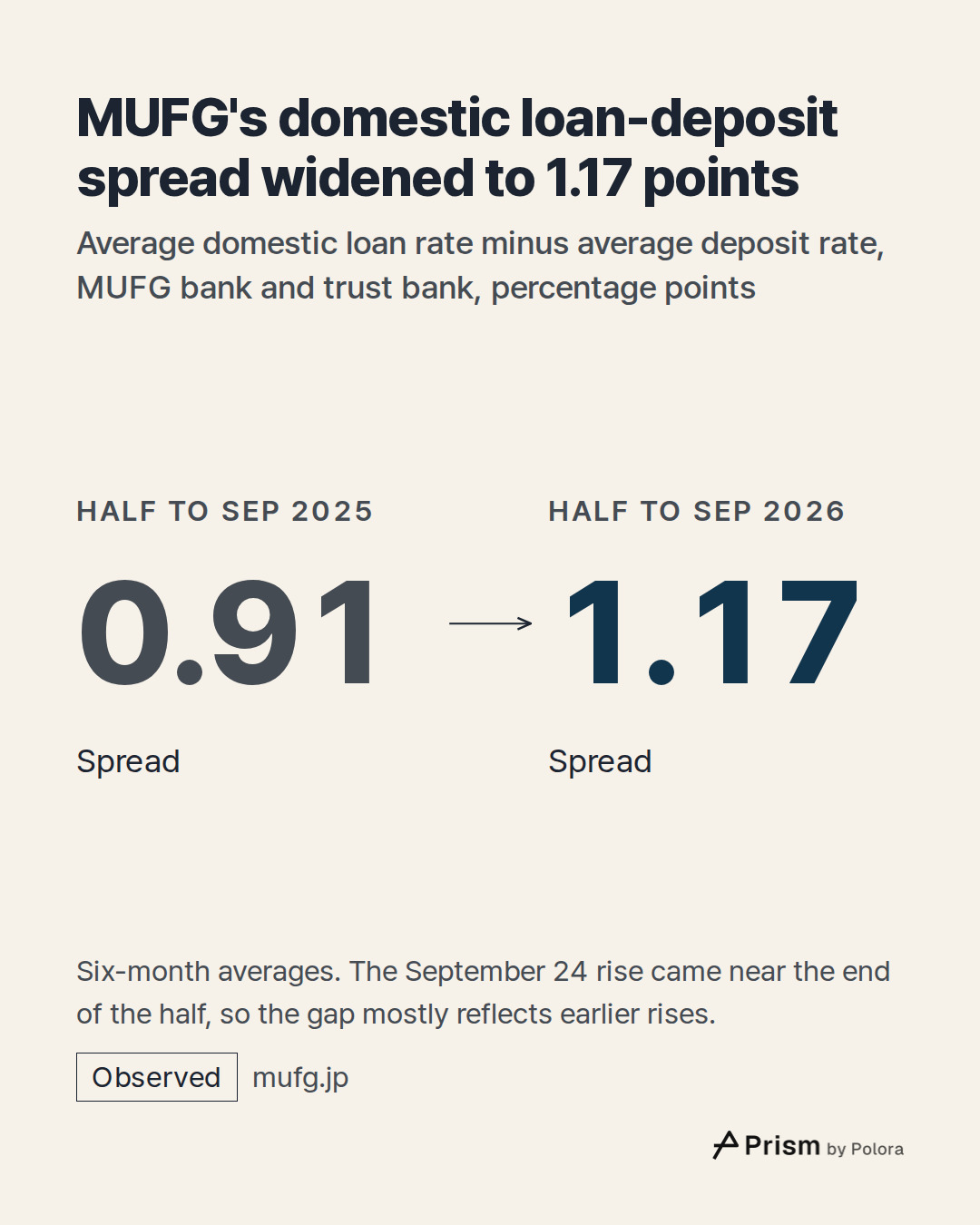
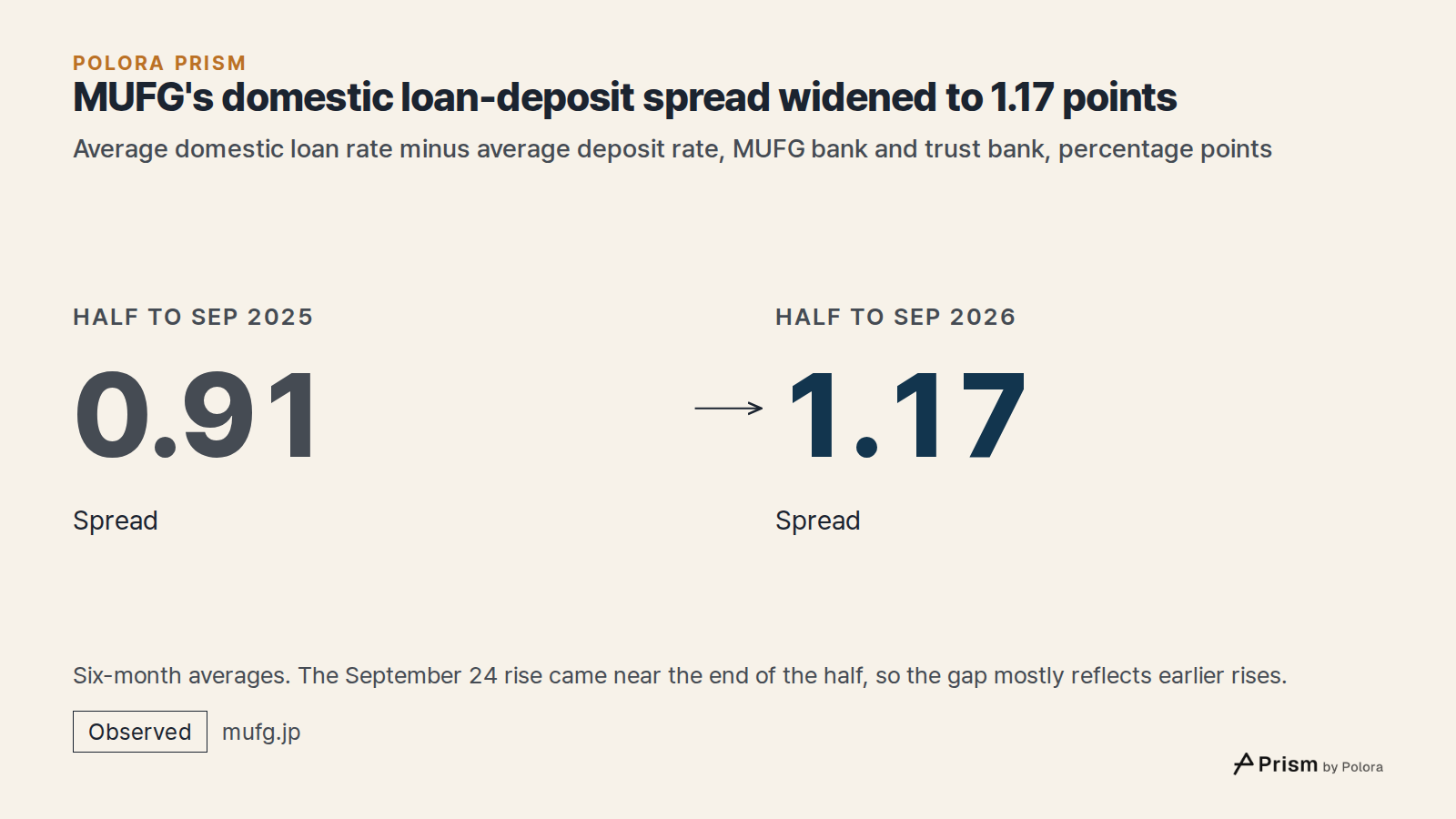
The three banks reported results for the half to September 30, 2026 in November. MUFG's filing shows the gap directly. Counting its main bank and trust bank together, and only their business in Japan, MUFG earned an average of 1.51% on loans and paid an average of 0.34% on deposits and negotiable certificates of deposit. The difference, its domestic loan-deposit spread, was 1.17 points, up from 0.91 a year earlier. Leaving out loans to the Japanese government gives slightly different figures, 1.53% and 1.19 points. The 0.34% average includes time deposits, so it is not the same figure as the 0.5% on an ordinary account.
These are averages over six months. The September rate rise took effect on September 24, near the end of that half, so the wider spread mostly reflects earlier rate rises and cannot be credited to the latest one alone.
MUFG's net interest income, what it earns on loans and other assets minus what it pays on deposits and other borrowing, rose about 29% to ¥1.851 trillion, from ¥1.440 trillion. MUFG said higher yen interest rates added about ¥140 billion to its net operating profit. Net profit for the half was a record ¥1.63 trillion, up 26%.
Not all of that came from rates. Fee income rose 14% to ¥1.23 trillion, gains on equity securities added to results, a weaker yen added about ¥35 billion, and interest income from overseas loans grew too. Rates are the biggest new driver, but they are one driver among several.
Added together, the three groups' reported net profits for the half come to about ¥3.53 trillion : MUFG ¥1.63 trillion, SMFG ¥1,003.2 billion and Mizuho ¥896.5 billion. For the full year to March 2026, their combined net profit was reported at ¥5.26 trillion, up 33.9% and the first time it passed ¥5 trillion.
The same rate rise lowers the value of bonds banks already own
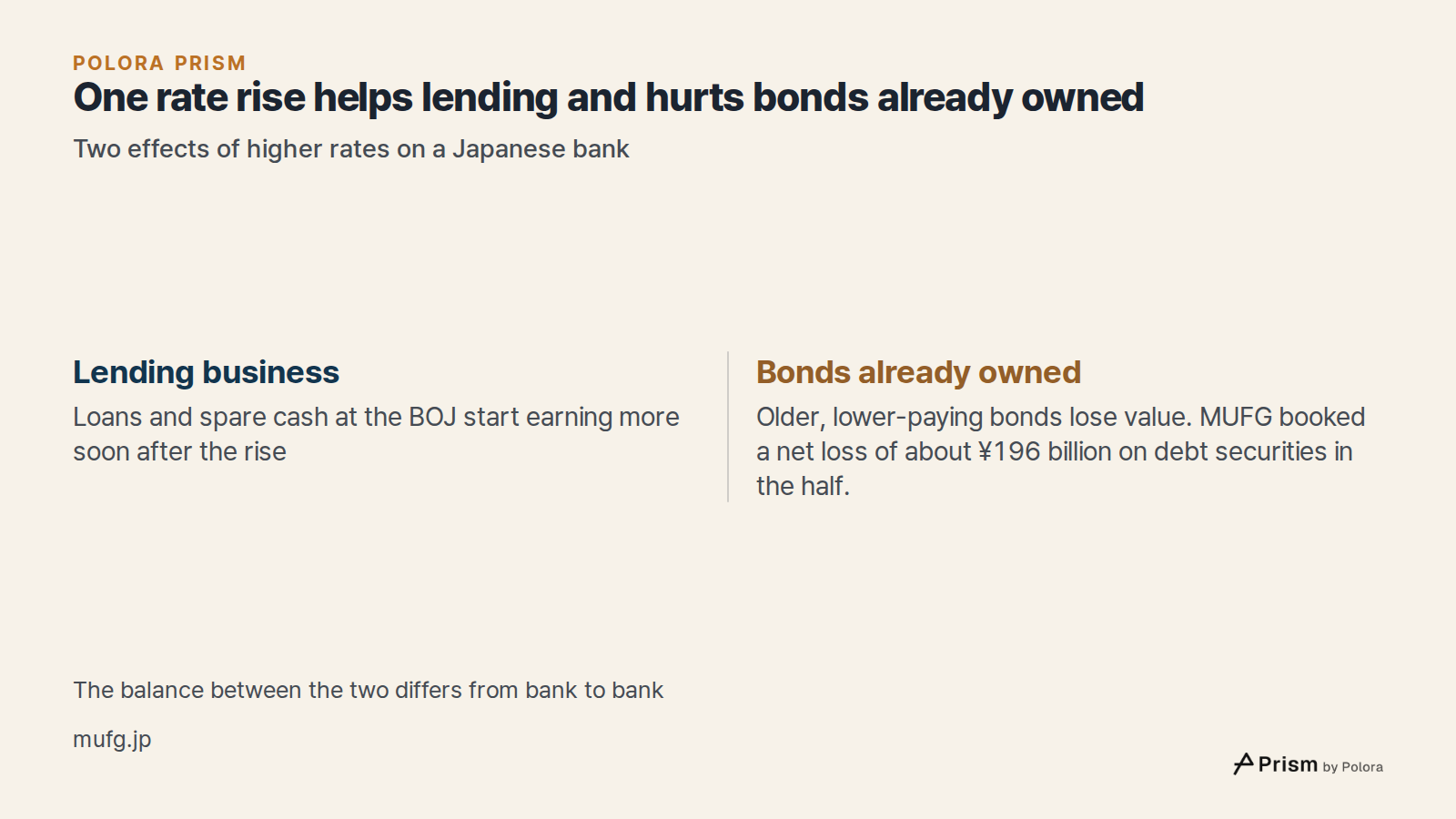
A rate rise has a second effect that pulls the other way. When new bonds pay more, older bonds that pay less are worth less. A bank holding older Japanese government bonds sees their market value fall as yields rise.
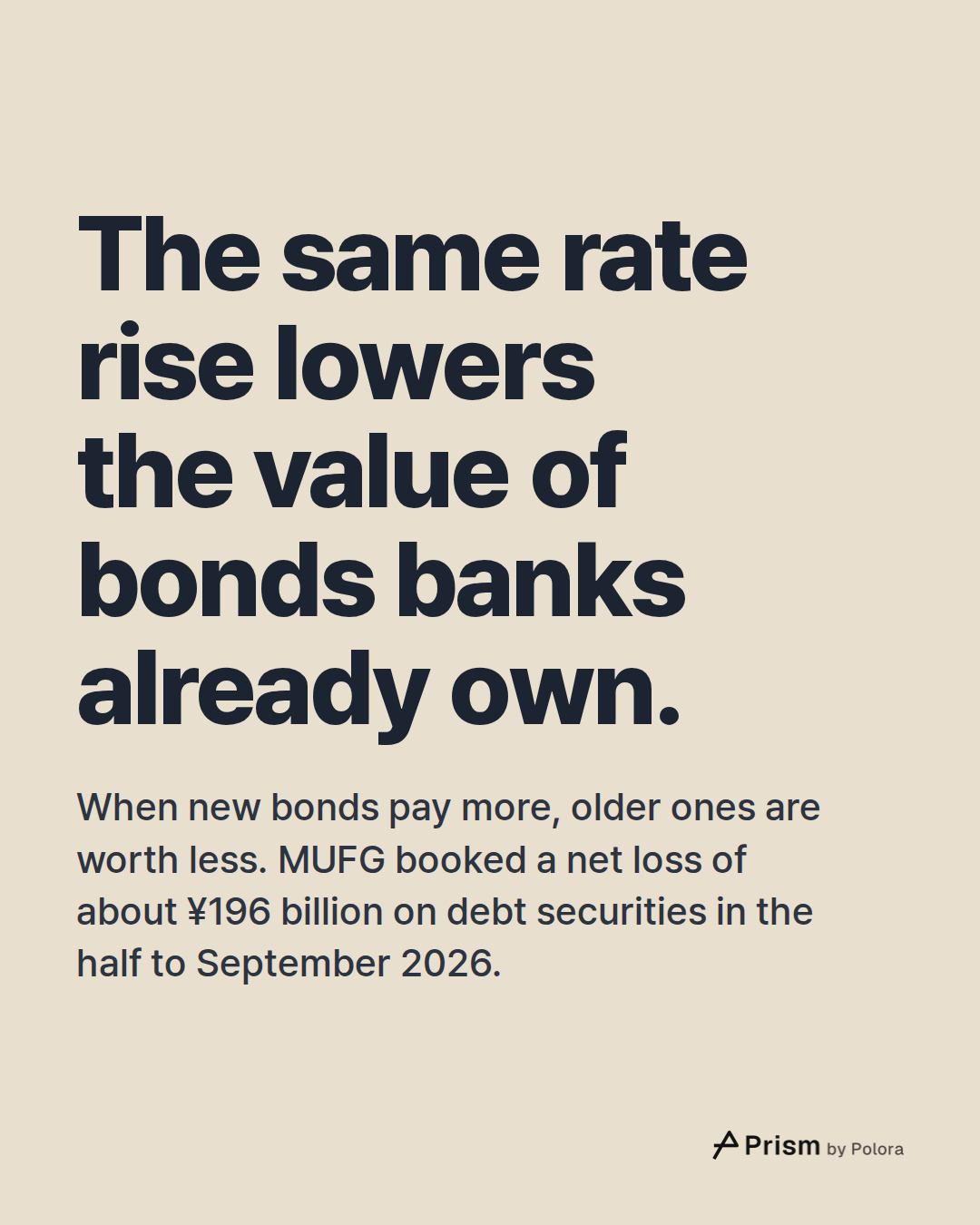
This shows in MUFG's filing too. In the half to September 2026, MUFG booked a net loss of about ¥196 billion on debt securities, against a small gain a year earlier. The megabanks can absorb losses like this partly because they also hold large stock portfolios that have gained in value, which they can sell to offset bond losses.
Smaller lenders often have less of that cushion. In its Financial System Report of October 2026, the BOJ said valuation losses on yen bonds have been growing, especially at regional banks and shinkin banks (local credit cooperatives) that hold a large share of yen bonds with long maturities. It also said many of them have already cut their holdings or shortened maturities, which limits how far the losses can grow, and it judged the financial system as a whole to be stable. Rising rates help a bank's lending business and hurt the bonds it already owns, and the balance between the two differs from bank to bank.
Record profits, still lower returns than the biggest US banks
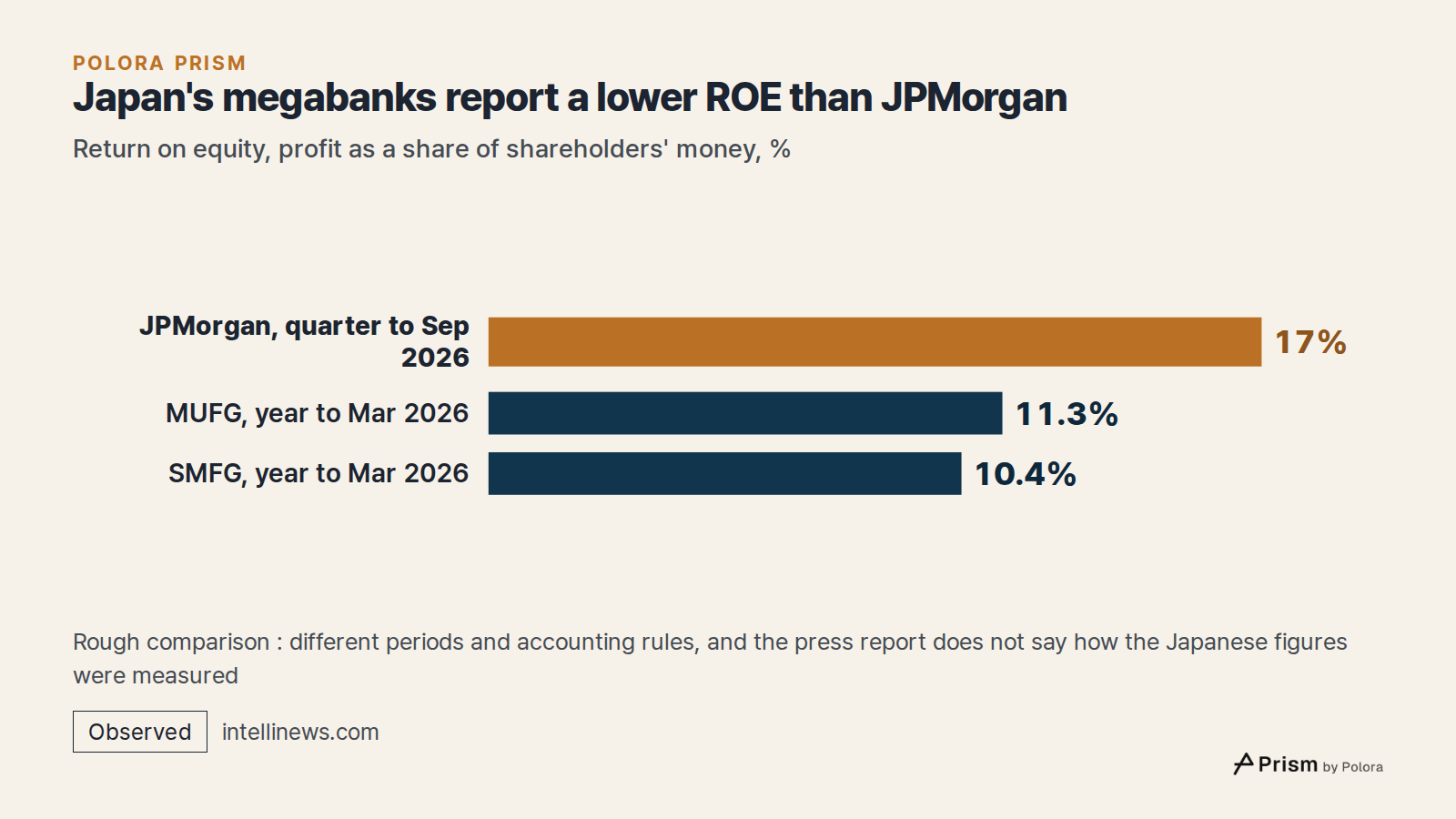
Record profit in yen is not the same as a high return. A common yardstick is return on equity (ROE), profit as a share of the shareholders' money in the business. For the year to March 2026, MUFG's ROE was reported at 11.3% and SMFG's at 10.4%, in a press report that does not say exactly how each was measured.
JPMorgan, the largest US bank, reported an ROE of 17% for the quarter to September 2026. It also reports a return on tangible common equity of 20%, which is a different measure and should not be compared with the Japanese figures. Even the ROE comparison is rough : one is a full year, the other a single quarter, and the two countries' accounting rules differ. MUFG's own half-year filing shows a higher figure for the latest half than for the year to March, so the gap depends on which period you pick. Still, on each measure the Japanese banks earn less on their capital than their largest US peer.
The gap lasts only while savers stay put
Everything above rests on one behaviour : depositors accepting a rate that trails the central bank's. If enough savers move money to time deposits, online banks or bonds that pay closer to the policy rate, banks have to pay more to keep it, and the gap narrows. The BOJ noted in October that some regional and shinkin banks are already offering higher time deposit rates to attract deposits, and it warned that money drawn in this way may be quicker to leave.
A wider gap is also not a promise of higher total profit. Besides the bond losses, higher rates can make it harder for some borrowers to repay, and that cost would show up later.
So the sentence to retell is this. Japan's megabanks earn more when rates rise because their loans and the spare cash they keep at the BOJ reprice quickly, while the rate they pay savers rises later and by less. That gap holds only as long as savers stay put, and the same rise lowers the value of the bonds the banks already own.
To see which way it is moving, open the next filing and find two lines next to each other : the average rate on domestic loans and the average rate on deposits. Whether the second one starts catching up with the first is what the next set of results will show.