What does a 91% chance of a December Fed rate hike actually measure?
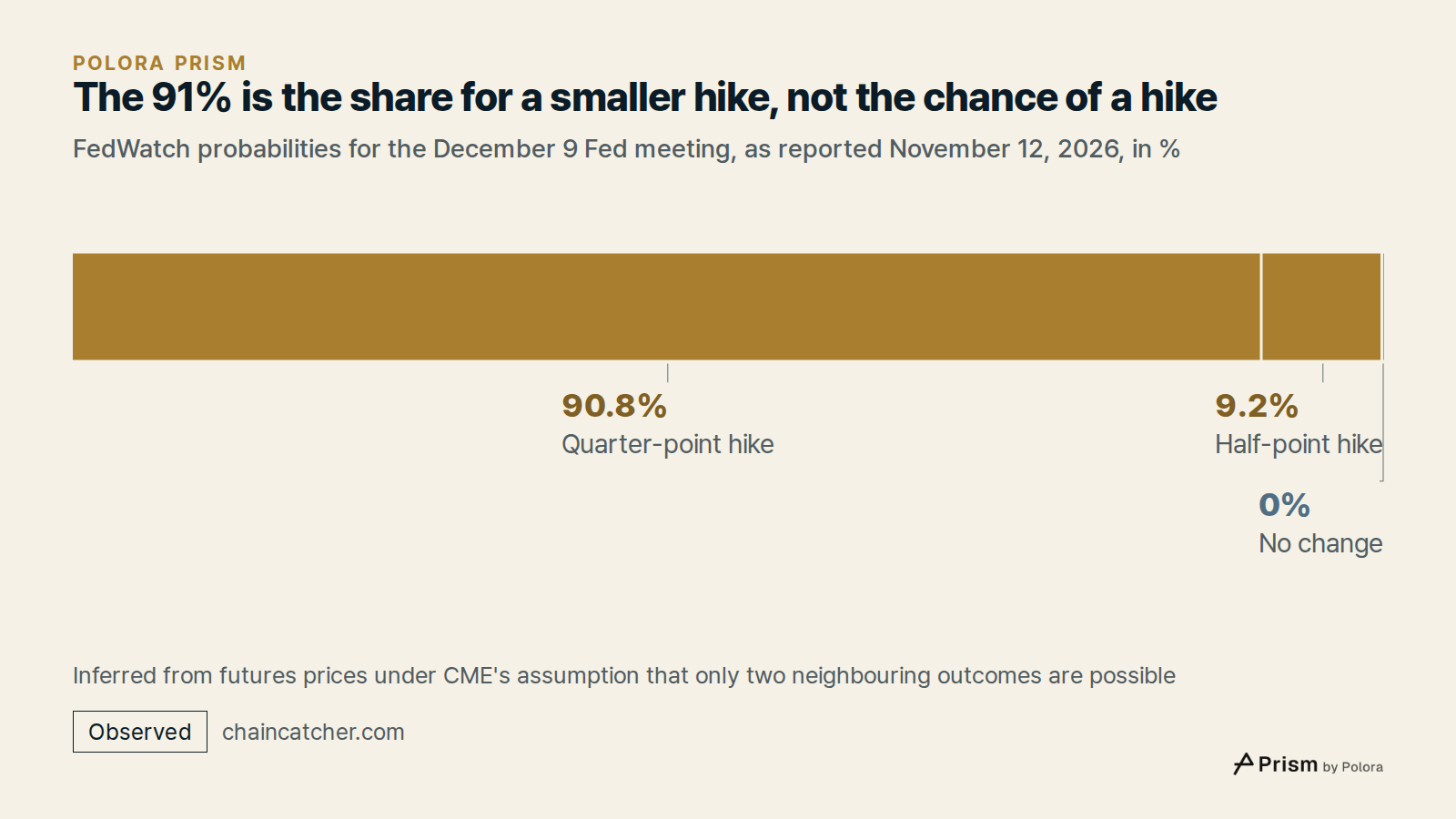
On the CME FedWatch screen behind it, the 91% is not the chance that the Fed hikes. A November 12, 2026 report of FedWatch put about 91% on a quarter-point December hike, 9% on a half-point one and 0% on no change. The split comes from futures prices under CME's assumptions.
2026-11-22
The 91% is about the size of the hike, not whether it happens
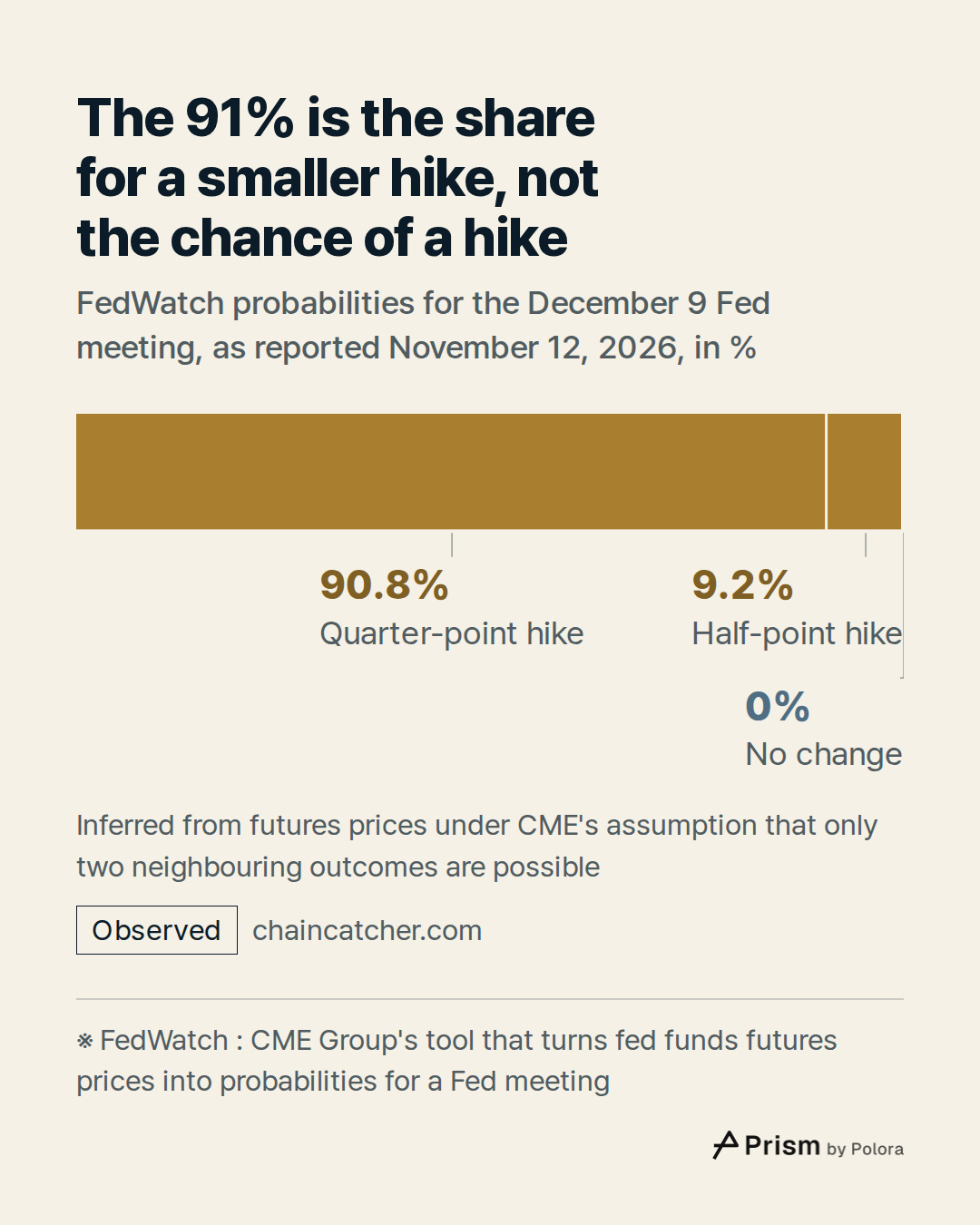
In the days after the October inflation report, headlines said traders saw a 91% chance of a Federal Reserve rate hike in December. Open the tool behind that number, CME Group's FedWatch, and the screen says something different. A report of FedWatch data dated November 12, 2026 put a 90.8% probability on a rise of a quarter of a percentage point at the December 9 meeting, a 9.2% probability on a rise of half a point, and nothing at all on leaving rates where they are.
So on that screen, the 91% is not the chance of a hike. Inside the calculation, some hike already carried all of the weight, and the 91% is the share of that weight given to the smaller of two possible steps. Headline figures do not all come from the same reading, so the first thing to check is which outcome a number is attached to. To see why the number takes that shape, and what it can and cannot tell you, you have to look at where it comes from, which is market prices.
FedWatch probabilities for the December 9 Fed meeting, as reported November 12, 2026, in %
FedWatch reads bets on the average interest rate for a month
The rate the Fed targets is the federal funds rate, what banks charge each other to borrow overnight. Every business day the New York Fed publishes the effective rate, a volume-weighted median of those overnight loans. The Fed does not set it exactly. It sets a range, and the effective rate trades inside it.
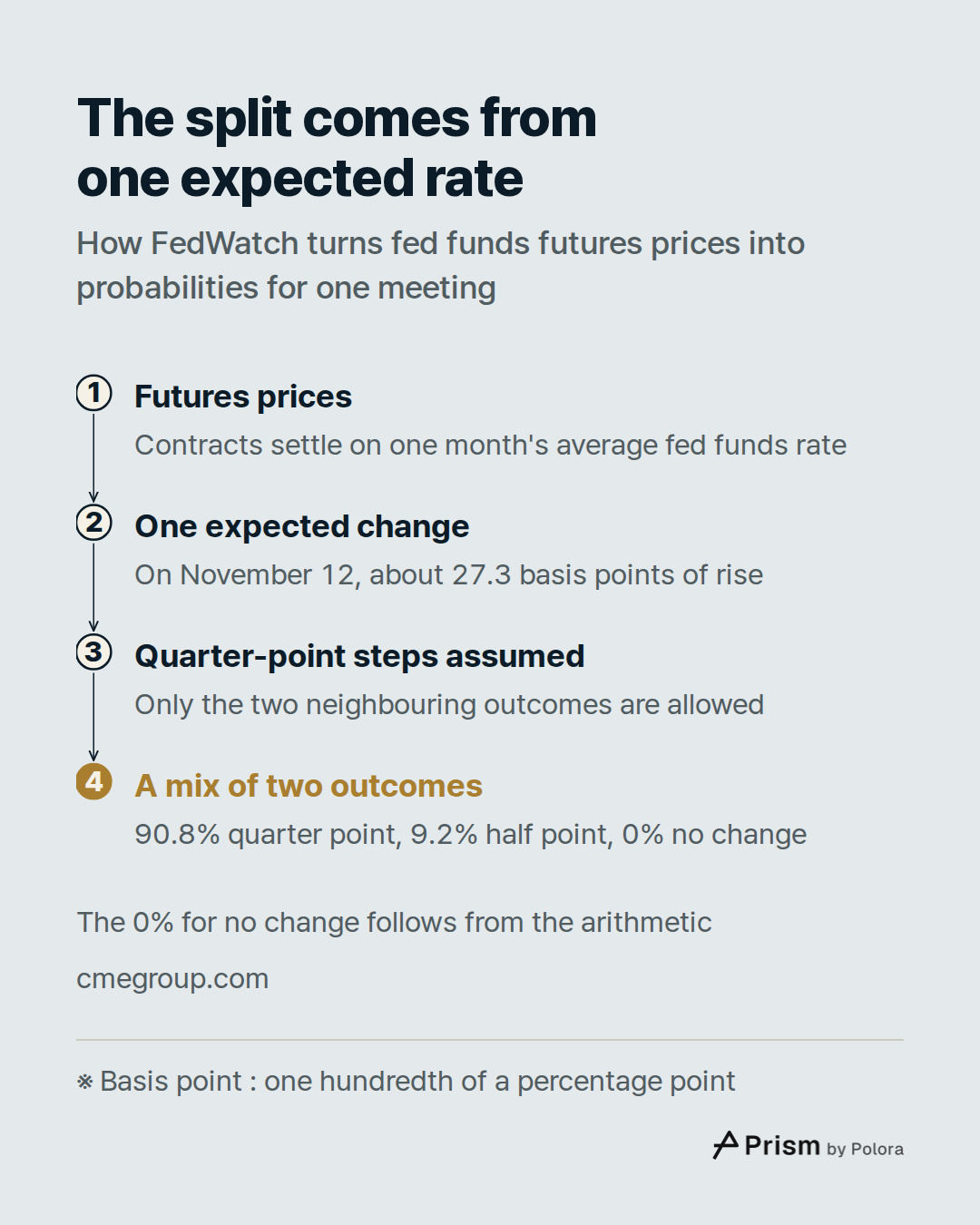
On the Chicago Mercantile Exchange, traders buy and sell 30-day fed funds futures, contracts that settle on the average of that effective rate over one calendar month. The price is quoted as 100 minus that average rate, so a price tells you directly what average rate the market is paying for. FedWatch takes these prices, including those of the months around a meeting of the Federal Open Market Committee, the Fed's rate-setting committee. From them it infers what rate is priced for the days after the meeting, then compares that with the rate before it.
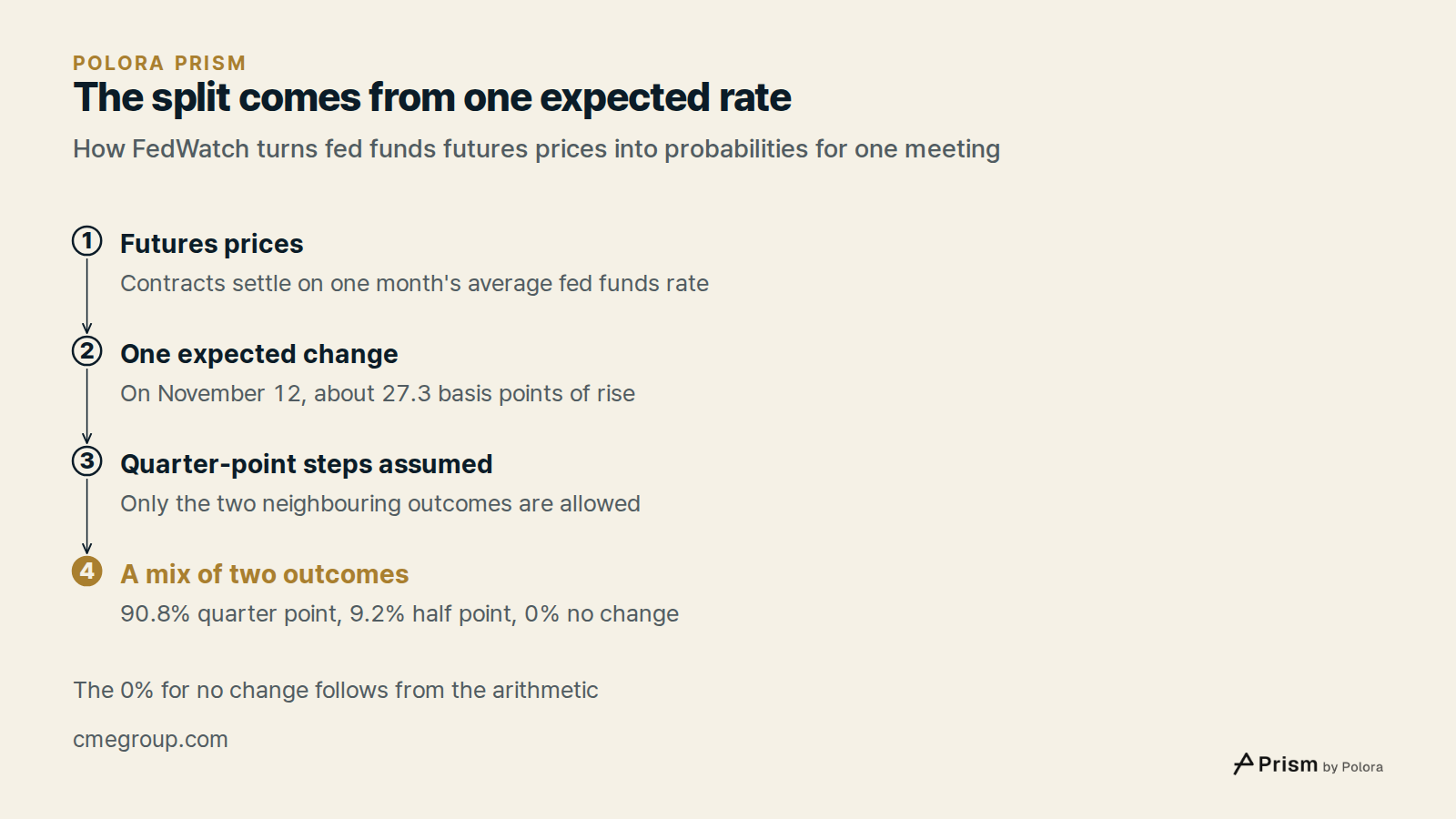
Futures prices give one number for the meeting, the change in rates traders are pricing on average. They do not say how sure anyone is. To turn that single number into probabilities, the method assumes the Fed will move in steps of a quarter point and that only two neighbouring outcomes are possible, then asks what mix of the two would produce the expected rate.
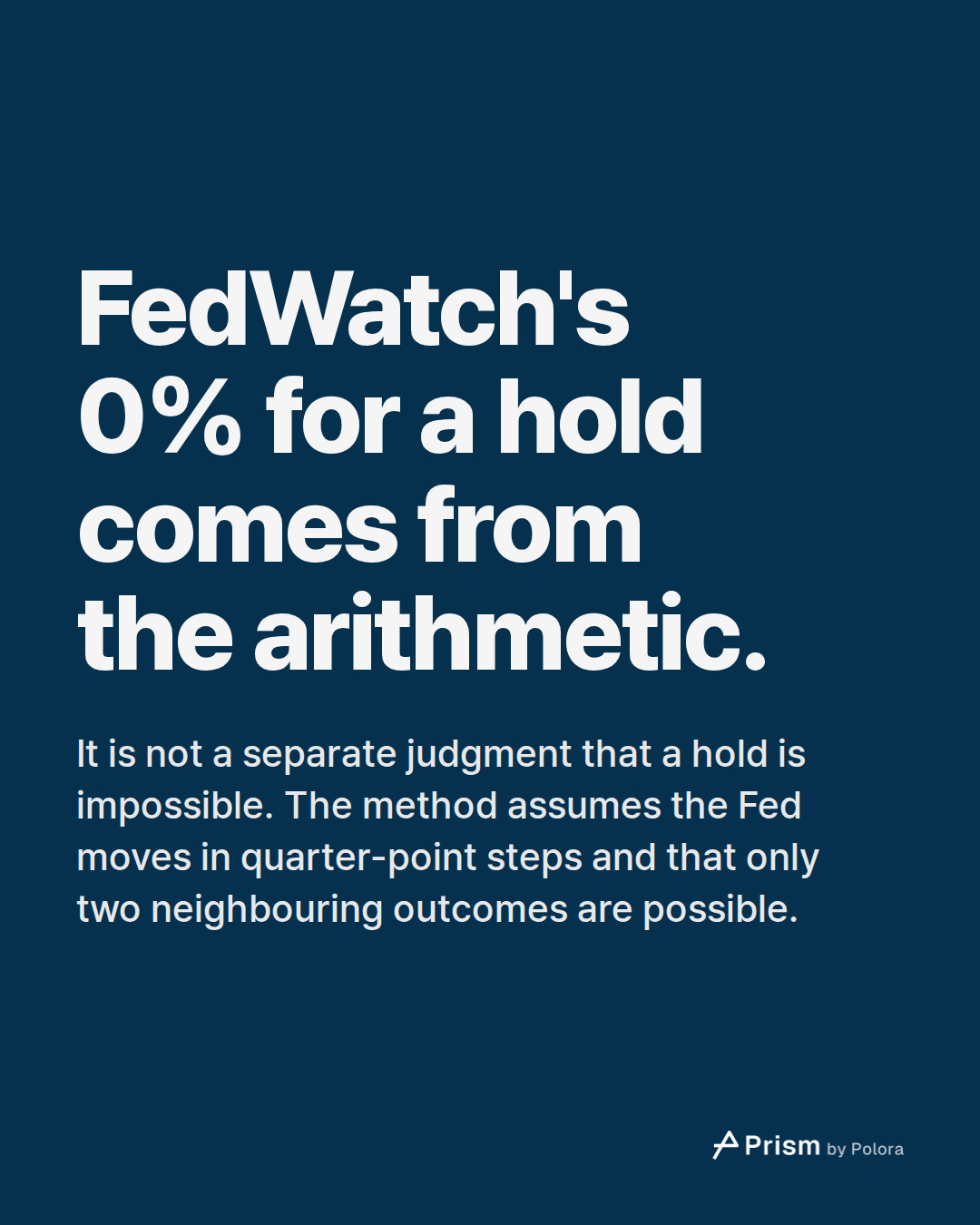
Run the November 12 figures backwards and the logic shows. A 90.8% weight on a quarter-point rise and a 9.2% weight on a half-point rise average out to an expected increase of about 27 hundredths of a percentage point (27.3 basis points). Because that is more than one quarter-point step, the two outcomes the method chooses are a quarter point and a half point, and no change is set to zero by construction. The 0% for a hold is a result of the arithmetic, not a separate judgment that a hold is impossible.
How FedWatch turns fed funds futures prices into probabilities for one meeting
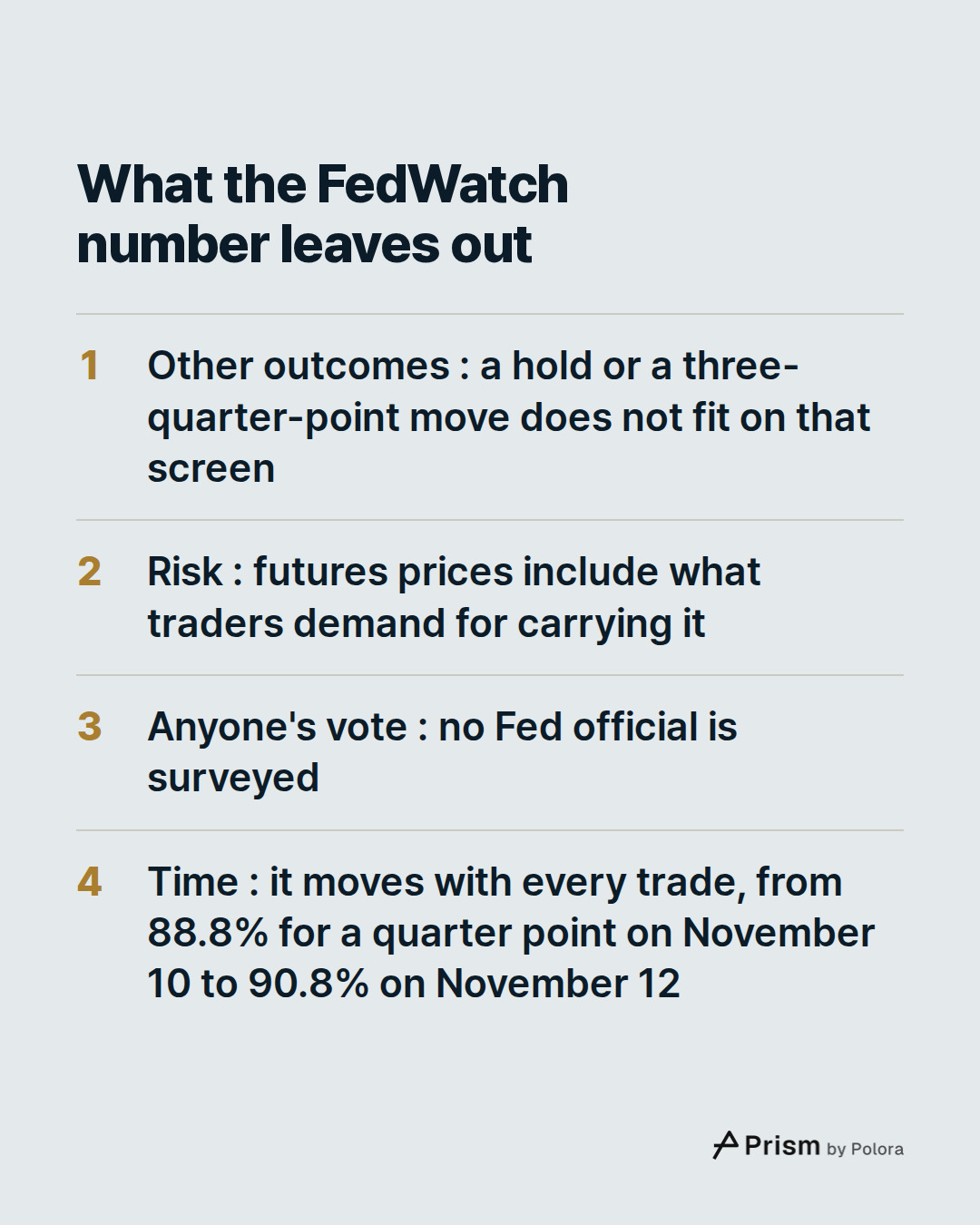
The first gap is the range of outcomes. Federal Reserve Board economists, writing in a February 2026 staff paper, note that fed funds futures give the average rate for a month but not the full range of outcomes unless one assumes only two are possible, and that this can be a problem in times of high uncertainty. A world in which the Fed holds, or moves by three quarters of a point, does not fit on that FedWatch screen at all.
The second gap is risk. Futures are traded by people with money at stake, and the price includes what they demand for carrying that risk, not only what they expect. A study by Monika Piazzesi and Eric Swanson in the Journal of Monetary Economics (2008) found that excess returns on fed funds futures had been positive on average and varied with the business cycle, and that ignoring this risk premium biases forecasts of the path of policy taken from these prices.
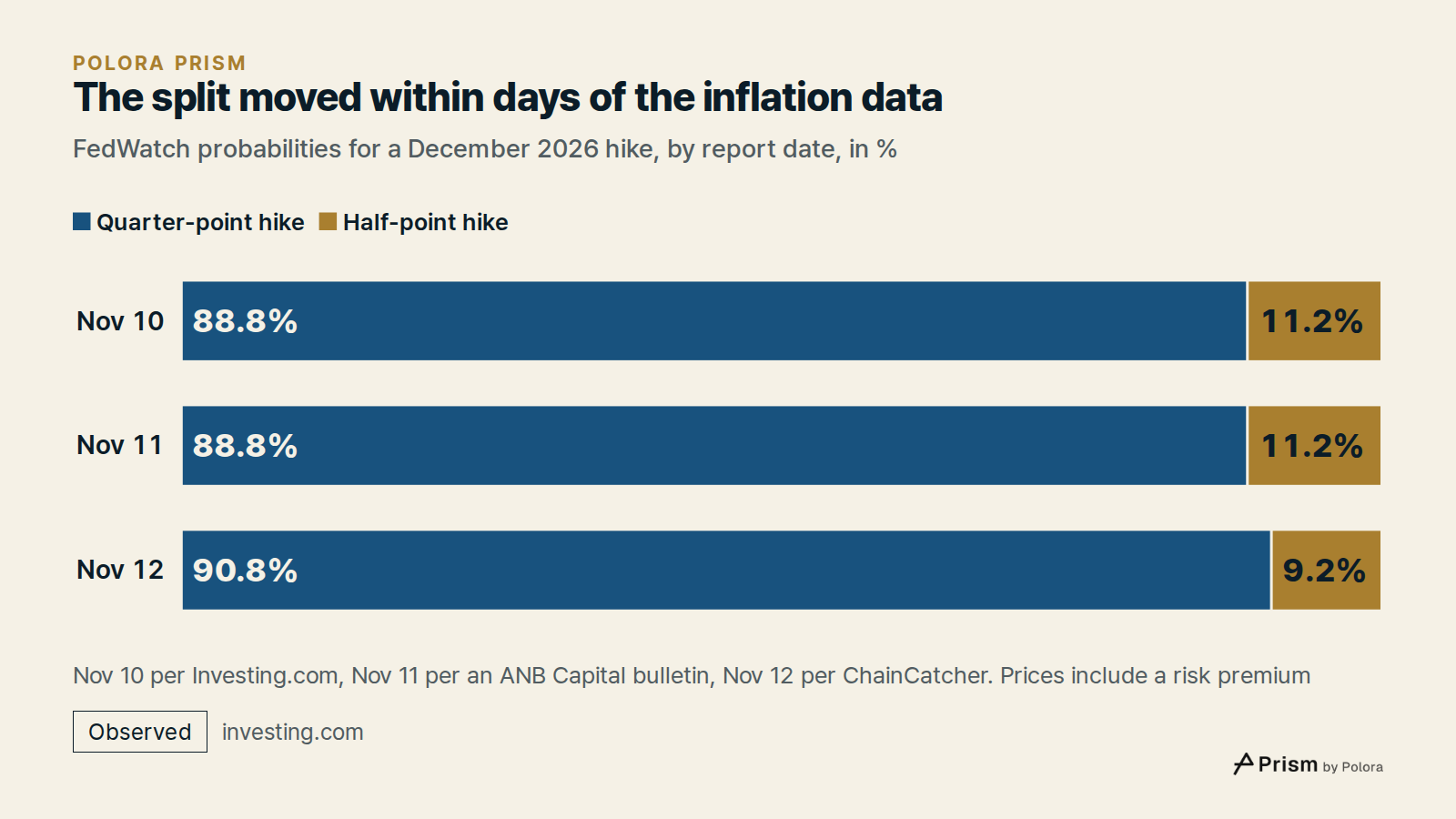
Third, the number is not a count of anyone's vote. No Fed official is surveyed, and it is not the forecast of any economist, Polora included. Probabilities like these are used as a market-implied forecast, but one that depends on the model's assumptions. It is the reading of prices at one moment, and it moves with every trade. On November 10, after the inflation data, FedWatch showed 88.8% for a quarter point and 11.2% for a half point, according to Investing.com, and a bank bulletin dated November 11 recorded the same split. The report dated November 12 gave 90.8% and 9.2%.
FedWatch probabilities for a December 2026 hike, by report date, in %
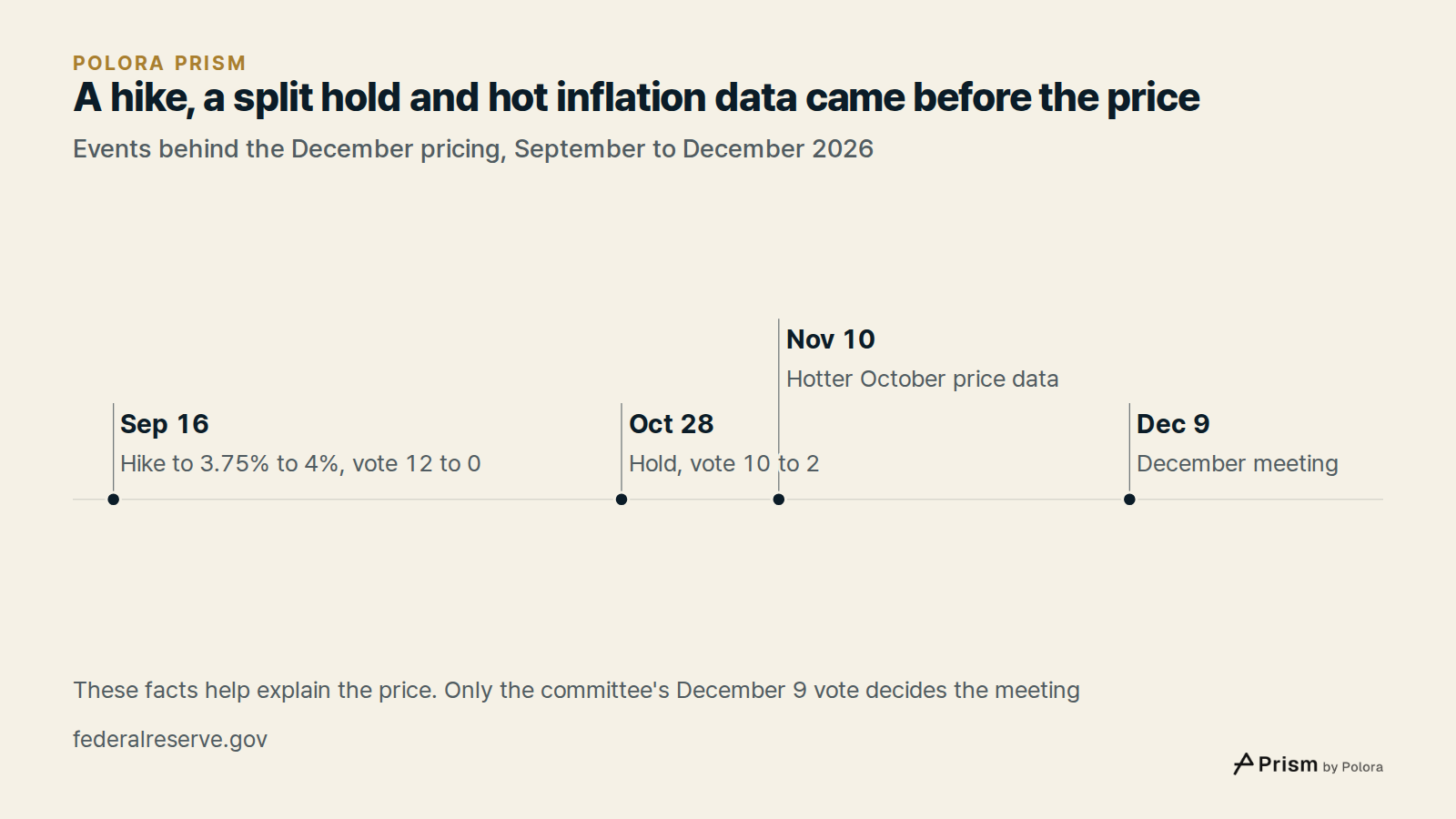
The price has a history behind it. On September 16, 2026, the committee voted 12 to 0 to raise its target range by a quarter point, to 3.75% to 4%. On October 28 it held the range there by 10 votes to 2. The two dissenters, Lisa Cook and Beth Hammack, preferred another quarter-point rise at that meeting, according to the Fed's statement.
Then, on November 10, consumer price data for October came in hotter than expected. Fed Governor Christopher Waller had said, according to reports of his remarks, that he would support a quarter-point rise in December and that a half-point move should be considered if the October inflation data came in hot. Those are among the facts traders were pricing. They help explain the number. They do not decide the December meeting, which only the committee's vote on December 9 will do.
Events behind the December pricing, September to December 2026
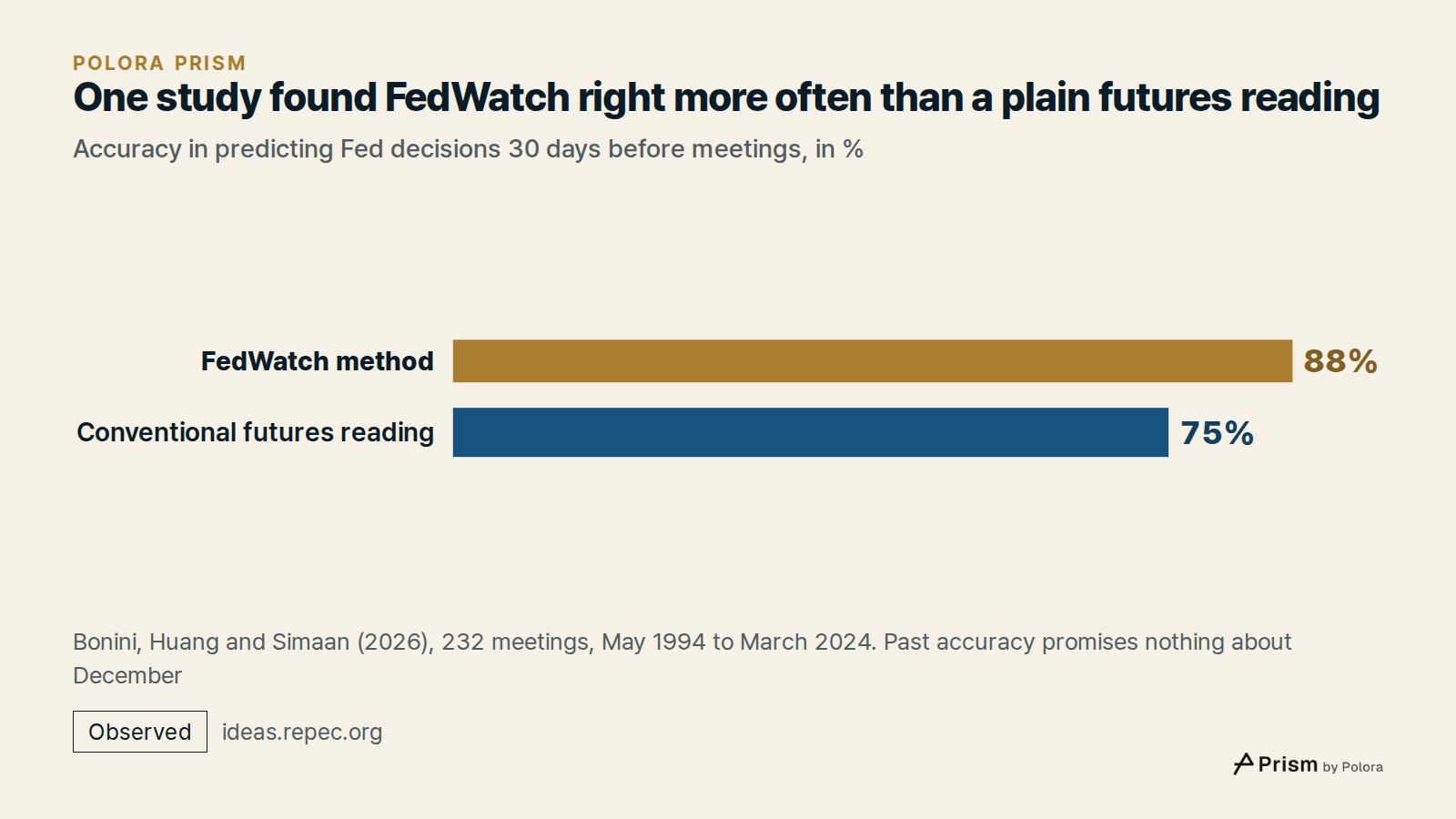
There is a track record, with limits. In a peer-reviewed study in the Journal of Futures Markets (2026), Stefano Bonini, Shengyu Huang and Majeed Simaan of the Stevens Institute of Technology report that the FedWatch method predicted committee decisions with 88% accuracy 30 days before meetings, against 75% for a conventional reading of fed funds futures. Their sample covers 232 scheduled meetings from May 1994 through March 2024. November 12 was about four weeks before the December meeting.
That is an average over many past meetings, under that study's definitions and sample. It does not say how often readings near 91% in particular turned out right, and it says nothing about whether this particular price, at this particular reading, will match what happens. A share of past meetings where the tool was right is not a rule for the next one. Past accuracy promises nothing about December.
Accuracy in predicting Fed decisions 30 days before meetings, in %
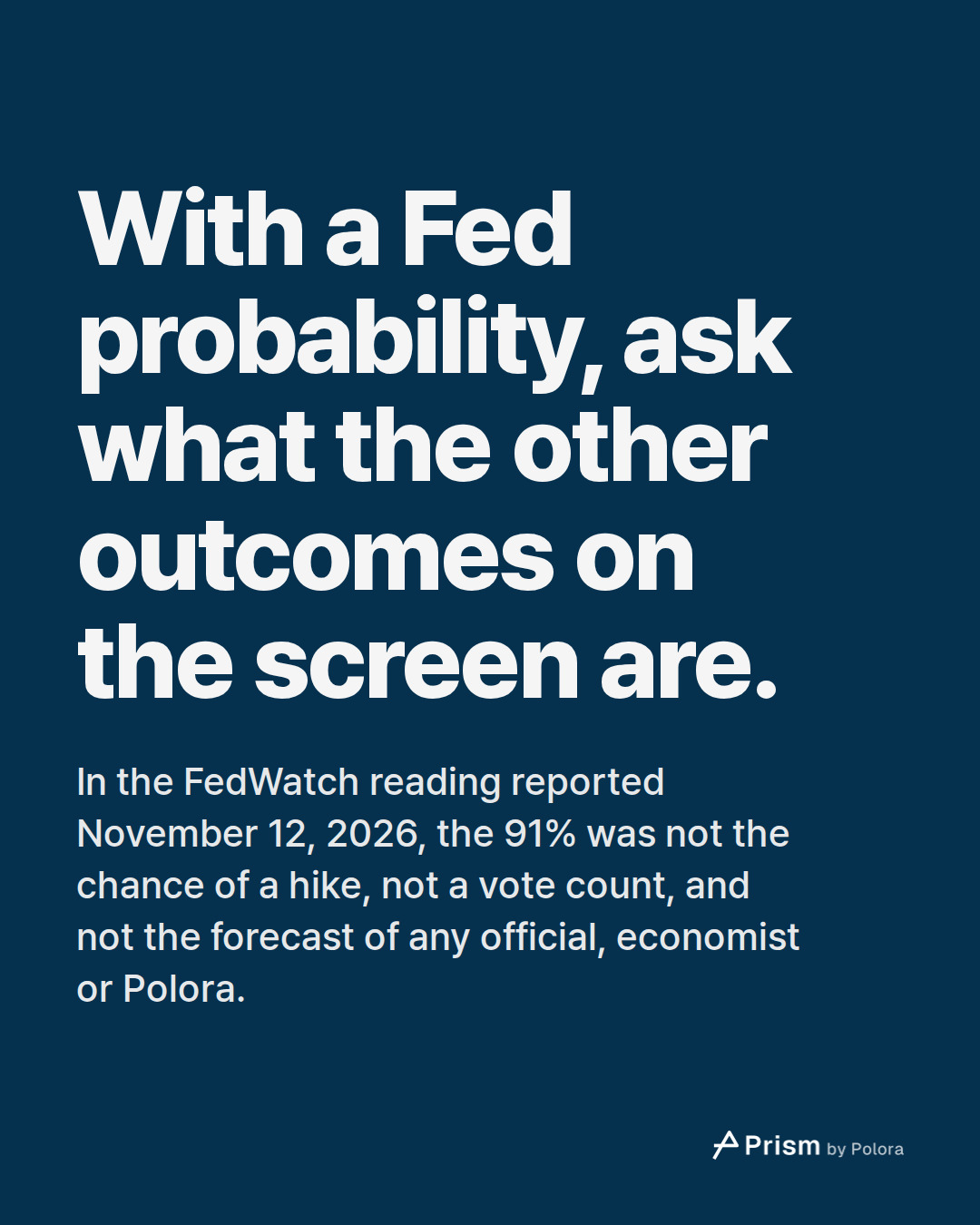
When you see a Fed probability in a headline, ask what the other outcomes on the screen are. In the reading reported on November 12, 2026, the 91% was the market's price for a quarter-point hike against a half-point one, worked out from fed funds futures prices under the assumption that only those two were possible, with a risk premium inside it. On that screen it was not the chance of a hike, not a vote count, and not the forecast of any official, economist or Polora.
What does a 91% chance of a December Fed rate hike actually measure?
Alpha · deepseek-v4-pro
A 91% chance of a December Fed hike does not measure the chance that the Fed hikes. It measures something narrower: the market-implied share of probability assigned to a quarter-point hike rather than a half-point hike, under a restrictive two-outcome assumption.
Where the number comes from
CME FedWatch starts from 30-day fed funds futures. Those contracts settle against the arithmetic average of the daily effective federal funds rate during the contract month, which is why the price is quoted as 100 minus the expected average rate. But a single futures price gives you only one number: the average rate the market is pricing for December.
To turn that one number into probabilities, the tool has to assume a menu of possible Fed actions. It assumes the Fed moves in quarter-point steps, and it usually restricts the possible outcomes to the two neighbouring steps around the implied rate. In mid-November 2026, the December futures price implied a post-meeting target rate roughly 27 basis points above the current 3.75%–4.00% range. That is between one and two quarter-point hikes, so the two outcomes the method considered were:
- a 25 basis point hike to 4.00%–4.25%, and
- a 5…
Beta · gpt-6-sol
The manuscript’s central distinction is sound, but its headline is too absolute. If the cited FedWatch reading really showed roughly 91% for a 25-basis-point hike, 9% for a 50-basis-point hike, and 0% for a hold, then 91% labels the quarter-point outcome—not the sum of all hike outcomes. Within that *particular FedWatch calculation*, the displayed hike outcomes sum to 100%. That does not establish that a hike is certain in the world outside the model. CME describes its nearest-meeting calculation as assigning weights to two adjacent 25-basis-point outcomes. (cmegroup.com)
Here is what I could check for the editor:
- Mechanism: supported, with a correction. CME says 30-day fed funds futures are quoted as 100 minus the expected arithmetic average of the daily effective federal funds rate for the contract month; they ultimately settle against that month’s average. FedWatch uses futures prices and assumptions about 25-basis-point moves to infer meeting outcomes. Thus, if the reported split is 90.8%/9.2%, its weighted increase is 27.3 basis points: \(0.9…
Gamma · gemini-3.1-pro
Here is what I found regarding the manuscript’s claims, building on the previous checks:
* The 90.8% / 9.2% split and timestamp: Supported for November 12. Multiple financial portals reporting on November 12, 2026, confirm that CME FedWatch showed a 90.8% probability for a 25-basis-point hike and a 9.2% probability for a 50-basis-point hike. The editor should update the text to specify November 12, rather than blending it with November 11 or using the brief's 91.2%. (Sources: tradingkey.com, kucoin.com)
* The 27-basis-point calculation: Supported. The arithmetic (0.908 × 25 + 0.092 × 50 = 27.3) is correct. As CME’s methodology restricts probabilities to the two adjacent quarter-point increments bracketing the implied rate, a hold (0 basis points) receives a 0% weight by construction because the implied rate of 27.3 is between 25 and 50.
* Waller's comments on CNBC: Supported. On November 10, 2026, Federal Reserve Governor Christopher Waller stated he would support a 25-basis-point rate increase in December and that a 50-basis-point hike should be considered if October inflation data came in hot (core CPI of…
Researcher · gpt-6-luna
CME’s own methodology supports the basic explanation, with an important nuance: FedWatch is not simply splitting one futures contract into two outcomes. It uses 30-day fed funds futures prices—quoted as 100 minus the contract month’s average effective federal funds rate—and, for a meeting month, uses the surrounding monthly rates to infer the rate change around the meeting. Under its assumptions, it assigns probabilities to two adjacent outcomes, typically one 25-basis-point step apart. (cmegroup.com)
For the reported 90.8% / 9.2% split, the weighted move is 27.3 basis points: \(0.908 \times 25 + 0.092 \times 50\). That makes the displayed 0% hold a consequence of the model’s selected outcomes—not independent evidence that a hold is impossible. The timestamp is better supported as November 12 than November 11: a dated report that day gives the 90.8%/9.2% figures, while I did not find a primary CME snapshot verifying that exact reading. (uat2049.chaincatcher.info)
The manuscr…
The Arbiter · gpt-6-sol
The voices agree on the key distinction: if the reported FedWatch screen showed about 91% for a quarter-point hike and 9% for a half-point hike, the 91% labels the quarter-point outcome, not the total of the displayed hike outcomes. CME’s published method supports the two-adjacent-outcome calculation. It also shows why the manuscript’s phrase “split one futures price” needs care: the calculation can use surrounding contract months to infer the change at a meeting. (cmegroup.com)
The consequential open point is which reading, and when. The Researcher found a November 12 report of the 90.8%/9.2% split, but no primary CME snapshot establishing that exact split on both November 11 and 12. Beta also found a different November 11 reading. The manuscript should not combine those figures or dates without a timestamped source.
There is a difference of emphasis, not arithmetic: Alpha stresses that a displayed 0% hold is produced by the restricted calculation; Beta warns that saying the price is “not a forecast” goes too far, since market-implied probabilities can b…
The Arbiter's Final Verdict · gpt-6-sol
Verdict
For the reported November 12 FedWatch reading, “91%” measured the market-implied weight on a *quarter-point* December hike—not the probability of *any* hike. The report put about 9% on a half-point hike and 0% on a hold. That exact split is supported by a dated secondary report, not by a primary CME snapshot; it should not be attributed to both November 11 and 12 without further evidence.
Here is what the number rests on. CME’s methodology uses prices of 30-day federal funds futures to infer the rate change around a meeting, then assigns weights to adjacent quarter-point outcomes. At the reported 90.8%/9.2% split, the weighted move is 27.3 basis points: \(0.908 \times 25 + 0.092 \times 50\). The displayed 0% for a hold follows from choosing 25 and 50 basis points as the two outcomes; it is not separate proof that a hold is impossible. The calculation can use surrounding months’ futures prices, so the manuscript’s “one futures contract” description is too simple.
The manuscript’s premise stands fo…