How much does Apple actually return to shareholders at a record share price?
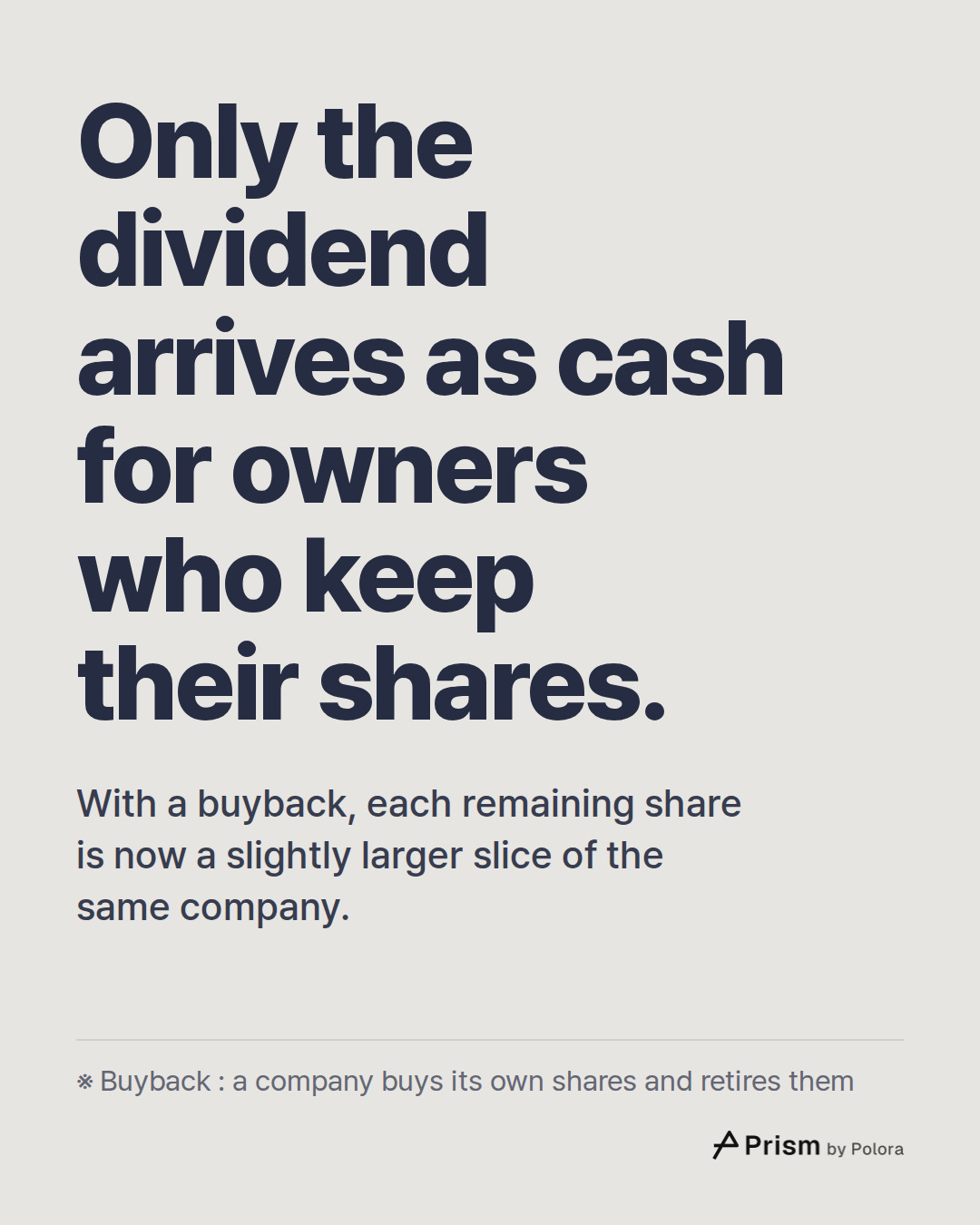
Just under 2% of its market value : about 1.7% through buybacks and 0.3% in dividends in fiscal 2026, measured at the $355.63 record close of Nov 11, 2026. Only the dividend arrives as cash for owners who keep their shares.
2026-11-20
About 2% in fiscal 2026, and most of it is buybacks
On Nov 11, 2026, Apple's shares closed at a record $355.63. At that price the whole company was worth about $5.17 trillion, counting the roughly 14.53 billion shares listed on the cover of its annual report. If you own a piece of it, a fair question follows : how much money does Apple actually hand back to its owners each year, compared with what that piece costs today?
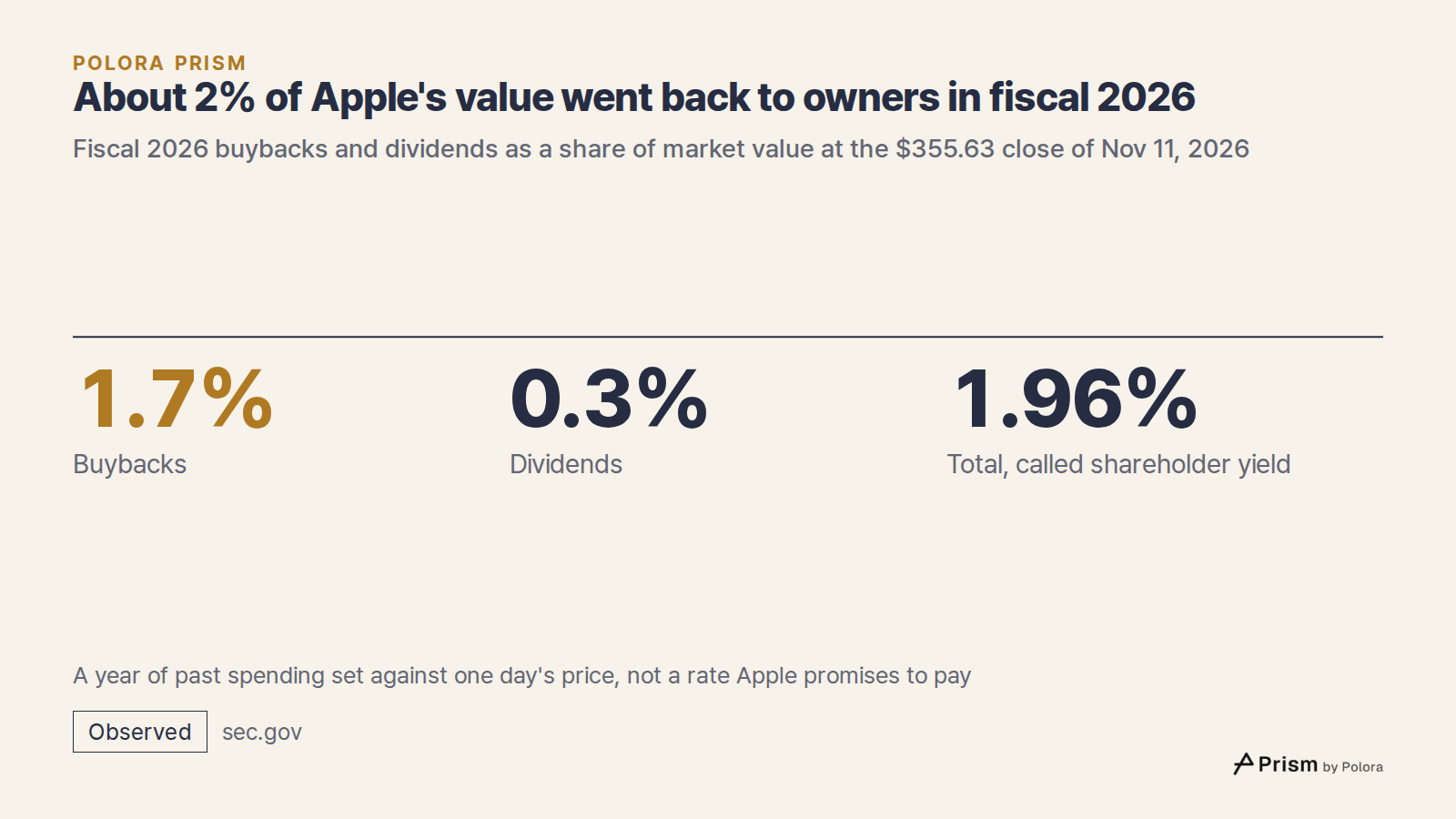
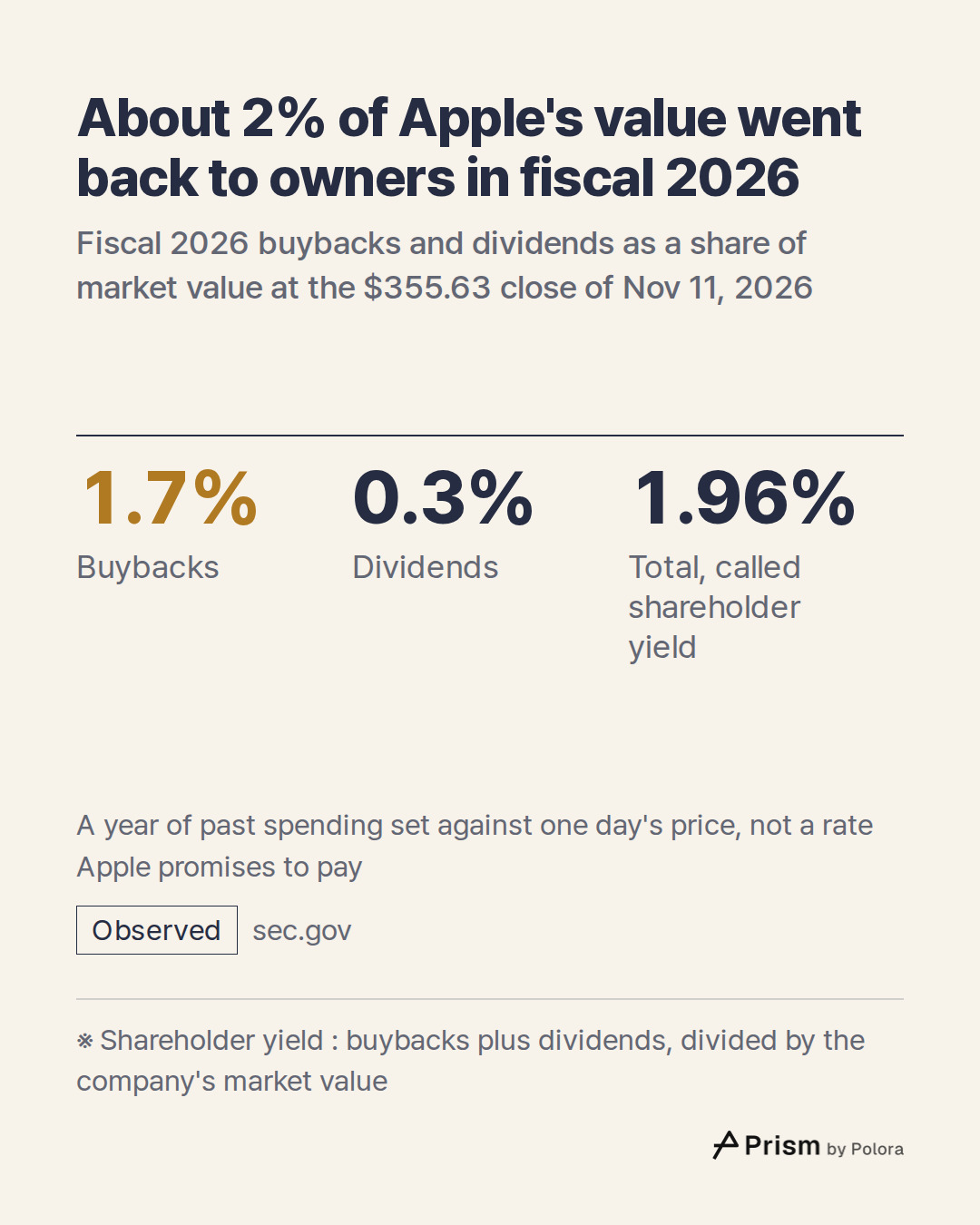
Worked from Apple's annual report for the year that ended Sept 26, 2026, the answer is just under 2%. About 1.7% comes from Apple buying back its own shares, and about 0.3% comes from dividends. Only the dividend arrives as cash for owners who keep their shares. The figure sets a year of past spending against one day's price. It is not a rate Apple promises to pay.
The $355.63 close was a record on the day, but it did not stay one. Apple's shares closed at $356.27 on Nov 13. At any higher price, both percentages are a little smaller.
Fiscal 2026 buybacks and dividends as a share of market value at the $355.63 close of Nov 11, 2026
A dividend is cash paid straight to shareholders. Apple raised its quarterly dividend from $0.26 to $0.27 a share starting in May 2026, so at the current rate it pays $1.08 a year. At $355.63 a share, that is about 0.30% of the price. Across fiscal 2026, Apple paid $15.7 billion in what the annual report calls dividends and dividend equivalents, which also comes to about 0.30% of the company's market value.
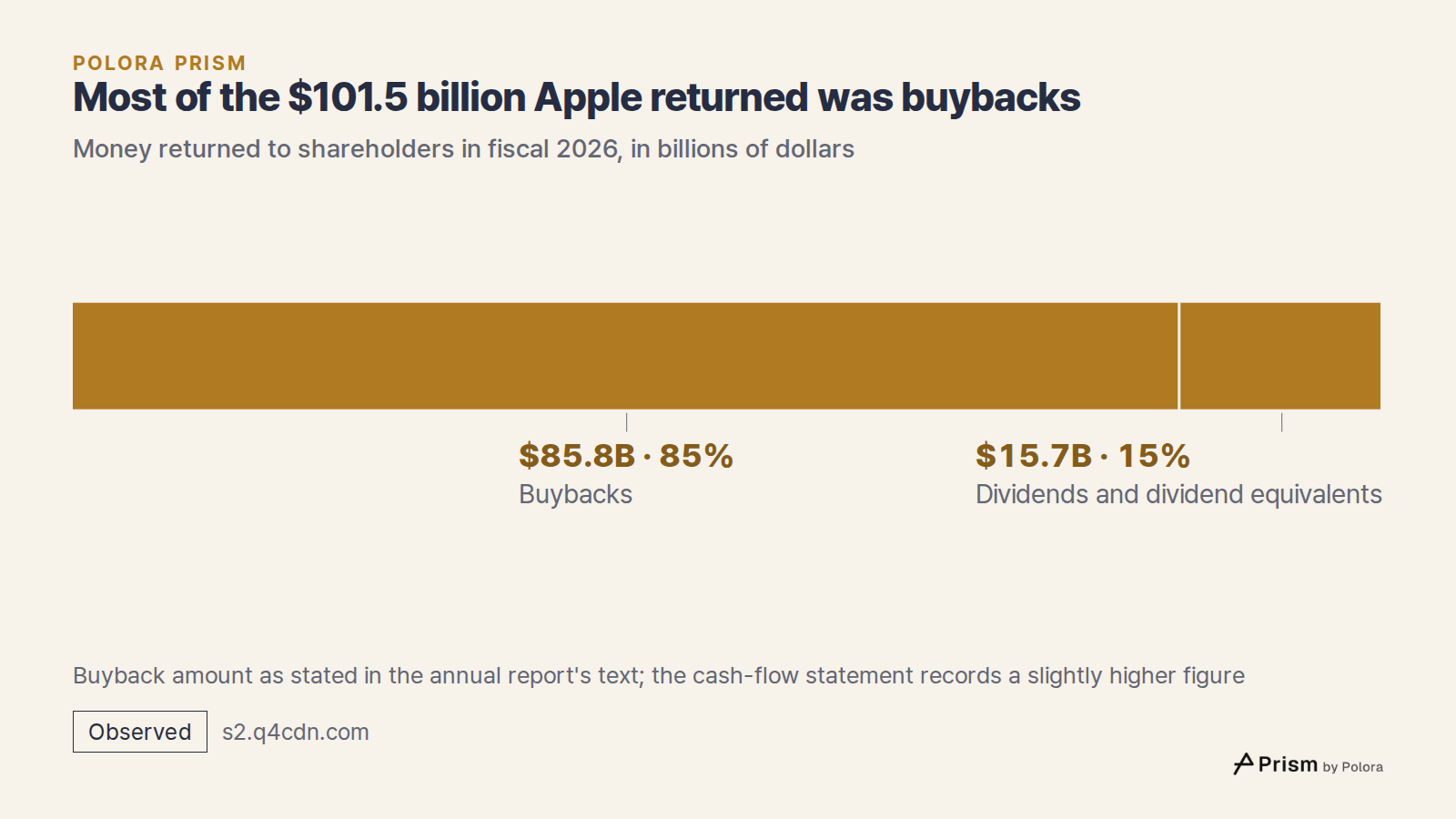
A buyback works differently. The company uses its cash to buy its own shares from investors who want to sell, and those shares are retired. The owners who keep their shares receive nothing in hand, but each remaining share is now a slightly larger slice of the same company. The annual report's text says Apple spent $85.8 billion this way in fiscal 2026, about 1.7% of its market value on Nov 11. The cash-flow statement in the same report records a slightly higher figure for repurchase payments. That is a different measure, and on that figure too the total comes to about 2%.
Add the two together, $101.5 billion, divide by what the company is worth, and you get what investors call shareholder yield, here about 1.96%. Keep one limit in mind. It sets a year of spending that has already happened against a price taken on a single day afterward, so it describes the past year, not the coming one.
Money returned to shareholders in fiscal 2026, in billions of dollars
Why the same buyback dollar now retires fewer shares
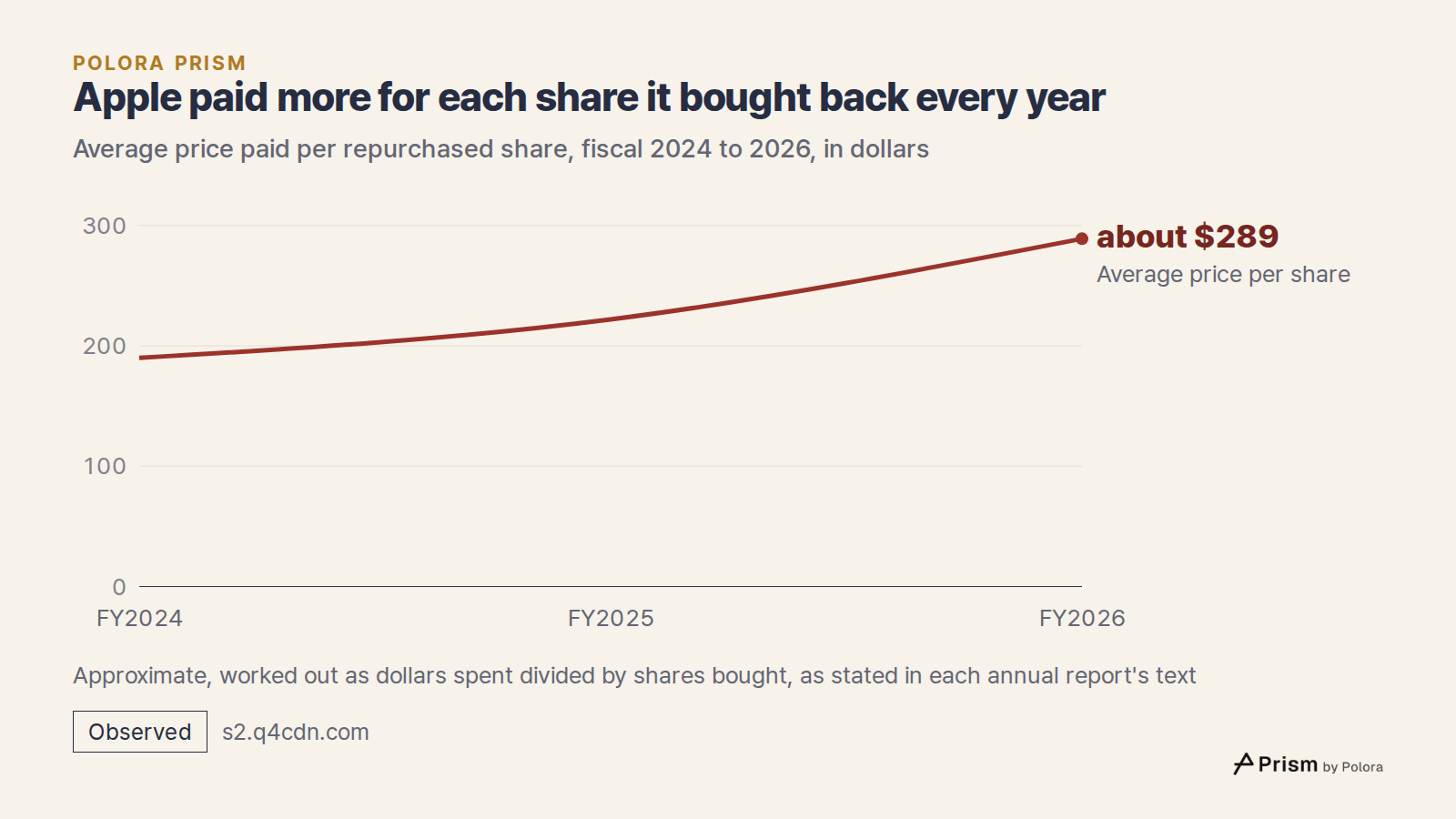
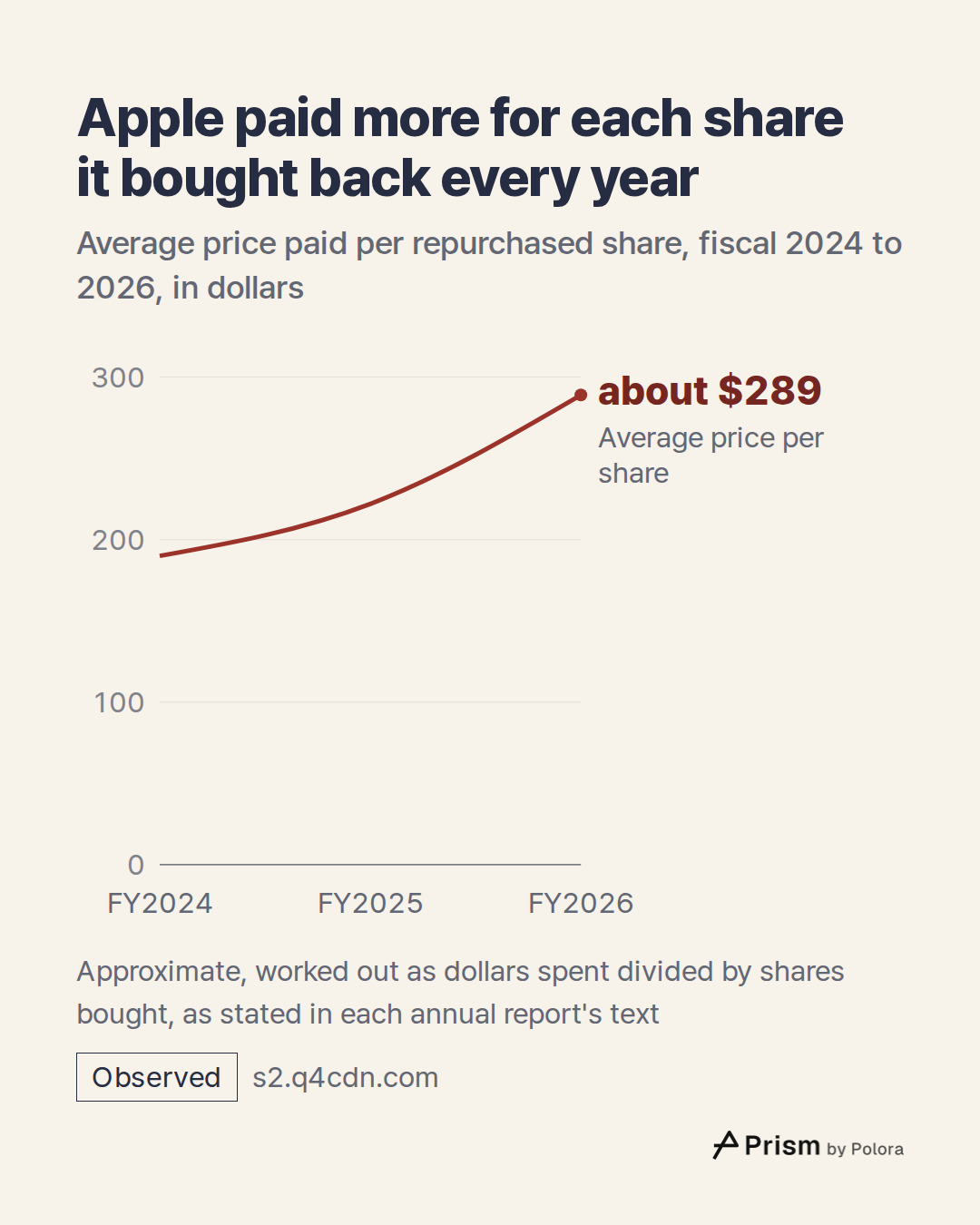
Apple's buyback spending has stayed in a narrow range while its share price climbed. Divide the dollars spent by the shares bought, as reported in each year's annual report, and you get the average price Apple paid per share.
In fiscal 2024 Apple bought 499 million shares for $95.0 billion, about $190 a share. In fiscal 2025 it bought 402 million for $89.3 billion, about $222 a share. In fiscal 2026 it bought 297 million for $85.8 billion, about $289 a share. These dollar amounts are the ones stated in each report's text. The cash-flow statements record slightly different payment amounts for the same years.
So each buyback dollar in fiscal 2026 retired about a third fewer shares than it did two years earlier. At the record price of $355.63, the same $85.8 billion would buy only about 241 million shares. That is an illustration, not what Apple bought. The arithmetic is simple : the higher the price, the less each dollar shrinks the share count. Whether the shares were worth what Apple paid is a separate question, and these numbers do not answer it.
Average price paid per repurchased share, fiscal 2024 to 2026, in dollars
Why the share count shrank by less than Apple bought
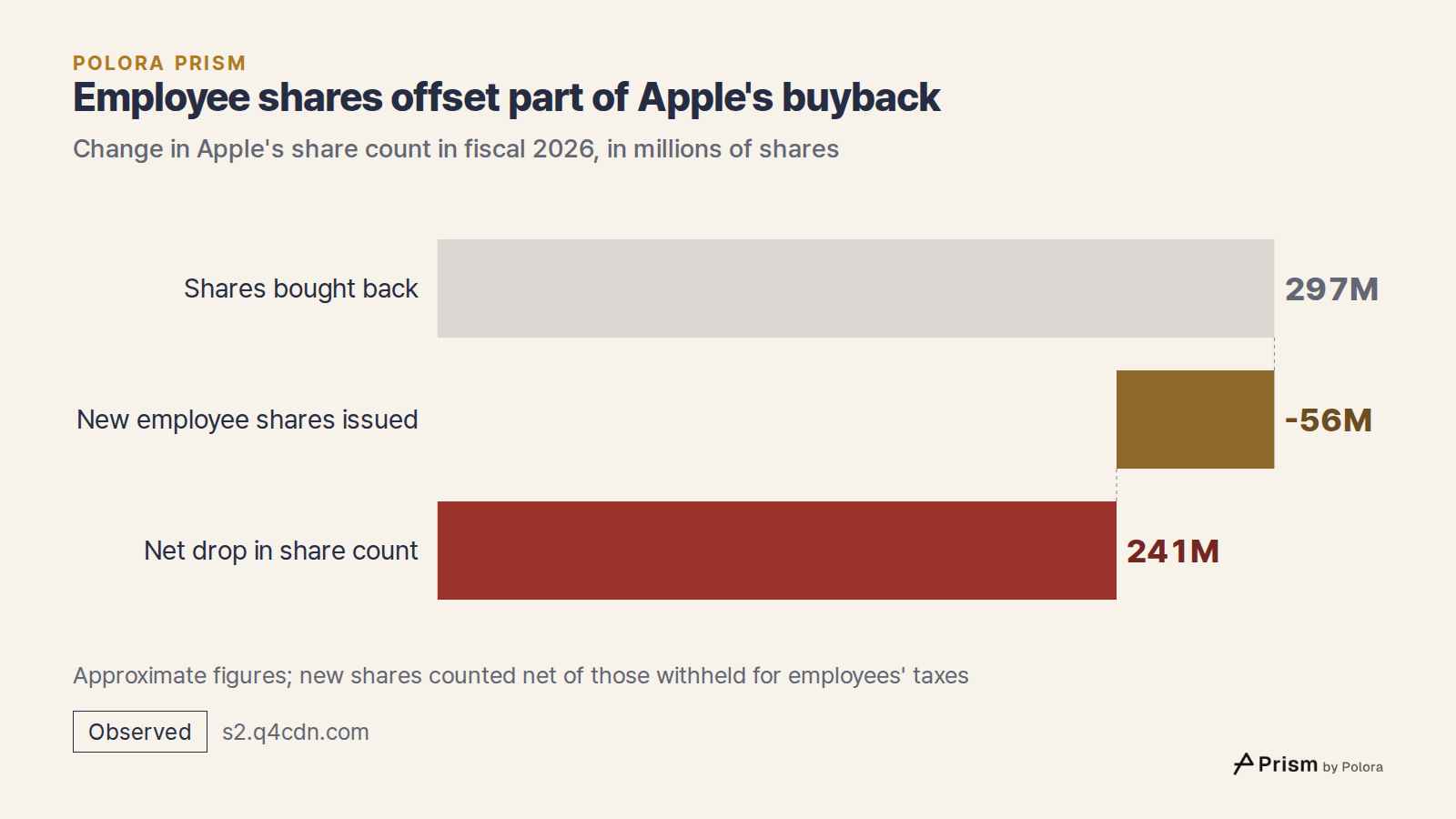
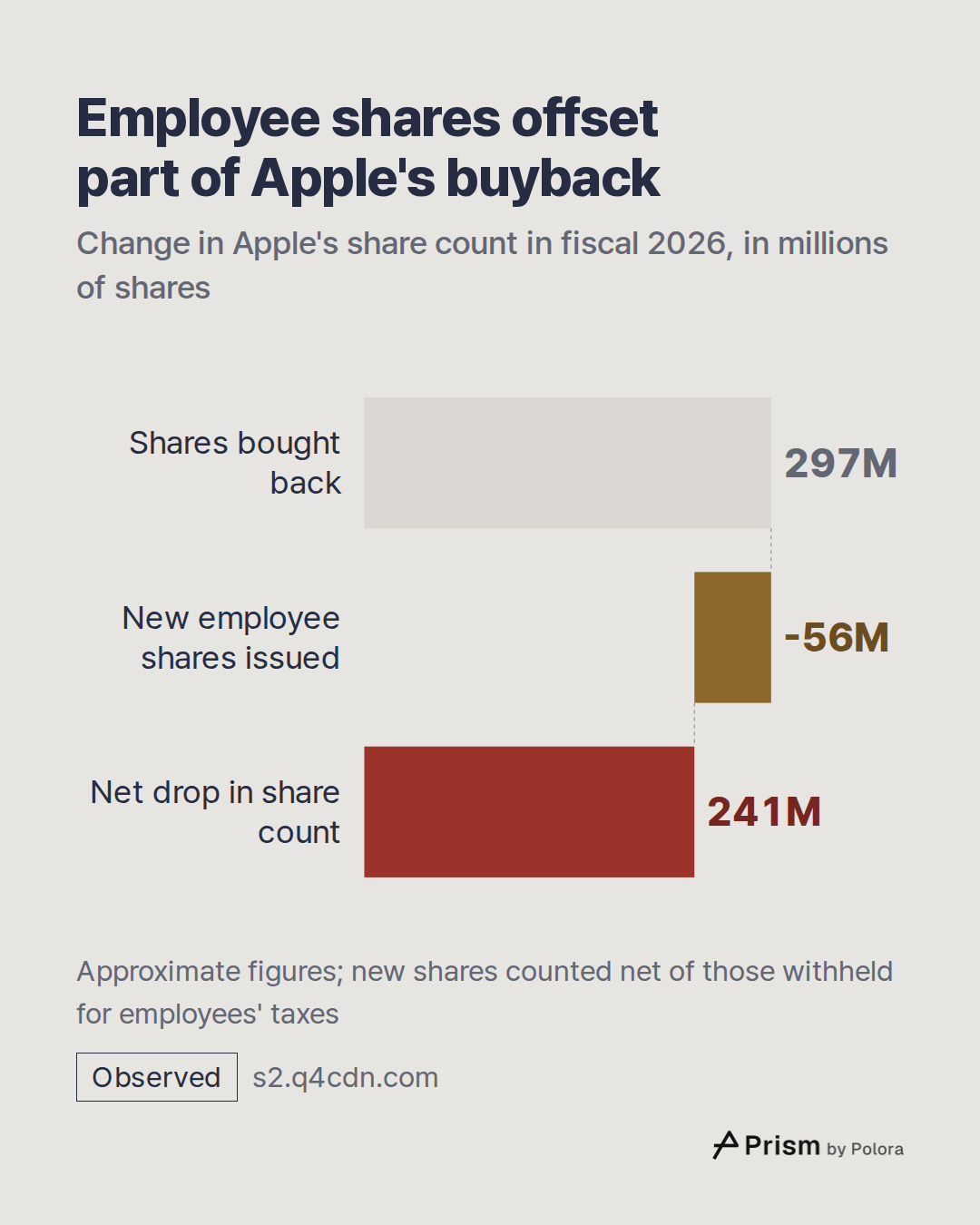
Apple ended fiscal 2026 with about 14.53 billion shares, down from about 14.77 billion a year earlier. That is about 241 million fewer shares, not 297 million.
The difference is employee stock. Apple pays part of its staff's compensation in shares, and in fiscal 2026 it issued about 56 million new shares, net of those withheld to cover employees' taxes. Part of every buyback simply cancels those out. The annual report's share table shows the same pattern in each of the past three years, with about 58 million issued in fiscal 2025 and about 66 million in fiscal 2024.
Change in Apple's share count in fiscal 2026, in millions of shares
What a comparison with Treasury bills does and does not mean
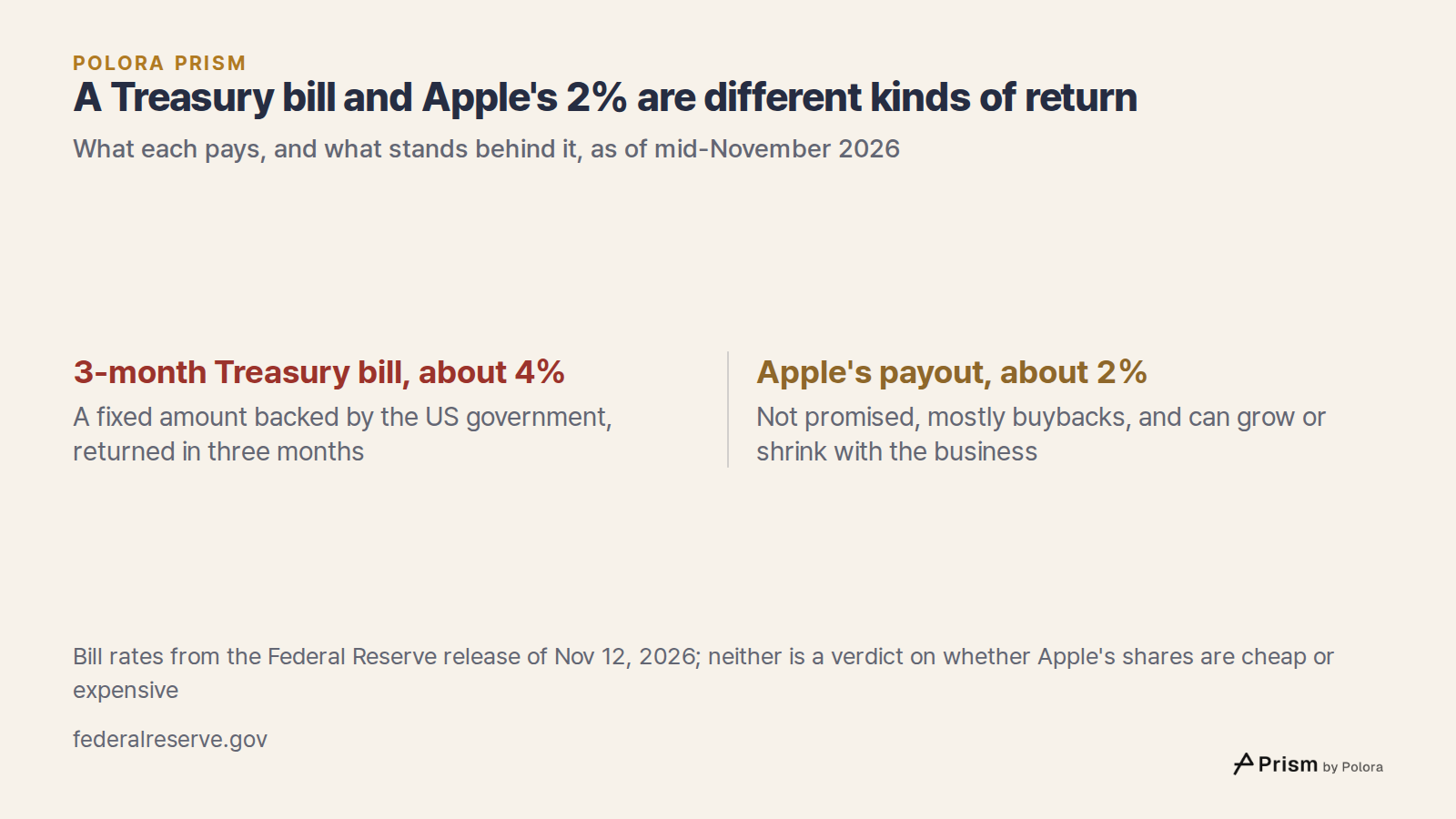
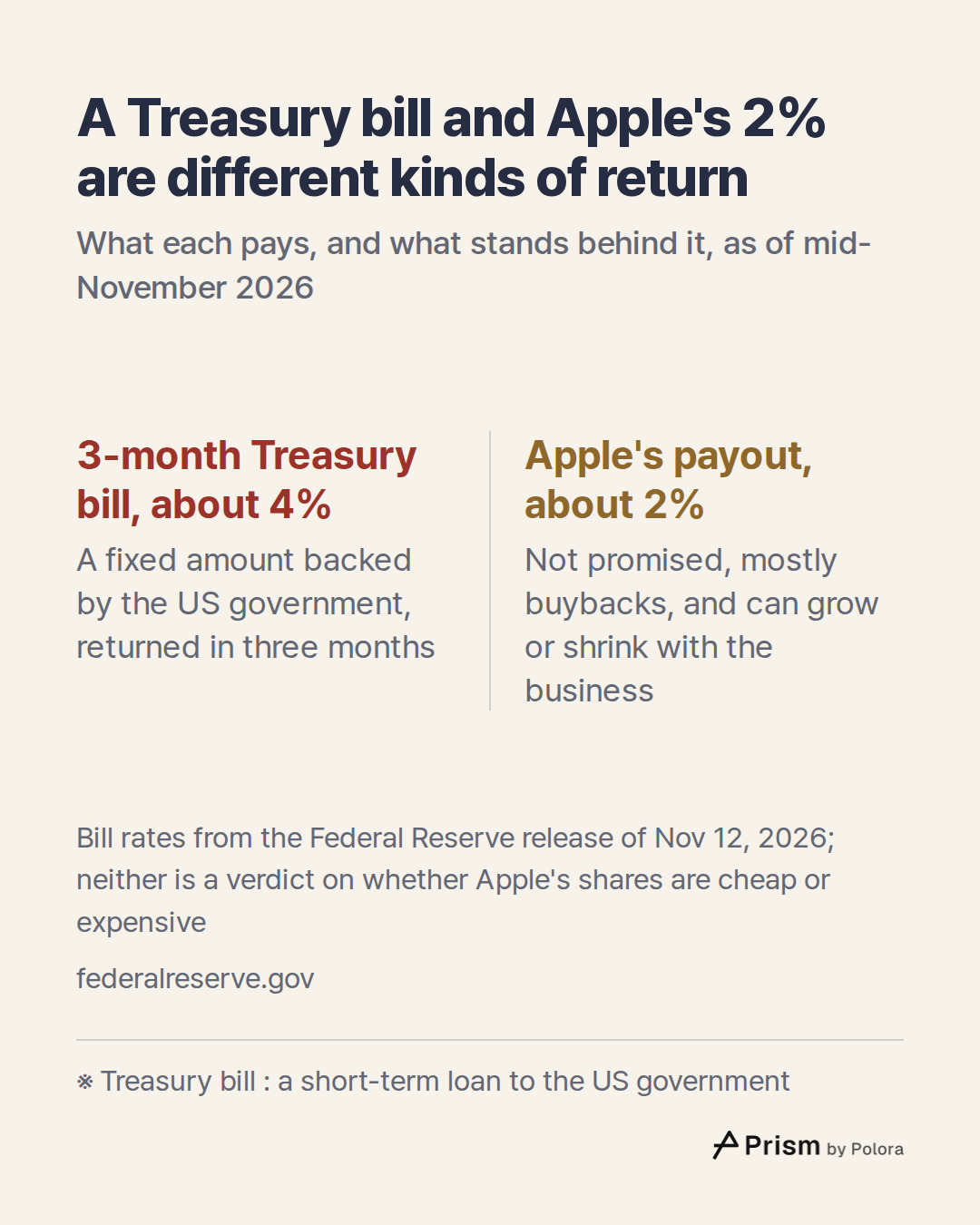
Treasury bills are short-term loans to the US government. The bond market was closed on Nov 11, 2026 for Veterans Day. On Nov 12, the Federal Reserve's daily interest rate release listed the 3-month bill at 4.14% on a discount basis, the traditional way bills are quoted, and at 4.32% on a constant-maturity basis, which is closer to a yield an investor would earn. Both are annual rates. Either way, the bill rate is about twice Apple's 2%.
The two numbers measure different things. A bill pays a fixed amount backed by the US government, and the money comes back in three months. Apple's 2% is not promised. Its board declares each dividend, its buyback programs do not oblige it to buy any minimum amount, and the share price can fall by more than any year's payout. Most of Apple's 2% is buybacks, which put no cash in the hands of owners who keep their shares. In the other direction, a company's profits can grow, and its payouts with them, which a bill's cannot.
So the gap between 2% and about 4% shows the difference between a fixed, government-backed payment and a share in a business whose results and price move. It is not a verdict on whether Apple's shares are cheap or expensive.
What each pays, and what stands behind it, as of mid-November 2026
In fiscal 2026 Apple handed back less cash than it generated
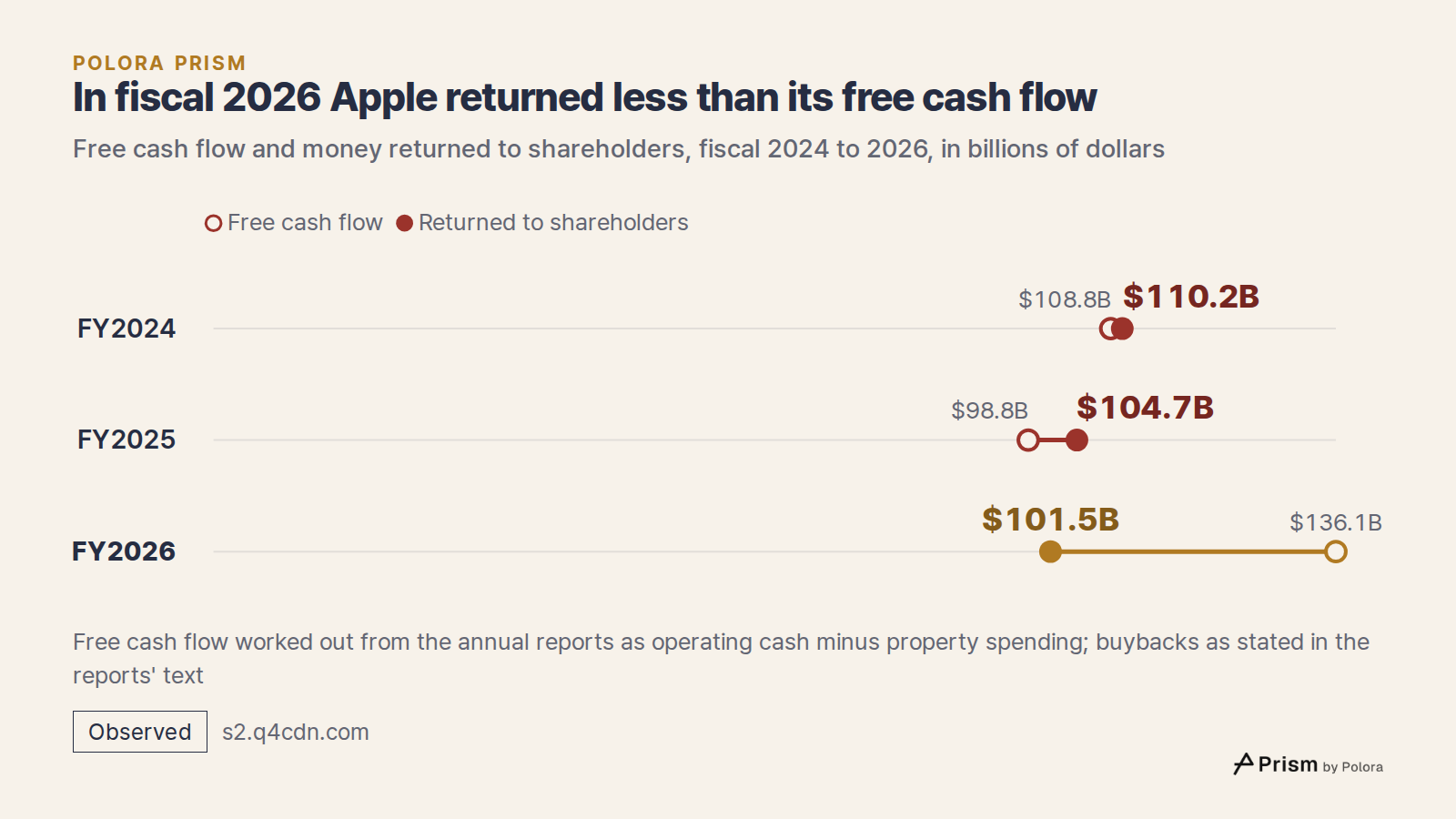
Free cash flow, the cash a business brings in after paying for its buildings and equipment, is not a line in Apple's annual report, but it can be worked out from it. In fiscal 2026, cash from operations was $145.1 billion and spending on property and equipment was $9.0 billion, leaving about $136.1 billion. Buybacks and dividends together came to $101.5 billion, about 75% of that. That total uses the buyback amount stated in the report's text. The cash-flow statement's payment lines give a slightly different total, and on either basis fiscal 2026 stays below the free cash flow worked out here.
The two years before went the other way. In fiscal 2025 Apple returned $104.7 billion against free cash flow of about $98.8 billion, and in fiscal 2024 it returned $110.2 billion against about $108.8 billion. Each time it handed back more than it generated, on either basis.
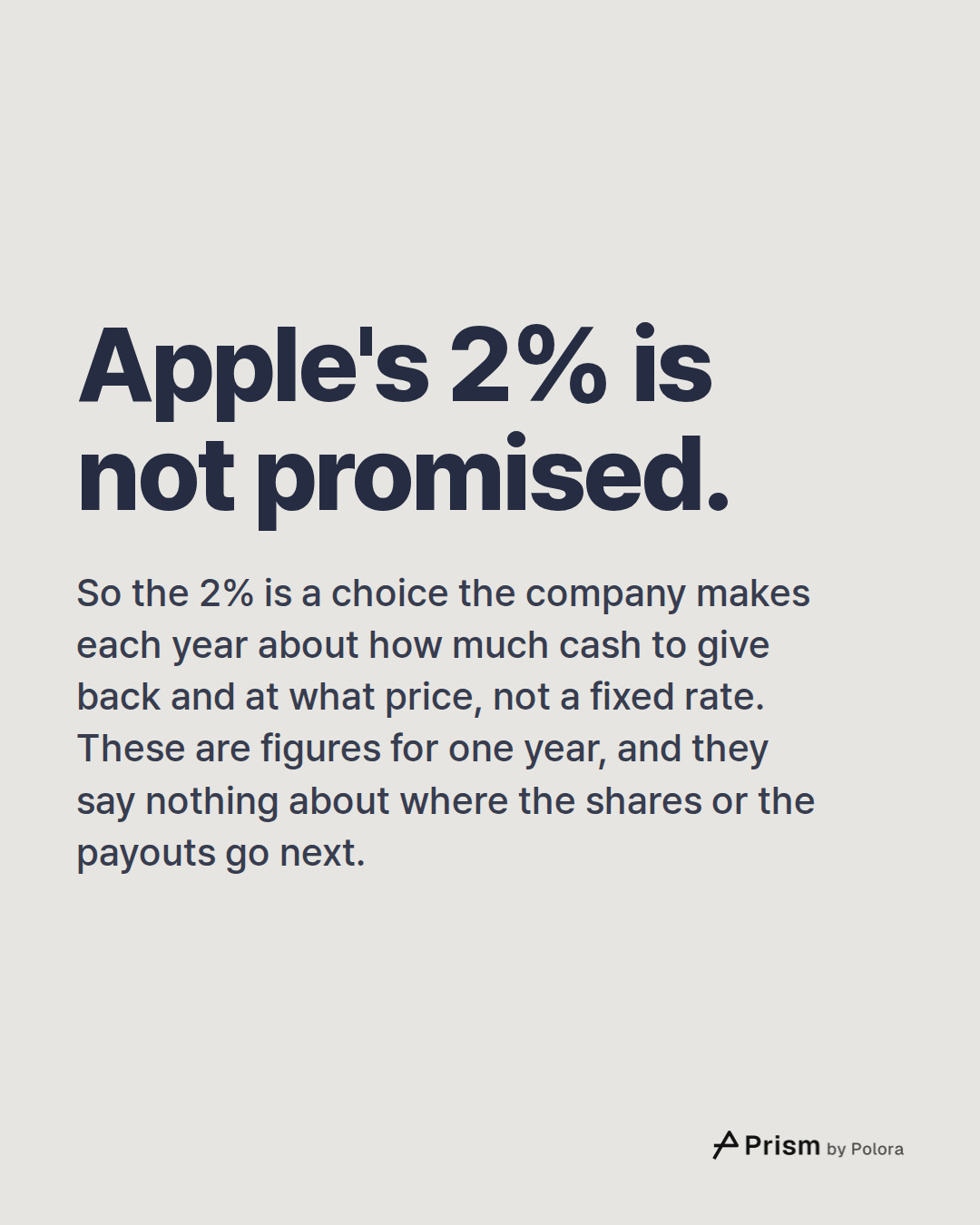
In April 2026 Apple announced a new buyback program of up to $100 billion. That is permission to buy, not a promise. The annual report says the programs do not oblige Apple to buy any minimum amount. So the 2% is a choice the company makes each year about how much cash to give back and at what price, not a fixed rate. These are figures for one year, and they say nothing about where the shares or the payouts go next.
Free cash flow and money returned to shareholders, fiscal 2024 to 2026, in billions of dollars
How much does Apple actually return to shareholders at a record share price?
Alpha · deepseek-v4-pro
At the Nov 11, 2026 record close of $355.63, Apple was worth about $5.17 trillion using the roughly 14.53 billion shares outstanding on the 10-K cover. Against that market value, the cash Apple handed back in fiscal 2026 works out to just under 2% a year:
- Dividends: $15.7 billion → about 0.30% of market value ($1.08 per share ÷ $355.63).
- Buybacks: $85.8 billion → about 1.66% of market value.
- Combined: $101.5 billion → about 1.96%, or basically 2%.
That is a *shareholder yield*, not a total return. It says nothing about the enormous capital gain shareholders got as the stock ran to a record. Measured only as cash returned relative to today’s price, the honest answer is: not much — roughly 2%, and falling as the price climbs.
The buyback number is the one to be careful with. The 10-K text reports $85.8 billion for fiscal 2026; the cash-flow statement’s line for share repurchases may differ slightly because of payment timing. If you use the cash-flow figure instead, the total rises only to about $102 billion, and the yield stays just under 2%. So the headline does not change.
There is also a real asymmetry in the word “actually…
Beta · gpt-6-sol
The manuscript’s central calculation stands, but its wording needs two qualifications. At Apple’s November 11, 2026 close of $355.63, its approximately 14.532 billion shares implied a market value of $5.17 trillion. Apple reports $85.8 billion of fiscal 2026 repurchases and $15.7 billion of dividends and dividend equivalents. Dividing their $101.5 billion total by that market value gives 1.96%: about 1.66% from buybacks and 0.30% from cash distributions. This is a *backward-looking shareholder yield*, not the return an owner received or a rate Apple promises to pay. Apple’s stock-price lookup confirms the November 11 close; its SEC filing supplies the share count and payments. (investor.apple.com)
Here is what I would flag before publication:
- “At a record share price” needs a date. November 11 was not the last higher close: Apple’s price lookup shows $356.27 on November 13. The manuscript correctly says shares subsequently closed higher, but must not imply $355.63 remained the record as of November 18. Its “at any higher price” arithmetic is conditional, not a claim that eve…
Gamma · gemini-3.1-pro
Here is what I found regarding the manuscript's claims and the editor's specific checks:
1. Share Price, Share Count, and Market Value
The premise that Apple closed at $355.63 on November 11, 2026, is confirmed by the prior debaters' checks. The 2026 10-K cover (filed Nov 3, 2026) lists 14,532,182,000 shares outstanding as of October 23, 2026. Multiplying this by $355.63 yields approximately $5.168 trillion, confirming the manuscript's $5.17 trillion market value calculation.
*Source: Apple FY2026 Form 10-K (https://www.sec.gov/Archives/edgar/data/320193/000032019326000026/aapl-20260926.htm)*
2. Buybacks and Dividends Figures
The manuscript claims $85.8 billion in buybacks and $15.7 billion in dividends for fiscal 2026. The text of the 2026 10-K explicitly states: "During 2026, the Company repurchased $85.8 billion of its common stock and paid dividends and dividend equivalents of $15.7 billion." This matches the manuscript exactly.
As requested by the editor, the discrepancy between the text note ($85.8B) and the cash flow statement ($86.39B) is due to settlement timing. It is worth adding a brief note to the manuscript explaining that the cash-flow statement recor…
Researcher · gpt-6-luna
Verification update: the fiscal-2026 arithmetic is broadly right, but $355.63 on November 11, 2026 was not the latest record close by November 18. Apple’s own historical-price lookup shows a close of $356.27 on November 13. At the November 11 price and the 10-K cover’s 14.532 billion shares, the implied market value is about $5.17 trillion; the “record” label should be dated, not presented as still current. Apple historical stock-price lookup (investor.apple.com)
Using the manuscript’s November 11 comparison point, Apple’s fiscal-2026 reported buybacks and dividends total roughly $101.5 billion, or about 1.96% of that market value: approximately 1.66% in buybacks and 0.30% in dividends. That is backward-looking spending relative to a later share price—not a promised yield or the return an individual shareholder necessarily receives. Apple’s 10-K cash-flow statement separately records $86.390 billion of repurchase payments and $15.721 billion of dividend payments; those cash-flow figures differ from the filing’s other repurchase and dividen…
The Arbiter · gpt-6-sol
The voices agree on the calculation at the specified November 11 price: they use Apple’s fiscal-2026 repurchases and distributions against a market value derived from that day’s close. They also agree that this measures past corporate spending relative to market value—not cash received by every continuing shareholder, a promised future payout, or an investment’s total return. Apple’s filing supports the spending figures and share-count changes. (sec.gov)
Two publication checks sharpen the record:
- Date the “record” precisely. Apple’s price lookup lists $355.63 on November 11, 2026, but $356.27 on November 13. The piece can use November 11 as its comparison point without suggesting it remained the highest close. (investor.apple.com)
- The Treasury figures have direct confirmation. Federal Reserve series list 4.14% for the three-month bill’s discount-basis rate and 4.32% for the three-month constant-maturity rate on November 12, 2026. That resolves the Researcher’s stated gap in retriev…
The Arbiter's Final Verdict · gpt-6-sol
About 2% on a backward-looking shareholder-yield measure—not a 2% cash payment to every shareholder. At Apple’s November 11, 2026 close of $355.63, its approximately 14.532 billion shares implied a market value of $5.17 trillion. Against that value, Apple’s fiscal-2026 figures of $85.8 billion in repurchases and $15.7 billion in dividends and dividend equivalents total about $101.5 billion, or 1.96%: roughly 1.66% from buybacks and 0.30% from distributions. Apple’s 2026 10-K · Apple stock-price lookup
The manuscript’s central premise stands, with qualifications before publication:
- Date the record. Apple’s lookup shows a higher close, $356.27, on November 13. November 11 remains a valid, specified price for the calculation, not a record that still stood on November 18. Apple stock-price lookup
- Label the accounting basis. The $85.8 billion repurchase figure comes from the filing’s discussion; its cash-flow statement instead records $86.390 billion of repurchase payme…