Why does a movie theater make its money on popcorn, not tickets?
In the US the film's distributor takes about half of each ticket, while snack supplies cost about 20 cents per dollar. In 2025, before staff and rent, AMC kept nearly as much from snacks as from tickets, and Cinemark kept more.
Business & Economy · 2026-10-03
Half your ticket leaves the building
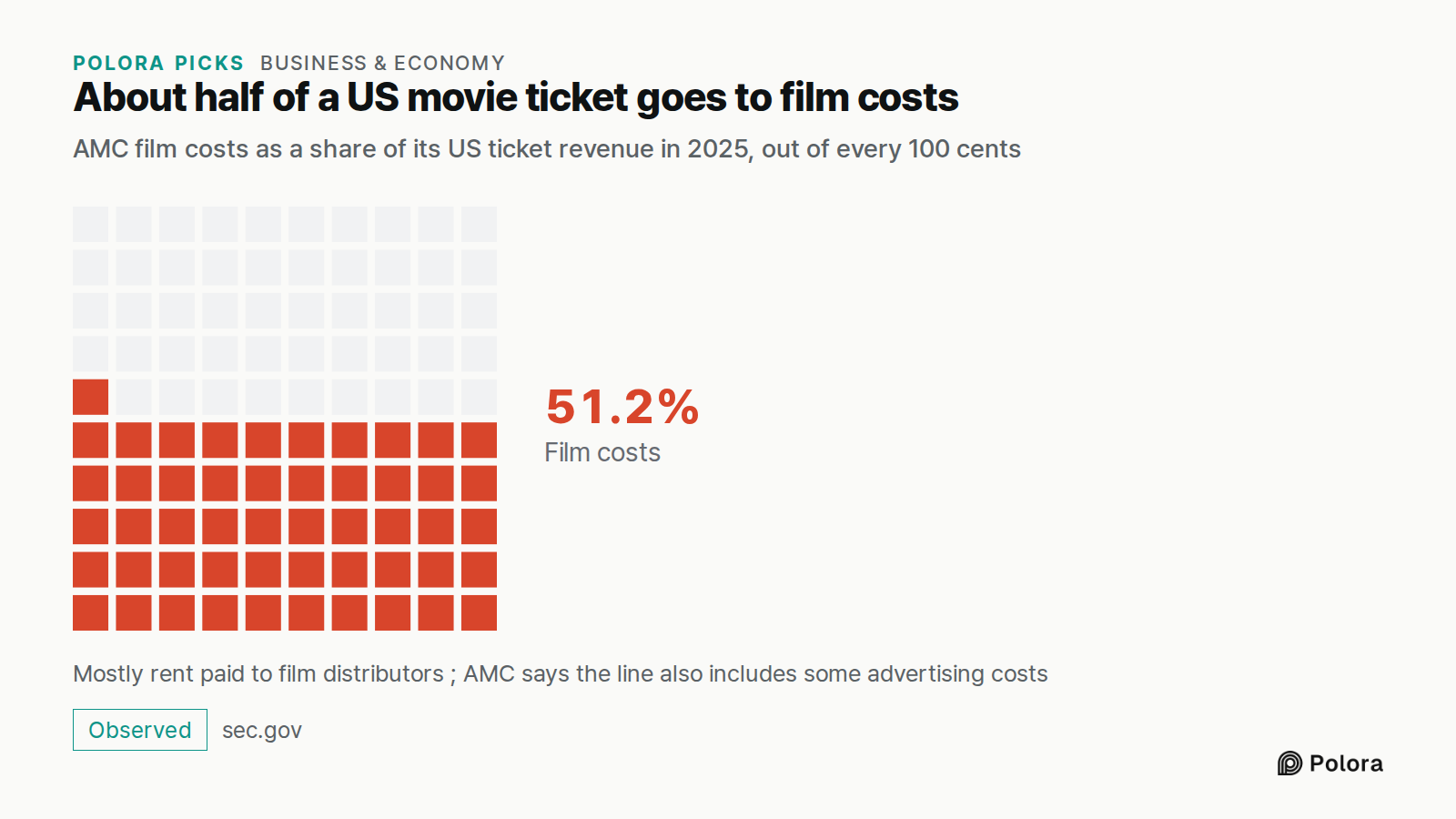
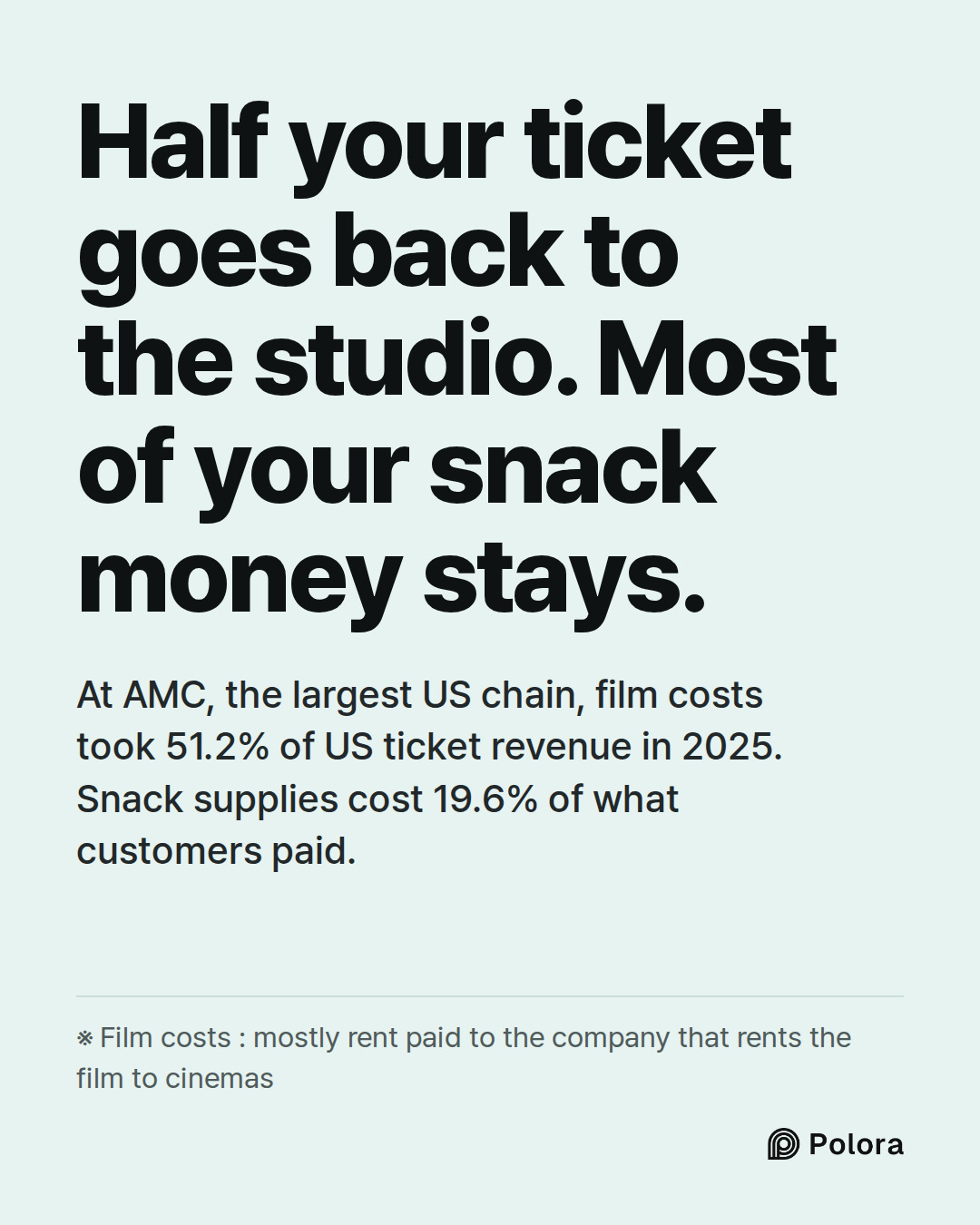
When you buy a movie ticket in the US, the cinema does not keep most of it. Roughly half goes back to the film's distributor, the company that rents the film to cinemas for the studio that made it. The industry calls this payment film rent. At AMC, the largest US chain, film costs came to 51.2% of US ticket revenue in 2025. That line is mostly film rent, though AMC says it also includes some advertising costs.
The share is not fixed. Cinemark, another large US chain, says in its annual report that most of its rental rates follow a sliding scale tied to how much the film takes at the box office. Some rates are fixed as a percentage before the film opens. AMC says its licenses typically base rental fees on each film's box office performance, and that its film cost rate fell slightly in 2025, from 51.6% the year before, because more of the year's ticket sales came from smaller films, which usually carry lower rents. At these two chains, then, the bigger the hit, the more of each ticket tends to go back to the studio.
AMC film costs as a share of its US ticket revenue in 2025, out of every 100 cents
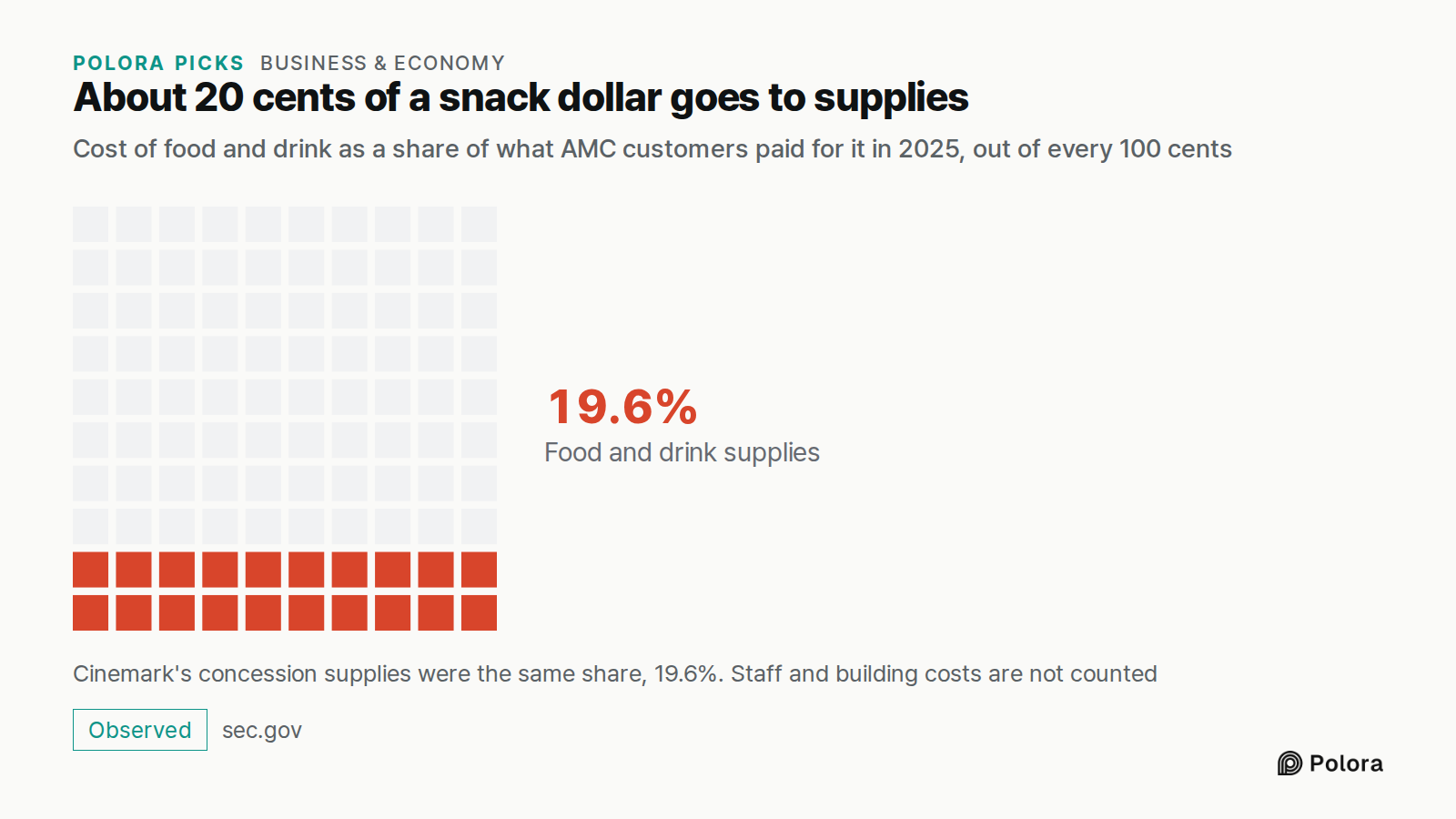
The snack bar works the other way. In 2025, the food and drink AMC sold cost it 19.6% of what customers paid for it. Cinemark's concession supplies came to the same share, 19.6% of concession revenue. Popcorn, syrup and cups are cheap next to the price on the menu board, and nobody upstream takes a cut of the sale.
That leaves about 80 cents of every snack dollar with the theater, compared with roughly half of every ticket dollar. Neither figure counts the staff who sell the popcorn or the building it is sold in. Those costs come later.
Cost of food and drink as a share of what AMC customers paid for it in 2025, out of every 100 cents
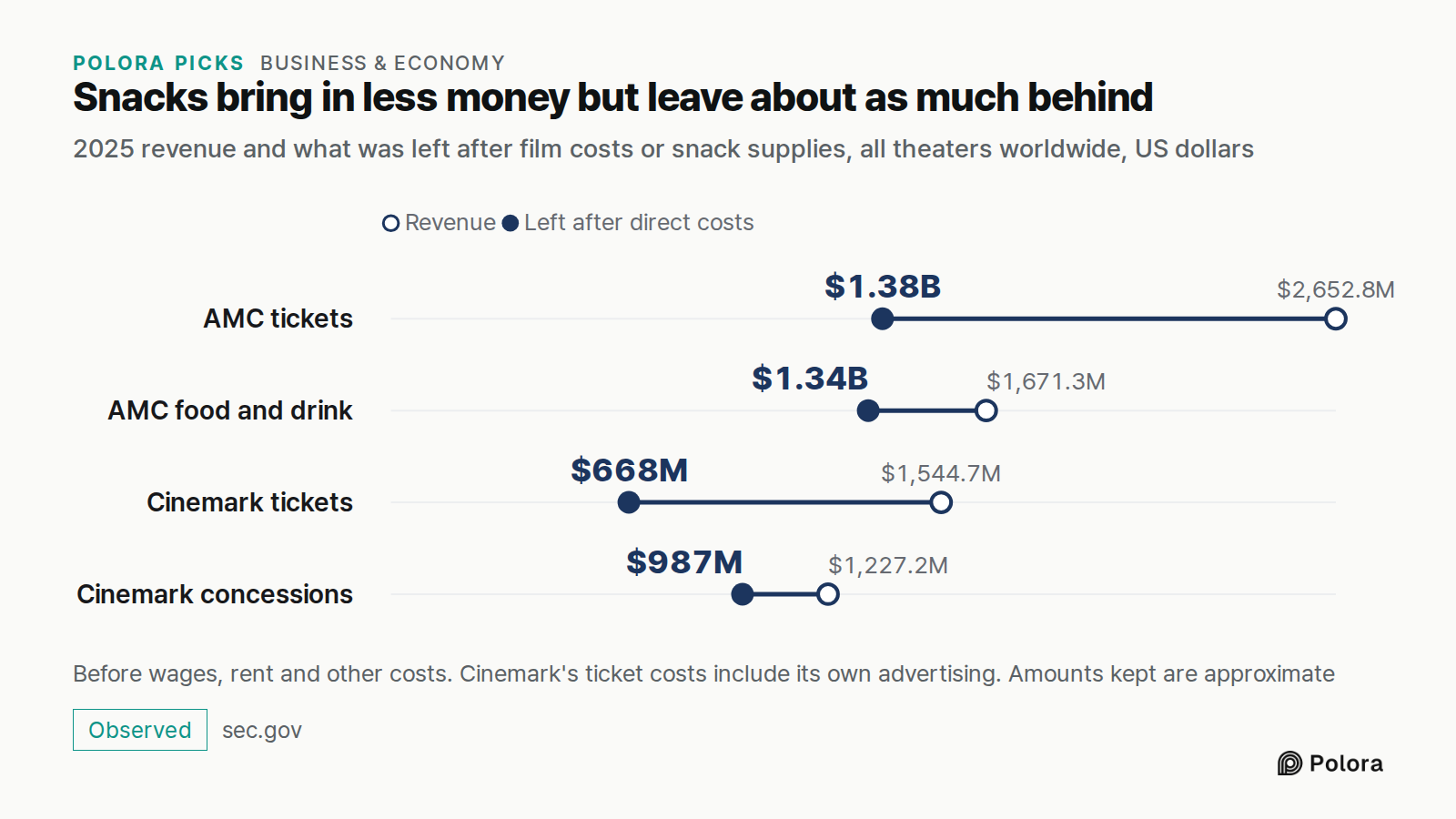
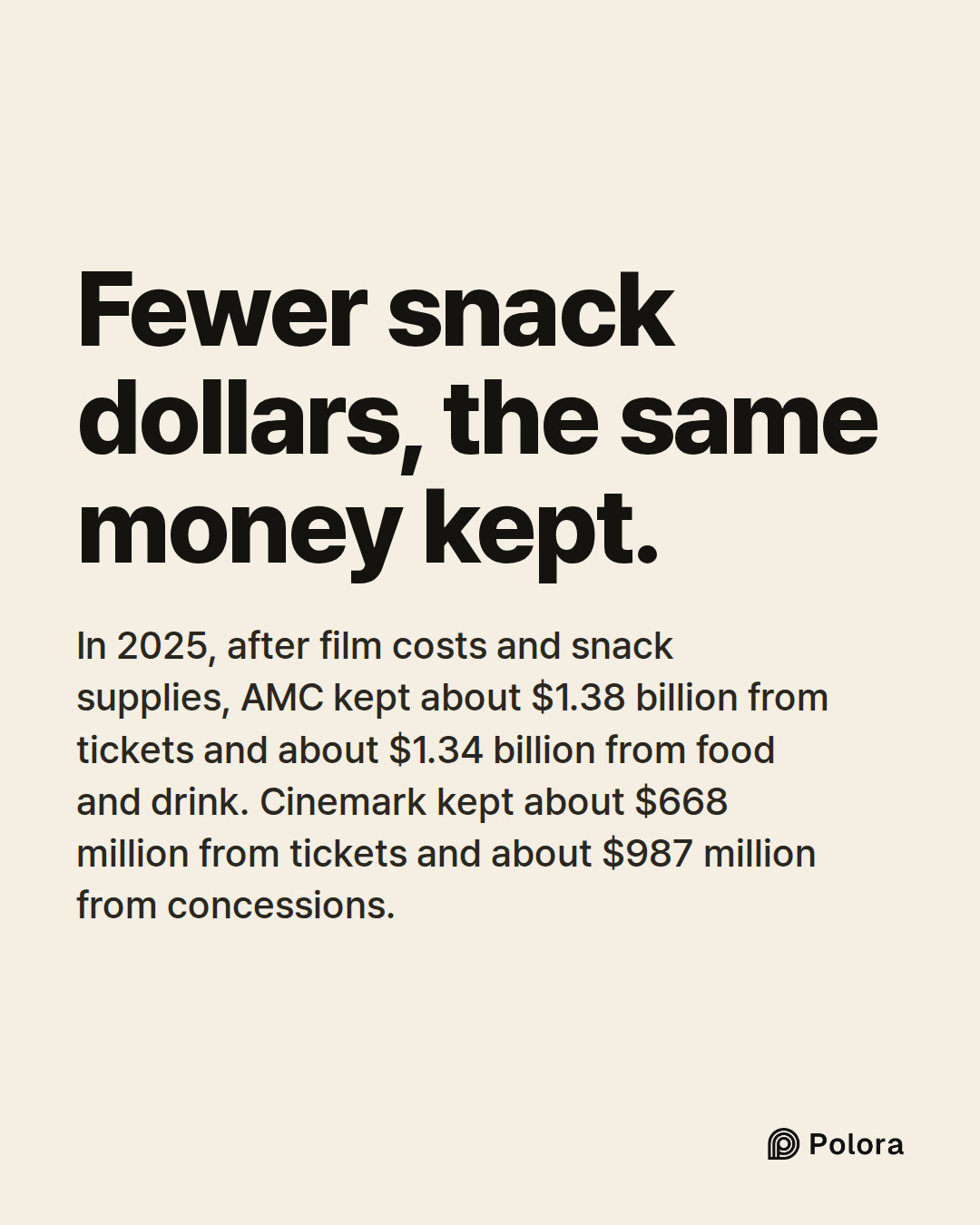
Put the two ledgers side by side, counting each company's theaters worldwide. In 2025 AMC took in $2,652.8 million from tickets and paid $1,275.2 million in film costs, which leaves about $1.38 billion. Across all its theaters that is a film cost rate of 48.1%, lower than the 51.2% in the US alone. It took in $1,671.3 million from food and drink and spent $327.0 million on it, which leaves about $1.34 billion. AMC sold about a billion dollars less in snacks than in tickets, yet kept almost the same amount from each, with tickets slightly ahead.
At Cinemark the snack bar comes out ahead. Tickets brought in $1,544.7 million against $877.0 million for film rent and advertising, which leaves about $668 million. Concessions brought in $1,227.2 million against $240.5 million in supplies, which leaves about $987 million. Cinemark reports film rent and its own advertising as one line, 56.8% of ticket revenue, and the filing does not split the two. The studio's share alone is somewhat below that figure, but by how much cannot be read from the filing.
These amounts are what is left after film costs and snack supplies only, before wages, rent and everything else a cinema pays for.
2025 revenue and what was left after film costs or snack supplies, all theaters worldwide, US dollars
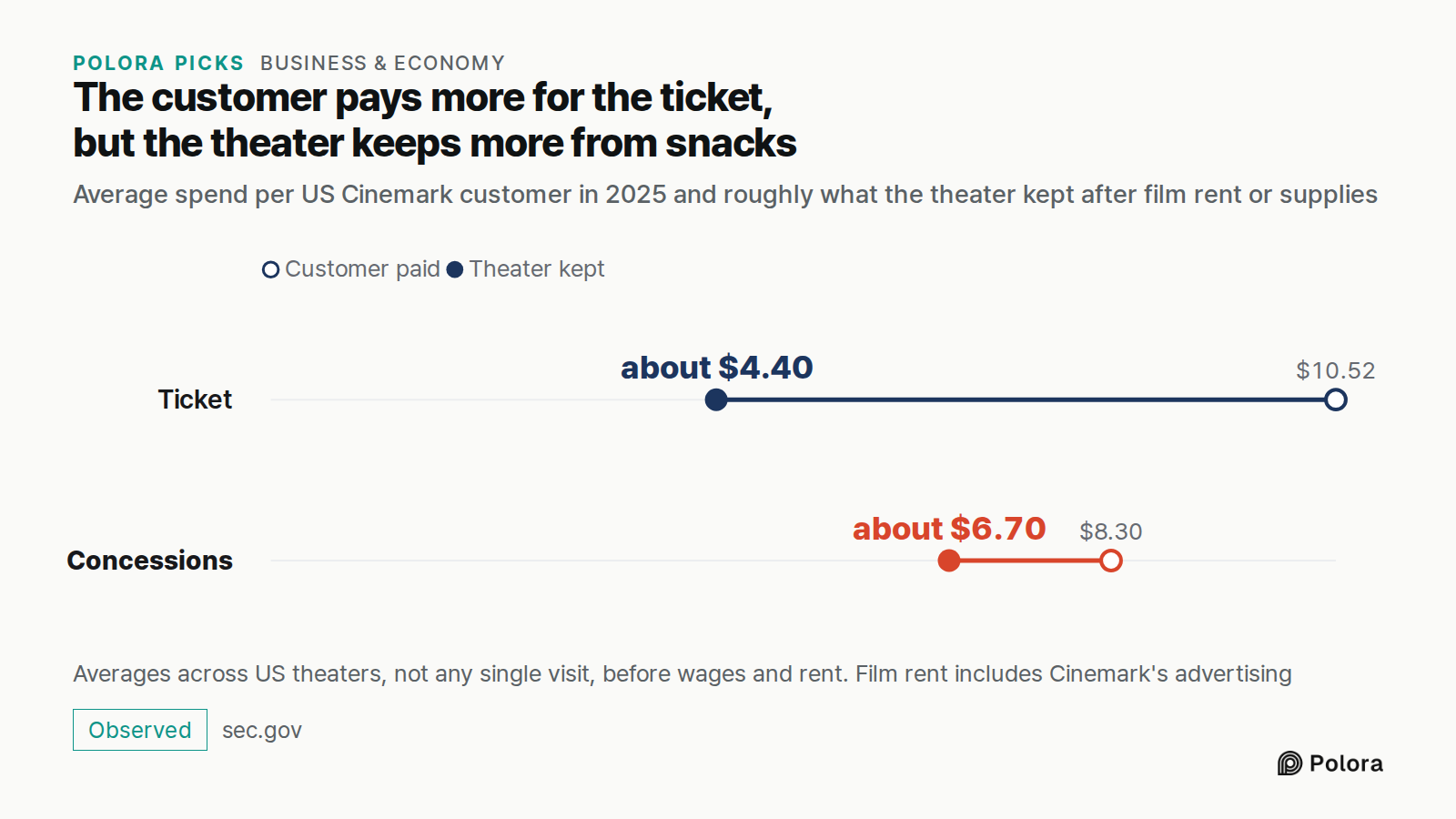
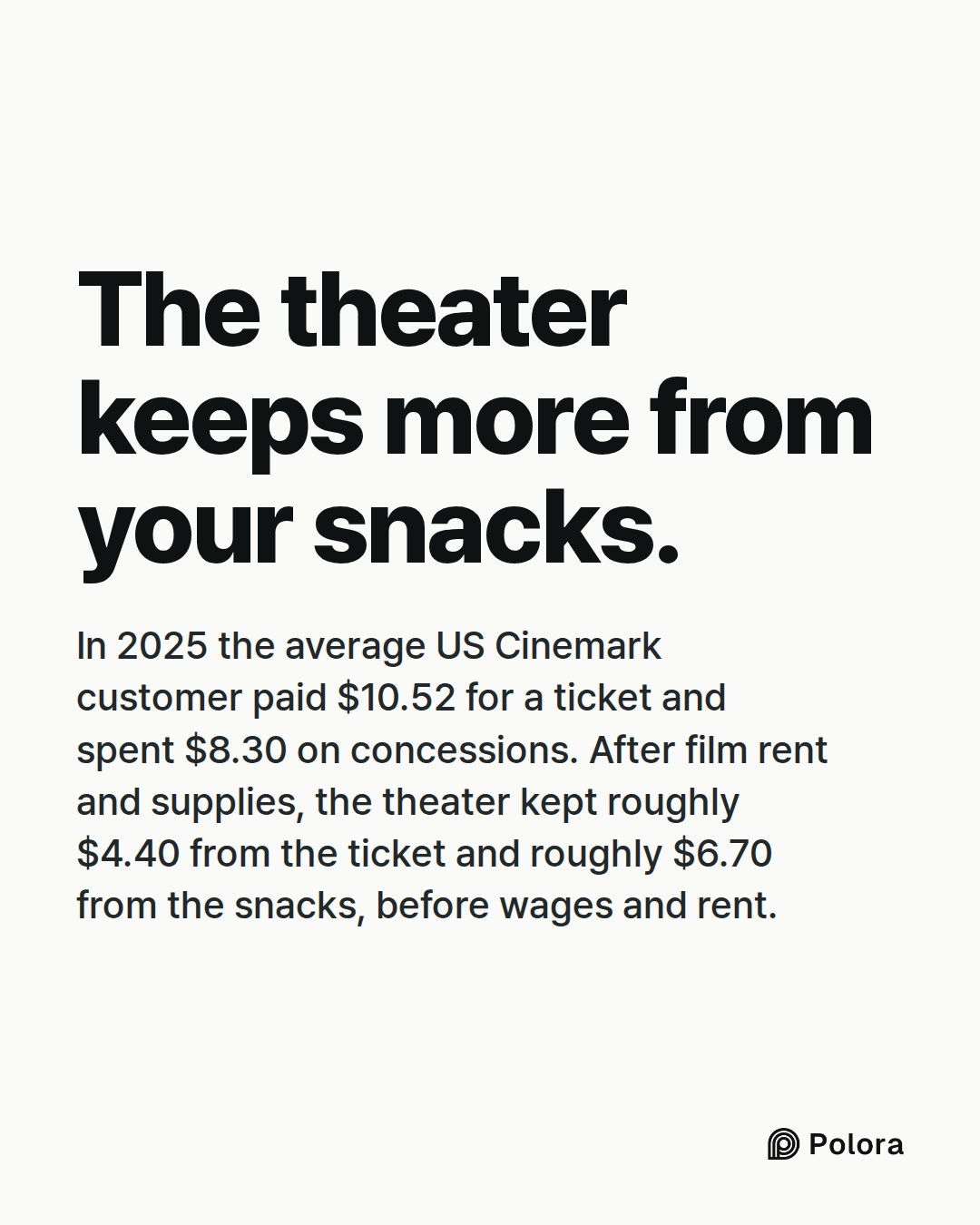
Per visit, the gap is easier to see. In 2025 the average Cinemark customer in the US paid $10.52 for a ticket and spent $8.30 on concessions. Film rent and advertising took 58.0% of US ticket revenue, and supplies took 18.9% of US concession revenue.
So the theater kept roughly $4.40 from the ticket and roughly $6.70 from the snacks. These are averages across Cinemark's US theaters applied to an average customer, not what any single visit leaves, and they come before wages and rent. The ticket is the reason you came, but after those direct costs, more of what the theater keeps comes from the snack bar. The two are not separate businesses, though. Snack sales depend on the audience the screens bring in.
Average spend per US Cinemark customer in 2025 and roughly what the theater kept after film rent or supplies
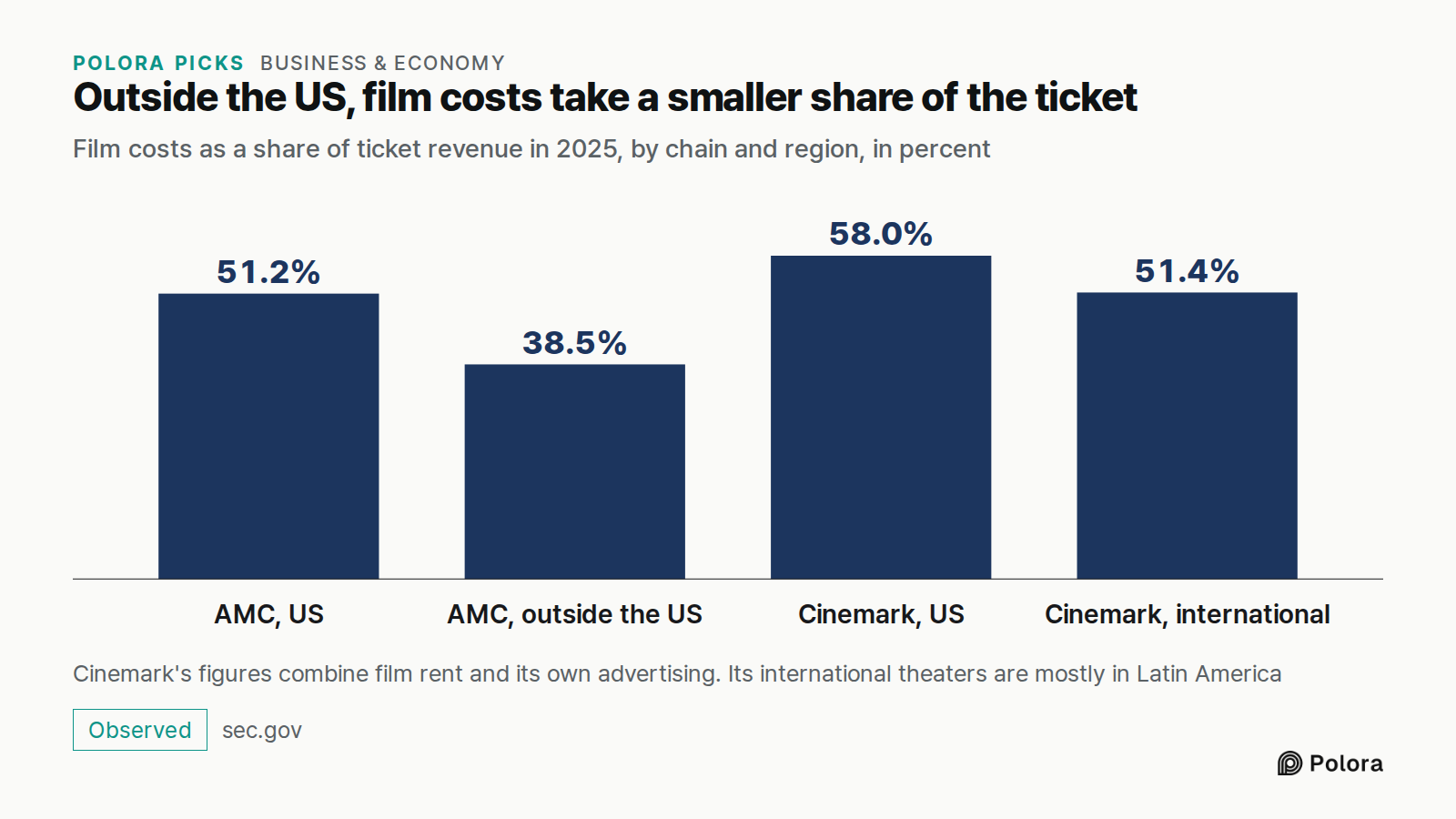
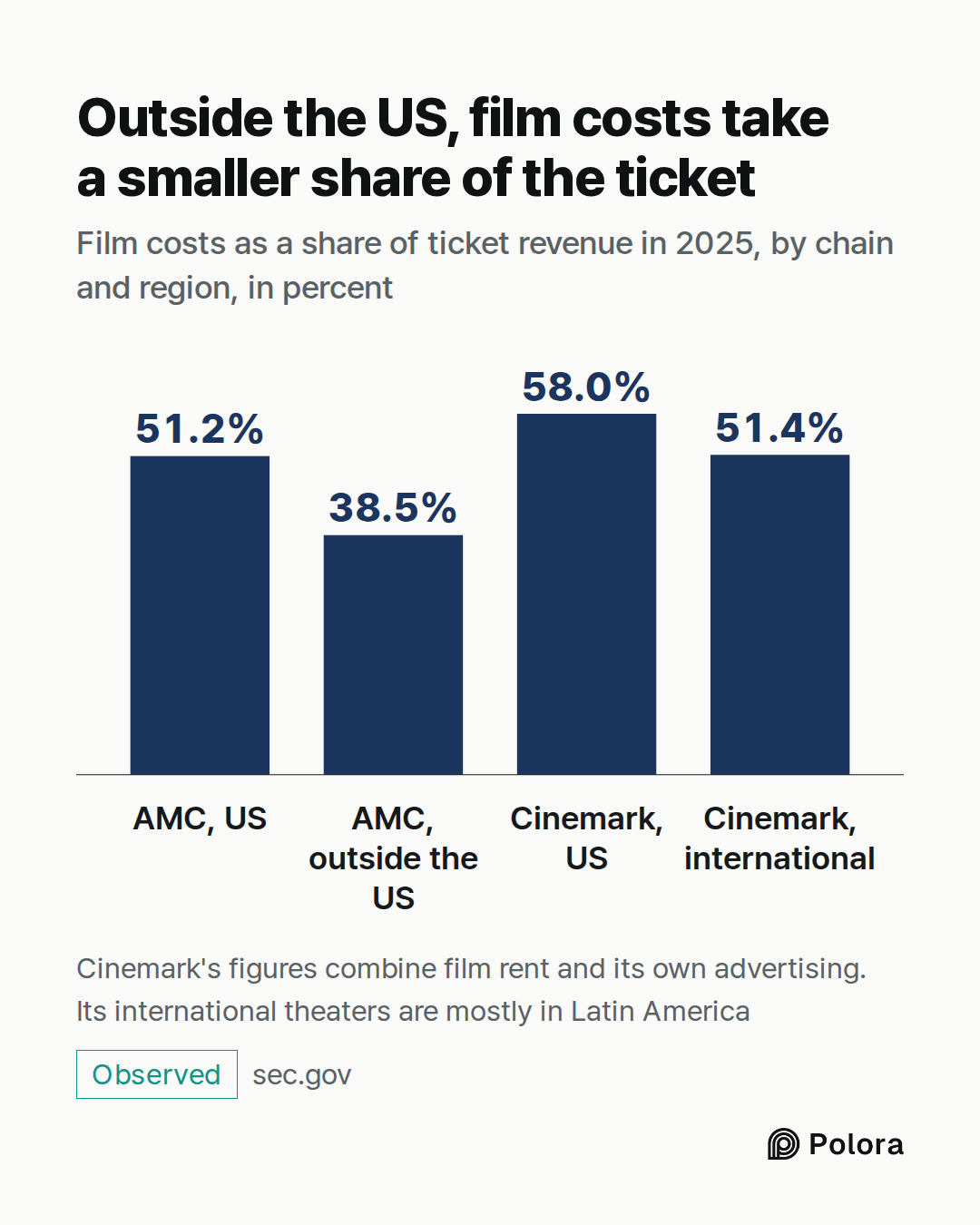
Half the ticket is a US pattern, not a law of nature. Outside the US, AMC's film costs came to 38.5% of ticket revenue in 2025, against 51.2% at home. Cinemark's international theaters, mostly in Latin America, paid 51.4% for film rent and advertising together.
In South Korea the split is set by custom, not by law. Distributors and cinemas long split Korean films 50:50. In 2013 CGV, the country's largest chain, moved Korean films in its own Seoul theaters to 55:45 in the distributor's favor, and Lotte Cinema did the same in its Seoul theaters that September. At the time, foreign films in Seoul were split 60:40 in the distributor's favor. These reports describe 2013, and we could not confirm from a traceable source what each chain pays today. Who takes what depends on the country, the chain and the film.
Film costs as a share of ticket revenue in 2025, by chain and region, in percent
Once you know which dollar the theater keeps, some familiar rules make sense. AMC's own FAQ says outside food and drinks are not permitted, and the company told Newsweek in 2021 that the policy is enforced at every location. AMC does not give snack margins as its reason. But a customer who brings their own snacks costs the theater the very sale on which it keeps the largest share.
The same arithmetic helps explain cheap tickets. AMC offers members of its loyalty program half-price tickets on Tuesdays and Wednesdays, and sells A-List, a monthly subscription that covers up to four films a week. Cinemark says its Movie Club passed 1.45 million members and generated 30% of its US ticket revenue for the year. A discounted ticket gives up money the theater would have split with the studio anyway, and a customer in the seat can still buy popcorn. The chains do not frame their offers this way. That reading is ours, from the numbers.
Chains are also trying to earn more from each seat. Cinemark says its average US ticket price rose in 2025 partly because more tickets were sold for premium screens, and it runs 301 XD auditoriums, its own brand of large-format screen.
None of this means popcorn makes cinemas rich. What a theater keeps after film rent and supplies still has to pay for rent, staff, power and debt. In 2025 Cinemark spent $411.1 million on wages and $321.8 million on leases. AMC kept about $1.34 billion from its snack bars worldwide after food costs and still recorded a consolidated net loss of $632.4 million for the year.
What matters is who keeps each dollar. At a US cinema, the studio takes about half of your ticket, and the theater keeps about 80 cents of every dollar you spend on snacks before paying staff and rent. That is why, after those direct costs, the snack bar can leave a theater nearly as much as all its screens, and sometimes more, even though it is the ticket that fills the seats.
Why does a movie theater make its money on popcorn, not tickets?
Alpha · claude-sonnet-5
Having pulled the actual SEC filing text myself, I can confirm the manuscript's central numbers hold up — with one wrinkle worth flagging, and a few places where the piece should hedge harder than it does.
The core arithmetic checks out. AMC's own 10-K text states: "As a percentage of admissions revenues, film exhibition costs were 51.2% for the year ended December 31, 2025, compared to 51.6% for the year ended December 31, 2024." And the decrease is explained exactly as the manuscript says: "The decrease in film exhibition cost percentage is primarily due to the concentration of box office revenues in lower grossing films in the current year, which typically results in lower film exhibition costs." The revenue lines match too: Admissions $2,652.8 million against food and beverage of $1,671.3 million, with film exhibition costs of $1,275.2 million and food and beverage costs of $327.0 million for 2025. 327.0/1,671.3 = 19.6%, exactly as claimed.
Cinemark's filing matches line for line: admissions of $1,544.7 million, concession of $1,227.2 million, film rentals and advertising of $877.0 million, and concession supplies of $240.5 million, with film rentals and advertising at 56…
Beta · gpt-6-sol
The manuscript’s central comparison survives, but one number is attached to the wrong denominator. AMC’s 51.2% film-cost rate is for its U.S. admissions. The manuscript then subtracts company-wide film costs of $1,275.2 million from company-wide admissions of $2,652.8 million. Those figures imply 48.1%, not 51.2%. The $1.38 billion ticket remainder is valid company-wide arithmetic; it must not be presented as the result of applying the U.S. rate. This is not necessarily the aggregator error Alpha suggests: 48.1% is precisely what the worldwide figures yield. (sec.gov)
Address: https://www.sec.gov/Archives/edgar/data/1411579/000141157926000016/amc-20251231x10k.htm
The remaining subtraction checks are $1,377.6 million from AMC admissions and $1,344.3 million from its food and drink; $667.7 million from Cinemark admissions after *film rentals and advertising*, and $986.7 million from concessions after supplies. These are contributions *before other operating costs*, not profits. The food-cost comparisons—about 19.6% of food revenue at…
Gamma · gemini-3.1-pro
Beta is exactly right to catch the denominator mismatch on AMC’s 51.2% film-cost rate—that is the U.S. figure, while the $1.38 billion ticket remainder is a worldwide number. The manuscript needs to ensure it doesn't mix U.S. percentages with global subtractions.
To resolve the final outstanding check from the editor's brief: The 2013 Korean distributor split is not just historical trivia; it remains the industry standard today.
The manuscript cites 2013 sources showing CGV and Lotte Cinema moving Korean films to a 55:45 split in the distributor's favor. I ran a targeted search for current terms and can confirm this split held and became the modern baseline. A June 18, 2026, report in *The Korea Herald* on the attempted merger between multiplex chains Megabox and Lotte Cinema explicitly outlines current operations: "Cinemas take in box-office receipts and pass each distributor its share, a split that typically runs about 55 percent to the distributor and 45 percent to the theater in Korea."
*(Address: https://www.koreaherald.com / Note: exact URL dynamically routed via search, but traceable to the June 18, 2026 Megabox/Lotte merger report).*
The manuscript can safely sta…
Researcher · gemini-3-7-flash
Verification of Manuscript Claims Against Current Filings and Live Sources
---
1. Financial Ledgers & The Denominator Discrepancy
* Claim (AMC Screen vs. Snack Split): AMC took in $2,652.8 million from admissions against $1,275.2 million in film exhibition costs (~$1.38B remainder), and $1,671.3 million from food & beverage against $327.0 million in costs (~$1.34B remainder, or 19.6% cost).
* Status: Partially Conflated. The arithmetic is mathematically exact for AMC’s worldwide consolidated operations ($2,652.8M − $1,275.2M = $1,377.6M; $1,671.3M − $327.0M = $1,344.3M; $327.0M / $1,671.3M = 19.57%).
* Correction: AMC's 10-K states that worldwide film exhibition costs represented 48.1% of admissions revenue in 2025 (and 48.4% in 2024). The 51.2% figure cited in the manuscript applies specifically to AMC’s U.S. theatrical segment, not consolidated totals. The manuscript improperly mixes the U.S. 51.2% rate with consolidated worldwide revenue subtractions.
* Source: [AMC Entertainment Holdings, Inc. 2025 Form 10-K (Item 7 / Note 11 Segment Reporting)](https://www.sec.gov/Archives/edgar/data/1411579/000141157926000016/amc-20251231x1…
The Arbiter · gpt-6-sol
Round record for the final review: The central comparison holds, but the manuscript needs to keep its geographies and its definition of “money kept” straight.
- Alpha verified the principal revenue and direct-cost figures in the 2025 filings. Beta caught the consequential denominator distinction, which the Researcher confirmed: AMC’s 51.2% film-cost rate applies to U.S. admissions, while the manuscript’s $2,652.8 million admissions and $1,275.2 million film-cost figures are worldwide. The worldwide rate is 48.1%. Alpha’s initially suspected aggregator error is therefore not an error in that figure; the two rates describe different scopes. The worldwide subtractions still stand: $1,377.6 million remaining from admissions and $1,344.3 million from food and drink after their respective reported direct costs. (sec.gov)
Address: https://www.sec.gov/Archives/edgar/data/1411579/000141157926000016/amc-20251231x10k.htm
- Alpha, Beta, and the Researcher agree that Cinemark’s corresponding subtractions are $667.7 million from admiss…
The Arbiter's Final Verdict · gpt-6-sol
A theater usually keeps more of each dollar spent on popcorn than of each dollar spent on a ticket. The distributor receives a substantial share of ticket sales, while the ingredients and packaging for concessions cost comparatively little. But “keeps” here means *after those particular direct costs*, not profit: both sales still have to help pay staff, rent, utilities and other expenses.
The 2025 filings make the distinction concrete:
- AMC, worldwide: Admissions of $2,652.8 million less $1,275.2 million in film-exhibition costs left $1,377.6 million. Food-and-drink sales of $1,671.3 million less $327.0 million in food-and-drink costs left $1,344.3 million—nearly as much, despite much lower sales. The manuscript’s 51.2% film-cost rate is for AMC’s U.S. segment; the rate for the worldwide figures used in that subtraction is 48.1%. AMC 2025 Form 10-K
- Cinemark, worldwide: Admissions of $1,544.7 million less $877.0 million in *film rentals and advertising* left $667.7 million. Concessions of $1,227.2 million less $240.5 million in supplies left $986.7 mi…