Who decides which companies get into the S&P 500?

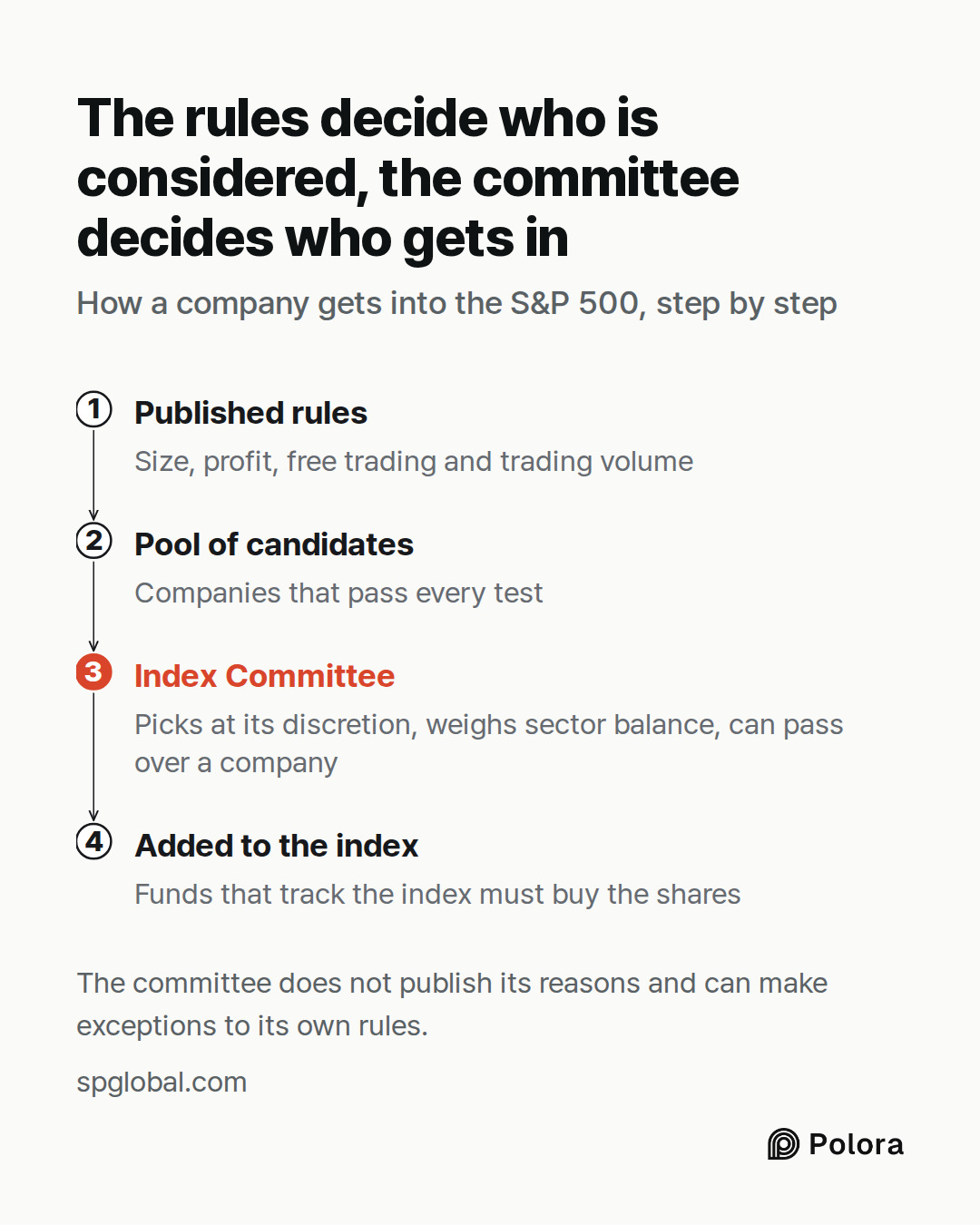
A committee of S&P Dow Jones Indices staff decides. Published rules on size, profit and share trading set who may normally be considered. The committee chooses from that pool, can pass over a company that meets every rule, and does not apply the entry rules to companies already inside.

Business & Economy · 2026-10-04

The S&P 500 is not simply the 500 biggest US companies

Ask most people what the S&P 500 is and they will say it is the 500 largest companies in America. That is close, but it leaves out the part that matters. The list is chosen. A committee at S&P Dow Jones Indices, the company that runs the index, decides who joins and who leaves.

S&P's own rulebook says the committee is made up of full-time S&P Dow Jones Indices staff. It meets once a month and keeps its discussions confidential, because news that a company is being added can move markets.

The rulebook fixes the count at 500 companies. The index usually holds a few more than 500 stocks, because some companies have more than one class of shares. At the end of September 2026 it held 503, according to S&P's factsheet for that date.

What a company has to show before it can even be considered

The published rules work like an entry exam. Under the July 2026 edition of the rulebook, a company must be based in the US and listed on a US exchange. A newly listed company must normally have traded there for at least 12 months, so a brand-new listing cannot join straight away. The rulebook makes some exceptions to that wait, for instance for certain spin-offs and for companies moving over from an exchange that does not qualify.

It must be worth at least $22.7 billion in total. That bar was set in July 2025. S&P reviews it every quarter, but a review does not mean a change : the bar is updated only when the market has moved enough, by S&P's own measure a difference of at least 10%. There is also a second size test. Counting only the shares freely available to trade, which are the shares the index actually adds, the company must be worth at least half of that bar.

It must make a profit under standard US accounting rules, known as GAAP, both in its latest quarter and across its last four quarters added together. At least 10% of its shares must be freely available to trade, rather than held by founders or other owners who are locked in. And its shares must change hands often enough. One of those tests asks for at least 250,000 shares traded in each of the previous six months.
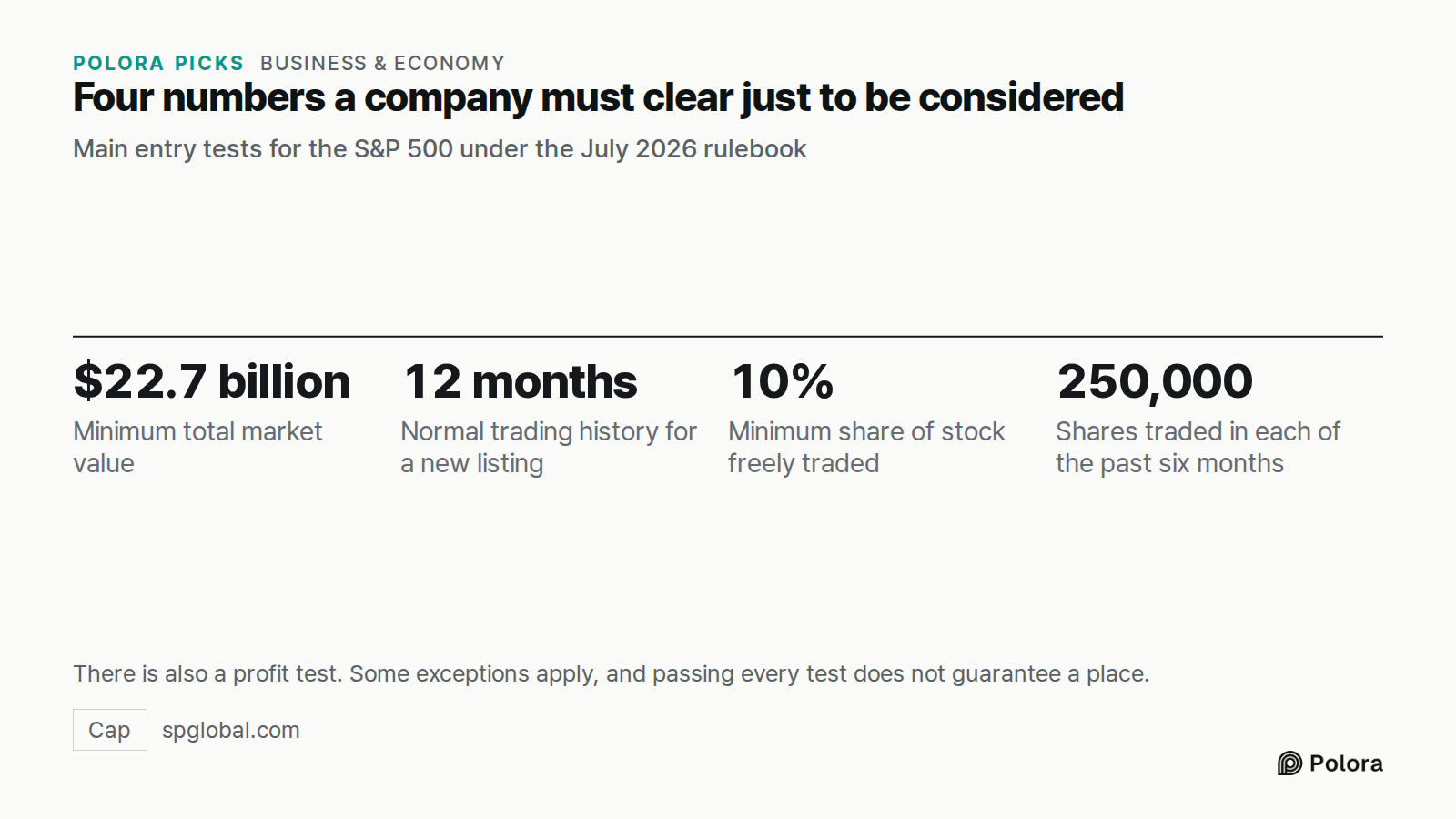
Four numbers a company must clear just to be considered · Main entry tests for the S&P 500 under the July 2026 rulebook · $22.7 billion · 12 months · 10% · 250,000 · Minimum total market value · Normal trading history for a new listing · Minimum share of stock freely traded · Shares traded in each o
Main entry tests for the S&P 500 under the July 2026 rulebook

Why meeting every rule does not guarantee a place

Passing the exam only puts a company in the pool of candidates. The rulebook says that choosing members 'is at the discretion of the Index Committee'. It adds that the committee weighs sector balance, comparing how much of the index each industry takes up with how much of the wider US market it takes up. The committee also reserves the right to make exceptions to its own rules when it sees a need.

That discretion is not a free hand. The committee works inside a long published rulebook on eligibility, exceptions and how companies move between S&P's indexes, and many changes follow from those rules. Where its judgment shows most is in the cases that stand out.

The case people remember is Tesla. By September 2020 it met the criteria, but the committee did not pick it in that month's changes, and CNBC reported it as a snub. The committee does not publish its reasons, so why it waited is not on the record. Two months later, on November 16, 2020, S&P announced that Tesla would join before trading opened on December 21.

The committee's judgment can also take the form of refusing to bend. In June 2026, after asking market participants for their views, S&P decided not to relax the 12-month waiting period, the profit test or the 10% free-trading minimum for very large newly listed companies. It said exceptions should not be granted 'solely based on market capitalization'.
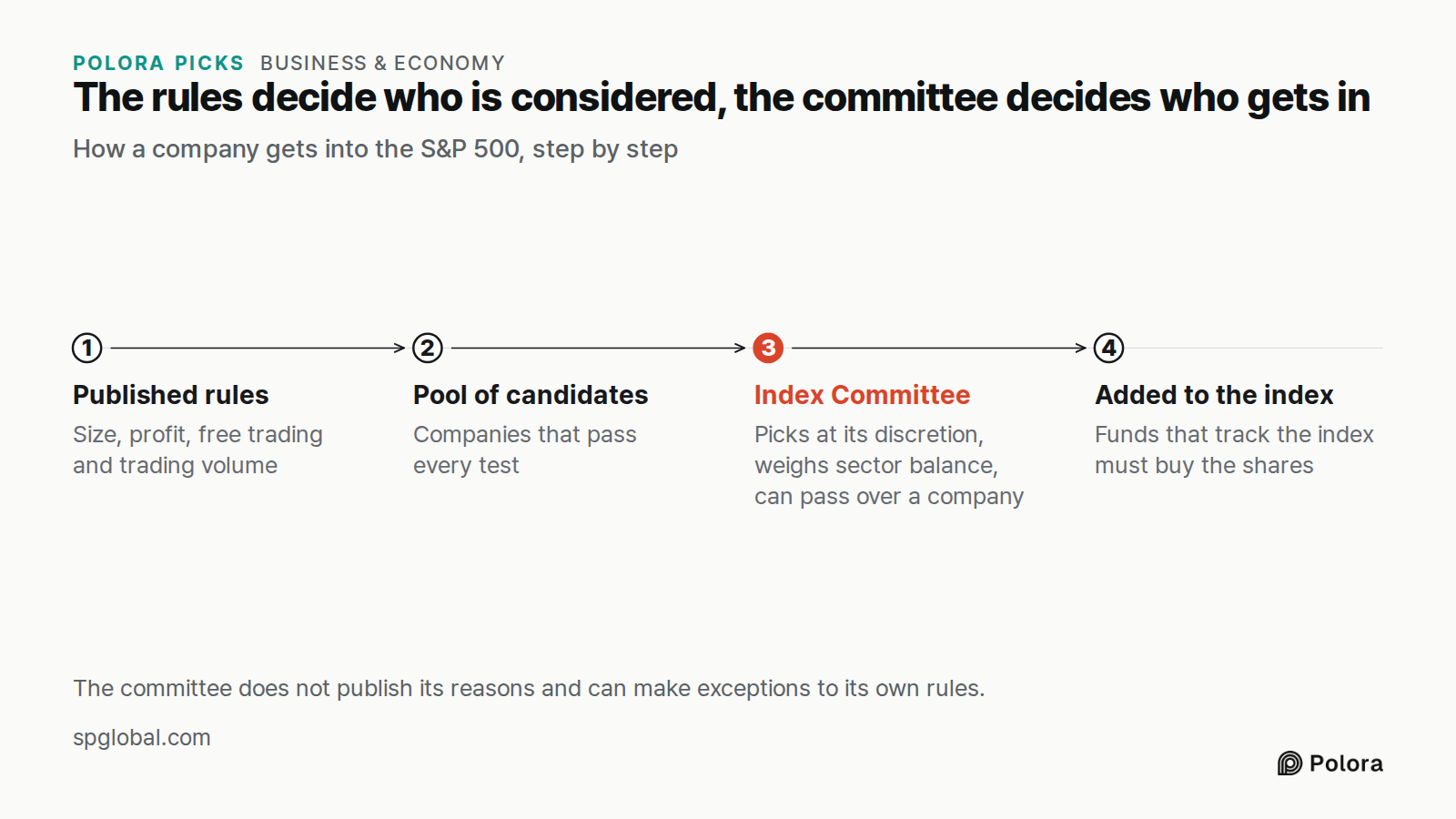
The rules decide who is considered, the committee decides who gets in · How a company gets into the S&P 500, step by step · Published rules · Pool of candidates · Index Committee · Added to the index · Size, profit, free trading and trading volume · Companies that pass every test · Picks at its disc
How a company gets into the S&P 500, step by step

Once a company is in, the entry rules stop applying

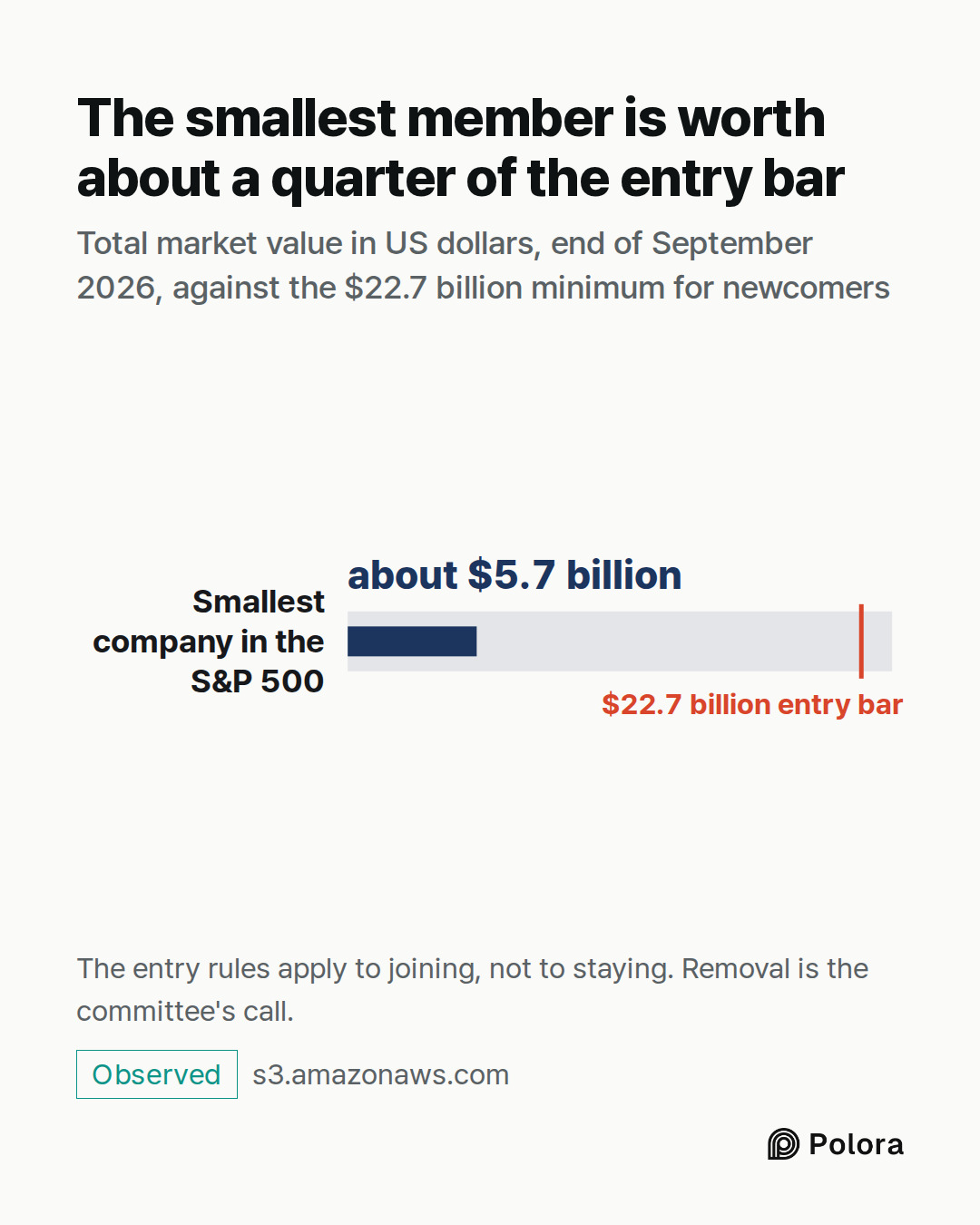
This is the part that surprises even people who follow markets. The size, profit and trading rules apply to companies joining, not to companies already inside. The rulebook says the criteria are 'for addition to an index, not for continued membership', and that S&P wants to avoid needless turnover. A member that slips below them is not removed automatically. It is removed only if 'ongoing conditions warrant' it, and that too is the committee's call.

S&P's own figures show the result. At the end of September 2026, the smallest company in the index was worth about $5.7 billion, roughly a quarter of the $22.7 billion a newcomer needs.

There is one more shortcut. A company moving up from S&P's index of mid-sized companies, the S&P MidCap 400, must still clear the $22.7 billion bar for total size, but it does not have to pass the profit and trading tests again, or the second size test on its freely traded shares.
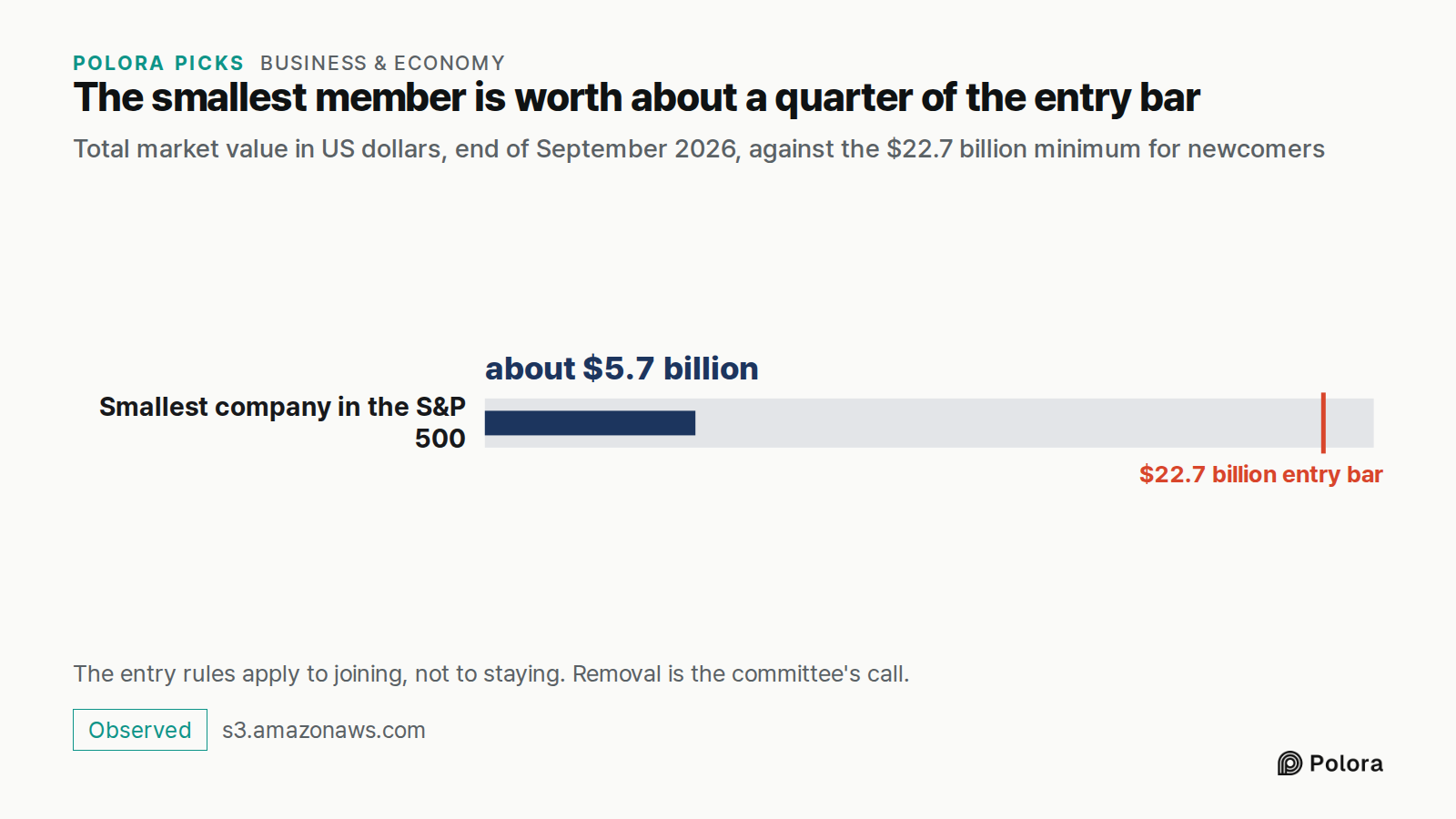
The smallest member is worth about a quarter of the entry bar · Total market value in US dollars, end of September 2026, against the $22.7 billion minimum for newcomers · Smallest company in the S&P 500 · about $5.7 billion · $22.7 billion entry bar · The entry rules apply to joining, not to staying
Total market value in US dollars, end of September 2026, against the $22.7 billion minimum for newcomers

How an index run by rules alone picks its members

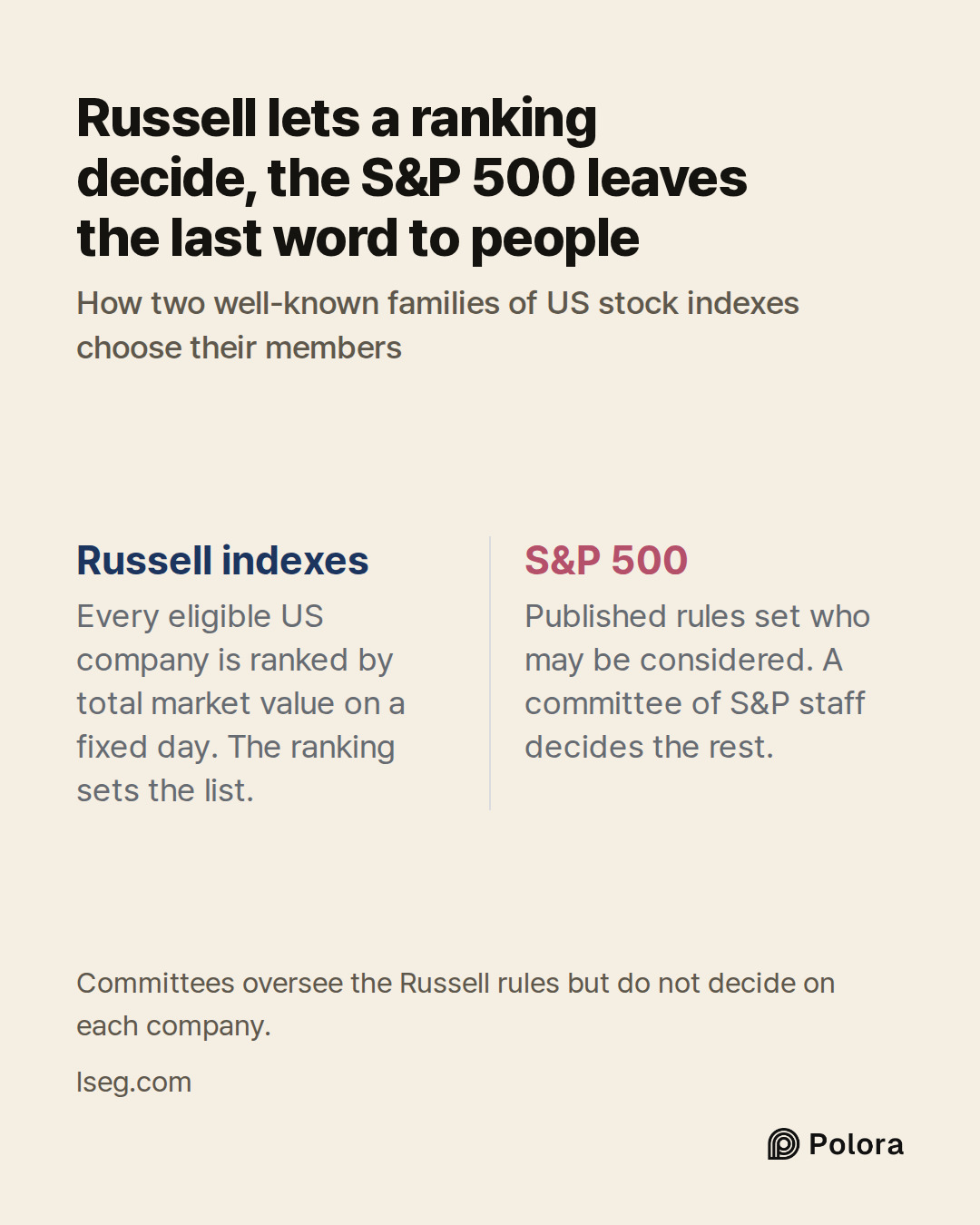
Not every index works this way. The Russell indexes, run by FTSE Russell, part of the London Stock Exchange Group, build their membership from a ranking. On a fixed rank day, every eligible US company is ranked by its total market value, and those that pass the trading rules are placed by size. Committees oversee the rules and review how they work, but the list comes out of the ranking rather than out of a decision about each company.

Since 2026 the Russell lists have been rebuilt twice a year, in June and December, instead of once. The next rank day is October 30, 2026, and the new lists take effect after the close on December 11.

So two of the best-known families of US stock indexes answer the question of who gets in differently. For Russell, the ranking decides. For the S&P 500, the rules decide who may be considered, and people working within those rules decide the rest.
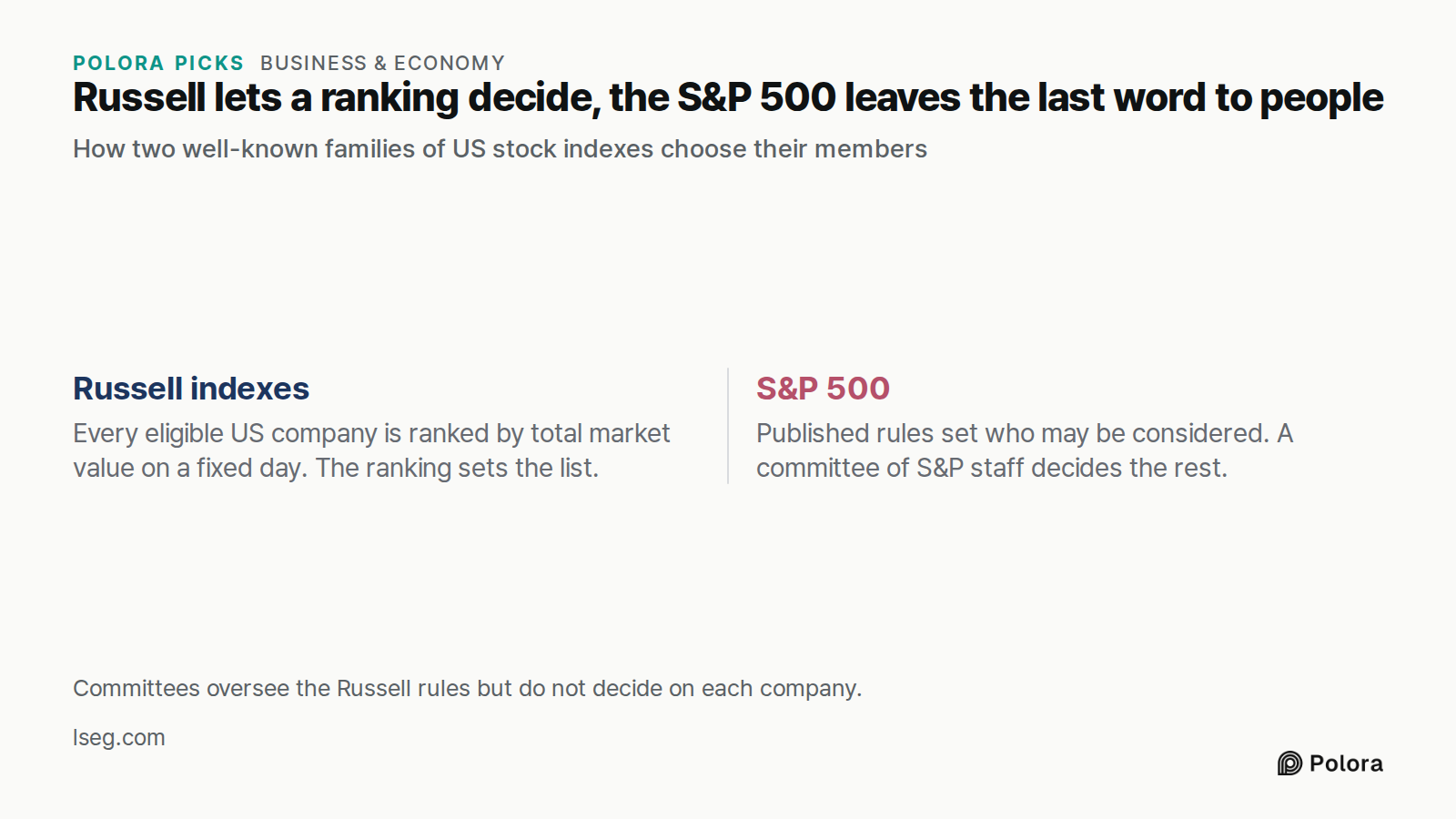
Russell lets a ranking decide, the S&P 500 leaves the last word to people · How two well-known families of US stock indexes choose their members · Russell indexes · S&P 500 · Every eligible US company is ranked by total market value on a fixed day. The ranking sets the list. · Published rules set wh
How two well-known families of US stock indexes choose their members

Why a place on the list used to be worth money

Funds that track the S&P 500 have to hold whatever is in it. When a company is added, they all have to buy its shares around the same date, whatever the price. In the 1990s that forced buying showed up clearly. Robin Greenwood and Marco Sammon of Harvard Business School found that a stock added to the index then gained on average 7.4% more than the market's overall movement would explain.

Tesla shows how big that buying can be. When its entry was announced, Reuters reported that it would set off a trade of about $51 billion, as index funds sold other holdings to buy Tesla. According to reports at the time, within two weeks the stock had risen nearly 40%, and on December 18, the last trading day before it joined, more than $150 billion of Tesla shares changed hands. Measured against the size of the index, Greenwood and Sammon's working paper counts it as the largest addition ever.

Why the jump has largely disappeared

Tesla's jump was the exception. In the published version of the same study, the average extra gain for an added stock fell to 0.3%, well under 1%, over the most recent decade studied, even though a much larger share of the stock market is now tied to the index than in the 1990s. In the researchers' earlier working paper, leaving Tesla out of 2020 brings that year's average for new members to roughly zero.

The researchers weigh several explanations. The clearest is where new members now come from. Their working paper finds that in the 1990s about 40% of additions moved up from the S&P MidCap 400, and in recent years it has been over 80%. When such a company moves up, funds tracking the S&P 500 must buy it, but funds tracking the mid-cap index must sell it at the same moment, so the net buying is much smaller.

They also find some evidence, which they call mixed, that additions have become easier to guess, so traders buy before the announcement. That means a smaller jump around the announcement does not show that an addition no longer moves the price at all ; some of the move may simply come earlier. And they argue that markets have become better at handling these trades. This is a finding about averages over the past few decades, and the effect has changed size before. It is not a rule for any future addition.
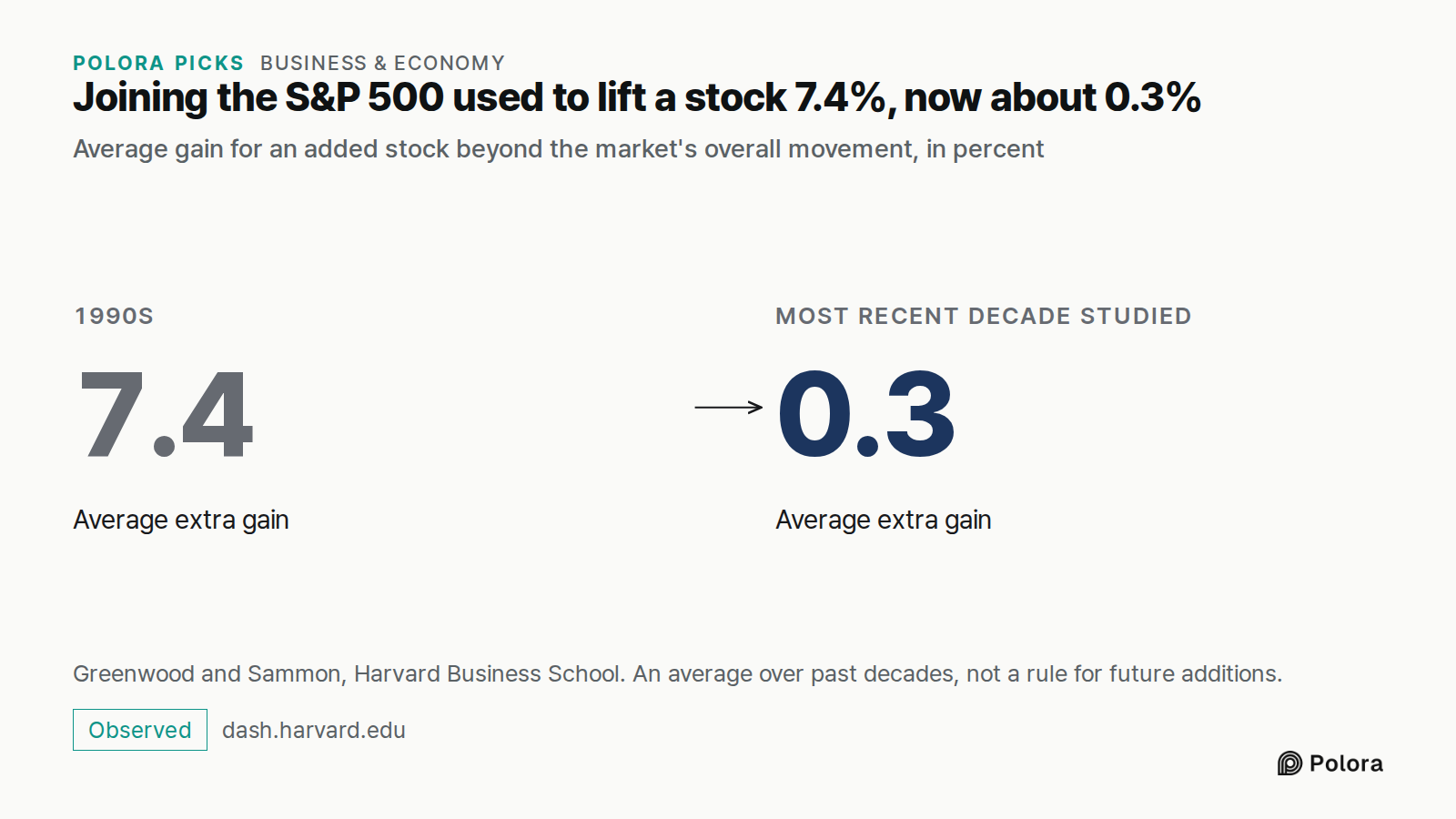
Joining the S&P 500 used to lift a stock 7.4%, now about 0.3% · Average gain for an added stock beyond the market's overall movement, in percent · 1990s · 7.4 · Average extra gain · Most recent decade studied · 0.3 · Greenwood and Sammon, Harvard Business School. An average over past decades, not a
Average gain for an added stock beyond the market's overall movement, in percent

What the committee still decides

So the money story has faded, but the question of who decides has not. A growing share of the US stock market is tied to the S&P 500, and which companies that money holds is settled not by a formula but by a committee of S&P staff. It meets every month, keeps its discussions confidential, and works within published rules it is allowed to step beyond.

The rules tell you who may be considered. They do not tell you who will be chosen, or who will be asked to leave.


Who decides which companies get into the S&P 500?Who decides which companies get into the S&P 500?A committee of S&P staff decides who joins the S&P 500 and who leaves. · Its members are full-time staff of S&P Dow Jones Indices, the company that runs the index, and its discussions are confidential.Published rules · Pool of candidates · Index Committee · Added to the index · Size, profit, free trading and trading volume · Companies that pass every test · Picks at its discretion, weighs sector balance, can pass over a company · Funds that track the index must buy the shares · The rules decide wBy September 2020 Tesla met the S&P 500's rules, but was not picked that month. · Two months later S&P announced that Tesla would join. The committee does not publish its reasons.Smallest company in the S&P 500 · about $5.7 billion · $22.7 billion entry bar · The smallest member is worth about a quarter of the entry bar · Total market value in US dollars, end of September 2026, against the $22.7 billion minimum for newcomers · The entry rules apply to joining, not to stayingRussell indexes · S&P 500 · Every eligible US company is ranked by total market value on a fixed day. The ranking sets the list. · Published rules set who may be considered. A committee of S&P staff decides the rest. · Russell lets a ranking decide, the S&P 500 leaves the last word to people · How tThe rules tell you who may be considered, not who will be chosen. · A growing share of the US stock market is tied to the S&P 500, and a committee of S&P staff, not a formula, settles which companies that money holds.Sources 15 : spglobal.com · S&P U.S. Indices Methodology, web.archive.org · S&P U.S. Indices Methodology (Internet Archive copy, July 2026 edition), s3.amazonaws.com · S&P 500 factsheet, September 30, 2026 + 12Read the full story at · polora.ai

Who decides which companies get into the S&P 500?

Alpha · claude-sonnet-5

My assessment: the manuscript's core premise holds up well Having checked the sourcing myself, I want to tell the reader plainly: the central claim of this piece — that a committee, not a formula, makes the final call on S&P 500 membership — is solidly supported. That's the answer to the headline question, and nothing I found undermines it. On the $22.7 billion threshold: Confirmed, and confirmed as still current. The July 2025 press release I pulled directly states S&P Dow Jones Indices updated the market capitalization eligibility criteria effective July 1, 2025, raising the S&P 500 minimum to US$22.7 billion or more. A June 2026 factsheet still shows the same $22.7 billion figure, so the manuscript's number is live as of the most recent data I could find — I did not locate an October 2026 revision superseding it. On "rules don't apply to continued membership": This is word-for-word accurate. The same press release states the market capitalization eligibility criteria are for additions to an index, not for continued membership, and a constituent that appears to violate the addition criteria is not removed unless ongoing conditions warrant an index change. Wikipe…

Beta · gpt-6-sol

The answer is an S&P Dow Jones Indices committee. Its published criteria determine which companies are eligible for consideration, but meeting them does not guarantee a place: the official methodology gives the Index Committee discretion over constituent selection and says it considers sector balance. The committee consists of S&P Dow Jones Indices staff, meets monthly, and keeps its discussions confidential. The manuscript’s central premise stands. (spglobal.com) I would make three corrections or qualifications before publication: - Alpha’s objection to the September figure does not hold. I opened the S&P-branded factsheet at the manuscript’s S3 address. It explicitly says “as of September 30, 2026” and reports 503 constituents and a smallest total market capitalization of $5,727.01 million. Those manuscript figures are supported by that copy, although I could not confirm them from an independently hosted copy on spglobal.com. Address: https://s3.amazonaws.com/bca2.0/fs-sp-500.pdf. (s3.amazonaws.com) - The entry exam…

Gamma · gemini-3.1-pro

Gamma's Assessment: The Premise is Solid, but the Nuance Matters I agree with both Alpha and Beta that the manuscript's core premise is entirely correct: the S&P 500 is not a purely mechanical index. A committee of S&P Dow Jones Indices staff makes the final decisions, and they have the discretion to bypass companies that meet all quantitative rules. Here is my synthesis of the remaining claims and where the manuscript stands: 1. The Tesla Case Study (2020) The manuscript's timeline of Tesla's inclusion is accurate and serves as an excellent illustration of committee discretion. Tesla reported its fourth consecutive quarter of GAAP profitability in July 2020, making it eligible for the index by the September 2020 rebalancing. The committee passed it over, causing a temporary dip in the stock, before announcing on November 16, 2020, that it would be added on December 21. The massive trading volume (over $150 billion on December 18) and the structural disruption it caused are well-documented facts that support the manuscript's narrative. 2. The Russell Index Contrast The manuscript correctly contrasts the S&P 500 with the Russell US Indexes. FTSE Russell relies on a…

Researcher · gemini-3-7-flash

Verification of Claims and Factual Audit The central premise of the manuscript—that an internal committee at S&P Dow Jones Indices (the U.S. Index Committee) uses human discretion to decide index membership rather than following a purely quantitative formula—matches primary index documentation and published academic research. Below is the verified status of the discrete claims, specific numbers, and references raised in the manuscript and the discussion. --- 1. Committee Discretion and Operating Rules * Claim: A committee of full-time S&P Dow Jones Indices staff chooses constituents, meets monthly, keeps discussions confidential, and evaluates sector balance. * Status: Confirmed. * Source: S&P Dow Jones Indices – U.S. Indices Methodology & Investor Factsheet on Governance. * Details: The methodology explicitly specifies: 1. *"Constituent selection is at the discretion of the Index Committee and is based on the eligibility criteria."* 2. The committee consists of full-time professional employees of S&P DJI and meets month…

The Arbiter · gpt-6-sol

Round record. Alpha, Beta, Gamma and the Researcher agree on the answer to the headline: S&P Dow Jones Indices’ Index Committee decides which companies enter the S&P 500. I opened S&P’s July 2026 methodology directly; it says constituent selection is at the committee’s discretion, based on eligibility criteria, with sector balance also considered. The manuscript’s central premise stands, but “the rules decide who may be considered” needs room for the methodology’s stated exceptions and migration provisions. (spglobal.com) The main factual dispute is resolved against Alpha’s correction. Beta and the Researcher read the S&P-branded PDF at the manuscript’s S3 address; I checked it too. It expressly dates its figures September 30, 2026, and gives 503 constituents and a $5,727.01 million smallest total market capitalization. The figures are supported by that copy, though an independently retrieved S&P-hosted September copy remains unconfirmed. (s3.amazonaws.com) Beta identified a material omission in the entry-rule summary: alo…

The Arbiter's Final Verdict · gpt-6-sol

S&P Dow Jones Indices’ Index Committee decides which companies enter the S&P 500. Its published rules set demanding eligibility tests, but passing them does not guarantee admission. The S&P U.S. Indices Methodology says constituent selection is at the committee’s discretion and that sector balance is among its considerations. The manuscript’s central premise stands: the S&P 500 is not simply a list of the 500 largest U.S. companies. For publication, I would make these distinctions: - Entry rules: The manuscript correctly identifies tests involving company size, U.S. listing and trading history, GAAP profitability, freely tradable shares and liquidity. It omits a second size test: the share class being added must also have float-adjusted market value of at least half the company-level threshold. The methodology is the source for the tests and their qualifications. S&P’s [July 2025 announcement](https://press.spglobal.com/2025-07-01-S-P-Dow-Jones-Indices-Announces-Update-to-S-P-Composite…