Do car dealerships actually make money selling new cars?
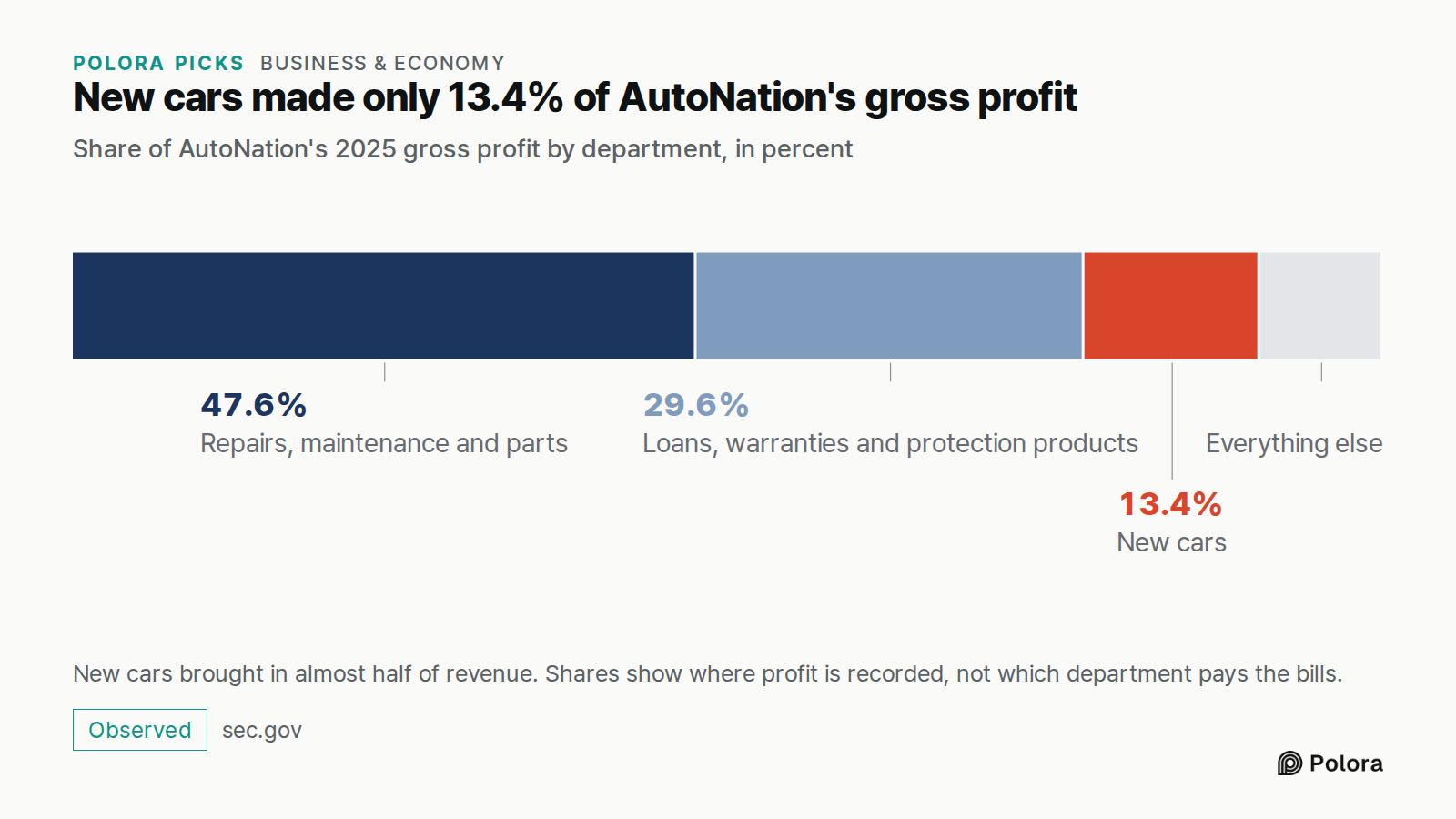
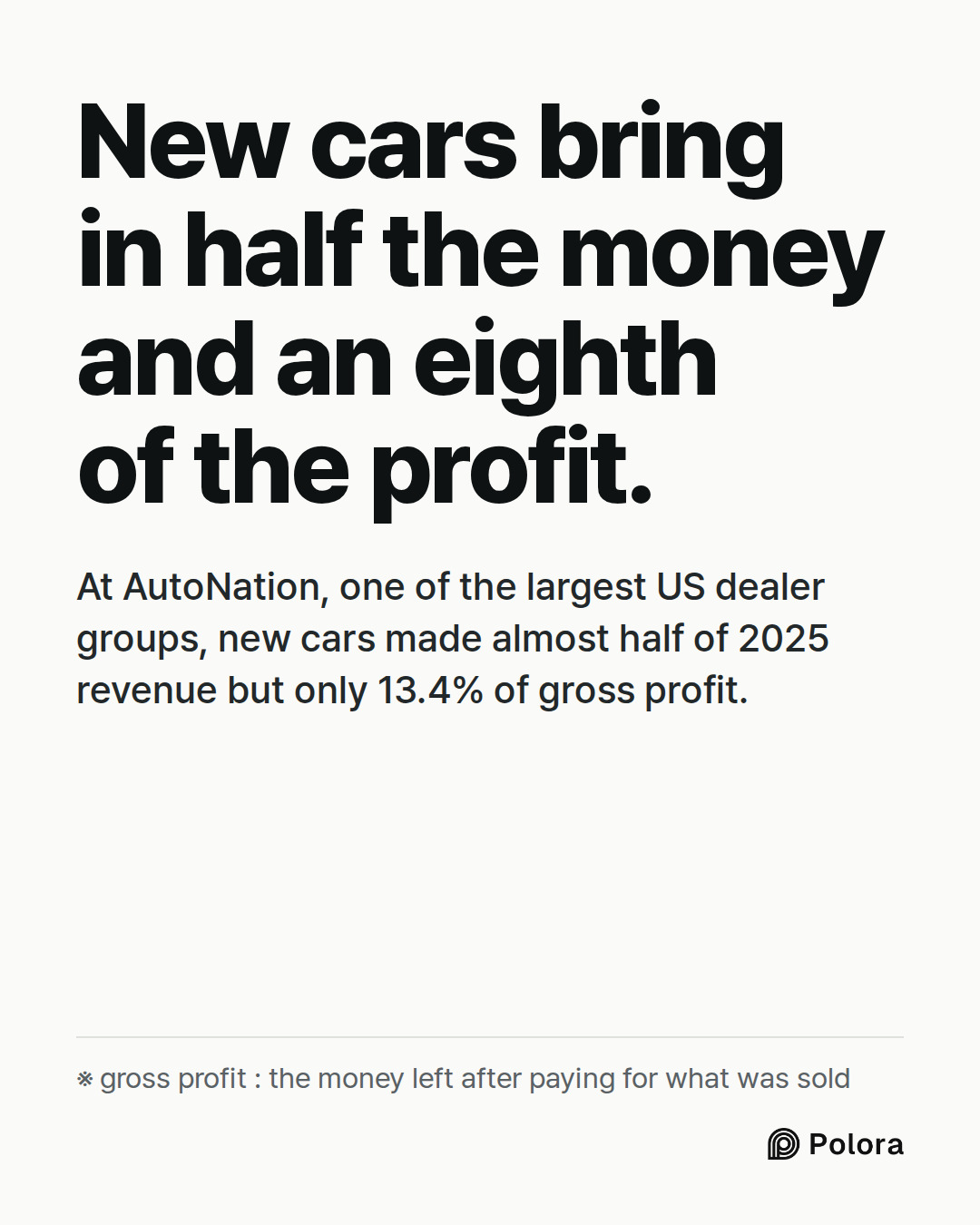
Yes, but it is a small share of their profit. At AutoNation, a large US dealer group, new cars brought in almost half of 2025 revenue but only 13.4% of gross profit. Repairs and service made 47.6%, and loans and warranties sold with the car most of the rest.
Business & Economy · 2026-10-04
New cars bring in half the money and an eighth of the profit
Ask most people where a car dealership makes its money and they point at the showroom. The price on the windshield looks like the business. One of the largest dealer groups in the United States says otherwise in its own filings.
AutoNation runs about 245 dealership locations across the country. In 2025 it sold $13.5 billion worth of new cars, almost half of its $27.6 billion in revenue. Yet new cars produced only 13.4% of its gross profit, the money left after paying for what was sold. Repairs, maintenance and parts produced 47.6%. Loans, extended warranties and protection products sold alongside the cars produced 29.6%.
On an average new car that sold for $52,075, the company kept $2,564 after the cost of the car, a margin of 4.9%. So a new car does make money, but not much. That is before salaries, rent and advertising, which took about two-thirds of all its gross profit that year. New-car gross profit also fell 14% in 2025, while the service side and the finance side both grew.
These figures show which department records the profit. They do not show which department pays the dealership's bills. Staff and buildings are shared, and the new-car sale is often what brings in the loan, the trade-in and the later service work. The numbers tell you where the profit shows up, not what a dealer would earn if it stopped selling new cars.
Share of AutoNation's 2025 gross profit by department, in percent
The loan and warranty desk earns about as much per car as the car
Once a buyer agrees on a price, the paperwork usually happens at a separate desk, which the trade calls finance and insurance. There the dealer arranges the loan or lease with a bank or the carmaker's lender and offers service contracts, often called extended warranties, and other protection products.
For the most part the dealer is not the lender or the insurer here, although AutoNation also runs its own lending business, AutoNation Finance. AutoNation describes most of this income as commissions : banks pay it for placing loans, and outside companies pay it for selling their service contracts and protection products. On some products it also receives a share of the provider's later profit if claims turn out low.
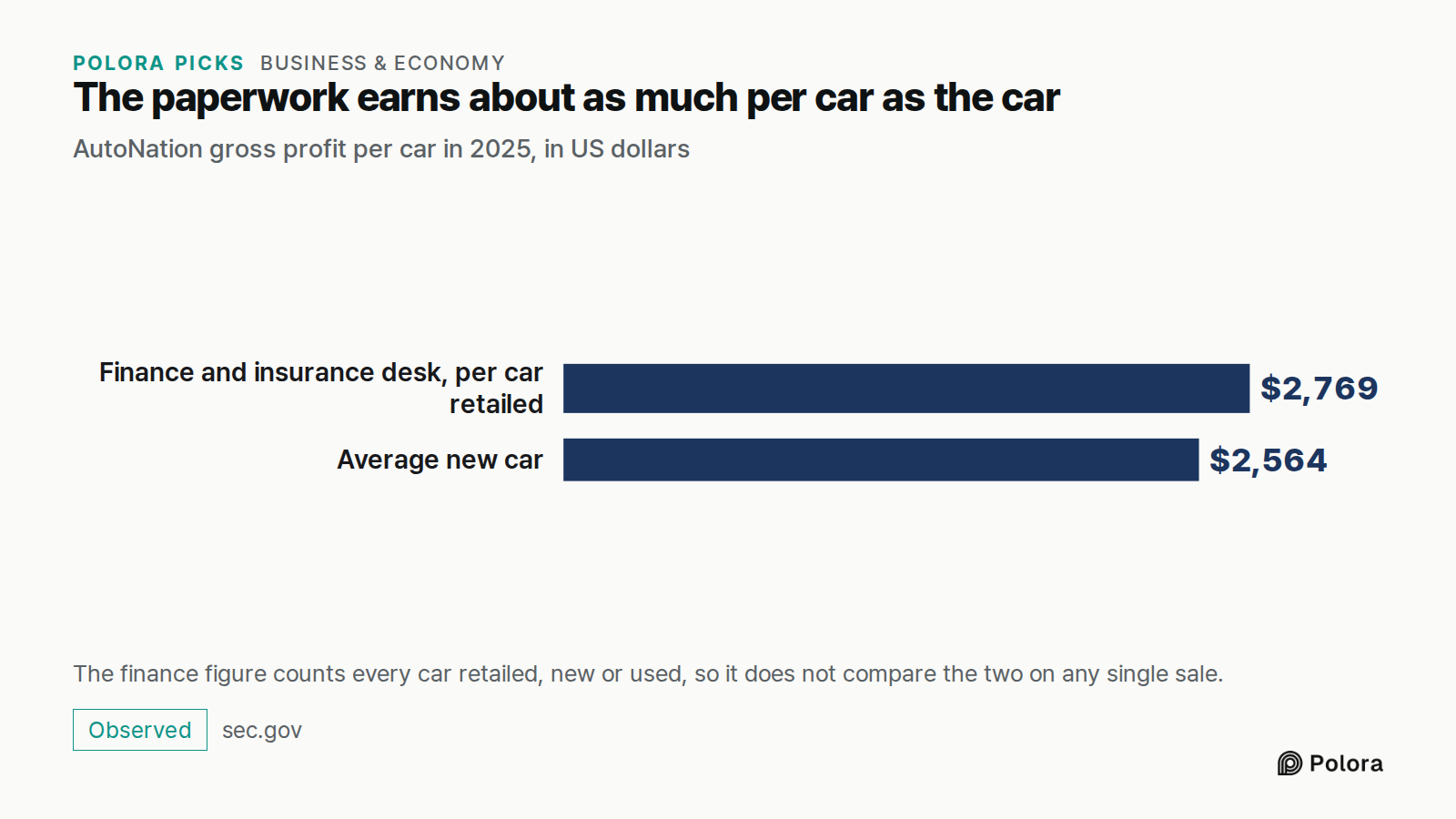
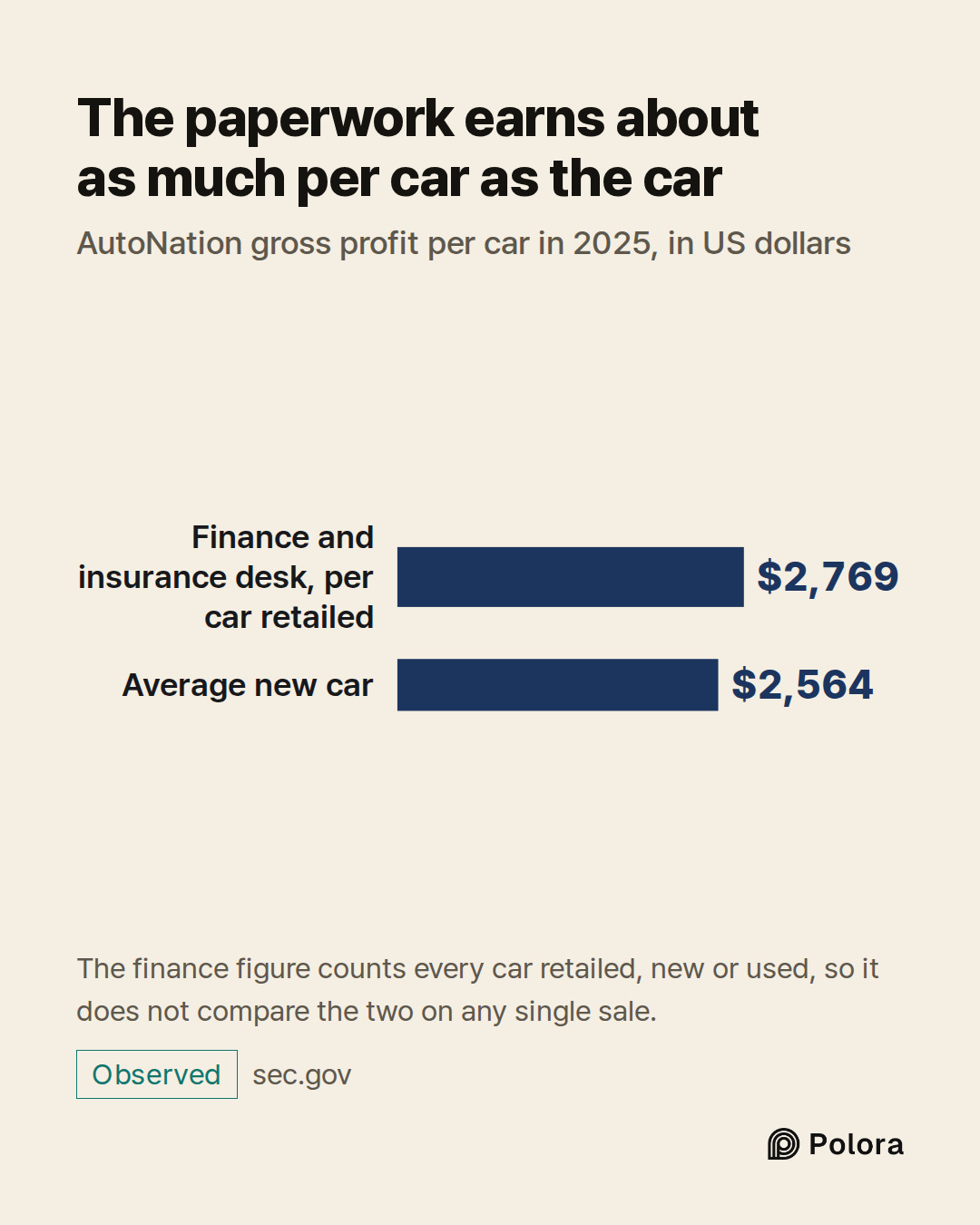
In 2025 that desk earned AutoNation $1,464.4 million, or $2,769 for every car it retailed, new or used. The average new car earned $2,564. The two figures are counted over different sets of cars, so they do not mean the desk made more than the car on any single sale. They do show that the paperwork is a business about the same size as the car itself. The company credited most of that year's rise in this income to higher margins on service contracts.
AutoNation gross profit per car in 2025, in US dollars
The service bay is the steadiest money in the building
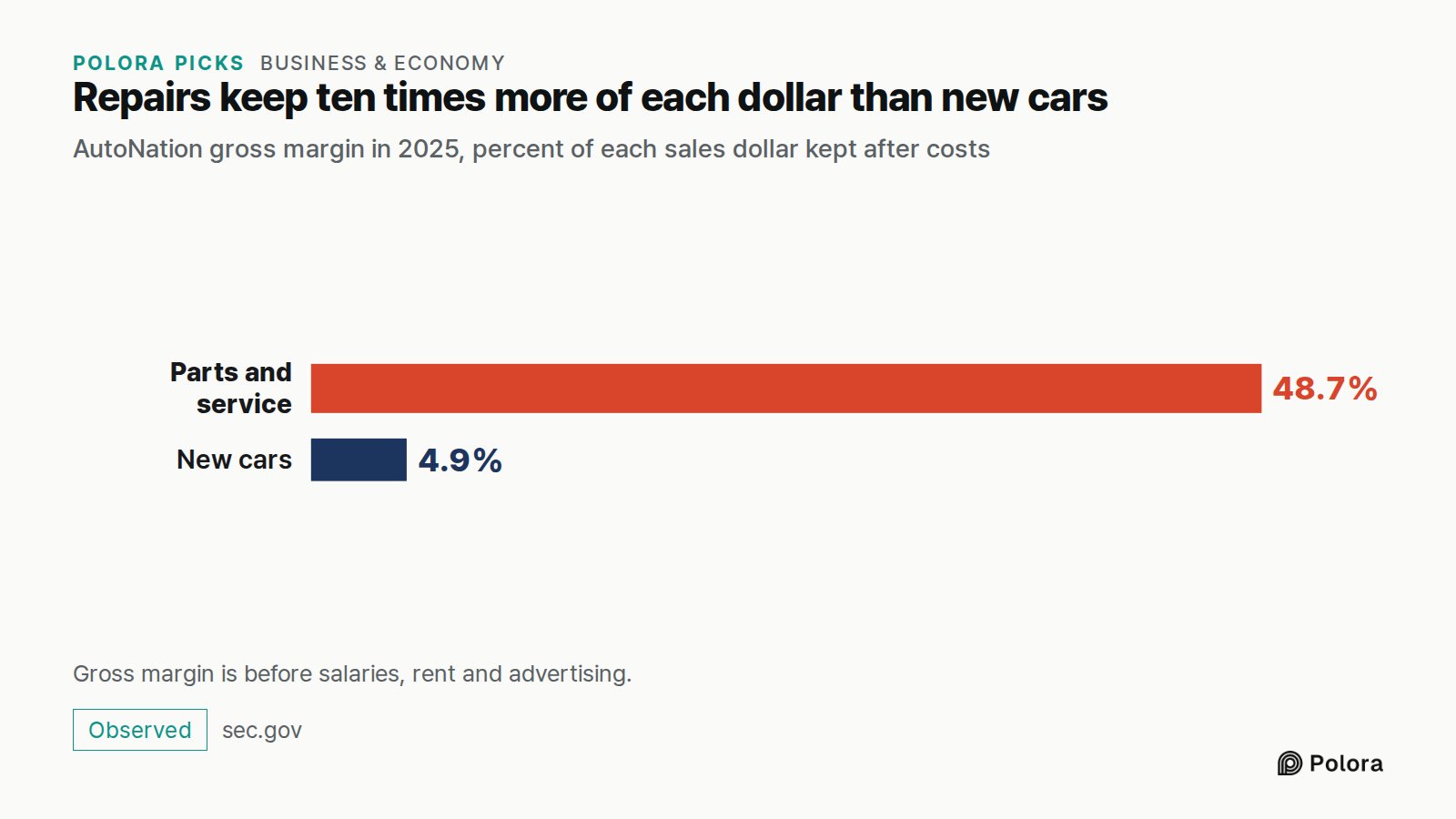
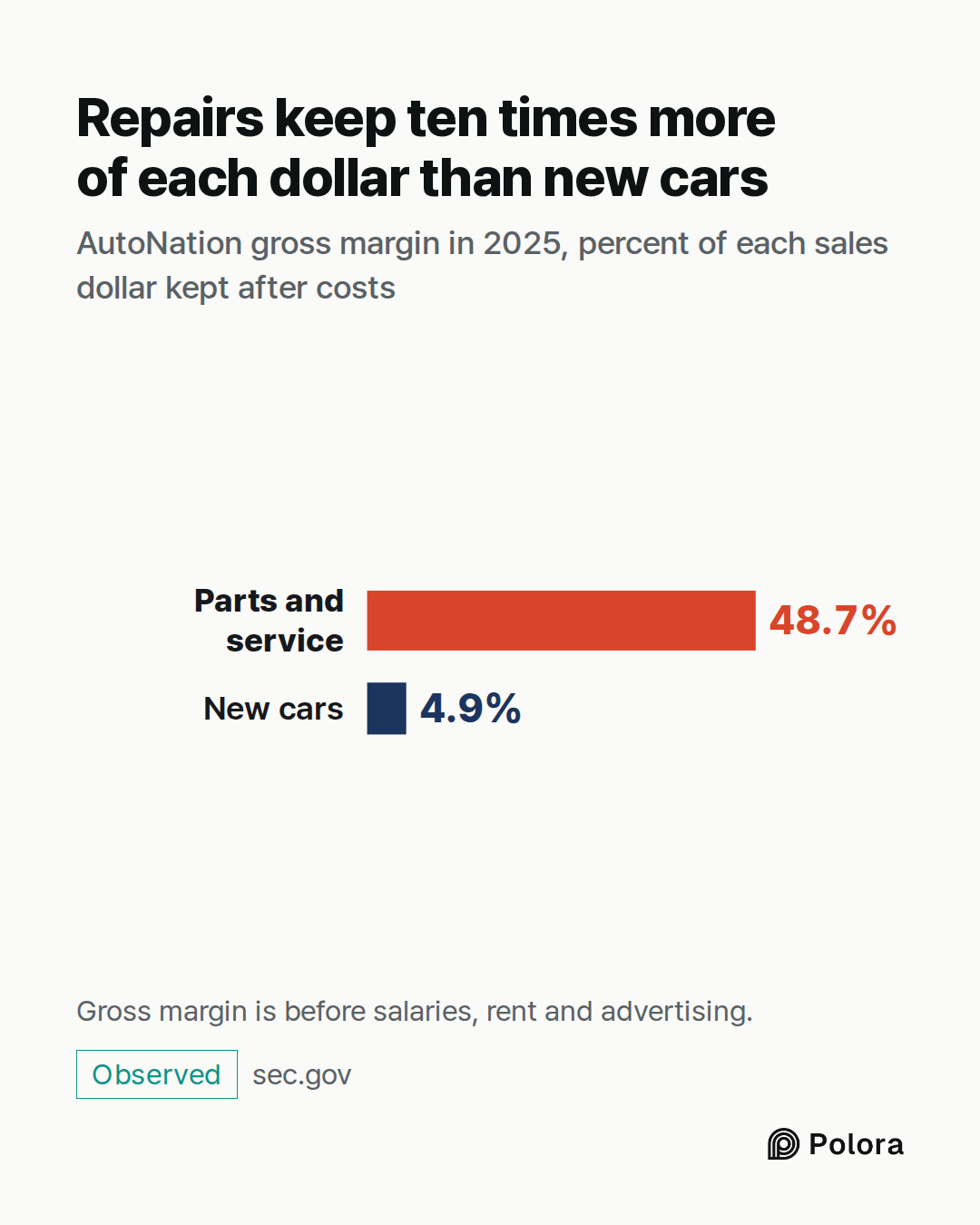
Repairs and parts are a smaller business by revenue and a larger one by profit. At AutoNation, parts and service brought in less than a fifth of revenue, but kept 48.7% of every dollar as gross profit, against 4.9% on a new car.
Some of that work is paid for by customers, for oil changes, brakes and repairs. Some is paid for by the carmakers : when a car under the factory warranty needs fixing, the dealer does the work and bills the manufacturer. AutoNation says both kinds grew in 2025, and that this side of the business has historically been less sensitive to the economy than car sales.
Across all 16,990 franchised new-car dealers in the United States, the dealers' trade body, NADA, counts more than 276 million repair orders and $164.6 billion in service and parts sales in 2025, with customers charged an average of $186 an hour for mechanical labor. Each car sold today can bring its owner back to a bay like this for years, though these totals do not say how many return to the dealer that sold the car.
AutoNation gross margin in 2025, percent of each sales dollar kept after costs
Part of a new car's thin profit is paid by the carmaker
Not all of the small profit on a new car comes from the buyer. Carmakers pay dealers in several ways : a holdback, a percentage of the car's price that the manufacturer pays back to the dealer after the sale ; cash incentives ; help with the interest on the loans dealers use to stock their lots ; and bonuses for hitting sales targets. AutoNation counts these as reductions in what its new cars cost it, so they are already inside the thin margin above.
Those targets can matter more than the price on any one car. According to figures from NADA, the dealers' trade body, reported in the trade press, the average US dealership lost $13,338 on its operations in 2018 yet still made a pretax profit of about $1.36 million. NADA's economist Patrick Manzi told Automotive News that dealers are willing to operate at a loss to chase incentive targets, and that the operating loss showed almost all the profit came from carmaker money. A loss on a store's operations is not the same as a loss on each car it sells. And these figures come from reports quoting NADA, not from NADA's own report.
The shortage years were the exception, not the rule
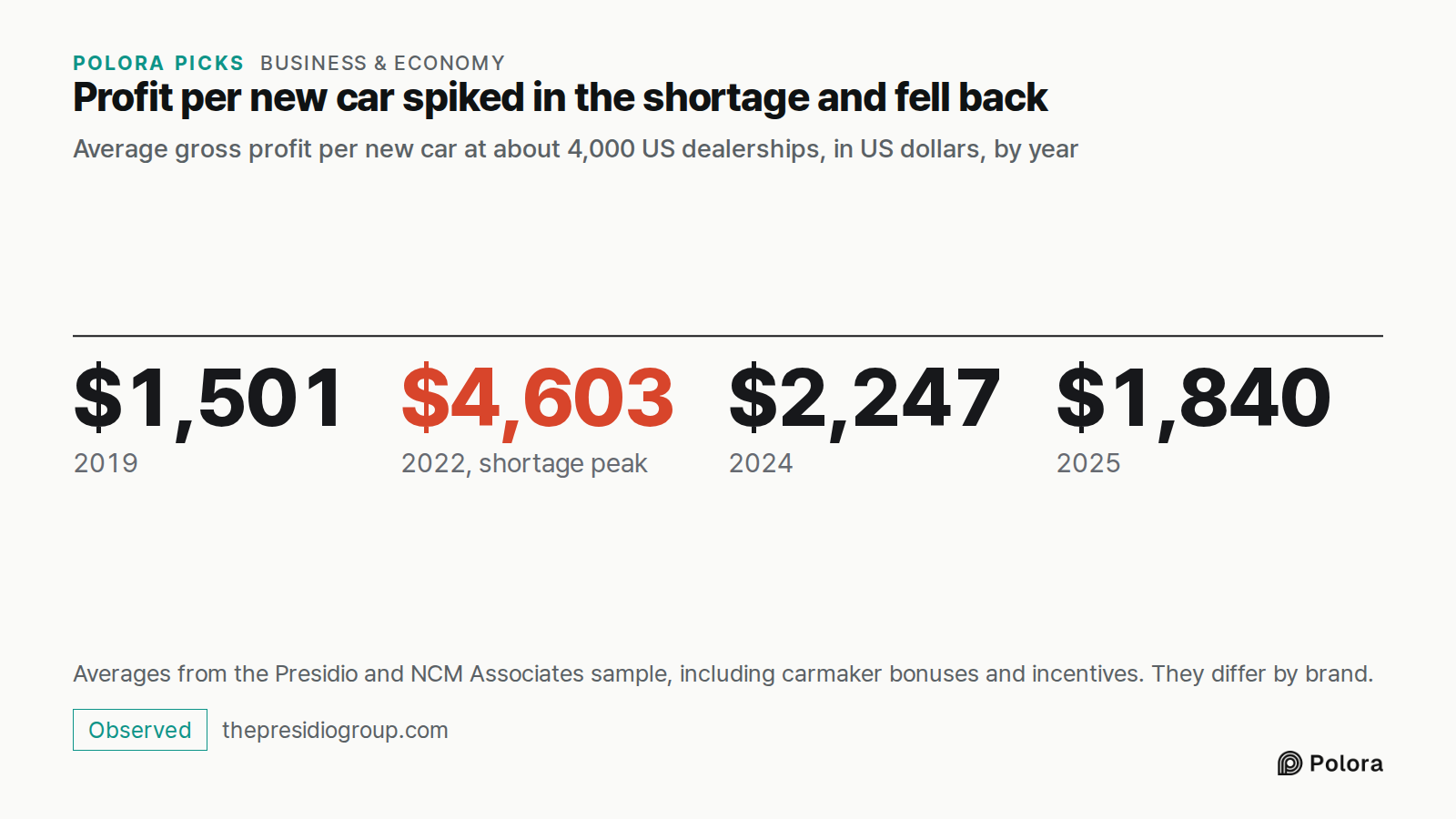
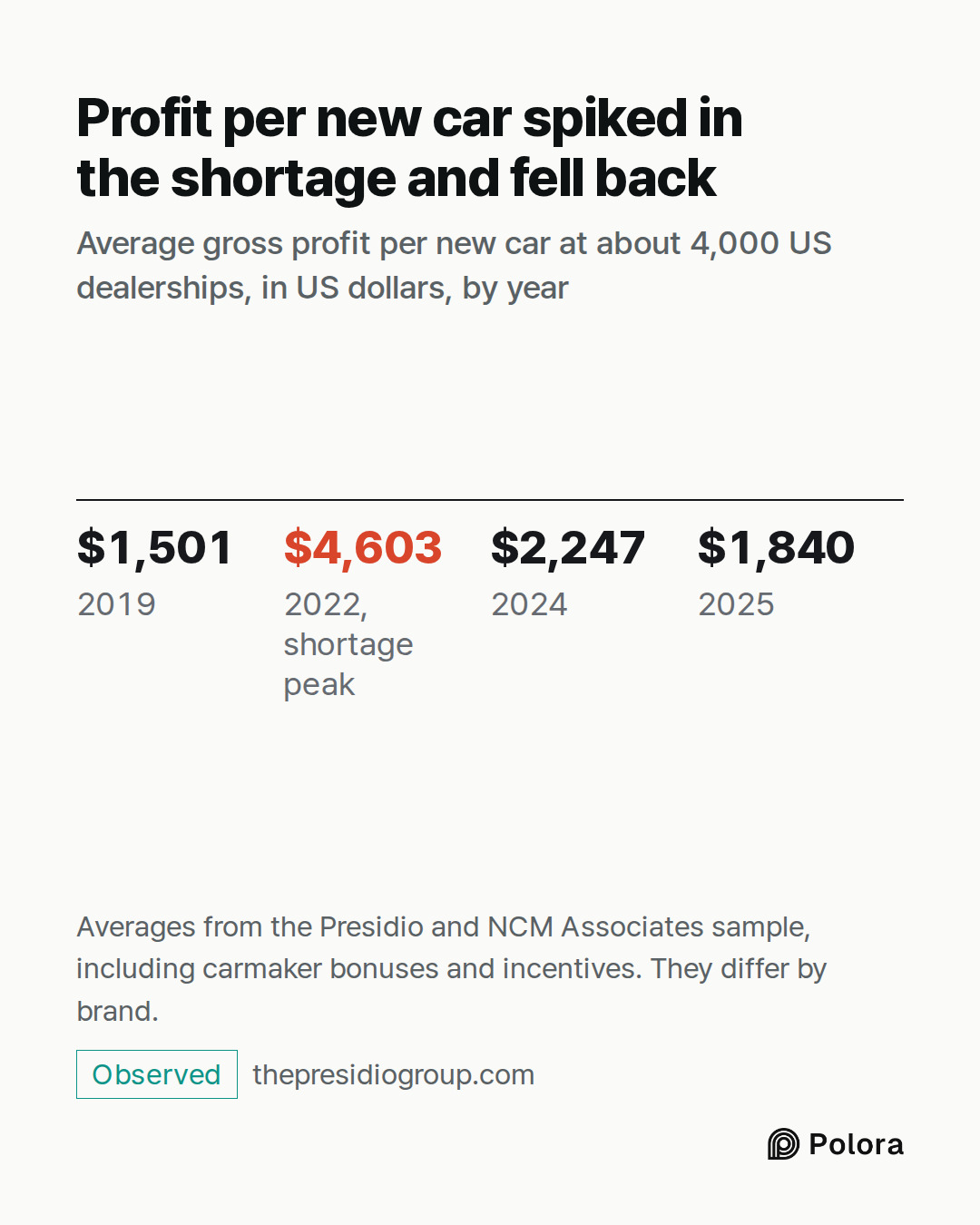
For a few years, new cars really did pay. When chip shortages emptied dealer lots, the profit on each new car rose sharply. Two industry firms, Presidio and NCM Associates, track about 4,000 US dealerships. They put the average gross profit per new car at $1,501 in 2019 and $4,603 in 2022.
Then it fell back : $2,247 in 2024, and $1,840 in 2025 and again in the second quarter of 2026. That is a return from the shortage peak, not a fall every year. At the average store they track, finance and insurance now earns almost as much per car, $1,769, and repairs and parts generate 52.8% of all gross profit. Their figures count carmaker bonuses and incentives inside each department's profit.
These are averages from the stores in their sample, and they differ by brand. Some new cars still sell at a healthy margin and some at a loss, and a small family dealership is not AutoNation. But AutoNation's filing and the average store in this sample point the same way.
Average gross profit per new car at about 4,000 US dealerships, in US dollars, by year
If the showroom earns so little, why keep the dealer at all? In the United States the answer is partly law. Many states have laws limiting or banning carmakers from selling directly to buyers, written to protect independent dealers from the manufacturers that supply them.
These laws also make it hard for a carmaker to drop a dealer without good cause or to open a competing store of the same brand nearby. AutoNation notes that franchise agreements are rarely ended against a dealer's will outside bankruptcy.
Tesla is the visible exception. It never had franchised dealers, sells through its website and its own stores, and has argued state by state that laws written for dealer relationships do not cover it. The rules differ from one state to the next : some agreed, some wrote narrow exceptions, and some still ban direct sales outright. In 2023 Delaware's Supreme Court ruled on how that state's dealer law applied to Tesla.
So the dealer stays, and the car becomes the entry ticket. It still earns something on its own. But much of what keeps the business running comes with the car and after it : the loan, the warranty and years of visits to the service bay.
Do car dealerships actually make money selling new cars?
Alpha · claude-sonnet-5
Opening assessment: the manuscript's core numbers check out, with small rounding quirks worth flagging.
I verified the central AutoNation claim directly against the 10-K text. The filing states plainly: "For the year ended December 31, 2025, new vehicle sales accounted for 49% of our total revenue and 13% of our total gross profit. Used vehicle sales accounted for 28% of our total revenue and 9% of our total gross profit. Our parts and service operations, while comprising 17% of our total revenue, contributed 48% of our total gross profit. Our finance and insurance sales, while comprising 5% of our total revenue, contributed 30% of our total gross profit." That matches the manuscript's 13.4%/47.6%/29.6% breakdown almost exactly (the 10-K's rounded headline percentages are 13/48/30, the annual report table gives the more precise 13.4/47.6/29.5–29.6 depending on which year-over-year table you read). So the "almost half the revenue, an eighth of the profit" framing is sound and traceable to https://www.sec.gov/Archives/edgar/data/350698/000162828026007800/an-20251231.htm.
I also confirmed the 2025 gross-profit decline direction: "Our total gross profit increased 3% during 2025,…
Beta · gpt-6-sol
Yes. Dealers generally make gross profit selling new cars; the mistake is to confuse a small share of the dealership’s *total* profit with a loss on each sale. AutoNation reported $2,564 in new-vehicle gross profit per vehicle in 2025, before dealership-wide expenses. New vehicles supplied 13.4% of its gross profit, compared with 9.3% from used vehicles, 29.6% from finance and insurance (F&I), and 47.6% from parts and service. Its 245 *stores* held 323 new-vehicle franchises, so “about 245 dealerships” is a reasonable shorthand if “stores” is meant. (sec.gov)
Address: https://www.sec.gov/Archives/edgar/data/350698/000162828026007800/an-20251231.htm
I would make three corrections to the manuscript’s interpretation:
- “A little, and less each year” overstates the trend. AutoNation’s new-vehicle gross profit fell in 2025, but “less each year” is not established. Presidio–NCM’s chart shows $1,501 per new vehicle in 2019, $4,603 in 2022, $2,247 in 2024 and $1,840 for the second quarter of 2026. It also shows $1,840 for *full-year 2025*: those identical figures refer to different periods.…
Gamma · gemini-3.1-pro
Both Alpha and Beta have thoroughly dismantled the manuscript's overreliance on AutoNation's specific numbers to represent the entire industry, and Beta correctly caught the denominator mismatch in the F&I comparison. I will focus on the remaining unverified claims and the broader economic reality of the dealership model.
The Shortage Years and Sticker Price Claim
The manuscript claims that during the chip shortage, "buyers paid close to sticker or above it." This is accurate and widely documented by automotive analysts. In 2022, Kelley Blue Book and Edmunds consistently reported that the Average Transaction Price (ATP) for new vehicles was frequently hundreds or even thousands of dollars above the Manufacturer's Suggested Retail Price (MSRP). This was a historical anomaly driven by supply chain constraints, supporting the manuscript's assertion that the 2021-2023 margins were the exception, not the rule.
Franchise Laws and Direct Sales
The manuscript's summary of franchise laws ("Every state has laws limiting or banning carmakers from selling directly to buyers") is functionally correct but lacks nuance. While the foundation of these laws dates back to the 1930s to prot…
Researcher · gemini-3-7-flash
Verification of Manuscript Claims Against Current Sources
1. AutoNation Financial Breakdown (2025)
* Claims: $13.5B new-car revenue out of $27.6B total; gross profit shares: new 13.4%, used 9.3%, F&I 29.6%, parts & service 47.6%; new GP per vehicle $2,564 on $52,075 ASP (4.9% margin); F&I total $1,464.4M ($2,769/retail vehicle); parts/service margin 48.7%; new-car gross profit fell 14% while service and F&I grew; store count ~245 (with 323 franchises).
* Status: Verified.
* Source: AutoNation Form 10-K (FY 2025).
* Nuance/Correction:
* As Beta pointed out, the denominator for the F&I comparison is per retail vehicle (new and used combined) ($2,769), whereas $2,564 is per new vehicle. Comparing them side-by-side to show that the F&I desk makes more per sale requires explicitly noting this blended base.
* In the broader public peer group (e.g., Lithia Motors and Penske Automotive Group), new and used vehicle sales similarly generate ~80–85% of total retail revenue but only ~30–35% of total gross profit, while service/parts and F&I produce ~65–70%.
---
####…
The Arbiter · gpt-6-sol
The round has converged on the central distinction: a dealership can make money on a new car without the new-car department being its largest source of gross profit. The remaining work is to keep that distinction intact in the manuscript, rather than turn it into a claim that new cars are generally sold at a loss.
- AutoNation: Alpha verified the filing’s broad revenue and profit mix; Beta and the Researcher confirmed the detailed figures. The 2025 filing reports $13.5 billion in new-vehicle revenue—48.9% of total revenue—but 13.4% of gross profit. Used vehicles supplied 9.3% of gross profit, parts and service 47.6%, and F&I 29.6%. New vehicles earned $2,564 in gross profit per new vehicle, at a 4.9% margin, before shared expenses. The filing identifies 245 stores with 323 new-vehicle franchises, making “about 245 dealerships” shorthand for stores, not franchises. AutoNation’s new-vehicle gross profit fell 14% in 2025 while parts/service and F&I grew; that supports a 2025 decline, not the headline’s “less each year.” (sec.gov)
Address: https://www.sec.gov/Archives/edgar/dat…
The Arbiter's Final Verdict · gpt-6-sol
Yes. Selling a new car generally produces *gross profit* for a dealership, but new cars often account for a much smaller share of its gross profit than their share of sales revenue suggests.
AutoNation’s 2025 filing is a concrete example: new vehicles brought in 48.9% of revenue but 13.4% of gross profit. It reported $2,564 gross profit per new vehicle, a 4.9% margin. Parts and service contributed 47.6% of total gross profit, and finance and insurance contributed 29.6%.
That does not mean the $2,564 was net profit after salaries, rent and advertising, or that dealerships routinely sell new cars at a loss. Nor can the new-car sale be cleanly separated from the financing, trade-in and future service business it may bring. The defensible answer is: dealers do make money selling new cars, but much of the dealership’s gross profit is recorded in the businesses alongside and after the sale.