How do stock apps make money if trading is commission-free?

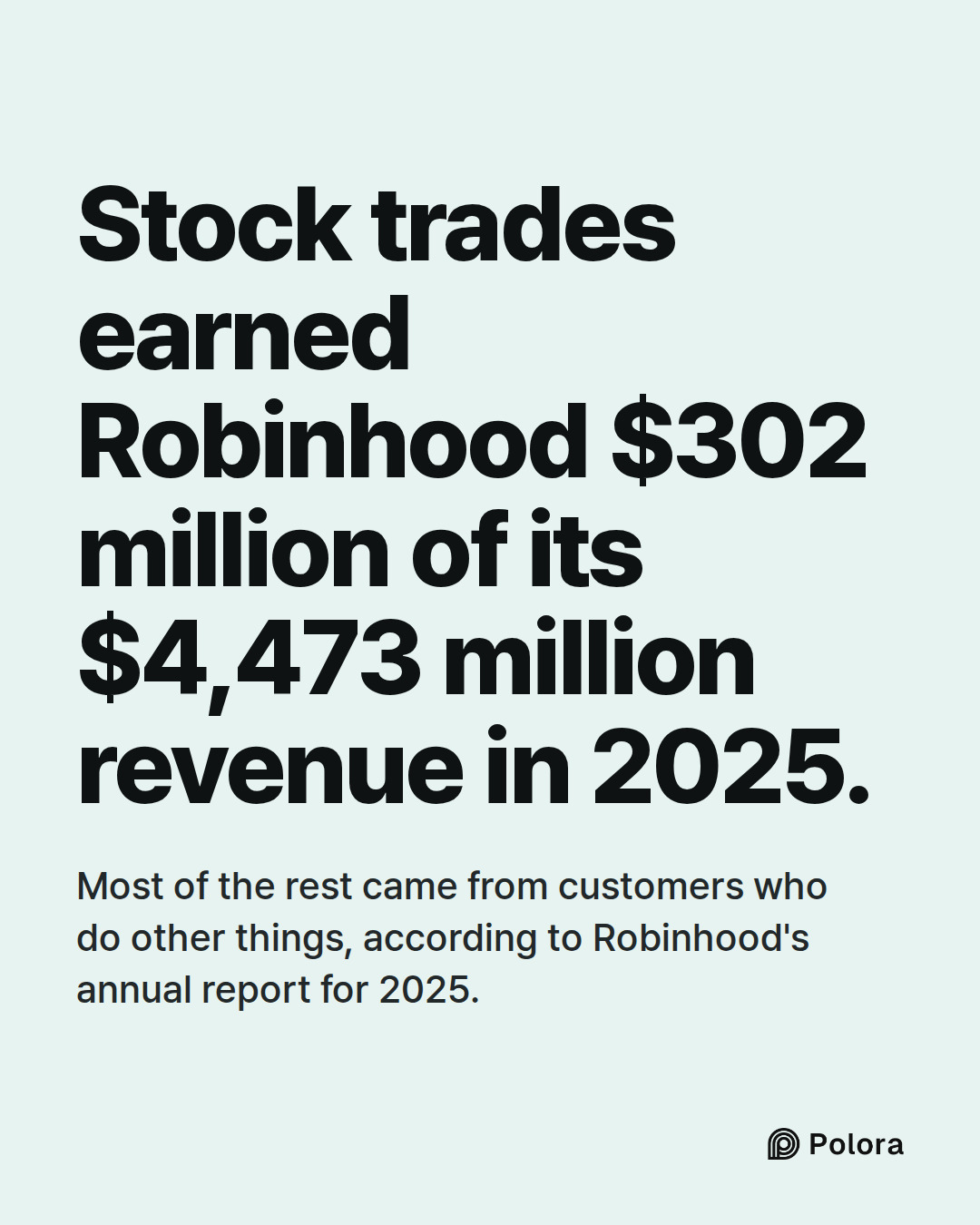
Mostly not from the free stock trades. In 2025, Robinhood made $302 million from stock trades out of $4,473 million in revenue. Option orders, crypto, and interest on loans and idle cash earned far more.

Business & Economy · 2026-10-04

The free trade is the smallest part of the bill

Ask most people how an app with no trading commission makes money, and they will say it doesn't, or that it makes a little on each trade. Robinhood's annual report for 2025 gives a different answer. The company's revenue that year was $4,473 million. Buying and selling shares of stock, the thing the app is known for, brought in $302 million of it.

Most of the rest came from customers who do other things. Some trade options or crypto. Some borrow money to invest. Some simply leave cash in their account. Some pay a monthly subscription. Most of these earn the company more than the share buyer does, and the subscription is not far behind. Once you see the list, "free" stops looking like a gift and starts looking like a way of sorting who pays.
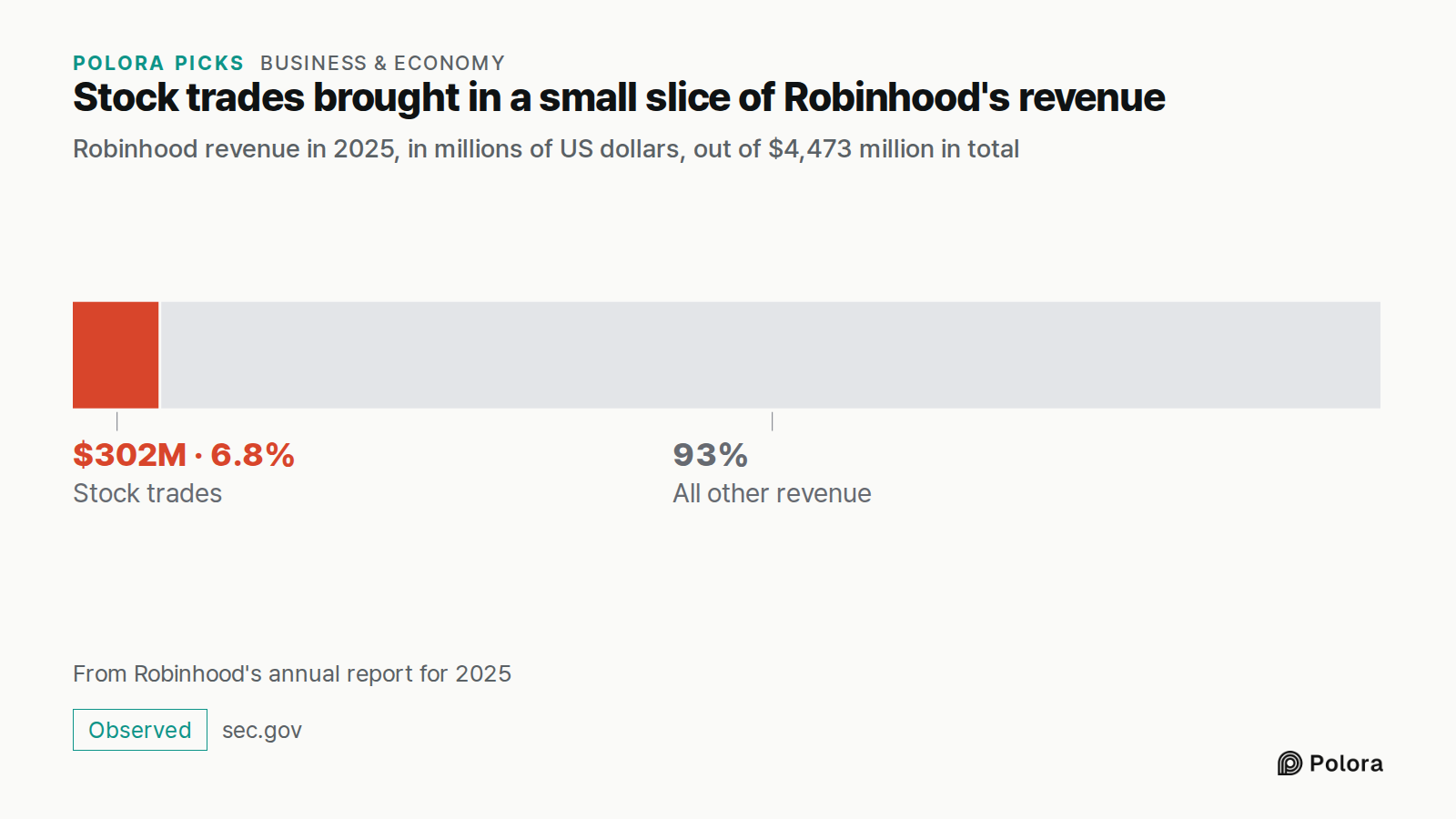
Stock trades brought in a small slice of Robinhood's revenue · Robinhood revenue in 2025, in millions of US dollars, out of $4,473 million in total · Stock trades · $302M · All other revenue · From Robinhood's annual report for 2025
Robinhood revenue in 2025, in millions of US dollars, out of $4,473 million in total

Where Robinhood's 2025 revenue came from

Robinhood's 2025 annual report divides its revenue roughly as follows. Option trades : $1,123 million. Crypto trades : $901 million. Other transactions, driven largely by prediction-market contracts and instant withdrawals : $302 million. Interest on loans to customers who borrow to invest (margin loans) : $573 million. Interest on cash, securities and deposits it holds aside under customer-protection rules : $319 million. Its share of the interest on idle customer cash placed at partner banks : $229 million. Lending customers' shares to other investors, after paying customers their share : $190 million. The Gold subscription : $179 million. Stock trades : $302 million.

Together, interest of all kinds made up $1,514 million, about a third of the total. Nearly every line except stock trading depends on customers doing something more than buying shares.
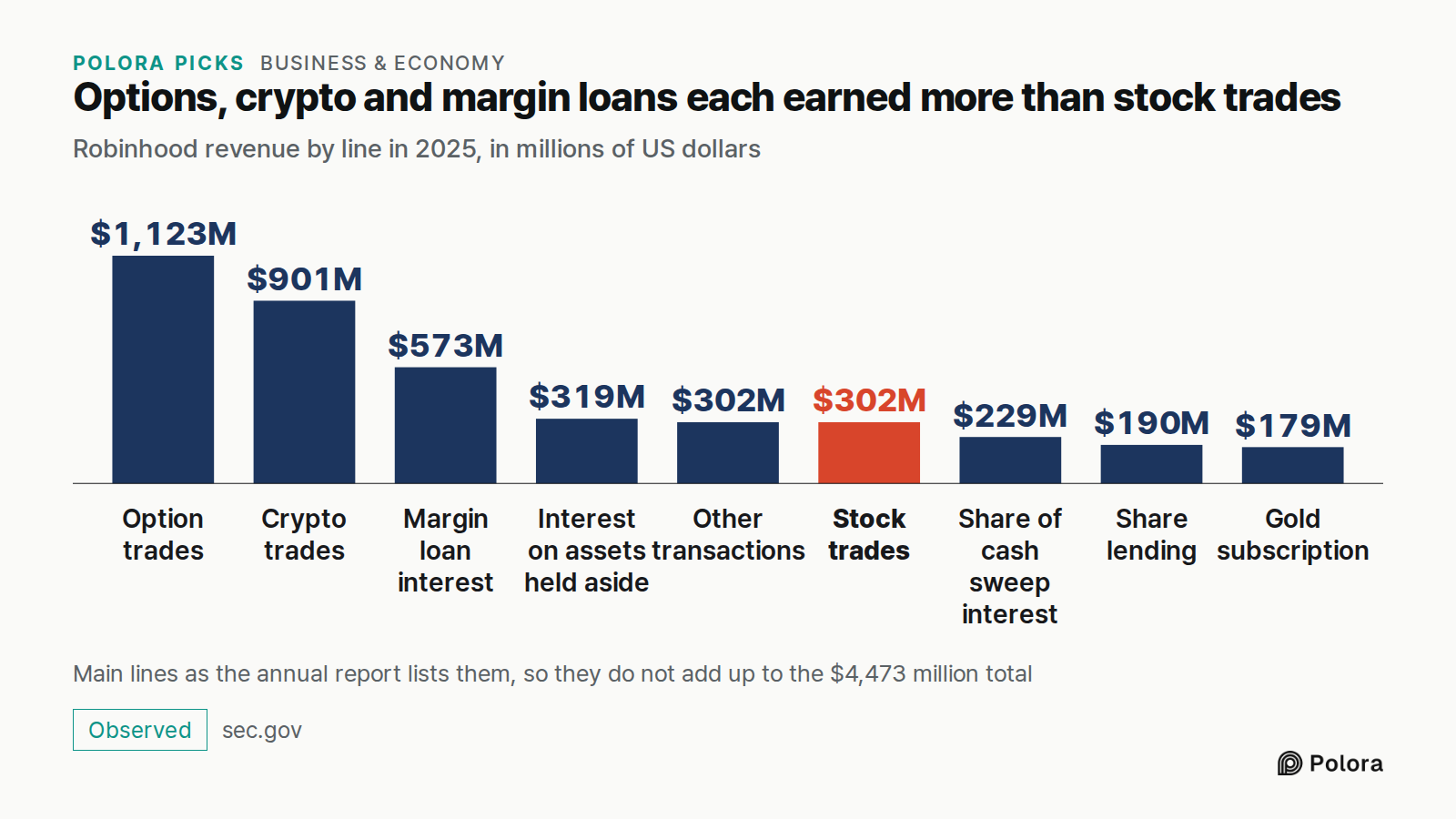
Options, crypto and margin loans each earned more than stock trades · Robinhood revenue by line in 2025, in millions of US dollars · Option trades · Crypto trades · Margin loan interest · Interest on assets held aside · Other transactions · Stock trades · Share of cash sweep interest · Share lending
Robinhood revenue by line in 2025, in millions of US dollars

The cash you leave idle is earning for the app

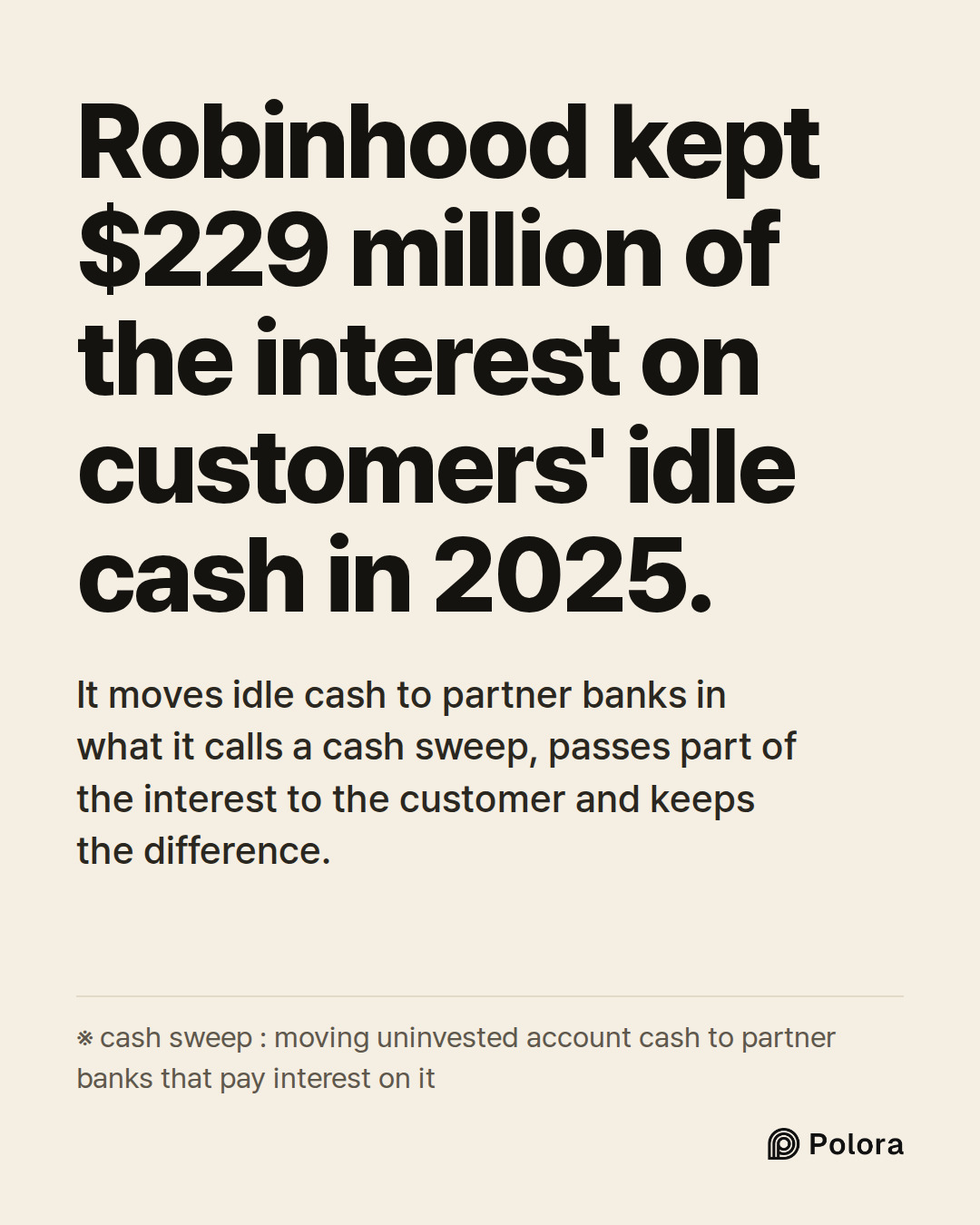
Money sitting uninvested in a brokerage account is not idle for the broker. Robinhood moves much of it to a network of partner banks in what it calls a cash sweep. The banks pay interest on it. Robinhood passes part of that interest to the customer and keeps the difference. In 2025 that difference came to $229 million on an average of about $30.9 billion in swept cash. The company reports this as a yield of 0.74% a year.

Robinhood also earns interest on the cash, securities and deposits it must hold aside under the rules for customer money : $319 million in 2025. Not all of that comes from money customers left sitting, because the assets behind it also include deposits with clearing organizations. At a traditional broker, idle cash is even more central. Charles Schwab's 2025 annual report calls uninvested client cash its "primary funding source" for the assets it earns interest on.

Why trading firms pay to fill your orders

When you tap "buy" in an American stock app, the order usually does not go to a stock exchange. It goes to a large trading firm, known as a market maker or wholesaler, that sells you the share itself. The firm earns the small gap between the price at which it buys and the price at which it sells, called the spread. It pays the app part of that gap for sending it the order. This is called payment for order flow.

Robinhood's own disclosure for the second quarter of 2026 sets out the terms. For stocks during regular market hours, it receives 12.35% of the spread. For options, it receives a fixed amount per contract, between $0.30 and $1.20, set by how wide the spread usually is for that option. Options are Robinhood's largest single revenue line. The disclosure explains how each order is paid for, not why options earn more in total ; that also depends on how much its customers trade options, and the filings do not separate the two.
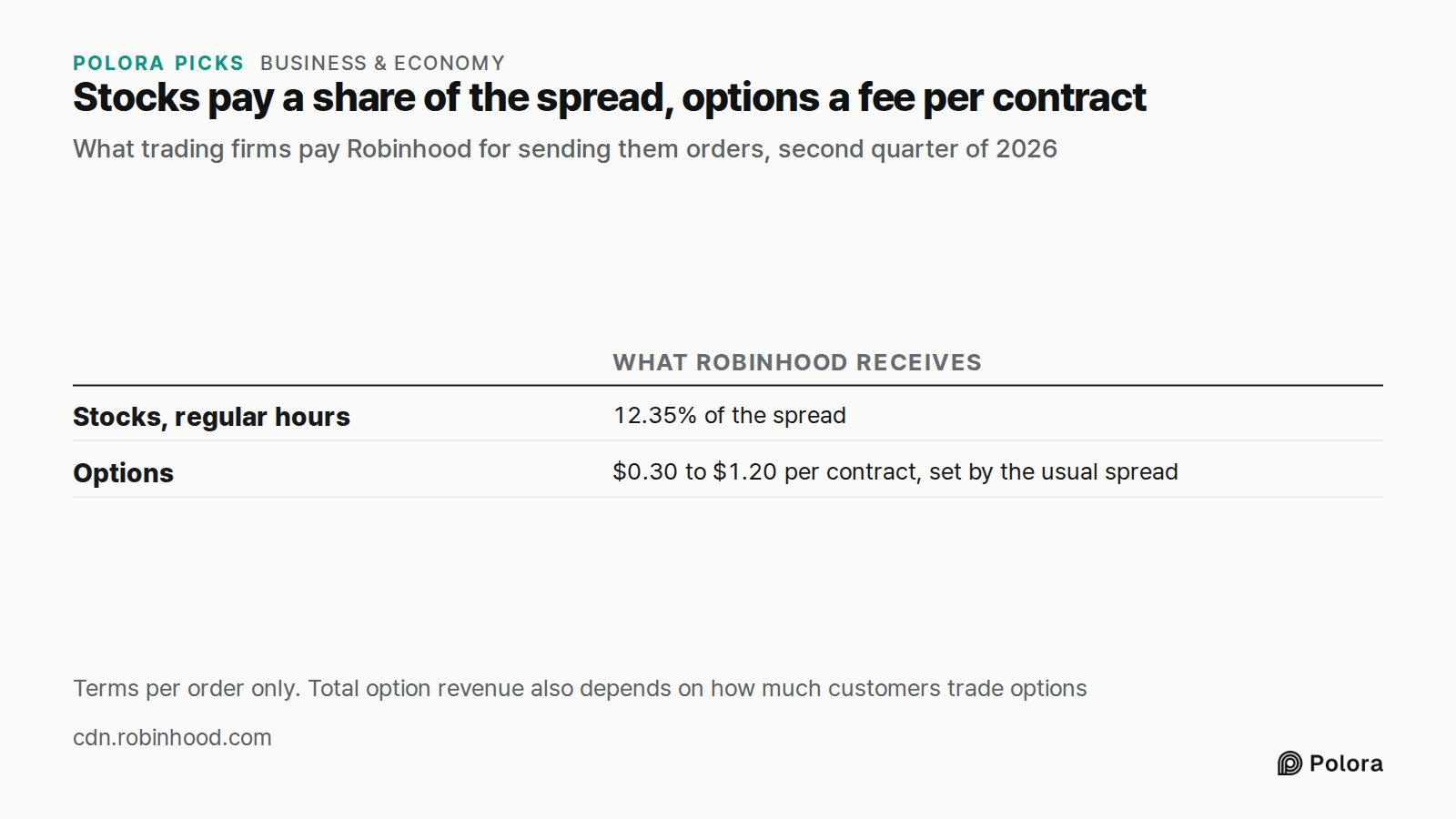
Stocks pay a share of the spread, options a fee per contract · What trading firms pay Robinhood for sending them orders, second quarter of 2026 · What Robinhood receives · Stocks, regular hours · Options · 12.35% of the spread · $0.30 to $1.20 per contract, set by the usual spread · Terms per order
What trading firms pay Robinhood for sending them orders, second quarter of 2026

Borrowers and lent-out shares pay too

Customers who borrow from the app to buy more than their cash covers pay interest on the loan. At Robinhood these margin loans averaged about $11.4 billion in 2025. They earned the company $573 million, at a reported yield of 5.01%. That makes the borrowers' interest a larger source than all of the stock trading.

Brokers can also lend customers' shares to investors who want to bet on a price falling, and collect a fee for doing so. Robinhood earned $190 million this way in 2025, after paying customers their share.

Subscriptions and crypto are a separate story

Robinhood also sells a monthly subscription, Gold, which brought in $179 million in 2025. Crypto is a large line on its own, at $901 million. Most of it works differently from payment for order flow on stocks and options, and Robinhood's filings report it under a different name, "transaction rebates". The company has also begun letting customers pay a direct fee on certain crypto orders instead. Either way, that money comes from the people who trade crypto, not from the people who buy shares. So does a further $302 million from other transactions, largely bets on prediction markets and fees for instant withdrawals.

Every broker splits the bill differently

Robinhood's mix is not every app's mix. At Charles Schwab, one of the largest American brokers, net interest revenue was $11,750 million out of $23,921 million in 2025, roughly half. Payments from trading firms were $1,930 million, about 8%. Fees for managing funds and accounts brought in $6,506 million. Commissions, which Schwab still charges on some trades, came to $1,797 million.

One pattern does hold at both companies : option orders bring in more than stock orders. Of Schwab's payments from trading firms, $1,167 million came from option orders and $763 million from stock orders.
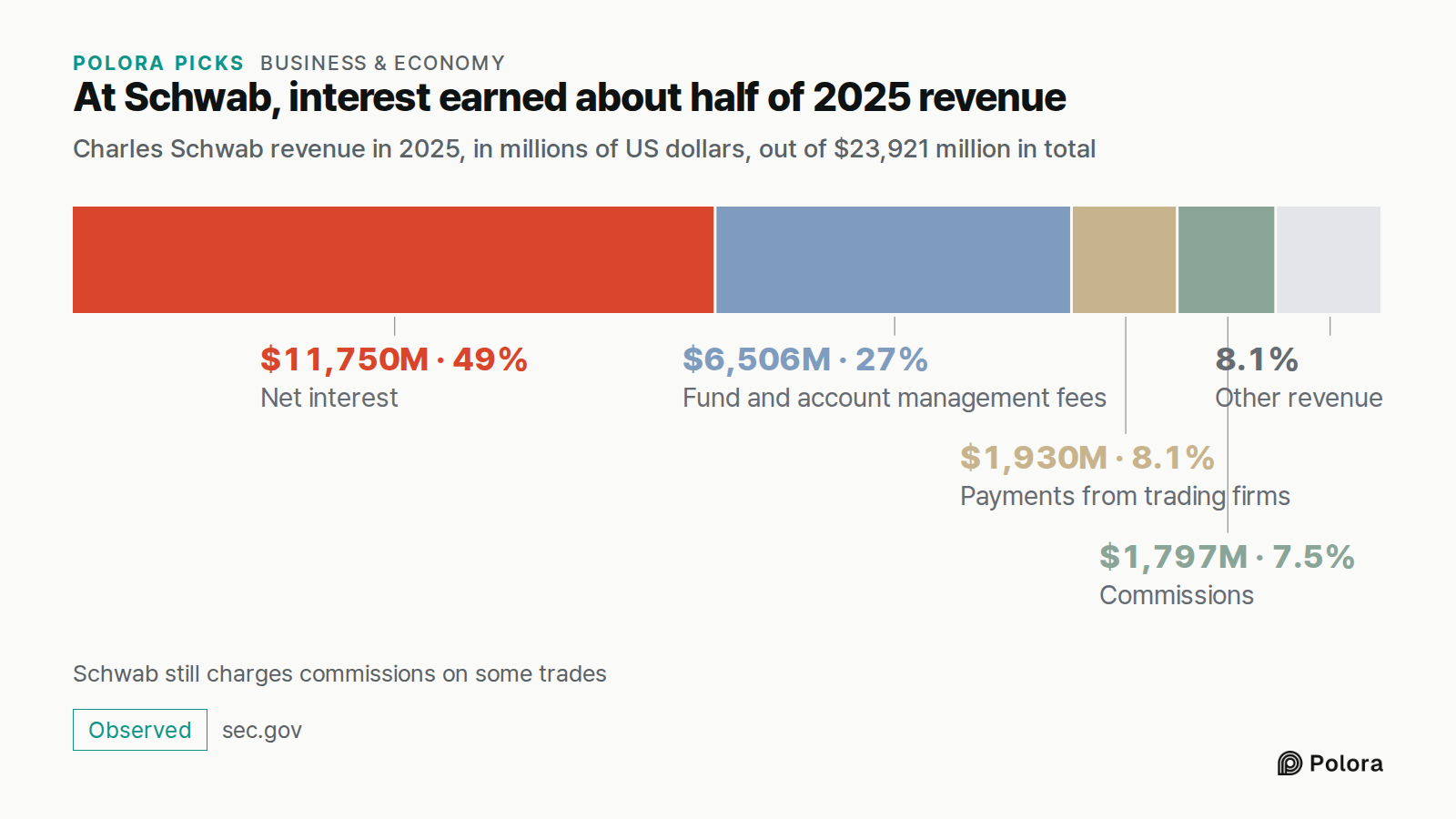
At Schwab, interest earned about half of 2025 revenue · Charles Schwab revenue in 2025, in millions of US dollars, out of $23,921 million in total · Net interest · Fund and account management fees · Payments from trading firms · Commissions · $11,750M · $6,506M · $1,930M · $1,797M · Other revenue ·
Charles Schwab revenue in 2025, in millions of US dollars, out of $23,921 million in total

Does selling your order cost you on price?

This is disputed, and both sides have evidence. Robinhood says in its disclosures that receiving these payments "does not interfere" with getting customers the best price. The same document notes that the US regulator's examination staff "has observed that there is a potential tradeoff" between the payments a broker receives and the price its customers get.

In 2022 the US Securities and Exchange Commission said that more than 90% of small investors' orders go to a small group of wholesalers. In support of a proposed rule to force order-by-order auctions, its staff estimated that these investors were missing about $1.5 billion a year compared with what open competition would give them. That was an estimate, not a measured loss, and the industry disputed it. The SEC withdrew the proposal on 12 June 2025, effective 17 June, without adopting it. In Britain, research cited by the CFA Institute found that the share of small trades executed at the best quoted price rose from around 65% to more than 90% between 2010 and 2014, a period spanning the 2012 decision by Britain's regulator that effectively ruled the practice out.

Banned in Europe, under review in Britain, legal in America

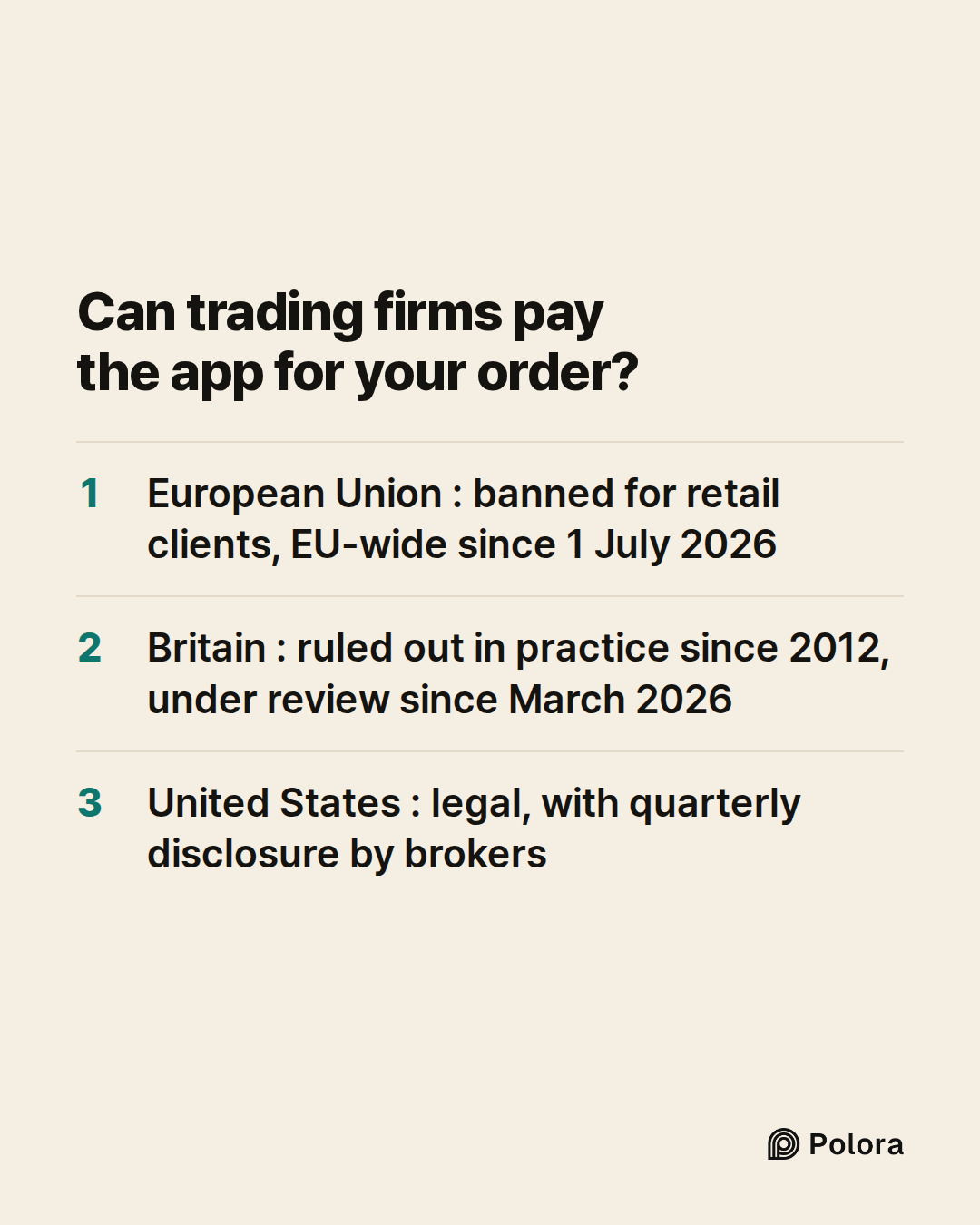
The European Union banned payment for order flow for retail clients in an amendment to its markets rules that took effect on 28 March 2024. Countries could exempt their own brokers' domestic customers until 30 June 2026, and only Germany did. Since 1 July 2026 the ban applies across the EU. Germany's regulator, BaFin, set out on 22 July 2026 which business models it still accepts.

Britain never passed a law against the practice. In 2012 its regulator at the time concluded that such payments create a conflict between earning the payment and getting each client the best price, which in practice ruled them out. In March 2026 the Financial Conduct Authority said it would review that position. Its May 2026 plan of regulatory work still describes a review, and it has not yet said what it will propose. In the United States the practice remains legal. Brokers must disclose it in quarterly reports like the one quoted above.
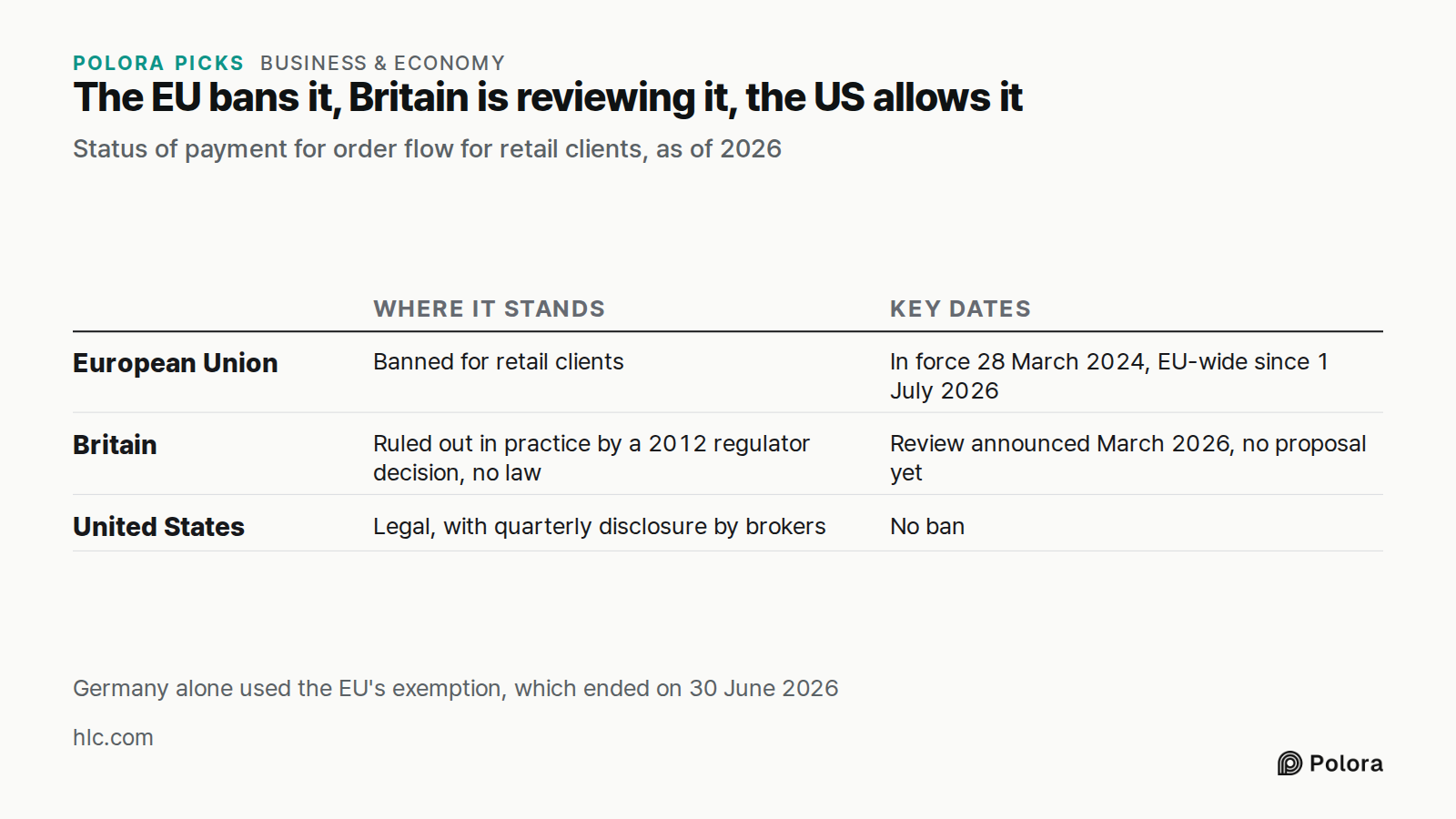
The EU bans it, Britain is reviewing it, the US allows it · Status of payment for order flow for retail clients, as of 2026 · Where it stands · Key dates · European Union · Britain · United States · Banned for retail clients · In force 28 March 2024, EU-wide since 1 July 2026 · Ruled out in practice
Status of payment for order flow for retail clients, as of 2026

Who pays for a free stock trade

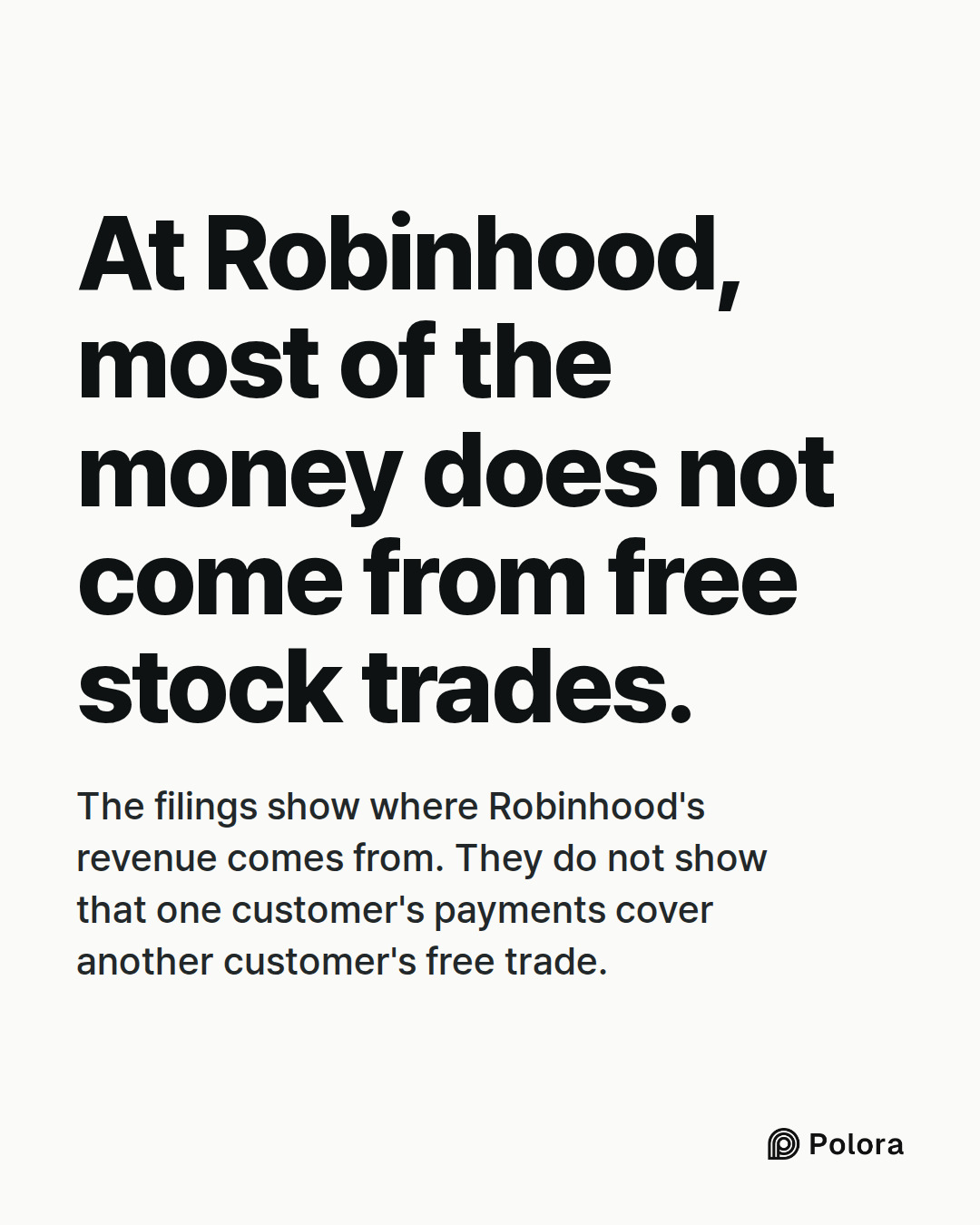
Commission-free trading is real for the person who buys a share. But the app is not a charity, and the money comes from somewhere. Some of it comes from the stock order itself, through what the trading firm pays to fill it. Far more comes from the option trader, the customer borrowing on margin, the crypto trader, and the cash that sits in an account earning the app more than it earns its owner. The filings show where the revenue comes from. They do not show that one customer's payments cover another customer's free trade, or that any particular order got a worse price. At Robinhood in 2025, stock trades came to $302 million out of $4,473 million. Most of the bill was paid elsewhere.

How do stock apps make money if trading is commission-free?How do stock apps make money if trading is commission-free?Stock trades earned Robinhood $302 million of its $4,473 million revenue in 2025. · Most of the rest came from customers who do other things, according to Robinhood's annual report for 2025.Robinhood kept $229 million of the interest on customers' idle cash in 2025. · It moves idle cash to partner banks in what it calls a cash sweep, passes part of the interest to the customer and keeps the difference. · ※ cash sweep : moving uninvested account cash to partner banks that pay interest oCan trading firms pay the app for your order? · European Union : banned for retail clients, EU-wide since 1 July 2026 · Britain : ruled out in practice since 2012, under review since March 2026 · United States : legal, with quarterly disclosure by brokersAt Robinhood, most of the money does not come from free stock trades. · The filings show where Robinhood's revenue comes from. They do not show that one customer's payments cover another customer's free trade.Sources 14 : sec.gov · Robinhood Markets, Inc. Form 10-K for fiscal year 2025, nasdaq.com · Robinhood reports fourth quarter and full year 2025 results, sec.gov · The Charles Schwab Corporation Form 10-K for fiscal year 2025 + 11Read the full story at · polora.ai

How do stock apps make money if trading is commission-free?

Alpha · claude-sonnet-5

This is a solid manuscript, and my search confirms its core architecture while flagging one real discrepancy worth flagging to readers. What checks out cleanly: The SEC withdrawal is accurate and well-dated. The SEC formally withdrew certain notices of proposed rulemaking issued between March 2022 and November 2023, and does not intend to issue final rules with respect to these proposals, with the Federal Register date of June 17, 2025, and the underlying Commission action on June 12, 2025. This matches the manuscript's "withdrew... on 12 June 2025" line exactly, confirmed independently via Schwab's own 10-K: On June 12, 2025, the SEC withdrew certain notices of proposed rulemaking issued between March 2022 and November 2023, which the Company had been evaluating. The withdrawn proposals included the December 2022 equity market structure rule proposals, "Order Competition Rule" and "Regulation Best Execution". Good, traceable, two independent filers confirm it. One real number mismatch I found — worth flagging to the editor: Robinhood's own 10-K table (SEC filing) gives different equities and "other" revenue figures than the manuscript states. Per the filing itself: Opt…

Beta · gpt-6-sol

The manuscript’s central answer holds: a zero commission on a stock trade does not mean the brokerage has no revenue. It can receive payment for routing orders, earn interest from margin lending and cash balances, lend securities, and sell subscriptions. But the manuscript sometimes turns *broker revenue* into an asserted *cost to a particular customer* without evidence that supports that allocation. The 2025 figures are substantially right. Robinhood reports $4,473 million in total net revenue, including $1,123 million from options transactions, $901 million from crypto, $302 million from equities, $573 million in margin interest, $229 million from cash sweep, $190 million in net securities-lending revenue, and $179 million from Gold subscriptions. Net interest revenue was $1,514 million. Its reported average margin book was $11,431 million at a 5.01% annual yield; average swept cash was $30,912 million at 0.74%. The filing also has a separate “other” transaction line of $302 million—identical to the equities figure, not a discrepancy in it. That other line grew largely with prediction-market activity and instant withdrawals, and should not disappear into “the res…

Gamma · gemini-3.1-pro

This manuscript is in very good shape for the editor, but Alpha and Beta left a few loose threads on the regulatory front that I have now pulled and verified. What I checked and can confirm: 1. The UK CFA Institute Statistic: The manuscript states that in Britain, research cited by the CFA Institute found that execution at the best quoted price rose from around 65% to more than 90% between 2010 and 2014 following the 2012 rule clarification. This is accurate. The CFA Institute released a 2016 study specifically analyzing the UK Financial Services Authority's (now FCA) 2012 guidance that effectively banned PFOF. The study explicitly states that the proportion of retail-sized trades executing at the best quoted price increased from "around 65% to more than 90%" over the 2010–2014 period. *(Source: CFA Institute, 2016 study on UK ban on PFOF / https://www.cfainstitute.org)* 2. The Germany / BaFin Timeline: The manuscript's dates for the European rollout are correct. Germany utilized the temporary exemption under Article 39a(2) MiFIR for domestic business until June 30, 2026. Following that expiry, the ban applied fully to German investment firms starting July 1, 2…

Researcher · gemini-3-7-flash

Fact-Check and Verification Report This report evaluates the checkable claims raised in the editor’s manuscript and the debaters’ assessments. --- 1. Verification of Manuscript Claims & Regulatory References A. Robinhood (FY2025 10-K) Revenue & Balance Sheet Metrics * Total Net Revenue & Disaggregated Lines: * Total Net Revenue: $4,473 million * Options: $1,123 million * Cryptocurrencies: $901 million * Equities: $302 million * Margin Interest: $573 million (reported average margin book of ~$11.4 billion at a 5.01% yield) * Cash Sweep: $229 million (reported average swept cash of ~$30.9 billion at a 0.74% yield) * Net Securities Lending: $190 million * Gold Subscriptions: $179 million * Net Interest Revenue: $1,514 million * The "Other" Line Overlap: Robinhood’s 10-K contains a separate "Other transaction-based revenues" line of $302 million (driven by event contracts/prediction markets and instant withdrawal fees) alongside the $302 million equities line. The manuscript correctly transcribed the equities figure, but treating the remainder exclusively as non-transaction revenue omits this distinct ca…

The Arbiter · gpt-6-sol

Round record: Alpha, Beta, Gamma and the Researcher agree on the central answer: a stock app can charge no commission on a share trade while earning revenue from order-routing payments, options trading, interest on margin loans and cash balances, securities lending, subscriptions, and—in Robinhood’s case—crypto and other transactions. The manuscript’s premise stands, but its claim about *who pays for whose trade* needs more care. - The headline numbers check out. Robinhood’s 2025 filing reports $4,473 million in total net revenue, including $302 million from equities, $1,123 million from options, $901 million from crypto and $1,514 million in net interest revenue. As Alpha noticed and Beta clarified, a separate “other” transaction line also happens to be $302 million; that is not a mismatch in the equities figure. The filing additionally supports $573 million in margin interest, $229 million from cash sweep, $190 million in *net* securities-lending revenue and $179 million from Gold subscriptions. Address: https://www.sec.gov/Archives/edgar/data/1783879/000178387926000023/hood-20251231.htm. ([sec.gov](https://www.sec.gov/Archives/edgar/data/1783879/000178387926000023…

The Arbiter's Final Verdict · gpt-6-sol

Commission-free means the app does not charge you a commission for a stock trade—not that the app earns nothing. Its revenue can come from several places: - Order routing: Some US brokers receive payment from trading firms that execute customers’ stock and options orders. This is called *payment for order flow*. - Interest: Brokers earn revenue from customers who borrow to invest (margin loans), and from certain cash balances and cash-sweep arrangements. - Securities lending: They may earn fees when customers’ eligible shares are lent out. - Subscriptions and other products: Paid memberships, crypto trading, and other transactions can add revenue. The mix differs by broker. In Robinhood’s 2025 filing, equities generated $302 million of $4,473 million in total net revenue; options generated $1,123 million, and net interest revenue was $1,514 million. Schwab’s 2025 filing shows a different mix, with net interest revenue accounting for roughly half its total. That does not…