Why is a big smart TV so cheap now?

The broad reason is that, over the long run, the screen inside became much cheaper to make. Some brands also earn money after the sale, from home-screen ads and viewing data. In 2024 Vizio's TVs and sound bars made a gross loss, and its profit came from that second business.

Business & Economy · 2026-10-04

Vizio's TVs and sound bars lost money, and what runs on the screen made it back

Ask most people how a TV company makes money and they will say it sells TVs. For Vizio, one of the most widely owned TV brands in the United States, the last figures it published on its own say otherwise.

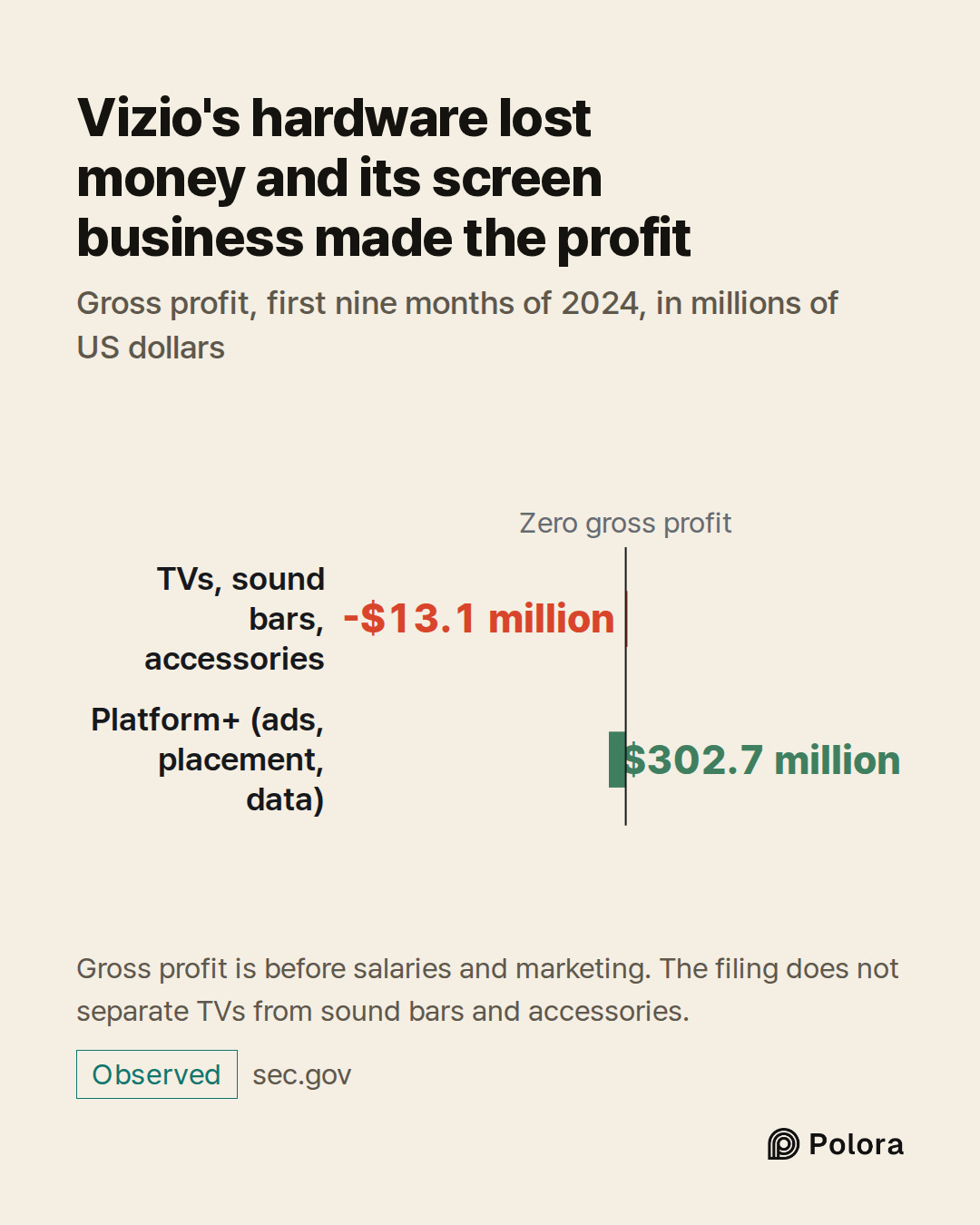
In the first nine months of 2024, Vizio's device business sold 709.9 million dollars of TVs, sound bars and accessories and spent 723.0 million dollars making and delivering them. That left a gross loss of 13.1 million dollars. Gross profit is what remains after the cost of the product itself, before salaries, marketing and everything else. Over the same months, Vizio's other business, which it called Platform+, brought in 526.0 million dollars and left a gross profit of 302.7 million.

Platform+ is the software on the TV and what it sells : ads on the home screen, ads in Vizio's own free channels, paid placement for streaming services, buttons on the remote that partners pay for, and licences to use data about what owners watch. Put the two halves together and Vizio's hardware added nothing to its gross profit. All of it came from what happened on the screen after the sale. The filing does not report TVs apart from sound bars and accessories, so it shows a loss on Vizio's hardware as a whole, not on each TV.
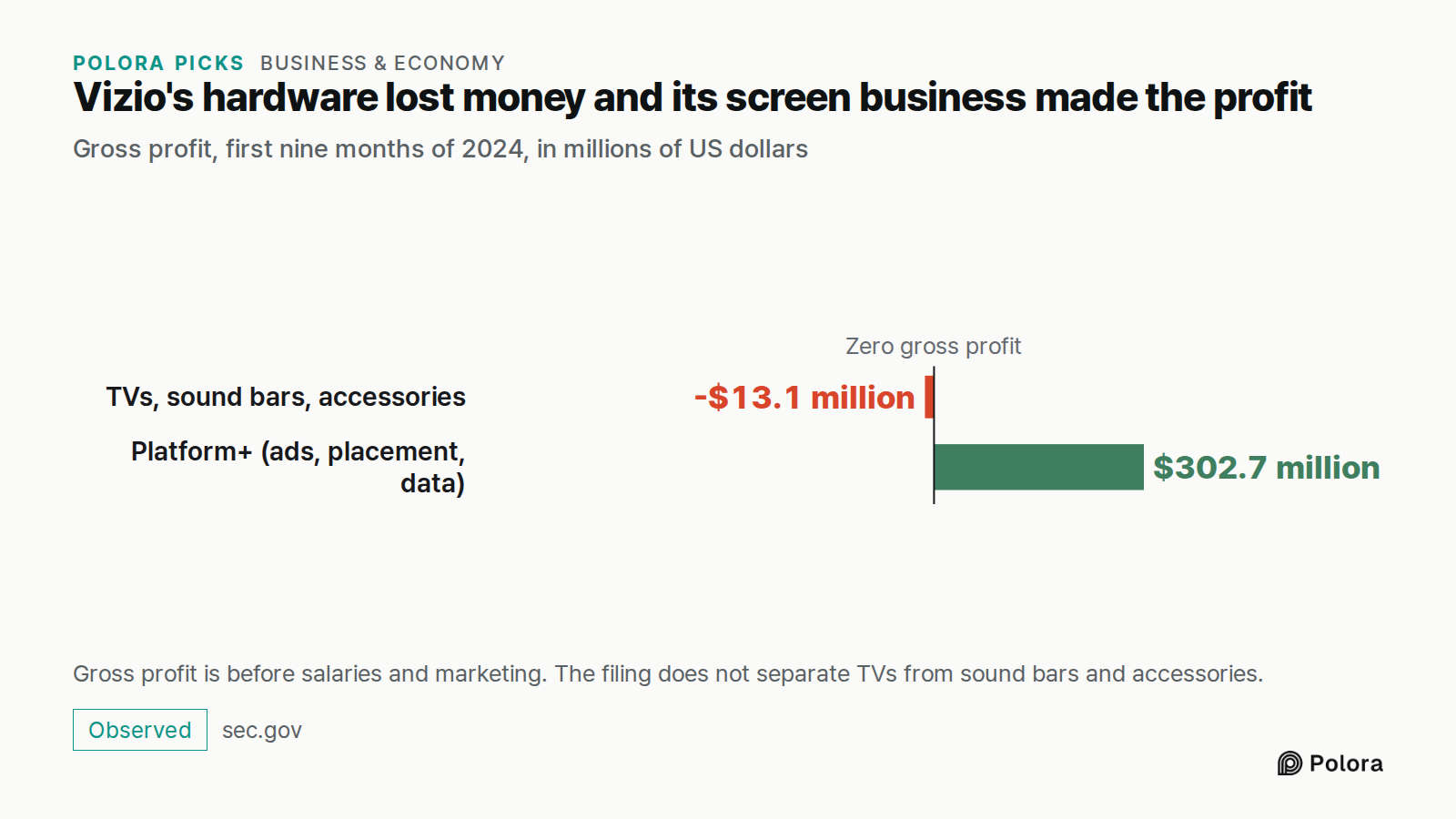
Vizio's hardware lost money and its screen business made the profit · Gross profit, first nine months of 2024, in millions of US dollars · Zero gross profit · TVs, sound bars, accessories · Platform+ (ads, placement, data) · -$13.1 million · $302.7 million · Gross profit is before salaries and marke
Gross profit, first nine months of 2024, in millions of US dollars

The first reason is the screen itself

That does not mean ads are why every TV is cheap. The bigger reason is the panel, the flat screen at the front, which TrendForce, a firm that tracks the display industry, puts at about 40 to 50 percent of what it costs to build a TV.

Over the past decade, panel factories in China grew until they made most of the world's LCD TV screens. TrendForce projected Chinese makers would hold 70.4 percent of LCD TV panel supply in 2023, with BOE, CSOT and HKC ranked first, second and third. So much capacity has meant long stretches of oversupply. In late 2022, TrendForce reported that prices for 65-inch TV panels had fallen close to the cost of their parts, and that factories might run at only 60 percent of capacity, the lowest in a decade.

This is a long-run story, not a yearly one. In January 2026 TrendForce reported that panel prices and the cost of other parts were rising again.

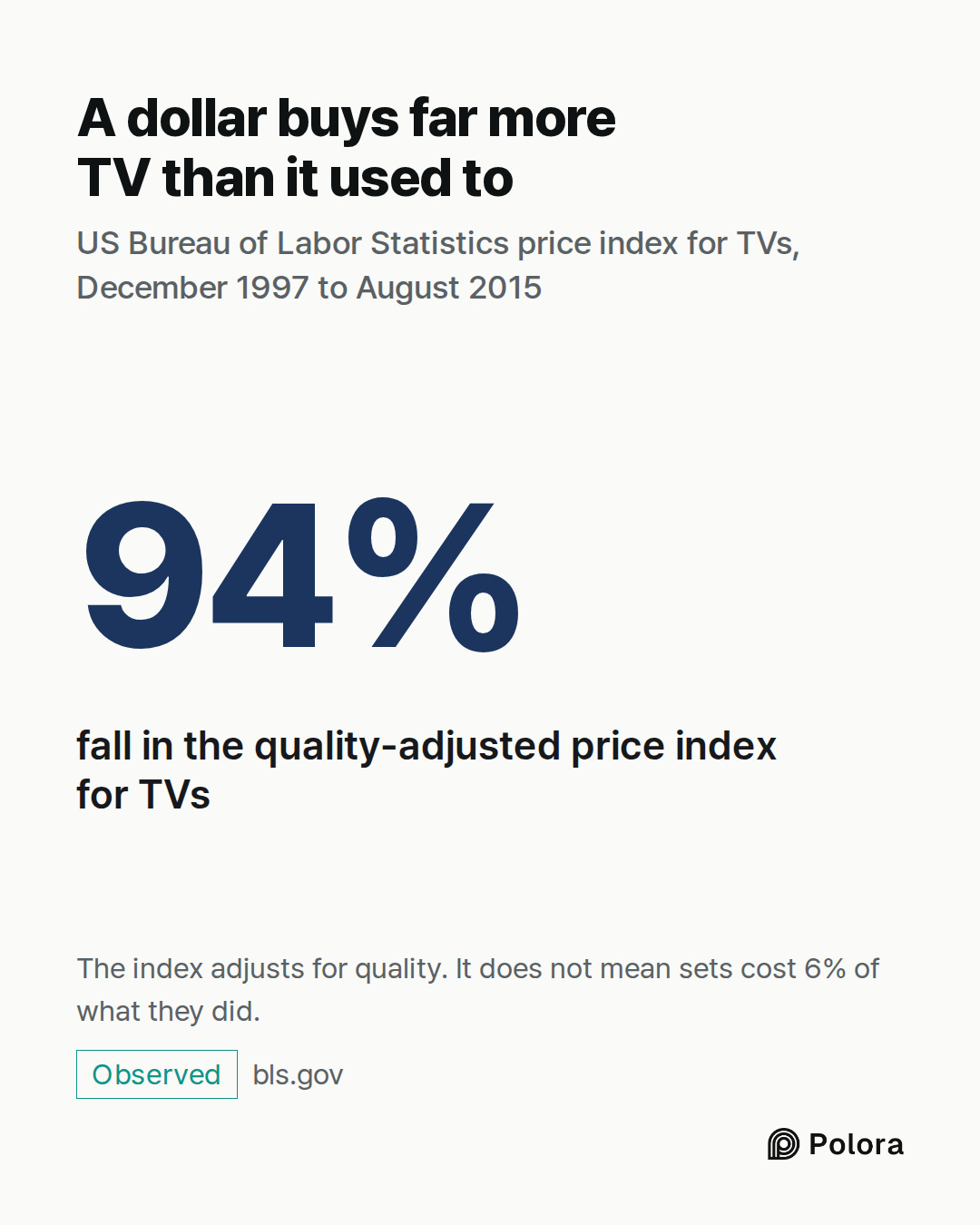
Cheaper screens lowered the price of TVs for every brand, whether or not it sells ads. The US Bureau of Labor Statistics found that its price index for TVs fell 94 percent from December 1997 to August 2015. That index adjusts for quality, so it means a dollar buys far more TV than it used to, not that sets cost 6 percent of what they did. The ad business sits on top of this. It may give some brands more room to price a set low, but no published figure shows how much it takes off the price of any particular TV.
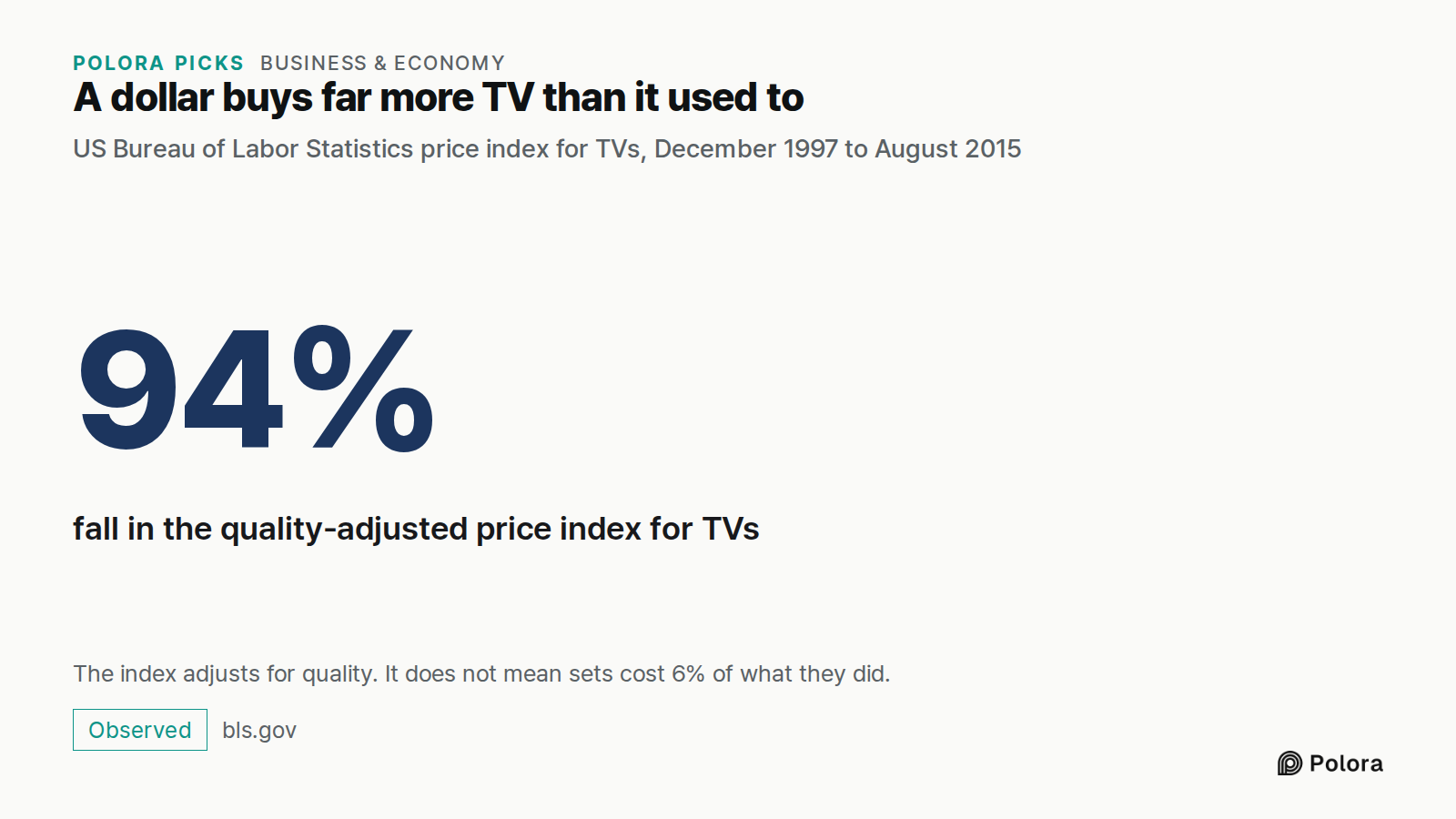
A dollar buys far more TV than it used to · US Bureau of Labor Statistics price index for TVs, December 1997 to August 2015 · 94% · fall in the quality-adjusted price index for TVs · The index adjusts for quality. It does not mean sets cost 6% of what they did.
US Bureau of Labor Statistics price index for TVs, December 1997 to August 2015

What a TV keeps selling after you take it home

A smart TV is a computer connected to the internet, with a home screen its maker controls. Vizio's filings describe three ways that screen earns money.

The first is advertising. Banners on the home screen are sold to streaming services, film studios and other brands, and the maker's free channels, which run shows with ad breaks the way broadcast TV does, carry ads the maker sells itself. The second is placement : a streaming service can pay to sit on the home screen or to have its own button on the remote.

The third is data. Many smart TVs use automatic content recognition, a feature that identifies what is on the screen, whether it comes from an app, a cable box or a game console. Vizio's version was called Inscape, and Vizio licensed the data it produced to measurement firms, ad agencies and networks to track who watches what.

At the end of September 2024, Vizio counted 19.1 million active accounts, TVs in use and connected. Over the preceding four quarters, its Platform+ revenue came to an average of 37.17 dollars per active account. That is revenue, not profit, and it is a yearly figure, not a monthly one. A TV sold once at a thin margin can keep earning for as long as it stays plugged in.
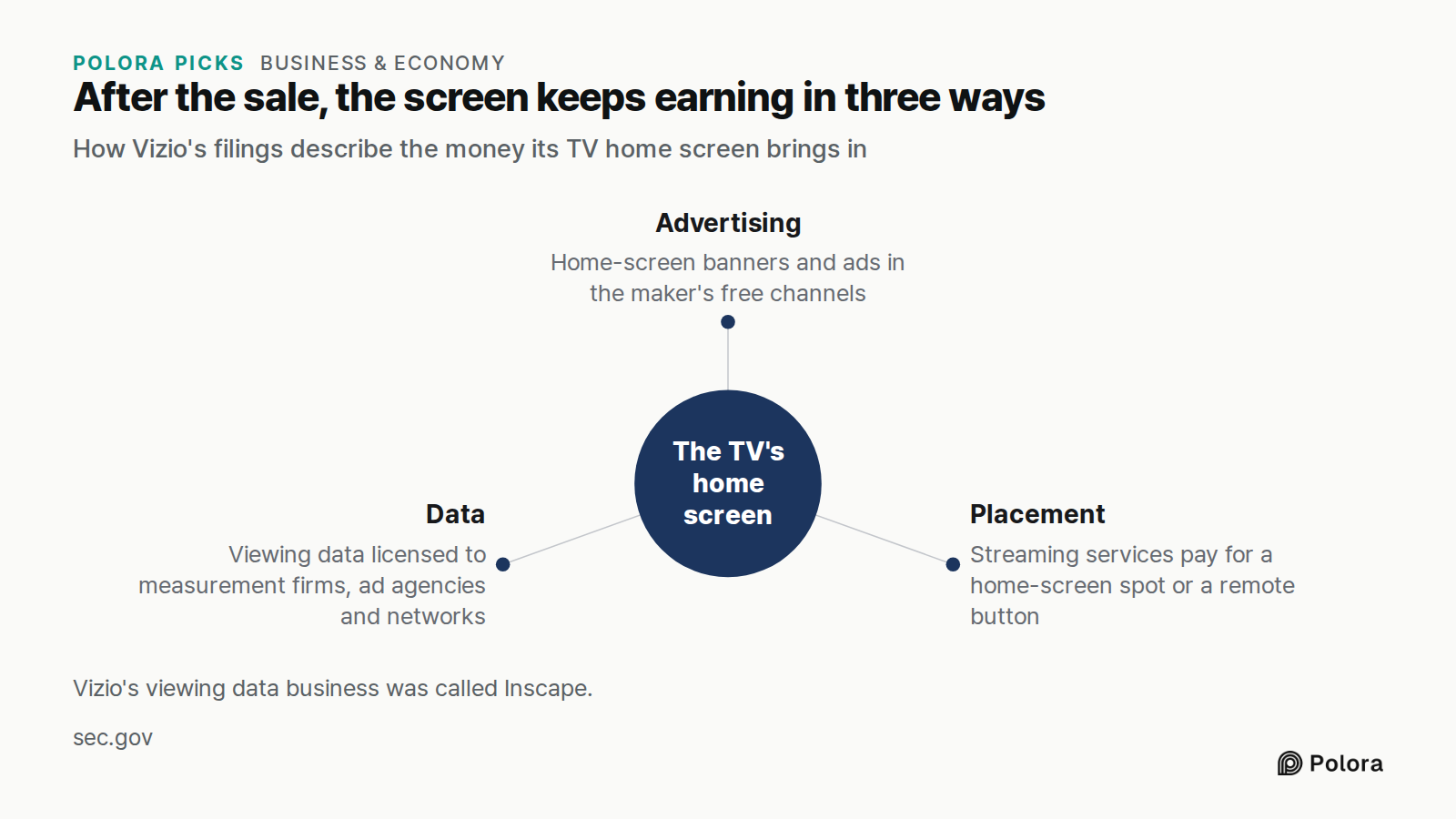
After the sale, the screen keeps earning in three ways · How Vizio's filings describe the money its TV home screen brings in · The TV's home screen · Advertising · Placement · Data · Home-screen banners and ads in the maker's free channels · Streaming services pay for a home-screen spot or a remote
How Vizio's filings describe the money its TV home screen brings in

Roku shows the same split, at a larger scale

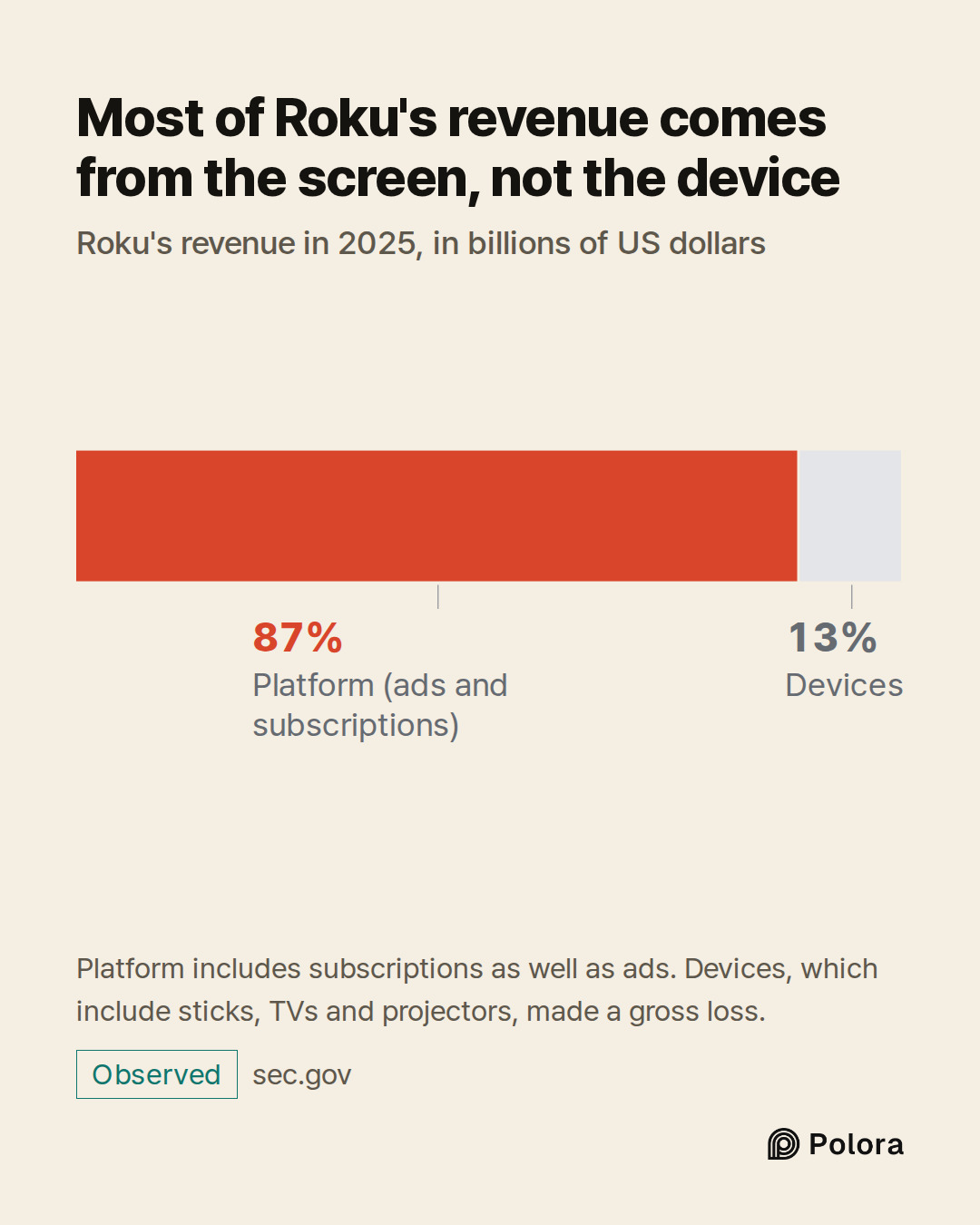
Roku makes streaming players and TVs and licenses its TV software to other brands. It reports the same two halves. In 2025, its devices made a gross loss of 82 million dollars, about 14 cents for every dollar of devices sold. Its platform business, made up of ads and the subscriptions it sells on behalf of streaming services, brought in 4.145 billion dollars, about 87 percent of Roku's 4.74 billion dollars in revenue, and earned about 2.16 billion dollars in gross profit.

Roku's devices segment mixes streaming sticks, Roku-made TVs and smart projectors, so the loss is not on TVs alone, and TVs other brands build with Roku's software are not in it. Its platform figure includes subscriptions as well as ads. The pattern is still the same as Vizio's : the hardware as a whole runs at a loss, and the money comes from the screen.
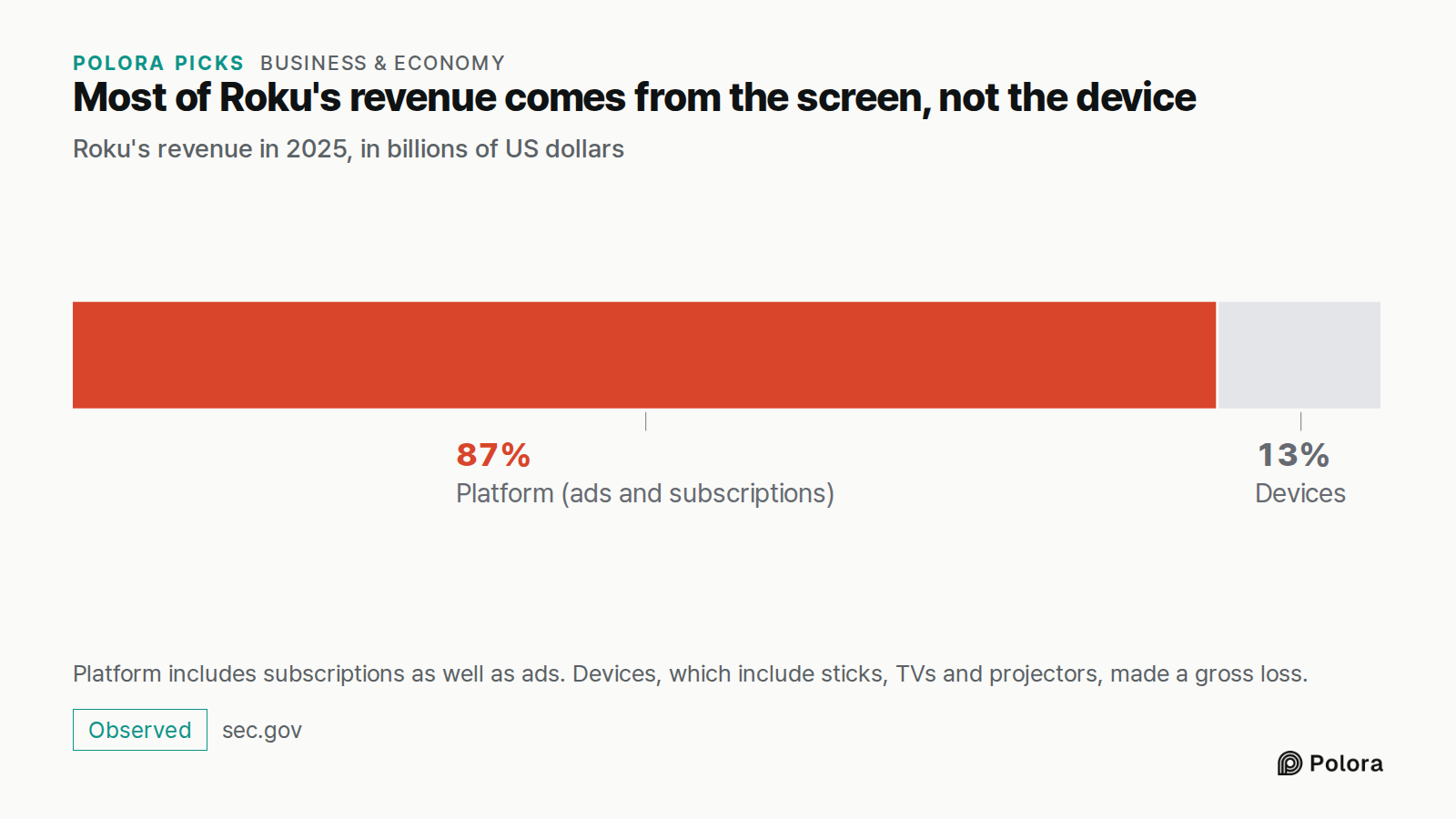
Most of Roku's revenue comes from the screen, not the device · Roku's revenue in 2025, in billions of US dollars · Platform (ads and subscriptions) · $4.145 billion · Devices · Platform includes subscriptions as well as ads. Devices, which include sticks, TVs and projectors, made a gross loss.
Roku's revenue in 2025, in billions of US dollars

What owners agreed to, and what regulators said

The data side runs on a choice most owners make once, during setup. In 2017 Vizio paid 2.2 million dollars to settle charges from the US Federal Trade Commission and New Jersey that it had collected viewing data from 11 million TVs, with the feature switched on by default, without owners' knowledge or consent. Vizio did not admit wrongdoing. The order required it to explain the collection clearly and get owners' express agreement first.

In December 2025, the Texas attorney general sued Samsung, LG, Sony, Hisense and TCL. The suits allege that the companies steer owners into turning content recognition on and bury what it means in dense legal text, and that the feature can capture what is on screen as often as every half second. These are the state's allegations, not findings about any particular set. Samsung settled in February 2026 and LG in May 2026, each agreeing to ask Texas owners for informed consent before collecting viewing data. When the LG settlement was announced in May, the cases against Sony, Hisense and TCL were still under way. Their status since then was not confirmed for this article.

The Texas attorney general's office has published a guide to turning the feature off. It sits in the settings under names that differ by brand, such as Viewing Information Services on Samsung or Live Plus on LG, and the TV does not always use those words at setup.

Only Vizio and Roku have shown the numbers

The clean split comes from just two companies, Vizio and Roku. Samsung, the world's largest TV seller by revenue, does not report what it earns from ads. LG gives one figure : its webOS advertising and content business, webOS being the software on its TVs, passed 1 trillion won in revenue in 2024. In 2025 the LG division that makes TVs and other displays had an operating loss of 750.9 billion won, while LG said webOS kept growing. LG does not separate webOS income from that division's result, so the two cannot be set side by side the way Vizio's can.

Vizio's own split ends in 2024. Walmart bought the company that December, and now counts Vizio inside its global advertising business, which came to close to 6.4 billion dollars in its 2026 fiscal year, without a separate line for Vizio.

So the sentence that holds up is this. A big TV is cheap mainly because, over the long run, its screen became much cheaper to make. On top of that, at Vizio and Roku the hardware as a whole made no gross profit, and the money came from the ads and data on the screen. How much that income takes off the price of a given TV, the published figures do not say. For other brands, the same pattern is a reasonable reading of what they say, not a measured fact.

Why is a big smart TV so cheap now?Why is a big smart TV so cheap now?A big TV is cheap mainly because its screen became much cheaper to make. · Some brands also earn money after the sale, from home-screen ads and viewing data.94% · fall in the quality-adjusted price index for TVs · A dollar buys far more TV than it used to · US Bureau of Labor Statistics price index for TVs, December 1997 to August 2015 · The index adjusts for quality. It does not mean sets cost 6% of what they did.Zero gross profit · TVs, sound bars, accessories · Platform+ (ads, placement, data) · -$13.1 million · $302.7 million · Vizio's hardware lost money and its screen business made the profit · Gross profit, first nine months of 2024, in millions of US dollars · Gross profit is before salaries and markePlatform (ads and subscriptions) · $4.145 billion · Devices · Most of Roku's revenue comes from the screen, not the device · Roku's revenue in 2025, in billions of US dollars · Platform includes subscriptions as well as ads. Devices, which include sticks, TVs and projectors, made a gross loss.No published figure shows how much home-screen ads take off a TV's price. · Only Vizio and Roku have shown the numbers. For other brands, the same pattern is a reasonable reading, not a measured fact.Sources 20 : sec.gov · Vizio third quarter 2024 results, exhibit 99.1, sec.gov · Vizio quarterly report for the period ending September 30, 2024 (Form 10-Q), grandviewresearch.com · Grand View Research, U.S. television market report + 17Read the full story at · polora.ai

Why is a big smart TV so cheap now?

Alpha · claude-sonnet-5

Alpha here. I ran the two most load-bearing checks myself — Vizio's and Roku's own filings — since those numbers carry the whole piece. Vizio's Q3 2024 figures check out almost exactly, with one correction. The manuscript's nine-month aggregate figures aren't the ones I pulled directly, but the underlying quarterly filing confirms the pattern precisely: Platform+ net revenue was $197.0 million with $115.8 million gross profit, while Device revenue was $247.7 million, and Device gross profit showed a loss of $6.7 million for the quarter (sec.gov exhibit 99.1, Q3 2024). SmartCast ARPU of $37.17 is confirmed, and Vizio's own definition states SmartCast ARPU as total Platform+ net revenue, less revenue attributable to legacy VIZIO V.I.A. Plus units, during the preceding four quarters — so the researcher's flagged uncertainty resolves cleanly: yes, it's a trailing-twelve-month figure, not a single-quarter number. The manuscript should say that explicitly. Account count of 19.1 million also checks out. Roku's numbers are correct, but one sentence in the manuscript blends two different metrics in a way a careful reader will trip over. The 10-K confirms Platform gross profit…

Beta · gpt-6-sol

Beta: The manuscript has a sound explanation of *two forces*, but its last sentence claims more than its evidence can measure. Cheaper panels help explain the long-run fall in TV prices; advertising and other platform income give *some* companies another way to earn from a TV. The filings do not establish how much either force reduces the price of a big TV today. - Vizio’s split is real, but it is not a TV-only loss. For the first nine months of 2024, its Device segment had $709.9 million in revenue, $723.0 million in costs and a $13.1 million gross loss. Platform+ had $526.0 million in revenue and $302.7 million in gross profit. Device includes sound bars and accessories, so “Vizio lost money on its TVs” is stronger than the filing permits. The manuscript’s “TVs added nothing to gross profit” needs the same qualification. Vizio defines the $37.17 SmartCast ARPU over the preceding four quarters, divided by an average active-account count—not as earnings from each of the 19.1 million accounts in September alone. (sec.gov) Address: https://www.sec.gov/Archives/edgar/data/1…

Gamma · gemini-3.1-pro

Gamma: I can close the loop on the legal and privacy claims Beta rightly flagged as unverified. I ran searches to check the Texas Attorney General’s actions and the technical claims about disabling ACR, and the manuscript’s account is highly accurate, with sources confirming the specifics. Here is what the record shows on the remaining checks: * The Texas lawsuits and 500-millisecond claim: In December 2025, Texas Attorney General Ken Paxton did indeed sue Samsung, LG, Sony, Hisense, and TCL. The state's December 15, 2025 press release explicitly alleges that ACR "can capture screenshots of a user’s television display every 500 milliseconds." (texasattorneygeneral.gov) * The settlements and informed consent: Samsung settled earlier in 2026, and LG settled on May 11, 2026. According to the state's announcements and subsequent reporting, both agreements require the companies to stop collecting viewing data without informed consent and mandate clear pop-up disclosures and opt-out mechanisms. ([texasattorneygeneral.gov](https://www.texasatto…

Researcher · gemini-3-7-flash

Claim-by-Claim Verification & Fact-Check 1. Vizio’s U.S. Market Position & ARPU Definition * Claim: Vizio is one of the best-selling TV brands in the United States. SmartCast ARPU was $37.17 for 19.1 million active accounts in September 2024. * Finding: Supported with nuance. Market research data ranks Vizio consistently among the top 3–4 TV brands in U.S. household penetration alongside Samsung, LG, and TCL. * ARPU Clarification: Per Vizio’s Q3 2024 Form 10-Q and Exhibit 99.1, SmartCast ARPU ($37.17) is defined as trailing-twelve-month (TTM) Platform+ net revenue (excluding legacy VIA Plus) divided by the average number of active accounts over that four-quarter period—it is not earnings generated solely within a single quarter or month. * Hardware vs. TVs: Vizio’s "Device" segment reported a gross loss of $13.1 million on $709.9 million net revenue for the first 9 months of 2024. However, "Device" includes soundbars and accessories alongside televisions, so stating "Vizio lost money on its TVs" represents a segment-level aggregation rather than an isolated television unit margin. * Source: [U.S. SEC EDGAR – Vizio Q3 2024 10-Q](https://www.sec.…

The Arbiter · gpt-6-sol

Round record Alpha and Beta agree on the financial pattern, but corrected its wording. Vizio reported a $13.1 million gross loss in its Device segment and $302.7 million gross profit in Platform+ for the first nine months of 2024. “Vizio lost money on its TVs” is not established: Device also includes sound bars and accessories. Its $37.17 SmartCast ARPU measures revenue over the preceding four quarters, divided by an average account count; it is not profit from each of the 19.1 million accounts active in September. (sec.gov) Address: https://www.sec.gov/Archives/edgar/data/1835591/000183559124000089/vzio-20240930.htm Alpha and Beta likewise agree on Roku’s figures and their limit. In 2025, Roku reported $2.156 billion Platform gross profit and an $82.0 million Devices gross loss. The manuscript’s 87% is Platform’s share of *revenue*, not a gross-profit margin. Devices combines types of hardware, so its loss does not establish that Roku-made TVs individually sold at a loss. ([sec.gov](https://www.sec.gov/Archives/edgar/data/1428439/000162828026008114/roku-20251…

The Arbiter's Final Verdict · gpt-6-sol

A big smart TV is cheap mainly because large LCD screens became much cheaper to produce over the long run. Manufacturing scale and periods of excess panel supply reduced a major part of the cost of making a set. That is the broad explanation; it does not mean panel costs fall every year. TrendForce reported rising panel and other component costs in early 2026. TrendForce on panel supply · TrendForce on 2026 costs Some smart-TV businesses also make money after the purchase. They can sell home-screen and free-channel ads, paid placement, subscriptions, and—in some cases—licences for viewing data. That income may give a company more room to compete on the set’s price, but the accounts examined do not measure how many dollars it takes off a particular TV. Vizio is the clearest example, with an important correction to the manuscript: in the first nine months of 2024, its Device segment had a $13.1 million gross loss while Platform+ had $302.7 million gross profit. Device includes sound bars and accessories, so this does not prove that Vi…