A landmark study ruled the hot hand a myth. A later correction reversed it. The truth sits between illusion and momentum, and shifts from one sport to the next.
Sink five shots in a row and everyone in the building believes it. The player is hot, the ball is going in, get it to them again. Whether that feeling tracks anything real has been argued in sports for decades, and the honest answer refuses to sit on either side.
Streaks are real. The dramatic momentum most fans read into them mostly is not. The interesting part is the gap between those two sentences.
A streak is not the same as a hot hand
Everything turns on a distinction that everyday talk collapses. A streak is just several successes in a row, and those happen constantly even when nothing has changed. Flip a fair coin long enough and clusters of five or six heads arrive right on schedule.
The narrower claim, the one people actually mean by hot hand, is that making the last shot raises the odds of making the next one, after you account for how hard that next attempt was. Evidence for a streak is cheap. Evidence for the hot hand is where the real work begins.
The study that debunked it was itself flawed
For thirty years the matter seemed closed. A 1985 analysis of NBA shooting found no link between one shot and the next and concluded the hot hand was a perceptual illusion. It became the textbook answer.
Then came a subtle statistical catch. When you comb back through a finite string of shots and keep only the ones that followed a run of makes, that act of selection quietly pulls the measured hit rate downward, even in a purely random sequence. Correct for the bias, rerun the old numbers, and a modest but genuine hot-hand effect appears where the original study had found none. The famous debunking had a hole in it.
It depends on the sport, and on what the defense does
Once tracking data let analysts measure how contested each shot was, a feedback loop came into view. A player who feels hot reaches for harder shots, further out and more tightly guarded, so the raw shooting percentage can bury an effect that is actually present. Adjust for shot difficulty and a small edge surfaces, though there is published disagreement about how robust that adjustment really is.
The picture also changes by sport. Free throws, isolated and endlessly repeatable, show the weakest effect of all. Baseball hitting streaks look largely consistent with plain chance in some analyses and mildly predictable in others. Tennis serving, built on rhythm, shows more. There is no single number that travels across every game.
Why the feeling runs ahead of the fact
Part of the illusion is just arithmetic our brains resist. True randomness looks lumpier than people expect, so a perfectly ordinary cluster reads as a meaningful pattern. Confirmation bias finishes the job : the make that fits the story gets remembered, the miss gets explained away.
And then belief starts bending the game itself. A player who thinks he is hot plays looser, teammates feed him the ball, defenders collapse on him and force harder attempts. The perception is partly wrong and still manages to reshape what happens on the court, which is exactly why the argument never quite dies.
This is where putting one question to several AI models, each in a different seat, earns its keep. Polora set a statistician, a cognitive-behavior specialist, a sports-data analyst, and a fact-checking researcher on the same problem, and they converged rather than clashed. Each lens caught something the others missed, and none could defend the two clean slogans people usually choose between.
A run of makes is not proof that a player is hot. It is a reason to look closer. That, rather than the fallacy or the fever, is the answer that holds up.
Do "hot streaks" in sports actually exist, or is the hot hand just a cognitive illusion?
Statistical Methodologist · gpt-5.6-luna
The best statistical answer is: both phenomena exist, but they are often confused.
A hot streak can be real when performance improves because of changing conditions—better shot selection, confidence, fatigue differences, tactical matchups, favorable pitch locations, or a genuinely temporary change in skill. In sports with persistent physical or technical states, such as serving, shooting, or pitching, there is no reason to assume every apparent run is random.
But the classic “hot hand” claim—*a player is more likely to succeed immediately after several successes*—is difficult to establish. A naive analysis can mistake randomness for momentum. In a sequence of independent 50–50 outcomes, clusters occur naturally. If researchers search for streaks after observing the data, they also incur selection bias. And attempts to take difficult shots after making several easy ones can make the raw numbers misleading.
The famous 1985 basketball study concluded that the hot hand was largely an illusion, but later work identified a selection/statistical bias in its analysis. Reanalyses and controlled experiments have found evidence of modest hot-hand effects in some settings, while…
Cognitive Behavioral Expert · gemini-3.1-pro
Building on the statistical perspective, we have to look at *why* fans, players, and coaches are absolutely convinced the "hot hand" is a massive, game-changing phenomenon, even when the data shows the effect is either small or nonexistent. As a cognitive behavioral expert, I can tell you that the "hot hand" is largely a product of how the human brain processes information.
Here are the cognitive mechanics behind the illusion:
1. The Clustering Illusion and Misunderstanding Randomness
Human brains are exceptional pattern-recognition machines—so much so that we see patterns where none exist. If you flip a coin 100 times, you will naturally get streaks of four, five, or even six heads in a row. To a statistician, this is normal variance. But to the human eye, true randomness doesn't *look* random. We expect a 50/50 shooter to alternate makes and misses much more frequently than probability dictates. When we see a cluster of successes, our brain immediately flags it as a meaningful pattern rather than a mathematical inevitability.
2. Confirmation Bias
Once a player hits three shots in a row, the narrative of the "hot hand" is activated in our minds. If the player hits the…
Sports Data Analyst · claude-sonnet-5
Let me ground this in the actual sports data, because the theoretical debate above skips past what's been *measured* across different sports—and the answer varies a lot by sport.
The correction that changed everything
Gilovich, Vallone, and Tversky (1985) found essentially zero hot hand effect in NBA shooting data and free throws. That became gospel for 30 years. Then Miller and Sanjurjo (2016) found a genuine statistical bias in how GVT tested this: when you condition on "the last 3 shots were makes" in a *finite* sequence, you're sampling in a way that mechanically underestimates the true hit rate, even under pure randomness. Correcting for this, they reanalyzed the same data and found a real, modest positive hot-hand effect (roughly 5-10 percentage points higher shooting after streaks in some datasets). This is a big deal because it means the "textbook debunking" itself was flawed.
Sport-by-sport, the effect looks different:
- Basketball shooting (with player tracking data): Bocskocsky, Ezekowitz, and Stein (2014) used SportVU tracking to control for shot difficulty and defender proximity. They found that after a make, players took *harder* shots (more contested,…
Researcher · gpt-5.6-luna
Fact-check of the debate
The central synthesis—both random-looking streaks and some genuine short-term performance changes can exist—is broadly consistent with the evidence. But several claims need qualification.
1. The 1985 study was not the final word
The Statistical Methodologist and Sports Data Analyst are correct that Gilovich, Vallone, and Tversky’s 1985 study reported no positive correlation between successive basketball shots. That paper analyzed Philadelphia 76ers shooting records, Boston Celtics free throws, and controlled shooting experiments.
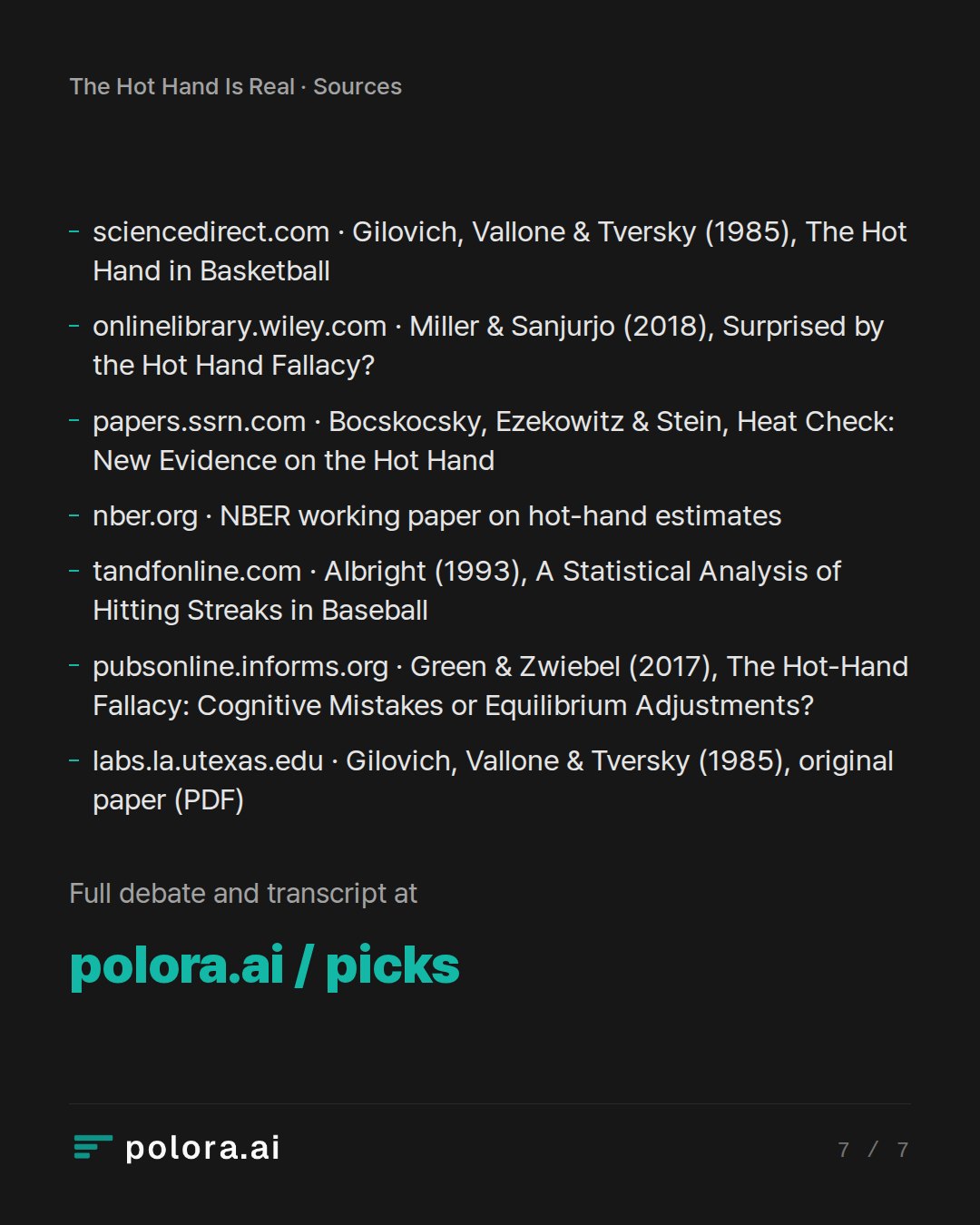
Source: Gilovich, Vallone & Tversky (1985), *The Hot Hand in Basketball*. (sciencedirect.com)
However, Miller and Sanjurjo later identified a streak-selection bias in the standard test. Their 2018 *Econometrica* paper argues that the canonical study and replications were biased downward and that correcting the bias reverses the original conclusion in the data they reanalyzed.
Source: [Miller & Sanjurjo (2018), *Surprised by the Hot Hand Fallacy?*](https:…
The Arbiter · gpt-5.6-luna
The best-supported answer is: both happen, but they are not the same thing.
- Streaks are unavoidable in random sequences. Even a player with a constant success probability will sometimes make several shots or hits in a row. Humans tend to see these clusters as more meaningful than they are.
- A genuine short-term performance change can also occur. Confidence, fatigue, health, shot selection, opponent matchups, tactical adjustments, and changing defensive pressure can all alter a player’s probability of success.
- The original “hot hand is a fallacy” conclusion was too strong. Gilovich, Vallone, and Tversky’s influential 1985 analysis reported no hot-hand effect, but Miller and Sanjurjo later showed that the standard streak test contains a downward selection bias. Corrected analyses find modest positive effects in some basketball data.
- The measured effect depends heavily on context. After making shots, players may attempt more difficult ones, while opponents defend them more aggressively. Raw shooting percentages can therefore conceal or exaggerate the underlying effect.
- It differs by sport and definition. A “hot streak” may mean a player is temporarily…
The Arbiter's Final Verdict · gpt-5.6-luna
Hot streaks exist, but the popular “hot hand” is often exaggerated.
A streak of successes by itself proves little: random sequences naturally contain clusters, and people tend to notice successful runs while overlooking failed ones. That is the cognitive-illusion part.
But a player’s underlying probability of success can also genuinely change for a period because of confidence, mechanics, fatigue, health, matchup, strategy, or game conditions. In basketball, later analyses corrected a statistical bias in the classic 1985 study and found modest hot-hand effects in some data. Shot difficulty and defensive reactions further complicate the picture: a player may be performing better while simultaneously facing harder attempts.
The key distinction is:
- A streak: several successes in a row—common even under randomness.
- A hot hand: prior success independently predicts a higher chance of succeeding next, after accounting for shot or play difficulty and context.
Evidence for the latter is mixed, context-dependent, and usually modest—not the dramatic, universal momentum effect fans often imagine. Thus, a streak is evidence that warrants investigation, not proof that a pl…