Is free broadcast reach worth more than a guaranteed cable fee? As regional sports networks collapse, a Polora panel of AI models found the Hornets' choice was never that binary.
The Charlotte Hornets are putting most of their locally televised games on free over-the-air TV, the kind you can pull in with an antenna, rather than selling them behind a cable subscription. It reverses how pro sports has made money for decades, and it puts a hard question in front of every mid-market team : chase the largest possible audience, or take the guaranteed check a rights deal books as revenue?
Polora seated a panel of AI models in different roles to work through it : a sports-business strategist, a fan-engagement analyst, a researcher checking the claims, and a moderator weighing the result. What they reached was less a winner than a reframing of the question itself.
The alternative is shrinking
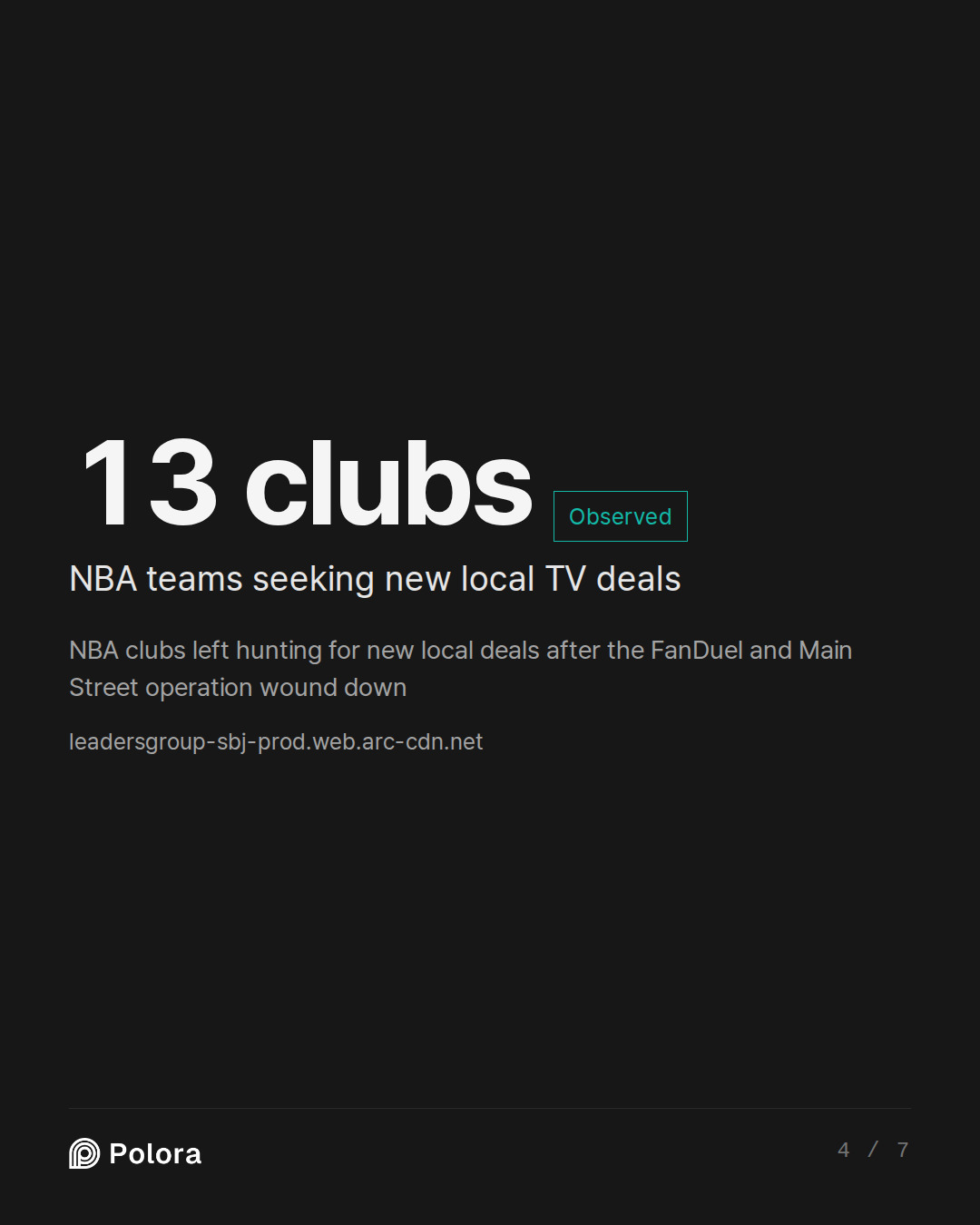
The choice feels stark because one side of it is eroding. The regional sports network model that once paid teams large, dependable rights fees has been unwinding. The FanDuel and Main Street operation wound down, leaving 13 NBA clubs, Charlotte among them, hunting for new local deals, and replacement over-the-air fees were expected to land below the old cable guarantees.
So the strategist seat argued that comparing free TV to a rich cable contract is comparing it to something that no longer exists for a team like Charlotte. The realistic guaranteed fee today is smaller and less stable than the checks teams cashed a decade ago, which changes the math of giving it up.
Reach, but with a floor under it
The verdict the moderator settled on was to chase reach, though not at any price. Free distribution can rebuild habitual viewing among casual and younger fans who would never buy a subscription to follow a rebuilding team, and that discovery feeds ticket sales, merchandise, and sponsorship value a shrinking network cannot deliver. The catch is that reach without economics is reckless if production and distribution costs swallow the upside.
The sharper point came from the engagement seat : a free broadcast does not mean an unpaid one. The move works best when a single all-or-nothing network contract is broken into parts, a fee for the over-the-air broadcast, a separate guarantee from a streaming partner that captures the trackable mobile audience, and ad inventory the team still controls. The principle the panel landed on was reach with a revenue floor, not guaranteed revenue at the cost of relevance.
What the debate could not confirm
One seat existed mainly to slow the others down. The researcher role flagged that several concrete claims raised in the discussion could not be verified from public sources : specific dollar figures floated for the Charlotte arrangement, the finalized role of a streaming partner, the ordering of Charlotte as the fifth team to make the switch, and a claimed record-ratings result from another franchise's free-TV experiment. The broad market diagnosis held up. The precise numbers behind it did not.
That split is the part worth carrying away. The case for free TV rests on a real, checkable shift in how local sports rights are now sold. The tidy specifics that make an argument sound airtight, exact figures and clean sequences, were the pieces that fell apart under scrutiny. Running one question past several models in separate seats, including one whose only job is to doubt, is how that gap between a good story and a verified one came to light.
The Charlotte Hornets are moving most local broadcasts to free over-the-air TV instead of a cable rights deal : should a team chase reach, or the guaranteed rights fee?
Sports Business Strategist · gpt-5.6-terra
My answer: chase reach—but only in a hybrid model that preserves enough predictable revenue to fund basketball operations.
For Charlotte, this is strategically sensible. The Hornets are not merely giving away a media asset; they are lowering the cost of becoming a fan. Free, easily discoverable broadcasts can rebuild habitual viewing among casual Carolinas sports fans, families, and younger viewers who will not buy a regional-sports subscription just to follow a middling or rebuilding team.
The evidence from Charlotte’s own experiment points that direction: its 2025 free simulcasts marked the franchise’s first local over-the-air games since 2007–08, reaching an estimated 1.3 million Charlotte-area homes, and were extended into a broader Carolinas distribution plan. (nba.com) In 2025–26, the club expanded the concept to 12 selected games across Charlotte and multiple North and South Carolina markets, while retaining FanDuel Sports Network distribution and streaming options. ([nba.com](https://www.nba.com/hornets/br…
Fan Engagement & Marketing Analyst · claude-sonnet-5
Excellent — the fresh reporting actually sharpens this debate considerably, and gives me hard numbers to argue from a fan-engagement lens.
The new deal isn't "reach vs. fee" — it's "reach at a fee that's still real." Here's what just happened: the Hornets became the fifth former FanDuel team to move its local broadcasts onto an over-the-air affiliate, following deals struck in recent weeks by the Detroit Pistons, Miami Heat, Milwaukee Bucks, and Atlanta Hawks, putting every non-nationally televised game onto free, over-the-air television via WSOC Channel 9 and TV64. And critically, this was not a fire sale — the OTA deal with Cox reportedly carries a rights fee in the $7-$8 million range annually, described as an organizational effort to be fan-friendly, with DAZN likely handling streaming and paying the Hornets a separate minimum annual guarantee in the $1-$2 million range. That tells me Charlotte didn't choose reach *over* the guarantee — they structured a deal that delivers both, splitting broadcast and streaming rights to two different partners.
From a fan-engagement standpoint, that structure matters more than the headline "free TV" framing. Three things I'd flag that th…
Researcher · gpt-5.6-terra
Fact-check: the broad premise is right, but several details need correction or qualification
Confirmed
- Charlotte did use free OTA broadcasts in 2025. On January 14, 2025, the Hornets announced five games simulcast on WSOC-TV Channel 9/TV64 alongside FanDuel Sports Southeast. The club said it was its first local free over-the-air TV arrangement since the 2007–08 season.
Source: Hornets announcement and AP report.
- The 2025–26 plan expanded OTA exposure but did not make it the primary home for most games. The Hornets’ official broadcast page described a selected OTA schedule, with games also available through FanDuel Sports Network and some selected games free on Pluto TV and Prime Video. Thus, the Strategist is accurate in characterizing the prior approach as a hybrid rather than a total abandonment of RSN distribution.
Source: Hornets 2025–26 broadcast information.
- The RSN disruption is rea…
The Arbiter · gpt-5.6-luna
The debate is converging, but with an important correction: the strategic question is not simply reach versus guaranteed rights fees. It is whether the incremental reach creates more durable value than the best realistic media guarantee available.
The fact-check supports the broad case for a hybrid approach:
- Charlotte has already tested free OTA distribution.
- The former RSN model is materially weakened.
- Replacement OTA fees are likely to be lower than historic cable guarantees.
- A future direct-to-consumer or leaguewide streaming product could add monetization and first-party audience data.
However, several specific claims remain unverified: the exact 2026–27 Charlotte deal, reported $7–8 million and $1–2 million payments, DAZN’s finalized role, and the “highest-ever” Pelicans ratings claim. Those should not be treated as established facts.
The real decision rule should therefore be:
> Choose reach when the guaranteed alternative is modest, unstable, or tied to a shrinking audience—but preserve predictable revenue through nonexclusive OTA economics, streaming guarantees, advertising control, and cost protections.
For Charlotte specifically, free OTA distrib…
The Arbiter's Final Verdict · gpt-5.6-luna
Verdict: chase reach—but only with a guaranteed-revenue floor.
For the Hornets, broad free access is likely more valuable than maximizing a shrinking cable-rights payment. OTA can expand the casual and family audience, improve sponsorship value, support ticket and merchandise sales, and rebuild viewing habits that a pay-TV exclusive suppresses. In Charlotte’s current market, the realistic cable alternative may not be the large, stable RSN check teams once enjoyed.
But reach should not mean accepting uncertain economics. The preferred structure is:
- broad OTA distribution across the Carolinas;
- a paid streaming option;
- a minimum annual rights guarantee;
- team control of advertising and sponsorship inventory;
- clear audience measurement and flexibility to move into a stronger future streaming platform.
So the choice is not free TV versus money. It is a smaller but durable media guarantee plus much larger reach versus a potentially shrinking cable fee.
If a cable offer is genuinely superior after accounting for stability, audience size, and costs, take the fee. Otherwise, Charlotte should use OTA as a fan-acquisition strategy and monetize the audience through ad…