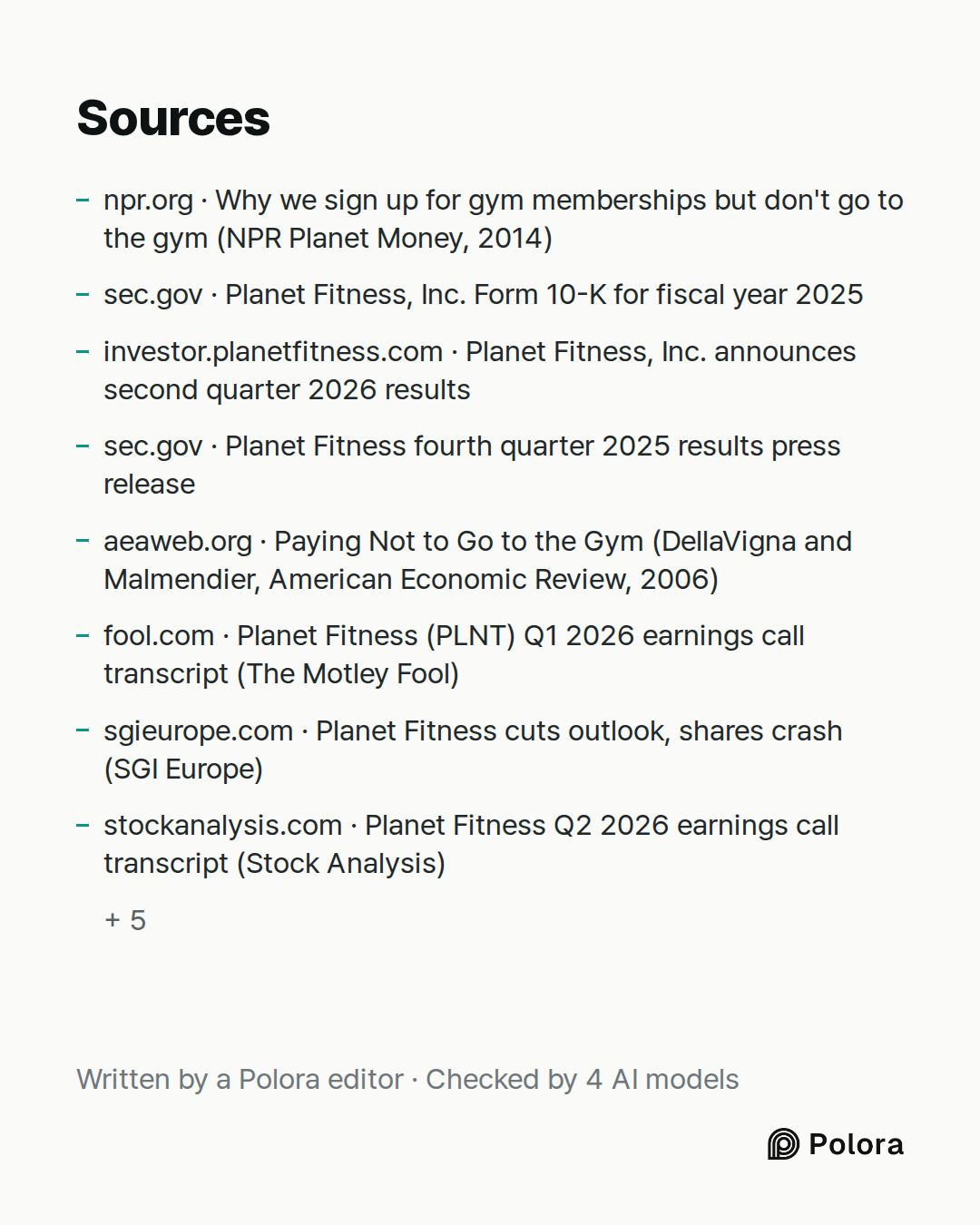
A gym signs up far more members than it can hold
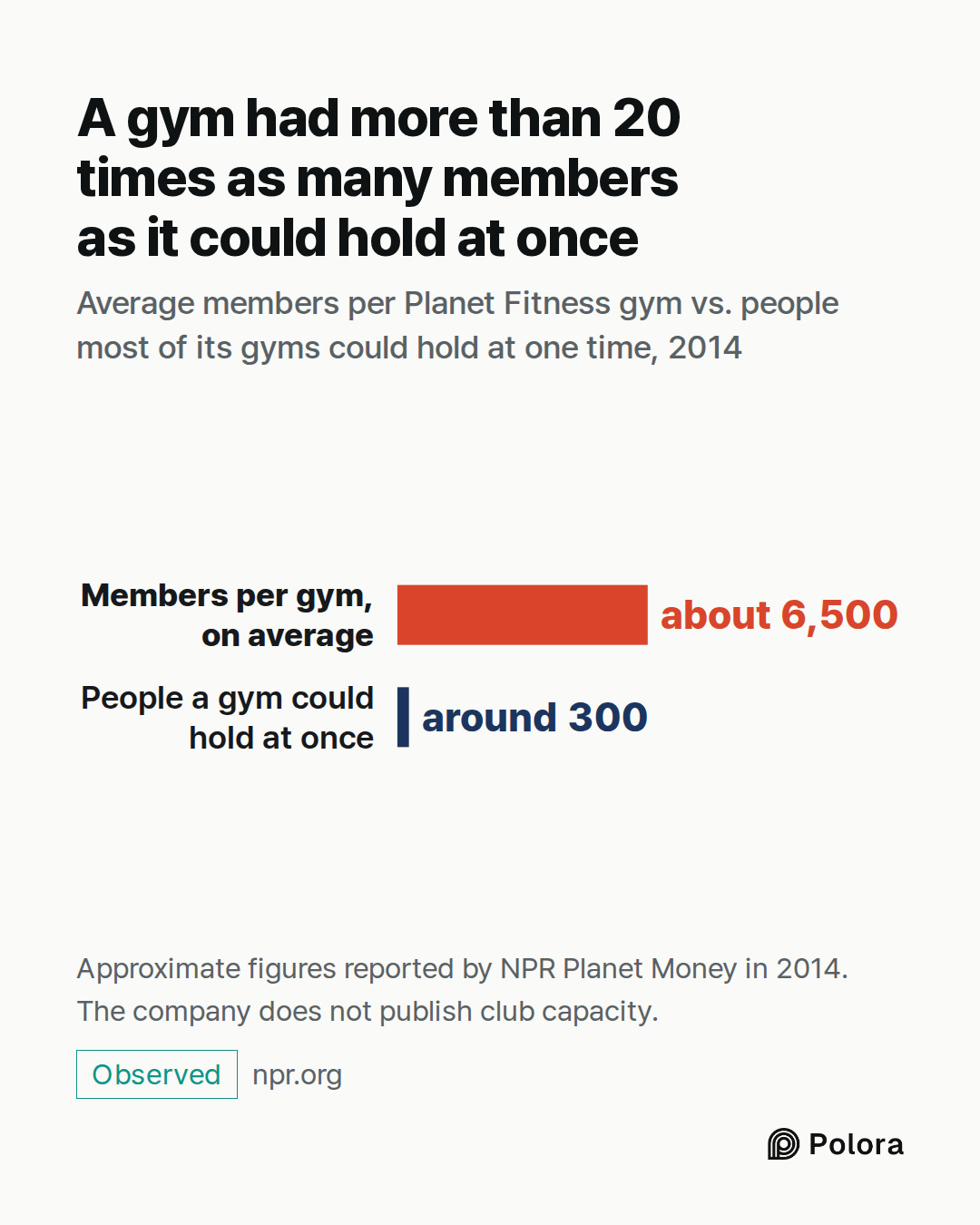
In 2014, NPR's Planet Money reported that a Planet Fitness gym had on average about 6,500 members, while most of its gyms could hold around 300 people at a time. If every member walked in at the same moment, they would need more than 20 times the space. Spread across a day they would not, because people come at different hours.
That gap is not overbooking. It is the plan. In Planet Money's words, the chain can do this "because it knows that members won't show up." Members who come rarely make the numbers easier, but what the plan strictly needs is that members do not all arrive at once. Low monthly prices work because many people pay and only a fraction of them are on the floor at any one time.
The numbers are higher today. At the end of 2025, Planet Fitness reported about 20.8 million members and 2,896 clubs, and by June 30, 2026 it reported 21.5 million members and 2,930 clubs. Dividing the 2025 figures gives roughly 7,200 members per club. That is an average across all clubs, not a number the company reports for a typical one. The company's annual report does not say how many people a club can hold, so the only capacity figure available is that older one from NPR.
The member who never comes helps keep the price low
Planet Fitness's basic membership starts at $15 a month for new members. Its Black Card, which adds perks, is $24.99, and about two thirds of members held one at the end of 2025. Across all members, dues averaged $19.51 a month. On top of that, the standard annual fee is $49. Prices vary by club and by promotion.
Prices like these leave little room for a crowded floor. As Planet Money put it, the people who do not go are paying for the people who do. Some members come every day and others never come at all, and the low price rests on that mix. Plenty of members, visits spread across the day and the week, low prices : the design works as long as the number of people on the floor at any one time stays well below what the club can hold.
Most of the company's money doesn't depend on anyone working out
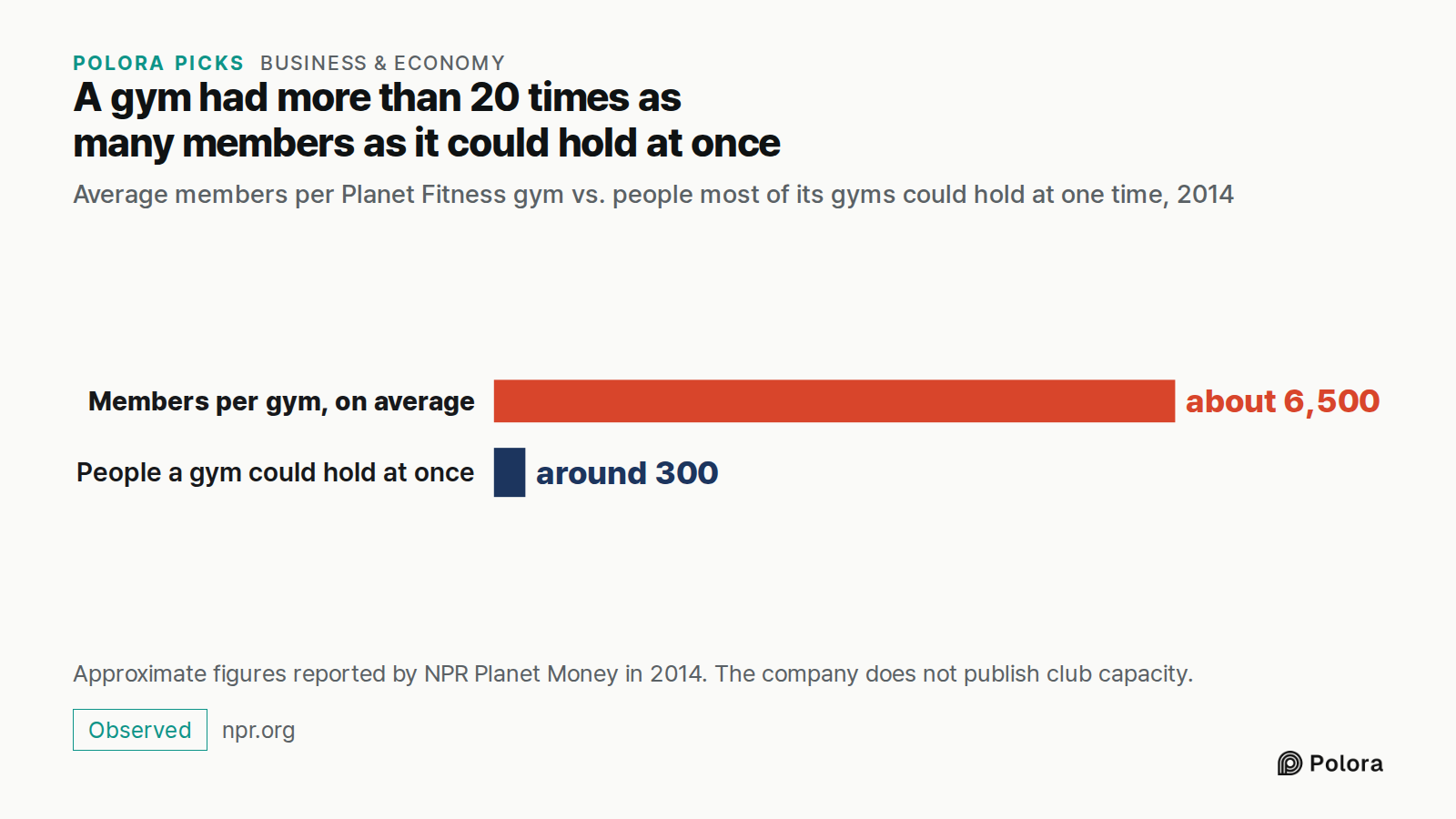
Most Planet Fitness clubs are not run by Planet Fitness. Of its 2,896 clubs, 2,604 belong to franchisees, local owners who pay to use the name. The company running the brand earns money from them in two ways that have little to do with whether members come in to work out.
The first is a royalty. Franchise clubs pay the company a cut of members' monthly dues and annual fees. Under the current franchise agreement the rate is 7%. About 63% of franchise clubs paid that rate at the end of 2025, and the average rate across all of them was 6.7%. A member who pays and never visits brings in the same royalty as one who comes daily. In 2025, franchise revenue came to $381.0 million, of which $314.6 million was royalties and the rest other franchise fees. The company also collected $87.0 million for a national advertising fund, but that money goes back out as advertising, with $87.6 million recorded as the fund's expense.
The second is equipment. The company sells treadmills and weight machines to franchise clubs, both when they open and later, since existing clubs are generally required to replace their equipment every five to nine years. That brought in $310.1 million in 2025.
Out of $1,324.1 million in total revenue, the clubs the company runs itself brought in $546.1 million. The rest, about 59%, came from franchise payments, the advertising fund and equipment sales. That is a share of revenue, not of profit. Equipment has to be bought before it is sold, and the advertising fund is spent.
People pay for the person they plan to become
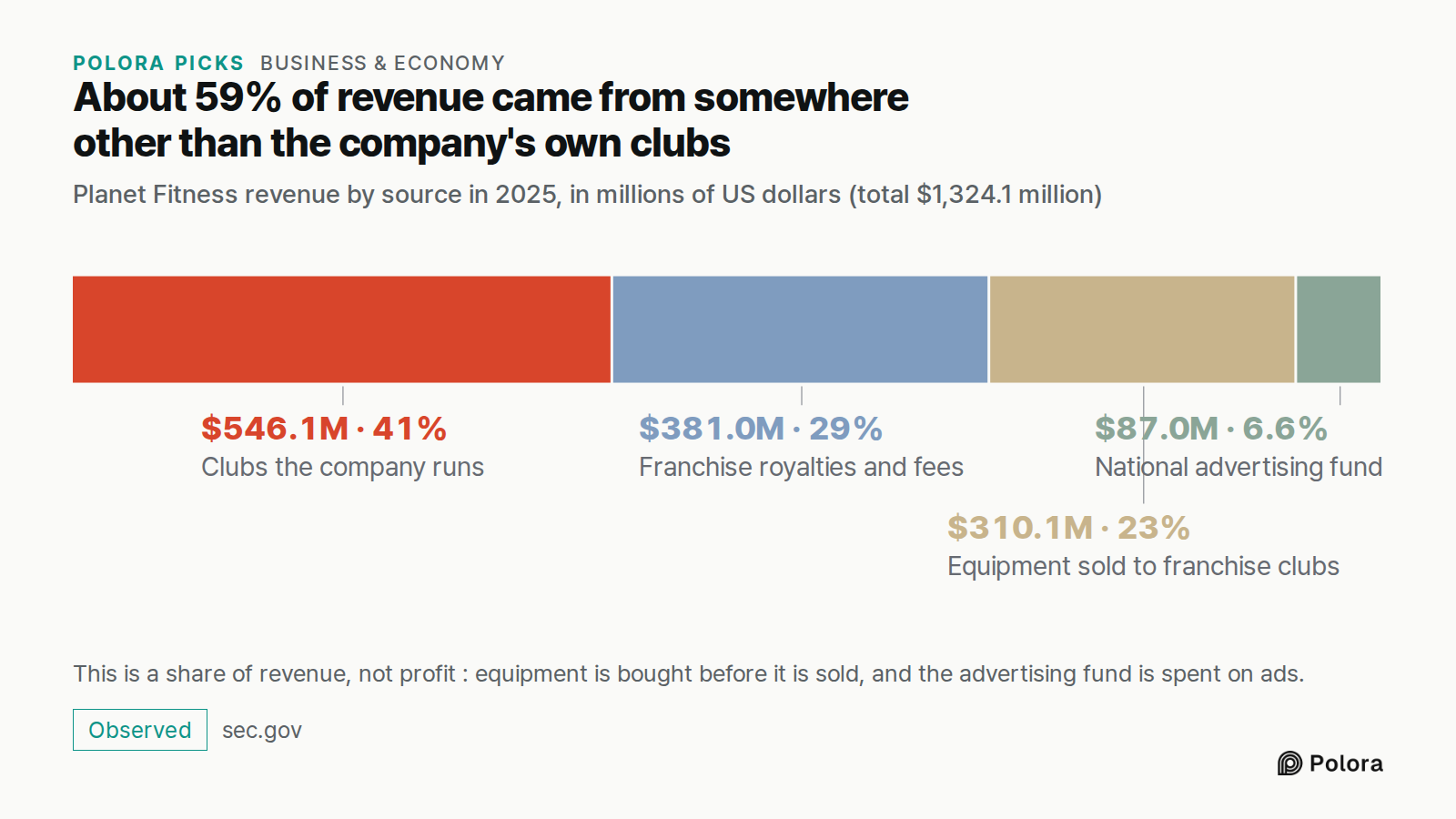
Why do people keep paying for a gym they hardly use? Economists Stefano DellaVigna and Ulrike Malmendier looked at this in a study published in the American Economic Review in 2006. They followed 7,752 members of three US health clubs over three years.
Members on a flat monthly fee of over $70 went on average 4.3 times a month. That came to more than $17 a visit, when a 10-visit pass would have cost them $10 a visit. In the authors' count, 80% of the monthly members would have been better off paying per visit for the same number of visits. Monthly members were also 17% more likely to stay enrolled past one year than members who had signed up for a year, even though monthly members could leave at any time.
The authors' leading explanation is overconfidence. People sign up expecting a future self who goes more often, and then they keep paying. The study covers three clubs at much higher prices than today's budget chains, so it does not measure how often Planet Fitness members go, and it does not explain every member who goes rarely. What it shows is that paying a lot for few visits is common, and the person paying is often the last to notice.
What happened when cancelling got easier
If a gym's model depends on people staying signed up, making it easier to leave puts that model under pressure. Planet Fitness made that change itself, though not as a controlled experiment. In May 2025 it rolled out online cancellation across the country. Management said the company wanted members to stay "based on the value we provide, not due to any barriers to cancellation."
In January 2026 more members than usual cancelled. Management put this partly down to TV ads that used the phrase "cancel anytime." Monthly attrition, the share of members who leave each month, had historically been between 3% and 4%. In the first quarter of 2026 it averaged 3.8%. The company said it expected attrition to stay in the top half of that range for the rest of the year. It gave two reasons, the move to online cancellation and a growing share of younger members, who historically leave more often. In the second quarter, average monthly attrition was 3.5%, the middle of the historical range.
In May 2026 the company cut its forecast for 2026 sales growth at existing clubs to about 1%, down from 4% to 5%, and its shares fell about 31% in a day. Management mainly blamed fewer sign-ups than expected. It said its ads had appealed to regular gymgoers more than to the beginners and casual users at the core of its business, and it also cited competition, bad weather and the economy, with higher attrition as one more pressure. The fall was mostly about who joined, not who left. Still, even a small rise in the share of members who leave each month affects a business with more than 20 million members.
Who decides how easy it is to quit a gym
In the US, there is currently no national rule that says cancelling must be as easy as signing up. The Federal Trade Commission adopted a "click-to-cancel" rule in 2024, but a federal appeals court struck it down in July 2025 before its main parts took effect. The court ruled that the agency had skipped a required cost analysis. In March 2026 the FTC asked for public comment on starting again, and it has not yet published new rule text. Other federal protections against unwanted recurring charges still apply. What is missing is one national rule on making cancelling easy.
For now, state laws decide. California, for example, requires that a subscription started online can be cancelled online, through a clear link or button or a ready-made email, without extra steps. The rule took effect on July 1, 2025 and covers contracts entered into, amended or extended on or after that date.
Such rules can change how easy it is to leave. They do not change the basic model. A gym sized on the bet that members will not all come at once, and a parent company paid on dues and equipment, both earn the most when members keep paying.
- FTC restarts negative option rulemaking after Eighth Circuit vacatur (Gibson Dunn)
- California automatic renewal law amendments take effect on July 1, 2025 (Cooley)
- Custom Communications, Inc. v. FTC, Eighth Circuit opinion
- Negative option rule (Federal Trade Commission)
- California AB 2863 (California Legislative Information)