Who decides when a new word gets into the dictionary?

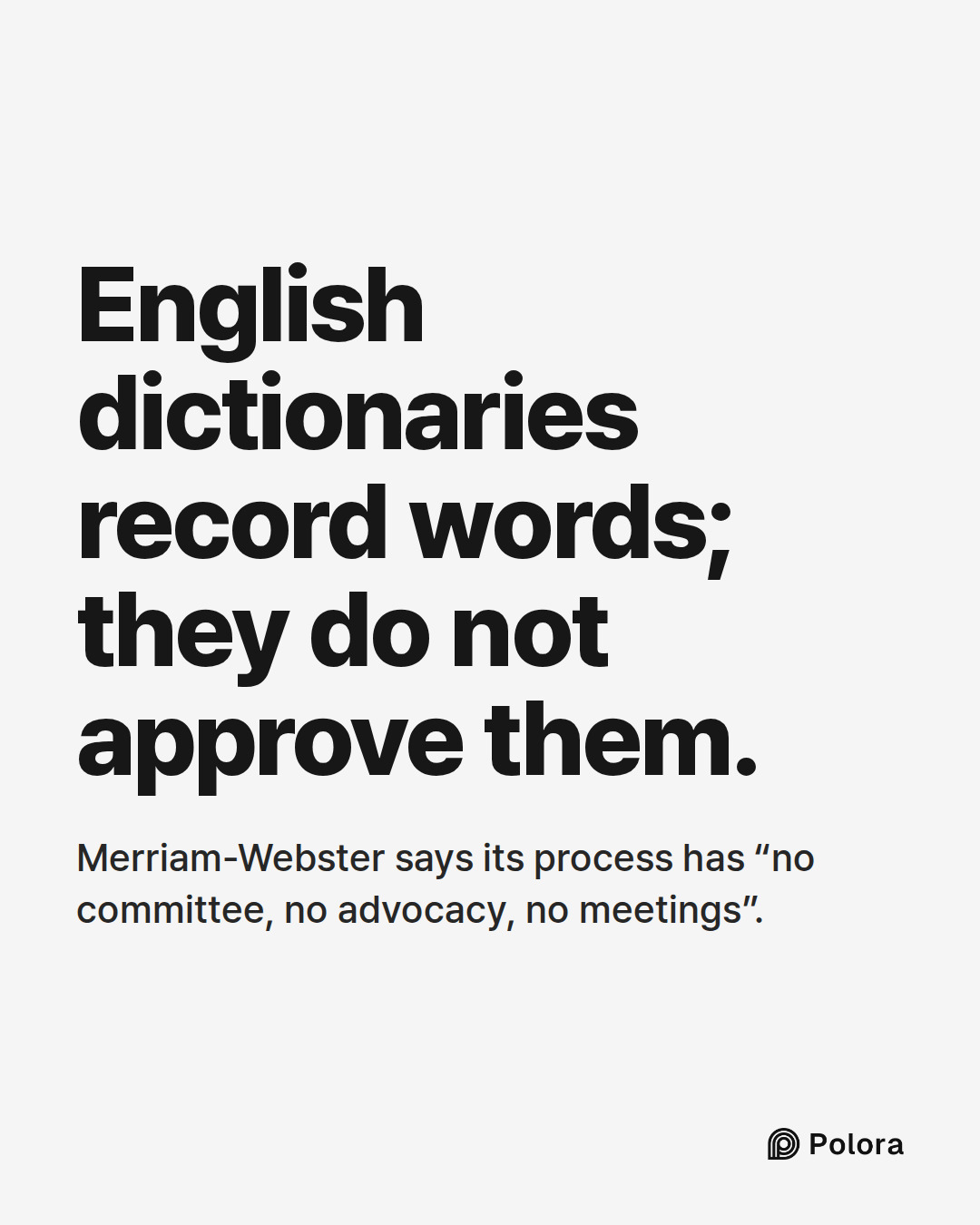
No committee votes on new English words. Dictionary editors add a word once they see wide use over several years and judge the evidence strong enough. An entry records how a word is used. It does not certify the word as correct.

Culture & The Arts · 2026-10-17

Being in the dictionary is not a seal of approval

Many of us settle arguments about a word by asking whether it is “in the dictionary”, as if someone had approved it. The big English dictionaries do not work that way.

Merriam-Webster, the American dictionary publisher, says that when it decides whether to add a word there is “no committee, no advocacy, no meetings”. Its editors, like those at the Oxford English Dictionary, are not deciding which words are allowed. They are deciding whether a word has already been used enough to be written down.

Dictionary editors find new words by reading

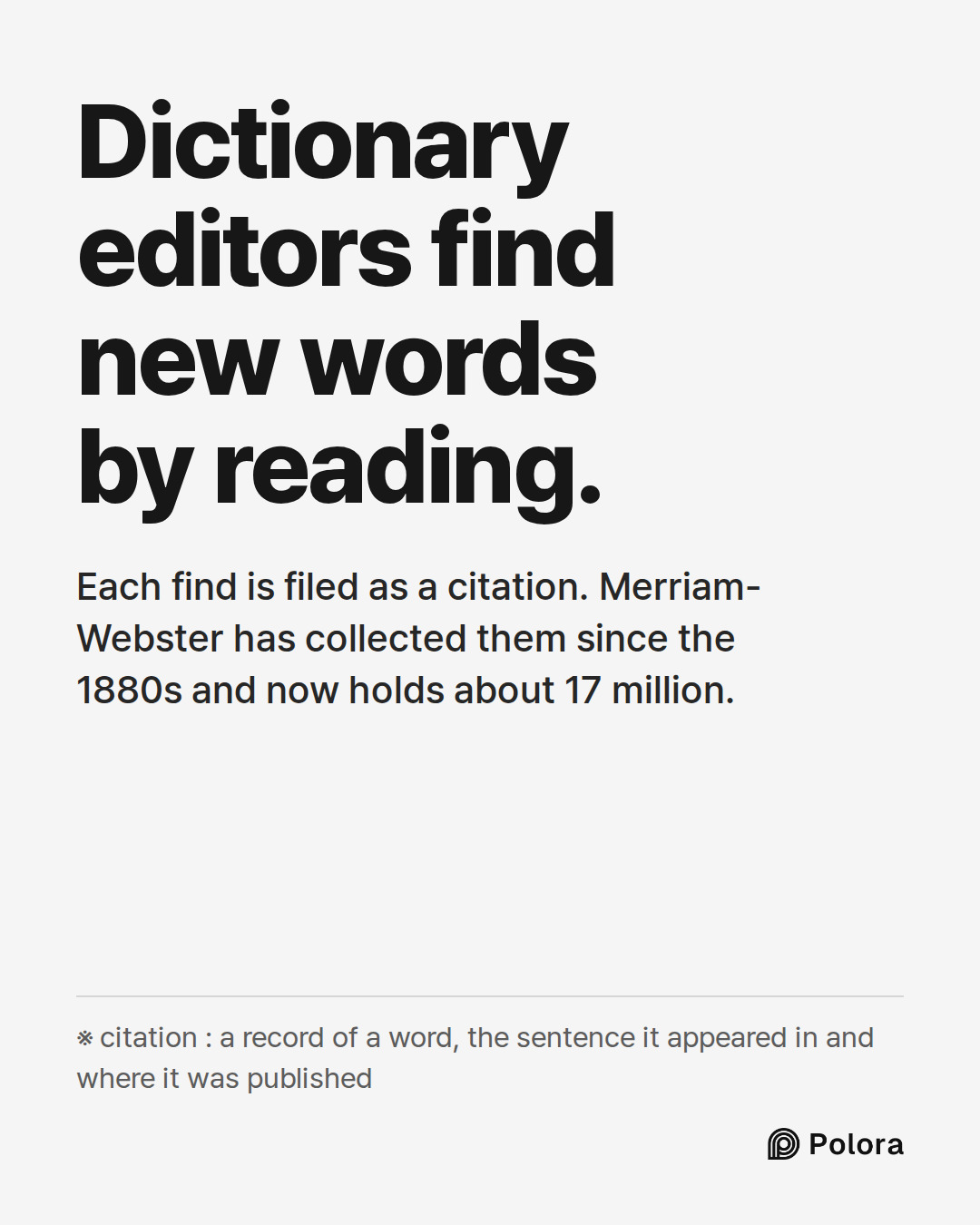
On most days, Merriam-Webster’s editors spend an hour or two reading a broad mix of books, newspapers, magazines and online publications. Inside the company this is called “reading and marking”. They look for new words, new meanings of old words and new spellings, and they mark each find along with the sentence around it.

Each marked passage becomes a citation, a record with three parts : the word, the sentence it appeared in, and where that sentence was published. The company started collecting citations in the 1880s, and its files now hold about 17 million of them. One of its editors has said they used to read soup can labels and restaurant menus, because that is language the public actually sees.

One sighting is not enough : a word needs years of wide use

A word gets in only when it turns up in a substantial number of citations, from a wide range of publications, over a considerable period of time. Merriam-Webster may reject a word if all its citations come from one source, or only from the specialist press of a single field.

Its editor at large describes the test as long-term use, widespread use and meaningful use : over time, many publications have used the word to mean the same thing. He calls this looking at language “in the rearview mirror”. A word is often old to the specialists who coined it by the time the general public finds it in the dictionary.

There are exceptions. In the 1980s the word AIDS spread so quickly, and was so clearly here to stay, that editors added it without the usual years of evidence. Size matters too. A smaller dictionary has room only for the most common words, so a word needs more evidence to get into one.

Whether the evidence is enough is a judgment. It rests with the editor who writes the definition, and more senior editors review it later. When a whole dictionary is re-edited, the same editors also decide which existing entries can be dropped.
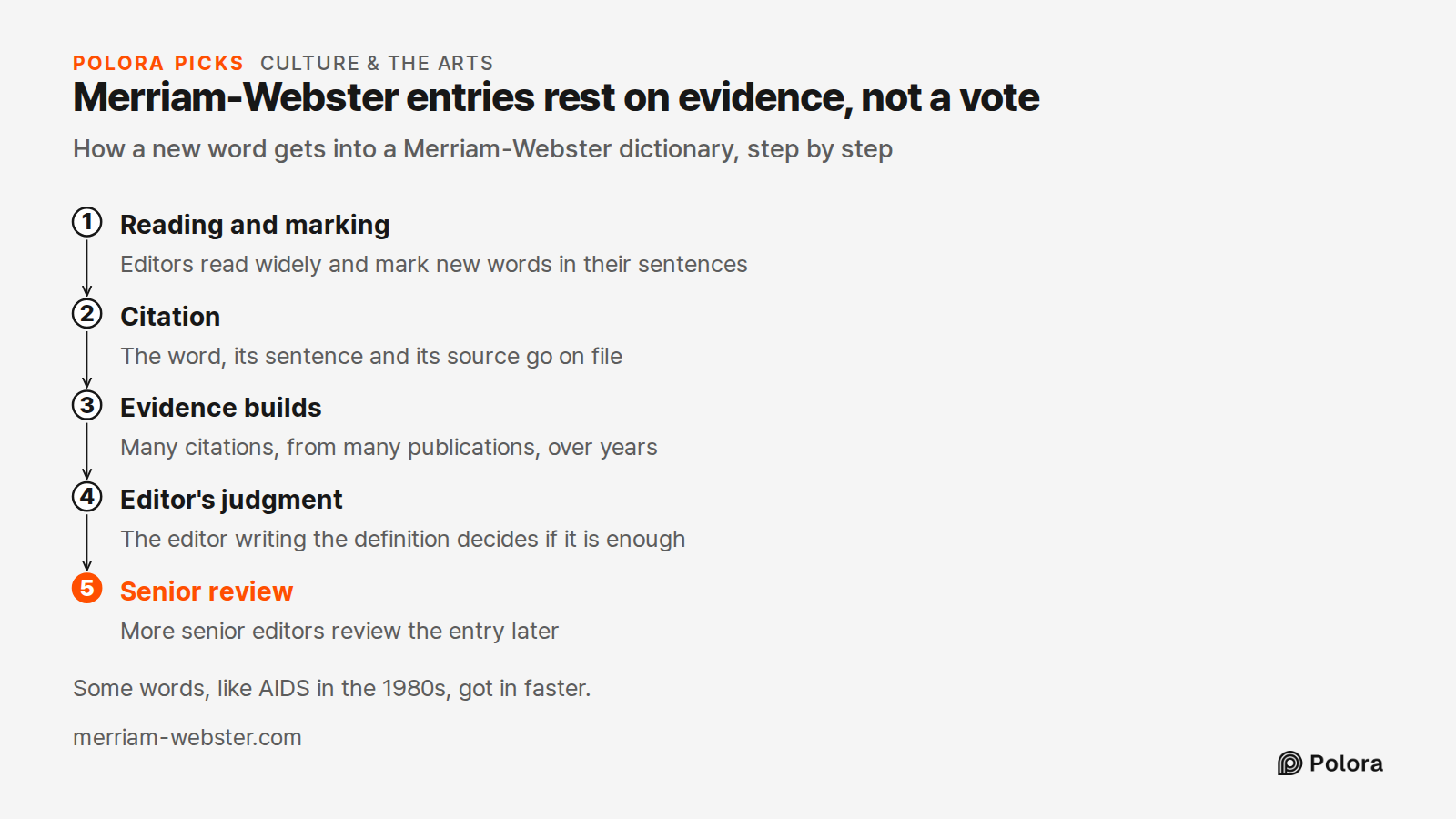
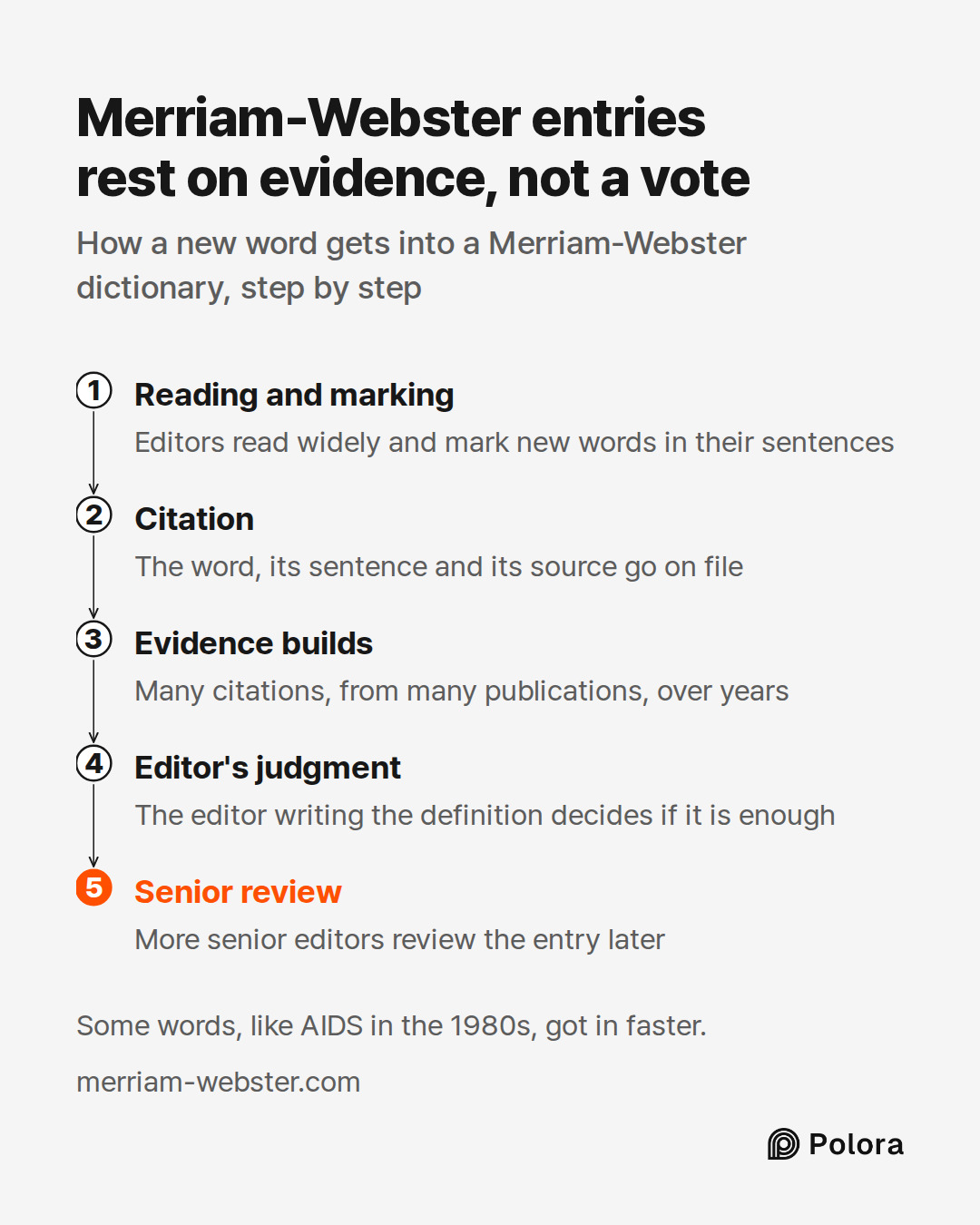
Merriam-Webster entries rest on evidence, not a vote · How a new word gets into a Merriam-Webster dictionary, step by step · Reading and marking · Citation · Evidence builds · Editor's judgment · Senior review · Editors read widely and mark new words in their sentences · The word, its sentence and i
How a new word gets into a Merriam-Webster dictionary, step by step

The Oxford English Dictionary keeps a watch list and waits

The Oxford English Dictionary, known as the OED and published by Oxford University Press, works in a similar way at a slower pace. A candidate word first goes onto a “watch list”. Suggestions come from the dictionary’s own reading programmes, from appeals to the public, and more and more from automated scans of huge collections of text.

According to the OED’s own description of its process, a word without enough evidence stays on the watch list and is checked again later. Only a word with “sufficiently sustained and widespread use” goes to an editor, who traces its history through sources such as newspaper archives, online forums, law texts, recipe books and social media. The Chief Editor and Deputy Chief Editor give the final approval, and new entries appear in updates every three months.

The OED takes its time because it is a historical dictionary. It aims to record English from the eleventh century to today, with each entry telling the word’s life story through dated quotations. Some years ago one of its editors told Smithsonian magazine that the OED “traditionally waits for 10 years of evidence” before adding a word, with exceptions such as livermorium, a chemical element that had only existed since 2012. That was one editor’s remark, not a published rule. The OED’s current policy page sets no fixed waiting period, and an Oxford University Press interview notes that some words are clearly established when they are less than ten years old. Each dictionary sets its own threshold.

A dictionary entry says a word is used, not that it is correct

Since an entry is a record of use, finding a word in the dictionary does not mean it is good style or polite. Merriam-Webster says it relies on evidence so that its dictionaries can “speak with authority without being authoritarian”.

Many dictionaries, including the Spanish one described below, mark this difference with labels. A word may be listed and also labelled, for example as informal, offensive or old-fashioned. The entry tells you that people use the word, and the label tells you how it tends to be received.

The “word of the year” that some dictionary publishers announce is a different kind of choice. Merriam-Webster says it picks its word of the year from words people look up in very high numbers on its website, with a sharp rise over the year before. That measures public curiosity, not the years of written use an entry needs.

Spain’s language academy approves words, and says it only records them

Spanish works differently on paper. The Real Academia Española, Spain’s royal language academy, publishes the main Spanish dictionary, and changes to it go through a formal approval. Committees prepare additions, deletions and corrections, and the academy’s lexicography institute gathers the evidence. Anyone can propose a word through an online form, as long as they show evidence that it is used.

Spanish is spoken in many countries, so proposals also go to the other Spanish-language academies, which review them and reply by approving or amending them. The Real Academia Española’s full assembly, or a commission it delegates, then settles the final wording. The association that links these academies has 23 members, but not every one of them has to endorse every change.

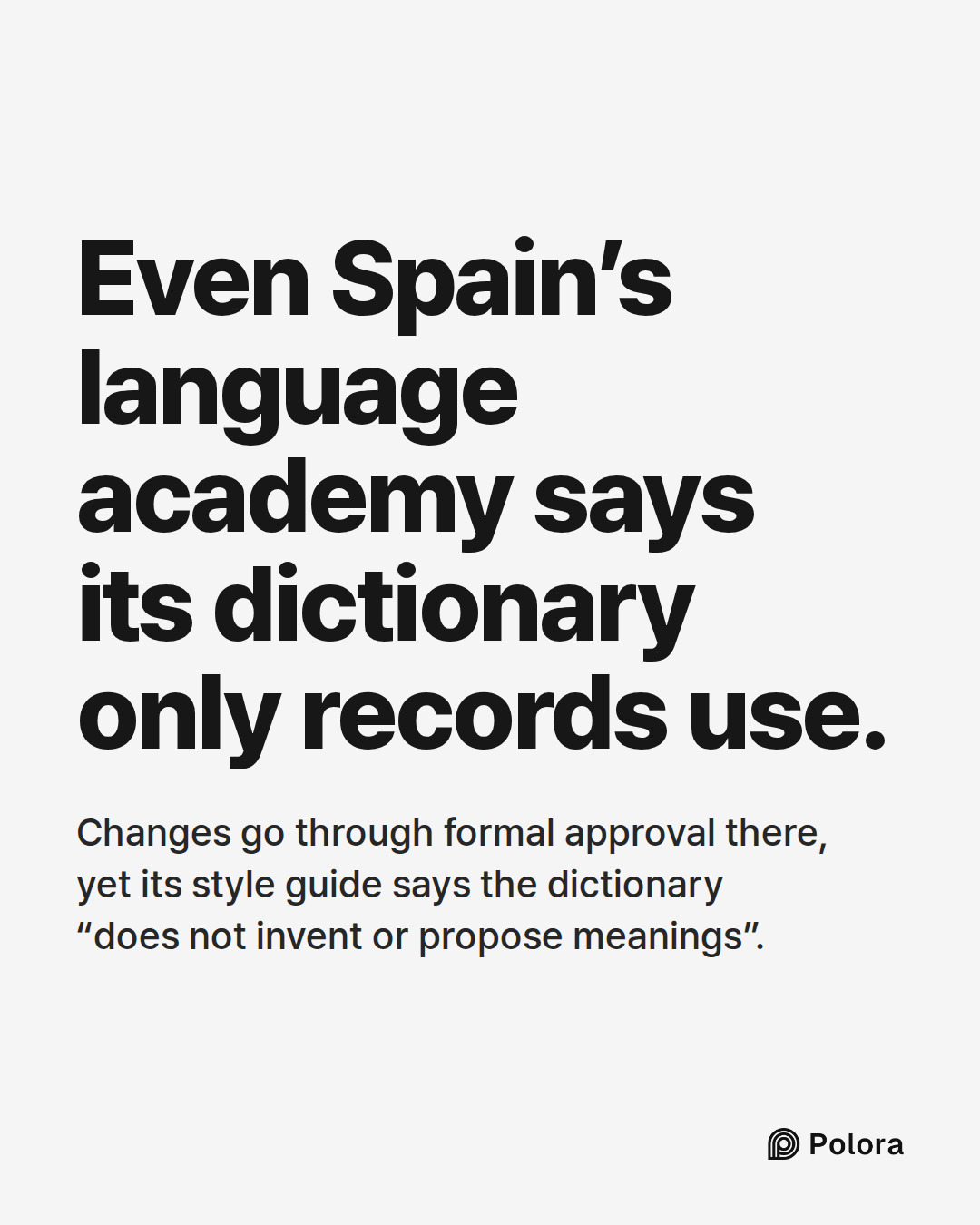
Even so, the academy describes its dictionary in much the same way English editors do. Its style guide says the dictionary “does not invent or propose meanings” but only records them, so a meaning appears “because it has been documented in use”. It adds that people often treat its dictionary as the model of a rule-setting dictionary, but every dictionary is largely a description of use. The norm is worked out from that description.
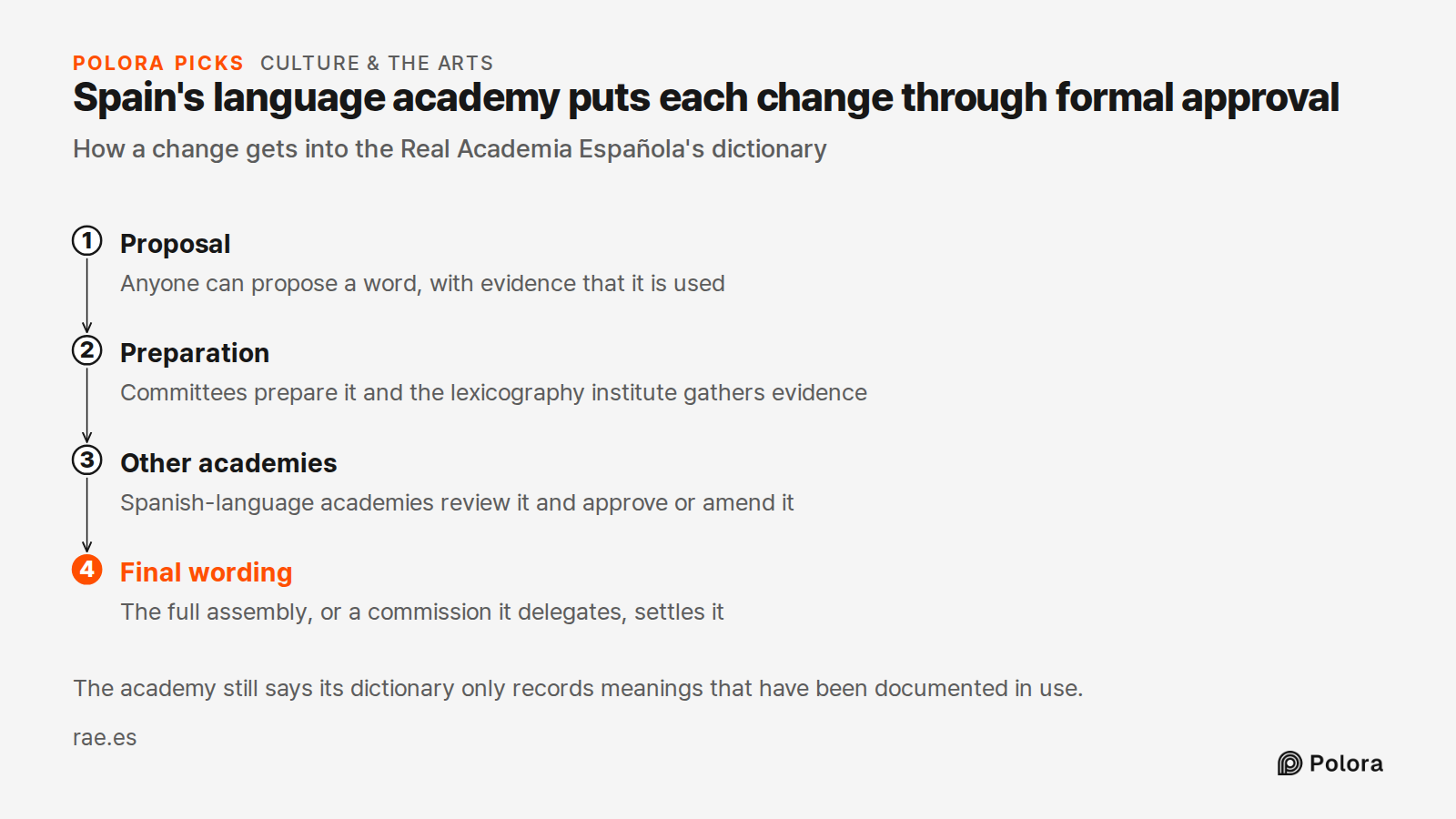
Spain's language academy puts each change through formal approval · How a change gets into the Real Academia Española's dictionary · Proposal · Preparation · Other academies · Final wording · Anyone can propose a word, with evidence that it is used · Committees prepare it and the lexicography instit
How a change gets into the Real Academia Española's dictionary

The French Academy’s last dictionary took from 1986 to 2024

France’s Académie française goes further and is far slower. A committee of its members goes through the dictionary text on Thursday mornings, and the full membership works through it in session on Thursday afternoons. The academy says both are guided by “bon usage”, meaning good usage.

Its ninth edition began in 1986, and the last of its four volumes came out in November 2024. The edition before it dates from 1932 to 1935. The ninth edition has about 53,000 words, 21,000 of them new since the eighth.

The Académie is more willing than English dictionaries to say what to avoid. Its dictionary carries more than 300 “normative remarks” that warn readers about faulty constructions. Yet it calls its work “a dictionary of usage”, and it admits specialist terms only once they have passed into everyday language. It even endorsed a simplified spelling of oignon, the French word for onion, then left it out of its own dictionary because the new spelling had not caught on.
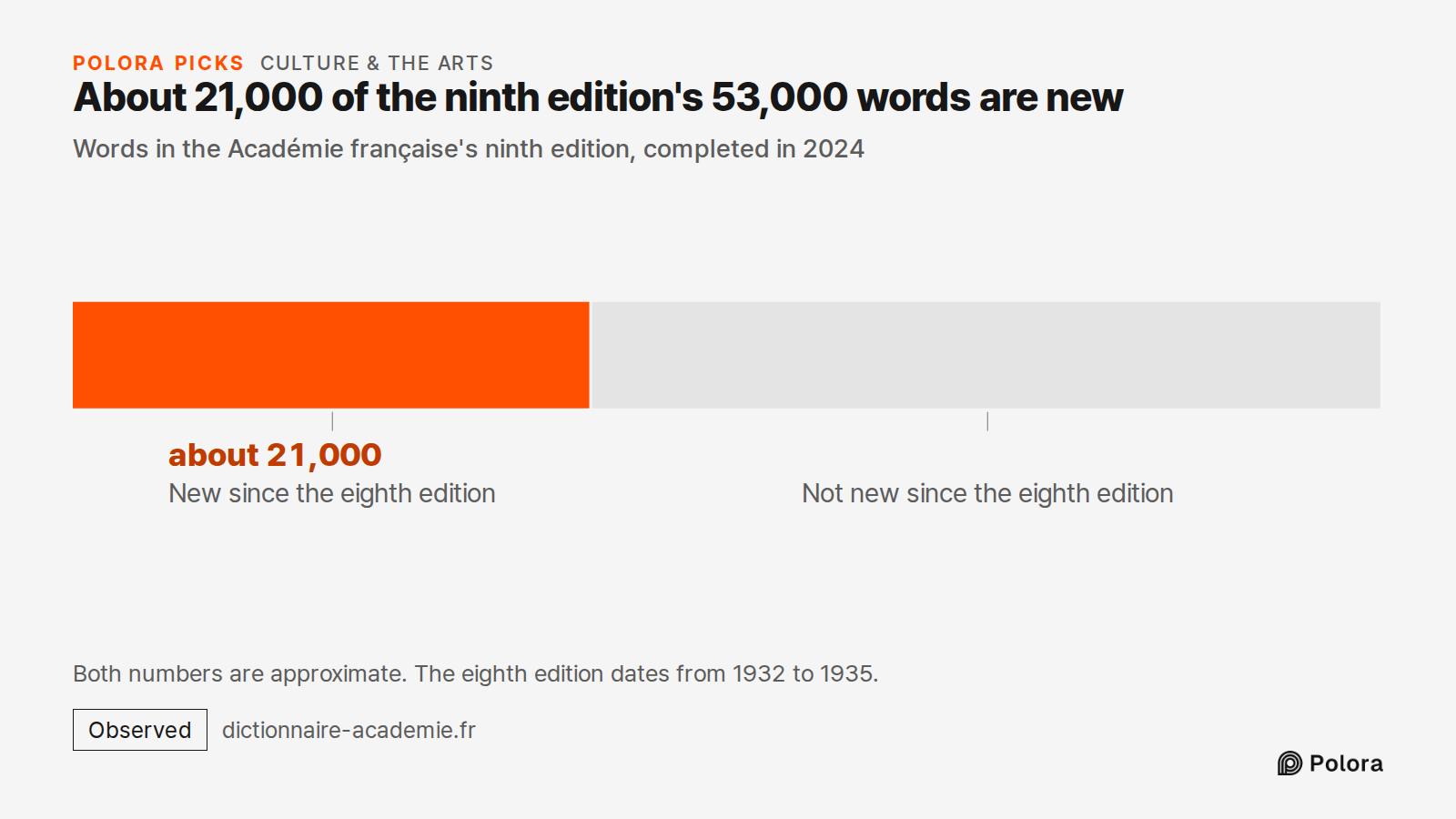
About 21,000 of the ninth edition's 53,000 words are new · Words in the Académie française's ninth edition, completed in 2024 · New since the eighth edition · about 21,000 · Not new since the eighth edition · Both numbers are approximate. The eighth edition dates from 1932 to 1935.
Words in the Académie française's ninth edition, completed in 2024

So who decides? Editors sign off, but usage is the evidence

Whether the gatekeeper is an editor in Massachusetts, a team in Oxford or academicians in Madrid and Paris, they all start from the same thing : how people actually use the word. Cambridge says the same of its own dictionary, whose editors check how often a word appears and in how many different contexts over time. What differs is who signs off, how much evidence counts as enough, and whether the institution also sets out what it considers correct.

So a word is not in the dictionary because someone liked it. It is there because enough people used it, in enough places, for long enough, and the editors of that dictionary judged the evidence strong enough to write it down.
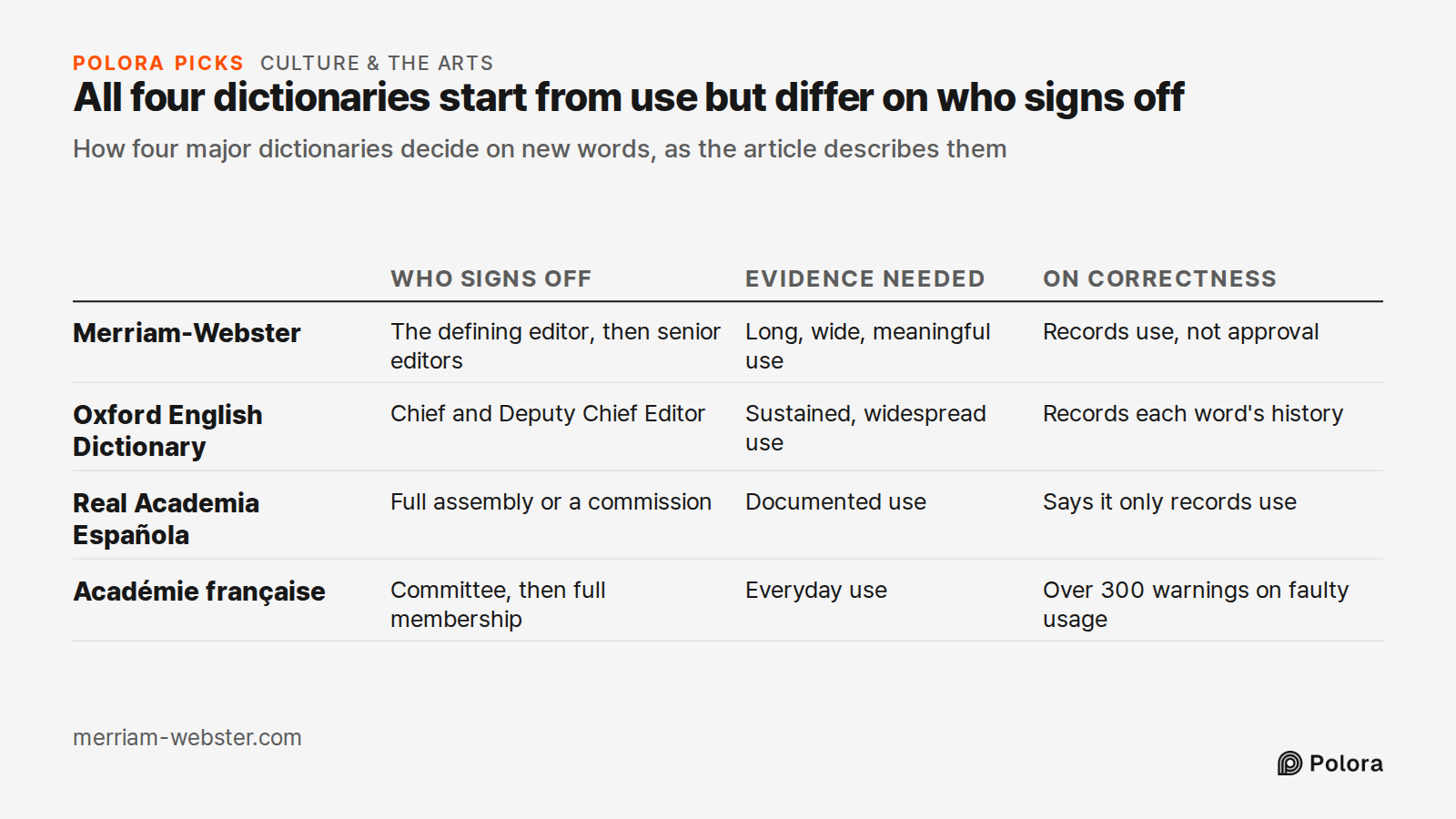

All four dictionaries start from use but differ on who signs off · How four major dictionaries decide on new words, as the article describes them · Who signs off · Evidence needed · On correctness · Merriam-Webster · Oxford English Dictionary · Real Academia Española · Académie française · The defin
How four major dictionaries decide on new words, as the article describes them
Who decides when a new word gets into the dictionary?Who decides when a new word gets into the dictionary?English dictionaries record words; they do not approve them. · Merriam-Webster says its process has “no committee, no advocacy, no meetings”.Dictionary editors find new words by reading. · Each find is filed as a citation. Merriam-Webster has collected them since the 1880s and now holds about 17 million. · ※ citation : a record of a word, the sentence it appeared in and where it was publishedReading and marking · Citation · Evidence builds · Editor's judgment · Senior review · Editors read widely and mark new words in their sentences · The word, its sentence and its source go on file · Many citations, from many publications, over years · The editor writing the definition decides if it iEven Spain’s language academy says its dictionary only records use. · Changes go through formal approval there, yet its style guide says the dictionary “does not invent or propose meanings”.A word in the dictionary tells you people use it, not that it is correct. · In many dictionaries, a label such as informal, offensive or old-fashioned tells you how it tends to be received.Sources 18 : merriam-webster.com · Merriam-Webster : How a word gets into the dictionary, nbcnews.com · NBC News : Merriam-Webster gives the dictionary a glow-up with 1,400 new words and definitions, merriam-webster.com · Merriam-Webster : How does a word get into a Merriam-Webster dictionary? + 15Read the full story at · polora.ai

Who decides when a new word gets into the dictionary?

Alpha · deepseek-v4-pro

The decision is made by lexicographers — the dictionary editors themselves — but they are constrained by a standard, not by personal taste. For major English dictionaries: - Merriam-Webster: an editor known as a definer drafts the entry, and senior editors review it. The test is evidence of long-term, widespread, meaningful use — not a committee voting on whether a word is “good” or “acceptable.” - Oxford English Dictionary: candidate words go onto a watch list, and only after sustained and widespread use does the word reach an editor; the Chief Editor and Deputy Chief Editor give final approval. So in one sense a small group of editors literally decides. But the real gatekeeper is how people use the word: enough citations, across enough publications, over enough time. If that evidence does not exist, the editor refuses or delays the entry. That is why I would push back on the simple answer “the dictionary editors decide.” It is more accurate to say the speech community decides by usage, and the lexicographer records that decision afterward. Editors apply judgment about thresholds and labels, but they are not inventing words or certifying them as correct. T…

Beta · gpt-6-sol

Dictionary editors decide what goes into a particular dictionary; speakers and writers provide the evidence they decide from. I agree with Alpha’s distinction, but would not say that usage *forces* an entry. Editors still judge whether the evidence is sufficient, and different dictionaries serve different purposes. Merriam-Webster says its definers examine examples of a word in context. For inclusion, they look for substantial evidence across a range of publications and a considerable period—not merely a high count from one source. It explicitly allows exceptions for words that become established quickly, and says a smaller dictionary has a higher bar for inclusion than an unabridged one. Its FAQ also confirms the manuscript’s 1880s starting date and 15.7 million citation count. The FAQ describes definers deciding whether to drop existing entries *while reediting a dictionary*, not necessarily during each online update. Merriam-Webster’s account. (merriam-webster.com) A useful addition missing from the manuscript is Cambridge. Its own…

Gamma · gemini-3.1-pro

I agree with Beta that the lexicographers' judgment is an active part of the process, but I can resolve some of the factual gaps the manuscript asked to have checked, as my live search confirms several specific claims. Here is what the sources show regarding the manuscript's checks: Merriam-Webster’s "No Committee" Quote and Citations The exact phrase *"there's no committee, no advocacy, no meetings for new word inclusion"* is indeed genuine. It appears directly in Merriam-Webster's own published article, "How a Word Gets Into the Dictionary." The same page confirms their citation collection began in the 1880s and currently states they have *"nearly 17 million such citations,"* not the 15.7 million figure in the manuscript. The manuscript should be updated to "nearly 17 million." Merriam-Webster: How a Word Gets Into the Dictionary. Word of the Year The manuscript is correct that "Word of the Year" is a separate process. Merriam-Webster explicitly states that its Word of the Year (such as "pandemic" in 2020) is *"Based upon a statistical analysis of words that are looked up in extrem…

Researcher · gpt-6-luna

Live-source check of the claims raised this round - Merriam-Webster’s process: Its own article, “How a Word Gets into the Dictionary”, contains the “no committee, no advocacy, no meetings” wording and says the citation file has about 17 million citations. Merriam-Webster’s video gives the same approximate count. That supports Gamma’s correction from 15.7 million, though “about 17 million” is safer than treating it as an exact current total. (scrabble.m-w.com) - Cambridge: Its dictionary help page says lexicographers check the Cambridge English Corpus for frequency and contexts, and add a word when it is used in many different contexts over time. That supports the broad account, but Cambridge’s stated process should not be treated as identical to Merriam-Webster’s or the OED’s. (dictionary.cambridge.org) - OED and a ten-year rule: I found no current OED page establishing a fixed ten-yea…

The Arbiter · gpt-6-sol

The debaters agree on the central distinction: people supply the usage; editors decide whether and when a particular dictionary records it. Their real difference is one of emphasis. Alpha gives speakers the stronger role; Beta cautions that usage does not *force* an entry, because editors judge the evidence against their dictionary’s purpose and space. Cambridge’s published account supports the broad usage-based picture without establishing that every publisher follows the same procedure. (letras.rae.es) Two manuscript corrections are especially clear from the checks reported this round: Merriam-Webster’s own article is the source for the “no committee” quotation and gives its citation total as about 17 million, rather than 15.7 million; and no current OED rule requiring ten years of evidence was established. The Researcher also found that the other Spanish academies have a more active review role than merely sending comments, but not evidence that every academy must endorse every change. What remains open is narrower but important for publication: direct c…

The Arbiter's Final Verdict · gpt-6-sol

Dictionary editors decide whether and when a word enters *their* dictionary. Speakers and writers provide the evidence: how widely, consistently and for how long the word has been used. The decision is not automatic, and an entry is not a certificate that a word is polite, advisable or “correct.” Verdict on the manuscript: its premise stands, but its closing line goes too far. Enough usage can make a word a strong candidate; it does not mean editors *“had to write it down.”* Different dictionaries have different purposes and thresholds. Merriam-Webster describes editorial judgment and exceptions to its usual expectation of sustained use; Cambridge says its lexicographers examine frequency and varied contexts over time. The evidence checked here does not justify treating their procedures—or the OED’s—as identical. For publication, the most consequential claim checks are: - Supported, with a corrected number: Merriam-Webster’s own account contains the “no committee, no advocacy, no meetings” wording. It gives about 17 million citations,…