When a state suspends its gas tax, do drivers actually get the savings?

Usually most of it, but rarely all. In studies of past state gas tax holidays, pump prices fell by a majority of the suspended tax, from about 58 to 87 percent depending on the state and the method. The tax is collected upstream and built into the pump price, so a cut reaches drivers only as far as suppliers and stations pass it on. What happens when the tax returns has varied from one holiday to the next.

Business & Economy · 2026-10-03

Ohio's gas tax was never a separate charge at the pump

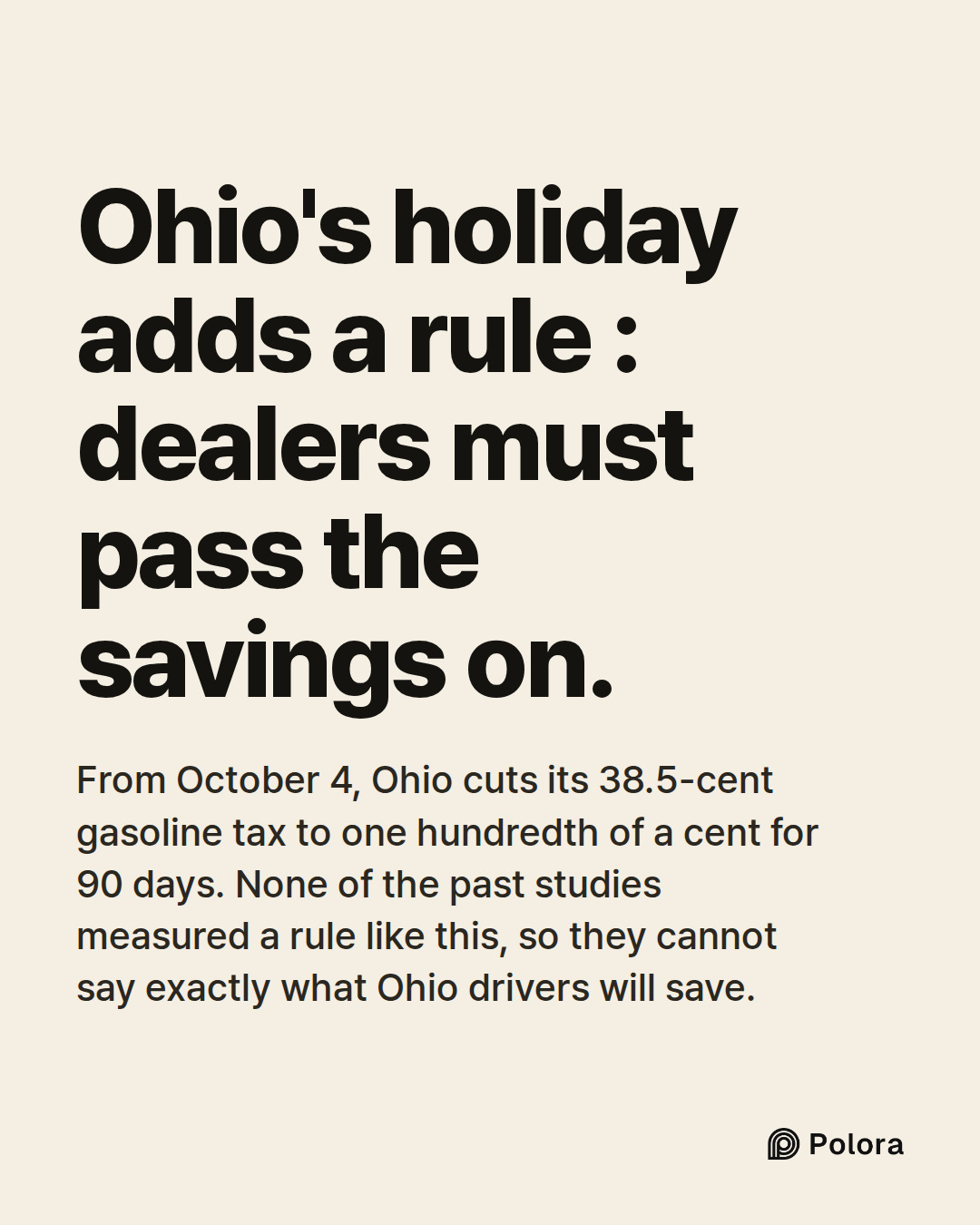
From October 4, Ohio cuts its gasoline tax from 38.5 cents a gallon to one hundredth of a cent for 90 days, until January 2, 2027. The diesel tax, 47 cents, is cut as well. The law also requires licensed fuel dealers to pass the savings on to customers. Most drivers would expect the pump price to fall by 38.5 cents the morning the holiday starts.

That expectation misses where the tax actually sits. A state gas tax is not added at the register the way a sales tax is. It is collected when fuel is bought wholesale, and its cost is built into the price that stations then post. So a cut has to travel the same route : through suppliers, and through stations that are still selling fuel they bought with the tax already paid. In an ordinary holiday, how much of the cut reaches the pump is decided along that chain, not set by the law that cut the tax. Ohio's rule that dealers must pass the savings on is an attempt to change that.

Several states have tried this before, and economists have measured what happened each time. Those measurements show why a full 38.5-cent drop overnight is not assured. They cannot say exactly what Ohio drivers will save, because none of them measured a rule like Ohio's.
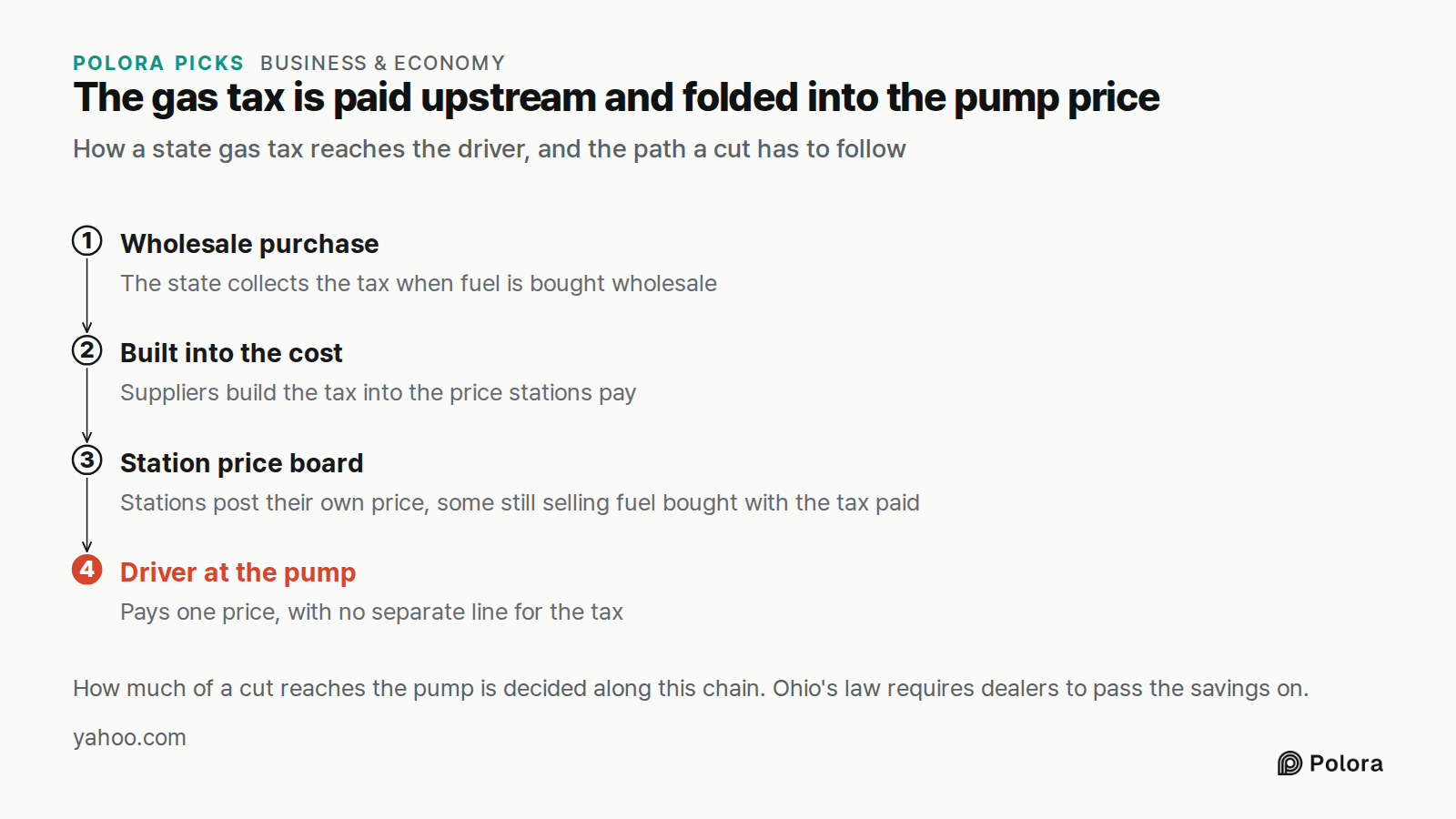
The gas tax is paid upstream and folded into the pump price · How a state gas tax reaches the driver, and the path a cut has to follow · Wholesale purchase · Built into the cost · Station price board · Driver at the pump · The state collects the tax when fuel is bought wholesale · Suppliers build th
How a state gas tax reaches the driver, and the path a cut has to follow

What past gas tax holidays actually delivered

The studies cover different states, years, kinds of tax and methods, and they mostly agree. Drivers got most of the cut and rarely all of it.

Illinois and Indiana, 2000 : when both states suspended their 5 percent sales tax on gasoline, about 70 percent of the cut showed up in lower pump prices. The authors estimate that in the short run somewhere between 60 and 80 percent of the cut reached drivers (Doyle and Samphantharak, Journal of Public Economics, 2008).

Maryland, Connecticut and Georgia, 2022 : the Penn Wharton Budget Model compared actual prices with an estimate of what they would have been without the holiday. By that measure, 72 percent of the savings reached drivers in Maryland, 71 to 87 percent in Connecticut and 58 to 65 percent in Georgia. The ranges come from using two methods, and the Connecticut and Georgia figures cover only the weeks up to mid-May, not the whole holiday.

The East Coast, 2022 : across 108 cities in 15 states, one study estimated an average of 79 percent, with large differences from place to place (Tsvetanov, Energy Economics, 2024).

Georgia and Indiana, 2026 : using prices from about 13,200 stations, economists found that Georgia's holiday this spring cut gasoline prices by 63.9 percent of the tax. When Indiana suspended its per-gallon excise on top of its sales tax, the combined share that reached the pump was 76 percent (Bradt and Taylor, Federal Reserve Bank of Dallas working paper 2624, August 2026, a preliminary paper not yet peer reviewed).

Each of these figures is an average for one state in one episode, measured in its own way. Together they say that drivers got a majority of the cut, not that any fixed share is a rule. None of them predicts what a particular station will charge or what a particular driver will save.
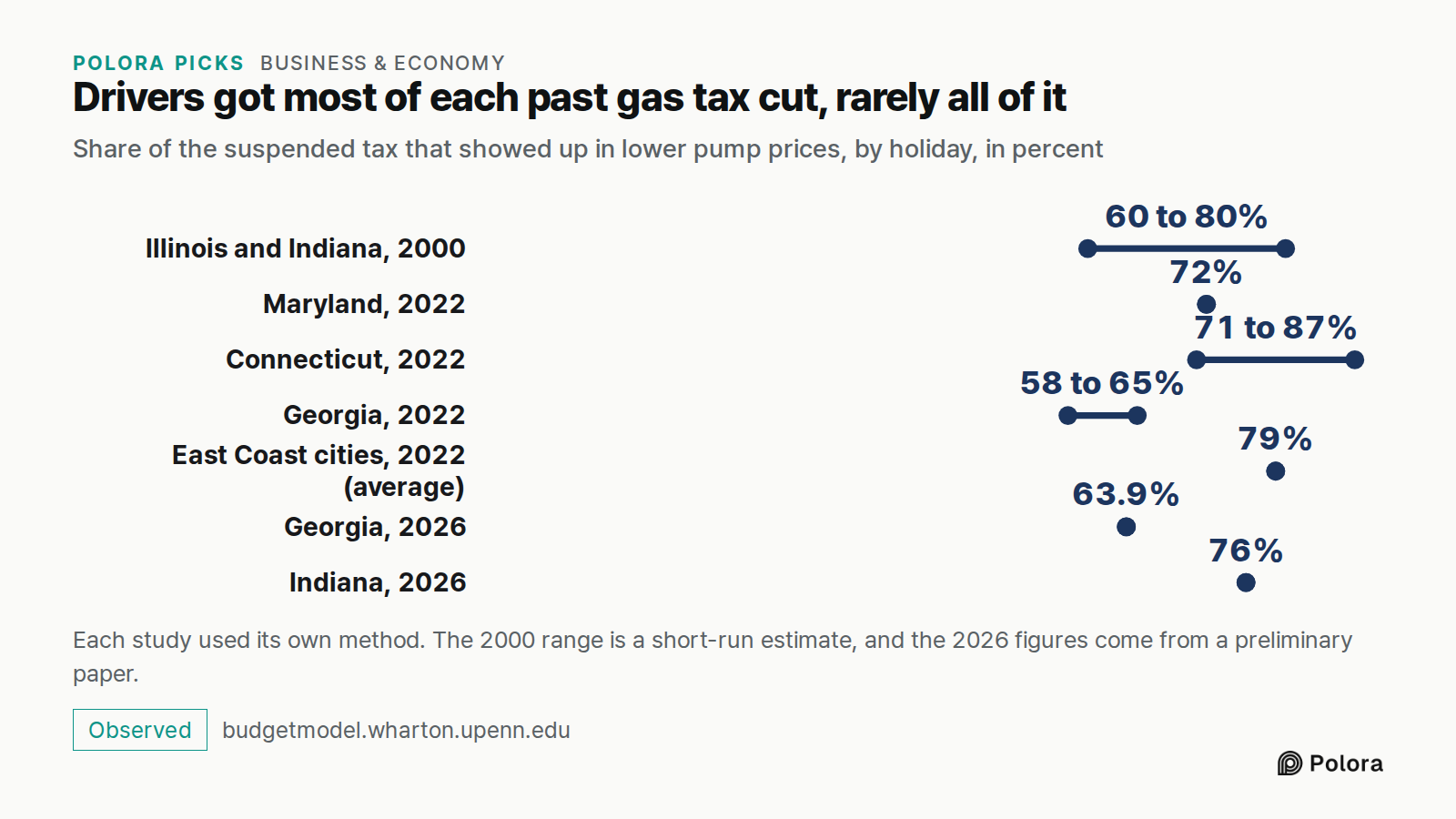
Drivers got most of each past gas tax cut, rarely all of it · Share of the suspended tax that showed up in lower pump prices, by holiday, in percent · Illinois and Indiana, 2000 · Maryland, 2022 · Connecticut, 2022 · Georgia, 2022 · East Coast cities, 2022 (average) · Georgia, 2026 · Indiana, 2026 ·
Share of the suspended tax that showed up in lower pump prices, by holiday, in percent

Why part of a gas tax cut stays with suppliers

Drivers keep buying roughly the same amount of fuel whatever it costs. The Penn Wharton Budget Model notes that when demand barely moves, suppliers can keep part of the benefit. That is one part of the explanation, not all of it : how much reaches the pump also depends on how suppliers and competing stations respond.

Location matters too. The study of 2022 East Coast holidays traced the differences from city to city to supply constraints, to how isolated a local market is, and to spillover across state lines, where stations compete with neighbors whose tax did not change.

The savings also shift over the course of a holiday. In 2022, Maryland's estimated price cut grew from about 12 cents just after the start to between 25 and 30 cents a gallon, then shrank before the holiday ended. Connecticut's price cut also shrank while the tax was still suspended. Georgia's went the other way, rising from about 7 cents in the first week to about 30 cents by mid-May. A single average hides all of this.
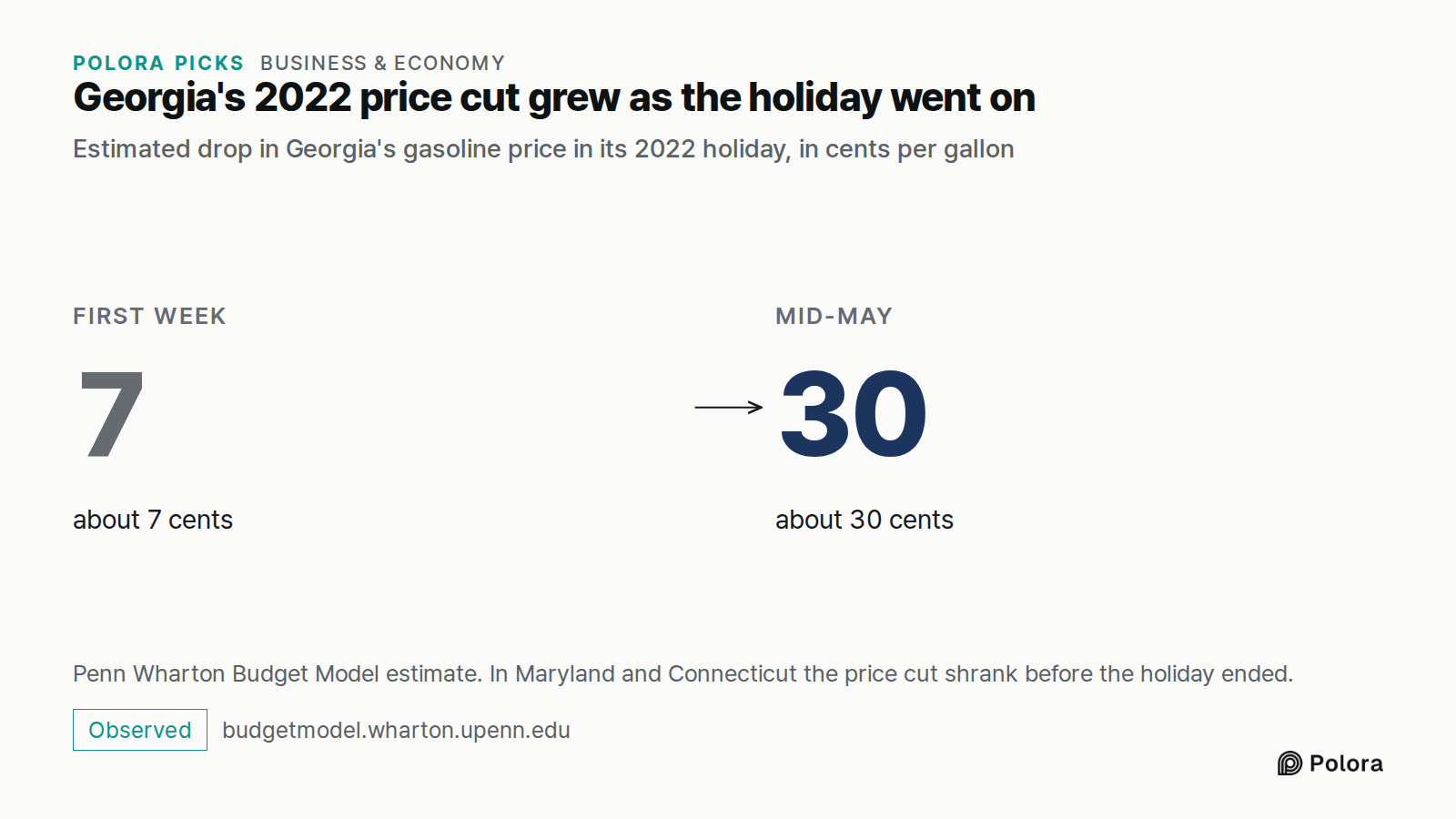
Georgia's 2022 price cut grew as the holiday went on · Estimated drop in Georgia's gasoline price in its 2022 holiday, in cents per gallon · First week · 7 · about 7 cents · Mid-May · 30 · about 30 cents · Penn Wharton Budget Model estimate. In Maryland and Connecticut the price cut shrank before th
Estimated drop in Georgia's gasoline price in its 2022 holiday, in cents per gallon

When the gas tax comes back, prices do not simply reverse

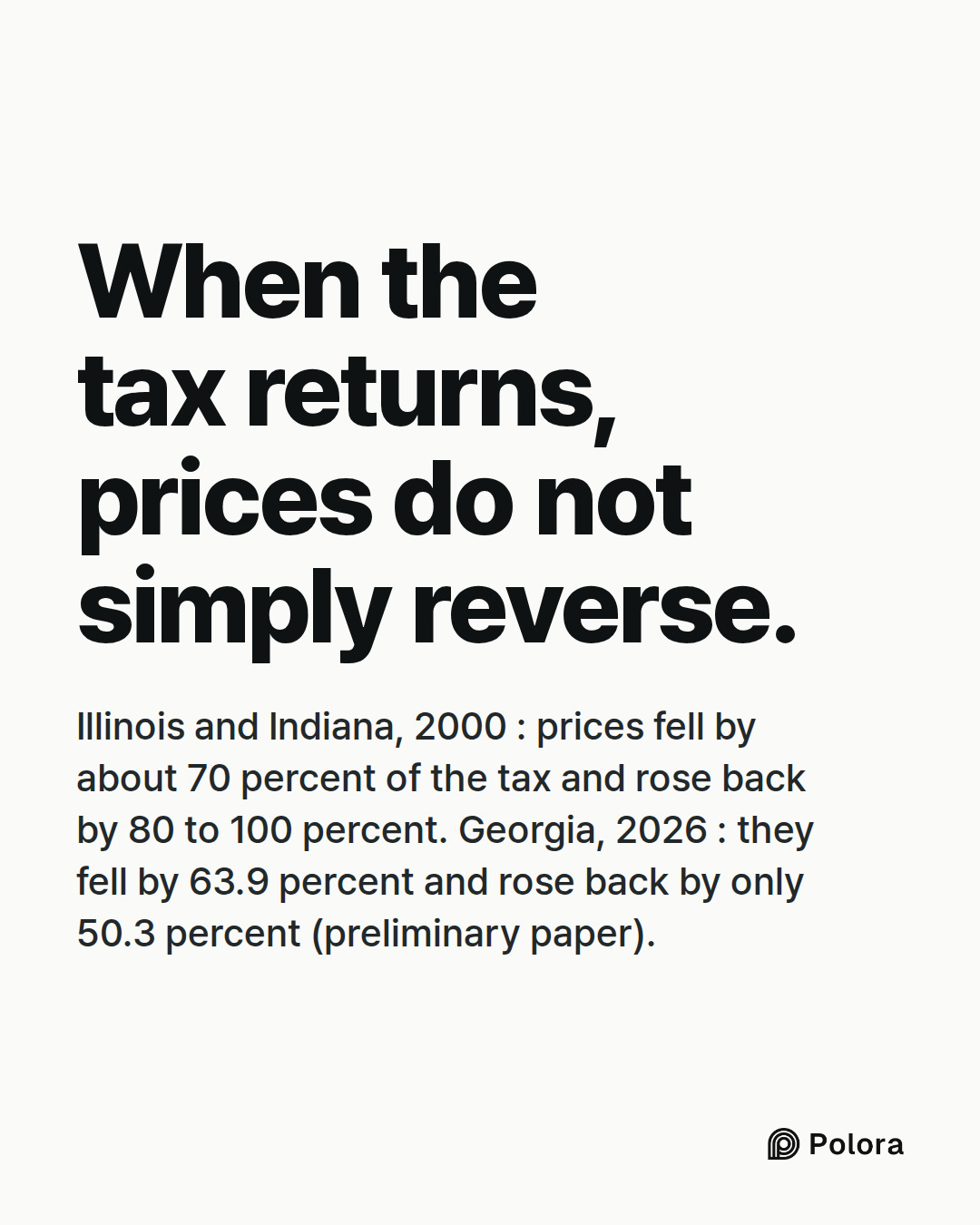
One common assumption is that prices rise faster when a tax returns than they fell when it was cut. The 2000 study supports that : in the authors' published estimates, about 70 percent of the suspension reached drivers, while 80 to 100 percent of the reinstatement did.

Georgia in 2026 went the other way. When the tax returned on June 3, gasoline prices rose by only 50.3 percent of the tax, compared with the 63.9 percent drop at the start. About four weeks later, when the data end, gasoline was still below its level before the holiday by roughly 14 percent of the tax. The authors point to how the tax is collected. Stations still selling fuel bought during the holiday paid no tax on it, and that put pressure on nearby stations to hold their prices. They also warn that four weeks may not be long enough to see where prices finally settle.

Maryland in 2022 offers a weaker hint. After its holiday ended, Penn Wharton's estimate put prices above where they would otherwise have been, but the difference was not statistically significant.

Different studies, different directions. The end of a holiday is not a mirror image of its start, and the evidence does not yet say which way it usually tilts.
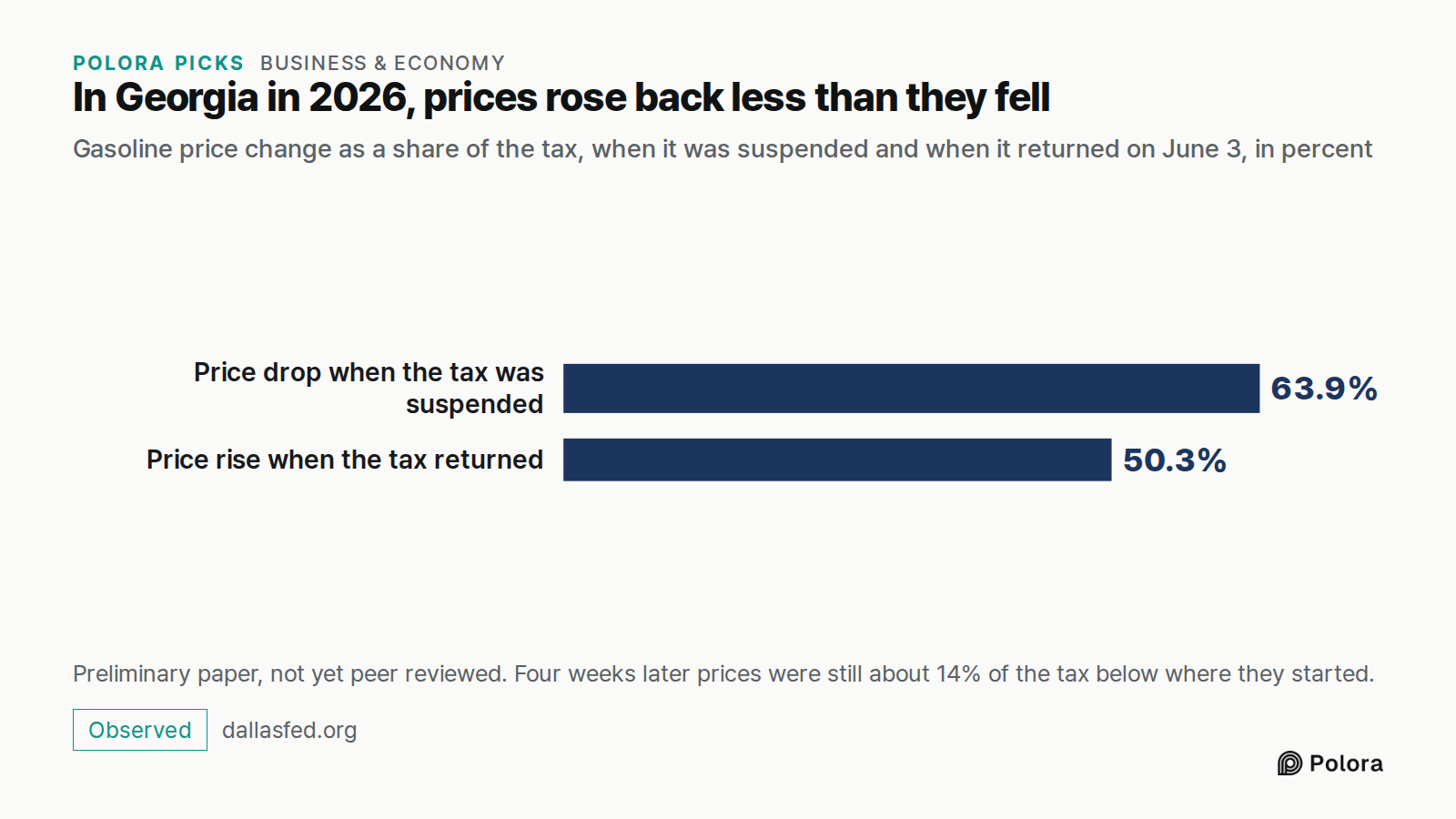
In Georgia in 2026, prices rose back less than they fell · Gasoline price change as a share of the tax, when it was suspended and when it returned on June 3, in percent · Price drop when the tax was suspended · Price rise when the tax returned · 63.9% · 50.3% · Preliminary paper, not yet peer review
Gasoline price change as a share of the tax, when it was suspended and when it returned on June 3, in percent

Ohio's rule that the savings must reach drivers, and who pays for the roads

Ohio's law requires licensed dealers to pass the tax break on. As reported in local coverage, a dealer that fails to do so could face a licensing inquiry by the state Tax Commissioner and a referral to the Attorney General, and the state warns that keeping the savings may be treated as an unfair or deceptive act. Reports differ on exactly who holds which enforcement power. None of the studies above measured whether a rule like this changes how much reaches the pump. It may make past holidays a weaker guide to Ohio's, and how much it changes is a question this holiday will answer, not one the evidence answers yet.

The money has to come from somewhere. Ohio's gas tax pays for roads and bridges, and according to news reports the law sets aside about $725 million from the state's General Revenue Fund to cover the lost revenue, with another $250,000 for administration. Some coverage describes the money as coming from state reserve accounts instead. Either way, the relief at the pump is paid for out of general state money rather than road funds, which means taxpayers as a whole, including those who drive little or not at all.

The 2026 Federal Reserve Bank of Dallas study adds one more detail. Georgia's holiday offset about the same share, roughly 28 percent, of the per-gallon price shock for households at every income level, judged by the median income of the neighborhood around each station rather than the income of each buyer. It lowered the burden without changing who carried the most of it.

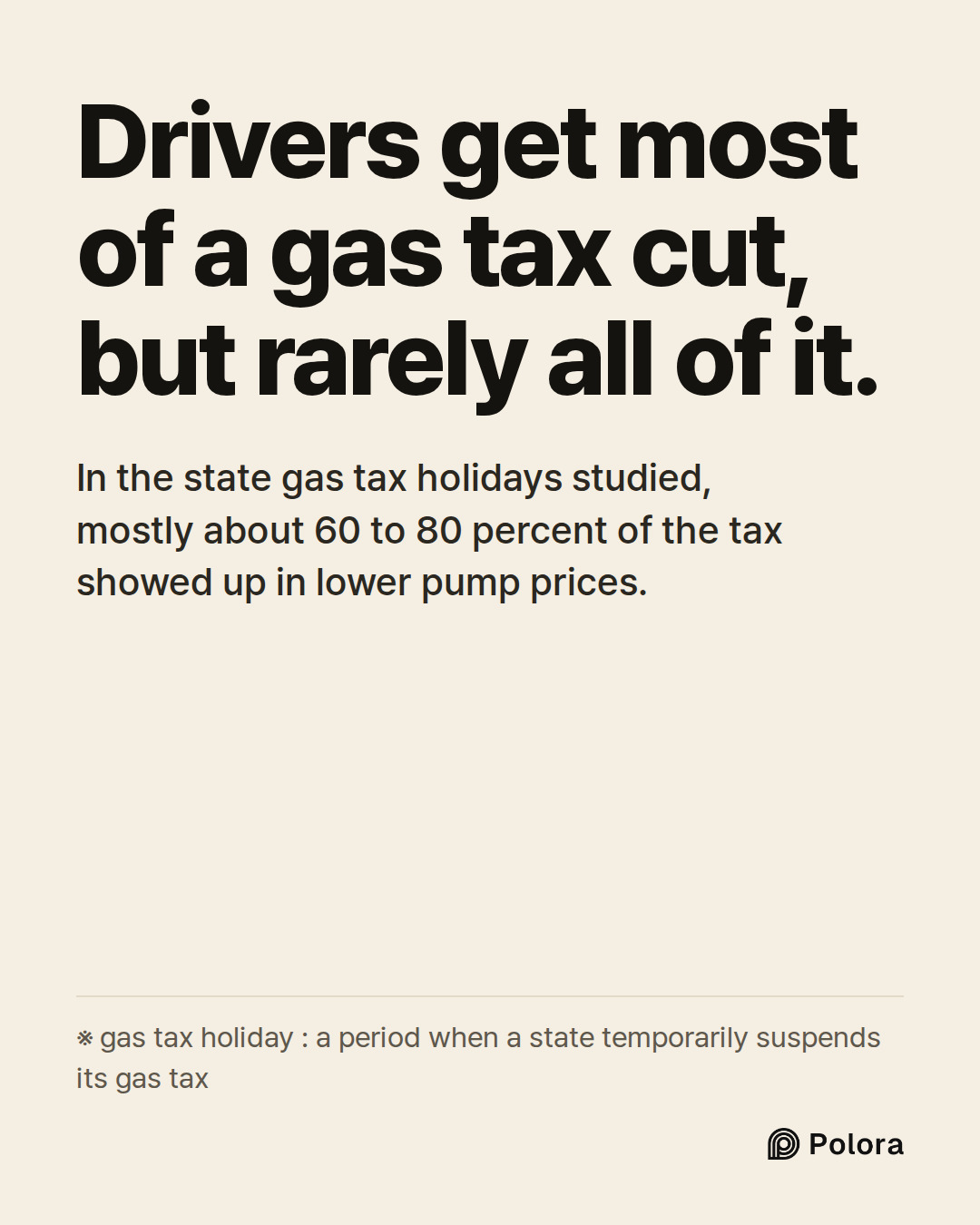
Drivers get most of a gas tax cut, but rarely all of it

A state gas tax is paid upstream, by the businesses that sell fuel wholesale, and its cost is built into the pump price. Cutting it gives drivers only what the supply chain passes down. In the holidays studied here, that was a majority of the tax and rarely all of it, mostly somewhere between about 60 and 80 percent, with wide differences between places, methods and weeks. What happens when the tax returns has varied from one holiday to the next.

Ohio's 90 days are one more test of that pattern, this time with a rule that says the full savings must reach the pump, and past holidays cannot say how much that rule will change. Whatever the price board shows in your town this month, the tax was never a separate line on it. It was folded into the price, and so is any cut.
When a state suspends its gas tax, do drivers actually get the savings?When a state suspends its gas tax, do drivers actually get the savings?Drivers get most of a gas tax cut, but rarely all of it. · In the state gas tax holidays studied, mostly about 60 to 80 percent of the tax showed up in lower pump prices. · ※ gas tax holiday : a period when a state temporarily suspends its gas taxThe gas tax was never a separate line on the pump price. · It is collected when fuel is bought wholesale and built into the price stations post, so a cut reaches drivers only as far as suppliers and stations pass it on.When the tax returns, prices do not simply reverse. · Illinois and Indiana, 2000 : prices fell by about 70 percent of the tax and rose back by 80 to 100 percent. Georgia, 2026 : they fell by 63.9 percent and rose back by only 50.3 percent (preliminary paper).Ohio's holiday adds a rule : dealers must pass the savings on. · From October 4, Ohio cuts its 38.5-cent gasoline tax to one hundredth of a cent for 90 days. None of the past studies measured a rule like this, so they cannot say exactly what Ohio drivers will save.Sources 12 : thepostathens.com · The Post (Athens) : DeWine signs gas tax holiday, yahoo.com · Ohio gas tax holiday explained, cleveland19.com · Cleveland 19 : Relief at the gas pump coming after Gov. DeWine signs gas tax holiday bill + 9Read the full story at · polora.ai

When a state suspends its gas tax, do drivers actually get the savings?

Alpha · claude-sonnet-5

Good — this confirms and corrects several points in the draft. Here's my read as Alpha. The $725 million figure: confirmed, but the draft's precision and source are shaky. Multiple outlets converge on $725 million from the General Revenue Fund — WHIZ gives the exact figure of "$725,250,000 from the General Revenue Fund to cover the expected loss from the suspended fuel taxes", and a WJW/Yahoo report independently confirms "The bill offsets lost gas tax revenue with a $725 million appropriation from the state's general fund, with another $250,000 appropriation for administrative expenses." But Signal Ohio complicates this: it says the bill "pulls $725 million out of the state's reserve accounts to cover the lost road and bridge maintenance funding", and separately reports that DeWine would only sign "now that it's funded via general budget dollars and not those earmarked specifically for road repairs and construction". That's two outlets using "reserve accounts" language against two using "General Revenue Fund." I'd call this resolved toward General Revenue Fund given WHIZ's exact-dollar specificity and WJW's independent corroboration, but the manuscript should not present $725…

Beta · gpt-6-sol

Drivers often get most of a suspended gas tax, but the pump price need not fall by the full tax—or immediately. The manuscript’s answer stands as a description of the holidays it cites, not as a prediction for every state or station. Penn Wharton estimates that consumers received 72% of Maryland’s 2022 cut, 58–65% of Georgia’s and 71–87% of Connecticut’s. Those are estimates against a *no-holiday price*, not necessarily changes a driver could read straight off a price board amid other price movements. (budgetmodel.wharton.upenn.edu) I would make three substantive corrections before publication: - The explanation of *why* savings are partial is too certain. The manuscript says that because drivers keep buying roughly the same amount, sellers have little reason to pass on the full cut. Inelastic demand alone does not establish that result; the response of supply and competition matters too. The evidence establishes partial pass-through in the cited episodes, but does not justify that one-sentence causal rule. The draft also says pass-through is decided along the…

Gamma · gemini-3.1-pro

As Gamma, here is my assessment of the manuscript and the evidence surrounding it. Alpha and Beta have rightly pointed out that while the historical evidence supports the manuscript's core premise—that drivers see most, but rarely all, of a gas tax cut—the manuscript risks turning complex, varied historical estimates into a rigid "60 to 80 percent" rule. I agree with that critique, but I want to focus sharply on the Ohio-specific claims and the strongest argument against the manuscript's angle. The Ohio Specifics: Funding and Enforcement The manuscript claims that $725,250,000 is being moved from the General Revenue Fund to cover the lost tax revenue. Alpha and Beta noted the conflicting reporting between "General Revenue Fund" (WHIZ/Yahoo) and "reserve accounts" (Signal Ohio). In state legislative finance, rainy day or reserve funds are often sub-accounts or transfers managed through the General Revenue Fund framework. Without the final Legislative Service Commission (LSC) fiscal note for HB 519 in front of us, the most accurate and defensible phrasing for the manuscript would be to blend these: "an appropriation of roughly $725 million from general state funds." This avoids…

Researcher · gemini-3-7-flash

Verification of Manuscript Claims Against Current Ground Truth --- 1. Ohio HB 519 Specifics (Start Date, Enforcement, and Funding) * Start Date (October 4, 2026): Confirmed. House Bill 519 was signed by Gov. Mike DeWine on Thursday, October 1, 2026. The statutory language enacts the suspension three days after signing, placing the effective start date on Sunday, October 4, 2026, running 90 days until January 2, 2027. Outlier reporting citing October 5 stems from counting full business days rather than calendar days. * *Source:* The Athens Post (Oct 2, 2026); Ohio General Assembly HB 519 Status. * Enforcement & Mandate Mechanism: Confirmed via LSC Analysis. The Ohio Legislative Service Commission (LSC) analysis confirms that retail dealers are required to pass the tax cut down to consumers. Non-compliance can trigger a licensing inquiry by the Ohio Tax Commissioner, which may be formally referred to the Ohio Attorney General's Office for enforcement under Oh…

The Arbiter · gpt-6-sol

Round record Alpha, Beta and Gamma agree on the central answer: In the holidays examined, drivers generally received a majority of the suspended tax through lower *estimated* pump prices, but not necessarily every cent or on the first morning. Penn Wharton reports 72% in Maryland, 58–65% in Georgia and 71–87% in Connecticut in 2022. Those figures compare prices with an estimated *no-holiday* price; they are not necessarily the change visible on a station’s sign. (budgetmodel.wharton.upenn.edu) The principal correction is to the manuscript’s certainty, not its premise. Alpha and Beta caution against presenting “60 to 80 percent” as a general rule assembled from different states, methods and kinds of tax. Beta also identifies two wording errors: an upstream tax can still be embedded in the posted pump price, and inelastic demand alone does not explain partial pass-through without considering supply and competition. The sentence saying the law does not decide pass-through is too absolute when Ohio’s law reportedly requires it. Ohio is still a prospective case on October…

The Arbiter's Final Verdict · gpt-6-sol

Yes, usually—but not necessarily all of it, and not immediately. A gas tax may be collected from fuel businesses upstream, but its cost is ordinarily built into the price drivers pay. Suspending it lowers a cost in the supply chain; how much of that reduction reaches a pump price depends on suppliers, stations, competition and the timing of fuel purchases. The measured result is a reduction relative to what prices would likely have been without the holiday, not necessarily a drop visible on the price board. For 2022 holidays, the Penn Wharton Budget Model estimated that drivers received 72% of the suspended tax in Maryland, 71–87% in Connecticut and 58–65% in Georgia. Those are episode-specific estimates, not a dependable “60–80% rule” for every state or station. Ohio’s result is not known yet as of October 3, 2026. Its reported requirement that dealers pass on the reduction makes past holidays an imperfect forecast; the studies cited here do not establish how much that requirement will change prices. The manuscript’s central premise stands, but it should not promise either…