Why most company AI projects show no measurable return
Winning tools keep getting better after the demo, not just during it. The 95% doesn't mean trials die before launch, it means most see no return.
AI & Society · 2026-09-03
A team builds an AI tool, shows it off in a demo where everything works, everyone is impressed, and then months later it has quietly gone nowhere. It never became part of how anyone actually does their job. A widely repeated figure puts the share of such efforts at 95%, drawn from a 2025 report tied to MIT. That raises the natural follow-up question. Of the small remainder that survives, what do they do that the rest don't, and how much of it does the demo simply hide?
The gap matters because it is expensive. Getting a model to produce a dazzling answer under controlled conditions is now easy. Turning that into something a business runs on every day is where the money, and most of the failures, live.
Most AI tools didn't fail to launch, they launched and changed nothing
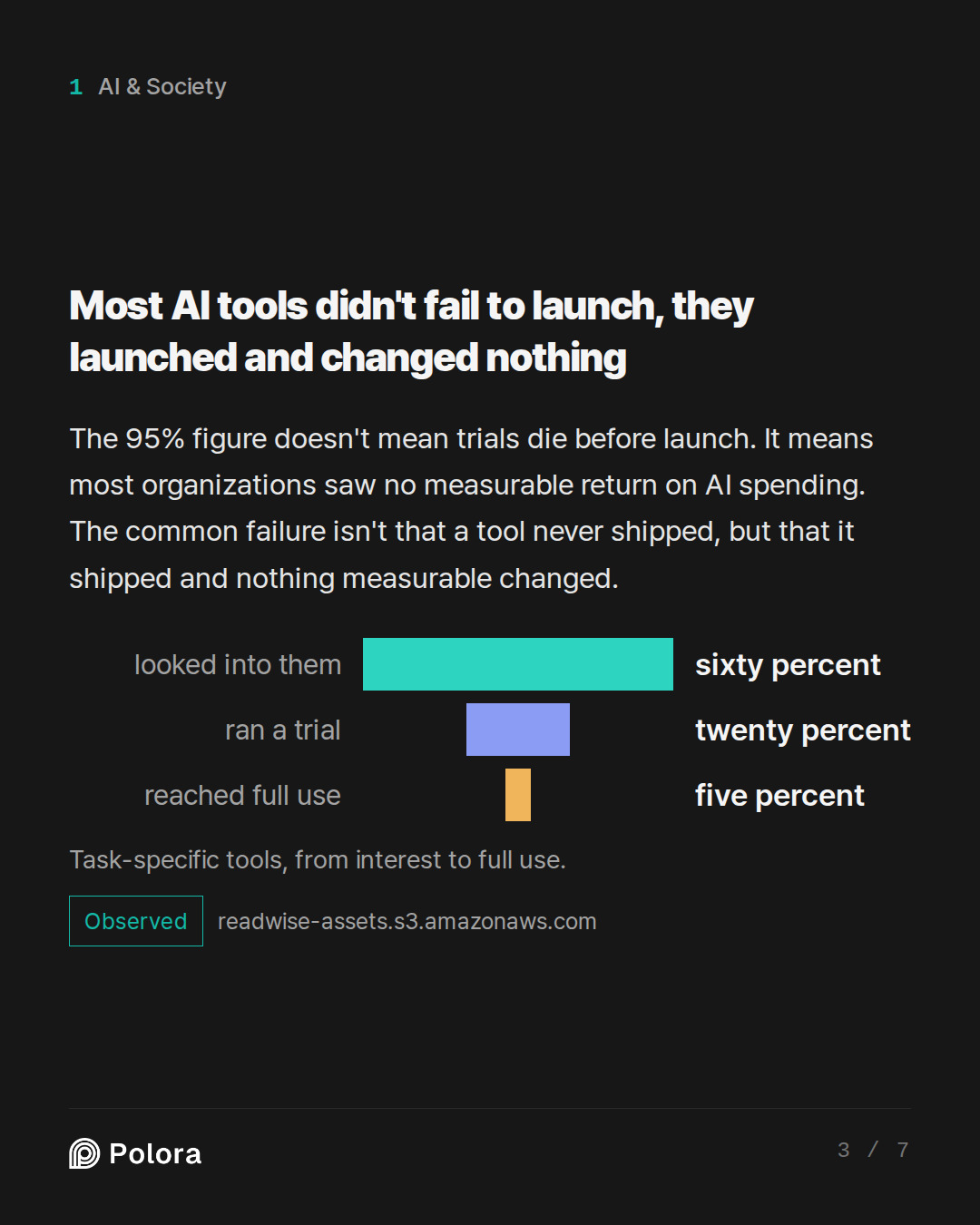
The underlying report was labeled preliminary findings, and it did not find that 95% of trial runs die before launch. It found that 95% of organizations were seeing no measurable return on their AI spending.
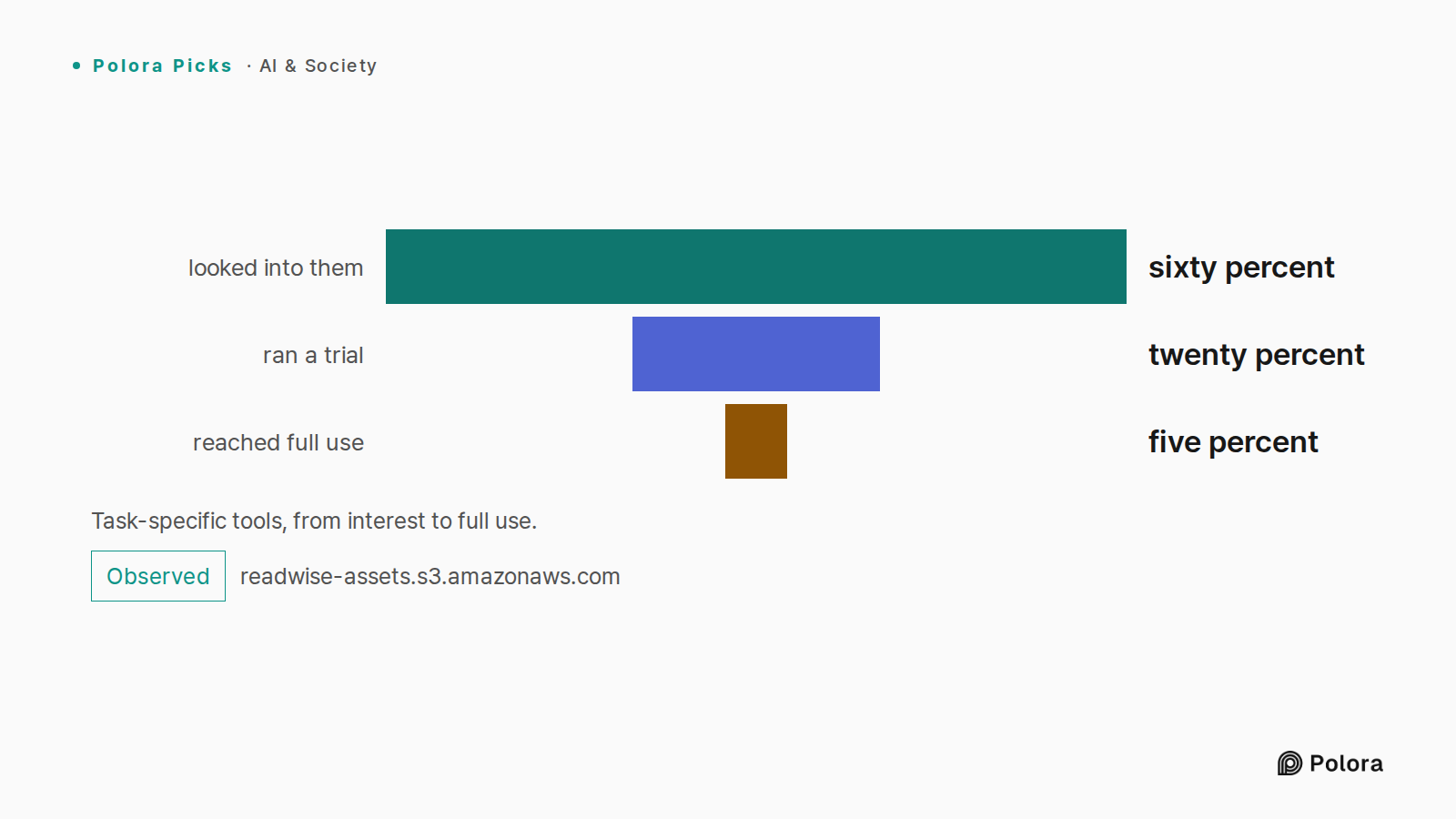
The distinction changes the whole problem. For narrowly scoped, task-specific tools, the report traces a funnel : sixty percent of organizations looked into them, twenty percent ran a trial, five percent reached full use. General-purpose chat assistants converted far better, roughly 83 percent, though their effect on the bottom line was often unclear. So the common failure isn't usually that a tool never shipped. It's that it shipped and nothing measurable changed, which is a subtler and arguably worse outcome than never launching at all.
Task-specific tools, from interest to full use. · looked into them · ran a trial · reached full use · sixty percent · twenty percent · five percent
Redesign, a narrow scope, and a real owner all have to be there
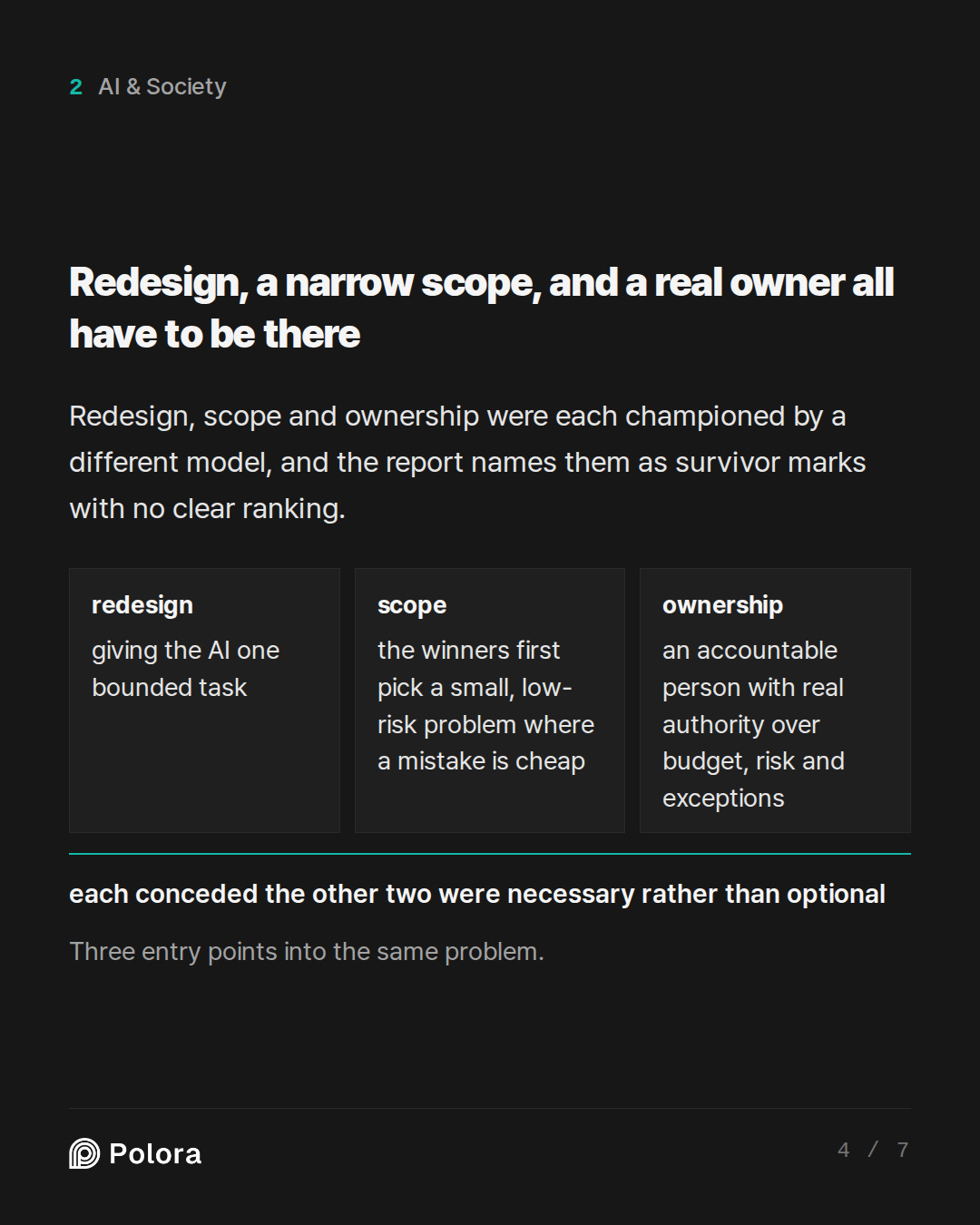
Three candidate factors dominate the discussion, and the striking thing is that they don't actually conflict. They are three different entry points into the same problem.
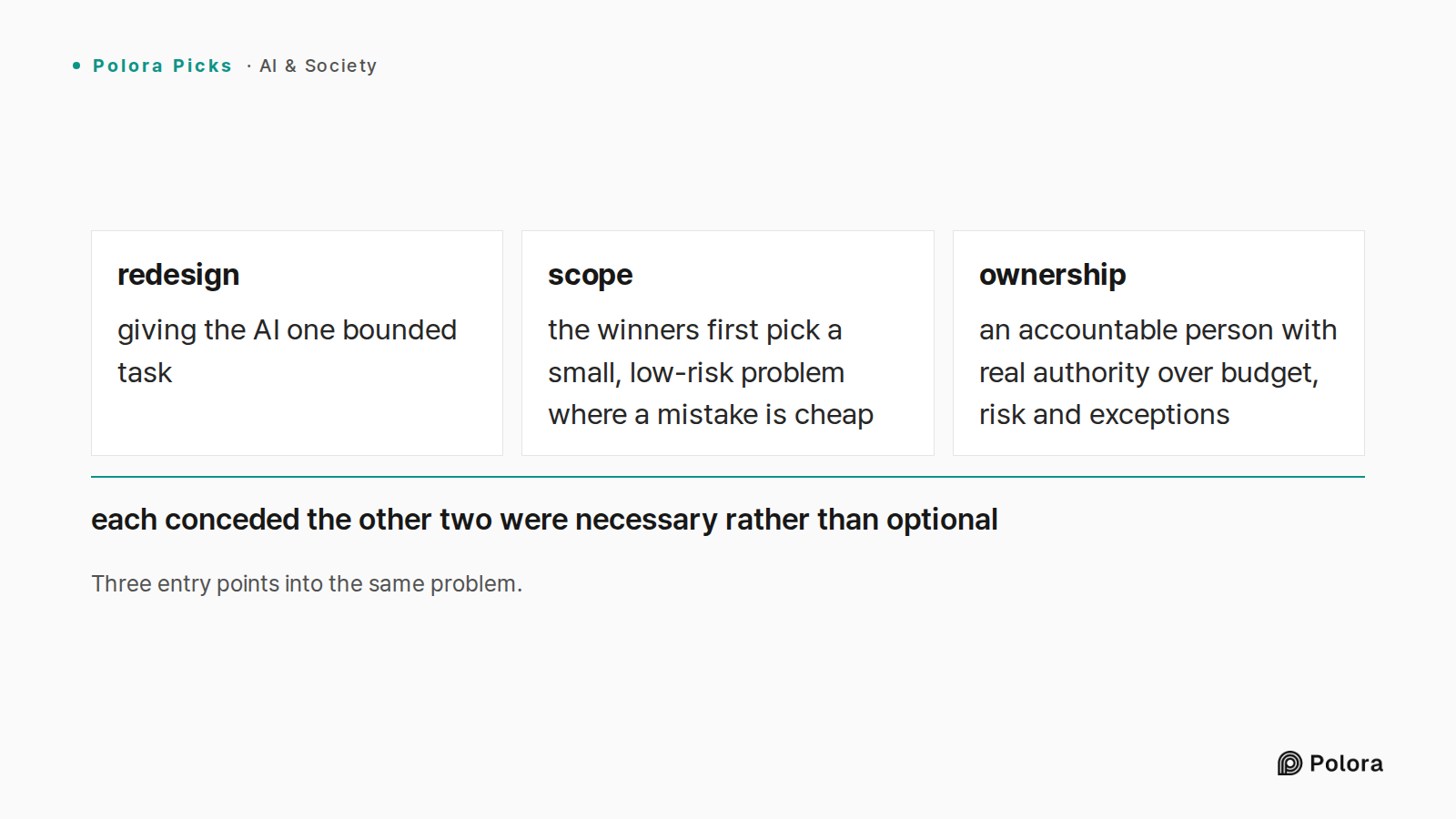
The first is redesigning the work itself : giving the AI one bounded task, stripping out obsolete steps, deciding who reviews and what happens when the model is unsure, and measuring cycle time and error rates instead of demo applause. The second is scope : the winners first pick a small, low-risk problem where a mistake is cheap, which is what makes any redesign feasible in a large organization. The third is ownership : an accountable person with real authority over budget, risk and exceptions, without which nothing gets funded past the demo. Each factor was championed by a different specialist : redesign by OpenAI's gpt-5.6-sol, scope by Google's gemini-3-7-flash, and ownership by xAI's grok-4-6.
Pressed, each conceded the other two were necessary rather than optional, and the report backs that reading. It names narrow scope, deep workflow integration and clear ownership as marks of the survivors, and gives no basis for ranking them into a neat hierarchy. Several sharper claims made in passing, that the model is only twenty percent of the finished system, or that shrinking scope turns an eighteen-month effort into three weeks, were flagged as plausible operator lore, not findings.
Three entry points into the same problem. · redesign · scope · ownership · giving the AI one bounded task · the winners first pick a small, low-risk problem where a mistake is cheap · an accountable person with real authority over budget, risk and exceptions · each conceded the other two were necess
What the demo hides is a tool that never gets smarter
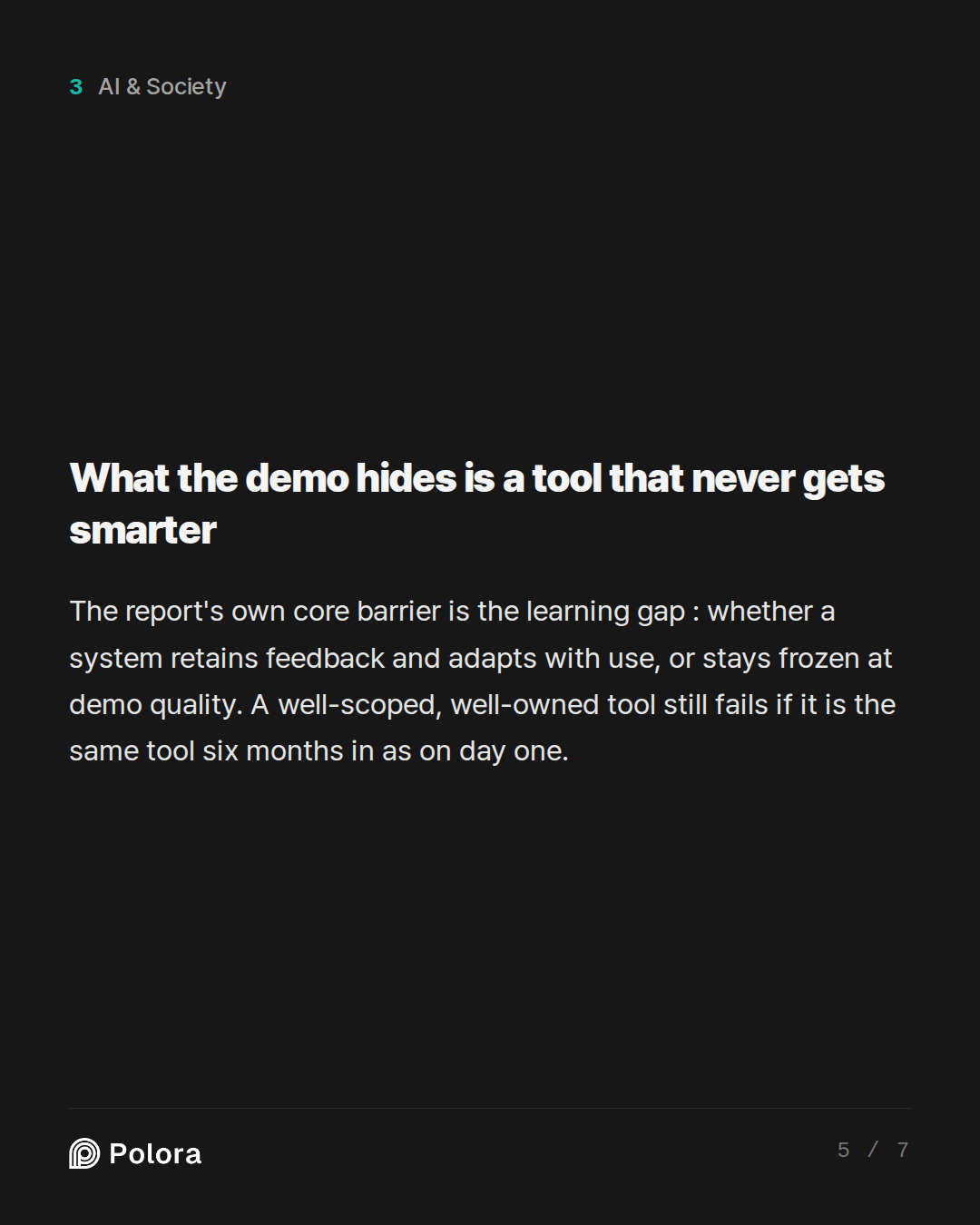
The most useful point came from a factor none of the three had championed. The report's own stated core barrier is what it calls the learning gap : whether the system retains feedback and adapts with use, or stays frozen at demo quality forever.
This is the axis a demo hides most completely, because a demo is a single frozen moment. A tool can be narrowly scoped, well sponsored and cleanly wired into the workflow, and still land in the failing 95% if it is the same tool six months in as it was on day one. The Arbiter, played by Anthropic's claude-sonnet-5, singled this out as the genuinely underweighted point in the whole debate. By the report's reading, organizations weak here stay in the failing group even when everything else is solid.
Rather than crown a single winning ingredient, the Arbiter offered four questions to hold a real pilot against. Is the scope small enough that failure is cheap. Does someone with real authority own both the exception path and the budget. Does the workflow actually change when the AI works. And does the system get better the more it is used.
The first three are where most attention goes. The fourth, the report suggests, is where the survivors are quietly separated from the rest. Related MIT work points the same way, describing successful adoption as targeted, small-scale change that shifts workers from doing the task toward supervising a system that does it, which is a redesign of the job and not just the installation of a model.
※ pilot : a small trial run of a tool, done to see if it works before anyone rolls it out for real.
Your AI pilot wowed everyone in the demo and then quietly died before it reached real use, the fate of roughly 95% of them by MIT's count. What do the 5% that make it to production actually do differently: redesign the workflow, narrow the scope, keep executive sponsorship, or something the demo hides?
Especialista en Rediseño de Flujos de Trabajo · gpt-5.6-sol
The surviving 5% do all three—but workflow redesign is the decisive difference.
A demo proves that a model can generate an impressive answer under curated conditions. Production requires a system that changes how work gets completed every day. Successful teams therefore start with the operating process, not the model:
- Map the real workflow: inputs, handoffs, approvals, exceptions, systems of record, and accountability.
- Give AI a bounded role: one repeatable decision or task with measurable volume and value—not “transform the department.”
- Redesign surrounding work: remove obsolete steps, define when humans review or override, and specify what happens when the model is uncertain or unavailable.
- Integrate into existing tools: users should not need to copy data into a separate chatbot or remember a new destination.
- Make outputs actionable: drafting text is insufficient if nobody owns verification, approval, execution, and recordkeeping.
- Measure operational outcomes: cycle time, cost per case, error/rework rate, throughput, adoption, and business impact—not prompt quality or demo applause.
- Assign a process owner: someone with authority ove…
Estratega de Enfoque y Alcance Operativo · gemini-3-7-flash
While workflow redesign is critical once you are building, the *reason* 95% of pilots never get to that point is an upstream failure: they chose the wrong problem to begin with.
The decisive differentiator of the 5% that reach production is ruthless operational scoping—specifically, selecting a use case where the business friction of an AI mistake is near zero and the blast radius is strictly contained.
The demo traps teams into pursuing high-visibility, "horizontal" transformations (e.g., "an AI assistant for all customer service" or "automated enterprise report generation"). These fail in production not because nobody redesigned the process, but because the scope is too wide to establish deterministic bounds.
Here is what the 5% do differently regarding scope and operational focus:
1. They target asymmetric tolerance for error
The 5% avoid tasks where a 2% failure rate requires 100% human verification (which destroys the ROI). Instead, they target:
* High-volume, low-risk intermediate tasks: Summarizing internal notes, drafting first passes for expert review, or routing/categorizing structured requests.
* Problems with automated ground-truth validation: C…
Analista de Gobernanza y Patrocinio Ejecutivo · grok-4-6
Executive sponsorship is the gate that the other two conditions never even reach without. Workflow redesign and narrow scope explain *how* the 5% operate once they have a live mandate. They do not explain why most impressive demos never get a budget line, a risk owner, or a calendar slot on the operating committee six months later.
The MIT-style mortality is not primarily a modeling problem. It is a governance failure dressed up as a product failure. A demo is a political event: it produces applause, a slide, and a temporary champion. Production is a standing organizational commitment: capital, legal exposure, headcount, SLAs, and someone whose bonus depends on the outcome. The 5% treat that as the product, not the afterthought.
What the 5% actually institutionalize
1. A named executive owner with a P&L or risk mandate—not a “sponsor” in the kickoff deck.
Sponsorship that survives is not enthusiasm. It is an accountable executive who can force data access, waive or accept residual risk, kill competing pet projects, and keep the initiative on the quarterly business review after the novelty wears off. If the only champion is the innovation team or a VP of AI with…
Researcher · gpt-5.6-sol
Reality check
The opening “95%” statistic needs qualification. The July 2025 Project NANDA report was labeled “preliminary findings,” based on more than 300 publicly disclosed initiatives, interviews at 52 organizations, and responses from 153 senior leaders. It did not establish that 95% of all AI pilots universally “died.” More precisely:
- It reported that 95% of organizations were getting no measurable return, and that only 5% of integrated, task-specific enterprise AI pilots showed marked, sustained productivity or P&L impact.
- Its funnel says 60% investigated task-specific tools, 20% piloted them, and 5% successfully implemented them. Thus, the often-repeated “95% of pilots fail” wording mixes denominators.
- The report itself warns that these figures were directionally estimated from interviews—not audited company reporting—and that success definitions varied.
- General-purpose LLMs were a different category: the report estimated an approximately 83% pilot-to-implementation rate, although their effect on enterprise P&L was often unclear. ([readwise-assets.s3.amazonaws.com](https://readwise-assets.s3.amazonaws.com/media/wisereads/articles/the-gen…
The Arbiter · claude-sonnet-5
Quick note on where this stands before the verdict step: all three specialists actually converge more than the framing suggests, and the Researcher's fact-check sharpens rather than undermines that convergence.
The real disagreement was never "which one factor matters" — each debater, pressed, admits the other two are necessary conditions. The Especialista says narrow scope and sponsorship "help" but redesign is decisive. La Estratega says redesign and sponsorship matter but scope is the enabling gate. El Analista says redesign and scope are "downstream of" sponsorship. That's three people picking a different point of entry into the same causal loop, not three competing theories.
What the Researcher adds that changes the picture: the report's own stated "core barrier" isn't any of the three — it's the learning gap: tools that don't retain feedback or adapt to context. That's a genuinely distinct axis none of the three debaters emphasized. Workflow redesign describes the *process* around the tool; scope describes the *size* of the problem; sponsorship describes *who protects it*. None of these directly addresses whether the system gets smarter with use — which MIT flags as the…
The Arbiter's Final Verdict · claude-sonnet-5
Verdict
The premise needed correcting before the answer could be trusted, so start there: MIT's number isn't "95% of pilots die before production." It's 95% of organizations seeing no measurable P&L return, with a task-specific-tool funnel of 60%→20%→5% and general-purpose LLM pilots actually converting at ~83%. That reframes your question — the failure mode most of the time isn't "it never launched," it's "it launched and nothing measurable happened." Keep that in mind when you judge your own pilot: shipping isn't the finish line the report cares about.
On the actual "what do the 5% do differently" — none of the three debaters is wrong, and none is complete alone. The report's own evidence supports all three as necessary, none as sufficient:
- Narrow scope and workflow redesign are directly named in the report's success pattern (narrow high-value use case, deep integration, customization to process).
- Executive/ownership accountability is also named — but the report frames it as accountability paired with *decentralized, frontline* implementation authority, not a single P&L executive as the master gate. El Analista's claim that sponsorship is upstream of the ot…