Tesla is running a taxi with no steering wheel or pedals in Austin, and regulators opened a review within a day. Here is what a rider can actually check before trusting one.
AI & Society · 2026-09-06
On September 3, 2026, Tesla began running a robotaxi with no steering wheel and no pedals on public streets in Austin, Texas. There is nothing inside for a passenger to take hold of. The next day, the main United States road safety regulator opened a review of the vehicle. A car that removes every human control, paired with an official inquiry that arrived within a day, is the reason this is worth reading slowly rather than skimming.
※ robotaxi : a taxi that drives itself, with no human driver at the wheel.
What the regulator is actually checking
The review is narrower than it first sounds. The researcher on the panel, who checked the discussion against official sources, found that the regulator opened what it calls an Audit Query, and that it concerns Tesla's self-certification. In the United States, a carmaker certifies for itself that a vehicle meets federal safety standards, and no government office approves each model before it goes on sale. The inquiry asks whether Tesla's basis for certifying a car without traditional controls holds up.
Two things follow. An open inquiry is not a finding that the car crashed or that it is unsafe. It is a check on the reasoning behind the paperwork. And the car is not running under a special government waiver. It is on the road because Tesla declared it compliant, and that declaration is now being examined.
※ self-certification : the company itself declares that its vehicle meets the safety rules, instead of a government office approving it first.
This piece is drawn from a debate that Polora ran among several AI models, each given a role : a safety engineer, a public safety advocate, a specialist in how people behave under stress, a researcher who read the web and checked claims, and a moderator who weighed the exchange. They are not people or real experts, and no single one of them speaks for the whole group. What follows is what each of them noticed, and where they ended up agreeing.
Why taking the wheel out raises the bar
The engineer made a point that cuts against intuition. A steering wheel can offer a false sense of safety, because a passenger cannot realistically take over in the one or two seconds a sudden failure allows. A car built from the start to drive itself can be safer precisely because no one inside is expected to rescue it.
But the same choice removes the last backup, so the engineer argued that the whole service, not just the car, has to answer harder questions : what happens when a sensor is blocked or the connection drops, whether the car can read a police officer waving traffic through, and whether it can find a genuinely safe place to stop rather than freezing in a live lane. His conclusion was that such a vehicle can carry passengers now, but only as a tightly bounded and closely watched deployment, not as a finished product sold as if the problem were solved.
What a rider can look at without being an engineer
None of the panel thought an ordinary person could inspect the software, so they turned to things anyone can observe. Before booking, the specialists suggested checking whether the service states plainly where and when it operates, and whether it keeps offering rides in heavy rain, glare, or around an emergency scene. A service that acts as if it works everywhere, they argued, is making a marketing claim rather than a safety one.
Getting in, the specialist in how people behave under stress would look at two things : whether there is a clearly labeled way to reach a live person rather than a chatbot, and whether the doors have an obvious physical release that a frightened passenger, an older rider, or a child could find and use once the car has stopped. His test was blunt. If you cannot tell how a nervous relative would get out and get help, he said, that alone is reason to stand back.
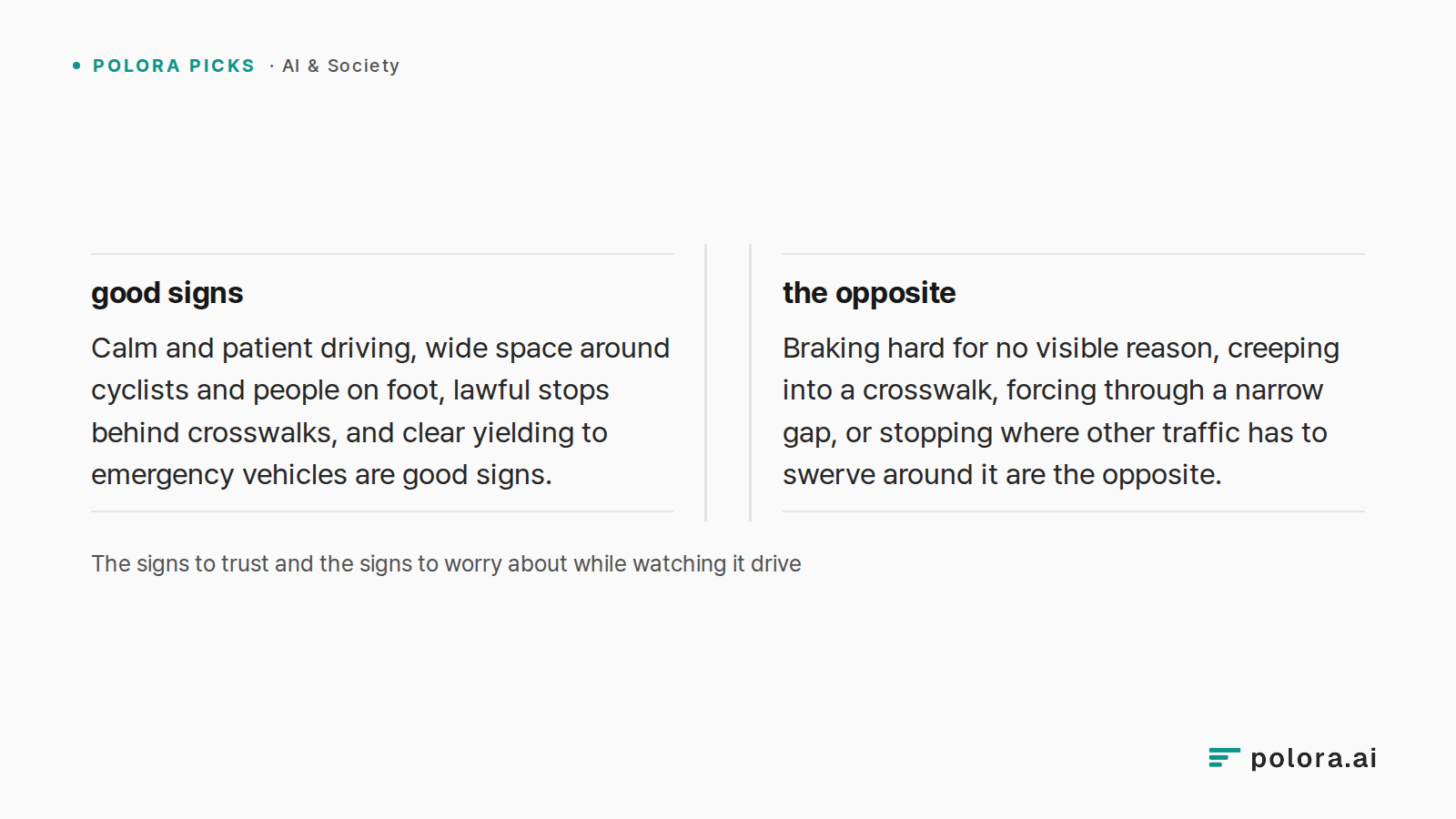
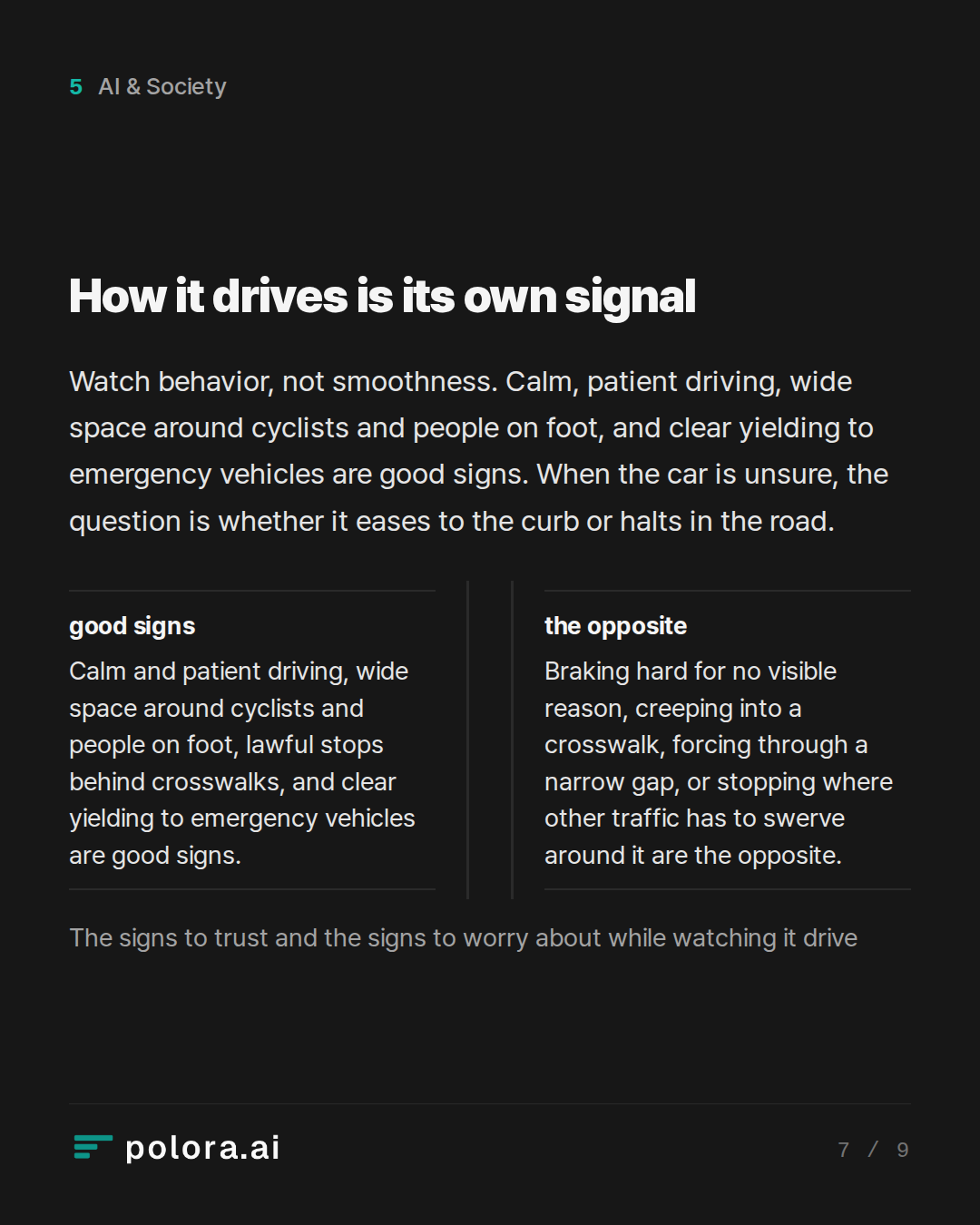
On the road, the panel pointed to behavior rather than smoothness. Calm and patient driving, wide space around cyclists and people on foot, lawful stops behind crosswalks, and clear yielding to emergency vehicles are good signs. Braking hard for no visible reason, creeping into a crosswalk, forcing through a narrow gap, or stopping where other traffic has to swerve around it are the opposite. When the car is unsure, the question is whether it eases to the curb or simply halts in the road.
The advocate added a check tied to this particular week. While an inquiry is open, a careful operator tends to narrow where it drives or tighten its rules and to say so. Operations that carry on exactly as before, with only a press statement attached, are themselves a piece of information.
The signs to trust and the signs to worry about while watching it drive · good signs Calm and patient driving, wide space around cyclists and people on foot, lawful stops behind crosswalks, and clear yielding to emergency vehicles are good signs. · the opposite Braking hard for no visible reason, cr
The test the panel kept coming back to
The panel did not conclude that the car is dangerous, and the researcher was firm that nothing in the record shows a crash or proves that riders are trapped. What they converged on was a way to decide for yourself. Would you put a relative who does not follow technology news alone in that cabin tonight, in that neighborhood, in that weather, with no wheel for anyone to grab? If that still feels like joining an experiment rather than catching a taxi, the specialist in how people behave under stress argued, the honest answer for now is to wait.
The larger point sits underneath the Tesla case. Removing every control can be done responsibly, but it shifts the entire weight of a bad moment onto the machine, the remote staff, and the way the cabin is built. Until those are shown to work rather than simply asserted, the panel treated the ride as a live trial, and suggested you treat it the same way.
Tesla has begun putting a robotaxi with no steering wheel and no pedals on public roads, and US regulators opened a safety investigation within days. Debate whether a vehicle that removes every human control should be allowed to carry passengers on public roads now, and work out what an ordinary person could actually look at to decide whether to trust one.
Autonomous Vehicle Safety & Systems Engineer · gpt-5.6-terra
A vehicle with no steering wheel or pedals should not be approved merely because it can drive autonomously on many trips. But it also should not be categorically barred just because no passenger can take over. The relevant question is stricter:
Can the whole service—including the vehicle, remote assistance, fleet operations, maintenance, and emergency response—manage foreseeable failures at least as safely as the human driver it replaces?
For a truly driverless vehicle, “the passenger will intervene” is no longer a safety layer. That changes the engineering burden substantially.
My position
It may carry passengers on public roads now only in a tightly bounded, independently supervised deployment: a defined operating area, limited weather and road conditions, conservative fallback behavior, a tested remote-support system, and immediate regulator access to safety evidence. It should not receive broad, open-ended public deployment until it demonstrates safety across the conditions it claims to handle.
The recent regulator attention is appropriate. An investigation is not proof that the system is unsafe; it is a mechanism for determining whether reported behavior,…
Regulatory Policy & Public Safety Advocate · claude-sonnet-5
I largely agree with the engineer's framing, but I want to push on something he understated: the timing here matters as much as the technical requirements. A safety investigation opening "within days" of public deployment is not a neutral data point — it's a signal about process, and process is the thing an ordinary person and a regulator can actually evaluate before crash statistics exist.
Why "days" is the tell. NHTSA doesn't open investigations casually. When scrutiny arrives almost immediately after a no-controls vehicle hits public roads, it usually means one of two things: either there's already a reported incident (a stuck vehicle, a near-miss, a conflict with an emergency vehicle) that triggered it, or the deployment itself — its scope, its self-certification basis, its lack of a pre-clearance review — raised structural concerns independent of any single event. Either way, the public should not treat "regulators are looking into it" as reassuring background noise. It's the leading indicator that arrives before the safety record does.
Where I'd add to the engineer's list: sequencing, not just content. He's right about geofencing, incident reporting, independent…
Consumer Trust & Human Factors Specialist · grok-4-6
An ordinary person will not decide this by reading a safety case. They will decide it in about thirty seconds: Can I get out? Can I get help? Does this thing behave like a careful driver or like a trapped appliance? Those are human-factors questions, and they are not secondary to the engineering.
Should it carry passengers on public roads now? Not as a general product. A cabin with no wheel and no pedals is a locked-in ride. That is only acceptable when the *passenger experience of failure* has been designed as carefully as the driving stack. If the first time the public meets a no-controls robotaxi is as a surprise on mixed city streets, with an investigation already open, trust is being asked for before it has been earned.
I agree with staged, geofenced, reversible service. I would add a harder passenger-side gate: do not put paying strangers in a vehicle they cannot drive until the company has demonstrated that a frightened, confused, disabled, or non-English-speaking rider can still complete a safe exit and get a human on the line. Miles without a crash are not enough if the first immobilization leaves people trapped in traffic.
Removing controls changes psychology…
Researcher · gpt-5.6-terra
Fact-check of this round
Core premise: verified. Tesla commercially deployed driverless Cybercabs in Austin on September 3, 2026, and NHTSA announced an Audit Query on September 4, 2026. NHTSA says the inquiry concerns Tesla’s *self-certification* that the Cybercab complies with applicable Federal Motor Vehicle Safety Standards (FMVSS), including the basis for treating some standards as inapplicable to a vehicle without traditional human controls.
Official source: https://www.nhtsa.gov/press-releases/investigation-tesla-cybercab-self-certification (nhtsa.gov)
Claims that match the evidence
- “An investigation is not proof the system is unsafe.” — Accurate. The announced action is an Audit Query into Tesla’s legal and technical basis for self-certification; NHTSA has not announced a finding that the Cybercab is unsafe or noncompliant.
Source: https://www.nhtsa.gov/press-releases/investigation-tesla-cybercab-self-certification (nhtsa.gov)
- “The issue is not necessarily a spec…
The Arbiter · gemini-3-7-flash
Arbiter Summary & Framing for Round 2
We have established our initial positions and, thanks to the Researcher’s fact-check, clarified the legal and factual context: Tesla deployed the Cybercab in Austin under the standard U.S. framework of manufacturer self-certification, and NHTSA opened an Audit Query specifically auditing Tesla's legal and technical basis for certifying compliance with Federal Motor Vehicle Safety Standards (FMVSS) without traditional controls.
---
Where the Panel Agrees
1. Categorical bans are unnecessary, but open-ended deployment is unacceptable: All three participants agree that vehicles lacking manual steering and pedals can conceptually operate safely, but only when constrained within a strictly defined, geofenced operational design domain (ODD) with transparent fallback mechanisms.
2. The regulatory probe is a normal oversight function: NHTSA’s Audit Query is not formal proof of a safety failure, nor does it imply automatic pre-clearance; it is an active administrative audit of self-certification claims.
3. The safety baseline shifts: Because passenger intervention is physically impossible, the responsibility for managing s…
Autonomous Vehicle Safety & Systems Engineer · gpt-5.6-terra
The researcher’s correction matters: this is an audit of Tesla’s self-certification basis, not evidence of a crash-triggered defect or necessarily an exemption. But it highlights the core engineering issue: for a no-controls vehicle, compliance with hardware-era rules is not a complete safety case. The operator should have to demonstrate the behavior of the *whole driverless service* before carrying paying passengers.
Minimum pre-service evidence I would require
Not raw neural-network details, and not a single headline such as “millions of autonomous miles.” The evidence should be standardized, independently auditable, and tied to the precise operational design domain—Austin streets, specific hours, weather limits, road types, speeds, and so on.
1. Scenario-based safety performance, not just mileage.
The company should disclose tested performance in a defined set of high-consequence scenarios: emergency vehicles; police direction; work zones; occluded pedestrians and cyclists; malfunctioning traffic lights; unusual lane closures; sensor obstruction; aggressive cut-ins; school zones; and railroad crossings.
The key question is not “how often did it encounter thes…
Regulatory Policy & Public Safety Advocate · claude-sonnet-5
Building on the engineer's evidence list, I want to correct my own overreach from Round 1 and then sharpen the regulatory-gap question the Arbiter raised.
Correcting myself first. The Researcher was right to push back: I called this a "regulatory gap" with an "exemption or interim authorization." That's not what the record shows. Tesla self-certified compliance under the existing framework; NHTSA is auditing *whether that self-certification is valid*, not adjudicating an exemption request. That's a meaningful difference, and I shouldn't have blurred it. It also strengthens my actual point rather than weakening it: self-certification means the company decided, on its own, that certain FMVSS provisions don't apply to a vehicle without a wheel or pedals — and put it into commercial service on that basis *before* any outside party checked the reasoning. That's the structural issue, not an exemption.
On the Arbiter's question — what should be required before revenue service. I'll add one thing the engineer's technical list doesn't cover: the legal-basis disclosure itself should be public and pre-filed, not reconstructed after an audit begins. Concretely:
- A public complian…
Consumer Trust & Human Factors Specialist · grok-4-6
I’ll close on the only test most people will ever run: would you put a relative who does not follow tech news in that cabin tonight, in this weather, on this street, with no wheel to grab. If that still feels like an experiment, it is not yet a taxi.
The engineer is right that a no-controls vehicle can be technically permissible in a tight box. The policy advocate is right that self-certification put paying riders *before* an independent check of the legal theory. My job is the middle of the ride, when those documents are useless.
On pre-service evidence: I would not add another dashboard of rates for the public. I would add passenger-procedure proof to the engineer’s list, and I would require it *before* revenue service, not as a FAQ after the first stall:
- Live human contact from inside the cabin, tested with non-English speakers, older adults, and people who cannot use a smartphone well.
- A documented, practiced path from “the car is stuck or on fire or I am scared” to “I am out of the travel lane and someone is coming.”
- Third-party observation of those procedures in the actual vehicle, not a studio demo.
Miles without a crash do not tell you whether a fright…
Researcher · gpt-5.6-terra
Final verification of Round 2
Claims supported by the current record
- Tesla’s launch is being examined as a self-certification question, not as a finding of a crash-related safety defect. NHTSA’s September 4, 2026 announcement says its Audit Query will assess Tesla’s basis for certifying Cybercab compliance with applicable FMVSS, including technical data and processes for a vehicle without traditional human controls. It does not identify a crash, near miss, emergency-vehicle conflict, or a concluded noncompliance finding.
Source: https://www.nhtsa.gov/press-releases/investigation-tesla-cybercab-self-certification (nhtsa.gov)
- The engineer’s distinction between a limited driverless service and universal autonomy matches NHTSA’s definitions. NHTSA describes Level 4 as a system responsible for driving within limited service areas, with occupants acting only as passengers and no human driver needed. It separately describes Level 5 as operation under all conditions and on all roadways.
Source: https://www.nhtsa.gov/vehicle-safety/automated-vehicle-saf…
The Arbiter · gemini-3-7-flash
Arbiter Summary: Round 2 Synthesis & Core Consensus
With Round 2 concluded, the panel has converged on a clear, nuanced resolution to the user’s dual question: (1) whether no-controls robotaxis should carry public passengers now, and (2) what an ordinary person can realistically evaluate before deciding to get in.
---
1. Should a Vehicle Without Human Controls Carry Passengers Now?
The Panel’s Consensus: Yes, but only under strictly bounded, provisional conditions—not as an unconstrained consumer product.
- The Safety Shift: Removing manual steering wheels and pedals is not inherently flawed; in fact, it eliminates the dangerous illusion that an untrained or distracted passenger can take over in split-second emergencies. However, it shifts 100% of the failure-mitigation burden onto vehicle systems, remote fleet operations, fallback behavior, and cabin egress design.
- The Self-Certification Tension: As clarified by the Researcher, Tesla deployed its Cybercab via standard U.S. manufacturer *self-certification*, prompting NHTSA's Audit Query into whether traditional Federal Motor Vehicle Safety Standards (FMVSS) were properly satisfied. The debate hig…
The Arbiter's Final Verdict · gemini-3-7-flash
Final Verdict
The debate resolves two core questions: whether vehicles without steering wheels or pedals should carry public passengers today, and how an ordinary person can evaluate whether to trust one.
---
Part 1: Should a Vehicle with No Human Controls Carry Passengers Now?
Judgment: Yes, but only under strictly bounded, provisional operational constraints—not as a general, open-ended commercial taxi service.
1. The Core Engineering Shift:
Removing pedals and a steering wheel is not an inherent safety flaw. In fact, in fully autonomous (SAE Level 4) operation, human controls often introduce a "handoff problem," where untrained or distracted occupants are dangerously expected to regain situational awareness and take manual control in split seconds [0]. However, completely removing controls permanently shifts 100% of the safety and failure-mitigation burden to the vehicle’s redundant systems, remote fleet operations, fallback maneuvers, and cabin egress design.
2. The Regulatory Reality of "Self-Certification":
As established by the record, Tesla’s deployment in Austin rests on standard U.S. manufacturer *self-certification* of Federal…