Where does the bottle deposit go when nobody returns the bottle?

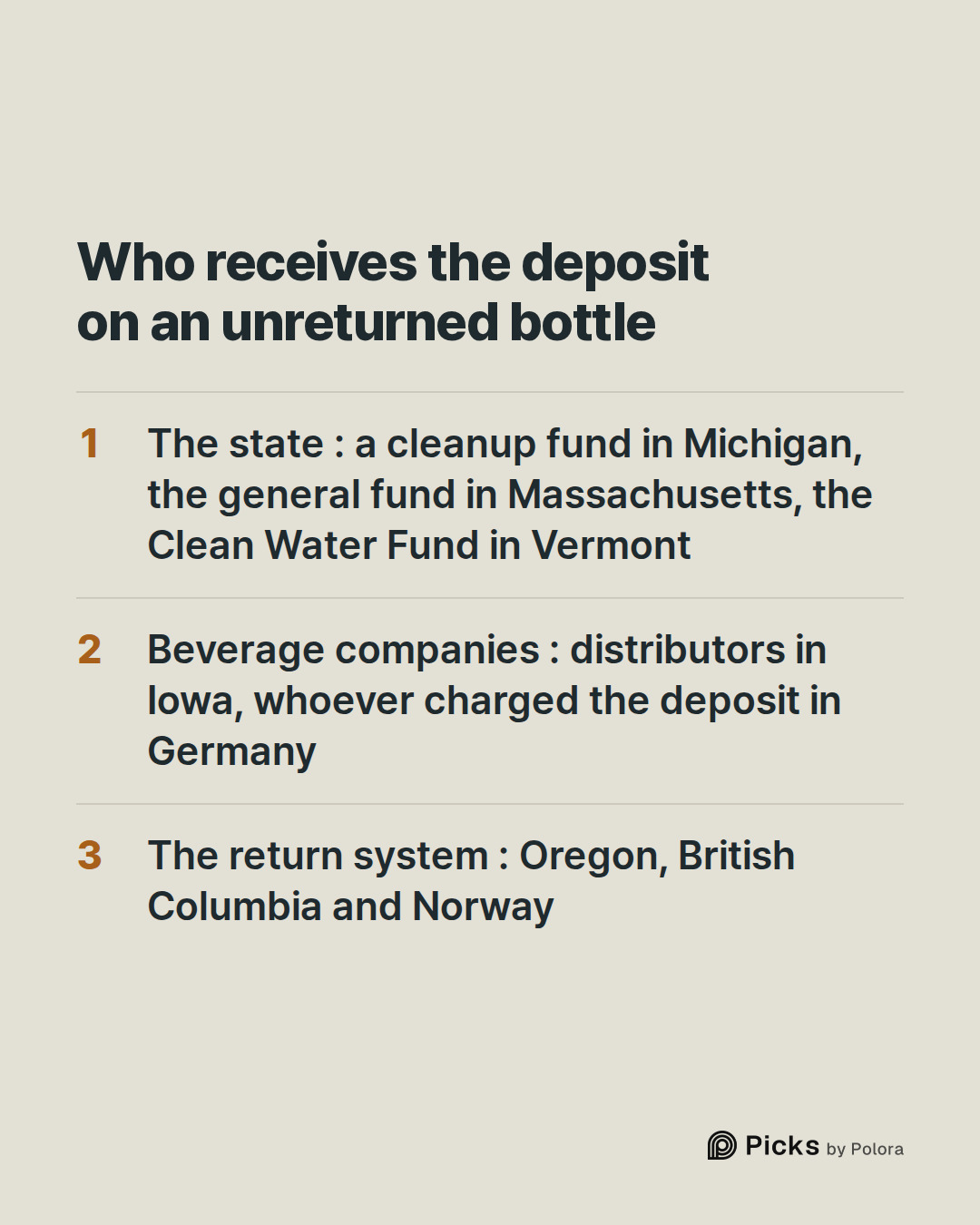
It goes wherever the law of the place you bought the drink sends it : to the state, to the beverage companies, or to the group that runs the return system. In Michigan in 2025, a reported $119.2 million went unclaimed, and most of it went to a state cleanup fund. In Iowa, distributors keep what is left after the payments the law requires.

Business & Economy · 2026-11-22

Michigan's unreturned bottles were worth $119.2 million in 2025

In Michigan you pay 10 cents extra for a can of soda and get it back when you return the can. Most people do. But in 2025, according to state Treasury figures reported in local news, shoppers paid $389.7 million in deposits and got back $270.4 million. That is a return rate of 69.4 percent. The Treasury put the money nobody came back for at $119.2 million. Subtracting the two rounded totals above gives a slightly different figure.

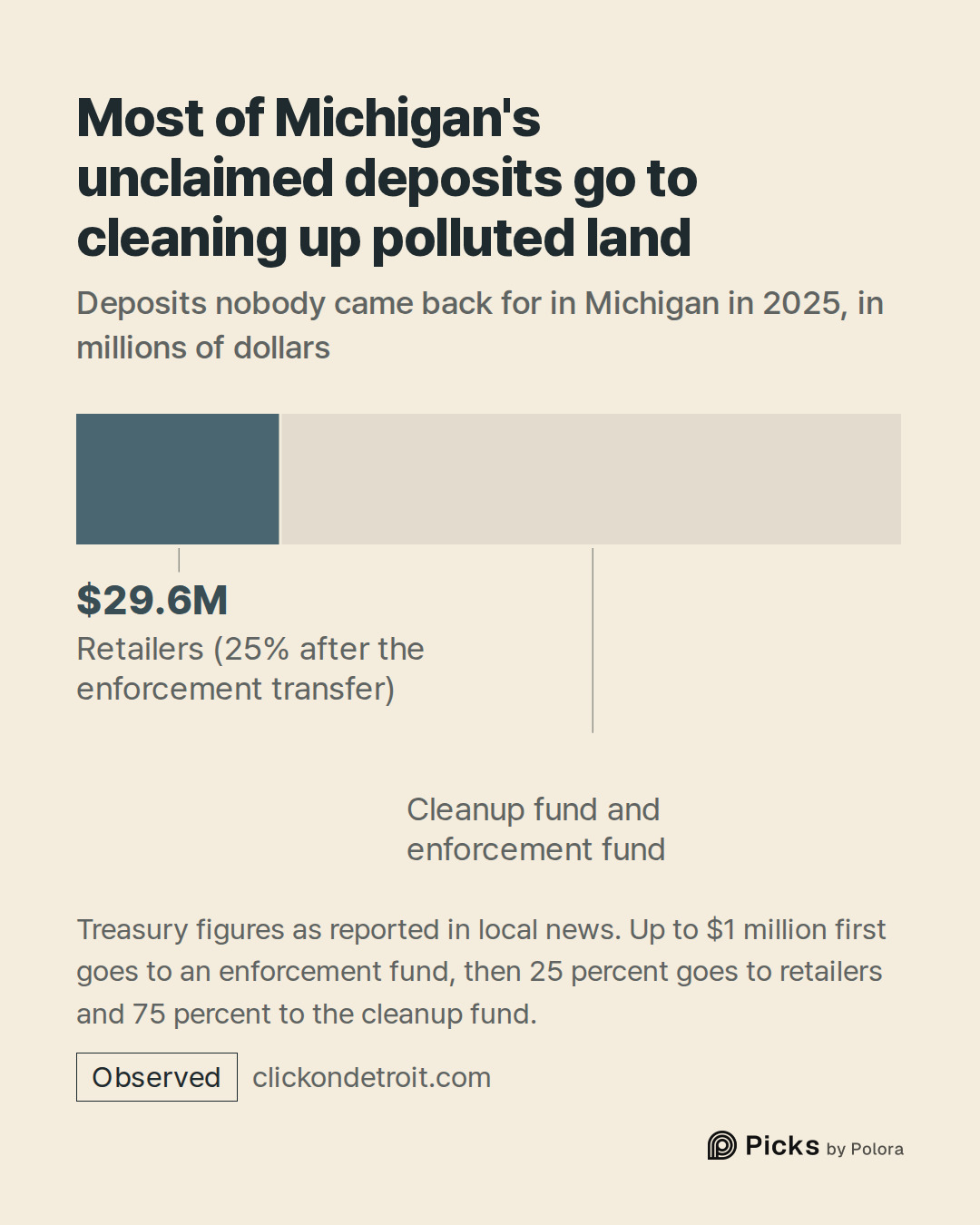
That money does not vanish, and it does not stay with the store that took it. Michigan law sends the first $1 million to a fund that enforces the deposit law. If that fund already holds more than $3 million, those transfers stop until its balance falls below $2 million. The rest is split. Retailers get 25 percent, divided according to the containers they handle, which came to $29.6 million in 2025 according to the same report. The other 75 percent goes to the state's Cleanup and Redevelopment Trust Fund, which pays for environmental cleanup.

So in Michigan, the deposits left on unreturned bottles are pooled, and most of that pool helps pay to clean up polluted land. No single can's 10 cents can be followed to a particular site. It is a rule for dividing up the total. Cross a border and the rule is different, and the money goes to one of three main places.
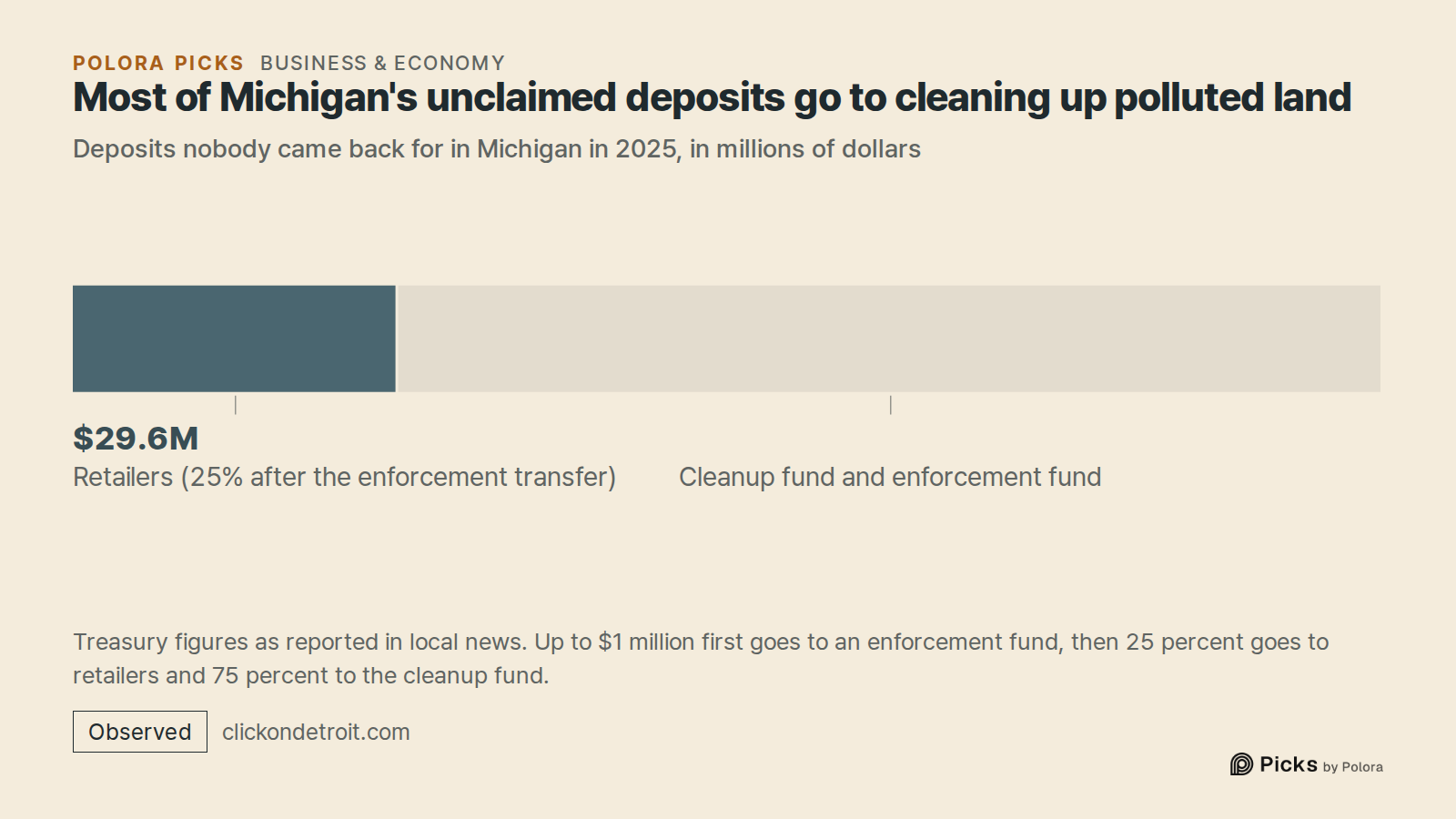
Most of Michigan's unclaimed deposits go to cleaning up polluted land · Deposits nobody came back for in Michigan in 2025, in millions of dollars · Retailers (25% after the enforcement transfer) · $29.6M · Cleanup fund and enforcement fund · Treasury figures as reported in local news. Up to $1 milli
Deposits nobody came back for in Michigan in 2025, in millions of dollars

In some states the unclaimed deposit becomes state money

In Massachusetts, unclaimed deposits have belonged to the state since a 1989 change to the law. They were first meant for a fund that paid for recycling. Since 2003 they have gone into the state's general fund, the same pot that pays for everything else the state does.

New York changed its rules in 2009. Before that, beverage distributors kept all unclaimed deposits. Now they keep 20 percent and send 80 percent to the state. According to a local news explainer, the first $23 million of the state's share goes to the Environmental Protection Fund and most of the rest goes to the general fund.

Vermont made the same switch more recently. Until 2019 its unclaimed deposits stayed with beverage makers and distributors. Since October 2019 they have gone to the state, which counts them as revenue for its Clean Water Fund. The current law also allows some of that money to be moved to a solid waste assistance account in fiscal years 2030 to 2033.

The route can also run the other way. Connecticut sent all unclaimed deposits to the state for more than a decade. Under a 2021 law, amended in 2023, distributors now keep part of them. The state legislature's research office reports that from fiscal year 2026 the share sent to the state depends on the previous year's return rate. In fiscal 2026 that share is 25 or 45 percent depending on the rate, with different percentages set for later years.
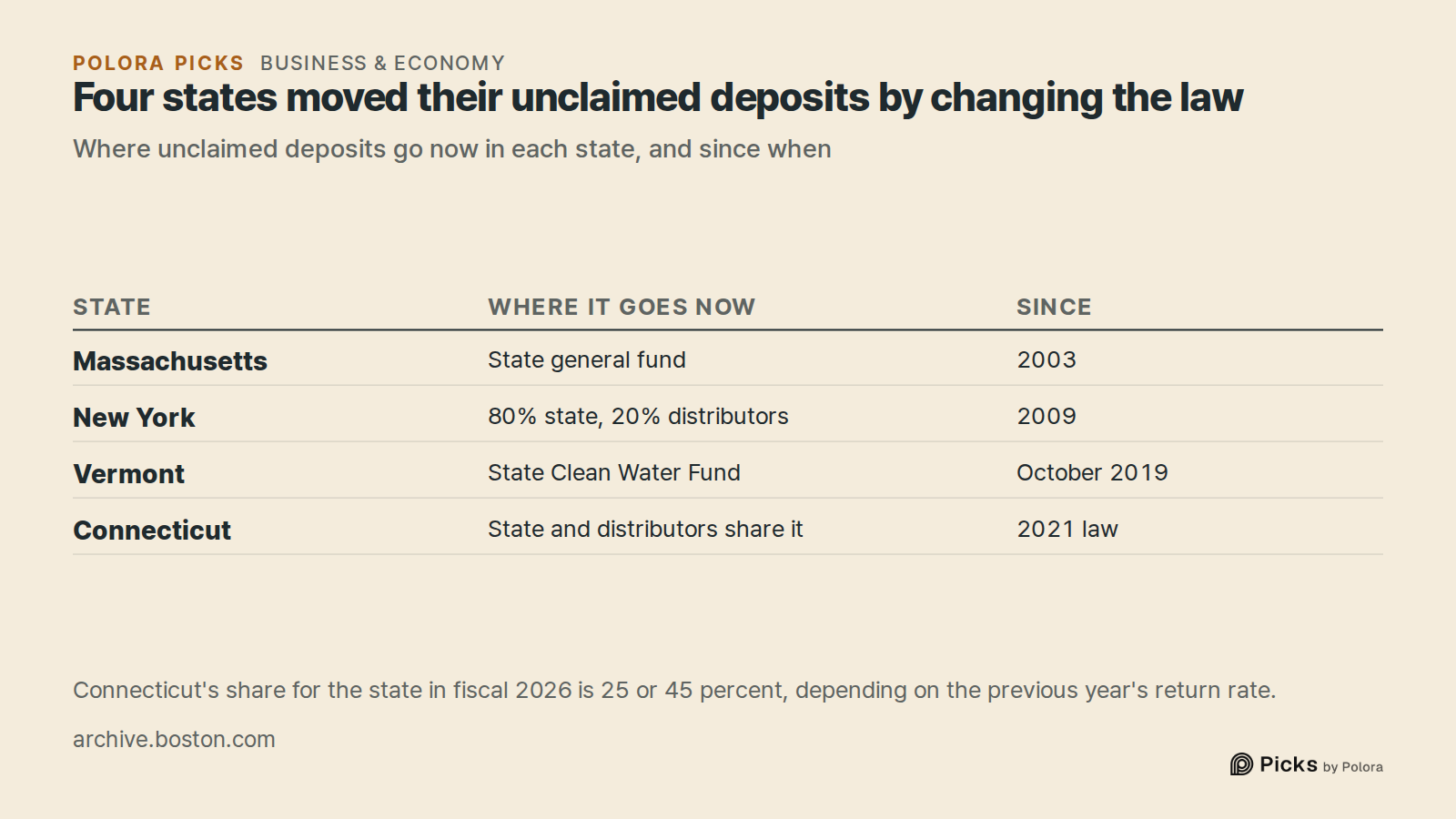
Four states moved their unclaimed deposits by changing the law · Where unclaimed deposits go now in each state, and since when · State · Where it goes now · Since · Massachusetts · New York · Vermont · Connecticut · State general fund · 2003 · 80% state, 20% distributors · 2009 · State Clean Water F
Where unclaimed deposits go now in each state, and since when

In Iowa and Germany the beverage companies keep it, and the total is hard to pin down

Iowa rewrote its bottle law in 2022 (Senate File 2378), effective in 2023. Under the state code, any refund money left with a beverage distributor after the payments the law requires belongs to the distributor. A 2002 state rule required distributors to keep and report records of deposits and returns. It is not clear whether those records produce an official yearly figure for the money left behind in Iowa.

Germany works on a similar principle for one-way plastic bottles and cans, which carry a 25 cent deposit. The money from a bottle that never comes back stays with whoever first charged the deposit. That is usually the bottler, and for a supermarket's own brand it is the supermarket itself. This is legal, and it is how the system was designed.

Germany's federal environment ministry says it has no figures of its own on how much this comes to. The best-known estimate comes from NABU, a German environmental group. It put the amount at about 180 million euros for 2015, assuming that 4 percent of bottles and cans were not returned. Change that assumed rate and the amount changes with it. The figure is an old estimate, not a count.

In Oregon, British Columbia and Norway the deposit pays for the return system

Oregon's return system is run by the Oregon Beverage Recycling Cooperative, which acts for the beverage industry. In 2024, by its own preliminary figures, 90.4 percent of containers came back and consumers got more than $206 million in refunds. The cooperative puts the unclaimed amount at $21.9 million and says all of it goes into running the system : return centers, bag drop-off, trucks, processing. Beverage distributors pay the rest of the cost.

British Columbia's system is run by Encorp Pacific, a not-for-profit. According to Encorp, for each type of container it first uses the unclaimed deposits and the money from selling the collected material. Only if that falls short does it add a container recycling fee to the price of the drink to cover the gap.

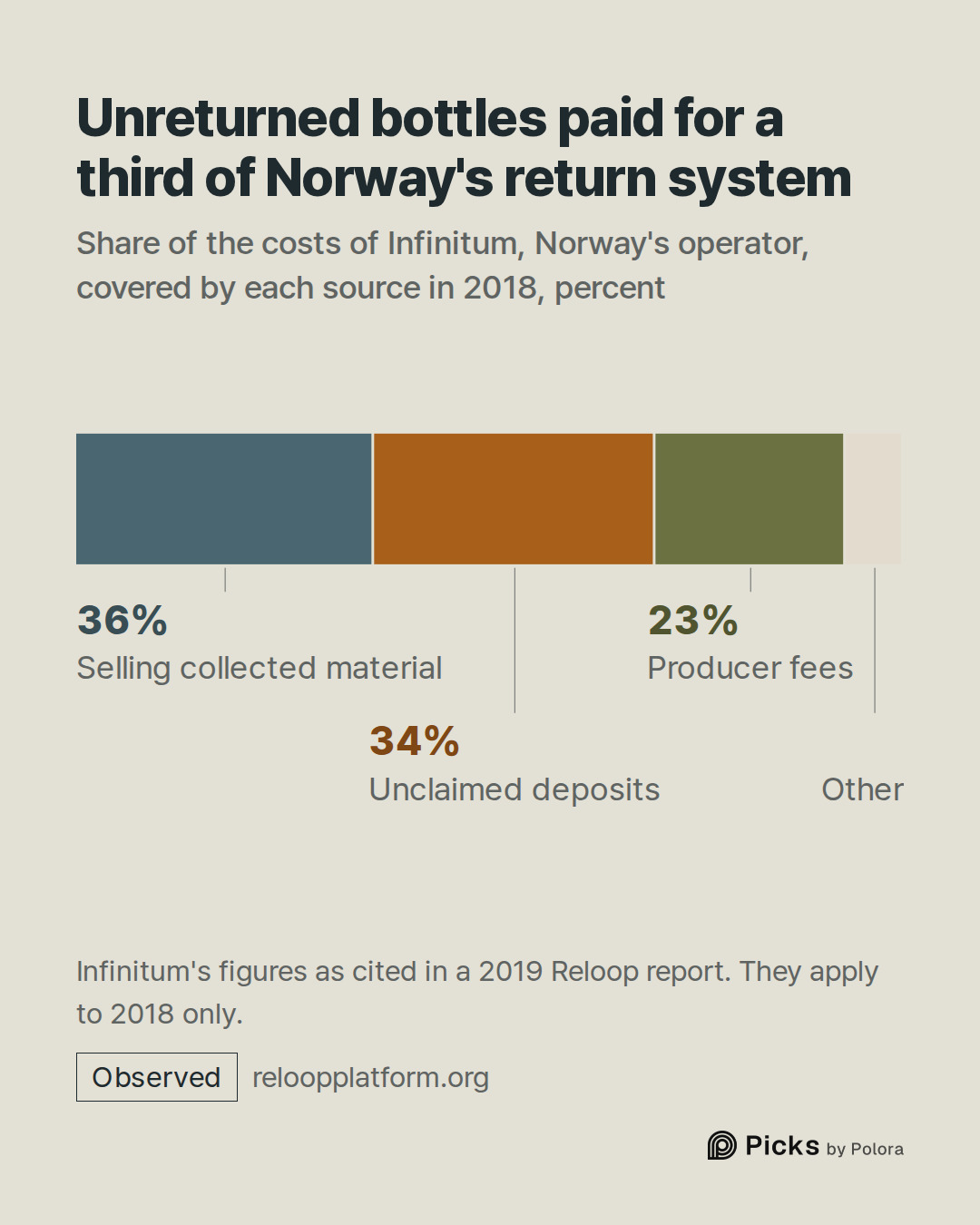
Norway's operator, Infinitum, is owned by beverage producers and retailers. According to a 2019 report by the group Reloop, citing Infinitum's figures, unclaimed deposits covered 34 percent of its costs in 2018 and selling the collected material covered 36 percent. Producer fees paid 23 percent. Those shares are for 2018 only.
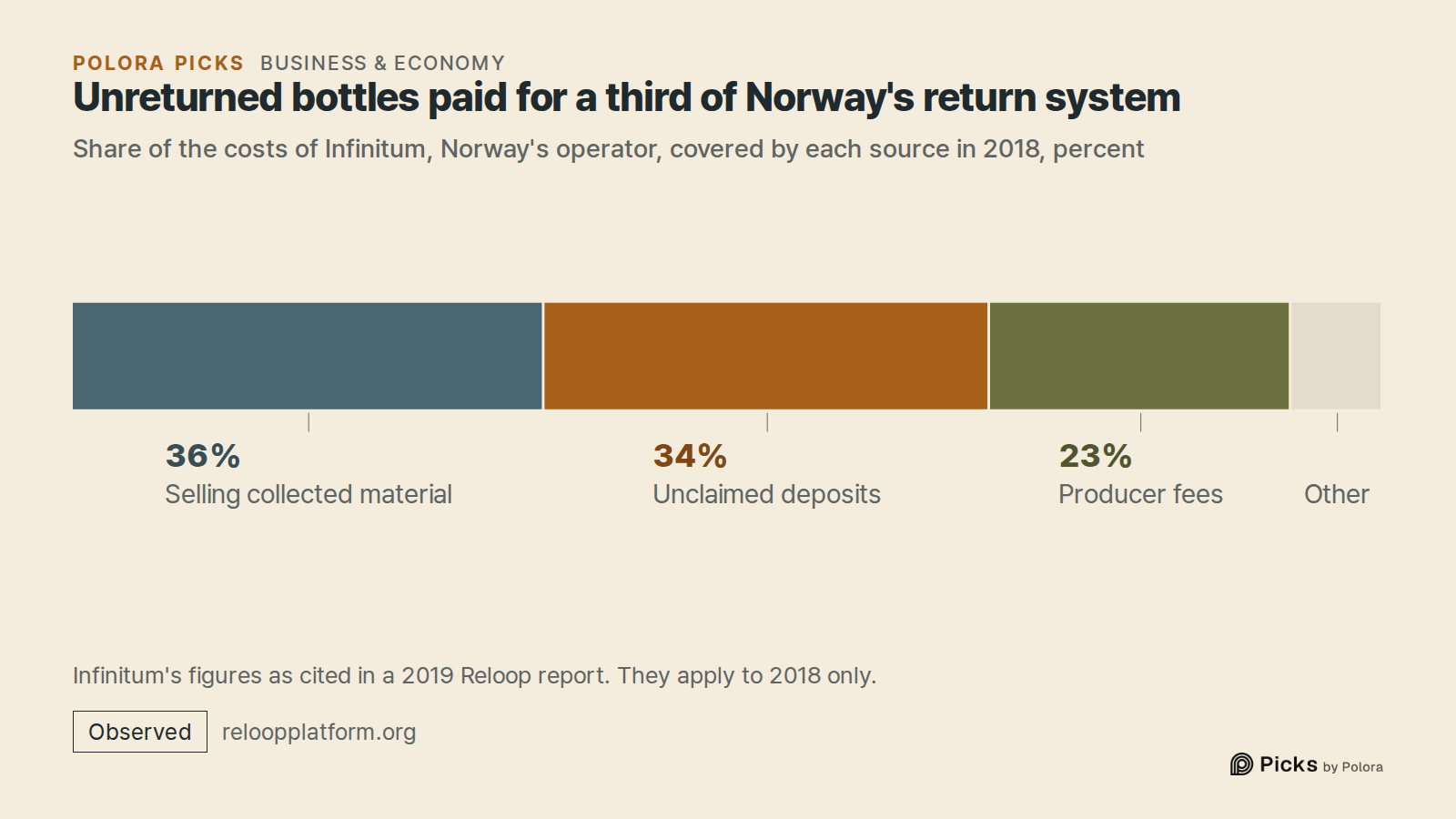
Unreturned bottles paid for a third of Norway's return system · Share of the costs of Infinitum, Norway's operator, covered by each source in 2018, percent · Selling collected material · Unclaimed deposits · Producer fees · 36% · 34% · 23% · Other · Infinitum's figures as cited in a 2019 Reloop repo
Share of the costs of Infinitum, Norway's operator, covered by each source in 2018, percent

Where operators run the system, people who don't return bottles help pay for it

Put Oregon, British Columbia and Norway side by side and a quiet fact appears. In operator systems, the unclaimed deposits, taken together, lower the bill the beverage industry would otherwise pay to run collection. In Norway in 2018, they paid for about a third of the system.

Oregon's cooperative has said openly that this could create the wrong incentive : if return rates fell far enough, unclaimed deposits could cover the whole system. A cooperative representative said in a 2024 interview that its board has a policy for that case. If the return rate ever drops below 80 percent, the unclaimed money beyond that line would go to a fund at the Oregon Community Foundation. This is the cooperative's own policy as described in that interview, not a state law. With reported rates above 90 percent, it has not been needed.

California sits between the routes. Its deposit, called CRV, goes into a state fund. A CalRecycle diagram shows unclaimed CRV supplying about 80 percent of the money the state uses to run the program, including payments to recyclers. That ties the program's budget to unreturned bottles too. In 2015 the state's Legislative Analyst warned that as more people recycled, the program had less money for its other costs and the fund was under strain.

A deposit is not the same as the fee stores get for taking bottles back

One thing is easy to mix up. The deposit is your money, held until you return the container. A handling fee is separate : it is what stores or return centers are paid for each container they take back. In Iowa, for example, distributors must pay a 3 cent handling fee for each container they accept from a participating store or redemption center, on top of the refund.

Michigan blurs the line. Its retailers receive 25 percent of the unclaimed deposits left after the enforcement transfer, divided according to the containers they handle. In practice that means stores in Michigan are partly paid for taking bottles back with money from the bottles that were never brought back.

The label promises you the money back, but the place decides where it goes if you don't take it

Every deposit system makes you the same offer : bring the container back and get your money. What none of them says on the label is what happens if you don't. That is settled by law, place by place. Pooled together, unclaimed deposits help fund cleanup in Michigan, the general budget in Massachusetts and clean water in Vermont. In Iowa they end up on beverage distributors' books, and in Oregon, by the cooperative's account, they pay for running the return centers.

So the deposit on an unreturned bottle is not money lost. It is money moved, and where you bought the drink decides who receives it.
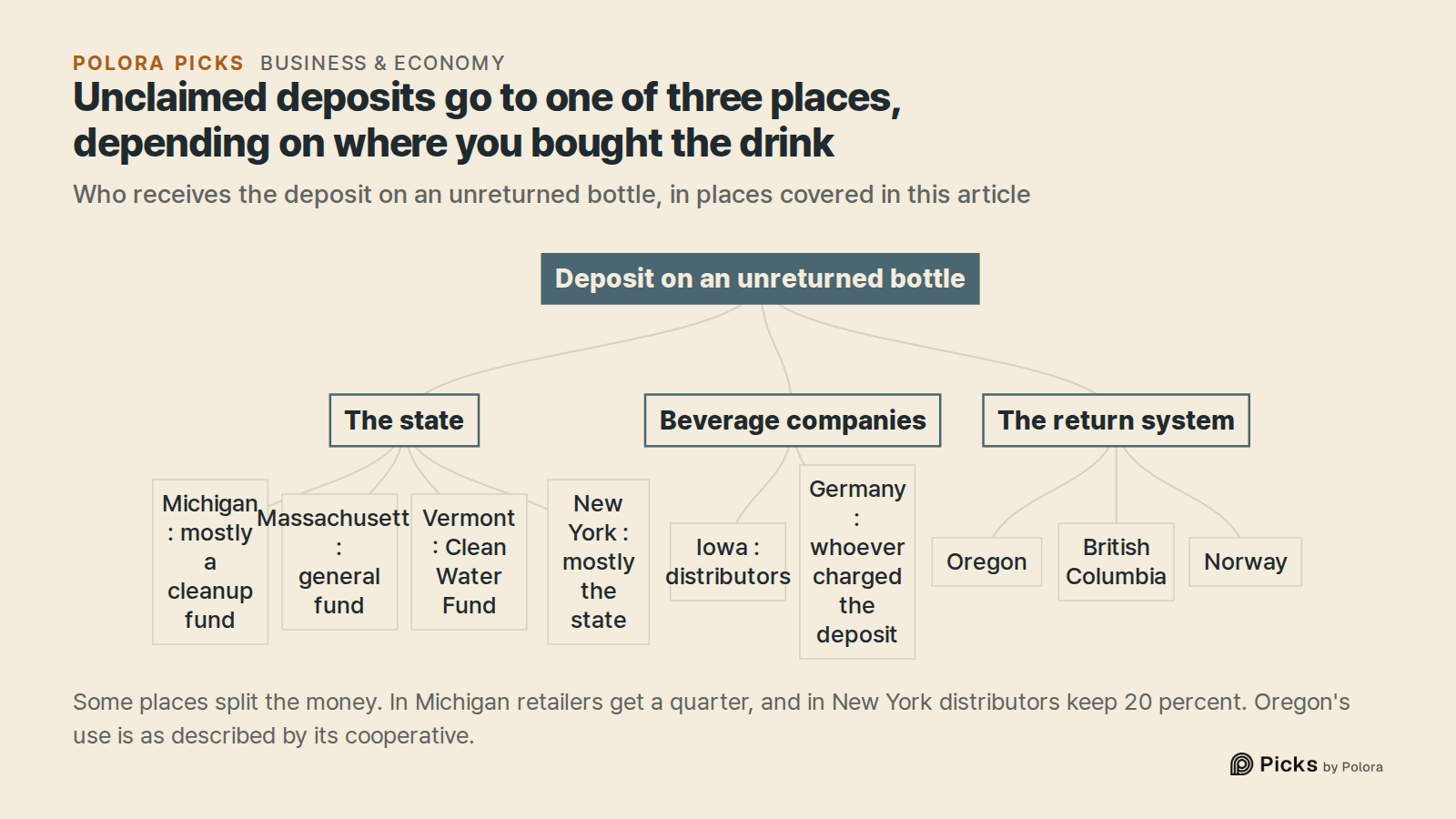
Unclaimed deposits go to one of three places, depending on where you bought the drink · Who receives the deposit on an unreturned bottle, in places covered in this article · Deposit on an unreturned bottle · The state · Beverage companies · The return system · Michigan : mostly a cleanup fund · Mass
Who receives the deposit on an unreturned bottle, in places covered in this article
Where does the bottle deposit go when nobody returns the bottle?Where does the bottle deposit go when nobody returns the bottle?Where you bought the drink decides who receives it. · The deposit on an unreturned bottle goes to the state, to the beverage companies or to the return system, depending on the law of the place.Who receives the deposit on an unreturned bottle · The state : a cleanup fund in Michigan, the general fund in Massachusetts, the Clean Water Fund in Vermont · Beverage companies : distributors in Iowa, whoever charged the deposit in Germany · The return system : Oregon, British Columbia and NorwayRetailers (25% after the enforcement transfer) · $29.6M · Cleanup fund and enforcement fund · Most of Michigan's unclaimed deposits go to cleaning up polluted land · Deposits nobody came back for in Michigan in 2025, in millions of dollars · Treasury figures as reported in local news. Up to $1 milliSelling collected material · Unclaimed deposits · Producer fees · 36% · 34% · 23% · Other · Unreturned bottles paid for a third of Norway's return system · Share of the costs of Infinitum, Norway's operator, covered by each source in 2018, percent · Infinitum's figures as cited in a 2019 Reloop repoThe deposit on an unreturned bottle is not money lost. It is money moved.Sources 23 : clickondetroit.com · Michigan bottle return rate falls to 69.4 percent as retailers push to overhaul bottle bill, legislature.mi.gov · Michigan Compiled Laws section 445.573c, archive.boston.com · Bottle law : it's about the money + 20Read the full story at · polora.ai
Where does the bottle deposit go when nobody returns the bottle?

Alpha · deepseek-v4-pro

The short answer: it doesn't vanish — it gets routed to whoever the law of the place where you bought the drink says it goes. Across the major deposit systems, those destinations fall into three broad groups. 1. To the state. - Michigan sends the first $1 million of unclaimed deposits to State Police enforcement of the bottle law. Of the rest, about 25% goes to retailers — $29.6 million in 2025 — and the remainder goes to the state's Cleanup and Redevelopment Trust Fund for environmental cleanup. In 2025, the unclaimed amount was about $119.2 million. - Massachusetts has sent unclaimed deposits to the state since 1989; since 2003 they go into the general fund. - New York changed the rule in 2009: distributors keep 20%, the state gets 80%. Of the state's share, the first $23 million goes to the Environmental Protection Fund and most of the rest to the general fund. - Vermont has sent unclaimed deposits to the state's Clean Water Fund since October 2019. 2. To the beverage companies or distributors. - Iowa, under its 2022 rewrite effective 2023, lets distributors keep unclaimed deposits, with no requirement to track the amount. - Germany works the…

Beta · gpt-6-sol

Alpha’s central answer is right: an unreturned deposit does not have one universal destination. But I would not publish all of the manuscript’s examples without qualifications. - Michigan: The statutory route is a bottle-deposit fund, then an enforcement allocation, with the remainder split 75% to the Cleanup and Redevelopment Trust Fund and 25% to dealers. The “first $1 million to enforcement” rule has an important exception: transfers are suspended when the enforcement fund’s balance exceeds $3 million, until it falls below $2 million. I could not independently confirm the manuscript’s 2025 dollar totals from Treasury data this turn. Source: Michigan Senate Fiscal Agency analysis. (legislature.mi.gov) - Iowa: The 2026 code expressly makes refund value *remaining with a distributor after required payments* the distributor’s property. It separately requires a three-cent handling payment for each container accepted from a participating dealer or re…

Gamma · gemini-3.1-pro

I agree with Beta that the manuscript’s core premise stands—unreturned deposits do not vanish, but are routed differently depending on the jurisdiction—and that the specific tracking of an individual bottle's ten cents is an accounting abstraction, not a physical reality. To supplement what Alpha and Beta have established, I ran live searches to verify several of the editor's specific requests regarding recent data and historical timelines: 1. Michigan’s 2025 Figures I can confirm the manuscript’s numbers for Michigan. Recent reporting from late 2026, citing the Michigan Department of Treasury, confirms that the state's return rate dropped to 69.4% in 2025. This left exactly $119.2 million in unclaimed deposits. *Source: Noticias Ambientales reporting on Michigan Treasury data (October 2026).* 2. Massachusetts General Fund The manuscript's timeline for Massachusetts is accurate. The state's first escheat law for container deposits was passed in 1989. While funds initially went to a Clean Environment Fund, state audits and legislative reports confirm that since 2003, these unclaimed deposits have been transferred to the state's General Fund. *Source: Massachusetts Offi…

Researcher · gpt-6-luna

Research check The broad premise holds: an unredeemed deposit is routed according to the law and accounting rules of the place where the container was sold. But several specific claims need qualification, and some of the most vivid examples are not established by the sources retrieved. - Michigan: Michigan’s statute is the relevant primary source, but I could not verify the manuscript’s 2025 totals or its specific allocation of unclaimed deposits from the statutory text retrieved. So the figures—$119.2 million unclaimed and $29.6 million to retailers—remain unconfirmed here. Don’t present them as independently verified on this check. Michigan Compiled Laws, chapter 445 - Iowa: The code says that refund value or handling fees remaining with a distributor after required payments are the distributor’s property. That supports the basic claim about where a remaining balance goes, but it does not by itself show that no official tracking exists. A separate Iowa administrative rule requires distributors to keep and report deposit and redemption records; whether that yields an official statewide unclai…

The Arbiter · gpt-6-sol

Round mediation — what remains to test before the verdict The voices agree on the basic distinction: the rules differ by jurisdiction, and an *aggregate balance* of unredeemed deposits can be allocated without anyone tracing a particular bottle’s ten cents to a particular expense. They also agree that a deposit and a return-site handling payment are different things. The clearest supported example is Michigan’s allocation rule. I checked the current statute: it directs the first $1 million to a bottle-law enforcement fund, then splits the remainder 75% to the Cleanup and Redevelopment Trust Fund and 25% to dealers according to containers handled. The enforcement transfer is suspended if that fund’s balance exceeds $3 million, until it falls below $2 million. That qualification is missing from the manuscript. The statutory source is MCL § 445.573c; it does not, by itself, establish the manuscript’s 2025 dollar figures. (legislature.mi.gov) The most consequential unresolved claims are: - Michigan’s 2025 totals: Gamma r…

The Arbiter's Final Verdict · gpt-6-sol

Verdict An unreturned bottle deposit has no universal destination. The governing law and the return system’s accounting rules decide whether the unredeemed balance goes to a public fund, remains with a distributor, or helps finance the return system. That central premise of the manuscript stands. What does not follow is that anyone can trace one particular bottle’s ten cents to one particular cleanup job or truck. For publication, I would separate the well-supported routes from the examples that still need checking: | Manuscript claim | Finding | |---|---| | Michigan’s allocation | Supported, with a missing exception. MCL § 445.573c provides for an enforcement transfer, then a 75% cleanup-fund / 25% dealer split. The enforcement transfer is suspended when that fund exceeds $3 million, until it falls below $2 million. The statute does not establish the manuscript’s 2025 totals; those remain figures attributed to Treasury in news coverage, not independently verified here. The displayed rounded amounts, $389.7 million and $270.4 million, subtract to $119.3 million, so the reported $119.2 million s…