Your library didn't buy the ebook you just borrowed
When you borrow an ebook through a library app like Libby, it feels like borrowing a book from the shelf. Behind the screen, though, it works differently. For many titles, especially from the largest publishers, the library does not own that copy. It holds a license, which is permission to lend the copy on terms the publisher sets, and the license often runs out.
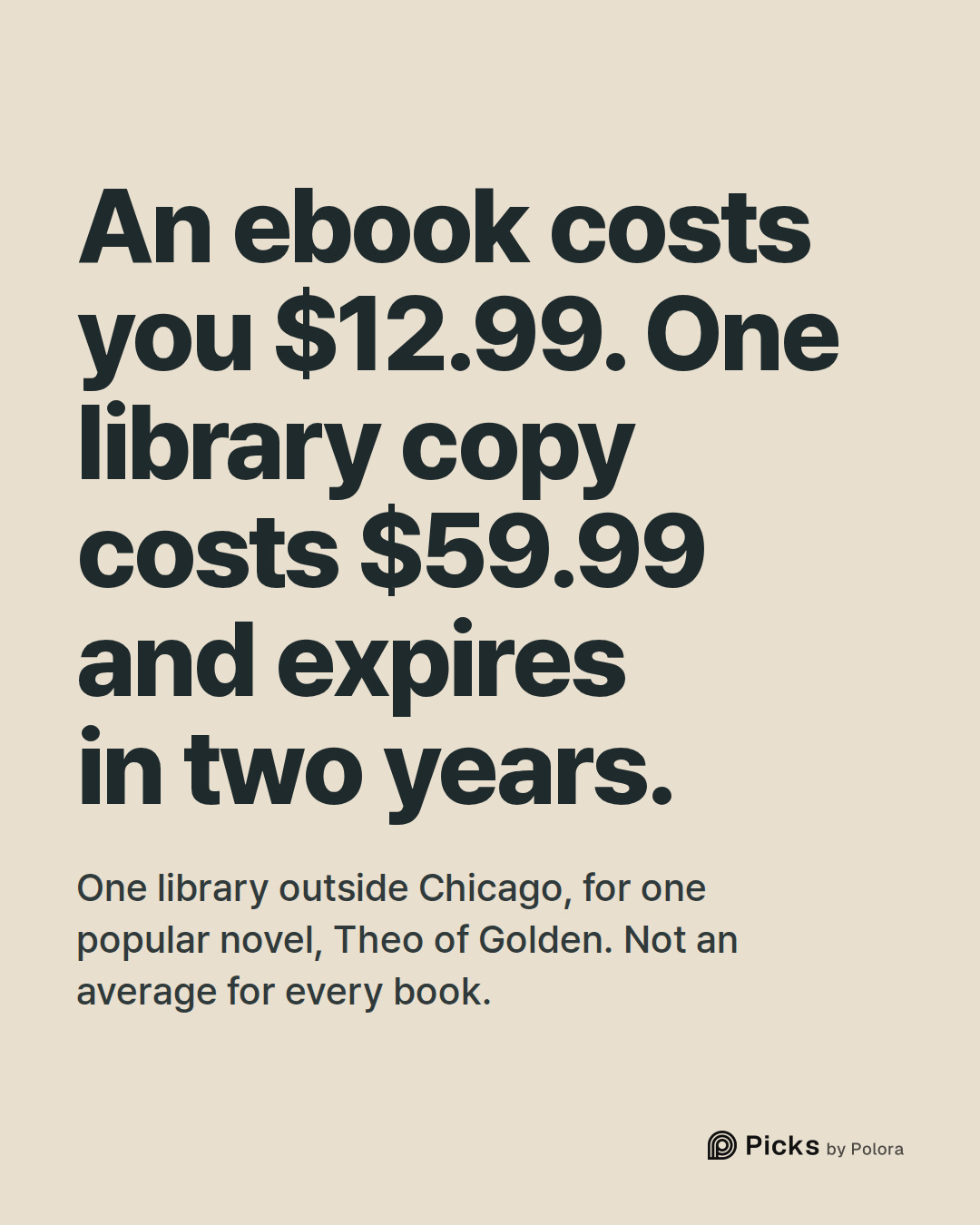
Take one library's numbers. The Schaumburg Township District Library, outside Chicago, published what it pays for the novel Theo of Golden. A reader can buy the ebook for $12.99. The library pays $59.99 for one copy, and that copy expires after two years. The audiobook costs a reader $16.99 and costs the library $89.99, also for two years. Those are one library's figures for one popular title, not an average for every book. The library's digital services librarian gave these figures to the Daily Herald, which reported in October 2026 that libraries commonly pay four or five times what a consumer pays.
A print book is owned. An ebook is rented.
When a library buys a hardcover, the library owns it. The library can lend it until it falls apart. Many ebooks are different. The library is renting them.
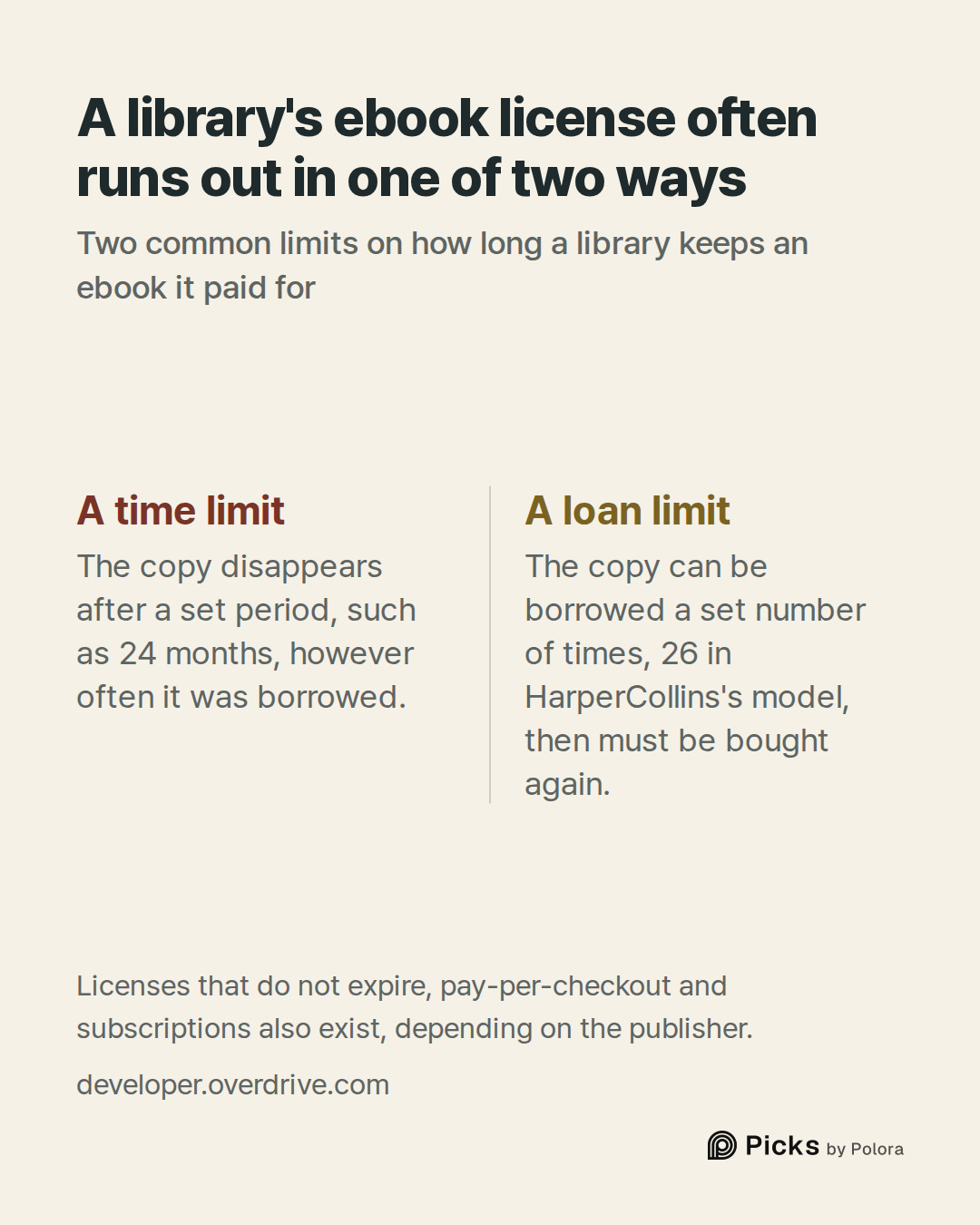
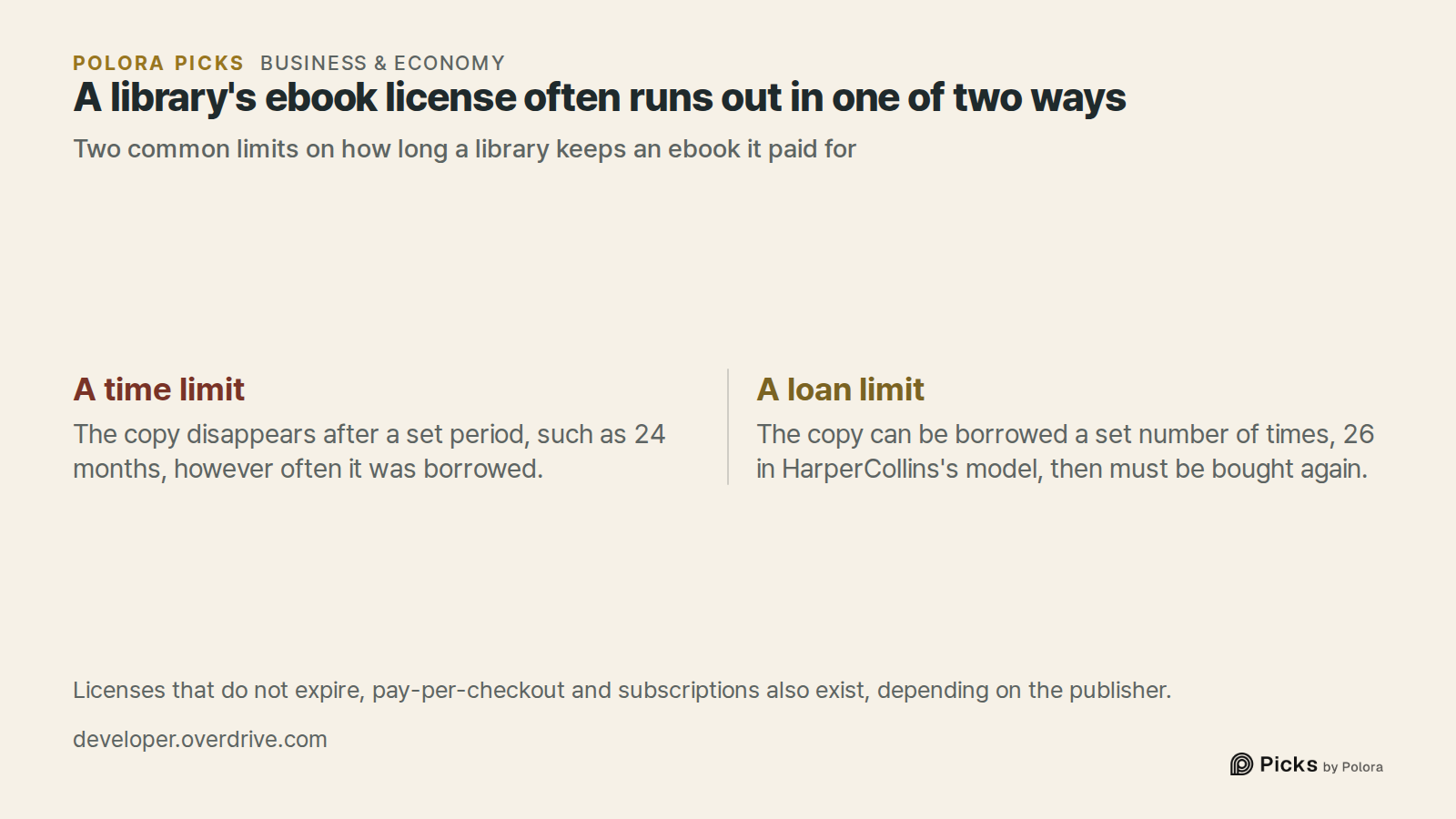
There are two common ways the rent runs out. One is time : a license like Schaumburg's disappears after 24 months, however often it was borrowed. The other is a loan count : HarperCollins introduced a model in 2011 in which a copy can be borrowed 26 times before the library must buy it again. Either way, a book the library already paid for can drop out of the catalog, and the library pays again to keep it. These are not the only terms on offer. OverDrive, the company behind Libby, also lists licenses that do not expire, as well as pay-per-checkout and subscription models. Which ones a library can choose depends on what each publisher allows.
Popular titles multiply the cost. To keep the waiting list for Theo of Golden manageable, Schaumburg bought 10 licenses of each format. That came to nearly $1,500 for digital access to a single title, and all of it will expire.
When did libraries stop owning ebooks?
Libraries could once buy ebooks with no end date. In publishing, the five largest houses are known as the Big Five : Penguin Random House, HarperCollins, Simon & Schuster, Hachette and Macmillan. HarperCollins moved away from open-ended licenses first. Readers First, a group of nearly 300 libraries, dates the wider change to 2018, when the other large publishers began trading that model for time-limited terms. The shift took a few years. Macmillan, for one, ended its last perpetual ebook option in March 2020, according to OverDrive.
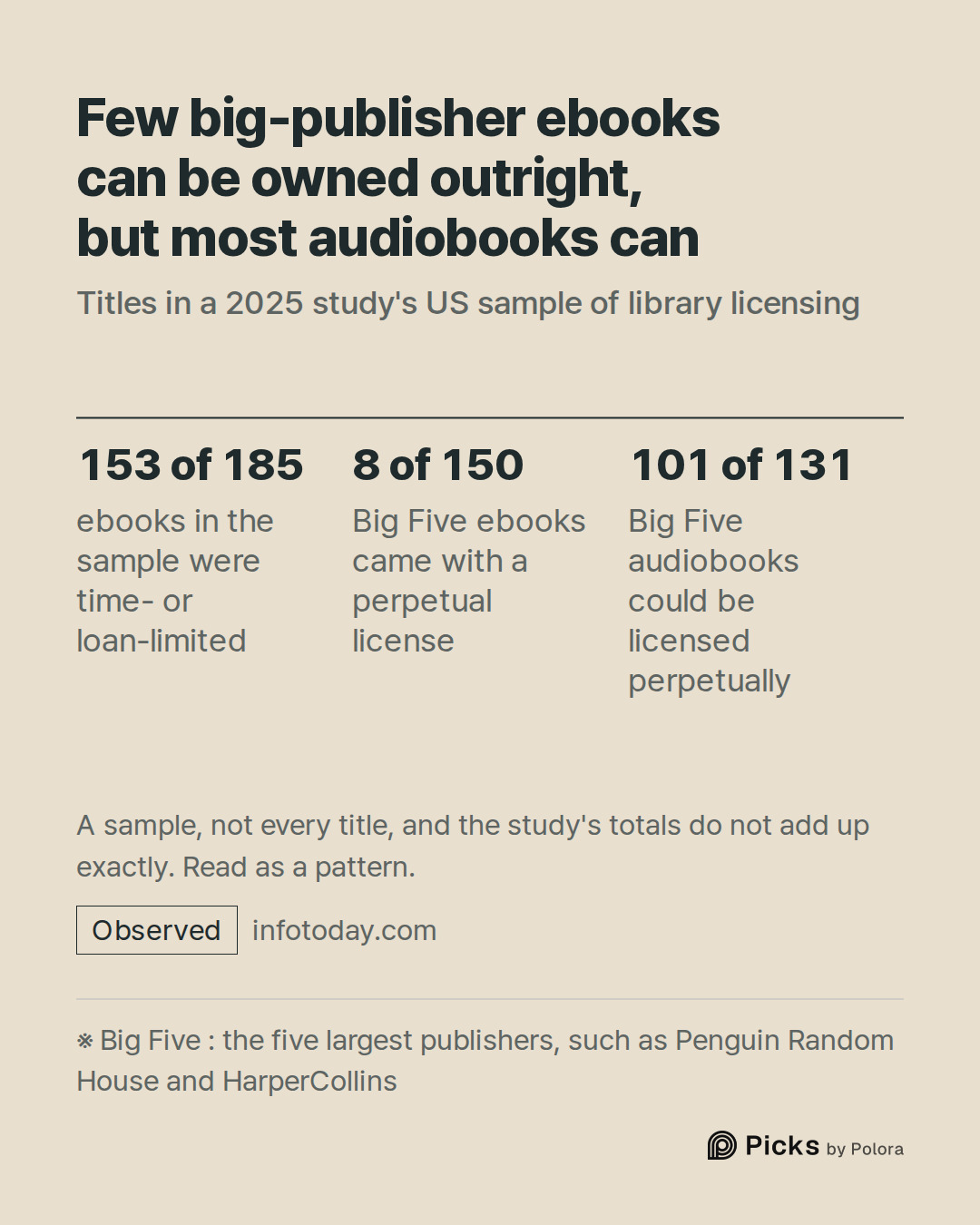
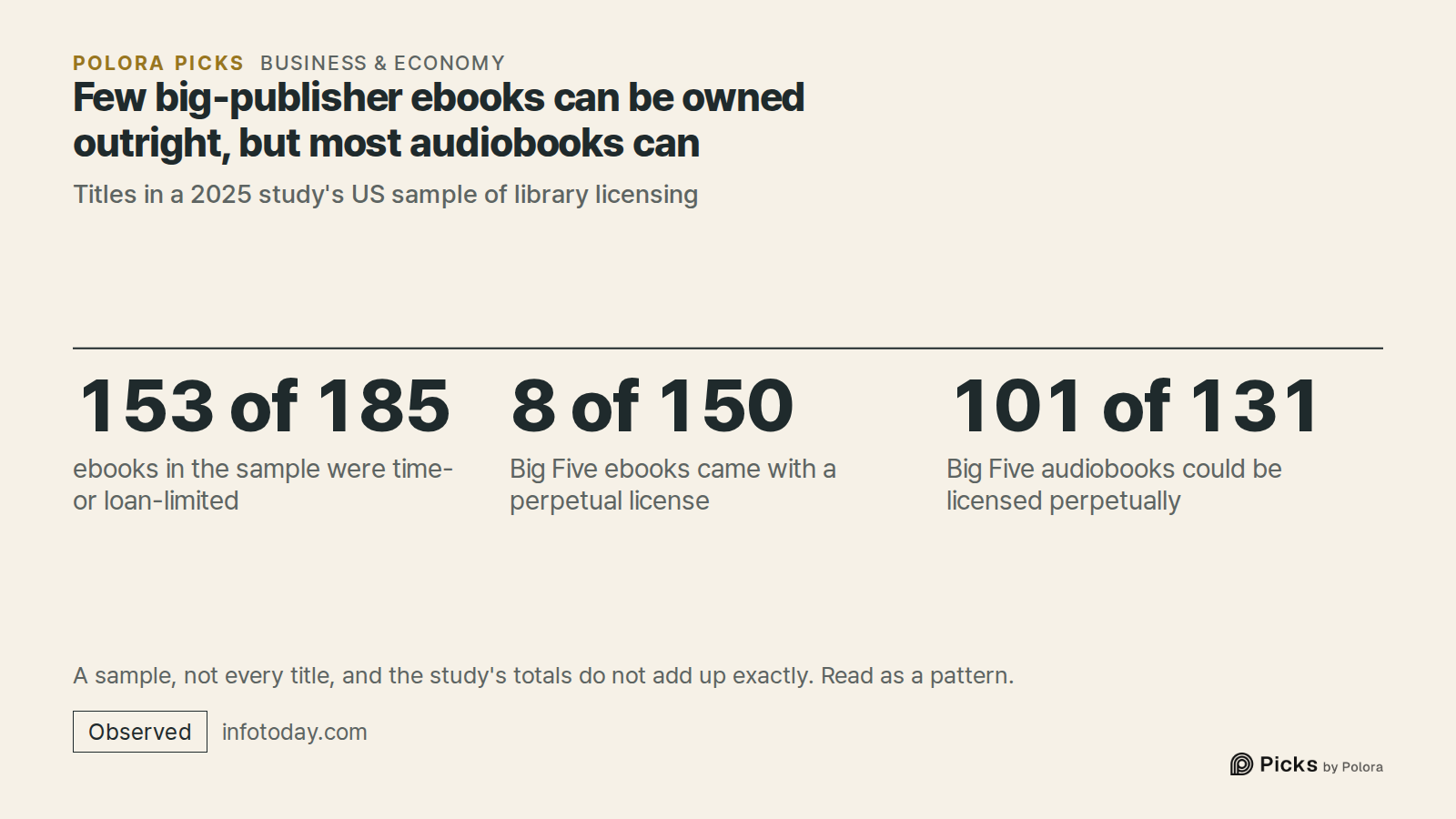
A 2025 follow-up study of ebook licensing in Canada and the US, published in Computers in Libraries, found that 153 of the 185 US ebook titles available in its sample, or 82.7%, were metered, meaning time- or loan-limited. That figure covers all the titles in the sample, not only the Big Five. Among 150 titles published or distributed by the Big Five, only eight came with a perpetual license, and those came from older or smaller imprints. Penguin Random House, for instance, offered a choice of one-year or two-year terms on the same ebook. Audiobooks are the exception. Three of the Big Five still offer a perpetual option, and 101 of the 131 Big Five audiobooks in the study's US sample could be licensed that way. These are results from a sample, not a count of every title, and the study's own totals do not add up exactly, so they are best read as a picture of the pattern rather than precise shares.
These are North American terms. The sources here cover libraries in the United States and Canada. How libraries elsewhere license ebooks is a separate question that this piece does not answer.
Is a $60 ebook expensive if many people read it?
The reader's price and the library's price buy different things. A reader's copy serves one person. A library's license lets the library lend the book to one reader after another. A higher price for the second does not by itself show that the price is unfair, and it does not show that it is fair either.
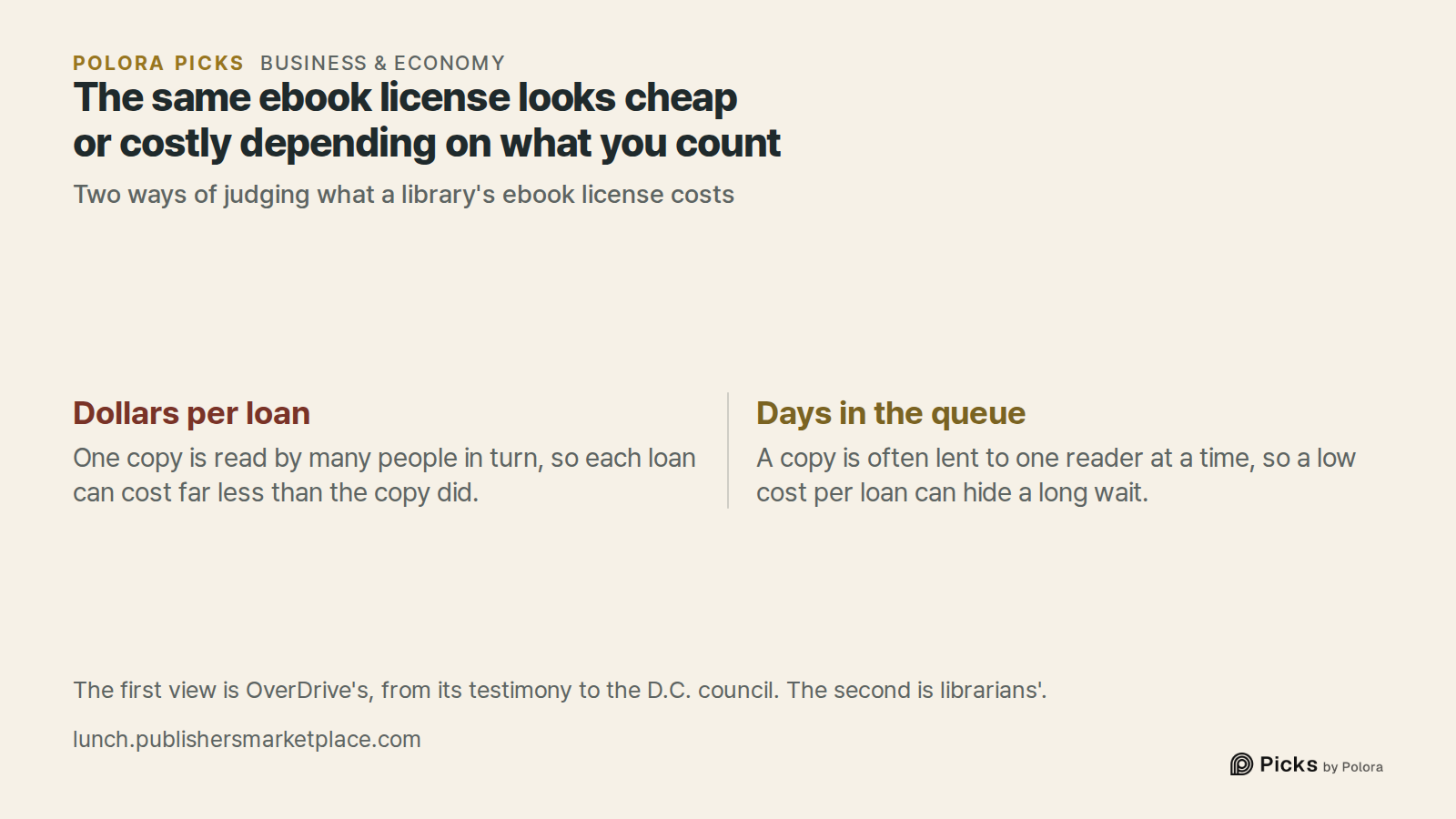
Nor is the price per copy the only way to measure cost. Because one library copy is read by many people in turn, what a library pays for each loan can be far lower than what it paid for the copy. OverDrive made its case along these lines to the Washington, D.C. city council in written testimony filed in January 2026, opposing a bill that would limit the licenses the city's library may sign. It argued the bill would take flexible arrangements away from librarians.
Librarians answer that a low cost per loan can hide a long line. A copy is often lent to one reader at a time, and while it is out, everyone else waits. Both views describe the same system. Which one matters more depends on whether you count dollars per loan or days in the queue.
Why publishers say libraries should pay more
Publishers and authors argue that library lending, when it becomes too easy, can replace buying. Part of their case is what they call friction. Borrowing a print book takes effort : you go to the library, wait for a copy, and carry it back. Borrowing an ebook takes a few taps on your phone. According to the Daily Herald's reporting, publishers say higher prices and license restrictions are part of a move to restore some of that effort.
On September 1, 2026, the Association of American Publishers and the Authors Guild released a study they commissioned from the economic consulting firm Secretariat Advisors. It reports that consumer print sales fall by about 0.85 to 1.0 percent for every one-point rise in the share of ebooks held by public libraries, and that for bestsellers, library lending substitutes for retail ebook sales. That is the finding of a study commissioned by one side, not a settled fact. The two groups said the answer is to fully fund libraries, not to change the market.
Library groups dispute the study. The Ebook Study Group, joined by Readers First and others, issued a joint rebuttal arguing that the economists misread how library consortia share ebooks. Rhode Island, it notes, has 48 libraries sharing one catalog, and the rebuttal says the study counted that catalog as if each library held its own, overstating how many library ebooks are available by a factor of 48. That is the library groups' criticism, and it has not been settled by an independent review.
- Association of American Publishers : New study analyzes the impact of library e-lending on commercial book markets
- infoDOCKET : AAP and the Authors Guild release new study analyzing the impact of library e-lending on commercial book markets
- Ebook Study Group : New joint statement dismantling the study
- Daily Herald : Libraries pay more for e-books than consumers. State lawmakers are trying to change that
What libraries are asking for
On May 27, 2026, five library organizations representing most public libraries in the US and Canada sent a joint statement to the Big Five, the largest publishers. They were the Association for Rural & Small Libraries, the Chief Officers of State Library Agencies, the Canadian Urban Libraries Council, the Public Library Association and the Urban Libraries Council. They asked for licenses that run out after a number of loans rather than a period of time, and for a perpetual option to return, as three of the Big Five still allow for audiobooks.
Their point is less about paying less than about what a payment buys. The president of the Public Library Association said libraries will pay a fair price for fair services. The Authors Guild and the publishers' association replied that ebook legislation threatens authors' ability to earn a living from their work.
Can a state make ebooks cheaper for libraries?
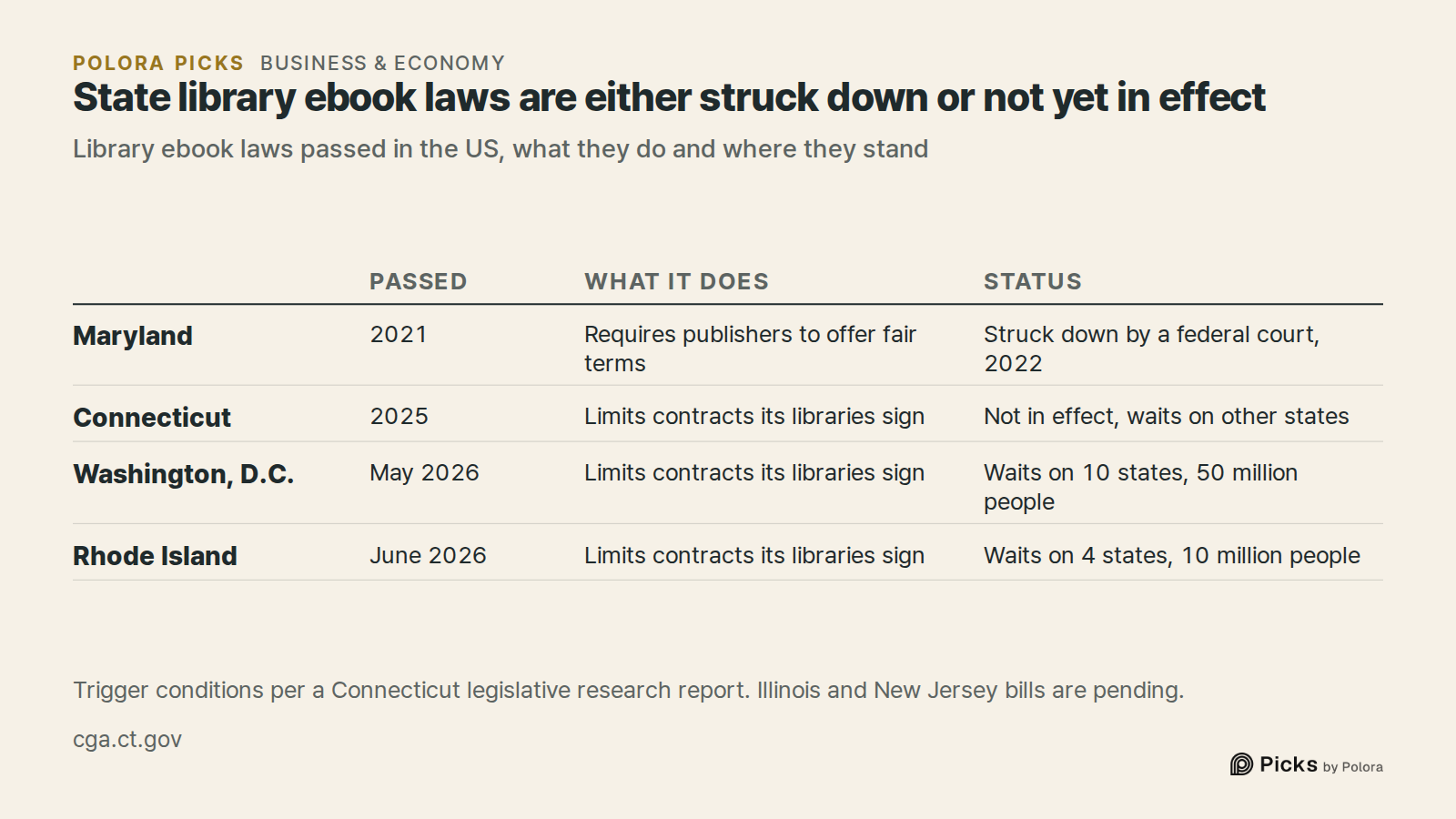
Not directly. In 2021, Maryland passed a law requiring publishers to offer ebooks to libraries on reasonable terms. A federal court declared it unconstitutional and unenforceable in 2022. The court held that federal copyright law gives publishers the right to decide when, to whom and on what terms they distribute their work.
So the newer laws take a different route. Instead of telling publishers what to sell, they limit which contracts a state's own libraries may sign. Connecticut passed one in 2025. Washington, D.C.'s mayor signed one on May 28, 2026. Rhode Island's became law in June 2026 without the governor's signature. None of the three is in effect yet. Each contains a trigger clause that holds it back until other states pass similar laws. According to a Connecticut legislative research report, Rhode Island's needs four other states with a combined 10 million people, and D.C.'s needs ten states with a combined 50 million.
Others are pending. Illinois's bill passed the state House 99 to 0 in April 2026 and, as of the latest reports, is waiting on the Senate. New Jersey's cleared an Assembly committee on October 15, 2026. There may also be some movement in the market itself. Readers First reports that, according to OverDrive, two of the Big Five are testing an option on select popular titles to buy copies that do not expire after a set time.
- Publishers Weekly : In final order, court declares Maryland's library e-book law unconstitutional
- Connecticut General Assembly, Office of Legislative Research : 2026-R-0123
- Words & Money : District of Columbia's library ebook bill is signed into law
- infoDOCKET : Statement after Rhode Island victory, Connecticut libraries call on more states to address predatory e-book pricing
- LegiScan : Rhode Island S2525, 2026
- Words & Money : Illinois library ebook law moves to the Senate
- Words & Money : New Jersey's library ebook law passes out of committee
- Schaumburg Township District Library : Why ebooks cost libraries more
The next time you borrow an ebook
The ebook you borrowed was quite possibly rented by your library, on terms that run out after a set time or a fixed number of loans, and often for several times what you would pay for it yourself. When it expires, the library pays again or the book leaves the catalog. The library is paying for something different from your copy : the right to lend it to one reader after another. Publishers and libraries are not mainly arguing about whether libraries should pay. They are arguing about what kind of rent is fair.