Why do ski resorts sell season passes for less than a few day tickets?

Because a pass sold months before the first snow gives the resort its money early and moves much of the risk of a bad winter onto the skier. At Vail Resorts, passes now bring in about 70% of lift revenue, and a steep peak-day walk-up price helps make the pass look like the obvious buy.

Business & Economy · 2026-11-13

A whole season for less than three days at the window

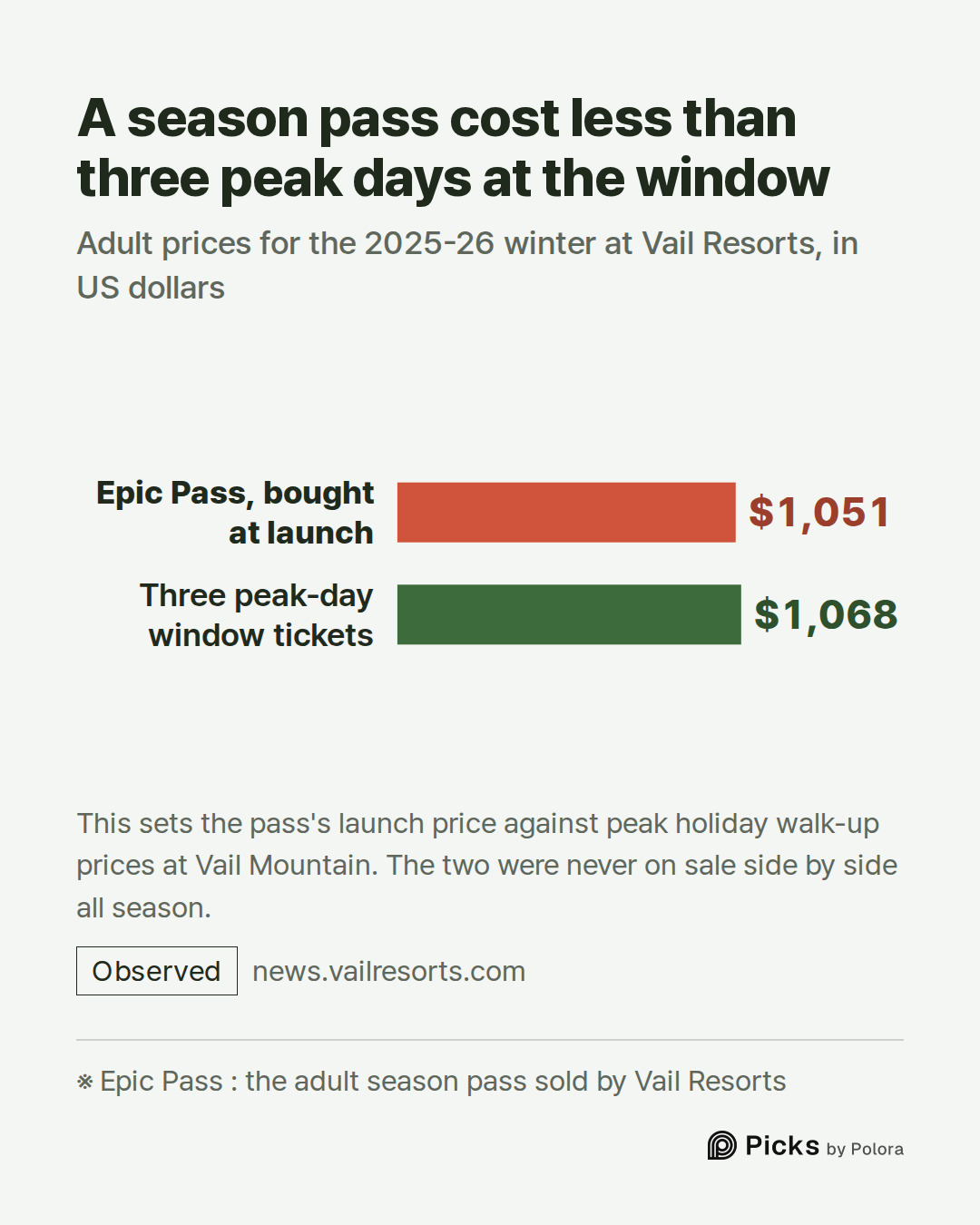
In March 2025, Vail Resorts put its adult season pass for the 2025-26 winter, the Epic Pass, on sale at $1,051, and called that the lowest price of the year. That same winter, on a peak holiday, one adult day ticket bought at the ticket window at Vail Mountain in Colorado cost $356. SnowBrains reported this as a record for an American ski resort. Three of those days come to $1,068. The pass, bought early and good for the whole season, cost less.

The comparison sets an early pass price against the most expensive days of the year. These were not two prices on offer side by side all season. Even so, the gap is real, and it was put there on purpose.

Most people would guess this is a bulk discount, like a gym membership that rewards regulars. That is part of it, and a frequent skier can get real value from a pass. But the company's own filings point somewhere else too. Much of what a resort sells with a pass is money in hand before anyone knows whether it will snow.
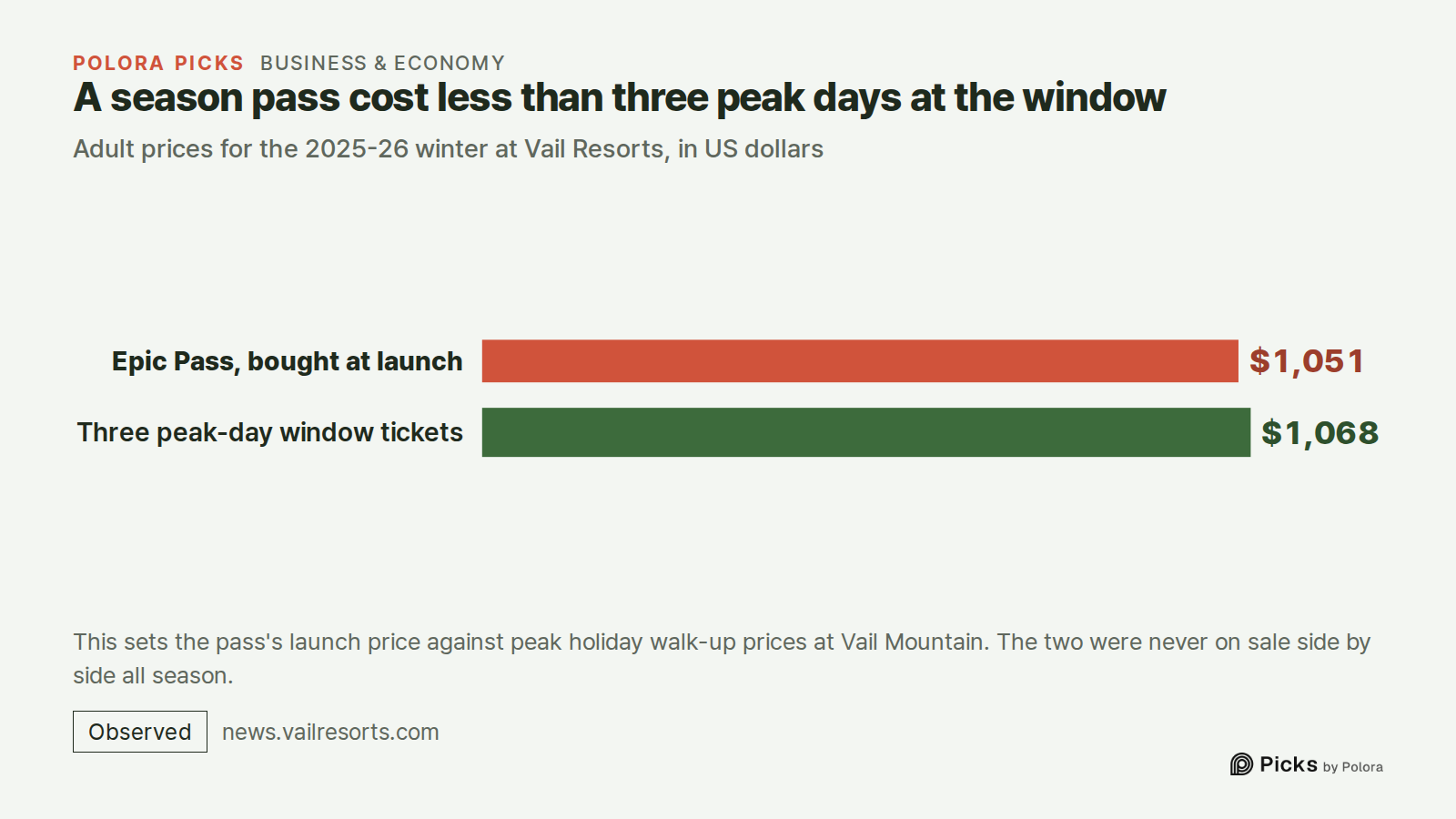
A season pass cost less than three peak days at the window · Adult prices for the 2025-26 winter at Vail Resorts, in US dollars · Epic Pass, bought at launch · Three peak-day window tickets · $1,051 · $1,068 · This sets the pass's launch price against peak holiday walk-up prices at Vail Mountain. Th
Adult prices for the 2025-26 winter at Vail Resorts, in US dollars

Why a ski company wants your money in spring

Vail Resorts is the largest ski resort owner in North America, and it launched the Epic Pass in 2008. It sells most of its passes before the lifts open. In its annual report, the company says the cash from those sales is “collected in advance”, and that its pass program “mitigates exposure to more weather sensitive guests, leading to greater revenue stability.”

That matters because a ski resort costs a lot to run whether or not anyone turns up. Lifts, snowmaking, land fees and staff have to be paid for regardless, and the same report says the company's cost structure “has a significant fixed component”. A resort that waits for walk-up skiers bets each winter on the weather. A resort that has already sold its season has passed much of that bet to its customers.

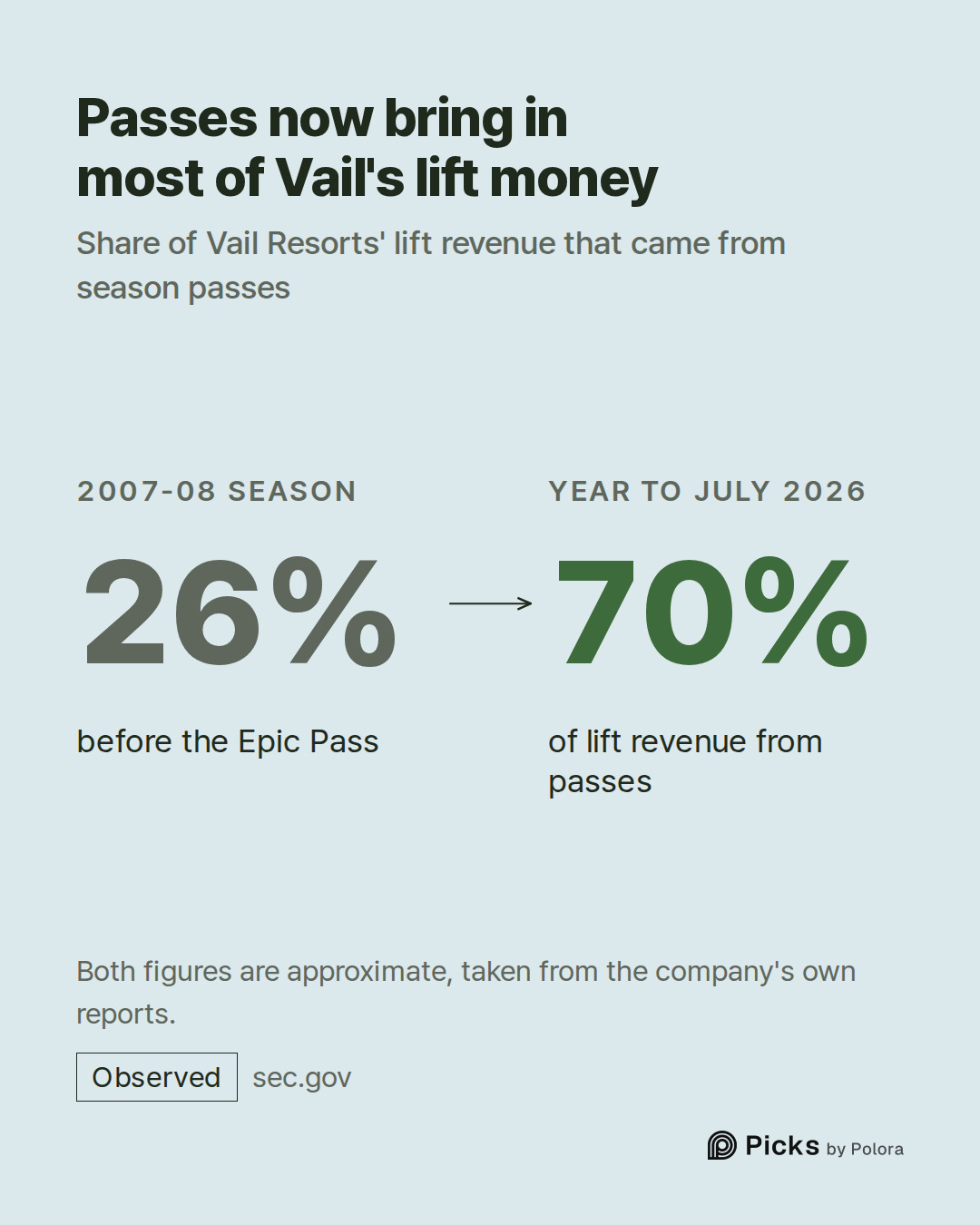
The share of lift money Vail collects this way has grown steadily. In the 2007-08 season, season passes brought in about 26% of Vail's lift ticket revenue. When the Epic Pass launched at $579 in 2008, the company said it hoped to raise that share. In the year to July 2026, passes brought in about 70% of Vail's lift revenue and accounted for about 73% of its skier visits.
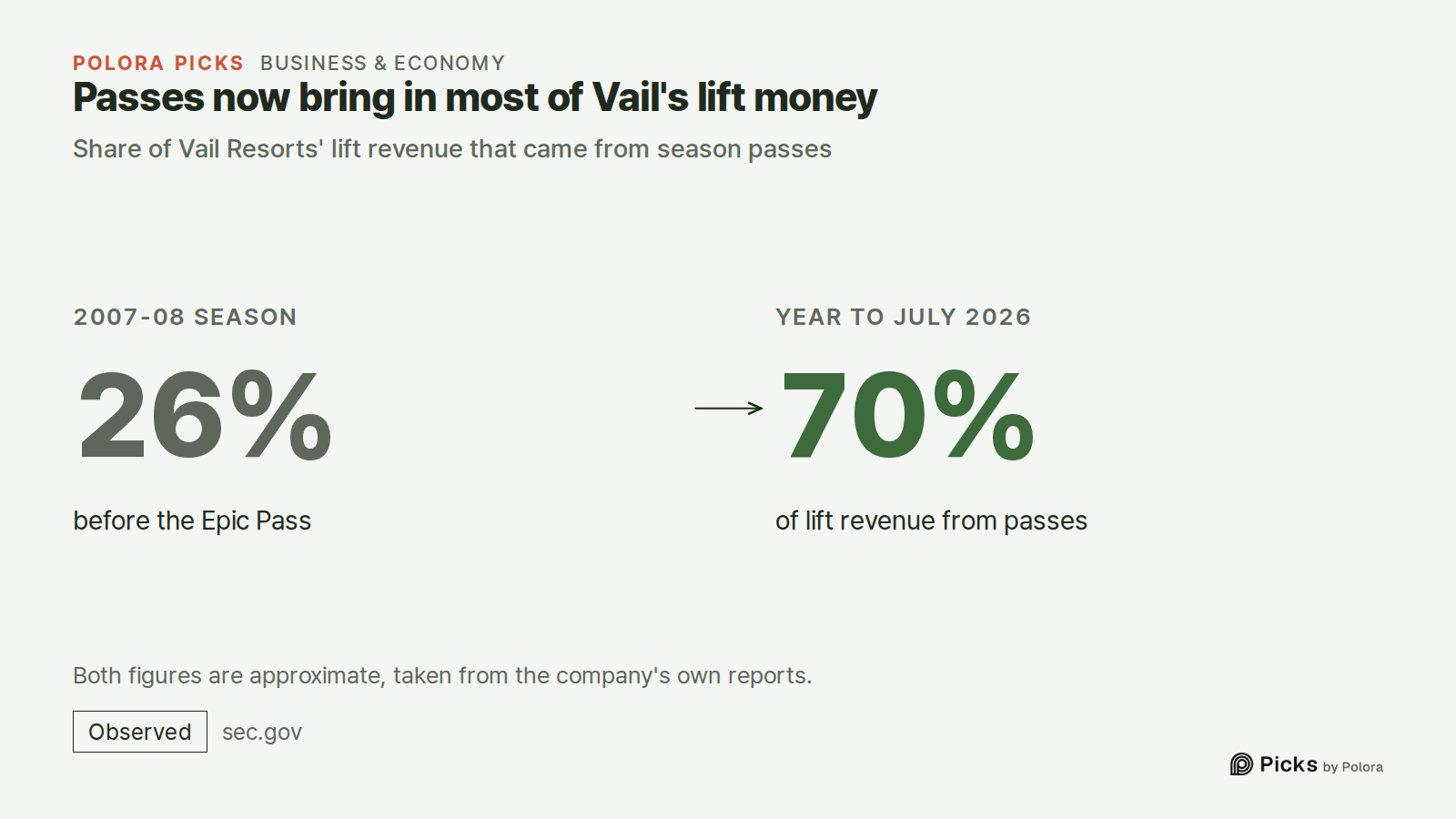
Passes now bring in most of Vail's lift money · Share of Vail Resorts' lift revenue that came from season passes · 2007-08 season · 26% · before the Epic Pass · Year to July 2026 · 70% · of lift revenue from passes · Both figures are approximate, taken from the company's own reports.
Share of Vail Resorts' lift revenue that came from season passes

What happened when the snow did not come

The 2025-26 winter put the idea to the test. Snow across the western United States was at or near record lows. According to National Ski Areas Association figures reported by the Denver Gazette, visits to US ski areas fell to 52.6 million, down nearly 15% from the season before. That is the association's preliminary estimate, set against 61.6 million visits in 2024-25.

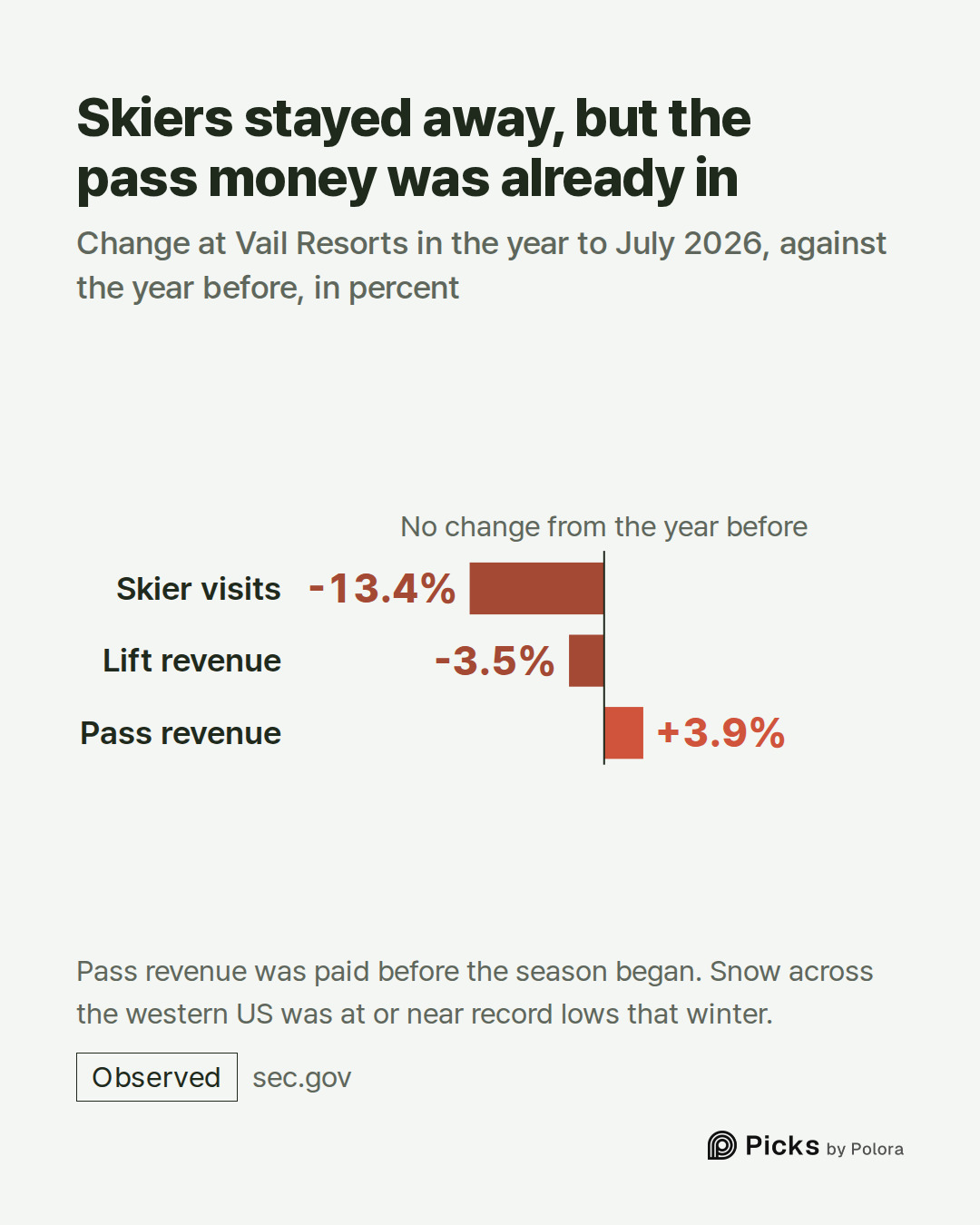
Vail's financial year runs to the end of July, so one year covers one ski season. In the year to July 2026, its skier visits fell 13.4%. Its lift revenue fell only 3.5%, because pass revenue, paid before the season began, rose 3.9%. Midway through that winter, chief executive Rob Katz pointed to “the strength and stability shown by our operating model” in “what many would consider a worst-case weather scenario.”

The figures suggest that much of the cost of the bad winter fell on pass holders. Many had paid in full and then skied fewer days, or on less open terrain, than they had planned. Vail's Epic Coverage refunds passes in some specified circumstances, but ordinary poor snow and limited terrain generally do not qualify. That is what a pass is underneath its price. The buyer takes on much of the weather risk, and in an ordinary bad winter the resort keeps the money.
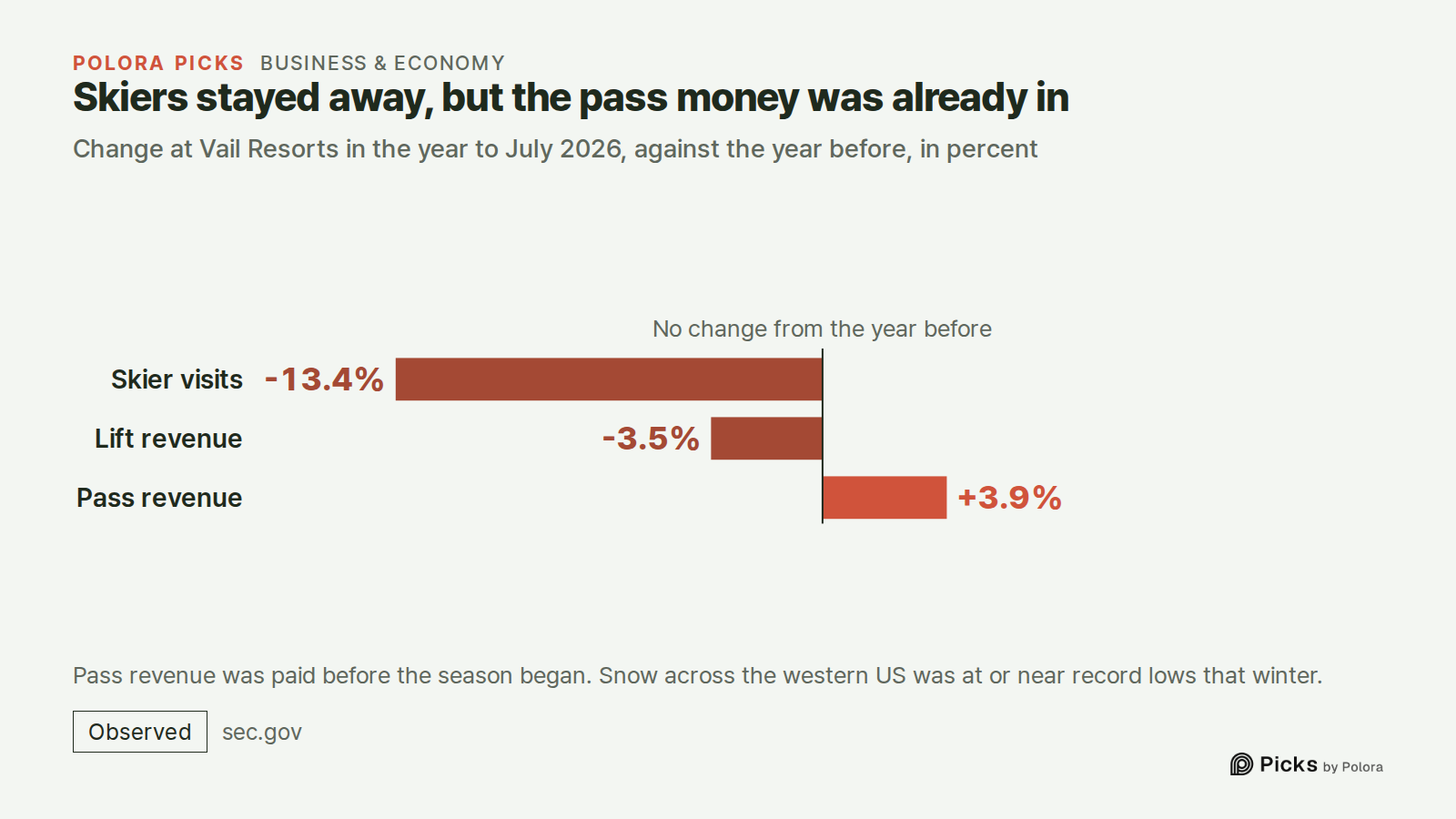
Skiers stayed away, but the pass money was already in · Change at Vail Resorts in the year to July 2026, against the year before, in percent · No change from the year before · Skier visits · Lift revenue · Pass revenue · -13.4% · -3.5% · +3.9% · Pass revenue was paid before the season began. Snow ac
Change at Vail Resorts in the year to July 2026, against the year before, in percent

The $356 ticket is not the price most people pay

Vail reports a number it calls the effective ticket price. It takes all lift revenue, from passes and day tickets together, and divides it by skier visits, where one visit is one person skiing for one day. In the year to July 2026, Vail took in about $1.45 billion in lift revenue over about 15.3 million visits, or $94.85 a visit. That is an average across pass and ticket visits, not what a day ticket typically costs. The peak-day window price was more than three and a half times that average.

So who is the $356 price for? Katz has spoken about it himself, in remarks attributed to an interview with the Wall Street Journal. The original interview could not be checked, so its exact wording and date are unconfirmed. As quoted, he said part of the change after the Epic Pass “was making the season pass the absolute best opportunity you could have and then make the lift ticket more expensive. If you're going to walk up to a ski resort and buy a lift ticket, you're not giving the ski resort any advance commitment.”

If the quote is accurate, the walk-up price is partly a charge for not committing. Most visits are paid for at far less. Vail also offers cheaper ways around it, such as tickets bought well in advance and half-price tickets for people who ski with a pass holder. Each of these pulls the day skier back toward booking early.
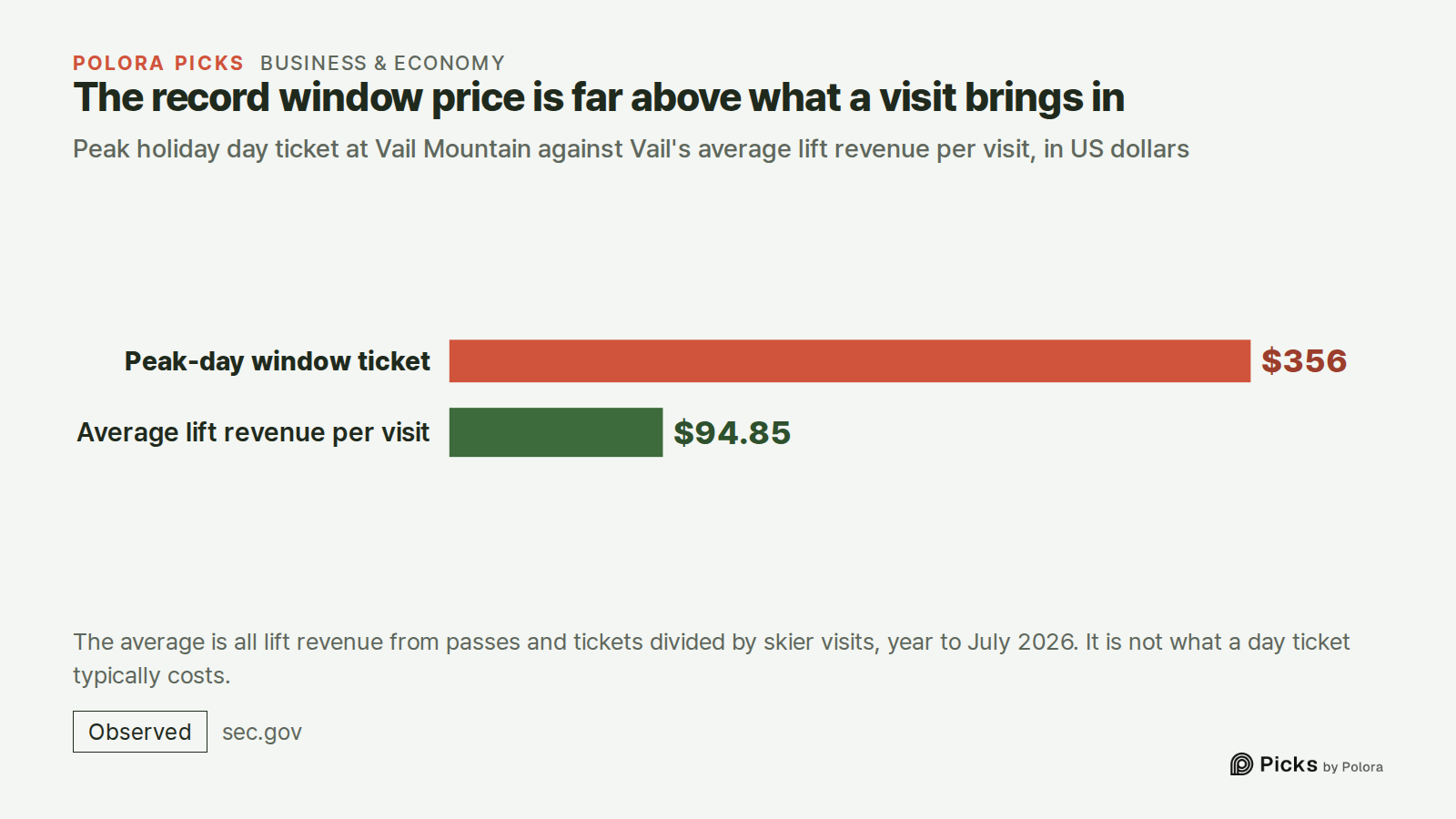
The record window price is far above what a visit brings in · Peak holiday day ticket at Vail Mountain against Vail's average lift revenue per visit, in US dollars · Peak-day window ticket · Average lift revenue per visit · $356 · $94.85 · The average is all lift revenue from passes and tickets divi
Peak holiday day ticket at Vail Mountain against Vail's average lift revenue per visit, in US dollars

Passes got cheaper, then both prices climbed

This is not simply a story of passes getting cheaper while day tickets got dearer. The $579 Epic Pass of 2008 replaced much pricier season passes, and a Vail spokesperson has described the change as cutting the price of a season pass by 60%. In 2021 the company cut pass prices again by 20%, taking the Epic Pass from $979 to $783.

Since then, both prices have gone up. The Epic Pass launched at $1,051 for 2025-26, and this autumn the adult pass for 2026-27 cost $1,145. By 2025-26, the peak holiday window price at Vail Mountain had reached $356. That winter, a pass bought at its launch price cost a little less than three peak days, and that gap is what makes it feel like a bargain.
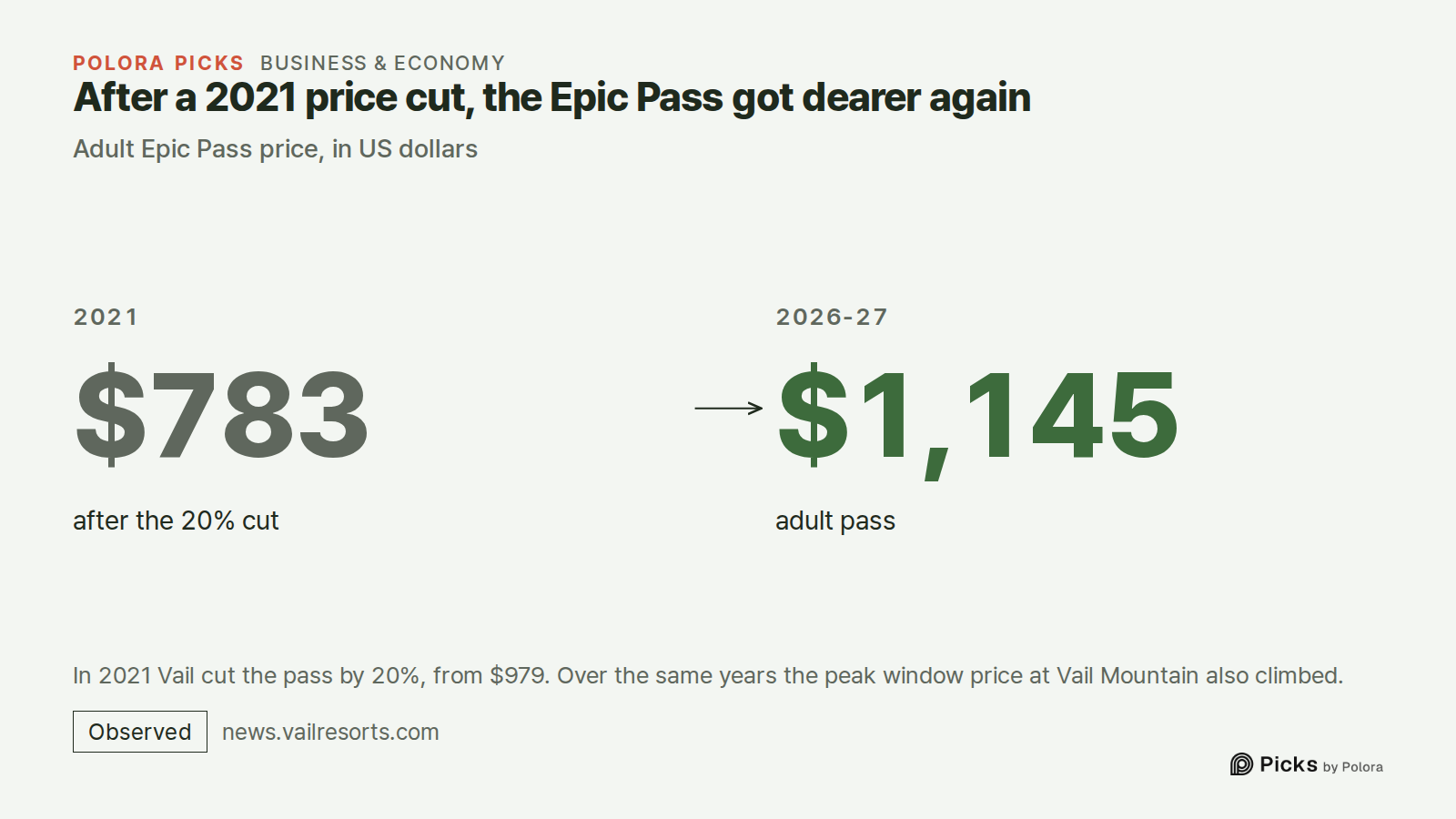
After a 2021 price cut, the Epic Pass got dearer again · Adult Epic Pass price, in US dollars · 2021 · $783 · after the 20% cut · 2026-27 · $1,145 · adult pass · In 2021 Vail cut the pass by 20%, from $979. Over the same years the peak window price at Vail Mountain also climbed.
Adult Epic Pass price, in US dollars

Vail is the clearest case, not the whole industry

Vail is the easiest company to study because it is listed on the stock market and has to publish these figures. Alterra Mountain Company, which sells the rival Ikon Pass, is privately owned and publishes no comparable numbers. Hundreds of independent and smaller ski areas set their own prices. The ski areas association said growth in 2024-25 came partly from small and medium-sized ski areas.

Across the US, the season pass is still the main way onto the mountain. In 2024-25, 492 ski areas operated and recorded 61.5 million skier visits in the association's preliminary count, the second highest on record. A later figure put that season at 61.6 million. Season pass holders made 49% of visits and standard day tickets 32%, according to the association. The pass-first model is widespread, but how heavily each resort relies on it varies.

Whether this pricing is fair to skiers is now also a question for a court. On March 23, 2026, four skiers filed a class action in federal court in Denver. They claim that Vail Resorts and Alterra price day tickets high to push people into buying their passes. These are the plaintiffs' allegations, not findings. Both companies say the claims have no merit. The defendants filed motions to dismiss in June, and when this article was checked, no ruling on those motions had been found.
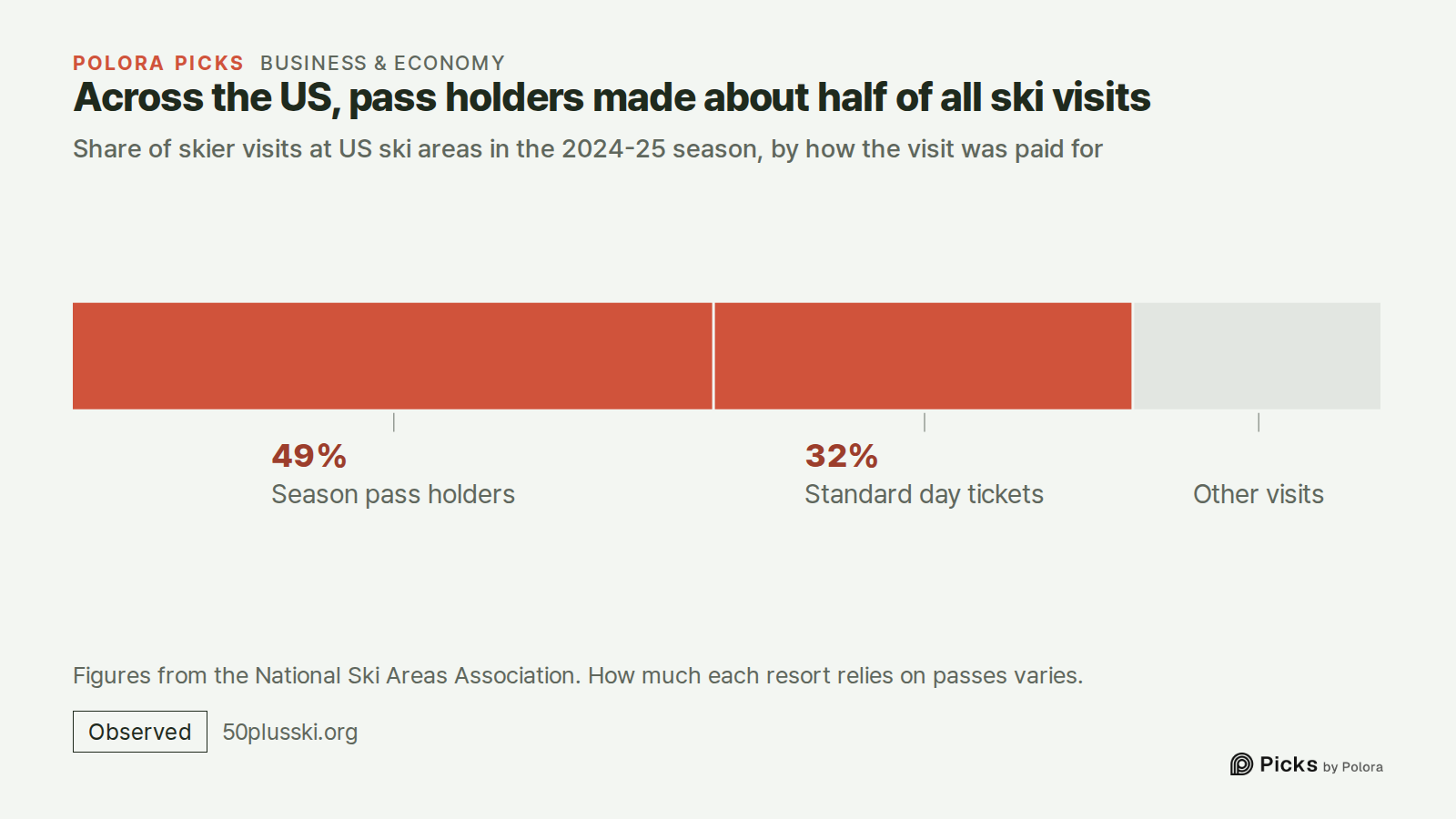
Across the US, pass holders made about half of all ski visits · Share of skier visits at US ski areas in the 2024-25 season, by how the visit was paid for · Season pass holders · Standard day tickets · 49% · 32% · Other visits · Figures from the National Ski Areas Association. How much each resort r
Share of skier visits at US ski areas in the 2024-25 season, by how the visit was paid for

When skiers stop placing the bet

The model only works if people agree to carry the weather risk, and after a bad winter fewer of them do. By September 18, 2026, Vail had sold about 12% fewer passes for the coming season than at the same point a year earlier. That compares sales partway through the selling season, not final totals. Most of the drop came from passes for a few days a year bought by people who travel to ski. Unlimited passes held up better.

Vail's chief financial officer, Angela Korch, told investors the company expects “to recapture a meaningful portion of lower pass visitation through increased lift ticket visitation.” Katz put it more plainly : “long term, this has been a lift ticket market.”

So a cheap season pass is neither generosity nor only a bulk discount. It is largely what the resort pays to know much of its income before winter starts. A skier who buys in spring gets cheap days if the snow comes, and carries most of the loss if it does not. The cheap pass is partly a bet on the weather, and the buyer is the one placing it.
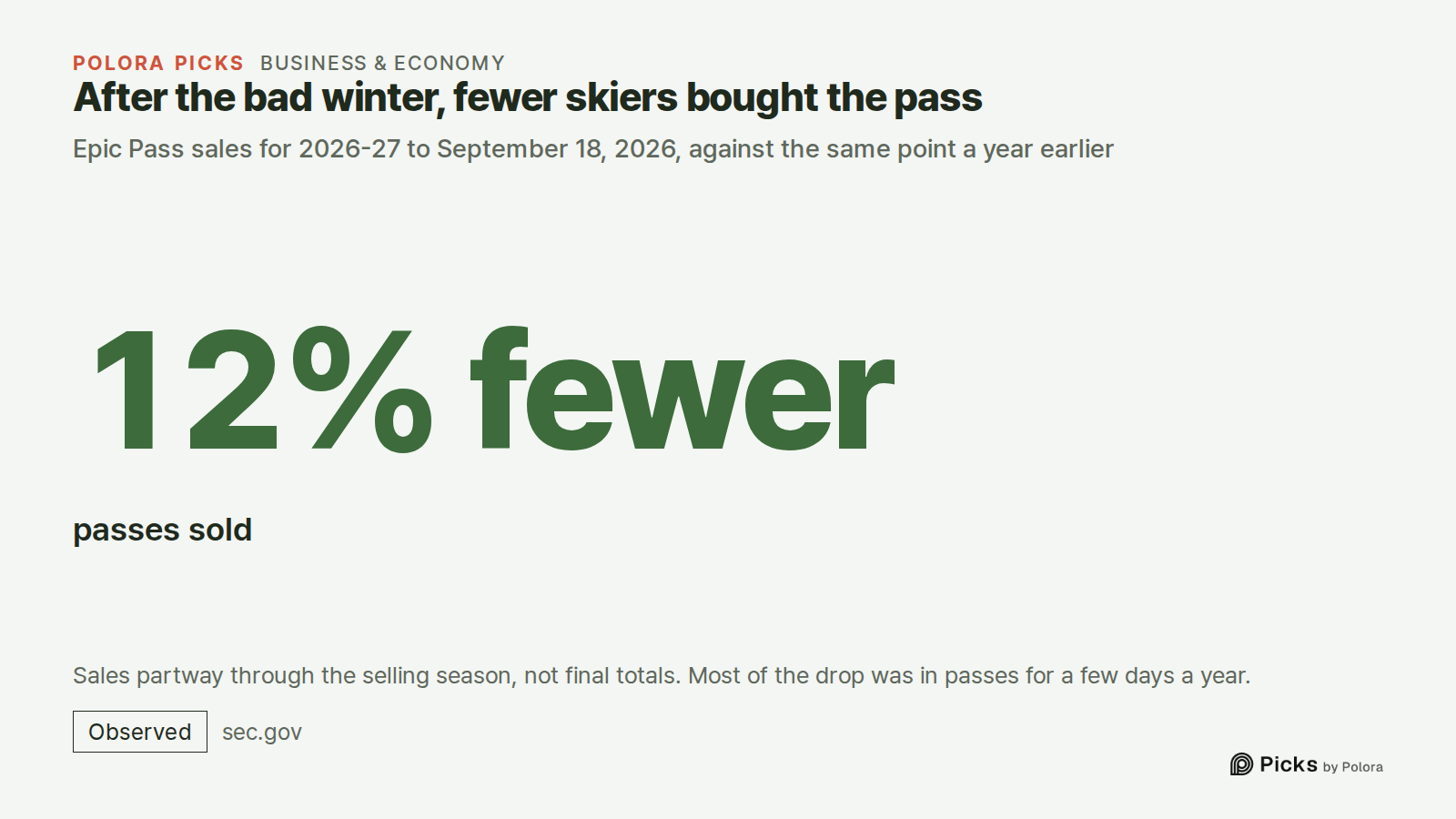
After the bad winter, fewer skiers bought the pass · Epic Pass sales for 2026-27 to September 18, 2026, against the same point a year earlier · 12% fewer · passes sold · Sales partway through the selling season, not final totals. Most of the drop was in passes for a few days a year.
Epic Pass sales for 2026-27 to September 18, 2026, against the same point a year earlier
Why do ski resorts sell season passes for less than a few day tickets?Why do ski resorts sell season passes for less than a few day tickets?A pass sold months before the first snow gives the resort its money early. · It moves much of the risk of a bad winter onto the skier.※ Epic Pass : the adult season pass sold by Vail Resorts · Epic Pass, bought at launch · Three peak-day window tickets · $1,051 · $1,068 · A season pass cost less than three peak days at the window · Adult prices for the 2025-26 winter at Vail Resorts, in US dollars · This sets the pass's launch pri2007-08 season · 26% · before the Epic Pass · Year to July 2026 · 70% · of lift revenue from passes · Passes now bring in most of Vail's lift money · Share of Vail Resorts' lift revenue that came from season passes · Both figures are approximate, taken from the company's own reports.No change from the year before · Skier visits · Lift revenue · Pass revenue · -13.4% · -3.5% · +3.9% · Skiers stayed away, but the pass money was already in · Change at Vail Resorts in the year to July 2026, against the year before, in percent · Pass revenue was paid before the season began. Snow acThe cheap pass is partly a bet on the weather, and the buyer is the one placing it. · A skier who buys in spring gets cheap days if the snow comes, and carries most of the loss if it does not.Sources 23 : deseret.com · Skiers sue Vail Resorts, Alterra Mountain over ski pass pricing (Deseret News), stormskiing.com · The Storm Skiing Journal, news.vailresorts.com · 2025-26 Epic Pass launches at lowest price of the year (Vail Resorts) + 20Read the full story at · polora.ai
Why do ski resorts sell season passes for less than a few day tickets?

Alpha · deepseek-v4-pro

The short answer is that the comparison is engineered: the walk-up day ticket is priced high partly so that the season pass looks like the only rational purchase. The pass is not really a bulk discount. It is prepayment, risk transfer, and price discrimination. A big ski resort has mostly fixed costs. Lifts turn, snowmaking runs, patrollers patrol, leases and staff are paid whether 5,000 or 15,000 people show up. The extra cost of one more skier on an already-running lift is small. So the resort's real risk is not losing money on a marginal visit; it is empty chairs and a bad snow year. Selling a season pass months before winter moves cash to the resort early and shifts snow risk onto the skier. If the snow is poor, pass revenue is already banked while walk-up revenue collapses. That is why large operators describe pass revenue as "collected in advance" and say it reduces exposure to weather-sensitive demand. The pass buyer gets a cheap full season, but bears the winter's downside. The high window price is the other half of the same strategy. If a peak day costs $356, three days exceed a $1,051 full-season pass, and a family doing the arithmetic buys the pass. The day-ticket rat…

Beta · gpt-6-sol

A resort can sell a season pass for less than a few *peak-priced* day tickets because the two products serve different purposes. A pass brings in money before winter and rewards a skier for committing early; a day ticket preserves the option to decide later, once the weather and travel plans are clearer. At Vail Resorts, the company explicitly says its pass program reduces exposure to weather-sensitive guests and makes revenue more stable. In fiscal 2026, pass products supplied about 70% of lift revenue and 73% of visits. (sec.gov) The comparison is real, but its timing matters. Vail advertised the adult 2025–26 Epic Pass at $1,051 when it launched in March 2025; that was its *lowest price of the year*, not necessarily what a buyer paid later. I could not independently verify the manuscript’s exact $356 Vail Mountain window ticket or its claim that this was a US record, so I would not publish the three-day arithmetic as a verified record-price example yet. Vail’s March announcement: https://news.vailresorts.com/2025-03-04-2025-26-Epic-Pass-Launches-at-Lowest-Pric…

Gamma · gemini-3.1-pro

I have reviewed the manuscript’s claims against live web sources to complete the checks requested in the brief. Here is what I found: 1. The $356 peak window ticket at Vail * Support: I can verify that Vail Mountain’s single-day peak walk-up rate reached $356 for the 2025–26 season, making it the highest recorded for a US ski resort at the time. * Source: *SnowBrains* and *The Storm Skiing Journal* (August 2025 reporting). https://snowbrains.com/vail-resorts-peak-lift-ticket-prices-hit-record-356-with-6-mountains-now-over-300/ * Conditions: This is a peak holiday rate. As the manuscript notes, it acts largely as an anchor price; very few skiers actually pay it. 2. The 52.6 million skier visits in 2025–26 * Support: The National Ski Areas Association (NSAA) preliminary data released on May 5, 2026, confirms an estimated 52.6 million snowsports visits for the 2025–26 season. * Source: NSAA official press release and *SAM Magazine*. https://www.nsaa.org/ * Context/Correction: The manuscript says this was "down nearly 15% from the season before." The prior season (2024–25) saw 61.5 to 61.6 million visits (depending on preliminary vs. fin…

Researcher · gpt-6-luna

Checks and corrections - $356 peak-day ticket and $1,051 pass: The $356 figure is supported as Vail Mountain’s 2025–26 peak-holiday single-day rate, and SnowBrains reported it as a U.S. record. Vail’s own investor presentation also lists $356 for holidays. Vail’s March 4, 2025 announcement describes the $1,051 adult Epic Pass as the lowest launch price of the year—not a price guaranteed later in the sales period. So the arithmetic ($1,068 for three $356 days) works for those stated prices, but the comparison needs to say which peak dates and pass-buying time it refers to. Sources: SnowBrains, Aug. 26, 2025 (the page’s actual address uses “overs-300”); Vail investor presentation; Vail’s March 4, 2025 pass announcement. ([snowbrains.com](https://snowbrains.com/vail-resorts-peak-lift-…

The Arbiter · gpt-6-sol

The voices agree on the central mechanism: an early pass sale gives the resort more predictable revenue, while a skier buying a day ticket keeps the option to wait and see the conditions. Vail’s filing explicitly says its pass program reduces exposure to weather-sensitive guests; passes supplied about 70% of its fiscal 2026 lift revenue. That supports the manuscript’s explanation for Vail, not automatically for every ski area. (sec.gov) The real difference is emphasis. Alpha and Gamma treat the high walk-up price and transfer of weather risk as the design’s defining features. Beta and the Researcher caution that a pass also gives skiers valuable repeat access, and that risk does not move entirely to them: qualifying circumstances can trigger refunds. “The resort keeps the money either way” is therefore stronger than the evidence warrants. (sec.gov) For publication, the record supports the $1,051 launch-price versus three $356 peak-day tickets…

The Arbiter's Final Verdict · gpt-6-sol

Verdict: The manuscript’s central explanation stands for Vail Resorts, but it overstates it when it says a pass is *mainly* a way to transfer weather risk. Resorts price passes cheaply relative to peak walk-up tickets because an early sale supplies predictable revenue and commits a customer before snowfall is known. The skier gets potentially inexpensive repeat access; the resort gets paid even if that skier visits less than expected. A day ticket, by contrast, lets its buyer wait to see the weather and pay only for days they use. Vail explicitly describes its pass program as reducing exposure to weather-sensitive guests (2026 annual report). The strongest objection to the manuscript’s angle is that this is a trade, not simply a loss imposed on skiers. A frequent skier can get substantial value from a pass, and a pass offers flexibility across days and mountains. Nor does every bad outcome leave the resort entitled to keep every payment: Epic Coverage provides refunds in specified circumstances, though ordinary poor snow is generally not one of the…