Two signs, one pair of prices
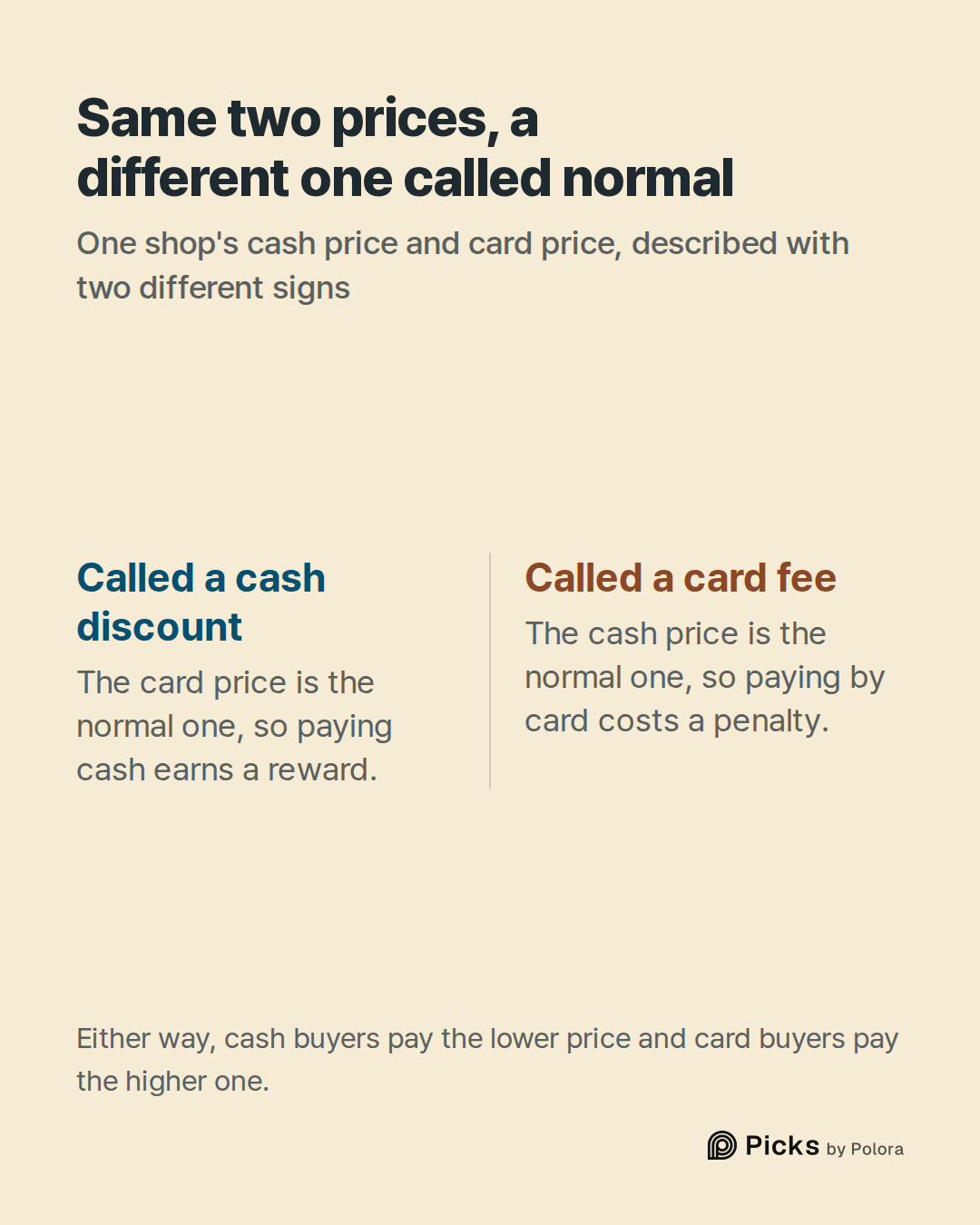
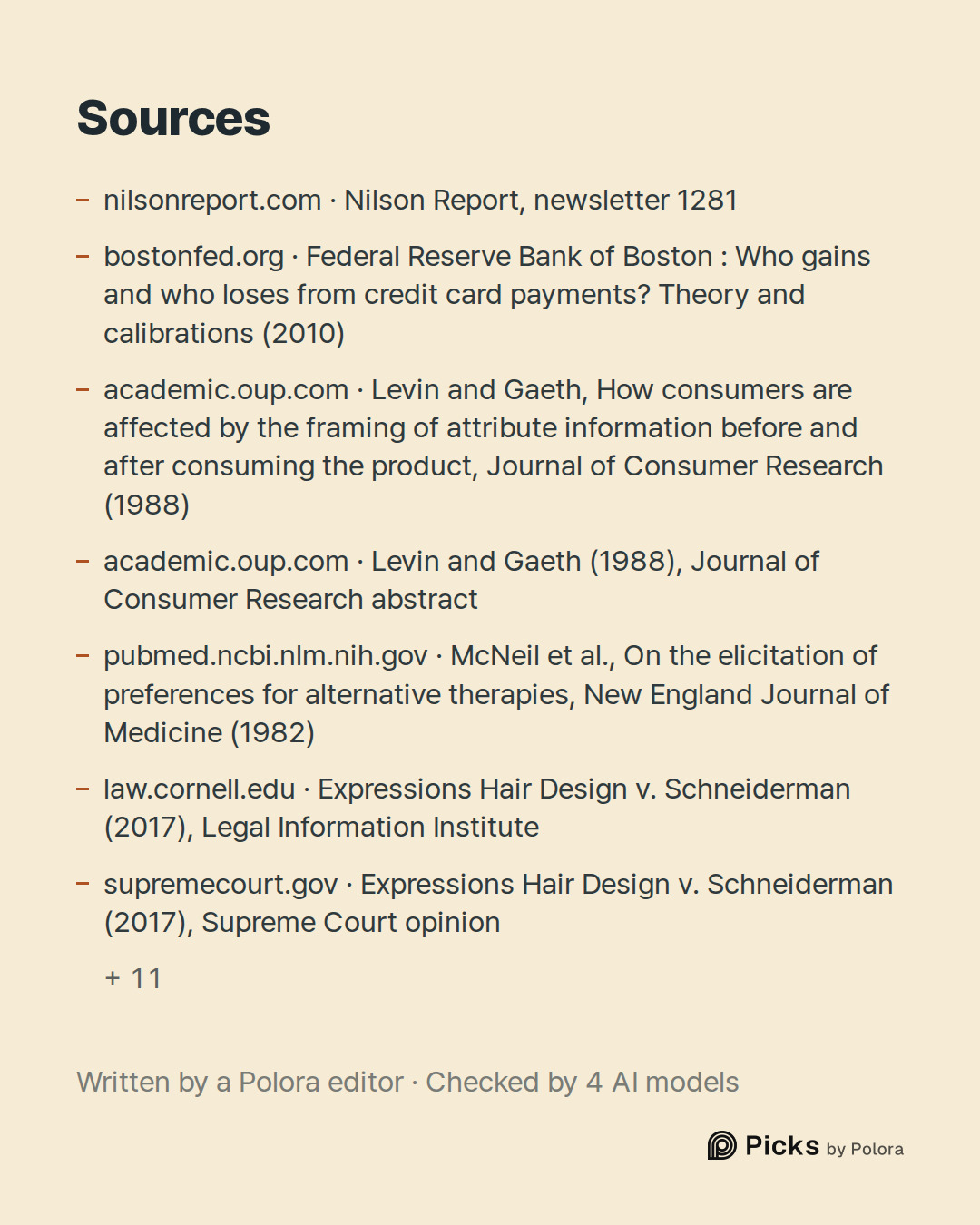
Picture a petrol station with two prices on the board : a lower one for cash and a higher one for cards. One owner calls the gap a cash discount. Another calls it a card fee. Either way the cash buyer pays the lower price and the card buyer pays the higher one. Not a cent changes.
What changes is which number gets called the real price. If the card price is the normal one, cash buyers get a reward. If the cash price is the normal one, card buyers pay a penalty. For decades, people who earn money from cards have cared a lot about which of those two stories a shopper hears.
And there is a second surprise inside the first. When you pay cash at a shop that doesn't charge card users extra, you aren't paying a clean price with no card costs in it. You are most likely helping to pay what the cards cost the shop.
The card fee is already in the price you pay in cash
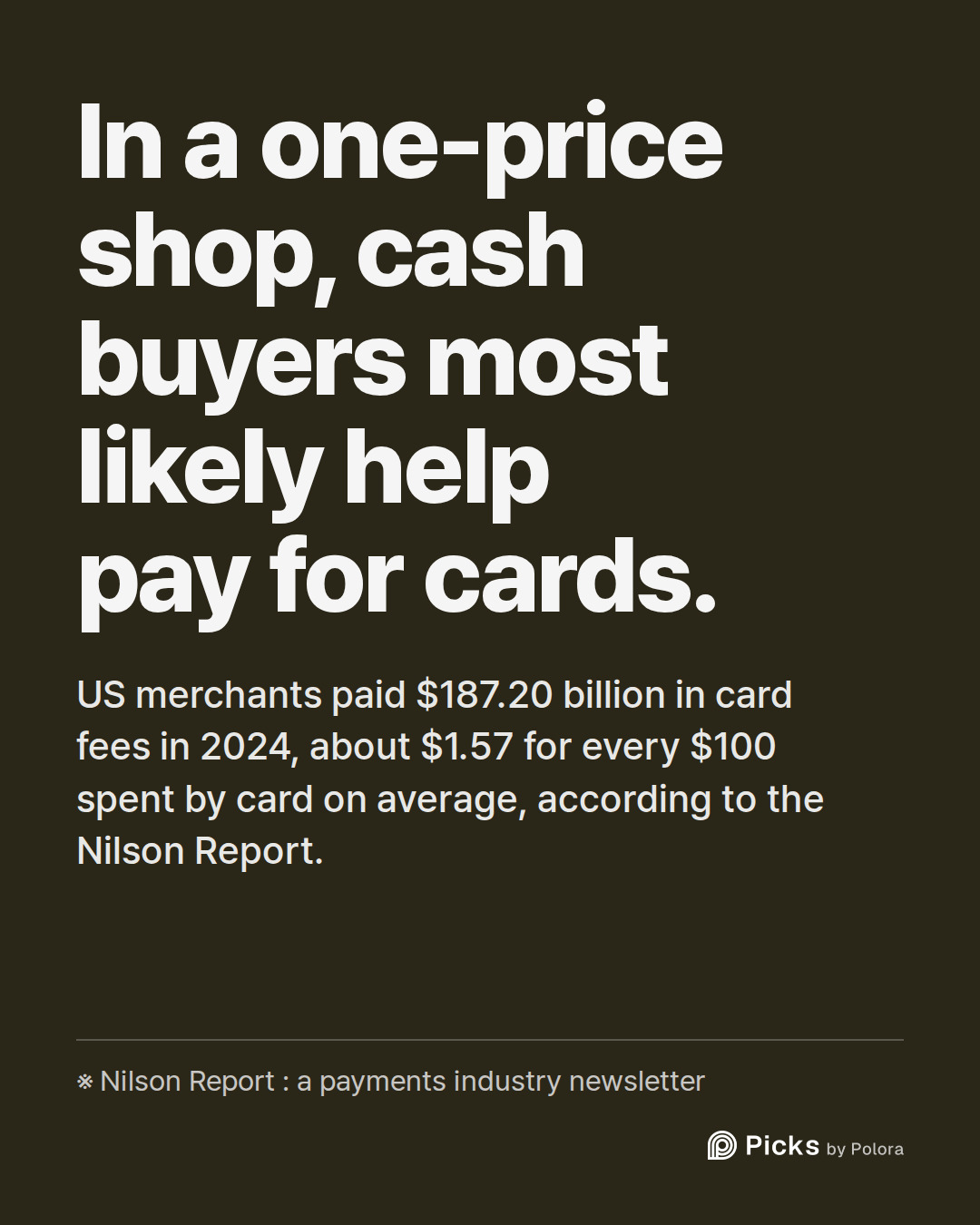
Every time a shop takes a card, it pays a fee to the banks and networks that move the money. In the United States in 2024, merchants paid $187.20 billion in such fees on $11.902 trillion of card payments, according to the Nilson Report, a payments industry newsletter. That works out to about $1.57 for every $100 spent by card. That figure is an average across all kinds of cards, not the fee on every purchase.
Most shops charge one price whatever you pay with, so they cover that cost the same way they cover rent or electricity : it goes into the price on the shelf. Everyone pays that price, including people who pay cash.
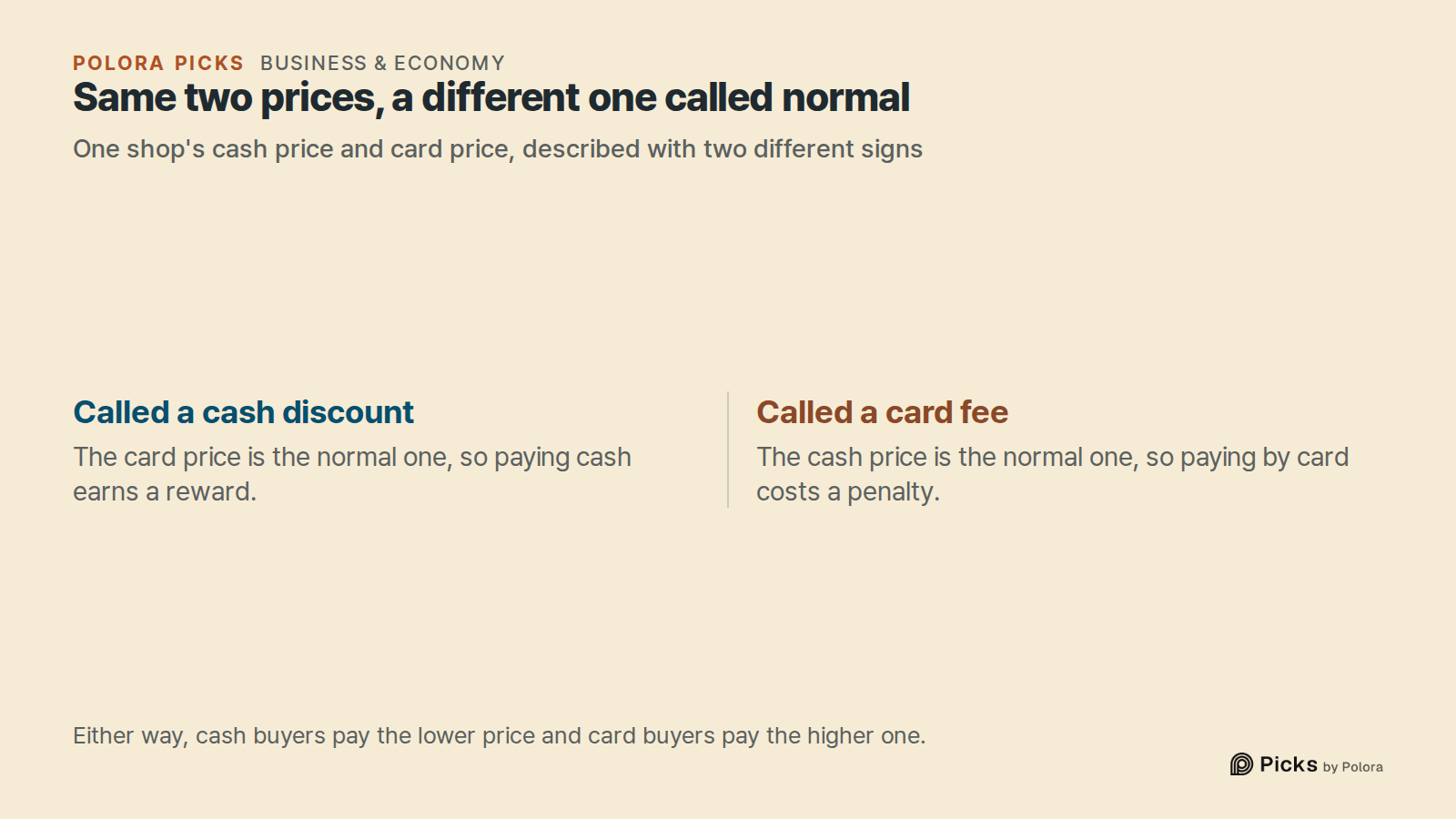
Economists at the Federal Reserve Bank of Boston tried to measure what that means. In a 2010 paper they estimated that each household not paying by credit card passed $149 a year to credit card users, while each household paying by credit card received $1,133 a year. The paper calls the first group cash users, though the group covers more than people paying in banknotes. That is a model built on its own assumptions, not a receipt, and it doesn't show how any particular shop sets its prices. But it shows the mechanism : in a shop with one price, the shelf price already carries the card cost, and a cash discount gives part of the fee back.
The same fact, worded two ways, gets judged differently
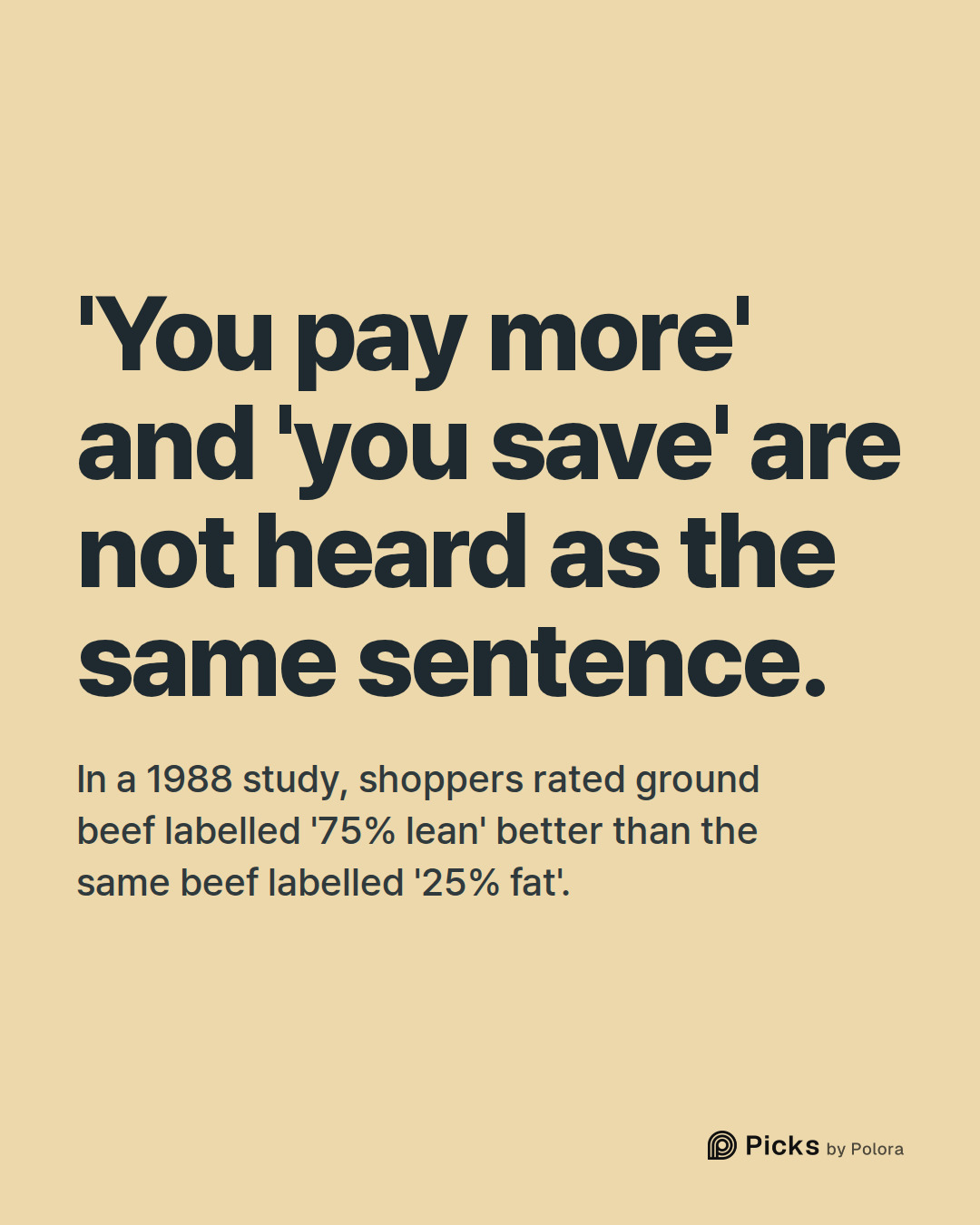
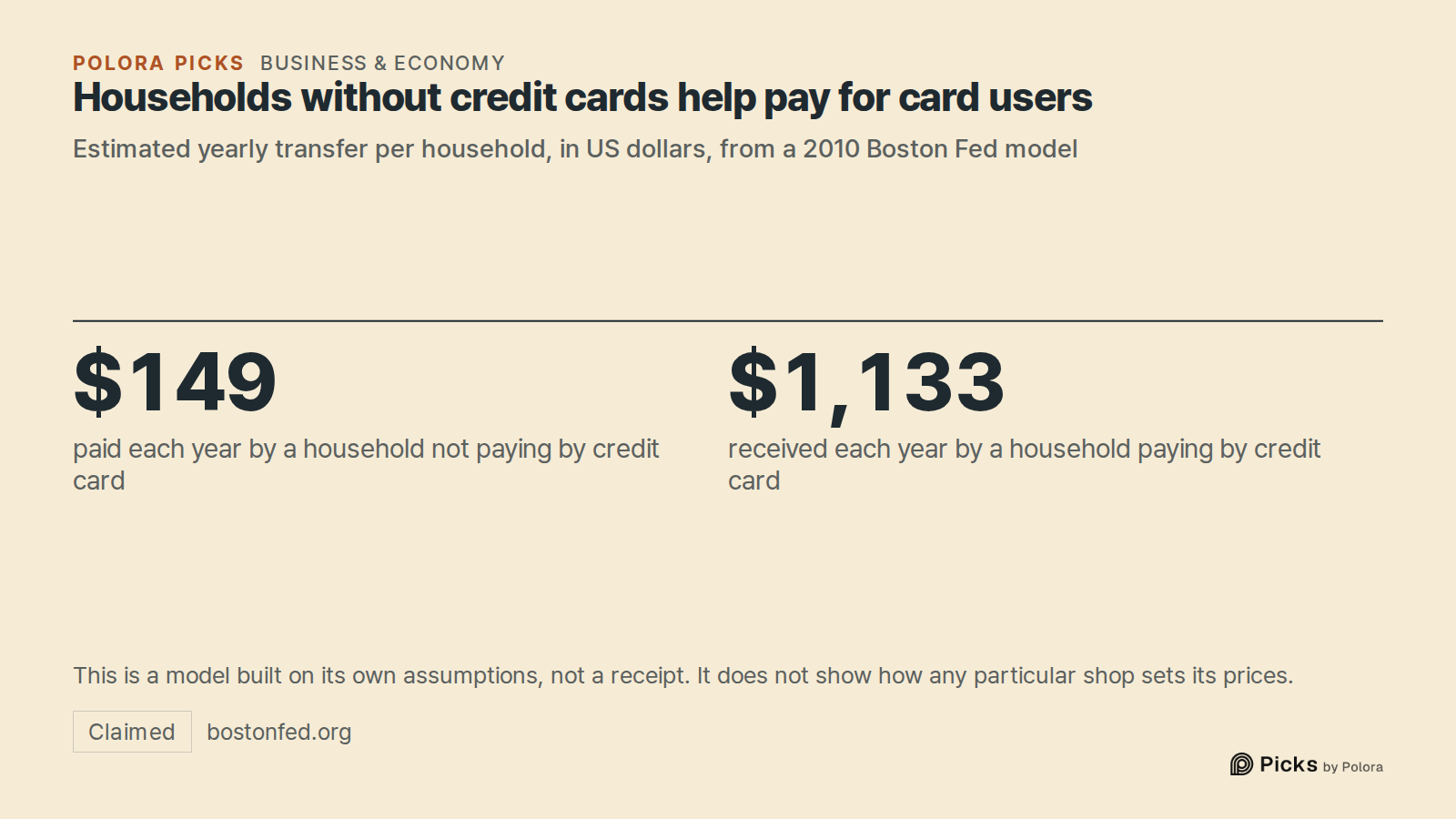
Psychologists have shown many times that the wording alone can shift a judgment. In a 1988 study, Irwin Levin and Gary Gaeth had shoppers rate ground beef labelled either '75% lean' or '25% fat'. It was the same meat, and the '75% lean' version got the better ratings. The gap shrank once people actually tasted it.
In a 1982 study published in the New England Journal of Medicine, Barbara McNeil and colleagues described lung cancer treatments to 238 patients, 491 graduate students and 424 physicians. Surgery looked noticeably more attractive when its outcomes were described as the chance of living rather than the chance of dying. The doctors were swayed too.
Studies like these measure ratings and imagined choices in one setting. They don't show how much any shop earns from its wording. What they do show is that 'you pay more' and 'you save' are not heard as the same sentence, even when the facts underneath are identical.
- Levin and Gaeth, How consumers are affected by the framing of attribute information before and after consuming the product, Journal of Consumer Research (1988)
- Levin and Gaeth (1988), Journal of Consumer Research abstract
- McNeil et al., On the elicitation of preferences for alternative therapies, New England Journal of Medicine (1982)
US law once spelled out the difference
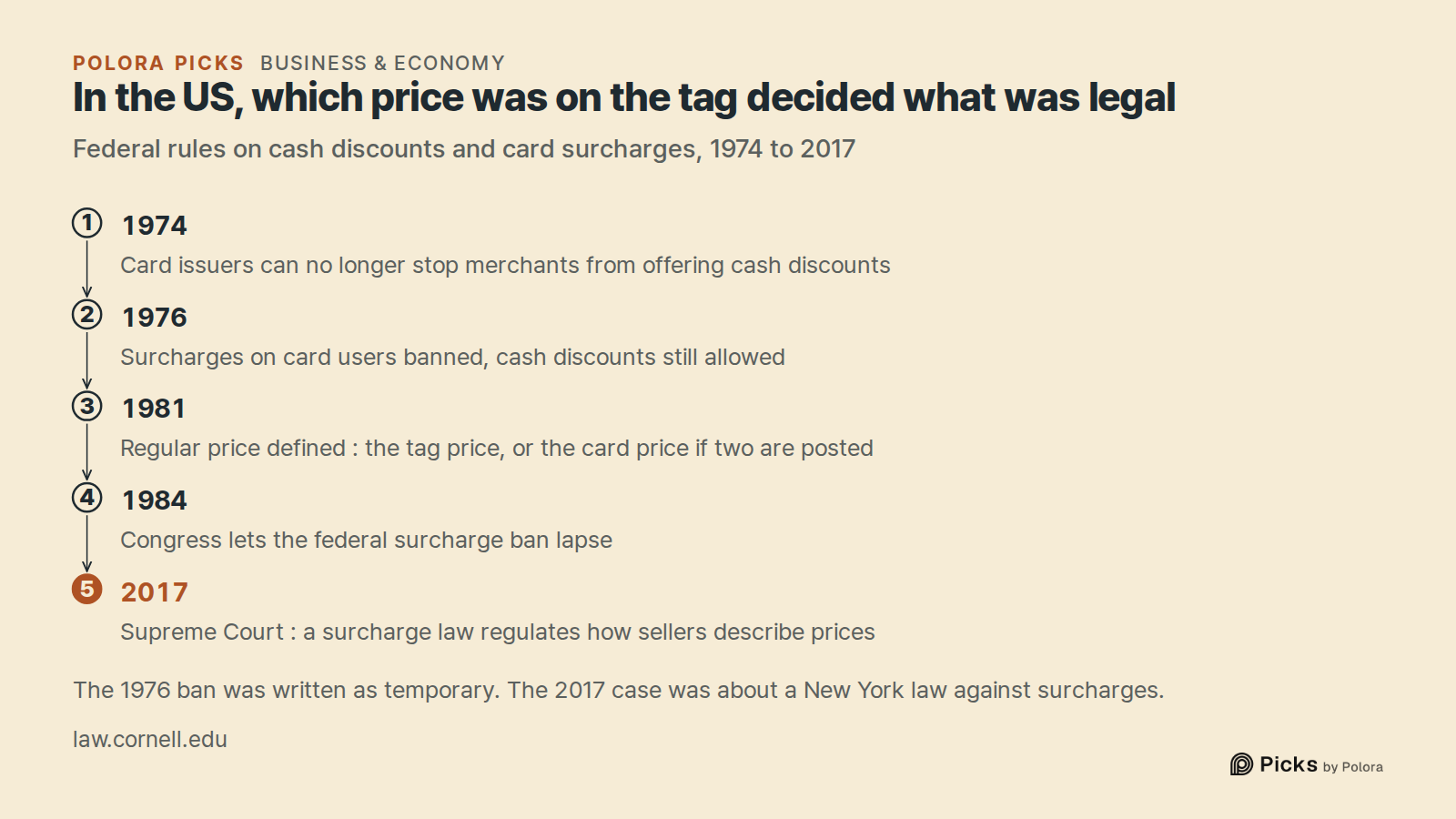
In the US, this wasn't left to sign painters. In 1974 Congress amended the Truth in Lending Act so that card issuers could no longer stop merchants from offering discounts to customers who paid cash. In 1976 it went further : it banned merchants from adding surcharges for card users, while still allowing cash discounts. That ban was written as a temporary measure.
That made the definitions matter. The law called a discount a reduction from the regular price, and a surcharge any increase in the regular price charged to card users but not to people paying cash. In 1981 Congress defined the regular price itself : the single price on the tag or the sign, or the card price if the shop posted two prices or none. Under that definition, the same two prices could be legal or illegal depending on which one was on the tag. The same 1981 change also removed an earlier 5% limit on qualifying cash discounts.
Congress let the federal surcharge ban lapse in 1984 and never brought it back. The US Supreme Court told this history in Expressions Hair Design v. Schneiderman in 2017, a case about a New York law against surcharges. The court said such a law regulates how sellers describe their prices, which makes it a question of speech.
What the card industry wanted the gap called
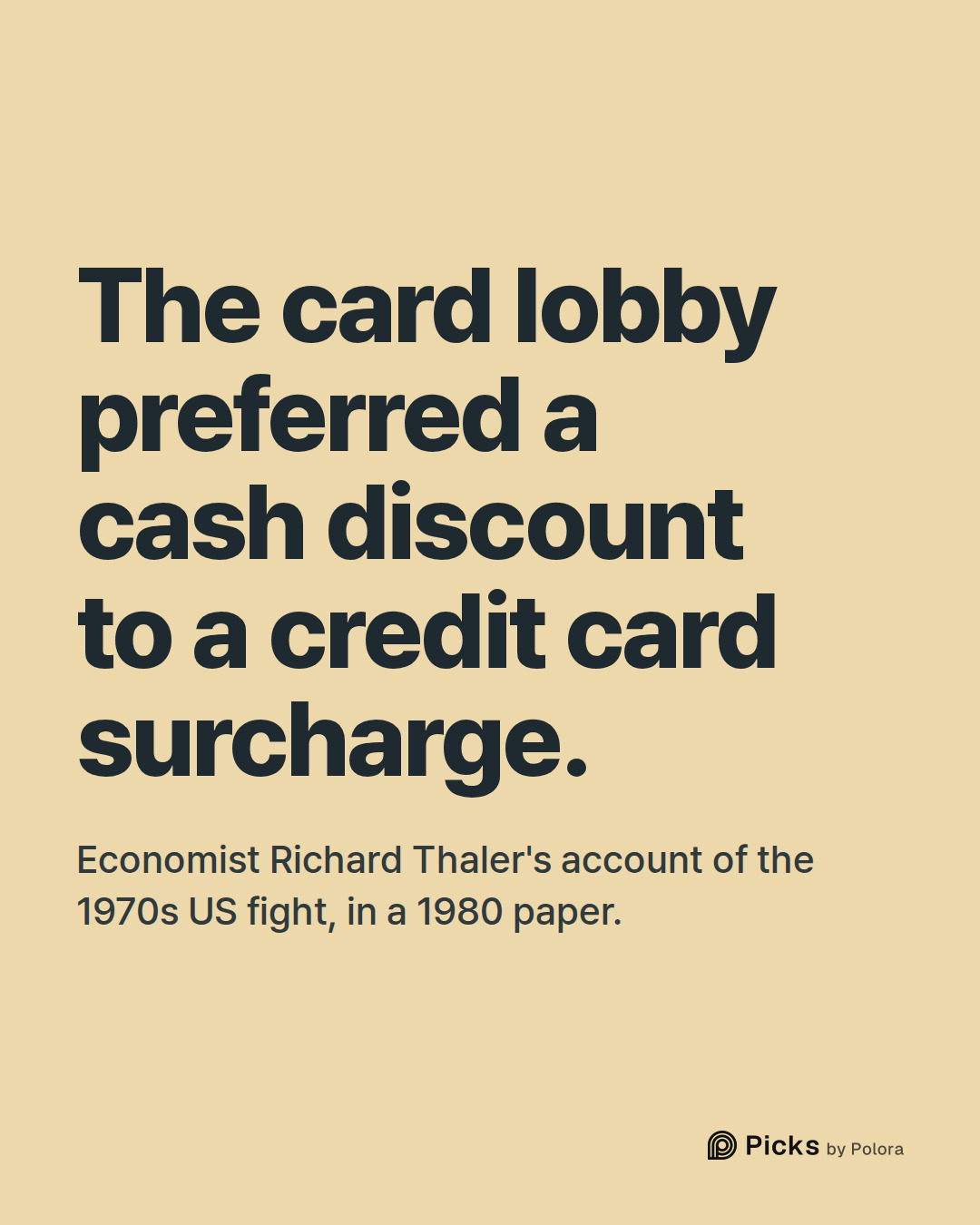
The economist Richard Thaler, who later won a Nobel prize, used this fight as an example in a 1980 paper. When it looked as if Congress would pass some bill, he wrote, 'the credit card lobby turned its attention to form rather than substance' and preferred that any price gap between cash and card customers 'take the form of a cash discount rather than a credit card surcharge.'
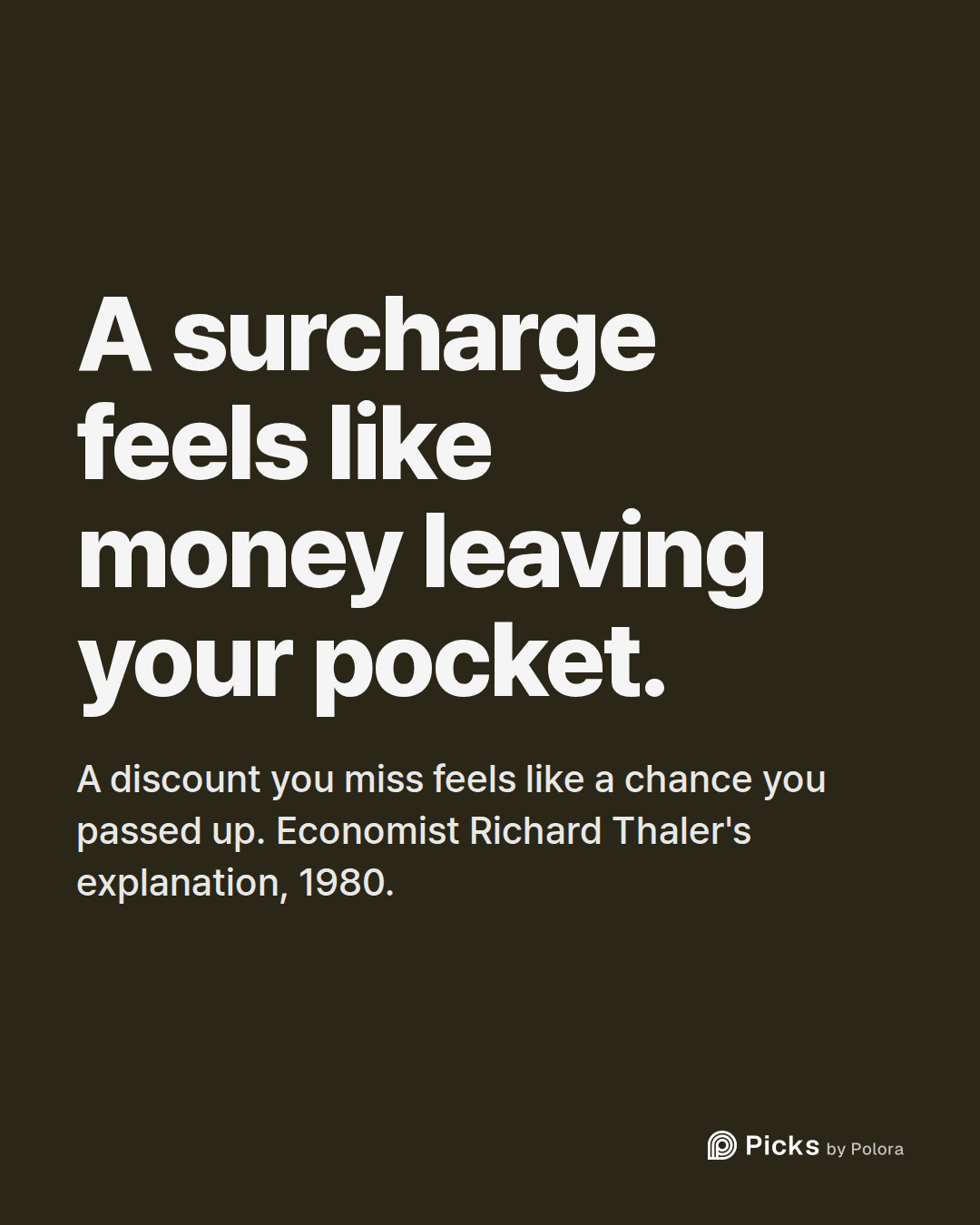
His explanation : a discount you miss feels like a chance you passed up, while a surcharge feels like money leaving your pocket. In a footnote he cites 1975 Senate testimony by Jeffrey Bucher of the Federal Reserve Board. Bucher himself argued that surcharges and discounts should be treated the same way. But he reported that critics argued 'a surcharge carries the connotation of a penalty on credit card users while a discount is viewed as a bonus to cash customers.'
This is Thaler's account of what the lobby preferred, backed by a public hearing record. It is not a record of the lobby's own internal reasoning.
Card fee or cash discount : the rules differ by country
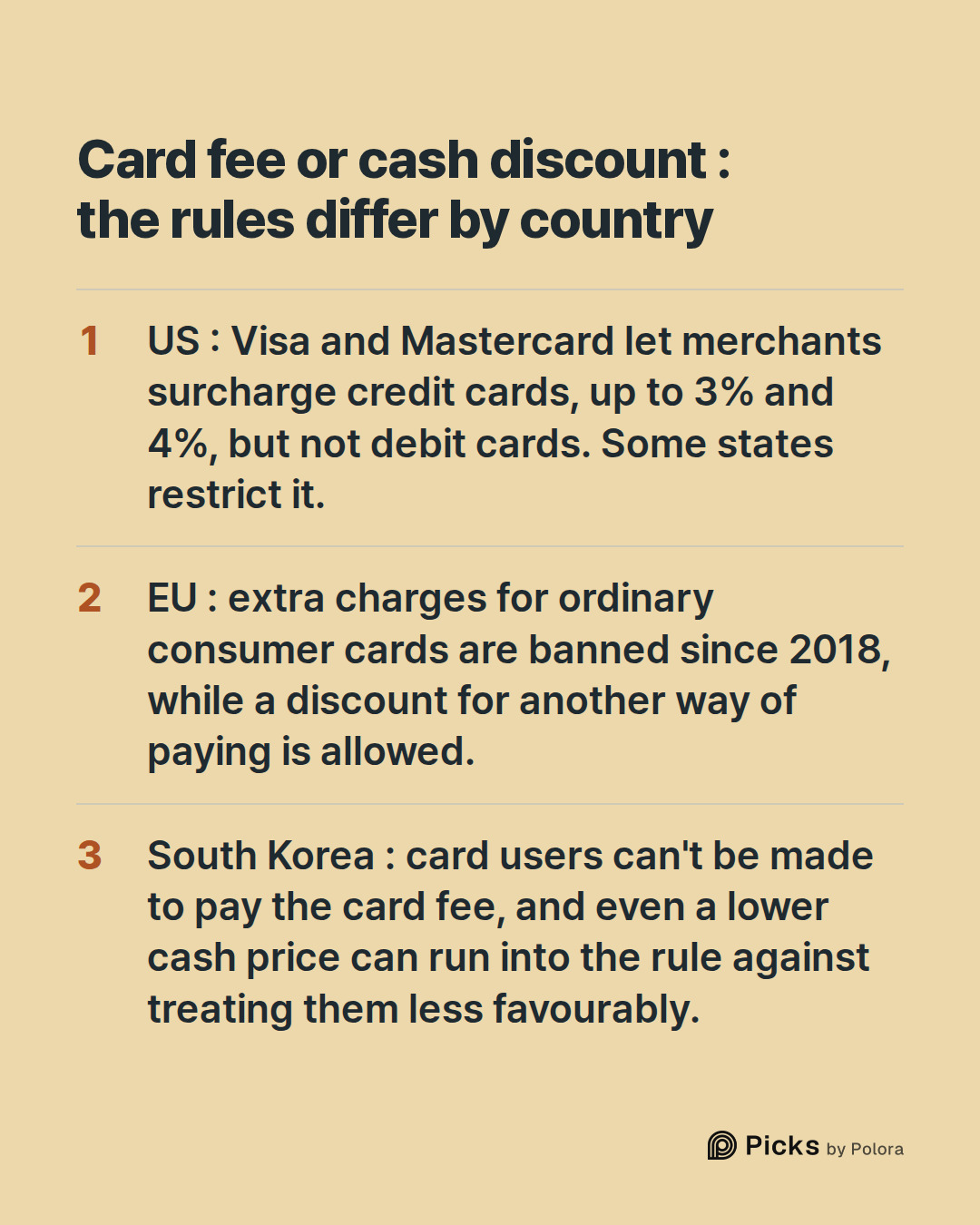
In the United States, card fees can now be shown openly. Visa's and Mastercard's published rules let merchants add a surcharge on credit cards, capped at 3% for Visa and 4% for Mastercard, and in both cases no more than what accepting the card actually costs the merchant. Debit cards can't be surcharged under either network's rules, and Visa excludes prepaid cards too. These are the networks' limits, not permission everywhere : some states restrict surcharges as well. Visa's own guidance, dated August 2023, lists Connecticut, Maine, Massachusetts and Oklahoma among them, and warns that its list may be incomplete.
Those rules may change again. A revised settlement between Visa, Mastercard and US merchants, in a lawsuit that began in 2005, got preliminary court approval in June 2026, and it still needs final approval. A hearing on final approval has been reported for November 16, 2026. Many merchants have objected to it.
The European Union drew the line between the two words in law. Under its revised Payment Services Directive, merchants may not charge extra for paying with ordinary consumer debit and credit cards, a ban that applies to payments made since 13 January 2018. The same directive expressly lets a merchant offer a reduction for using a particular payment method, subject to other applicable rules. In the EU, then, a card fee is banned while a discount for another way of paying is allowed.
South Korea goes further still. Its Specialized Credit Finance Business Act forbids card merchants from treating cardholders less favourably because they pay by card, and from making cardholders pay the card fee. A shop owner who wanted to favour cash customers challenged the rule, and the Constitutional Court rejected the challenge in 2014. In Korea, then, a lower price for cash can itself run into the rule against treating card users less favourably, whichever word is on the sign.
- LawPay : Credit card surcharge rules
- Visa : Merchant surcharging Q&A
- Visa : Merchant surcharging considerations and requirements
- Mastercard : Merchant surcharge FAQ
- Payments Dive : Visa, Mastercard urge court to approve fee settlement
- Visa statement on MDL settlement
- Directive (EU) 2015/2366 (PSD2), EUR-Lex
- Court of Justice of the European Union, Case C-484/20, EUR-Lex
The real choice is which price counts as normal
So the gap is the same, and the feeling is not. Whoever decides which price is the normal one decides whether the other price sounds like a penalty or a reward. In the US, that choice was argued over in Congress and later reached the Supreme Court, and in the EU the two words now lead to different legal answers.
There is one honest limit. No study cited here measures how much the label alone changes what people actually do at the till. The lab studies show the pull of wording, and the history shows people fought over it. How large the effect is at a real checkout is still an open question. And a sign by itself doesn't reveal why a particular shop chose it : the owner may simply be describing how the prices are posted, or following the local rules.