Are outlet store clothes really last season's leftovers?
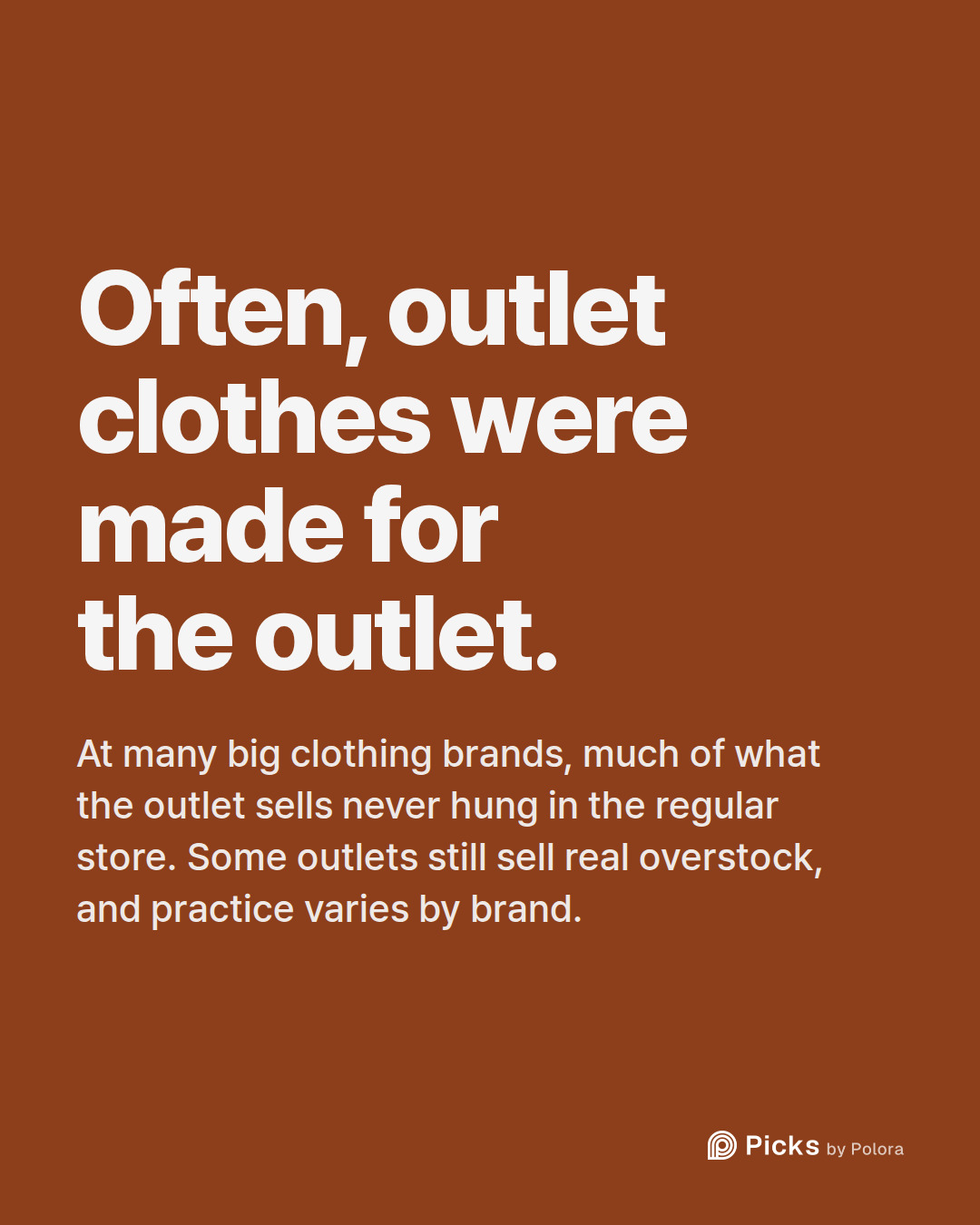
Often they are not. At many big clothing brands, much of what the outlet sells was made for the outlet and never hung in the regular store, and some brands say so themselves. Some outlets still sell real overstock, and practice varies by brand.
The story most of us were told about outlets
Ask almost anyone what an outlet store is and you get the same answer : it is where a brand sends the clothes it could not sell at full price. They might be last season's colors, extra stock or a jacket with a loose button. You get the same brand for less because nobody else wanted those items.
That answer was once largely right. On January 30, 2014, US Representative Anna Eshoo and three US senators, Sheldon Whitehouse, Richard Blumenthal and Ed Markey, wrote to the Federal Trade Commission, the US agency that polices misleading advertising. Their letter said outlets had historically offered excess inventory and slightly damaged goods that retailers could not sell in their regular stores. The point of the letter was that, in their view, this no longer described most of what outlets sold.
Several brands say they make clothes just for their outlets
The clearest evidence comes from the brands. Gap Factory says on its own customer service pages that its line is exclusive to Gap Factory, and that it does not sell Gap overstock or last season's products.
In a 2016 investigation, the Canadian consumer program CBC Marketplace compared outlet and regular-store products from Banana Republic, J.Crew, Kate Spade and Coach. As Marketplace reported it, Coach, Banana Republic and J.Crew all confirmed that they make items specifically for their outlet stores. J.Crew told Marketplace that its outlets sell only made-for-outlet products, and that it sometimes uses different fabrics or design details to reach a lower price. Banana Republic said its outlet stores carry no product from its regular stores. Coach said everything it makes, whichever store it is for, uses fine leathers and fabrics. Kate Spade declined to comment. The check behind this Pick could not open the Marketplace report itself, so these are the brands' statements as that report and later coverage relay them, not wording confirmed against the original.
In other words, for these brands the outlet is not the end of the line for regular-store clothes. It is a separate product line with the same name on the label.
In 2014 the US regulator said outlet goods can be made only for outlets
Two months after the lawmakers' letter, on March 20, 2014, the Federal Trade Commission published advice on outlet shopping. Its central sentence was that merchandise sold at outlet stores can be manufactured exclusively for them, and may differ in quality from merchandise sold at non-outlet stores.
The wording matters. The agency said outlet goods can be made for outlets and may differ in quality. It did not say every outlet item is made that way or that every outlet item is worse.
How much is made for outlets? Only estimates exist
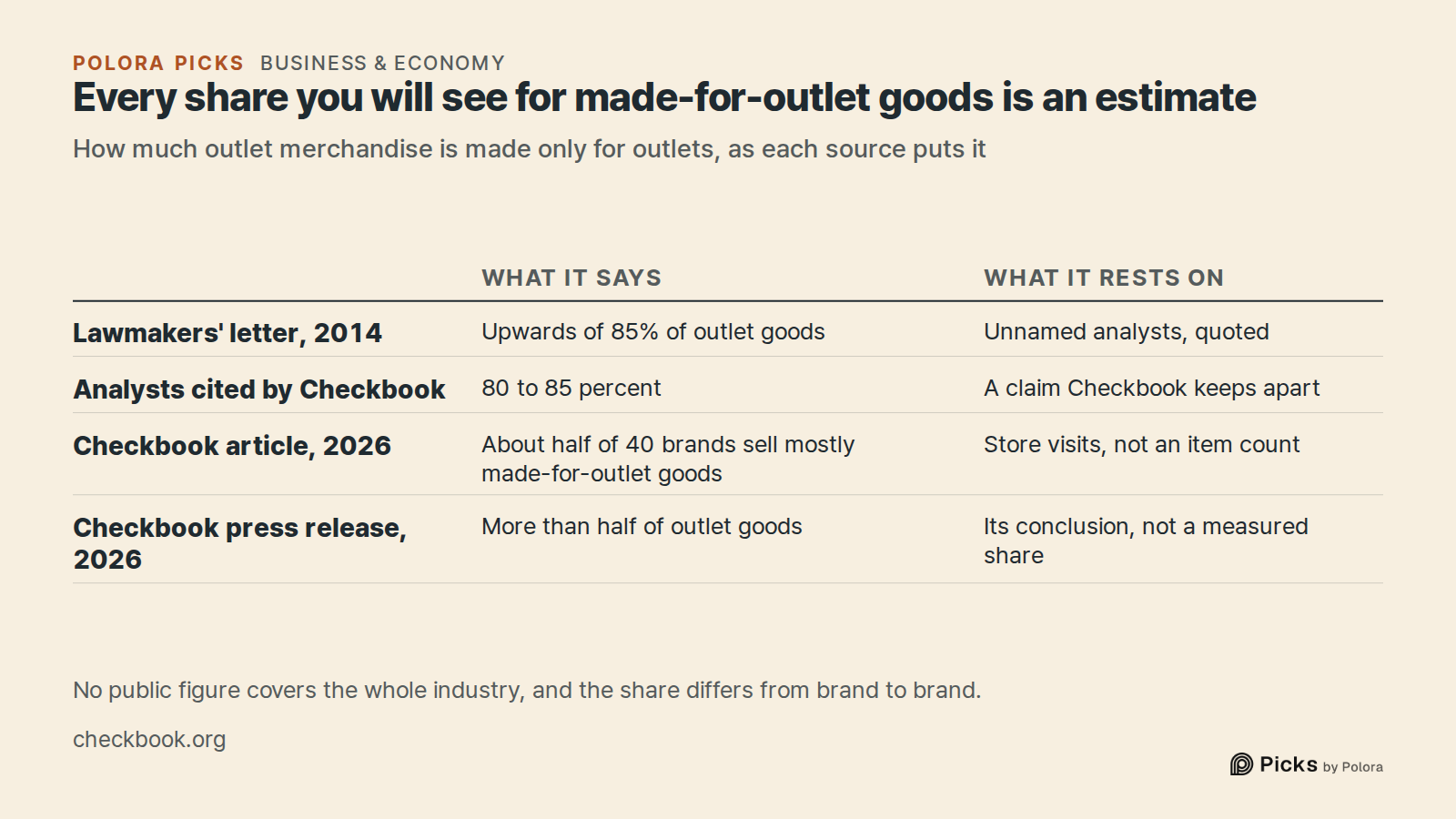
The figure you will see most often is 85%. It comes from the same 2014 letter, which said some analysts estimate that upwards of 85% of the merchandise sold in outlet stores was made exclusively for those stores. The letter does not name the analysts, so this is an estimate quoted by lawmakers, not a measurement.
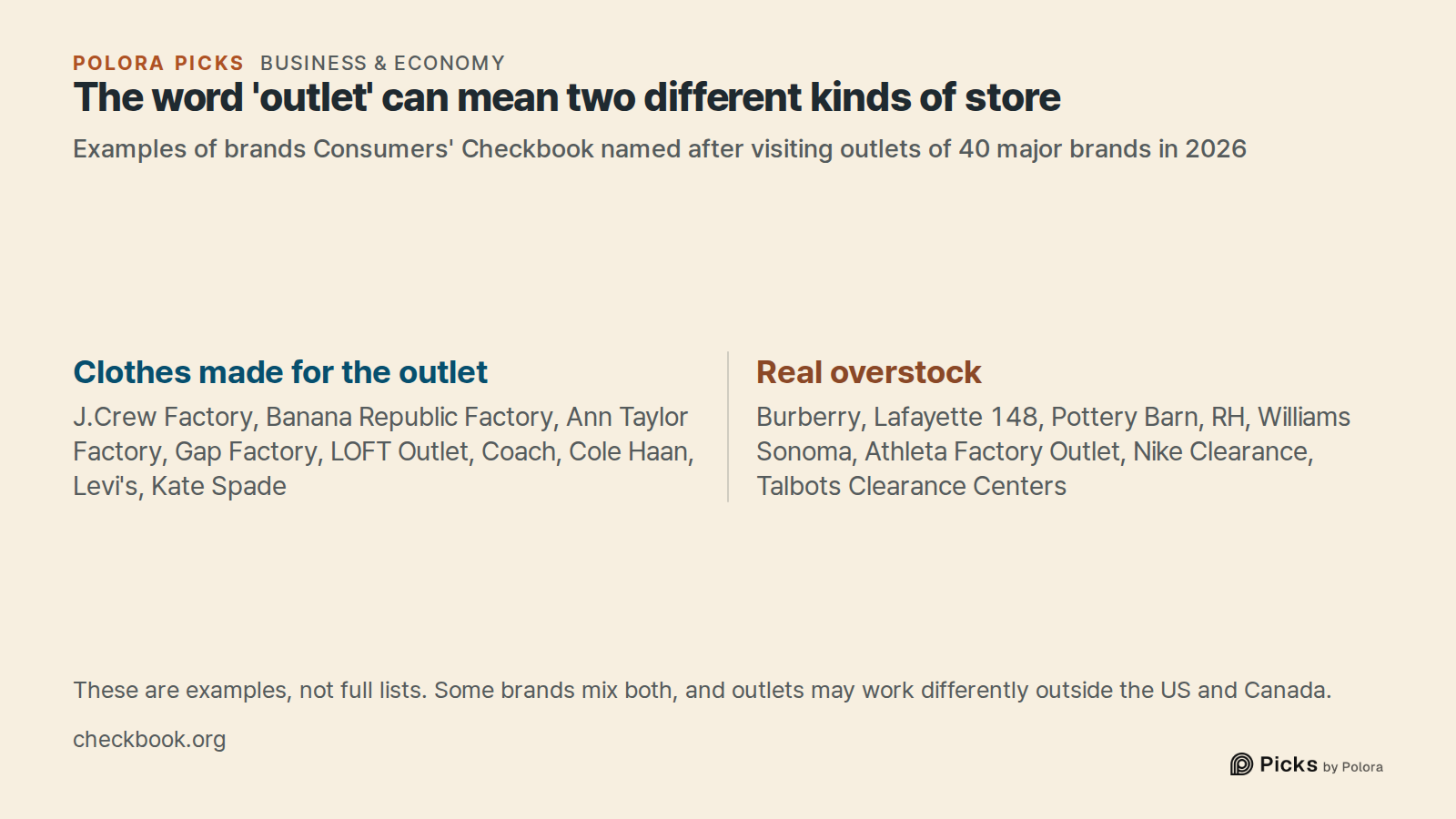
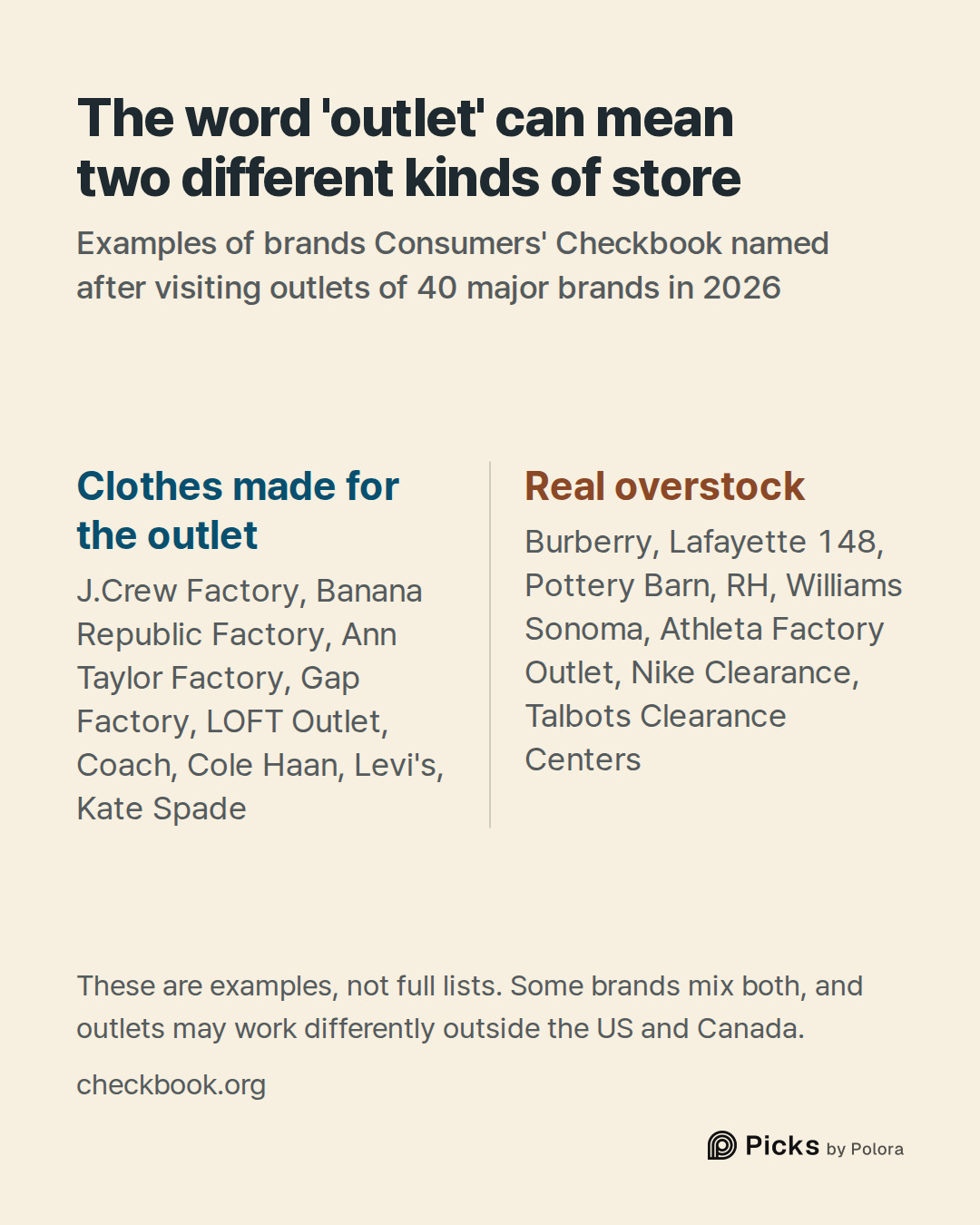
A more recent check points the same way, though it measures something narrower. In June 2026 Consumers' Checkbook, a nonprofit consumer group, published the results of three months of visits to outlet, factory and clearance stores for 40 major brands. Its staff read labels and price tags and questioned store staff. In its article, the group reports that about half of the brands it studied had outlets carrying only or mostly made-for-outlet goods. Its press release words the conclusion more broadly, saying more than half of the goods sold at outlet and factory stores are made specifically for those stores rather than discounted from regular retail. The visits did not count every item sold, so that broader wording is Checkbook's own conclusion, not a measured share. The group named J.Crew Factory, Banana Republic Factory, Ann Taylor Factory, Gap Factory, LOFT Outlet, Coach, Cole Haan, Levi's and Kate Spade among the brands selling merchandise made for their outlets.
The same Checkbook article mentions retail analysts who claim 80 to 85 percent, and keeps that claim apart from its own finding. What Checkbook offers is one group's observations from its own store visits, and the share differs from brand to brand. No public figure covers the whole industry.
- Truth in Advertising : Congress members call on FTC to investigate deception at outlet stores
- Senator Markey : Sens. and Rep. to FTC : Outlet stores may be misleading consumers
- PR Newswire : Most outlet and factory stores offer cheaper goods made specifically for off-price locations, Consumers' Checkbook investigation finds
- Consumers' Checkbook : Outlet stores, what do they really sell?
What the price on the tag is compared with
This changes how you read an outlet price tag. Outlet tags often show a higher 'compare at' or 'retail' price next to the price you pay. The FTC's guides on price comparisons say a 'former price' is a fair basis for a comparison when it is the actual price at which the item was offered to the public on a regular basis for a reasonably substantial period of time. Those guides are general rules. They set out nothing specific to outlet stores or to clothes made for them, and they use the word 'outlet' only in the ordinary sense of a seller's 'principal retail outlets'.
The 2014 letter argued that this creates a problem for made-for-outlet goods. In the lawmakers' words, it is common to show a retail price next to the outlet price even on items never sold in regular stores, and since such an item was never sold at that retail price, the price is impossible to substantiate. That is the lawmakers' argument, not a ruling.
Consumers' Checkbook reported a related finding in 2026. In its store visits, the 'compare at' and 'MSRP', or manufacturer's suggested retail price, shown at outlets often referred to different, higher-quality regular-store products rather than to the item on the rack.
- 16 CFR 233.1 : Former price comparisons (Cornell LII)
- 16 CFR 233.2 : Retail price comparisons; comparable value comparisons (Cornell LII)
- 16 CFR Part 233 : Guides against deceptive pricing
- Truth in Advertising : Congress members call on FTC to investigate deception at outlet stores
- Senator Markey : Sens. and Rep. to FTC : Outlet stores may be misleading consumers
- PR Newswire : Most outlet and factory stores offer cheaper goods made specifically for off-price locations, Consumers' Checkbook investigation finds
Leftovers still exist, just not everywhere
The old model has not disappeared. The same Checkbook investigation found that a smaller group of retailers, including Burberry, Lafayette 148, Pottery Barn, RH, Williams Sonoma, Athleta Factory Outlet, Nike Clearance and Talbots Clearance Centers, offer real overstock. That means past-season pieces or floor models from their regular stores. Some brands mix the two. Most of the reporting here is from the United States and Canada, and a brand can run its outlets differently in another country.
So 'outlet' no longer tells you where an item came from. The word used to mean the place where a brand's leftover clothes ended up. At many big clothing brands it now means a separate line of clothes, designed and made for that store, that carries the same name as the regular store. At others it still means what it used to, and the store name alone will not tell you which.