Does Disney make more money from its theme parks than from its movies?
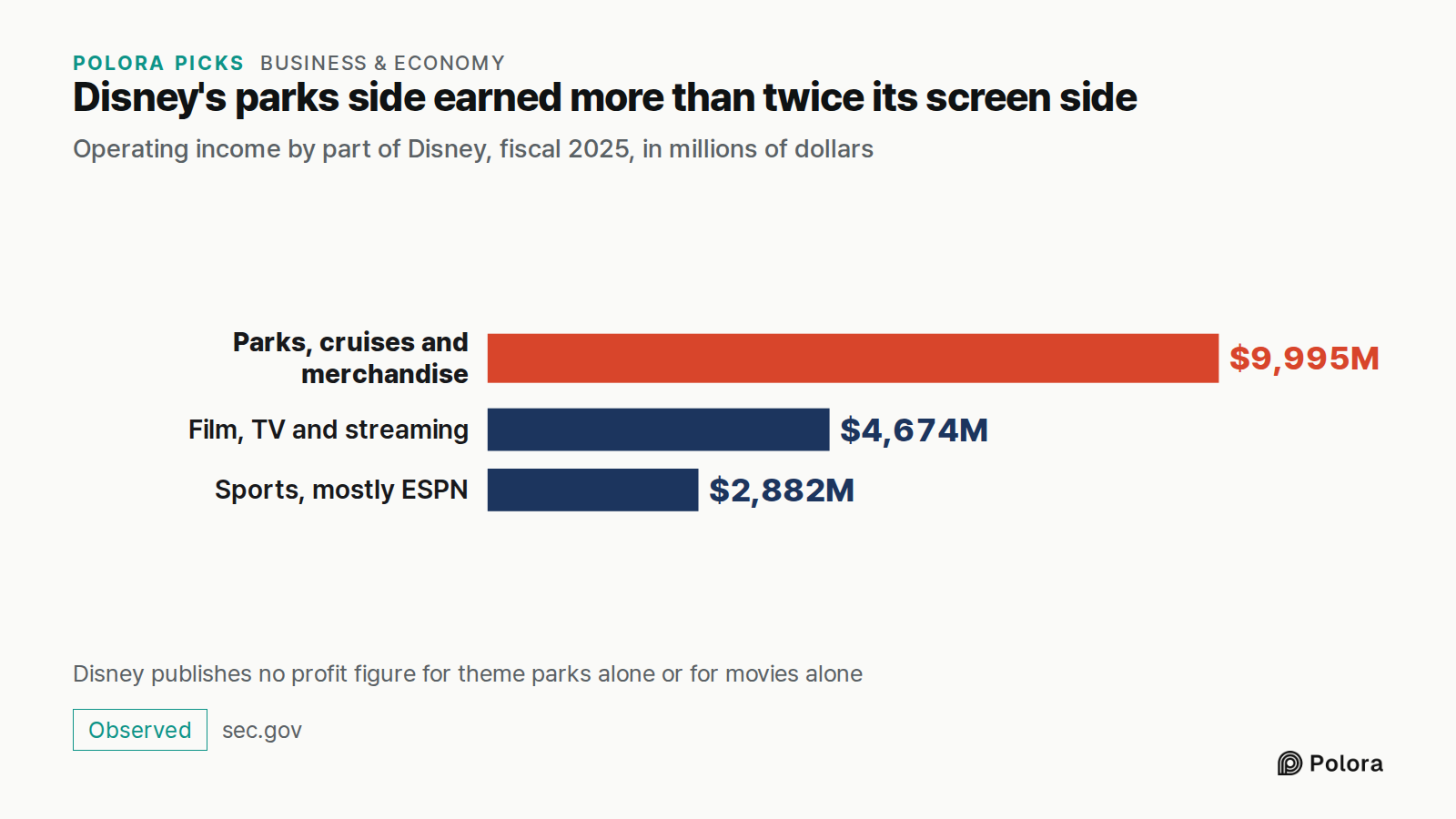
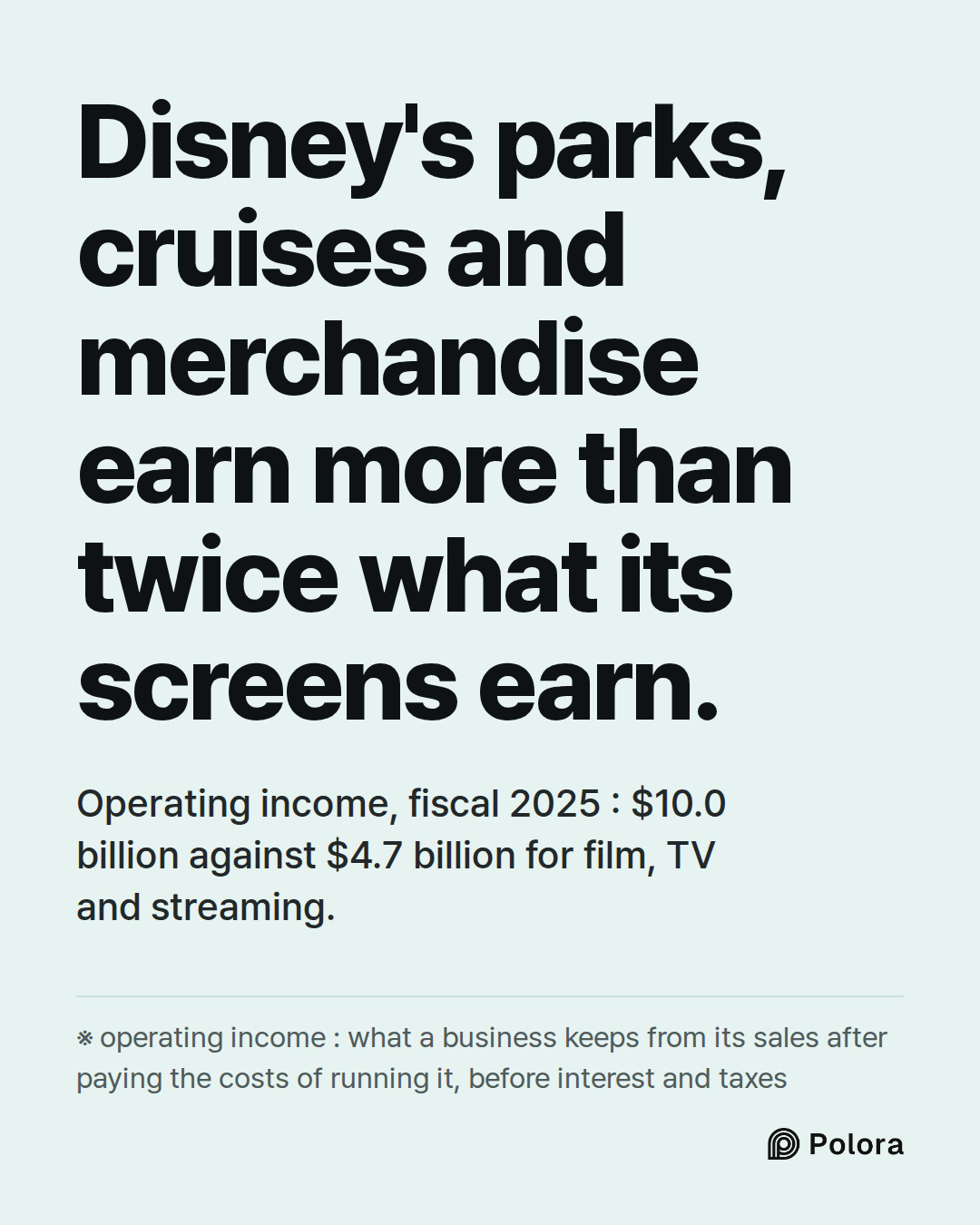
Yes, by a wide margin. In fiscal 2025, Disney's parks, cruises and merchandise earned $10.0 billion in operating income, more than twice the $4.7 billion from film, TV and streaming combined. Disney does not report a profit figure for movies alone.
Business & Economy · 2026-10-12
Disney's parks side earns more than twice what its screen side earns
Ask most people where Disney makes its money and they will say the movies. Mickey Mouse, Frozen, Marvel and Star Wars all started on a screen. Disney's own accounts say otherwise. In the year that ended on September 27, 2025, the part of Disney that runs its theme parks, cruise ships and merchandise had $9,995 million in operating income, about $10.0 billion, a record for that part of the company. The part that makes films, runs TV channels and operates Disney+ and Hulu had $4,674 million, about $4.7 billion.
Operating income is what a business keeps from its sales after paying the costs of running it, before interest and taxes. It is the closest the filings come to showing where the profit is made. By that measure, Disney's parks side made more than twice as much as everything it puts on screens. Sports, mostly ESPN, is reported separately and made $2,882 million.
Neither side is a pure theme-park business or a pure movie business, and Disney publishes no profit figure for theme parks alone or for movies alone. So the comparison here is between the two parts of the company that hold them.
Operating income by part of Disney, fiscal 2025, in millions of dollars
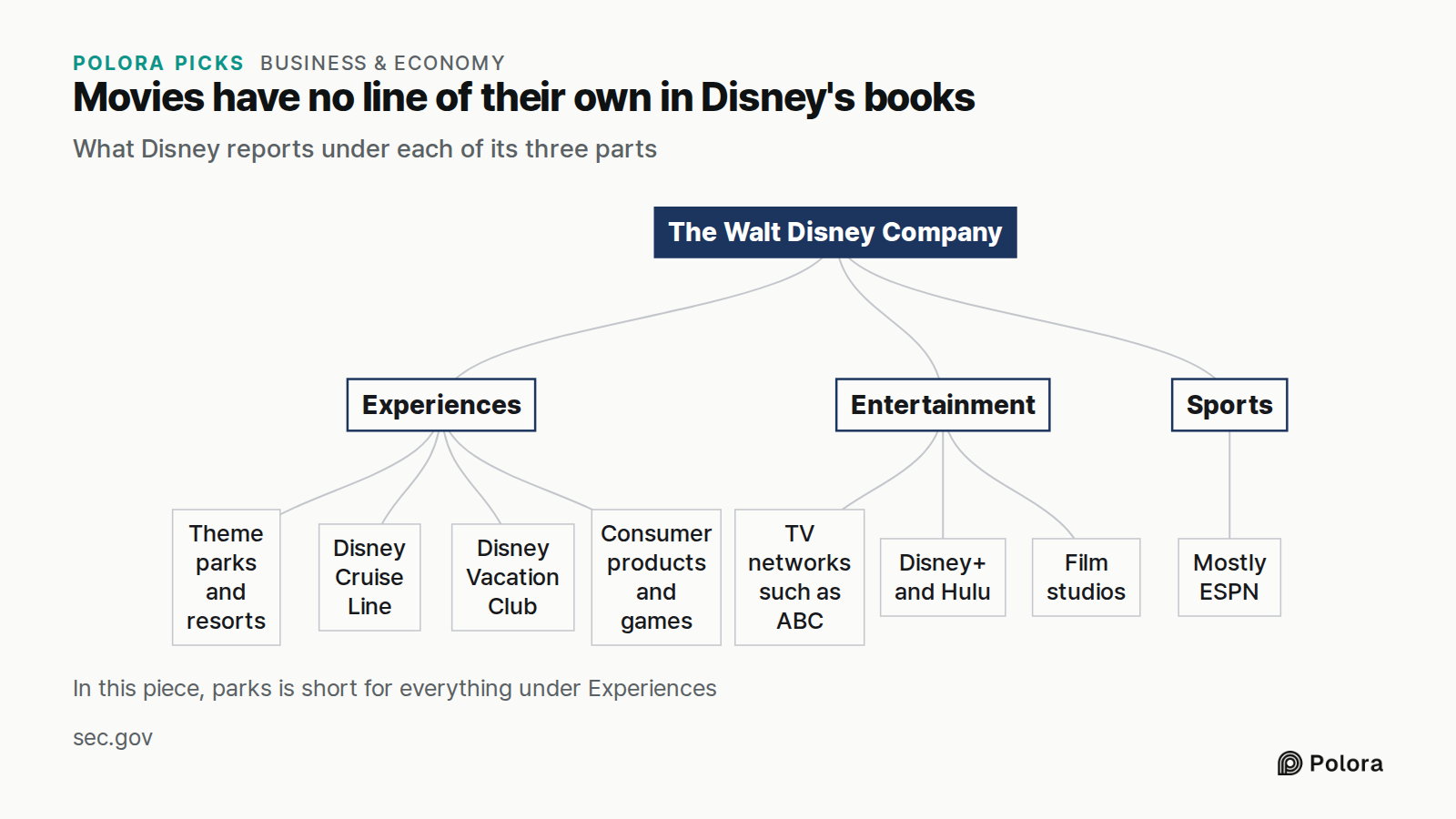
Disney calls the parks side Experiences. It covers more than rides. It includes Walt Disney World in Florida, Disneyland in California and Disney's resorts abroad, the Disney Cruise Line, the Disney Vacation Club and consumer products and games, which means the toys, clothes and games that carry Disney characters, many of them made by other companies under licence. In this piece, parks is short for all of that.
The other side is called Entertainment. It holds the TV networks such as ABC, the Disney+ and Hulu streaming services, and the film studios. Movies do not get a line of their own. To see what films earn, you have to look inside Entertainment.
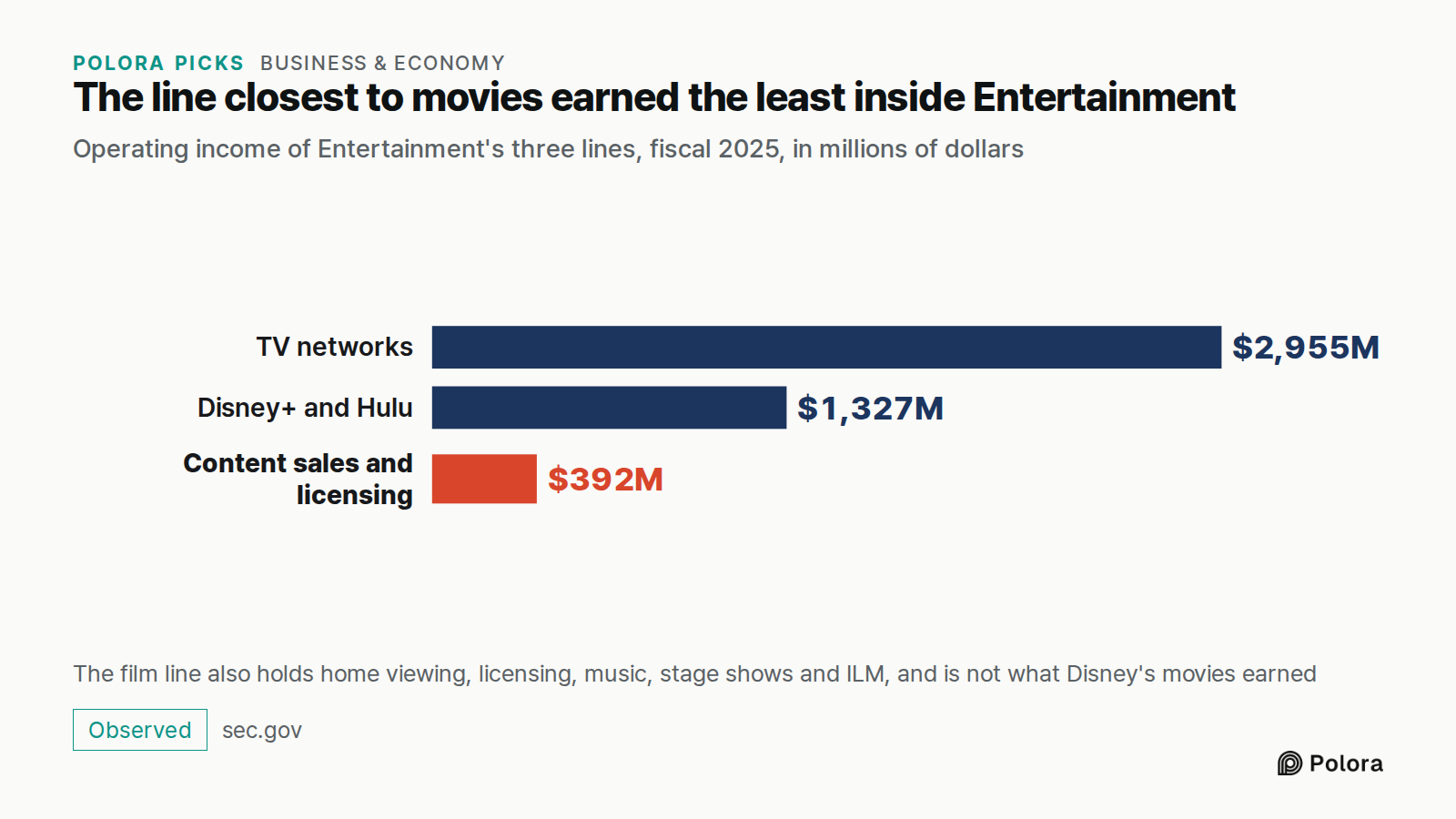
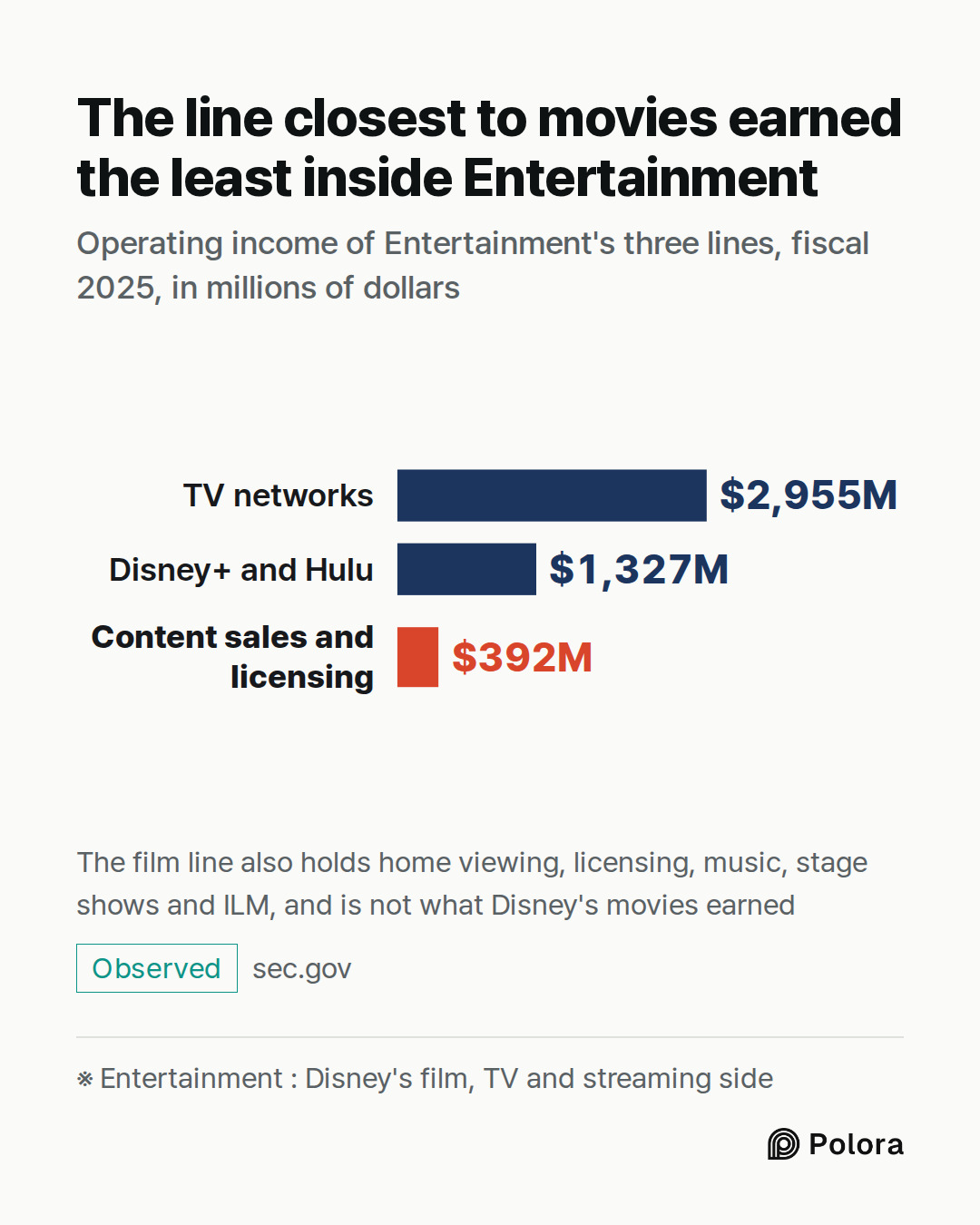
The line closest to Disney's movie business earned $392 million
Inside Entertainment, Disney reports three results. The TV networks earned $2,955 million in fiscal 2025. Disney+ and Hulu earned $1,327 million. The third line, Content Sales/Licensing and Other, covers releasing films in cinemas, selling and renting films and shows for home viewing, and licensing them to other channels and streaming services, along with music, stage shows and the special effects house Industrial Light & Magic. It brought in $8,488 million in sales, $2,592 million of that from cinemas, and kept $392 million.
That figure is not the same as what Disney's movies earned. Disney spreads the cost of making a film across its Entertainment businesses according to its own estimate of what each way of showing the film is worth, so a film that goes to Disney+ carries part of its cost there. Marketing for cinema releases is counted when it is spent, which can show a film losing money before it opens. The line also swings with each year's slate of releases : in the last quarter of fiscal 2025, Disney said Entertainment's results fell largely because its films compared poorly with those of a year earlier. Still, $392 million is the nearest thing to a movie business that Disney publishes, and it is small next to the parks.
Operating income of Entertainment's three lines, fiscal 2025, in millions of dollars
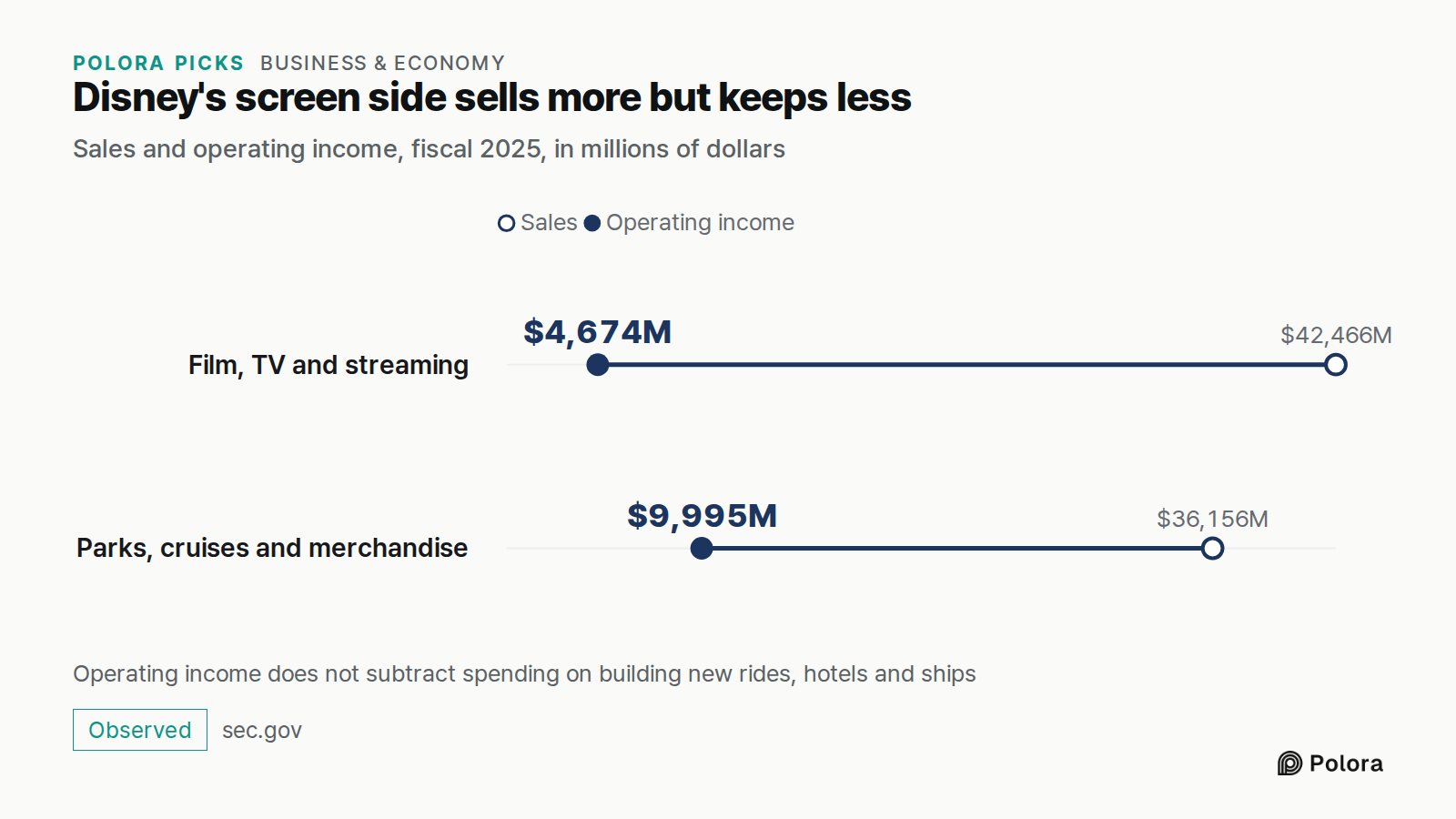
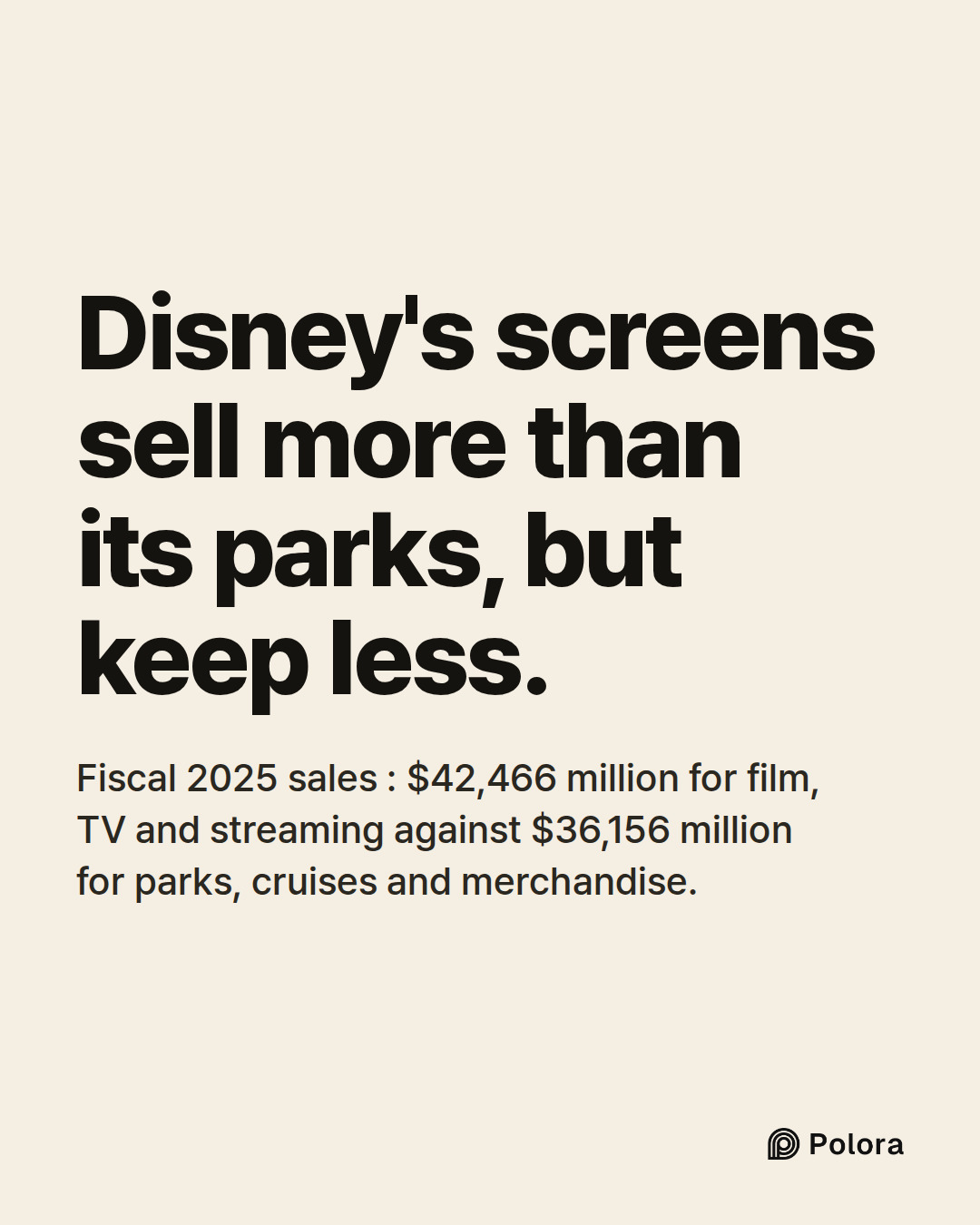
By sales, the order flips. Entertainment brought in $42,466 million in fiscal 2025, more than Experiences at $36,156 million. The screen side is the bigger business by sales and the smaller one by what it keeps. Out of every dollar of sales, the parks side kept more than twice as much as the screen side.
Part of the reason is how each business is built. A film or a series is paid for before anyone knows whether it will work, and much of its earning happens in a short window after release. A park, a ship or a licensed toy line goes on selling the same characters year after year. Parks are not cheap either, since rides, hotels and ships cost a great deal to build and run. But once they exist, they keep selling every day, whether or not a new film is a hit that year.
One caution goes with this comparison. Operating income does not subtract what Disney spends building new rides, hotels and ships, so it does not show how much cash the parks return on that money.
Sales and operating income, fiscal 2025, in millions of dollars
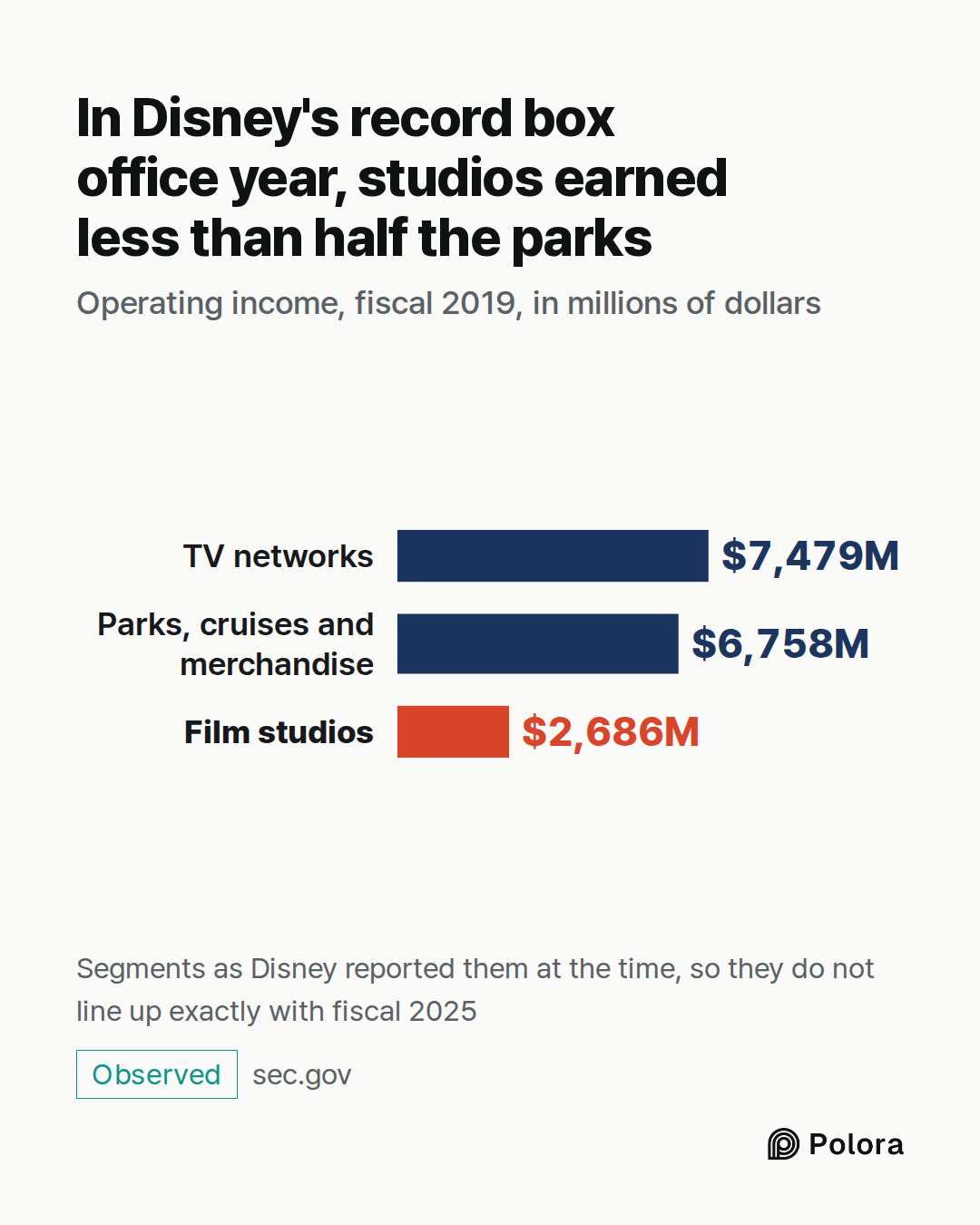
Even in Disney's record box office year, the parks earned more
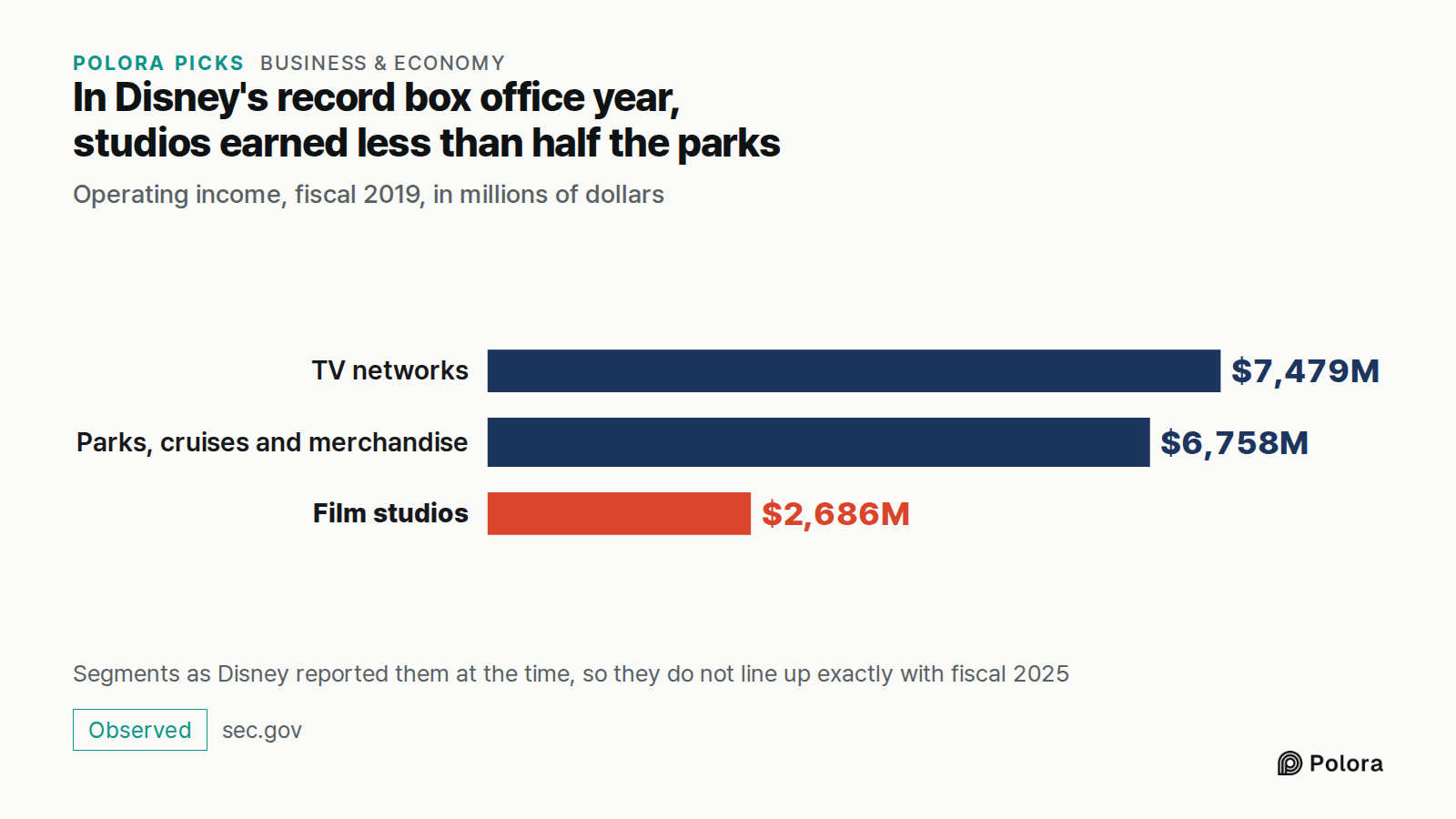
This is not one year's accident. Before 2020, Disney reported its film studios as a separate segment called Studio Entertainment, which is the cleanest comparison available. In fiscal 2018 the studios earned $3,004 million and the parks side earned $6,095 million. In fiscal 2019 the studios earned $2,686 million and the parks $6,758 million. Disney has since redrawn its segments, so these years do not line up exactly with fiscal 2025.
Fiscal 2019 was the year of Avengers : Endgame, The Lion King and Toy Story 4. By box-office trackers' counts reported at the time, Disney's films took $11.12 billion at cinemas worldwide over calendar 2019, and Disney became the first studio to pass $10 billion in a year. That is ticket sales over a calendar year, not Disney's profit over its fiscal year. Even in that year, the parks earned more than twice as much as the studios. And neither was Disney's largest business at the time. The TV networks were, with $7,479 million.
Operating income, fiscal 2019, in millions of dollars
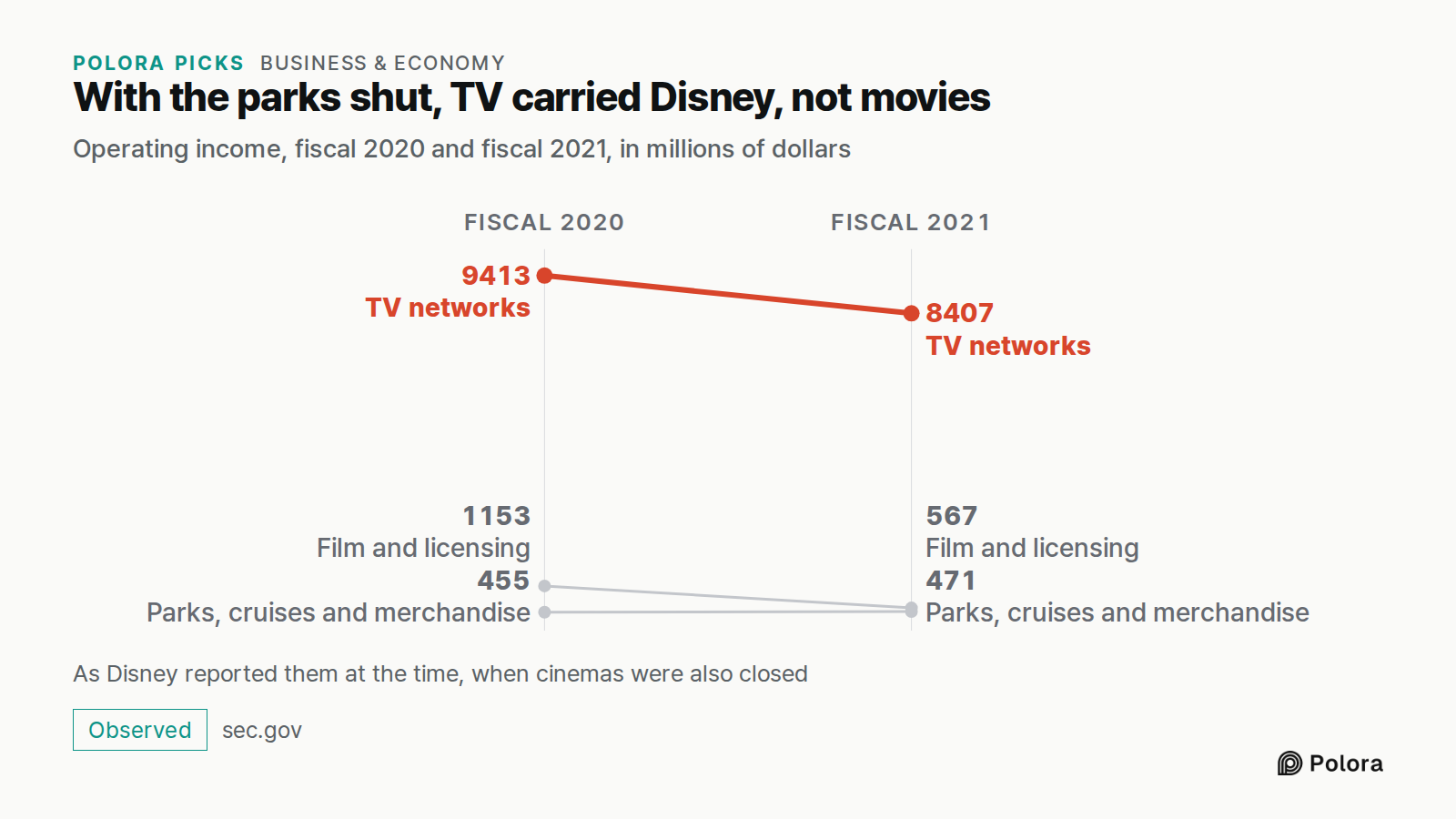
The one stretch when the order reversed was the pandemic. With parks closed or running at reduced capacity, the parks side earned only $455 million in fiscal 2020 and $471 million in fiscal 2021, as Disney reported them at the time. Disney then reported film, TV and streaming together in one segment, which earned $7,653 million and $7,295 million, so it can look as though movies took over.
They did not. Cinemas were closed as well. Inside that segment, the TV networks earned $9,413 million and $8,407 million, while the film and licensing line fell from $1,153 million to $567 million and the young Disney+ was still losing money. TV carried Disney through those years. Once the parks reopened, they returned to the top, and by fiscal 2024 the parks side earned $9,272 million.
Operating income, fiscal 2020 and fiscal 2021, in millions of dollars
Disney's films create the characters that earn elsewhere
None of this means the films do not matter. The films create the characters, and the parks, ships and toys are where those characters go on earning money for decades. Disney's own books record that link. Part of what the parks side earns from licensing characters for merchandise is credited back to Entertainment as a royalty, though Disney does not say how much.
So the sentence to carry away is this. On the figures Disney reports, the side of the company that runs its parks has for years earned more than the side that makes its films, except while the pandemic kept the parks shut. The films still feed the parks, ships and toys with characters. How much of that later income any one film should be credited with is something the accounts do not show. Disney does not publish what a single film earns, or how much of the parks' income any one character brings in, so the full return on a film cannot be read from outside the company.
Does Disney make more money from its theme parks than from its movies?
Alpha · claude-sonnet-5-5
Short answer: yes, but the comparison needs care. The premise holds, with caveats about the unit of comparison.
What I checked. I read Disney's FY2025 Q4 release. The numbers in the manuscript match it.
- Experiences segment operating income was $9,995M, against $4,674M for Entertainment.
- Entertainment revenue was $42,466M and Experiences revenue was $36,156M. So Entertainment is bigger by sales and smaller by operating income.
- Disney called the Experiences figure a record $10.0 billion.
- The manuscript's margin claim is its own arithmetic. 9,995/36,156 is about 27.6%, and 4,674/42,466 is about 11.0%. "More than twice" holds (2.5×).
Where I'd push back on the manuscript's angle:
1. "Yes, by a wide margin" compares a segment with a segment, not parks with movies. Experiences includes cruises, consumer products and games, not only parks. Entertainment includes TV networks and streaming. The manuscript says this, but the headline "parks earn more than twice what screens earn" blurs it. Disney does not report a movies-only line.
2. The film-related line is volatile and easy to misread. In Q4 FY2025, Content Sales/Licensing and Other posted an operating loss o…
Beta · gpt-6-sol
Yes—if “make more money” means operating income. Disney’s latest full-year figures available here are for the fiscal year ended September 27, 2025. Its Experiences segment earned $9.995 billion in segment operating income, versus $4.674 billion for Entertainment. That supports the manuscript’s “more than twice” comparison, but Experiences is not just theme parks, and Entertainment is not just movies. (sec.gov)
The annual report allows a narrower test than the manuscript uses: domestic and international Parks & Experiences together earned $7.817 billion ($6.375 billion plus $1.442 billion), *excluding* the $2.178 billion from Consumer Products. That is still greater than all of Entertainment’s $4.674 billion, though it is not twice as much. Parks & Experiences still includes cruises and other travel offerings, so Disney does not publish a theme-parks-only profit figure. (investors.thewaltdisneycompany.com)
What the manuscript gets right, with necessary lim…
Gamma · gemini-3.1-pro
Yes, the manuscript’s core comparison is accurate, though it rests on segment definitions that blend movies and parks with other businesses.
While Alpha and Beta have correctly covered the FY2025 financial disclosures, I will address the remaining historical and contextual checks the manuscript asks for based on my live search and verification.
What I verified regarding the manuscript's checks:
1. Release Dates and FY2019: The manuscript correctly places *Avengers: Endgame* (April 26, 2019), *Toy Story 4* (June 21, 2019), and *The Lion King* (July 19, 2019) within Disney's Fiscal 2019, which ended on September 28, 2019.
2. Calendar 2019 Box Office: The claim that Disney grossed $11.12 billion worldwide at the box office in calendar 2019, making it the first studio to cross the $10 billion mark in a single year, is a widely reported industry figure cited by box-office trackers (like Comscore). It is crucial to maintain the manuscript's distinction here: this $11.12 billion is a *calendar-year gross revenue* figure across the entire industry, not a fiscal-year operating income figure for Disney itself.
3. Pandemic-era Segment Figures (FY2020 & FY2021): The m…
Researcher · claude-haiku-5-5
Researcher check: the Disney parks-versus-movies premise
Searching this turn, I confirmed the headline segment figures. I could not confirm several supporting claims in the round, and I found newer data.
Confirmed (FY2025, year ended September 27, 2025)
- Experiences reported record full-year segment operating income of $10.0 billion, up $723 million. Experiences: Record full year segment operating income of $10.0 billion, an increase of $723 million compared to the prior year. Source: https://thewaltdisneycompany.com/press-releases/the-walt-disney-company-reports-fourth-quarter-and-full-year-earnings-for-fiscal-2025/
- The same release's table gives Experiences revenue of $36,156 million and Entertainment segment operating income of $4,674 million, with Sports at $2,882 million. Source: the SEC 8-K Exhibit 99.1, https://www.sec.gov/Archives/edgar/data/1744489/000174448925000154/fy2025_q4xprxex991.htm
- The margin arithmetic is correct: 9,995 / 36,156 is about 27.6%, and 4,674 / 42,466 is about 11.0%. Entertainment revenue of $42,466 million is the figure the manuscript and Alpha cite. I checked it against the table in the release, not a separate source.
- Entertainment's…
The Arbiter · gpt-6-sol
The voices agree on the reported FY2025 comparison, but they are testing a broader manuscript claim than the figures alone can prove. Disney reports $9.995 billion in operating income for Experiences and $4.674 billion for Entertainment. Those are not parks-only and movies-only accounts. Beta also identified a narrower Parks & Experiences subtotal of $7.817 billion, excluding Consumer Products, that deserves a direct check before it is used in the published piece. (investors.thewaltdisneycompany.com)
I opened Disney’s FY2025 10-K to resolve two points left open by the Researcher. It does say Entertainment receives an intersegment revenue allocation intended to reflect royalties on Experiences’ consumer-products licensing of Entertainment-created IP. It also says production costs are generally allocated among Entertainment businesses by the estimated relative value of distribution windows. Its discussion of theatrical marketing says those costs are expensed as incurred and can produc…
The Arbiter's Final Verdict · gpt-6-sol
Yes, on Disney’s reported operating-income figures—but not as a precise parks-versus-movies tally. In fiscal 2025, Disney’s Experiences segment reported $9.995 billion in operating income, more than twice Entertainment’s $4.674 billion. Entertainment includes films, television and streaming; Experiences includes theme parks, cruises, resorts and consumer products. Disney does not publish a movies-only or theme-parks-only operating-profit figure. The manuscript’s central premise therefore stands as a segment comparison, not as a literal measurement of movies against park gates. Disney FY2025 earnings release
The manuscript’s revenue contrast also holds: Entertainment sold more—$42.466 billion versus $36.156 billion—but its segment operating-income margin was about 11.0%, against 27.6% for Experiences. The proposed $392 million “closest to movies” figure is the operating income of *Content Sales/Licensing and Other*, not movie profit: that line includes activities besides theatrical releases, and Disney allocates film costs across distribution businesses.…