Is Guinness World Records paid by the companies that break its records?
Not for the verdict, Guinness says. Individuals chasing a record for themselves can apply free, but brands must pay : for help choosing a record, a judge or the logo. An executive said in 2023 that this work brings in about half its revenue.
Business & Economy · 2026-10-12
The short answer : not for the verdict, but for nearly everything around it
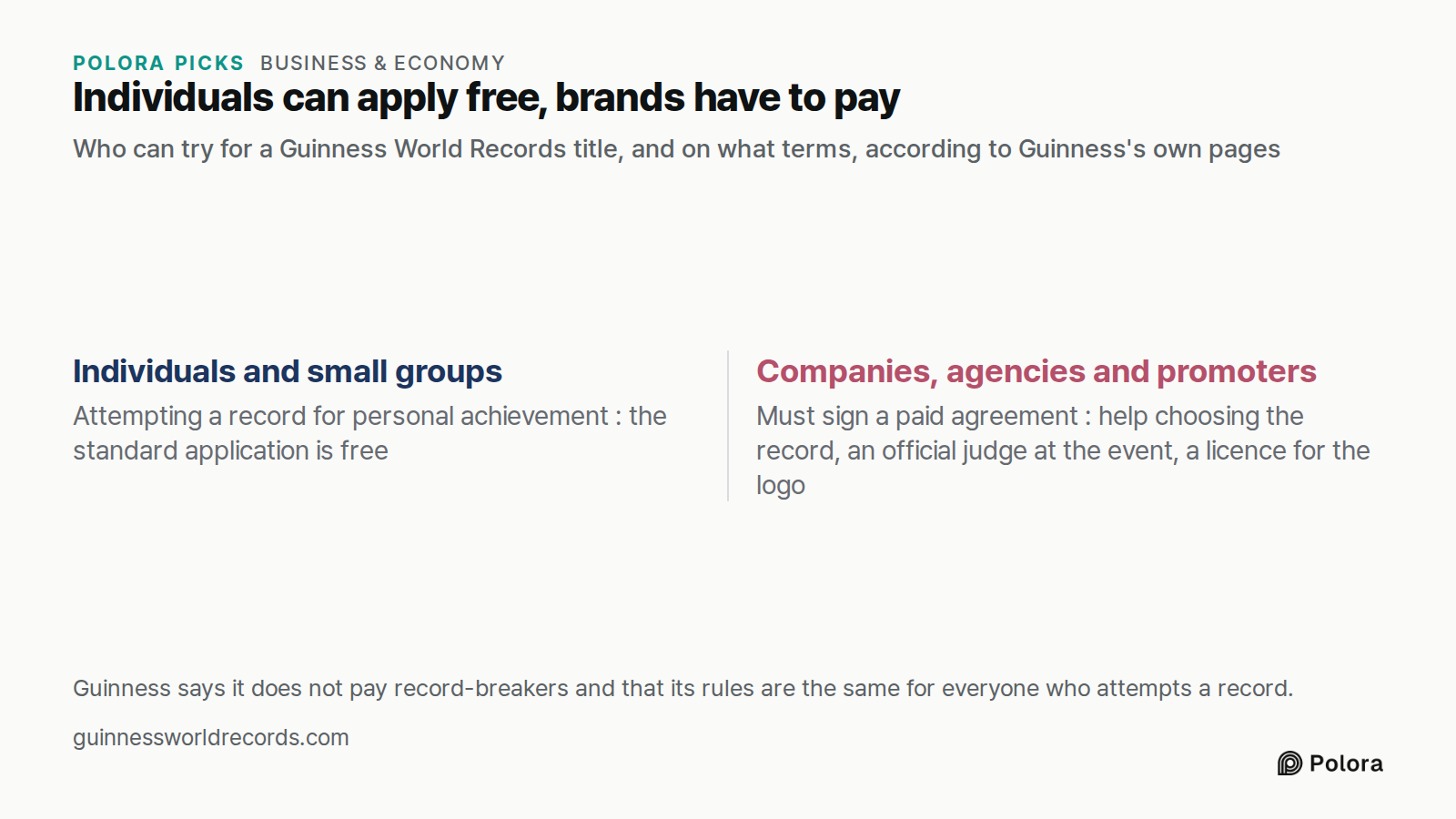
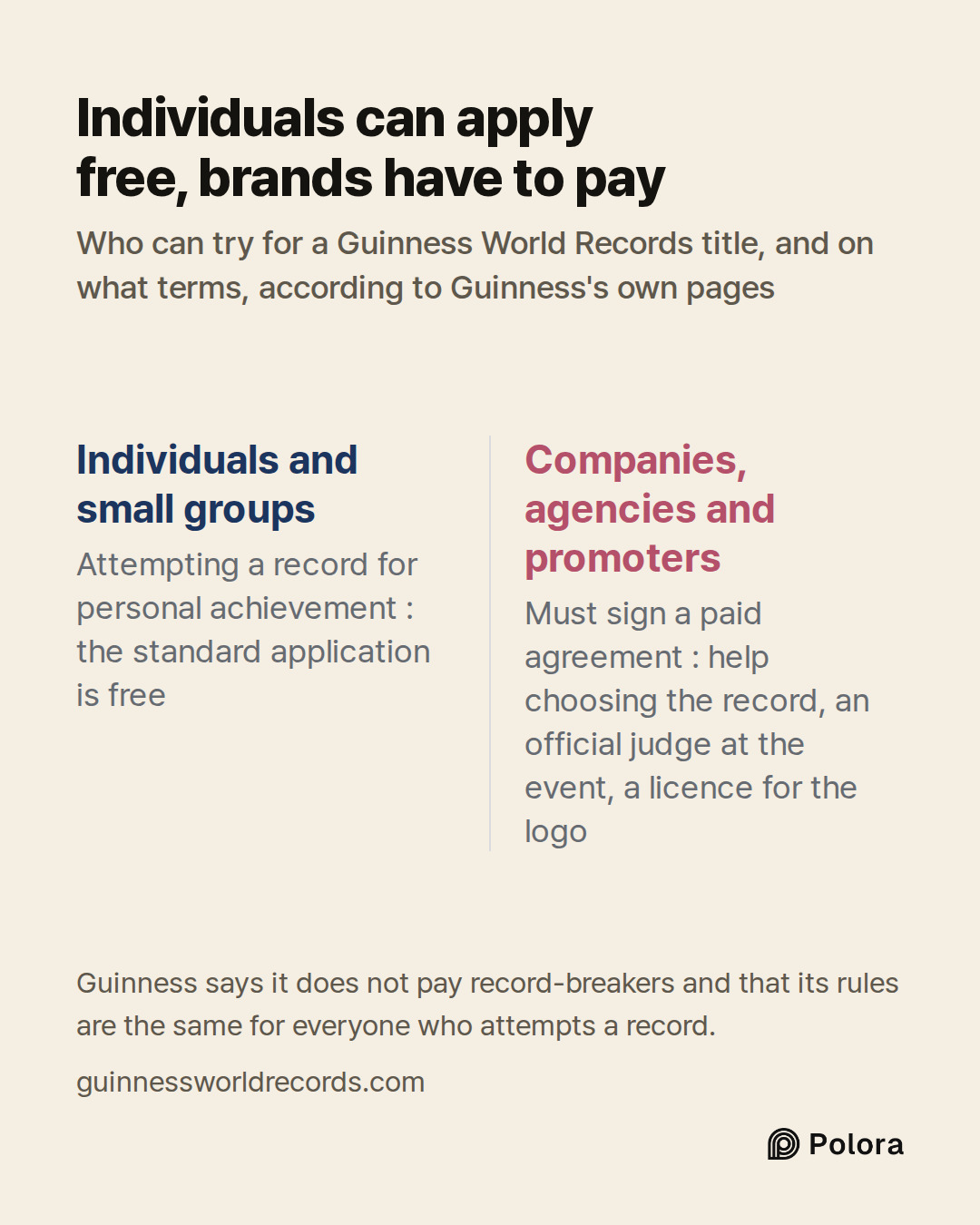
A person who wants to try for a Guinness World Records title for their own sake can still apply without paying. Guinness's own pages call this the standard, free application, and they limit it to individuals or small groups whose main purpose is personal achievement. Guinness also says it does not pay anyone for breaking a record, and that its rules are the same for everyone who attempts one.
Brands are different. Guinness says that companies, agencies and anyone attempting a record to promote something must sign a paid agreement with its consultancy. The agreement can cover help choosing which record to try for, an official judge sent to the event, and the chance to license the Guinness logo. Services can be picked separately and fees are quoted case by case. In 2023 one of its executives said the consultancy now earns about as much as the famous book.
Who can try for a Guinness World Records title, and on what terms, according to Guinness's own pages
The book was the Guinness brewery's idea. Twin brothers Norris and Ross McWhirter were hired in 1954 to compile it. The first edition came out in 1955 and topped the British bestseller list by that Christmas. For decades, selling the book every year was the whole business.
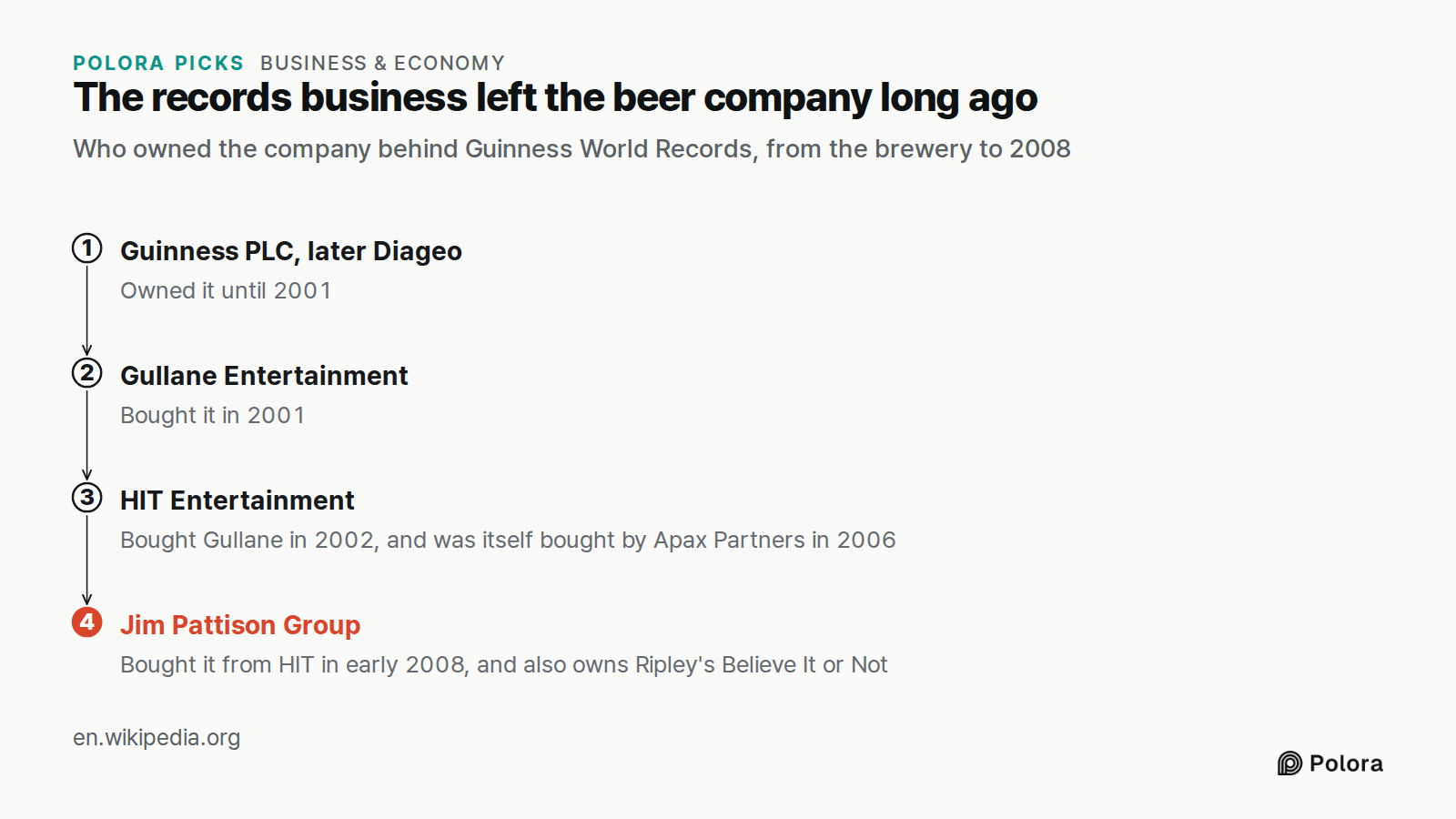
Ownership then changed several times. Guinness PLC and later the drinks group Diageo owned the company until 2001, when it was sold to Gullane Entertainment. HIT Entertainment bought Gullane in 2002, and the investment firm Apax Partners bought HIT in 2006. In early 2008 HIT sold the records business to the Jim Pattison Group, a Canadian private company that also owns Ripley's Believe It or Not. The beer and the records now have nothing to do with each other beyond the name.
Who owned the company behind Guinness World Records, from the brewery to 2008
Book sales fell, as they did for publishers in general. In 2017 NPR's Planet Money reported that about ten years earlier Guinness had realised it needed a new way to make money. Peter Harper, a senior vice president at the company, said the answer came to them : companies started asking Guinness to fly someone out to their events, because a record title gets a lot of press.
So Guinness began selling that service. Marco Frigatti, who runs the company's consultancy, told the trade site Marketing Beat that the consultancy began in the late 2000s and that it was set up “to remain viable as a company.”
A brand buys services, sometimes bundled into a package. Bloomberg Businessweek described one in 2013. A casino in New York State paid Guinness $10,500 for a “Silver Package” to set a record that hadn't existed before, the largest human playing card. The package included a consultant who helped come up with the idea, an official adjudicator in a blazer to certify it, and a licence to use the Guinness trademark. Frigatti has said Guinness proposes record ideas, while the client runs the event itself.
Bigger campaigns cost far more. In 2017 Planet Money reported that the company's services started at $12,000 and went up to more than half a million dollars, and that Guinness ran hundreds of such events a year. Reebok broke 44 records in one day on four continents to launch a shoe. The Gates Foundation, Audi and Dwayne Johnson were also named as clients. These are reported prices from 2013 and 2017, not today's.
Guinness does not publish a price list. Its business pages say fees are quoted case by case. A judge at the event must be supplied by Guinness. A brand can license a logo for the attempt before it happens and, only if the record is broken, a record-holder logo for a limited time, not a permanent one.
In January 2023 Marco Frigatti described the change in one sentence : “from being close to 100% of our revenue stream, the book now accounts for just 50%. The consultancy business has become the other half of our revenue.”
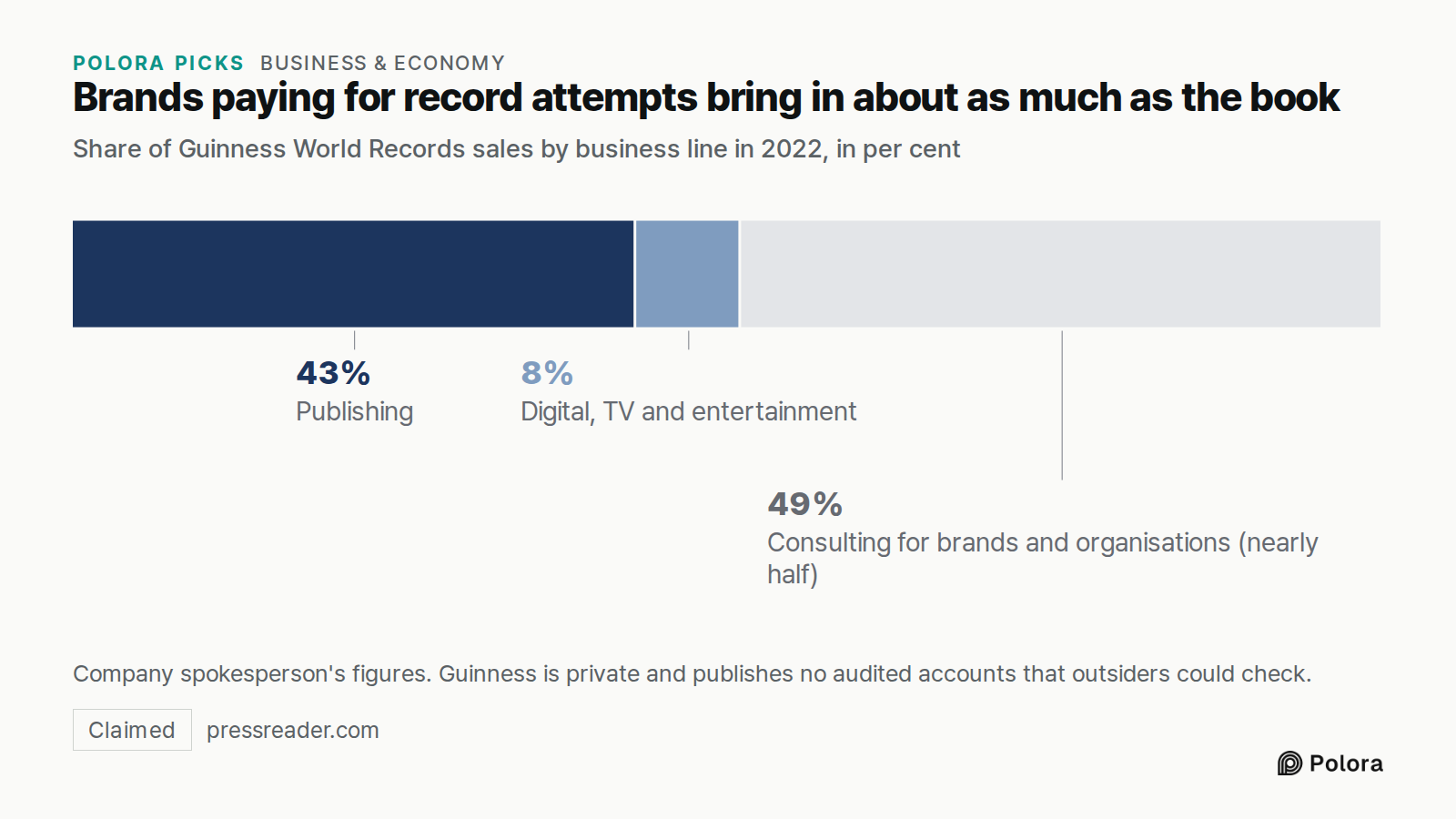
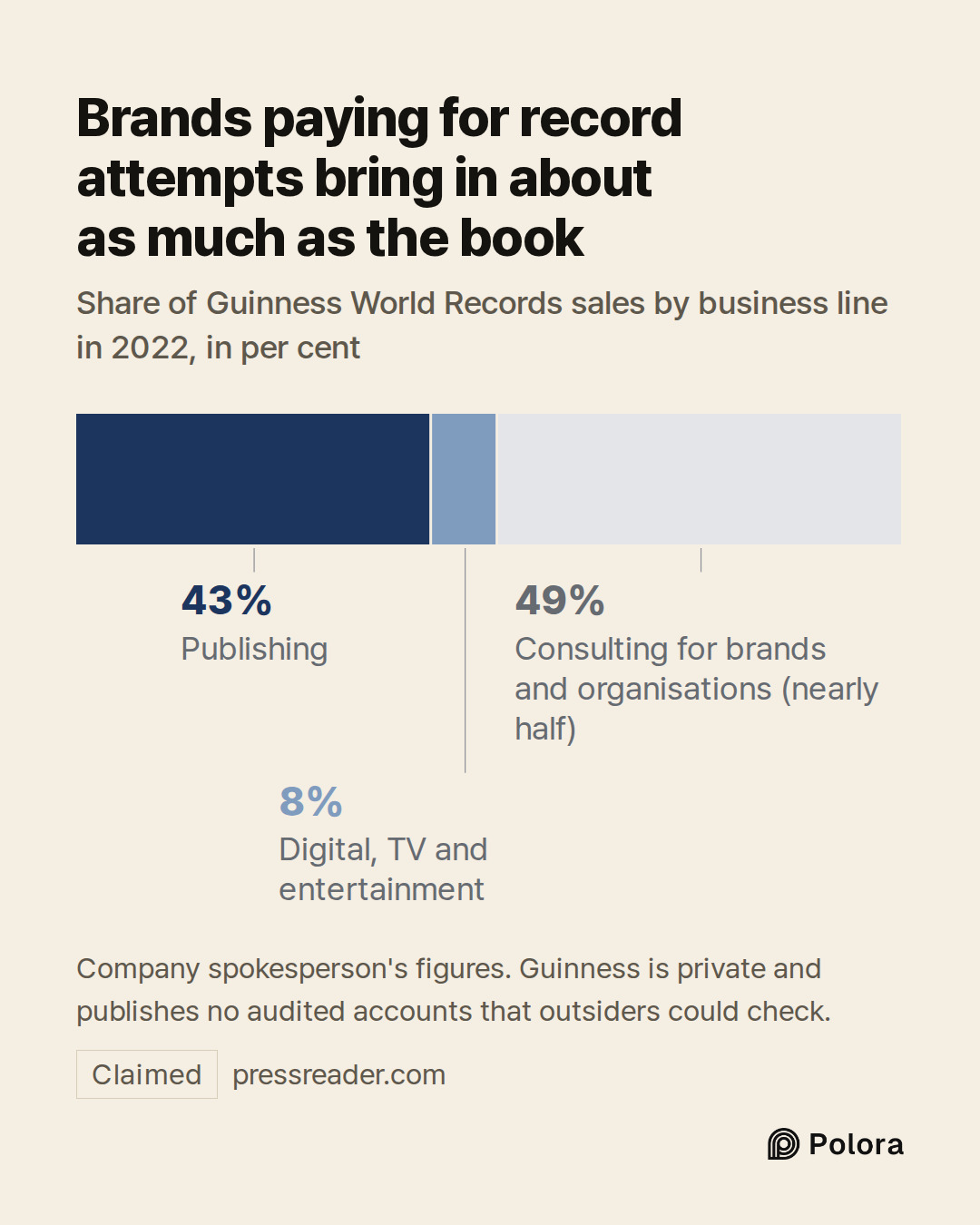
Amanda Marcus, a company spokesperson, later gave a more precise split for 2022 : nearly half of sales came from consulting, 43 percent from publishing, and 8 percent from digital, TV and entertainment. Both sets of figures come from the company itself and describe past years. Guinness is privately owned and does not publish audited accounts that would let anyone outside check them.
By the company's own figures, then, the brands and organisations whose record attempts it helps to plan now bring in about as much as the people who buy the book, or a little more.
Share of Guinness World Records sales by business line in 2022, in per cent
Guinness says the judging is not for sale. Its website says every record title is measured so that everyone attempts it under the same conditions. It also says that whether a record is checked from uploaded evidence or by a judge in person, the aim is the same : to be certain the record really is the best in the world. Most records are checked from evidence people send in, and a judge in person is a paid service.
The company also says it does not pay record-breakers or cover their costs. In its own words, an official adjudicator is available only through its “fee-based Consultancy service.” Individuals have been able to pay to have their applications reviewed faster, but the FAQ now says that option is temporarily unavailable. On the radio in 2017, Peter Harper said the company was aware of the risk : if it lost its reputation as an authority, the business would collapse quickly.
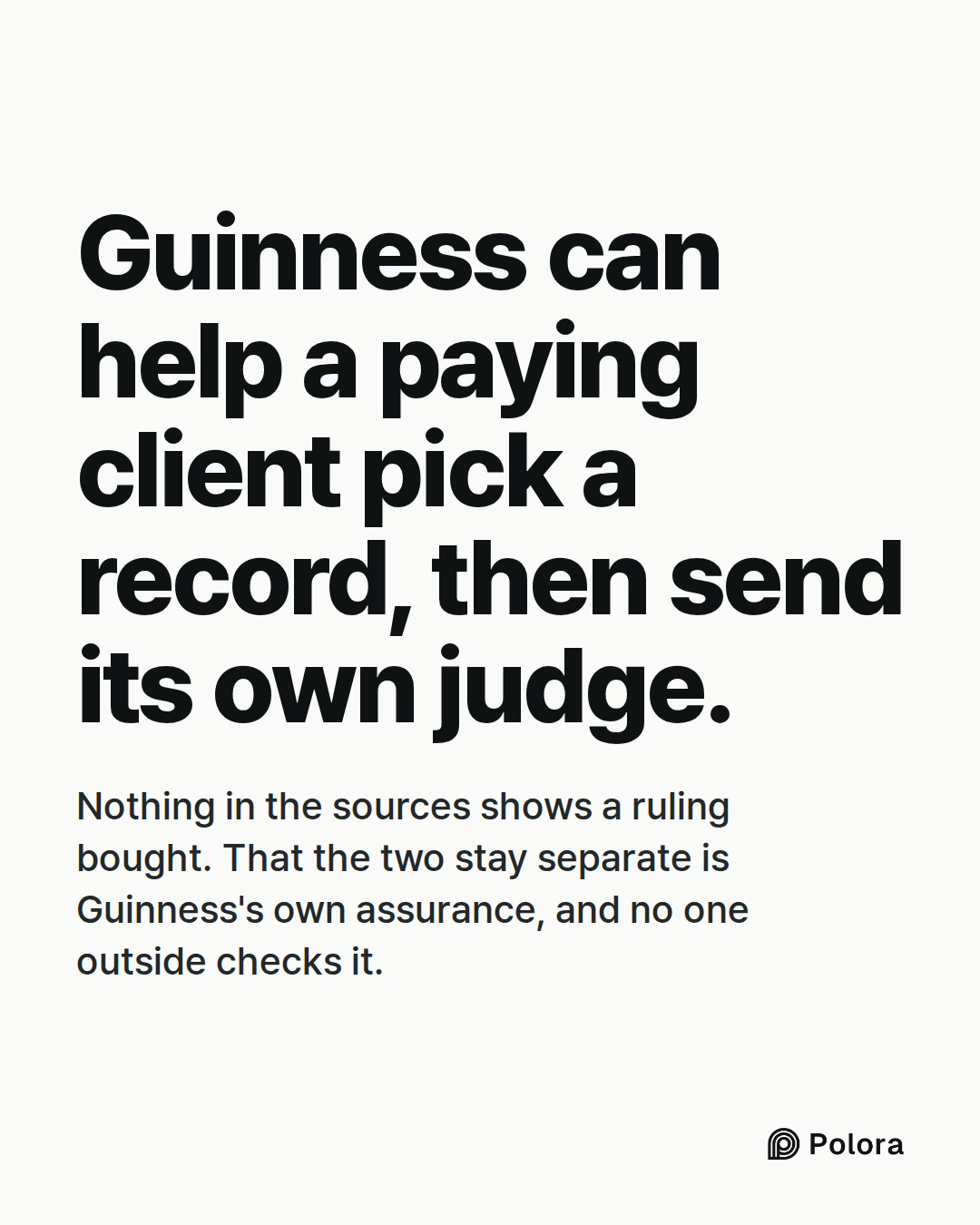
The firmest doubt is about how the system is built, not about any one case. The same company can help a paying client pick a record it is likely to break, then send its own judge to rule on it. Nothing in the sources here shows that a ruling has been bought, but Guinness's assurance that the two sides stay separate is its own, and no one outside the company checks it.
Some record-breakers go further. In Planet Money's 2017 reporting, David Adamovich, a knife thrower who holds records, said that if you are not paying it can feel very hard to get a Guinness record. He described the system as “all about money” and joined a rival non-profit record body run by record-breakers.
In 2019 the comedian John Oliver argued on his TV show that Guinness had taken money from authoritarian governments for vanity records, naming Turkmenistan. Guinness called his segment “false and unfair allegations” and said it seemed to be motivated by Guinness turning down the show's own record attempt. These are the critics' arguments and the company's answer to them, and no outside authority has ruled on them.
When you see that a brand, a city or a government has “broken a world record”, the record was judged by Guinness's published rules, which the company says are the same for everyone. What was often paid for is everything else : which record was chosen, the event built around it, the judge who flew in, and the logo on the press release.
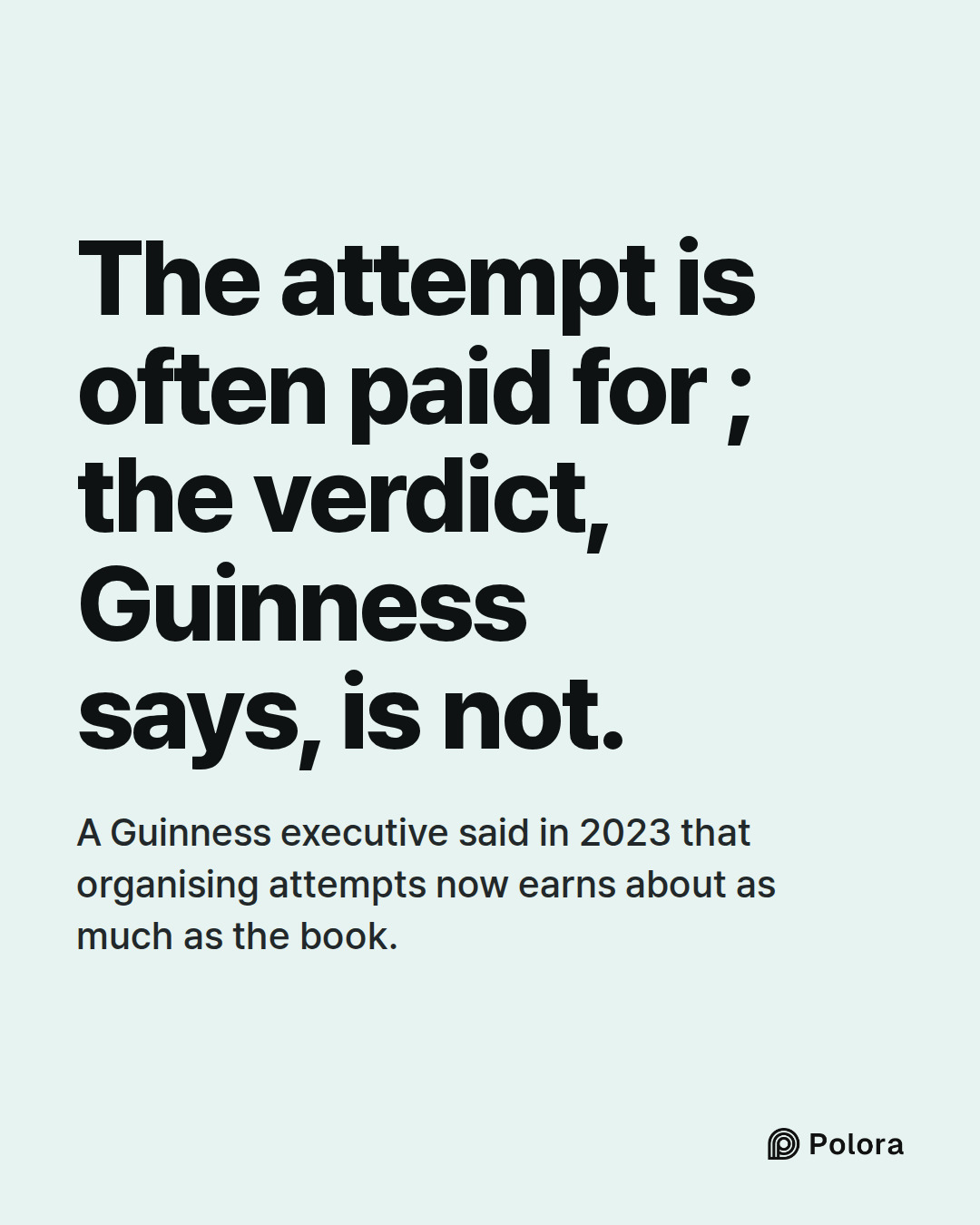
In one line : the attempt is often paid for ; the verdict, Guinness says, is not, and nothing in the sources here shows one being sold. One of its own executives said in 2023 that organising attempts now earns about as much as the book that made its name.
Is Guinness World Records paid by the companies that break its records?
Alpha · claude-sonnet-5-5
Alpha's read: the manuscript's core premise holds, but several of its claims are stated more firmly than I can support. I did not run searches this turn, so everything below is from my own knowledge and is unverified against live sources. The Researcher should check the specifics.
Does the premise stand? Yes, with care. The answer "not for the verdict, but for the services around it" matches the brief's warning not to stretch "paid for a service" into "records can be bought." Companies do pay Guinness for consultancy, an on-site adjudicator and the logo licence. I'm not aware of any evidence that payment changes the outcome of a judging decision.
Where I'd push back on the manuscript:
1. "Anyone can apply for free" is stated as current fact. The editor's own check found that the live FAQ doesn't say "free" outright. The wording comes from a 2017 NPR line and a dev subdomain. I'd attribute it to NPR in 2017, or to a live page if one turns up. I don't think it is wrong, but it isn't confirmed.
2. "In the company's own words, nobody buys the verdict." This reads like a quotation, but the manuscript doesn't show a source for it. The company's actual claim is that…
Beta · gpt-6-sol
[Beta]: Yes—when a company pursues a record for promotion, Guinness World Records says it must enter a paid agreement. That is a stronger and more useful answer than the manuscript’s suggestion that brands *usually* buy an optional package. Guinness’s current business FAQ says commercial applicants are routed to its fee-based consultancy; the agreement can cover help finding a title, verification, and the *opportunity* to license its logos. Services can be selected separately, and fees are quoted case by case. That does not establish that a company pays for a favorable verdict. (guinnessworldrecords.com)
Address: https://www.guinnessworldrecords.com/business-marketing-solutions/faqs
I differ from Alpha on one important verification point: the free route is confirmed on the live site, not just an old NPR report or a development page. The same FAQ explicitly calls it a “Standard (free) Application” for individuals or small groups attempting a record for personal achievement. “Anyone can apply for free” is therefore too broad: promotional attempts, including fundraising, fall under the paid rout…
Gamma · gemini-3.1-pro
Gamma's read: the premise holds, but the manuscript needs careful attribution and dating for its claims.
Alpha and Beta have laid out the core issues well. I ran searches to check the historical claims the manuscript asked for, and here is what I found:
What I could verify:
* Bloomberg 2013 ($10,500 Silver Package): The text is accurate. While I could not pull the live canonical Bloomberg link, syndicated versions of the 2013 Bloomberg report (such as in *The Economic Times*) confirm that Turning Stone Resort Casino paid Guinness $10,500 for a "Silver Package" that included a consultant, an adjudicator, and a trademark licence.
* Jim Pattison Group (2008): The ownership change is correct. A CBC News article from December 18, 2008, confirms that the Vancouver-based Jim Pattison Group had "recently acquired the Guinness World Records business." (https://www.cbc.ca/news/canada/flaherty-names-11-member-economic-advisory-panel-1.712613)
* John Oliver / Turkmenistan (2019): This is accurately summarized. In an August 2019 episode of *Last Week Tonight*, Oliver criticized Guinness for taking money from authoritarian governments, specifically focusing on the…
Researcher · claude-haiku-5-5
Researcher's check (English, live web, this turn)
I ran three searches and got partial results. Where I did not confirm something, I say so.
1. Free vs. paid applications (confirmed in part)
- The official business FAQ says Guinness keeps record-breaking "free to as many individual applicants as possible," but payment can be needed for a Priority Application or Priority Evidence Review, and brands, agencies, businesses or groups are redirected to a "fee-based" Consultancy division. It also says the Standard (free) route is "only available to individuals or small groups whose primary purpose for attempting a record is personal achievement." Source: https://www.guinnessworldrecords.com/business-marketing-solutions/faqs
- So the manuscript's "anyone can apply for free" is too broad. The live FAQ limits the free route by purpose and group type.
- A development-subdomain page says existing titles are free through the standard process (https://dev-micro.guinnessworldrecords.com/records/the-application-process/standard-applications). This is not a live public page, so I would not rely on it alone.
- Secondary reporting quotes Guinness's FAQ as saying it does not pay record-break…
The Arbiter · gpt-6-sol
The voices agree on the central distinction: Guinness charges for services connected with commercial record attempts; payment is not evidence that a successful ruling can be bought. The point still requiring care is how firmly the manuscript can state that judging is independent, rather than attributing that assurance to Guinness.
Two checks sharpen the manuscript:
- Guinness’s live business FAQ calls its standard application free only for individuals or small groups pursuing personal achievement. It says organizations and people attempting records for promotional purposes must enter a paid agreement; services are selectable and prices are quoted case by case. So “anyone can apply for free” and “every brand buys a package” both overstate the rule. Address: https://www.guinnessworldrecords.com/business-marketing-solutions/faqs (guinnessworldrecords.com)
- I found the previously elusive 2022 sales breakdown in a publicly accessible Yahoo-hosted version of the reported story: it attributes nearly half of sales to consulting, 43% to publishing and 8% to digital, TV and entertainmen…
The Arbiter's Final Verdict · gpt-6-sol
Yes. Guinness World Records says companies pursuing records for promotional purposes enter a paid agreement with its consultancy. They can pay for help choosing a record, verification services such as an on-site adjudicator, and rights to use Guinness branding. Fees are quoted case by case. That is not evidence that they can pay for a successful verdict. Guinness business FAQ
The manuscript’s premise therefore stands, with a qualification: “the verdict isn’t for sale” should be presented as Guinness’s position and what the available evidence indicates—not as an independently proven guarantee of impartiality. The strongest objection is structural: Guinness may help a paying client plan an achievable attempt and then supply the adjudicator who rules on it.
For publication, these are the consequential checks:
- Free applications: The live FAQ describes a free standard route for *individuals or small groups seeking personal achievement*. “Anyone can apply for free” is too broad; promotional attempts are treated differently. [Business FAQ](https://www.guinnessworldrecords.com/business-market…