How does U.S. News decide which colleges rank best?

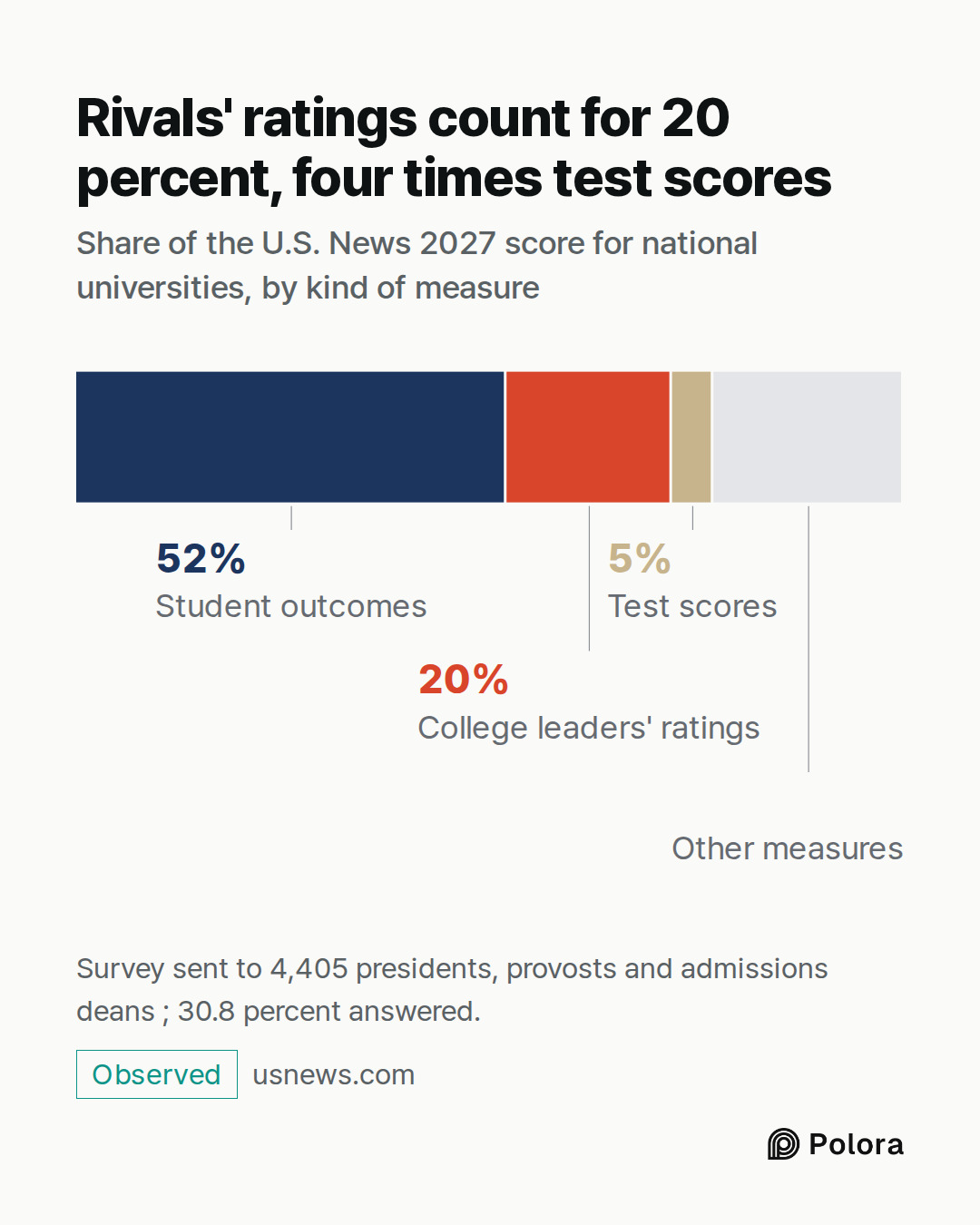
By a weighted formula it keeps revising. For national universities, 52 percent is how students fare after enrolling, 20 percent is college leaders rating rival schools, and acceptance rate counts for nothing.

Business & Economy · 2026-10-10

Why did MIT become No. 1 this year?

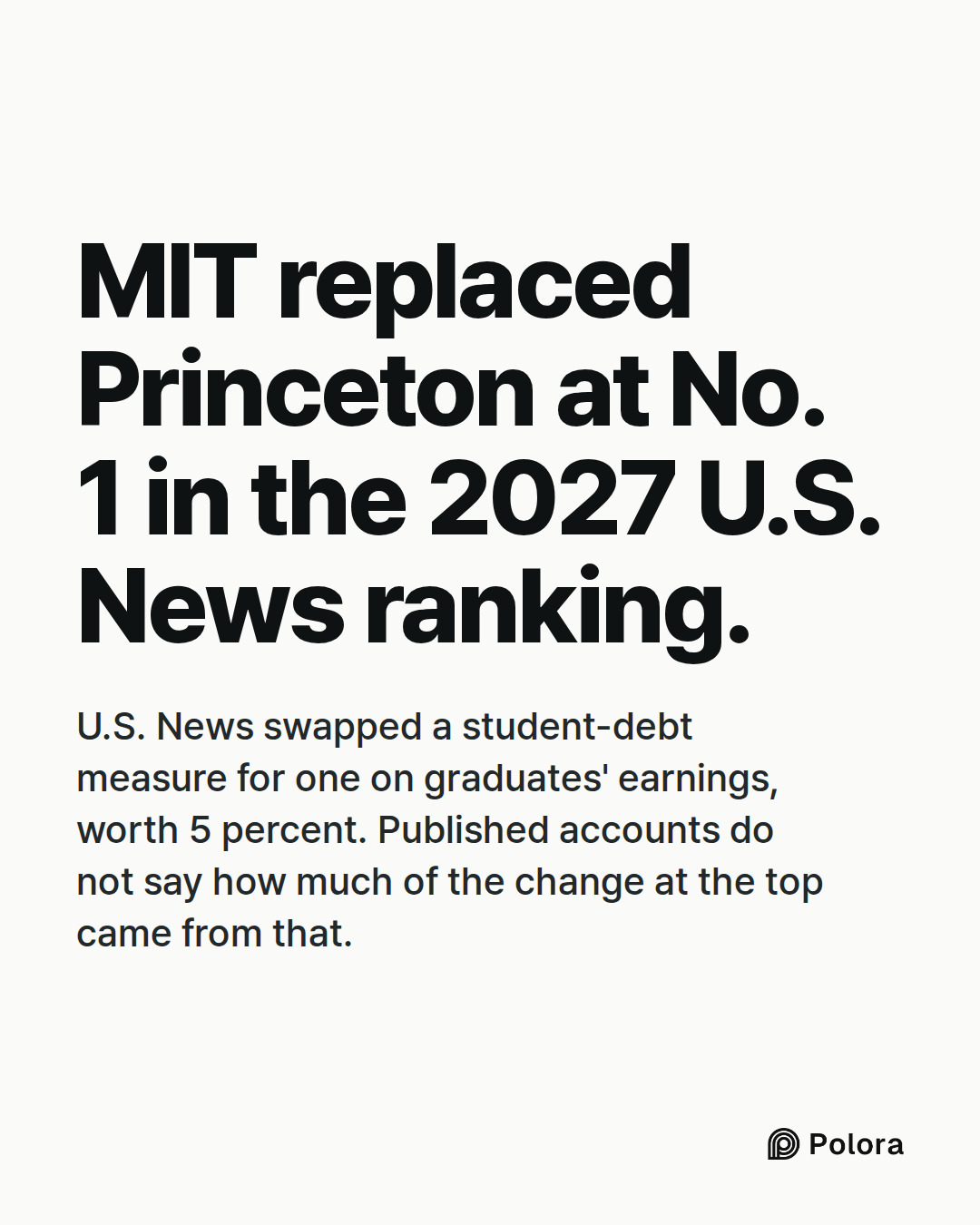
On September 22, 2026, U.S. News & World Report published its 2027 Best Colleges rankings. For the first time since the 2012 edition, Princeton was not No. 1 among national universities. MIT was. Princeton came second and Harvard third.

One thing that clearly changed was the formula. U.S. News dropped a factor that measured how much federal student-loan debt graduates carried. In its place it put a new one : how much graduates earn four years after finishing, compared with others who studied the same subject, drawn from the Education Department's College Scorecard data. The new factor is worth 5 percent of a school's score.

Princeton has long met students' financial need with grants instead of loans, so it was hard to beat on debt. Eric Brooks, the U.S. News director of education data analysis, told Princeton's alumni magazine that Princeton's underlying data "netted out about the same." He also said Princeton's lead over other universities had been narrowing for several editions, since U.S. News added measures of faculty research. U.S. News pointed to MIT's strong marks on faculty research, test scores and graduates' earnings. The scale the two schools were weighed on moved, but that is not the whole story : the published accounts do not say how much of the swap at the top came from the new earnings factor and how much from a gap that was already closing.
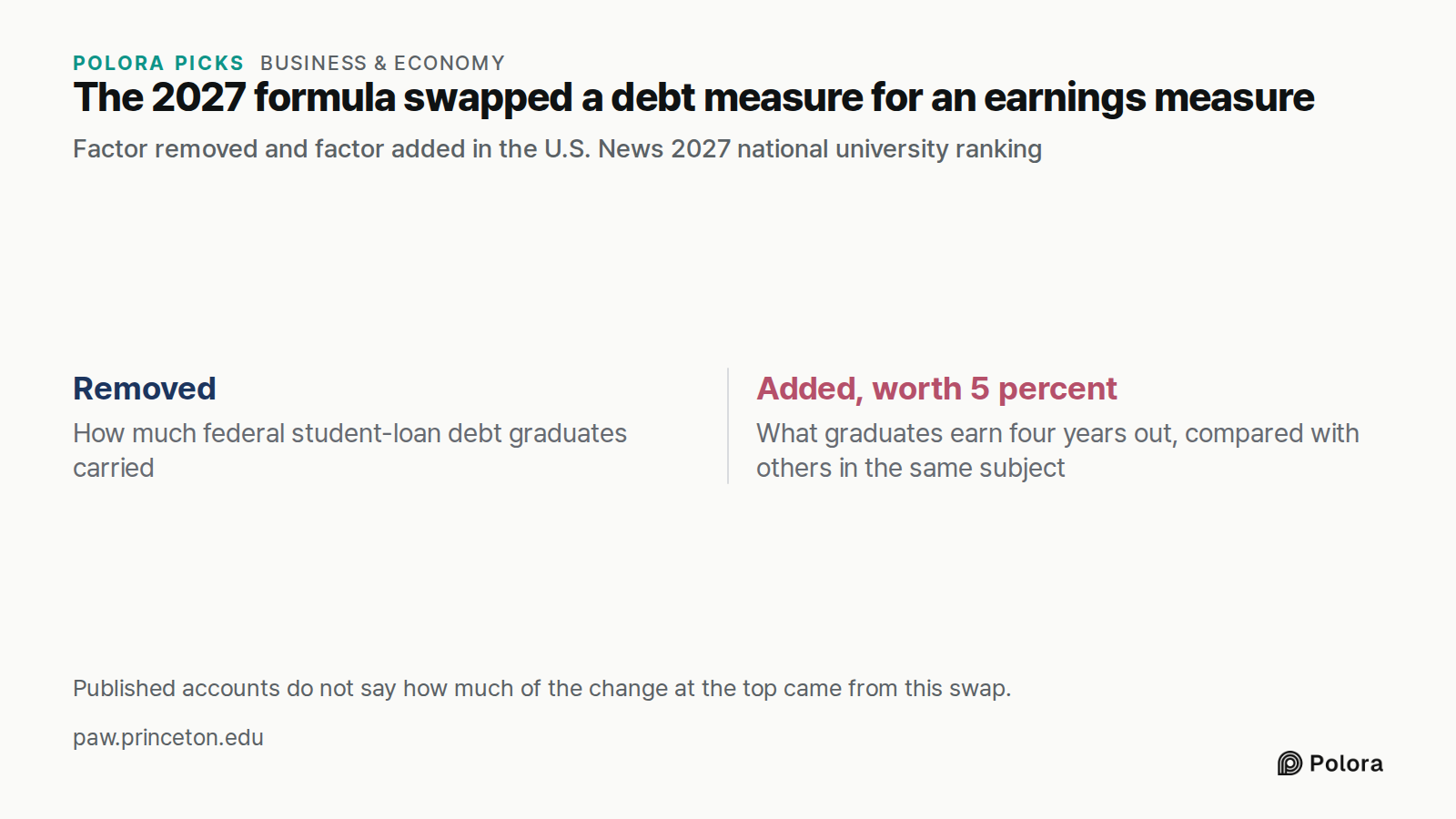
The 2027 formula swapped a debt measure for an earnings measure · Factor removed and factor added in the U.S. News 2027 national university ranking · Removed · Added, worth 5 percent · How much federal student-loan debt graduates carried · What graduates earn four years out, compared with others in
Factor removed and factor added in the U.S. News 2027 national university ranking

How hard a college is to get into counts for nothing

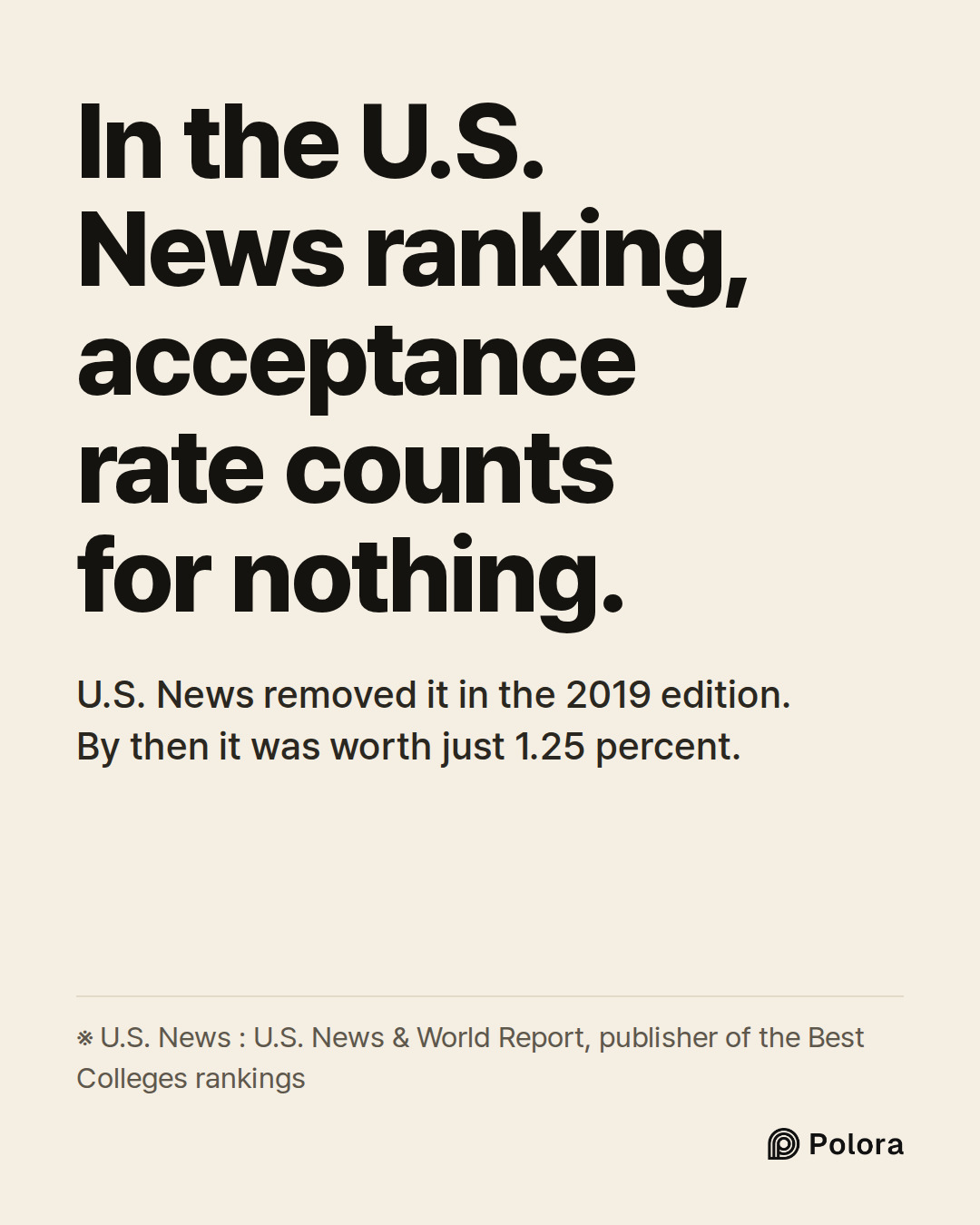
Ask most people what makes a top college and they will say it is hard to get into. The ranking does not measure that. U.S. News removed acceptance rate from its formula in the 2019 edition, published in September 2018. By then it was worth just 1.25 percent. U.S. News still publishes a separate list of the schools with the lowest acceptance rates, but that list feeds nothing into the main ranking.

The closest thing left is test scores : the SAT and ACT results of entering students, worth 5 percent for national universities. High school class rank and the share of alumni who donate money were both once part of the formula. Both were dropped in the 2024 edition.

More than half the score is what happens after students arrive

For national universities, 52 percent of the score is what U.S. News calls student outcomes. The largest piece is the share of students who graduate, worth 16 percent. Another 10 percent compares that graduation rate with the rate U.S. News predicts for a school given the students it admits, so a school that graduates more students than expected gains. Whether first-year students come back for a second year is worth 5 percent.

Eleven percent goes to students from low-income families, those who receive Pell Grants, the main federal grant for low-income undergraduates. Two measures, worth 5.5 percent each, count how many of them graduate and how their graduation rate compares with everyone else's. The last 10 percent is about money after college : 5 percent for the share of graduates who earn more than a typical high school graduate, and 5 percent for the new earnings-by-major factor.

U.S. News also publishes a separate social mobility list built from the Pell measures. It is a different list from the main ranking and does not replace it.
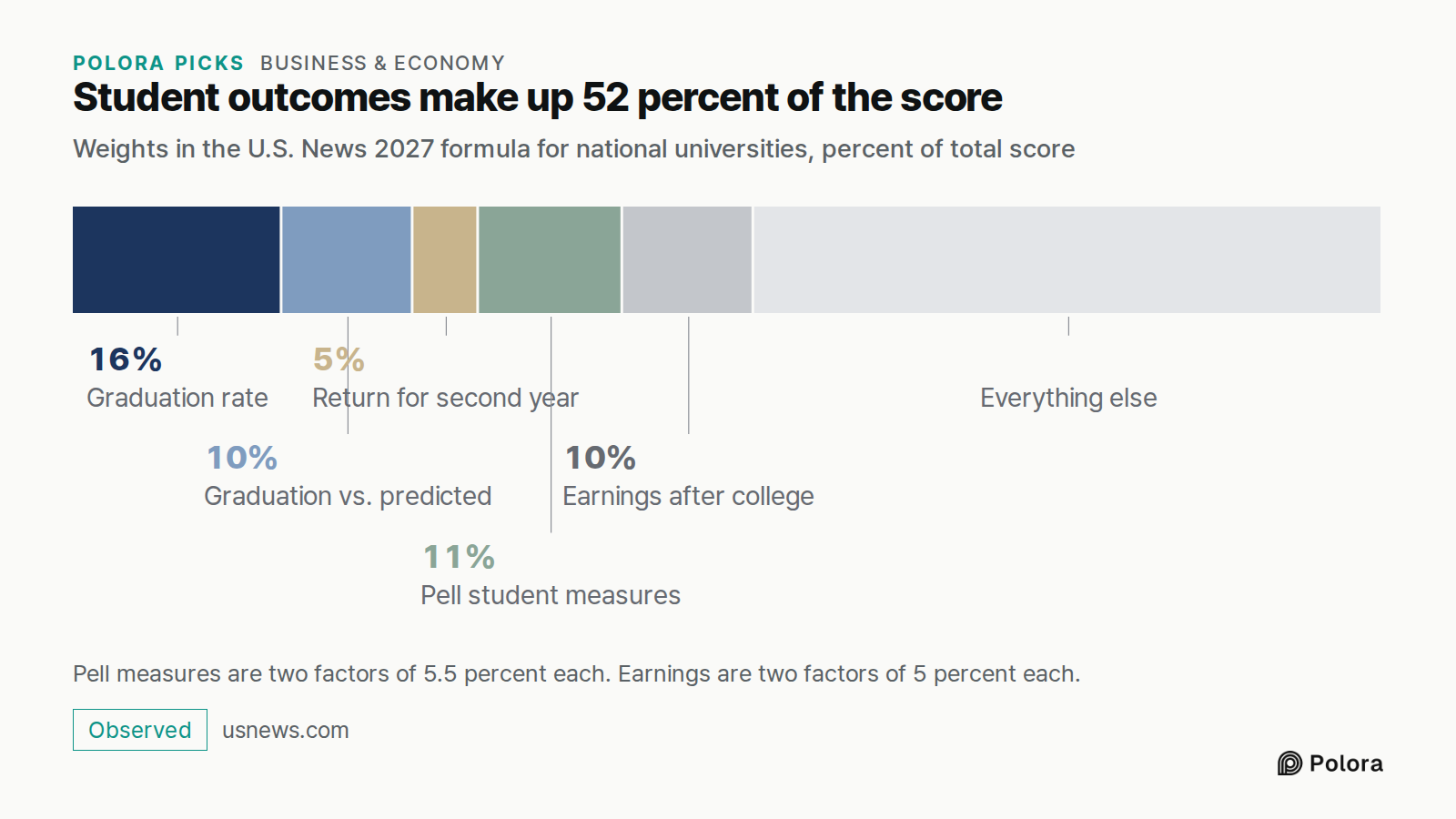
Student outcomes make up 52 percent of the score · Weights in the U.S. News 2027 formula for national universities, percent of total score · Graduation rate · Graduation vs. predicted · Return for second year · Pell student measures · Earnings after college · 16% · 10% · 5% · 11% · Everything else ·
Weights in the U.S. News 2027 formula for national universities, percent of total score

A fifth of the score is college leaders rating their rivals

Outside student outcomes, the largest factor is a survey. U.S. News sends a questionnaire to the president, the provost (the chief academic officer) and the dean of admissions at each school. Each is asked to rate the academic quality of schools in the same category, on a scale of 1 to 5, and only the schools they know. The average rating is worth 20 percent of the score.

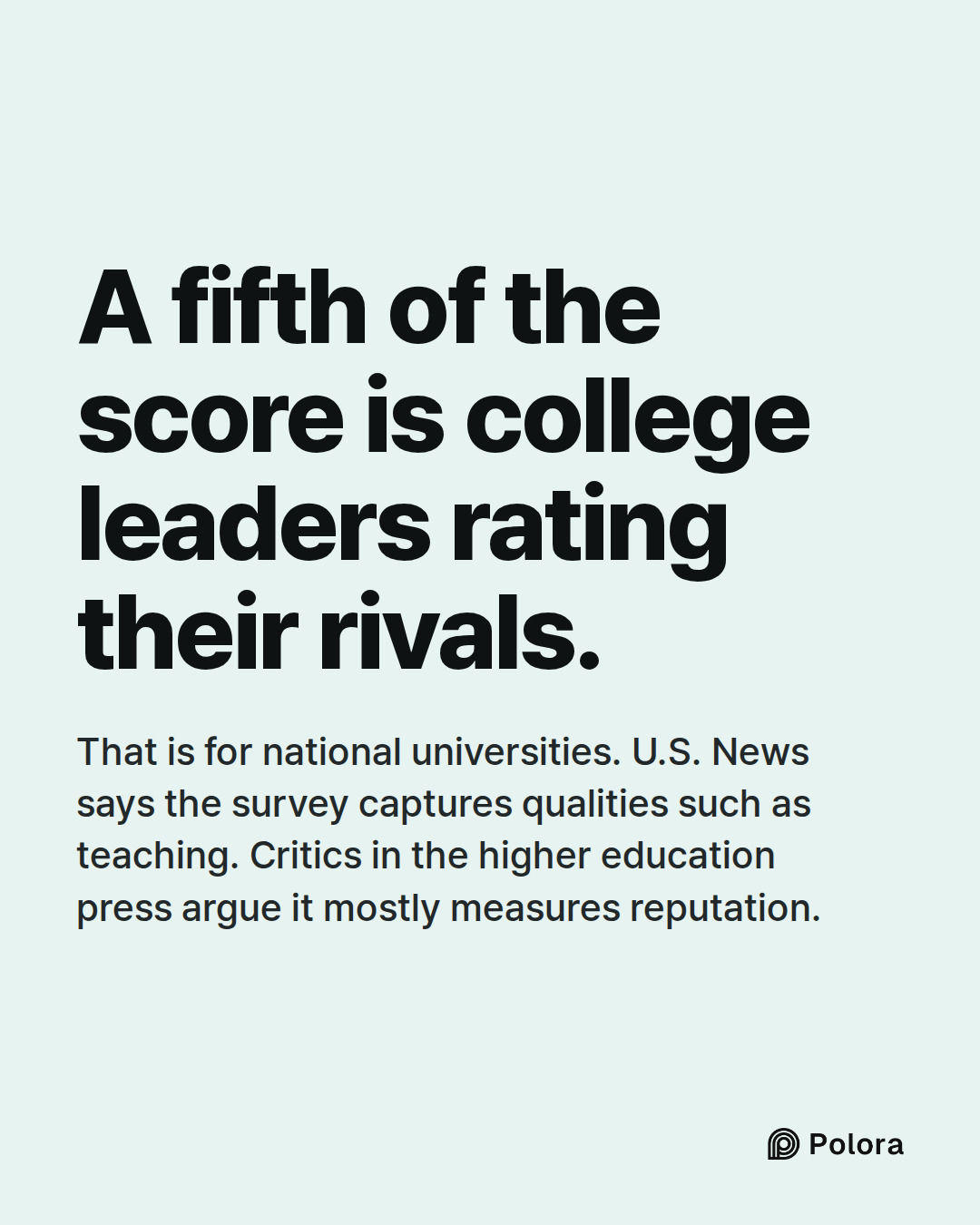
According to the U.S. News methodology document for the 2027 edition, the survey went to 4,405 people and 30.8 percent answered. Among national universities the response rate was 41 percent. U.S. News says the survey captures qualities that are hard to measure otherwise, such as teaching and institutional health. Critics in the higher education press have argued for years that it mostly measures reputation.
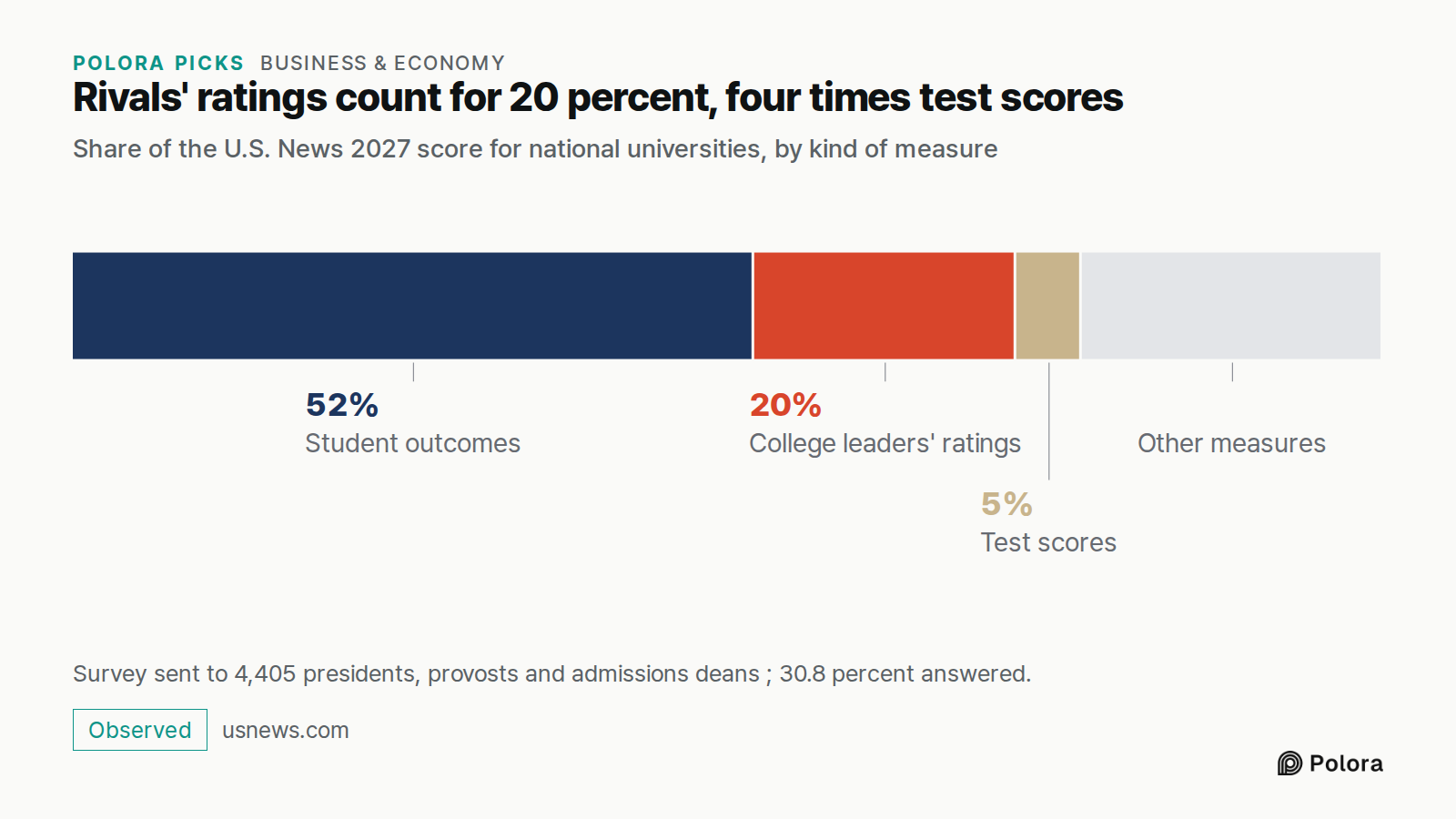
Rivals' ratings count for 20 percent, four times test scores · Share of the U.S. News 2027 score for national universities, by kind of measure · Student outcomes · College leaders' ratings · Test scores · 52% · 20% · 5% · Other measures · Survey sent to 4,405 presidents, provosts and admissions dean
Share of the U.S. News 2027 score for national universities, by kind of measure

Where the numbers come from

The figures behind the formula come from two places. Some come from a statistical survey U.S. News sends to each school, which the school fills in about itself. Others come from the federal government. These include graduation data that schools must report to the Department of Education, and earnings data from the College Scorecard, the department's public database of college costs and outcomes.

The balance has shifted toward federal data. In the 2024 edition U.S. News removed five factors, together worth 18 percent, including class size, alumni giving and the share of faculty with the highest degree in their field. Another was the share of graduates who borrowed federal loans, a different measure from the debt factor replaced in 2027. U.S. News said it was replacing measures that schools did not all report. For the 2027 edition, U.S. News reports that 73 percent of ranked schools sent in the statistical survey, down from 79 percent the year before, and that 99 of the top 100 national universities sent it in.
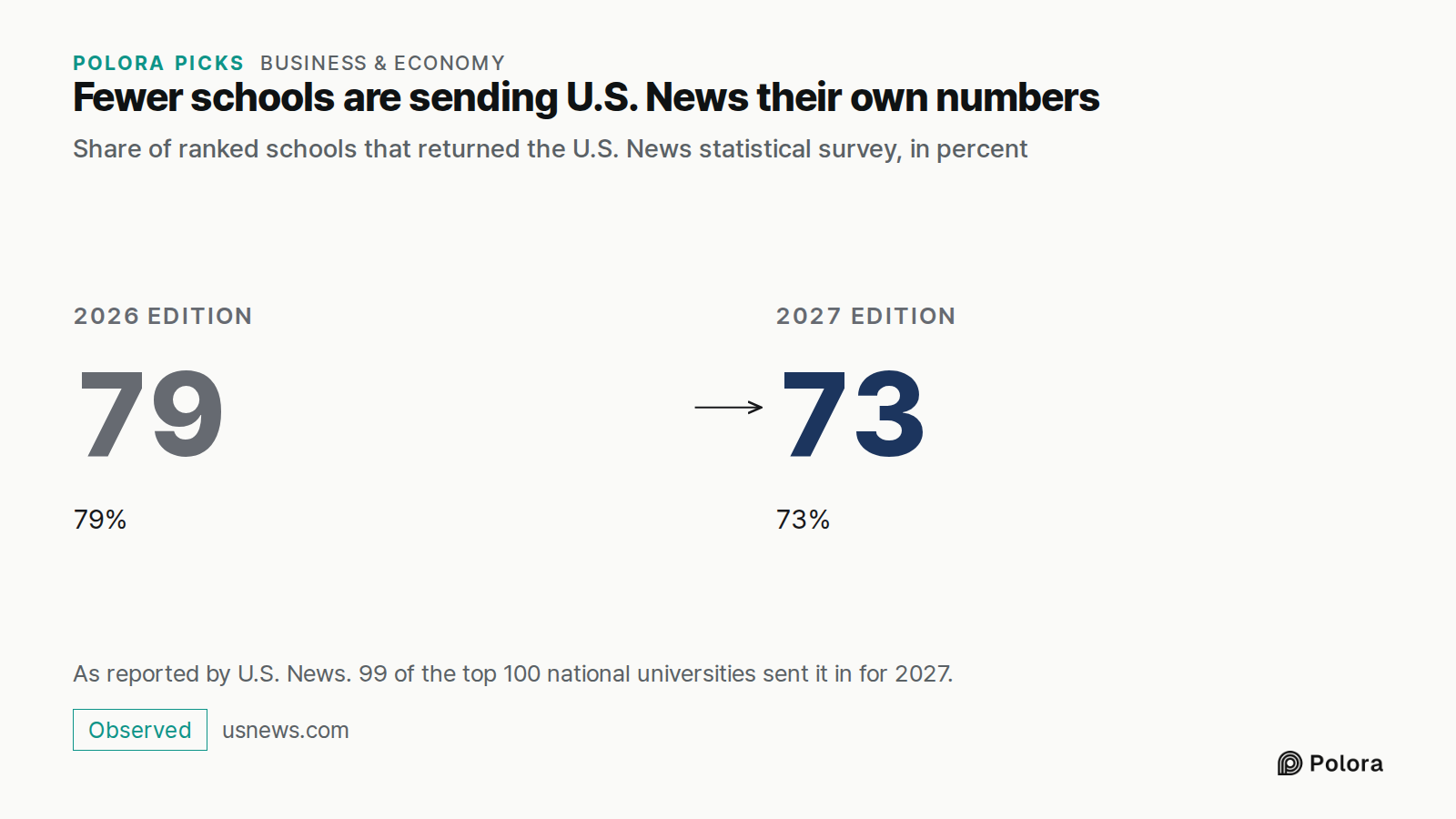
Fewer schools are sending U.S. News their own numbers · Share of ranked schools that returned the U.S. News statistical survey, in percent · 2026 edition · 79 · 79% · 2027 edition · 73 · 73% · As reported by U.S. News. 99 of the top 100 national universities sent it in for 2027.
Share of ranked schools that returned the U.S. News statistical survey, in percent

What happened when Columbia's own numbers were wrong

Numbers a school reports about itself are only as good as the school's reporting. In 2022 Columbia was ranked No. 2. That year Michael Thaddeus, a Columbia mathematics professor, published an analysis questioning the data behind the rank. Among other things, he questioned a claim that 83 percent of Columbia's classes had fewer than 20 students.

In September 2022 Columbia acknowledged problems with two figures, class size and the share of faculty with the highest degree in their field, saying it had relied on "outdated and/or incorrect methodologies." That acknowledgment covered those two figures, not everything the professor had questioned. Columbia did not send a new survey, and U.S. News placed it at No. 18 that month. In 2025 Columbia agreed to pay $9 million to settle a class action brought by students over the data, while denying wrongdoing. U.S. News has said that Columbia has not addressed questions about three other figures, and that it will keep evaluating whether to include the school.

Refusing to take part does not take a college off the list

On November 16, 2022, Yale Law School said it would stop sending data to U.S. News, and Harvard Law School followed hours later. Stanford, Columbia, Berkeley, Georgetown and others joined. U.S. News answered that it would keep ranking every accredited law school using data the American Bar Association requires schools to publish. It also cut the weight of its reputation survey for law schools, which had been 40 percent. Yale had held or shared No. 1 since U.S. News began ranking law schools in 1990. It kept appearing in the rankings, and in the 2026 law rankings Stanford was first on its own, with Yale tied for second.

Columbia's undergraduate schools stopped taking part in June 2023. U.S. News ranks Columbia anyway from the figures the university reports to the federal government. In the 2027 edition it is listed tied for No. 12.

Medical schools went a different way. Harvard Medical School withdrew in January 2023, and Stanford, Johns Hopkins, Columbia and others followed. U.S. News then stopped giving medical schools numbered ranks and in its 2024 edition sorted them into four tiers. Schools that did not send data were listed as unranked in that edition. Whether leaving takes a school out depends on whether U.S. News can rebuild the school's numbers from public records.
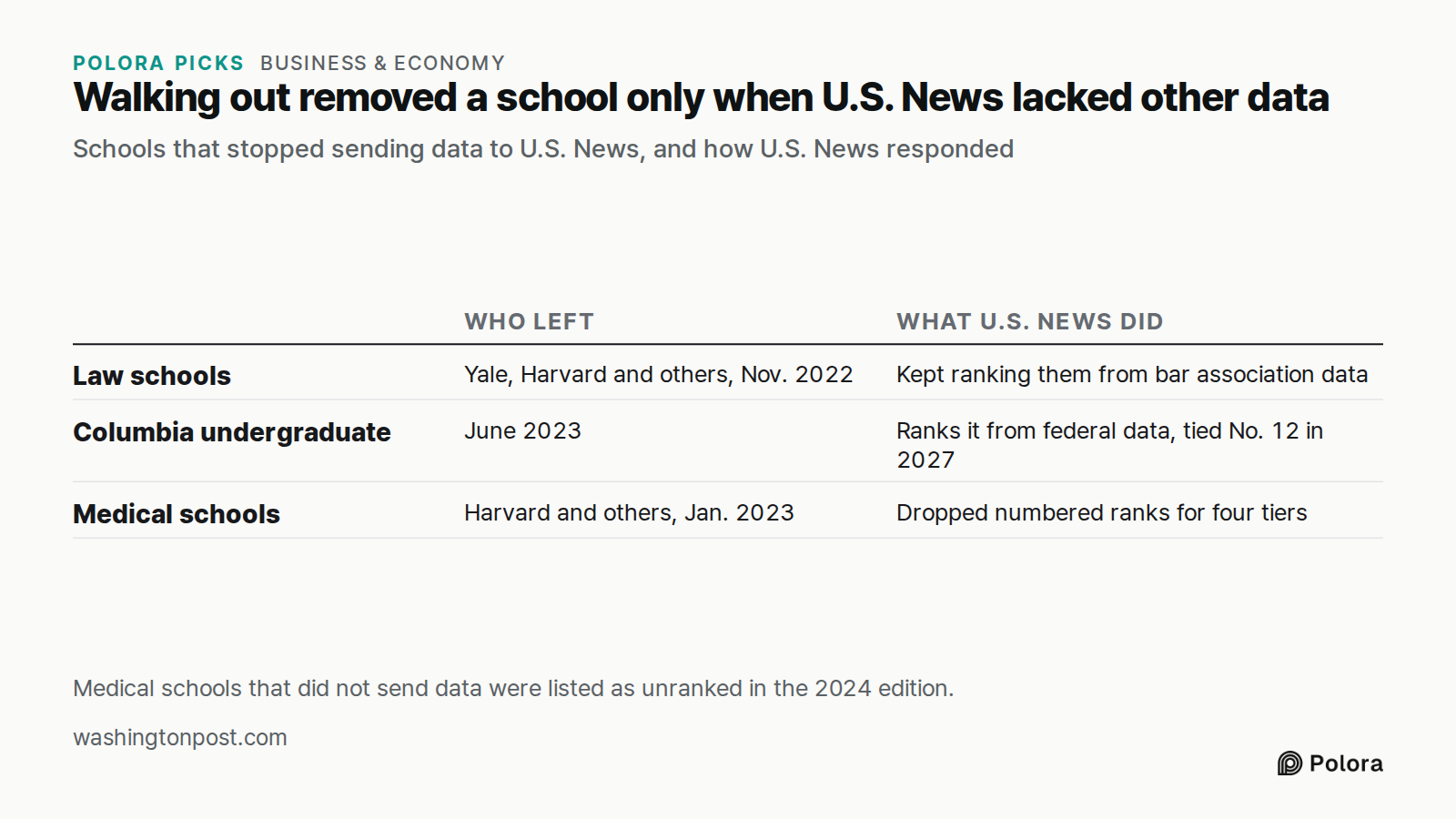
Walking out removed a school only when U.S. News lacked other data · Schools that stopped sending data to U.S. News, and how U.S. News responded · Who left · What U.S. News did · Law schools · Columbia undergraduate · Medical schools · Yale, Harvard and others, Nov. 2022 · Kept ranking them from bar
Schools that stopped sending data to U.S. News, and how U.S. News responded

A rank is a set of choices about what counts

Put together, a U.S. News rank comes from more than a dozen measures, with weights that U.S. News chooses. The data comes partly from the schools and partly from the government, so schools shape the numbers too, by what they report and whether they report at all. The categories schools are compared within get redrawn as well. This year a national system for classifying colleges, the Carnegie Classification, was revised. About one in five previously ranked schools moved to a different ranking category as a result, and that alone can move a school's rank.

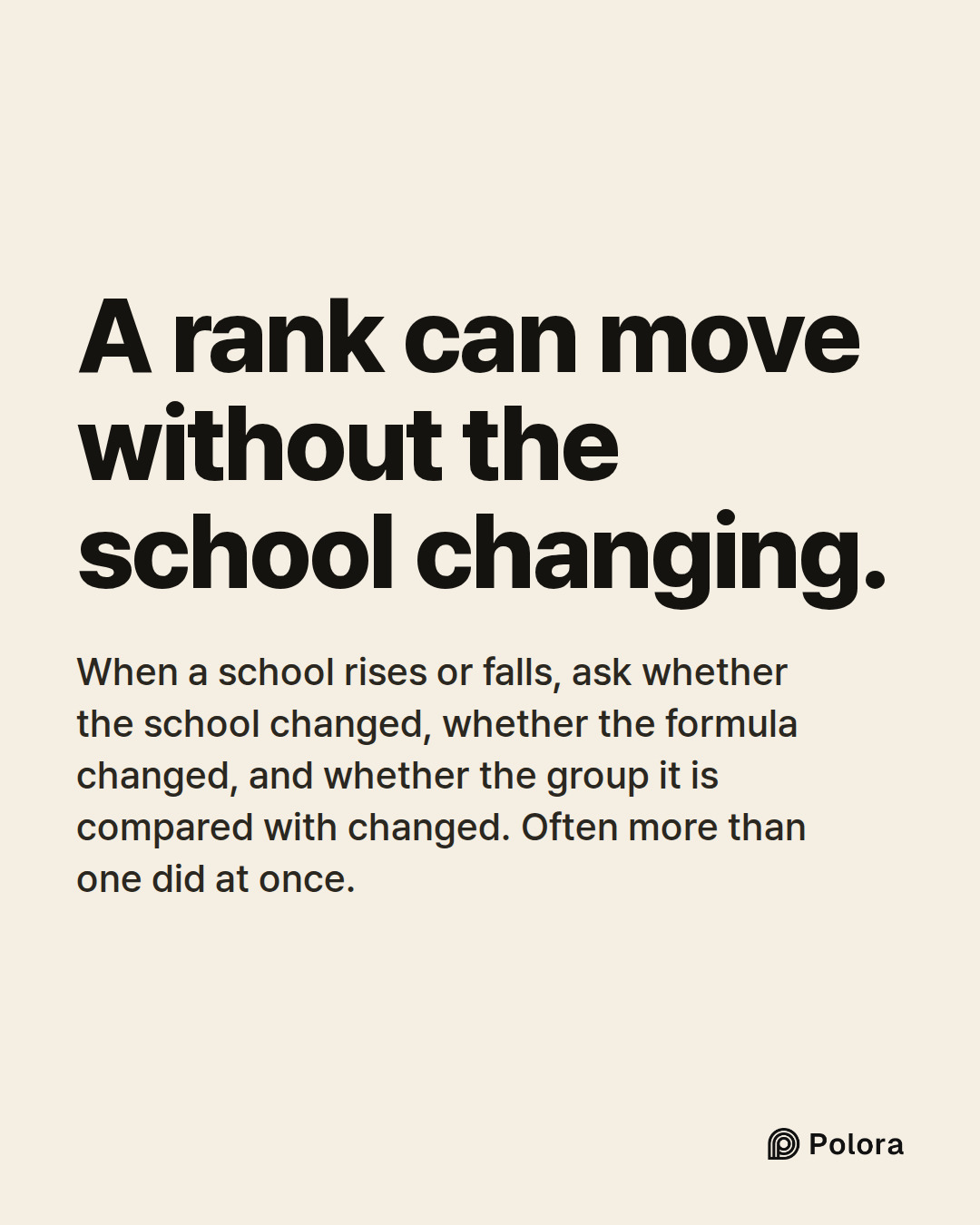
None of this makes the ranking meaningless. It does mean that when a school rises or falls, the questions worth asking are whether the school changed, whether the formula changed, and whether the group it is compared with changed. Often more than one did at once. At the very top this year, U.S. News's own data director pointed to the formula, while also describing a gap that had been closing for years.
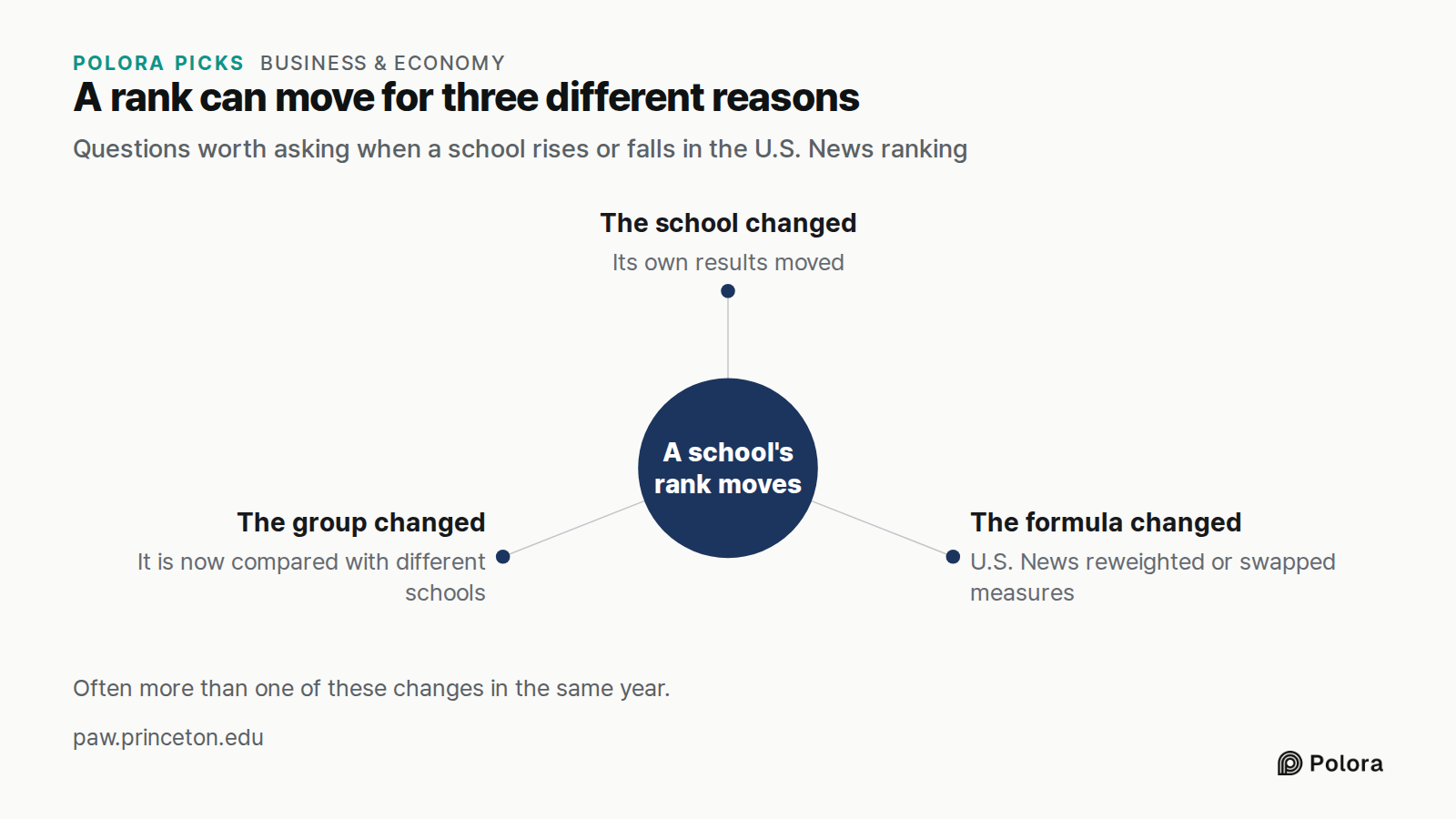
A rank can move for three different reasons · Questions worth asking when a school rises or falls in the U.S. News ranking · A school's rank moves · The school changed · The formula changed · The group changed · Its own results moved · U.S. News reweighted or swapped measures · It is now compared wi
Questions worth asking when a school rises or falls in the U.S. News ranking
How does U.S. News decide which colleges rank best?How does U.S. News decide which colleges rank best?In the U.S. News ranking, acceptance rate counts for nothing. · U.S. News removed it in the 2019 edition. By then it was worth just 1.25 percent. · ※ U.S. News : U.S. News & World Report, publisher of the Best Colleges rankingsStudent outcomes · College leaders' ratings · Test scores · 52% · 20% · 5% · Other measures · Rivals' ratings count for 20 percent, four times test scores · Share of the U.S. News 2027 score for national universities, by kind of measure · Survey sent to 4,405 presidents, provosts and admissions deanA fifth of the score is college leaders rating their rivals. · That is for national universities. U.S. News says the survey captures qualities such as teaching. Critics in the higher education press argue it mostly measures reputation.MIT replaced Princeton at No. 1 in the 2027 U.S. News ranking. · U.S. News swapped a student-debt measure for one on graduates' earnings, worth 5 percent. Published accounts do not say how much of the change at the top came from that.A rank can move without the school changing. · When a school rises or falls, ask whether the school changed, whether the formula changed, and whether the group it is compared with changed. Often more than one did at once.Sources 25 : paw.princeton.edu · MIT unseats Princeton as U.S. News No. 1 ranked college (Princeton Alumni Weekly), yahoo.com · MIT claims No. 1 spot (U.S. News press release, via Yahoo), usnews.com · MIT claims No. 1 spot in U.S. News 2027 Best Colleges rankings + 22Read the full story at · polora.ai

How does U.S. News decide which colleges rank best?

Alpha · claude-sonnet-5

Alpha J'ai vérifié les chiffres-clés de ce manuscrit et la plupart tiennent, avec quelques précisions à apporter. Les poids 2027 sont confirmés, avec une nuance. La page méthodologie de U.S. News confirme que les résultats étudiants (« student outcomes ») comptent pour 52% du score total, incluant les taux de diplomation (16%) et la rétention en première année (5%), ainsi que la performance par rapport à un taux de diplomation prédit (10%). Le détail Pell est légèrement différent de ce qu'écrit le manuscrit : ce n'est pas un bloc unique de 11%, mais le taux de diplomation Pell (5,5%) et la performance de diplomation Pell (5,5%) — soit bien 11% au total, donc le manuscrit arrive au bon chiffre global mais simplifie la structure interne. Le nouveau facteur de revenus par filière est confirmé : les métriques post-diplôme évaluent le pourcentage de diplômés gagnant plus qu'un diplômé du secondaire typique (5%) et un nouveau facteur sur les revenus par filière (5%) qui remplace un facteur de dette fédérale médiane. Les autres poids cités (peer assessment 20%, faculty resources 11%, financial 8%, tests 5%, faculty research 4%) sont confirmés par Poets&Quants : l'évaluation par l…

Beta · gpt-6-sol

Beta: The manuscript’s core explanation holds: U.S. News ranks colleges *within categories* using a weighted formula, not a direct measure of how hard they are to enter. For national universities in the 2027 edition, the stated weights are 52% student outcomes, 20% peer assessment, 11% faculty resources, 8% financial resources, 5% entering students’ test scores, and 4% faculty research. The outcomes portion includes graduation, retention, Pell-recipient outcomes and post-college earnings. I could not open U.S. News’s 2027 methodology document directly, so I would not present its more granular figures—particularly the survey response and school-submission rates—as independently checked by me. The document’s address is https://www.usnews.com/media/ai/education/2027BC-methodology. Two corrections matter before publication: - The 2024 and 2027 debt measures must not be conflated. The five factors removed for 2024 included the *proportion of graduates who borrowed*. The factor replaced by earnings-by-major for 2027 was *graduate indebtedness*. Thus the manuscript’s account of the 2024 removals should say “proportion of graduates borrowing,” not “share of graduates with deb…

Gamma · gemini-3.1-pro

Gamma: I have run live searches to verify the remaining specific claims about the graduate schools and Columbia's 2027 position, as well as the 2026 law school rankings. Here is what the live web confirms: * Yale Law's rank in 2026: The manuscript is correct. In the 2026 U.S. News Best Law Schools ranking, Stanford took the No. 1 spot alone, and Yale (which had held or tied for No. 1 since 1990) dropped to a tie for No. 2 with the University of Chicago. This is confirmed by multiple legal news outlets, including Justia News (https://news.justia.com/stanford-overtakes-yale-for-top-u-s-law-school/). * Medical schools moving to tiers: The manuscript's claim holds. U.S. News overhauled its medical school rankings for the 2024 edition, moving away from ordinal rankings to place schools into four tiers (Tier 1 through Tier 4) for both Research and Primary Care. Schools that refused to submit statistical data were indeed labeled as "Unranked." This is confirmed by Becker's Hospital Review (https://www.beckershospitalreview.com/hospital-management-administration/us-news-releases-medical-school-rankings.html). * Columbia's 2027 rank: I can confirm Columbia is tied f…

Researcher · gemini-3-7-flash

Researcher Verification Report I have checked the remaining specific factual claims, weights, and dates against live web sources. --- 1. Methodology Weights & Formula Components (2027 Edition) * Status: Verified. * Details: * Outcomes (52% total): Six-year graduation rate is 16%, graduation rate performance (predicted vs. actual) is 10%, first-year retention is 5%, Pell Grant graduation metrics comprise 11% combined (split 5.5% Pell graduation rate and 5.5% Pell graduation rate performance), post-college earnings above a high school graduate is 5%, and the newly introduced "Earnings by Major" metric is 5% (replacing graduate indebtedness). * Remaining National University Weights: Peer assessment is 20%, faculty resources is 11% (faculty salary, student-faculty ratio, full-time faculty share), financial resources (per-student instructional spending) is 8%, entering class standardized test scores is 5%, and faculty research/citations is 4%. * Source: * *Poets&Quants / U.S. News 2027 Breakdown:* https://poetsandquantsforundergrads.com/news/u-s-news-best-colleges-ranking-2027-mit-ends-princetons-long-run-…

The Arbiter · gpt-6-sol

The voices agree on the shape of the answer: U.S. News compares colleges within categories using a weighted formula. For national universities in the 2027 edition, the reported weights are 52% student outcomes, 20% peer assessment, 11% faculty resources, 8% financial resources, 5% test scores and 4% faculty research. They also agree that the 11% attributed to Pell-recipient outcomes consists of two 5.5% measures, rather than one measure. Two distinctions matter for the manuscript. The debt-related factor removed for the 2024 edition was the *proportion of graduates who borrowed*; the factor replaced by earnings-by-major for 2027 was *graduate indebtedness*. And Princeton’s data reportedly “netted out about the same,” but that does not establish that neither Princeton nor MIT changed on any measure, or that the new earnings factor alone caused the change at No. 1. The principal evidence gap is direct access to U.S. News’s 2027 methodology: my attempt to open its document was blocked. In particular, the manuscript’s precise peer-survey response rates and school-survey submission rates remain supported here by search excerpts rather than a document someone in thi…

The Arbiter's Final Verdict · gpt-6-sol

Verdict The manuscript’s premise stands: U.S. News decides which colleges rank best by comparing schools *within ranking categories* on measures it selects and weights. A change in rank can therefore reflect a change in the school’s reported results, a change in the formula, or a change in which schools are compared—not necessarily one cause alone. For national universities in the 2027 edition, the reported formula assigns 52% to student outcomes, 20% to peer assessment, 11% to faculty resources, 8% to financial resources, 5% to entering students’ SAT/ACT scores, and 4% to faculty research. Within outcomes, graduation is worth 16%, graduation relative to a predicted rate 10%, first-year retention 5%, Pell-recipient graduation measures 5.5% each, and two earnings measures 5% each. The new earnings-by-major measure replaced *graduate indebtedness*. These weights are supported by the published breakdown at Poets&Quants and U.S. News’s [methodology address](https://www.usnews.com/education/best-colleges/articles/how-us-new…