Is a diamond still worth what you paid for it?

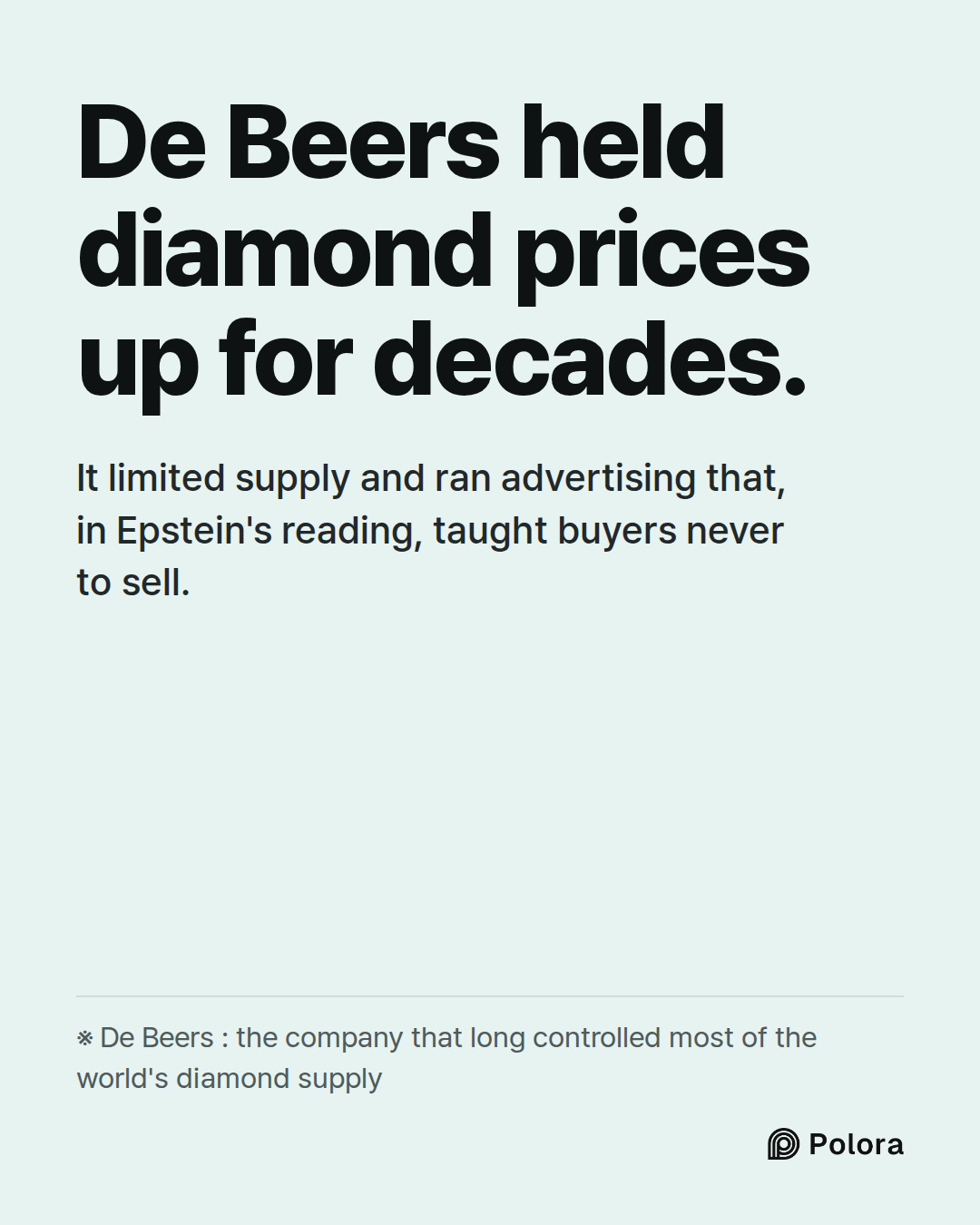
Usually it never was. A diamond bought in a shop has long sold back for a fraction of its price, because the shop price carried a retail markup, while anyone buying it back pays wholesale or less. Separately, De Beers, the company that long controlled most of the world's diamond supply, held the price level up. Lab-grown stones have weakened that system, and De Beers is up for sale.

Business & Economy · 2026-10-08

Selling a diamond back has rarely brought back the price

The word 'still' in the question assumes a diamond once held its value. The evidence says it mostly did not, and the gap is far older than lab-grown diamonds.

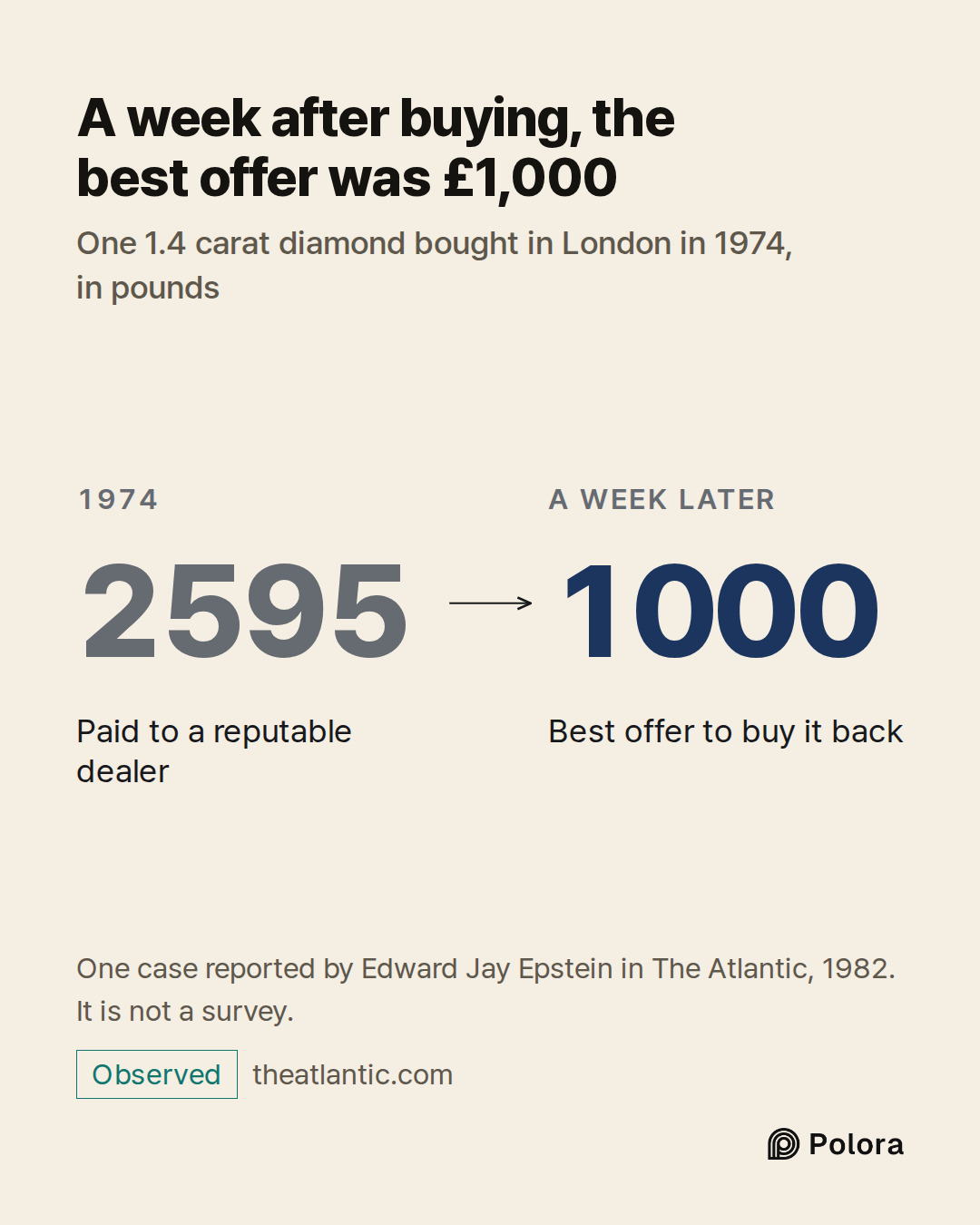
In 1982 the writer Edward Jay Epstein described what happened when ordinary owners tried to sell, in a cover story for The Atlantic titled 'Have You Ever Tried to Sell a Diamond?'. In one case, from 1974, a buyer in London paid £2,595 for a 1.4 carat stone from a reputable dealer, decided a week later to sell it, and got a best offer of £1,000. A New York diamond buyer told Epstein a half-carat ring that might cost $2,000 in a jewelry shop could be sold to his firm for only $600.

These are cases one reporter collected and estimates from people in the trade. They are not a survey, and they do not give the share of the price an owner would get back today.

None of this was a market crash. It was how the price of a diamond had been built all along.
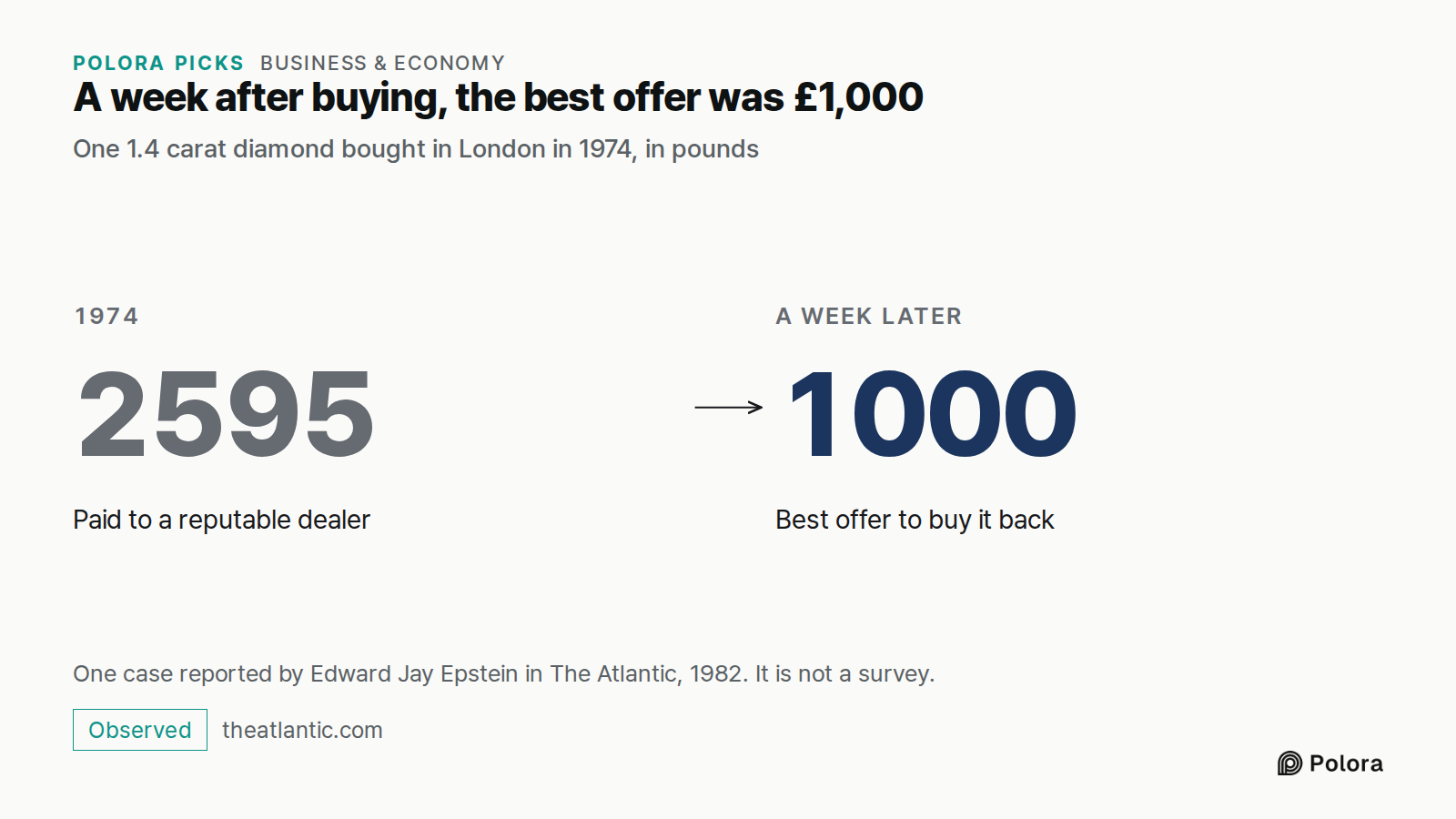
A week after buying, the best offer was £1,000 · One 1.4 carat diamond bought in London in 1974, in pounds · 1974 · 2595 · Paid to a reputable dealer · A week later · 1000 · Best offer to buy it back · One case reported by Edward Jay Epstein in The Atlantic, 1982. It is not a survey.
One 1.4 carat diamond bought in London in 1974, in pounds

Why a shop's price and a buyer's offer are two different prices

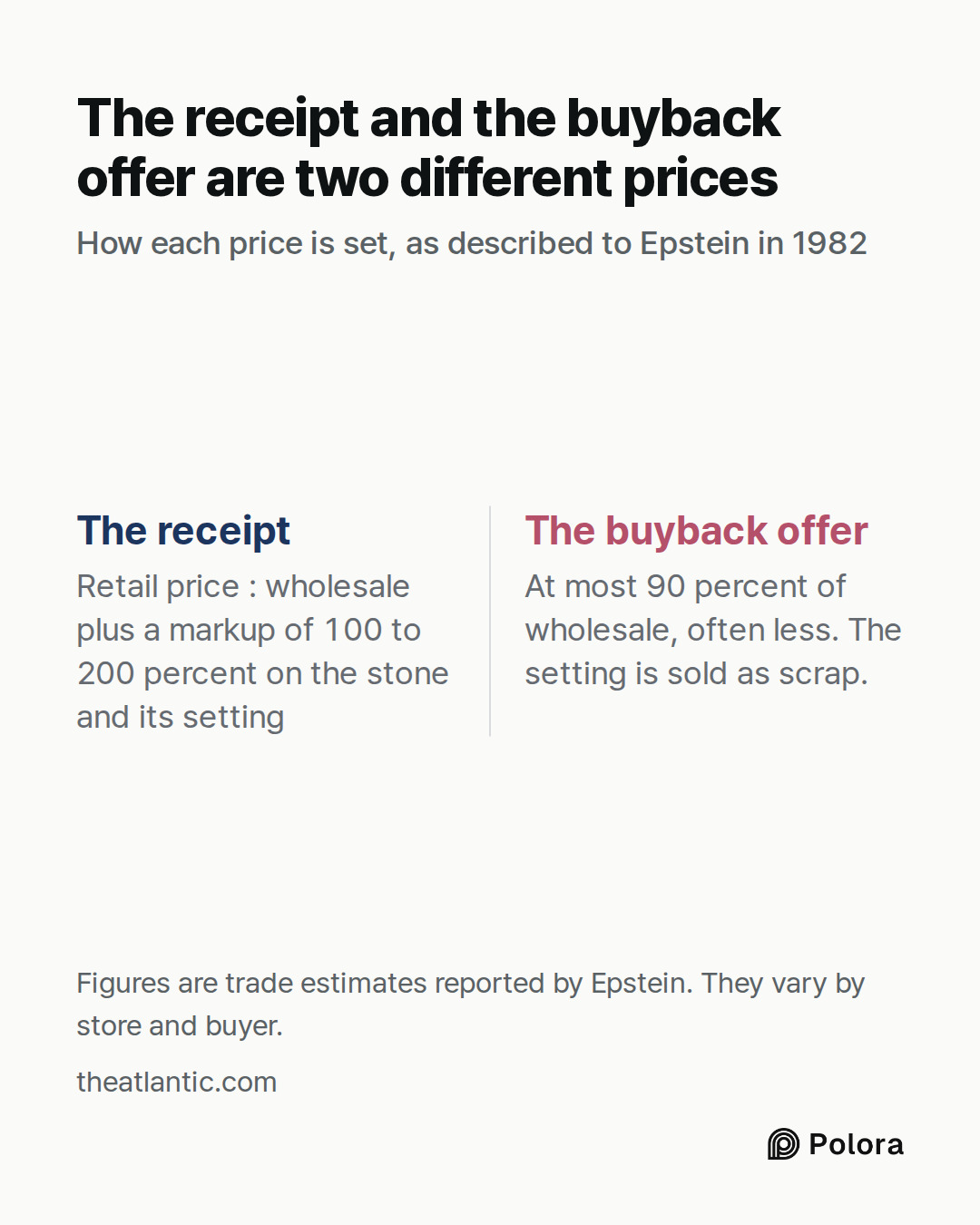
A shop buys its stones at wholesale and adds its own margin. Epstein reported that the markup on a diamond and its setting could run from 100 to 200 percent, depending on the store.

When you sell, you are on the other side of that margin. The New York buyer Epstein interviewed said his firm could usually pay at most 90 percent of the current wholesale price, and often less, because the setting is sold as scrap and the buyer leaves room for error. Shops, Epstein wrote, generally preferred not to buy back stones at all, because the honest offer would look insulting next to the receipt.

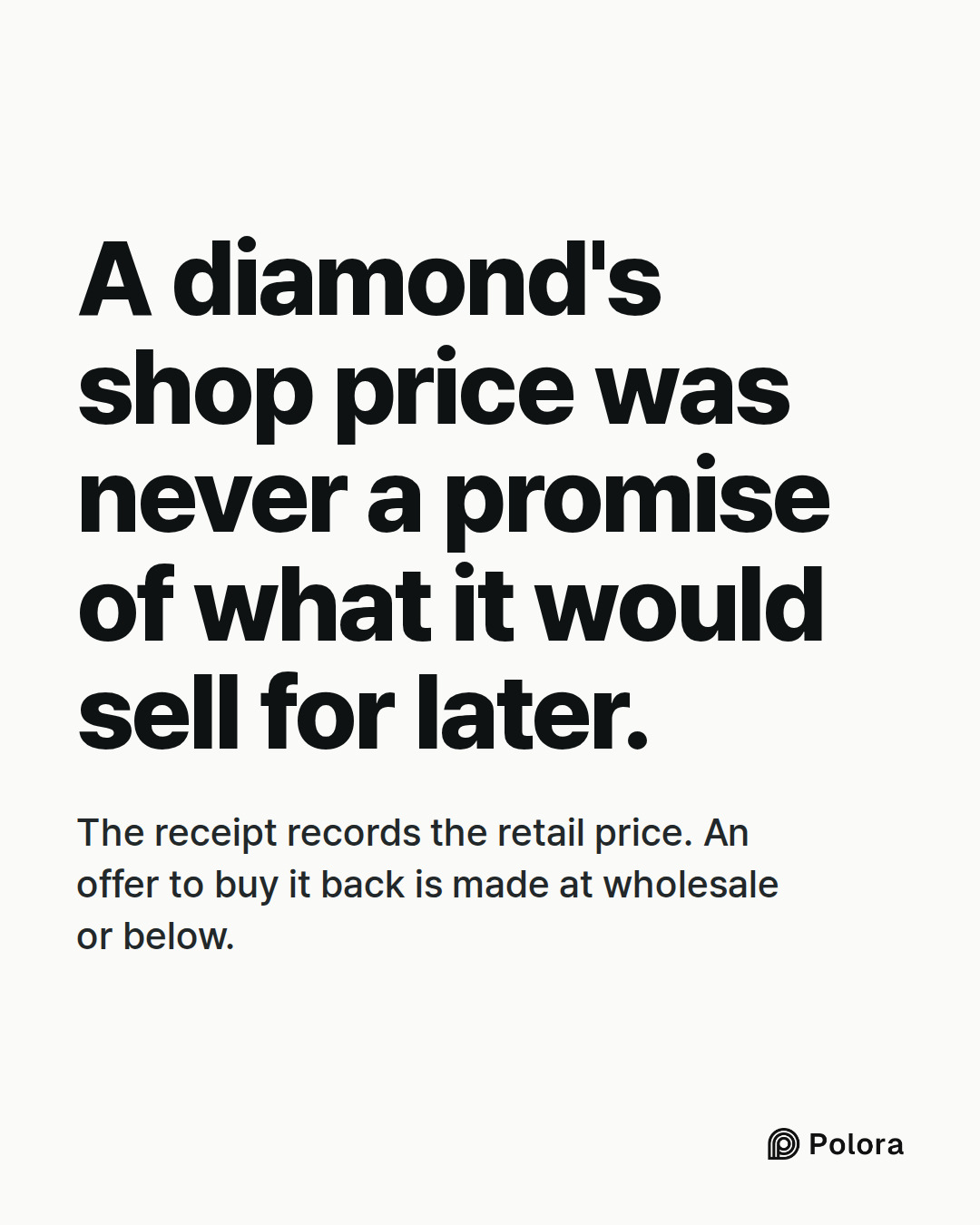
So the receipt records the retail price. An offer to buy it back is made at wholesale or below. Those were never going to match.
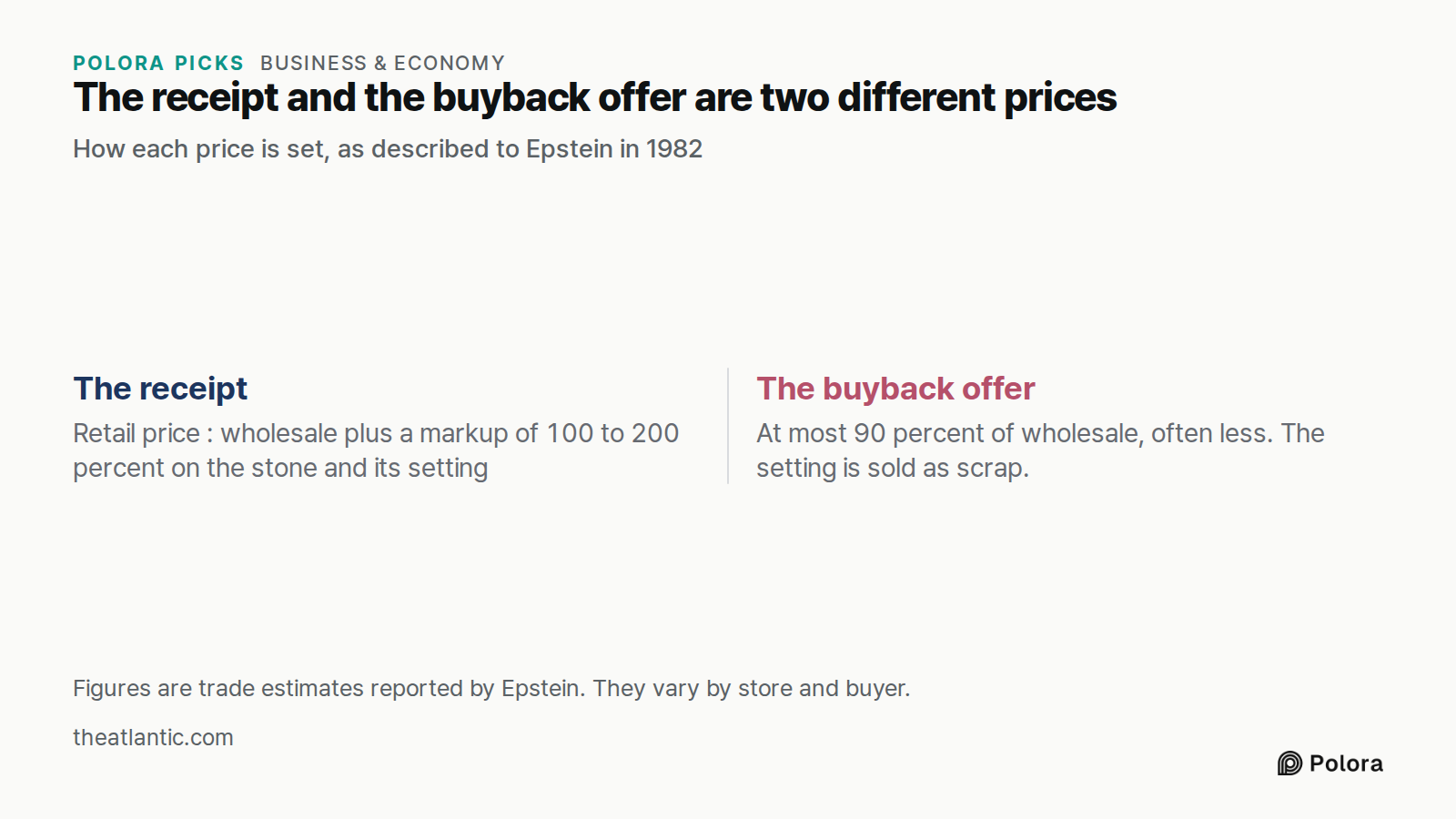
The receipt and the buyback offer are two different prices · How each price is set, as described to Epstein in 1982 · The receipt · The buyback offer · Retail price : wholesale plus a markup of 100 to 200 percent on the stone and its setting · At most 90 percent of wholesale, often less. The setting
How each price is set, as described to Epstein in 1982

One company decided how many diamonds reached the market

Diamonds start as rough stones dug from mines and are cut and polished before they reach a shop. For most of the 20th century, most of that rough supply passed through one company, De Beers. According to the Gemological Institute of America, by 1900 De Beers controlled an estimated 90 percent of the world's rough diamond production.

Holding most of the supply meant De Beers could decide how much reached the market, and so keep prices steady. Epstein described how, when the Soviet Union began mining diamonds, De Beers offered it a 'single channel' for selling them rather than compete on price.

That role has largely gone. The Gemological Institute of America says De Beers 'greatly reduced its role as the custodian of diamond supply', and that diamonds now reach the market through many channels instead of one.
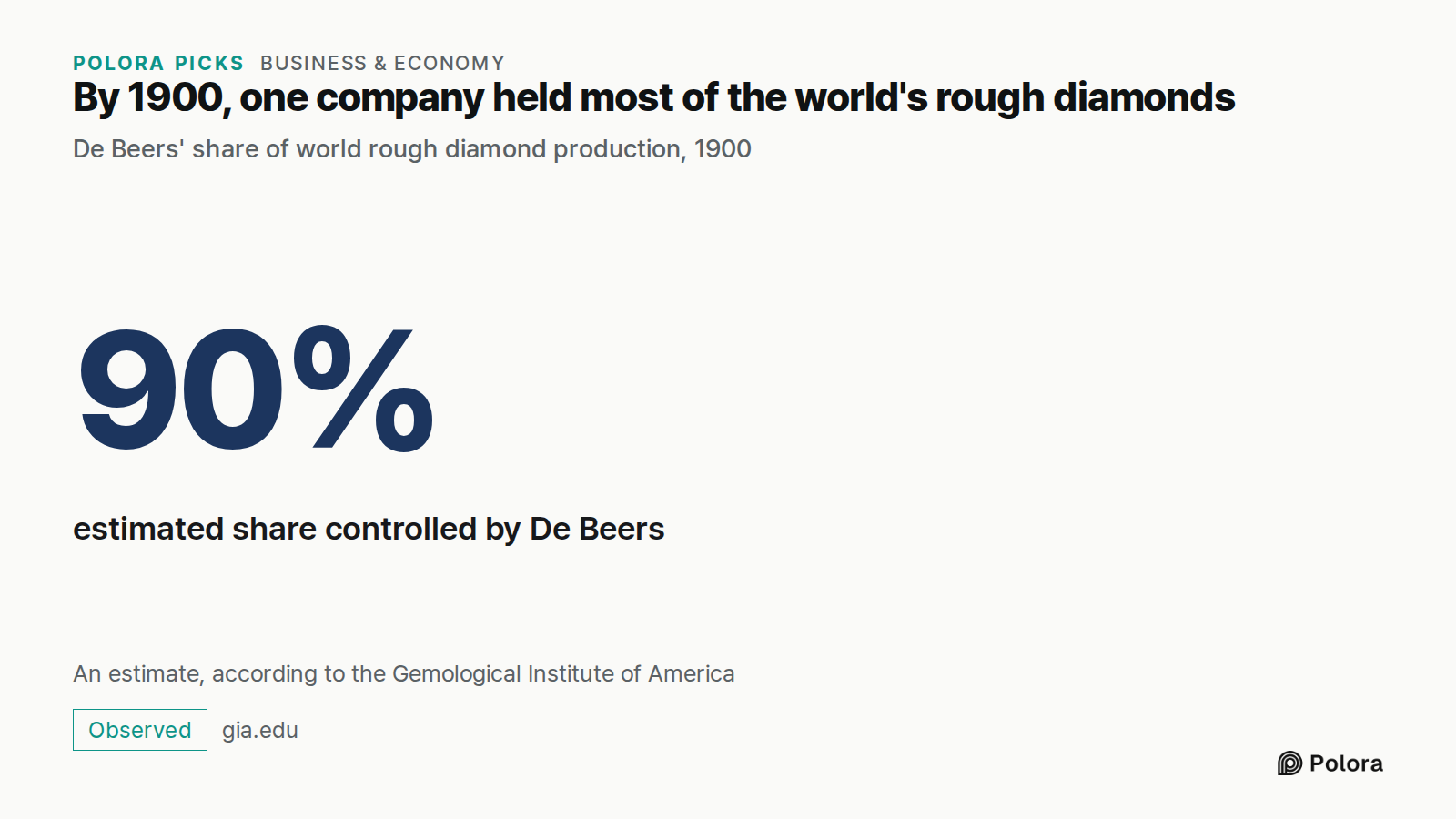
By 1900, one company held most of the world's rough diamonds · De Beers' share of world rough diamond production, 1900 · 90% · estimated share controlled by De Beers · An estimate, according to the Gemological Institute of America
De Beers' share of world rough diamond production, 1900

'A diamond is forever', read as 'never sell'

Controlling supply was half the job. The other half was making sure the stones already sold never came back onto the market and competed with new ones.

In 1938 De Beers hired N. W. Ayer, an American advertising agency. A 1947 strategy plan from the agency, quoted by Epstein, set out to make the engagement ring 'a psychological necessity'. De Beers credits Frances Gerety, a copywriter at the agency, with writing the line 'A Diamond Is Forever' in 1947. It first ran in advertisements in 1948.

Epstein's reading of the line is blunt. The idea, he wrote, was that diamonds were forever 'in the sense that they should never be resold'. That is his interpretation of the campaign, not something its writer is recorded as saying. On his reading, a stone kept in a drawer for life cannot drag down the price of the next one.

In the US, a lab-grown diamond is a diamond, with a label

Diamonds can now be grown in factories, with the same carbon crystal as a mined stone. In July 2018 the US Federal Trade Commission revised its Jewelry Guides, its guidance for sellers. The new definition of a diamond no longer contains the word 'natural', so a grown stone fits it.

There is a condition. The Guides call it unfair or deceptive to use a gem's name for a grown stone unless the name comes right after a word such as 'laboratory-grown' or 'laboratory-created', printed just as clearly.

There is also a limit. The Guides say they 'do not operate to bind the FTC or the public'. They are the agency's view of what would mislead a buyer, not a law of their own, though a claim that goes against them can still lead the agency to bring a case under the law it enforces.

Once anyone could grow a diamond, its price kept falling

De Beers tried selling grown diamonds itself. Its brand Lightbox launched in 2018 at a flat retail price of $800 per carat, a carat being the unit diamonds are weighed in.

On 8 May 2025 De Beers said it would close Lightbox. It said wholesale prices for lab-grown jewelry diamonds had fallen 90 percent since Lightbox launched. That is a fall in wholesale prices, not a fall from the $800 Lightbox charged shoppers. Its chief executive, Al Cook, told the trade magazine JCK that lab-grown stones could now be bought 'in supermarkets for $200'.

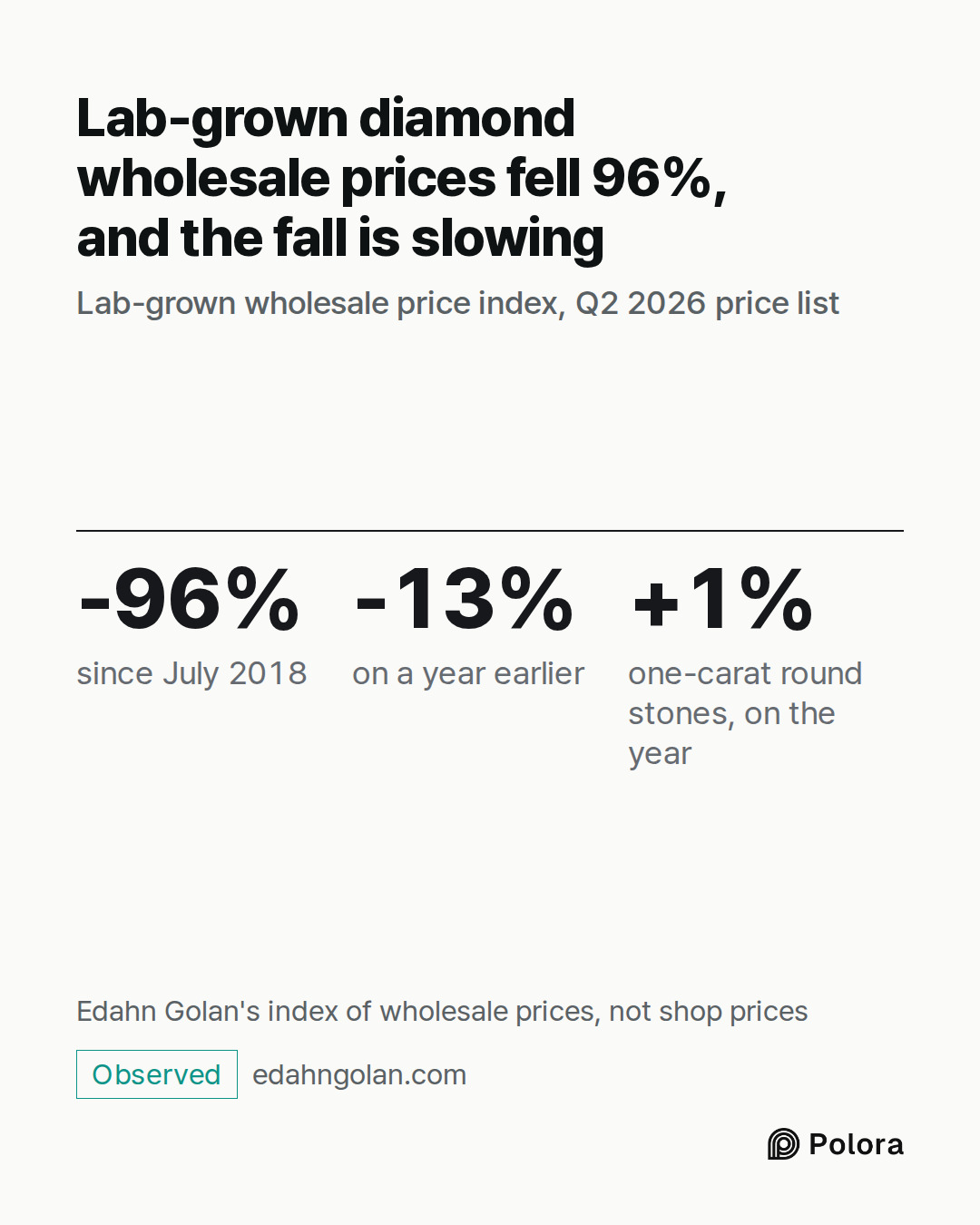
The analyst Edahn Golan, who has tracked lab-grown wholesale prices since July 2018, put his index 96 percent below its starting point in his Q2 2026 price list, published on 7 July 2026, with prices down 13 percent from a year earlier. His figures also show the fall slowing, with one-carat round stones up 1 percent on the year. A stone that can be made in growing numbers has lost the scarcity that once held diamond prices up.
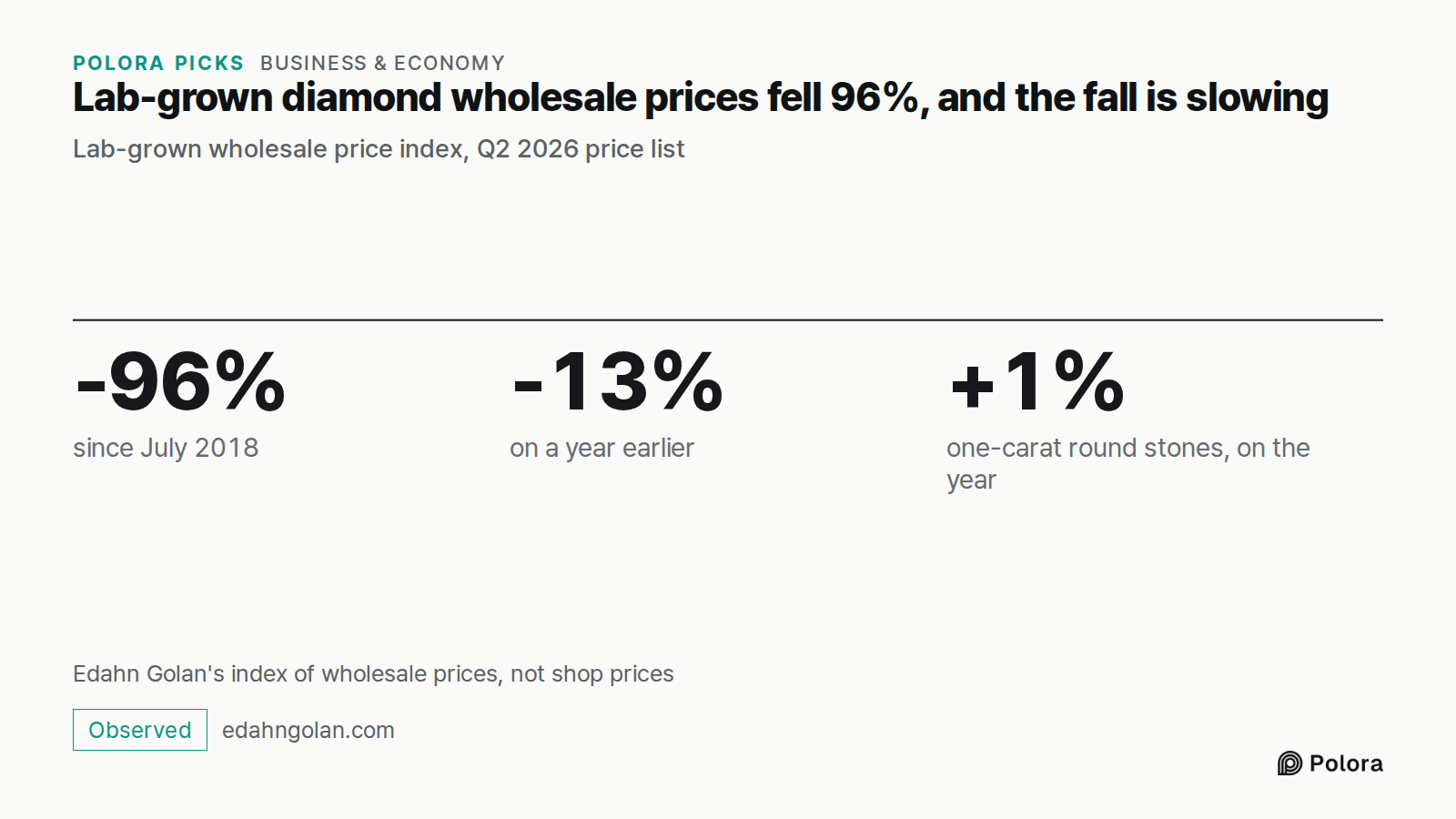
Lab-grown diamond wholesale prices fell 96%, and the fall is slowing · Lab-grown wholesale price index, Q2 2026 price list · -96% · -13% · +1% · since July 2018 · on a year earlier · one-carat round stones, on the year · Edahn Golan's index of wholesale prices, not shop prices
Lab-grown wholesale price index, Q2 2026 price list

Natural diamond prices : the indexes do not agree

For mined diamonds there is no single price, and the people who measure it report different things.

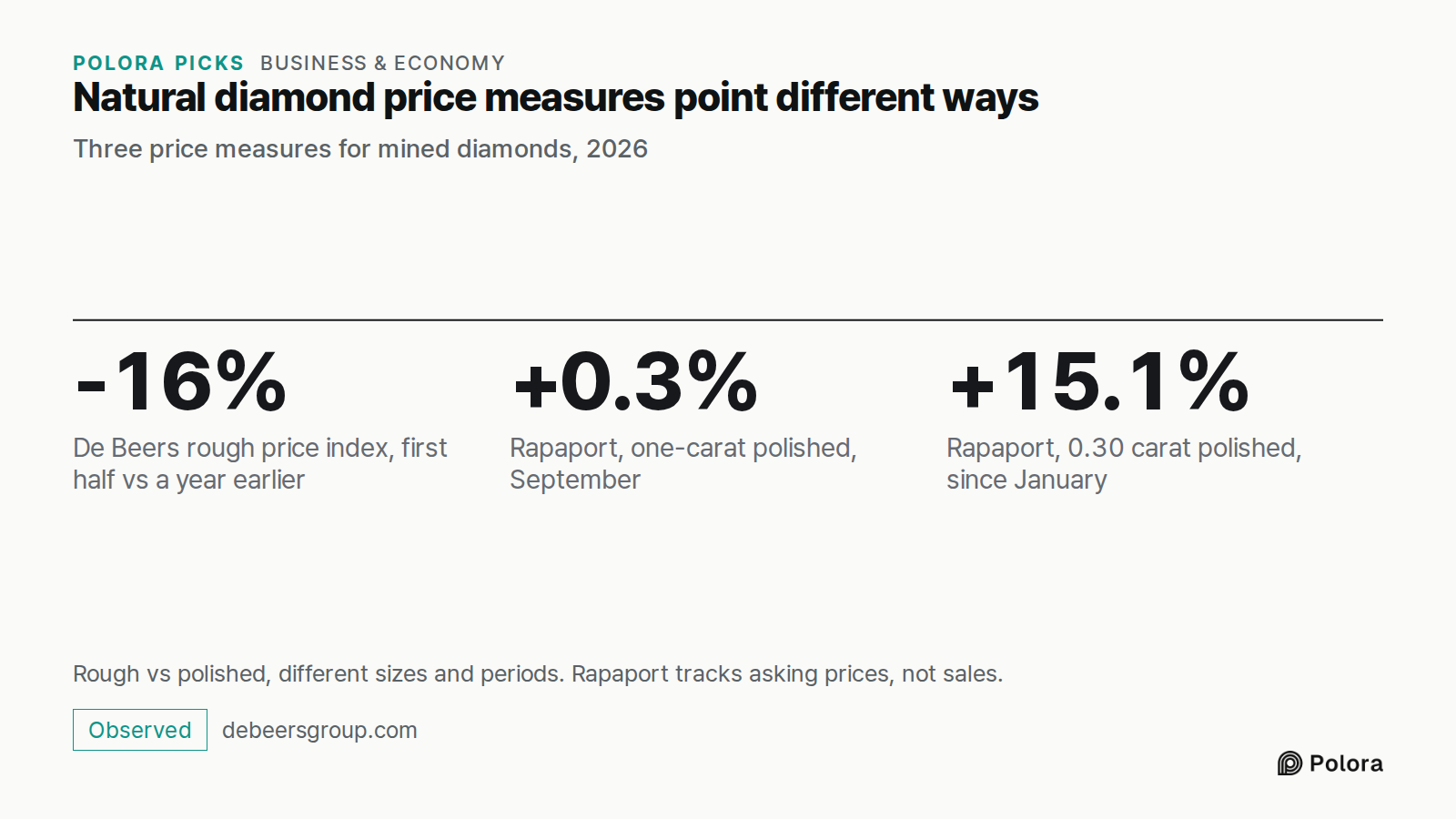
De Beers' own figures, published on 30 July 2026, show its average rough diamond price index 16 percent lower in the first half of 2026 than a year earlier, and the average price it got for each carat down from $155 to $105. De Beers said part of that larger fall came from a change in the mix of stones it sold.

Rapaport, a trade price service that tracks polished stones, said on 4 February 2026 that 'diamond demand is permanently lower because of synthetics, China's slowdown, and social changes like dropping marriage rates'. By 6 October 2026 it was reporting a second monthly rise for one-carat stones, of 0.3 percent in September, and its index for 0.30 carat stones up 15.1 percent since the start of the year. Its index tracks the asking prices of selected polished stones, not completed sales, shop prices or what an owner is offered.

These numbers measure different things : rough stones or polished ones, small sizes or large, a half-year average or one month. Read together, they say natural prices fell hard and some have begun to steady. They do not give one number for what a diamond is worth now, and none of them tells an owner what their own ring would fetch.
Natural diamond price measures point different ways · Three price measures for mined diamonds, 2026 · -16% · +0.3% · +15.1% · De Beers rough price index, first half vs a year earlier · Rapaport, one-carat polished, September · Rapaport, 0.30 carat polished, since January · Rough vs polished, differe
Three price measures for mined diamonds, 2026

The company that held the system together is for sale

In May 2001 De Beers' shareholders approved an $18.7 billion buyout by a group including the mining company Anglo American and the Oppenheimer family, JCK reported at the time ; the first offer had been $17.6 billion. Anglo American later came to own 85 percent of De Beers.

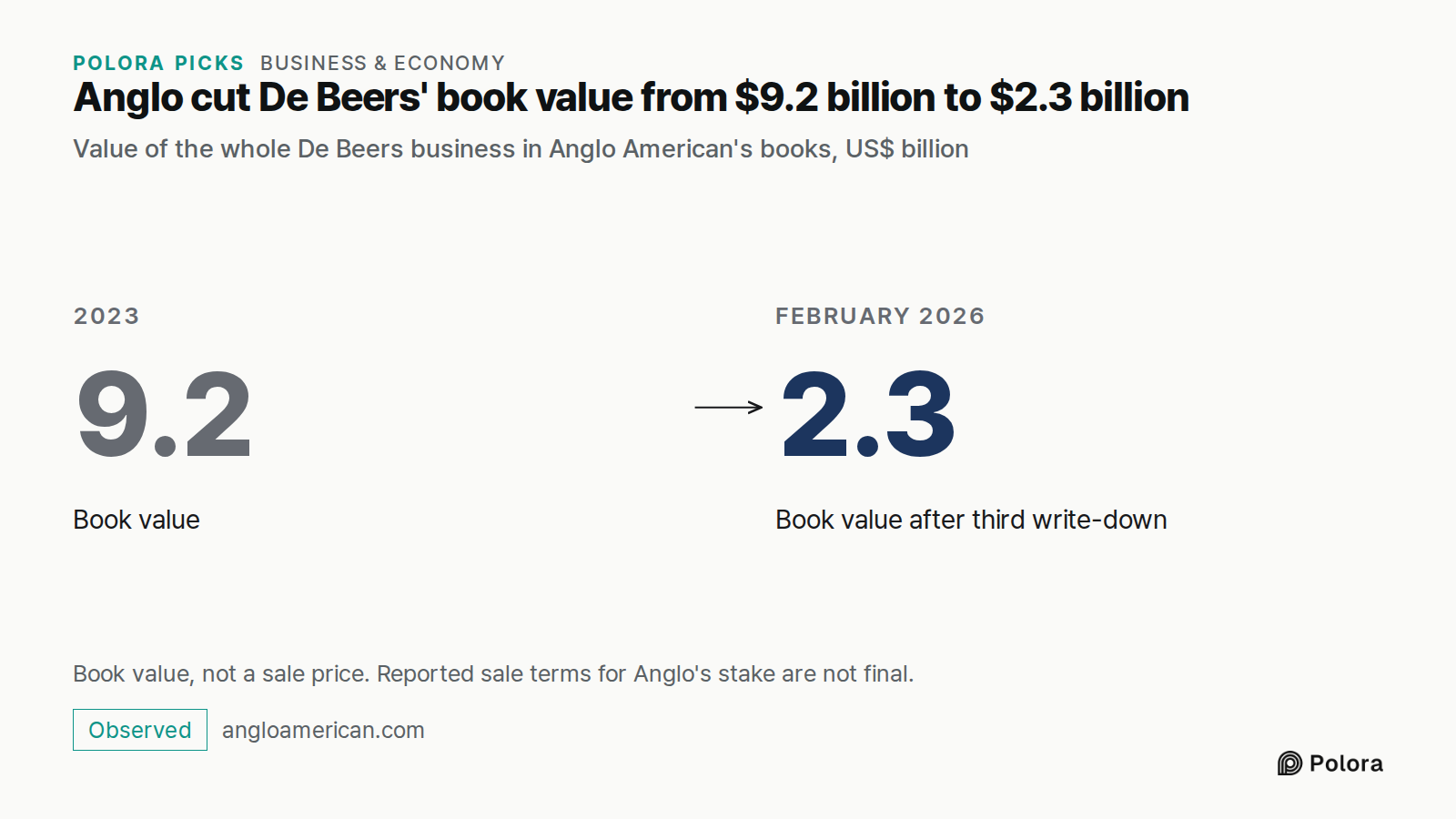
Anglo American has since written down what De Beers is worth on its books three times. After the latest cut, announced in February 2026, Anglo values the whole De Beers business on its books at $2.3 billion, against $9.2 billion in 2023; Anglo's own share of that is $1.9 billion. De Beers' revenue fell to $1.6 billion in the first half of 2026, from $2.0 billion a year earlier.

Anglo American has picked a preferred bidder : the Global Diamond Consortium, led by Gareth Penny, a former De Beers chief executive. On 29 July 2026 Bloomberg reported a price of about $1 billion for Anglo's 85 percent stake, roughly $750 million up front and $250 million later, and said the terms were not final. A day later Anglo's chief executive, Duncan Wanblad, said the company was in the final rounds of negotiation and hoped to sign by the end of the year. On 7 October 2026 he said negotiations were still under way.

The government of Botswana, which owns the other 15 percent of De Beers and produces more than 70 percent of its diamonds, has to approve the sale. Its minister said the sale would likely be concluded by the final quarter of 2026, subject to conditions. As of 8 October 2026 we found no announcement from Anglo American that a deal had been signed.
Anglo cut De Beers' book value from $9.2 billion to $2.3 billion · Value of the whole De Beers business in Anglo American's books, US$ billion · 2023 · 9.2 · Book value · February 2026 · 2.3 · Book value after third write-down · Book value, not a sale price. Reported sale terms for Anglo's stake are
Value of the whole De Beers business in Anglo American's books, US$ billion

What the receipt was really paying for

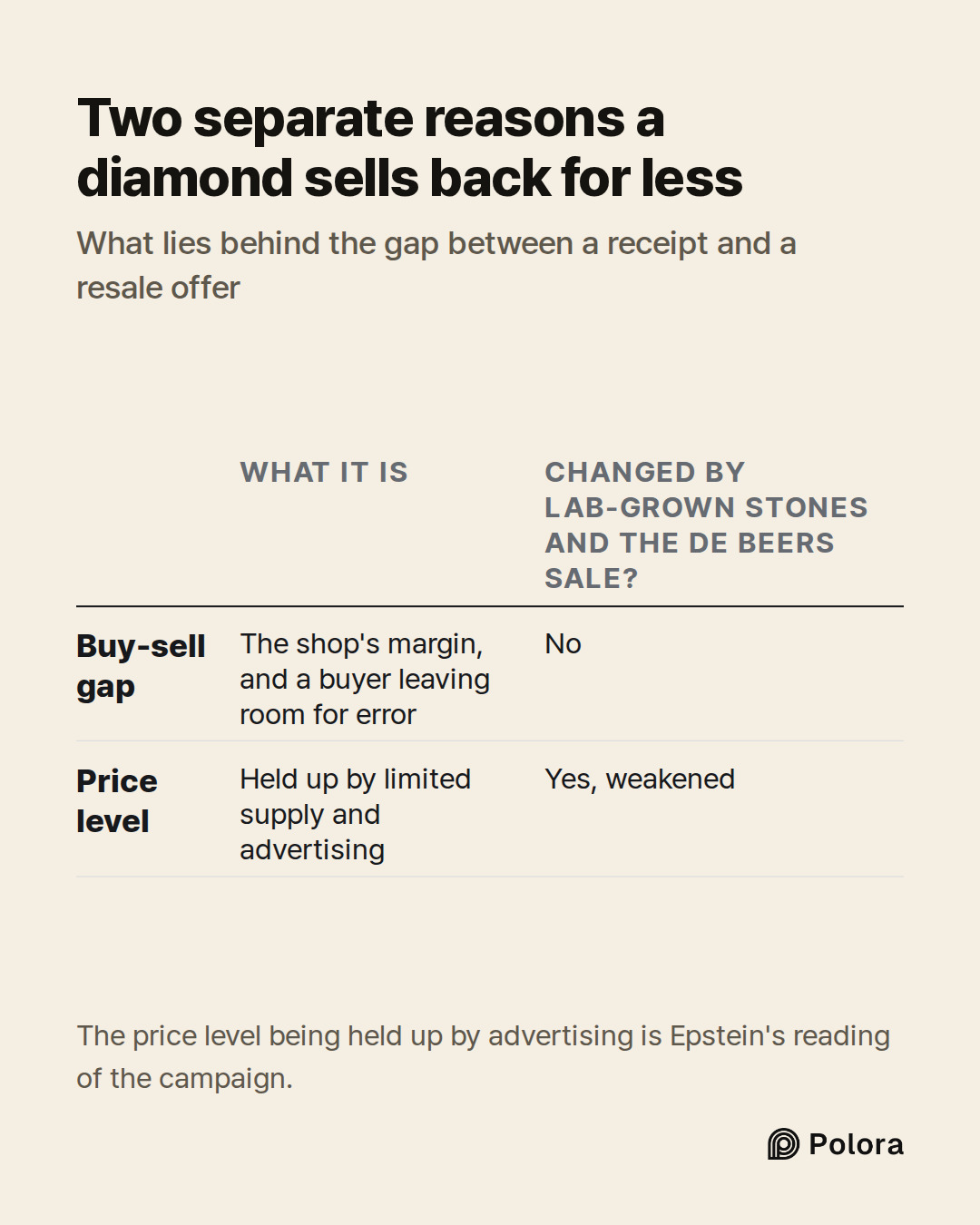
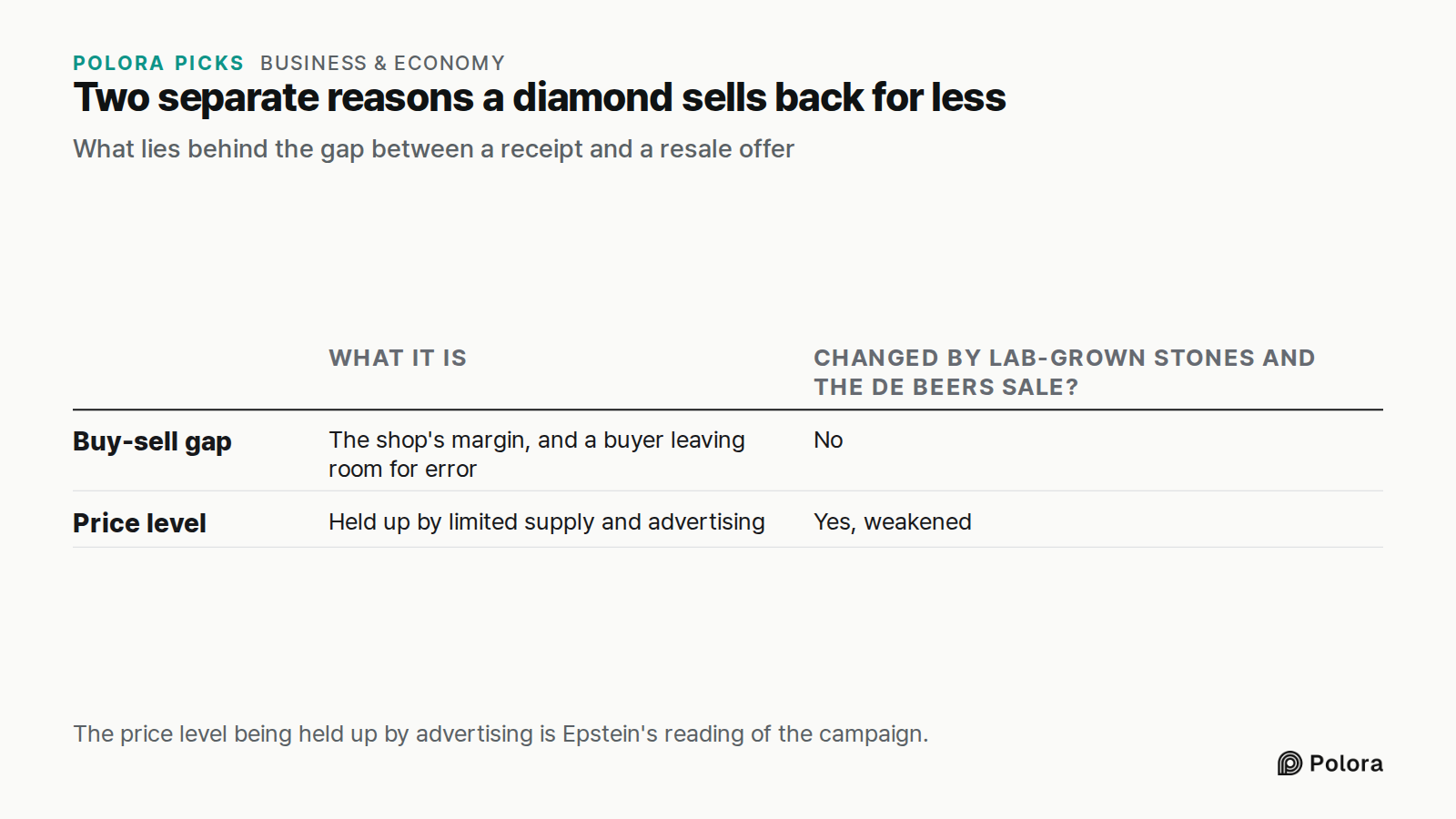
A diamond's price in a shop was never a promise of what someone would pay for it later. Two separate things explain why. The first is the gap between buying and selling : the shop's margin, and a buyer who has to resell the stone and leaves room for error. That gap would exist even without De Beers. The second is the price level itself, which De Beers held up for decades by limiting supply and by advertising that, in Epstein's reading, taught buyers never to sell.

Lab-grown stones and the sale of De Beers bear on the second. Grown stones have weakened the idea that diamonds are scarce, and the company that ran the system is being sold. Neither changes the first. The old examples show how wide the gap could be, but no one has a single current figure for how wide it is today. The stone in the drawer has not changed. The receipt recorded what it cost to buy it, and that was never the price of selling it again.
Two separate reasons a diamond sells back for less · What lies behind the gap between a receipt and a resale offer · What it is · Changed by lab-grown stones and the De Beers sale? · Buy-sell gap · Price level · The shop's margin, and a buyer leaving room for error · No · Held up by limited supply a
What lies behind the gap between a receipt and a resale offer
Is a diamond still worth what you paid for it?Is a diamond still worth what you paid for it?A diamond's shop price was never a promise of what it would sell for later. · The receipt records the retail price. An offer to buy it back is made at wholesale or below.1974 · 2595 · Paid to a reputable dealer · A week later · 1000 · Best offer to buy it back · A week after buying, the best offer was £1,000 · One 1.4 carat diamond bought in London in 1974, in pounds · One case reported by Edward Jay Epstein in The Atlantic, 1982. It is not a survey.The receipt · The buyback offer · Retail price : wholesale plus a markup of 100 to 200 percent on the stone and its setting · At most 90 percent of wholesale, often less. The setting is sold as scrap. · The receipt and the buyback offer are two different prices · How each price is set, as describedDe Beers held diamond prices up for decades. · It limited supply and ran advertising that, in Epstein's reading, taught buyers never to sell. · ※ De Beers : the company that long controlled most of the world's diamond supply-96% · -13% · +1% · since July 2018 · on a year earlier · one-carat round stones, on the year · Lab-grown diamond wholesale prices fell 96%, and the fall is slowing · Lab-grown wholesale price index, Q2 2026 price list · Edahn Golan's index of wholesale prices, not shop pricesWhat it is · Changed by lab-grown stones and the De Beers sale? · Buy-sell gap · Price level · The shop's margin, and a buyer leaving room for error · No · Held up by limited supply and advertising · Yes, weakened · Two separate reasons a diamond sells back for less · What lies behind the gap betweeSources 25 : web.archive.org · Have You Ever Tried to Sell a Diamond? (The Atlantic, archived copy), theatlantic.com · Have You Ever Tried to Sell a Diamond? (The Atlantic), gia.edu · Diamond history and lore (GIA) + 22Read the full story at · polora.ai

Is a diamond still worth what you paid for it?

Alpha · claude-sonnet-5

Alpha here. I'll focus on the two biggest open items the editor flagged, then give the one argument that should give a careful reader pause. 1947 slogan date — confirmed, with the name the manuscript omitted. Multiple independent sources — an academic thesis on N.W. Ayer's De Beers campaigns, The Drum, Sotheby's, and a dedicated slogan-history page — converge on the same account: "In 1947 'a diamond is forever' became the official slogan of the De Beers Consolidated Mines Limited", and the line was written by a specific person, not an anonymous "Ayer copywriter." "Frances Gerety, a young copywriter for N.W. Ayer & Son, scribbled down a few words to finish a new De Beers advertisement" late one night in 1947. Sotheby's corroborates the same date and author independently: "'A Diamond Is Forever' was conceived by copywriter Frances Gerety for the advertising agency N. W. Ayer & Son, as De Beers was facing slumping sales in the wake of WWII." The slogan then "was written by copywriter Frances Gerety at Philadelphia agency NW Ayer in 1947" but first ran in ads the following year. This is well-sourced enough to fix the manuscript's gap: name Gerety, date the line 1947, note firs…

Beta · gpt-6-sol

Beta here. The manuscript’s answer to the reader holds, but two price claims need correction before publication. An ordinary diamond ring generally cannot be sold back for its shop price. That was true well before lab-grown diamonds became a significant competitor. The receipt records a retail transaction; it is not a standing offer from the trade to repurchase the ring. (theatlantic.com) | Manuscript claim | What I found | |---|---| | Owners historically recovered a fraction of retail; markups and buyback prices explain the gap. | Supported as historical examples, not a present-day resale percentage. Epstein’s *Atlantic* article identifies the £2,595 purchase and £1,000 best offer as a 1974 experiment. It also reports a buyer’s illustrative $2,000 ring/$600 offer, a stated maximum of 90% of wholesale, and a possible 100–200% markup on the diamond and setting, depending on the shop. These are reported cases and trade estimates, not a representative survey of today’s offers. Address: https://www.theatlantic.com/magazine/archive/1982/02/have-you-ever-tried-to-sel…

Gamma · gemini-3.1-pro

Gamma here. I will finalize the checks requested in the research brief, building on what Alpha and Beta have already established, and give my assessment of the manuscript's underlying premise. Here is what the record shows for the specific items the editor asked us to resolve: 1. The 1947 Slogan and Frances Gerety *Correction required.* The manuscript refers to an anonymous "Ayer copywriter." Alpha and Beta are correct: historical records and De Beers' own corporate history confirm the copywriter was Frances Gerety, and she wrote "A Diamond Is Forever" in 1947 (first appearing in print in 1948). The manuscript should insert her name. *Source:* https://www.debeersgroup.com/about-us/our-history 2. The 2001 De Beers Buyout Figure *Supported.* The $18.7 billion figure represents the final approved buyout offer in May 2001, raised from an initial $17.6 billion proposal. Using $18.7 billion is historically accurate for the final deal value. *Source:* https://www.jckonline.com/editorial-article/shareholders-ok-de-beers-buyout/ 3. The FTC Guidelines *Supported, with section confirmations.* The current eCFR confirms the manuscript's reading. 16 CFR § 23.12 defines a d…

Researcher · gemini-3-7-flash

Reality Check & Factual Verification Below is the factual verification of the specific claims and queries raised in the manuscript and debaters' arguments, checked against the live web and official primary records as of October 8, 2026. --- 1. The 1947 Slogan and Frances Gerety * Manuscript Claim: An anonymous N. W. Ayer copywriter created "A Diamond Is Forever" following Ayer's 1947 strategy papers. * Live Record: Verified with attribution correction. The phrase was penned in 1947 by copywriter Frances Gerety of N. W. Ayer & Son, and the campaign officially launched in print in 1948. De Beers' corporate history explicitly credits Gerety with the 1947 creation. * Source: De Beers Group Corporate History --- 2. The 2001 De Beers Buyout Figure ($18.7B vs. $17.6B) * Manuscript Claim: The May 2001 buyout of De Beers was worth $18.7 billion. * Live Record: Verified. The initial proposal from DB Investments (Anglo American, the Oppenheimer family/Central Holdings, and Debswana) was $17.6 billion, but the consortium raised its offer in May 2001 to secure shareholder approval, valuing the…

The Arbiter · gpt-6-sol

Round record for the verdict: Alpha, Beta and Gamma agree that the manuscript’s central answer is supported: a retail diamond receipt has historically been a poor guide to what an owner can recover on resale. Beta dates Epstein’s £2,595 purchase and £1,000 best offer to a 1974 example, not a present-day resale rate. No participant established a representative current resale percentage. The agreement comes with an important distinction. Alpha identified it, and Beta and Gamma endorsed it: the retail-to-resale gap and the level of diamond prices are different questions. Shop margins and a buyer’s resale risk help explain a low offer even without De Beers. Historic supply control, advertising and lab-grown competition bear on broader prices; they do not, by themselves, establish what a particular ring will fetch. Epstein’s claim that “forever” discouraged resale should remain attributed to *his interpretation*, not stated as the copywriter’s documented intent. The checks yielded these publication-relevant points: - History and attribution: GIA’s estimate of De Beers’ roughly 90% control of rough production by 1900 stands in the record. De Beers credits Frances Ger…

The Arbiter's Final Verdict · gpt-6-sol

Usually not if “worth” means what you could sell it for. A shop’s receipt records a retail price; a resale buyer generally offers a wholesale-based price or less. That gap existed long before lab-grown diamonds. Edward Jay Epstein documented striking examples in *The Atlantic* in 1982, but those examples are historical—not a reliable percentage for a sale today. Market prices are a separate question. De Beers reported a 90% fall in *wholesale lab-grown* prices since Lightbox launched in 2018. Natural-diamond measures have also weakened, though some selected polished-stone indexes rose in September 2026; those indexes do not tell you what someone would offer for your ring. (De Beers, July 2026; Rapaport, October 2026) So the man…