Is a product labeled 'Made in Italy' actually made in Italy?
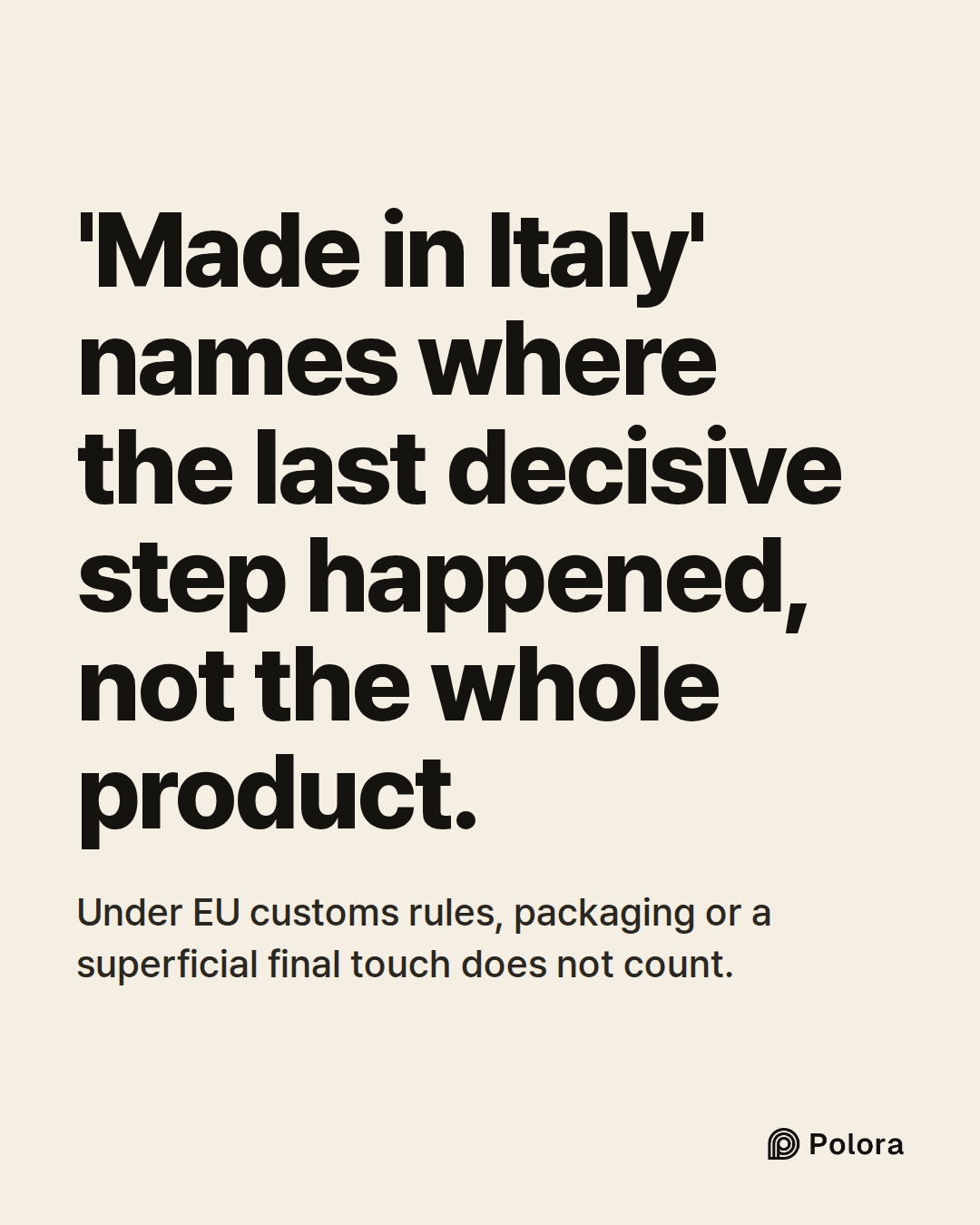
Partly. Under EU rules, 'Made in Italy' names the country where the last substantial stage of manufacture took place, not a mere finishing touch. A shirt sewn in Italy from imported fabric can carry it.
Business & Economy · 2026-10-07
The label names one step, not the whole product
Picture a shirt or a pair of shoes with 'Made in Italy' on the label. Ask yourself where it was made and the easy answer is Italy, meaning the cloth, the leather, the cutting and the stitching. The rule behind the label says something narrower.
When a product passes through more than one country, EU customs law gives it the origin of the country where its last substantial transformation took place. That is Article 60 of the Union Customs Code. The processing has to be economically justified and done in a business equipped for it, and it has to produce a new product or be an important stage of manufacture. Packaging or a superficial final touch does not count. The label does not add up where the parts came from. It points to where the last decisive step happened.
Italy ties its label to this test. Under Article 4(49) of Law 350/2003, putting 'Made in Italy' on goods that do not originate in Italy under the European customs origin rules is a false indication, punishable under Article 517 of the Italian criminal code. The test is a legal standard, not a checklist, so a company's origin claim can be challenged.
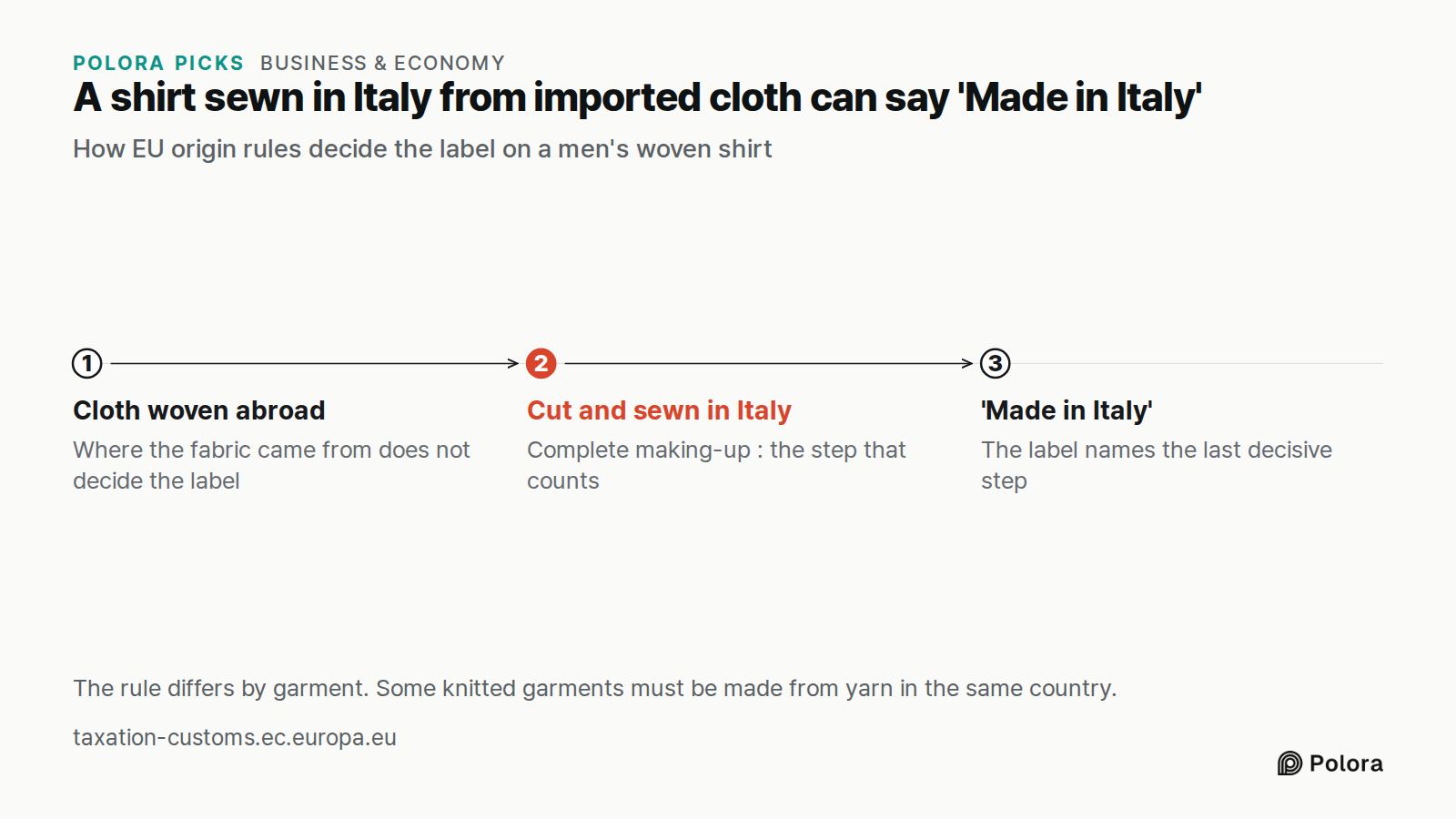
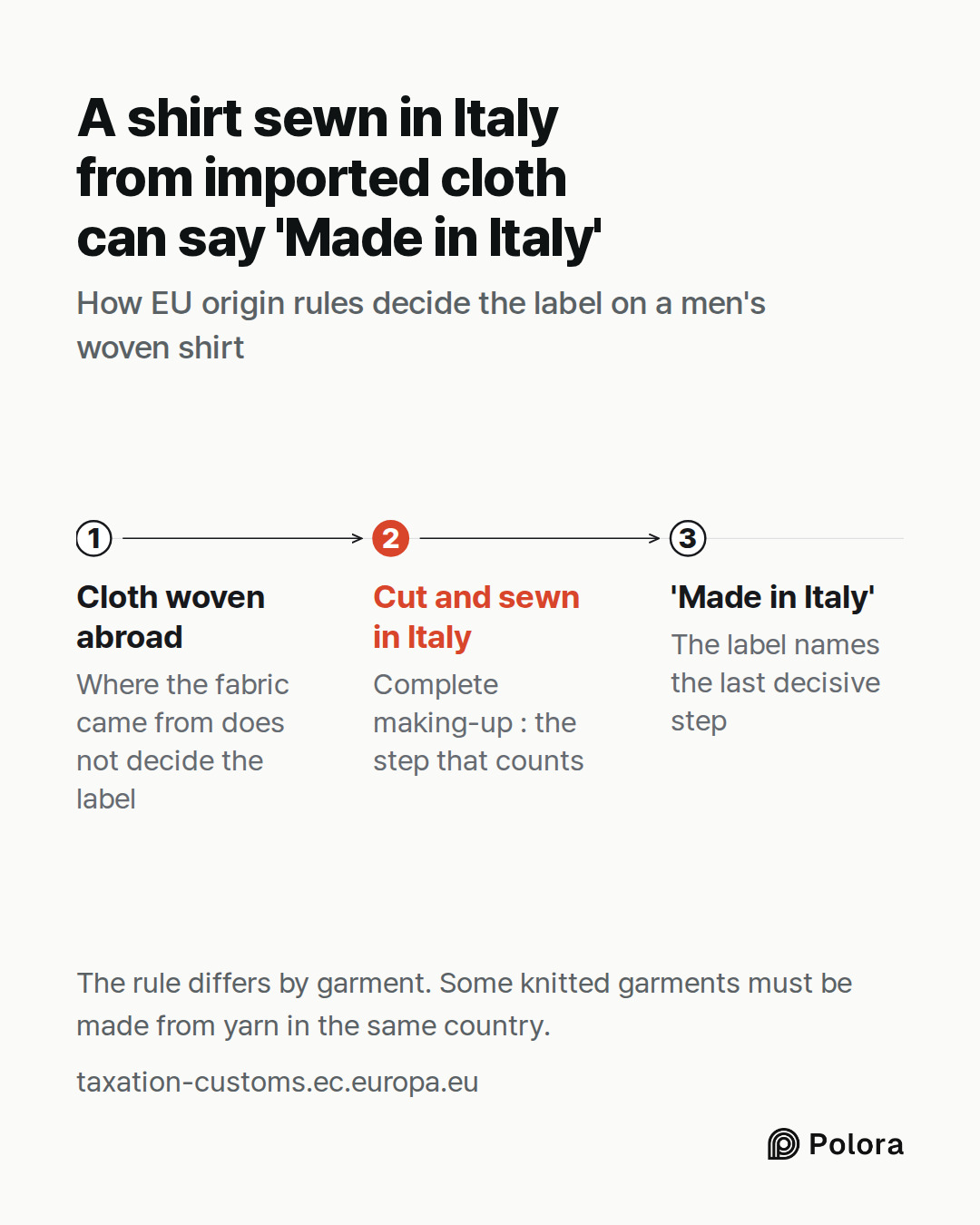
The EU spells out, product by product, which step counts as decisive, in Annex 22-01 of Delegated Regulation 2015/2446. For many garments the test is 'complete making-up' : all the operations that follow the cutting of the fabric have to happen in one country, apart from a few finishing touches. A finished men's woven shirt is one of the garments under this rule.
So the country that wove the fabric does not decide the label, and neither does the country where the design was drawn. A woven shirt cut and sewn in Italy from imported cloth can honestly say 'Made in Italy'. That is the rule working as written, not a loophole.
Not every garment follows the same test. For some knitted garments the rule asks for manufacture from yarn, so which test applies depends on how the product is classified and on what was actually done where.
How EU origin rules decide the label on a men's woven shirt
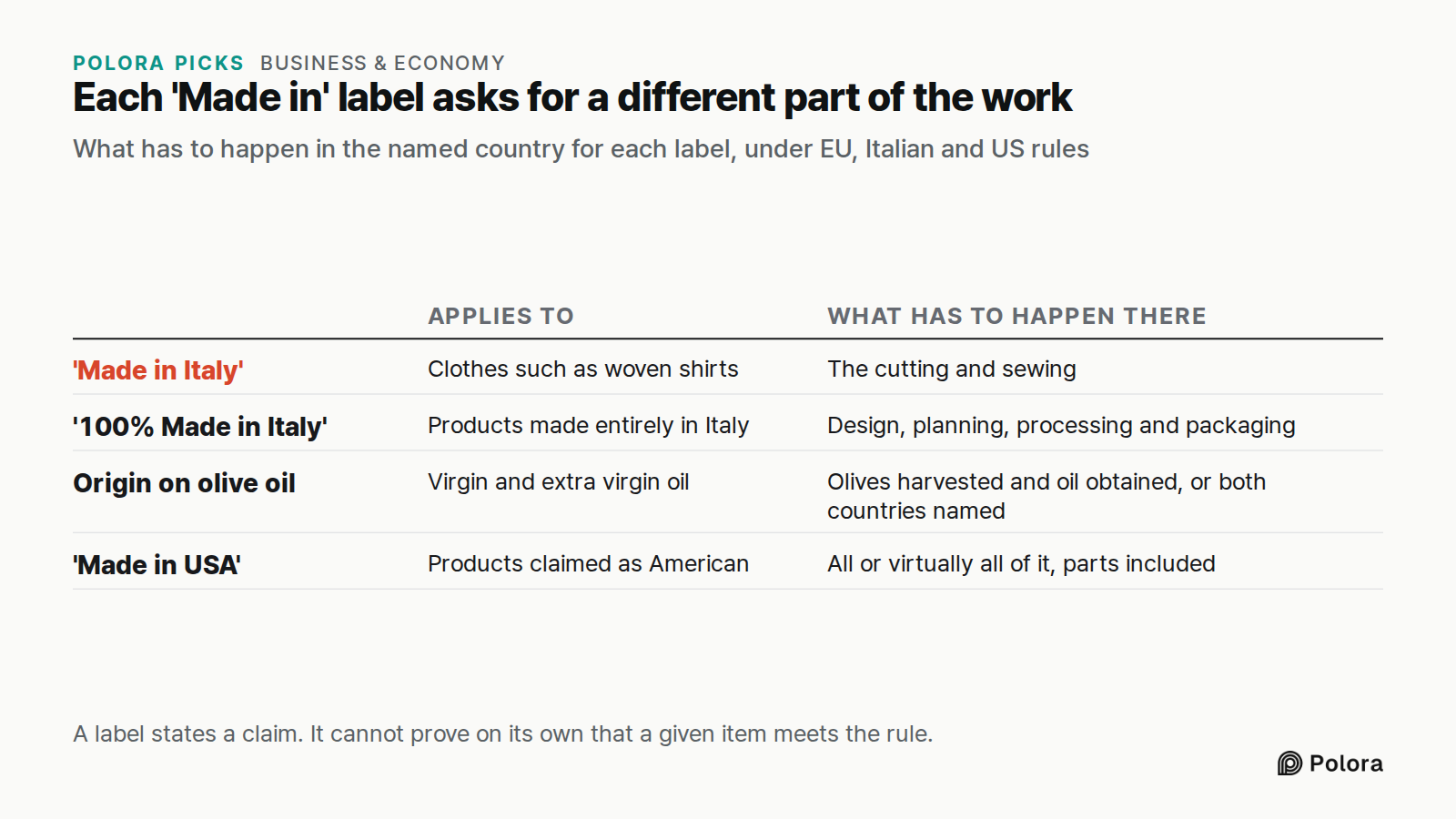
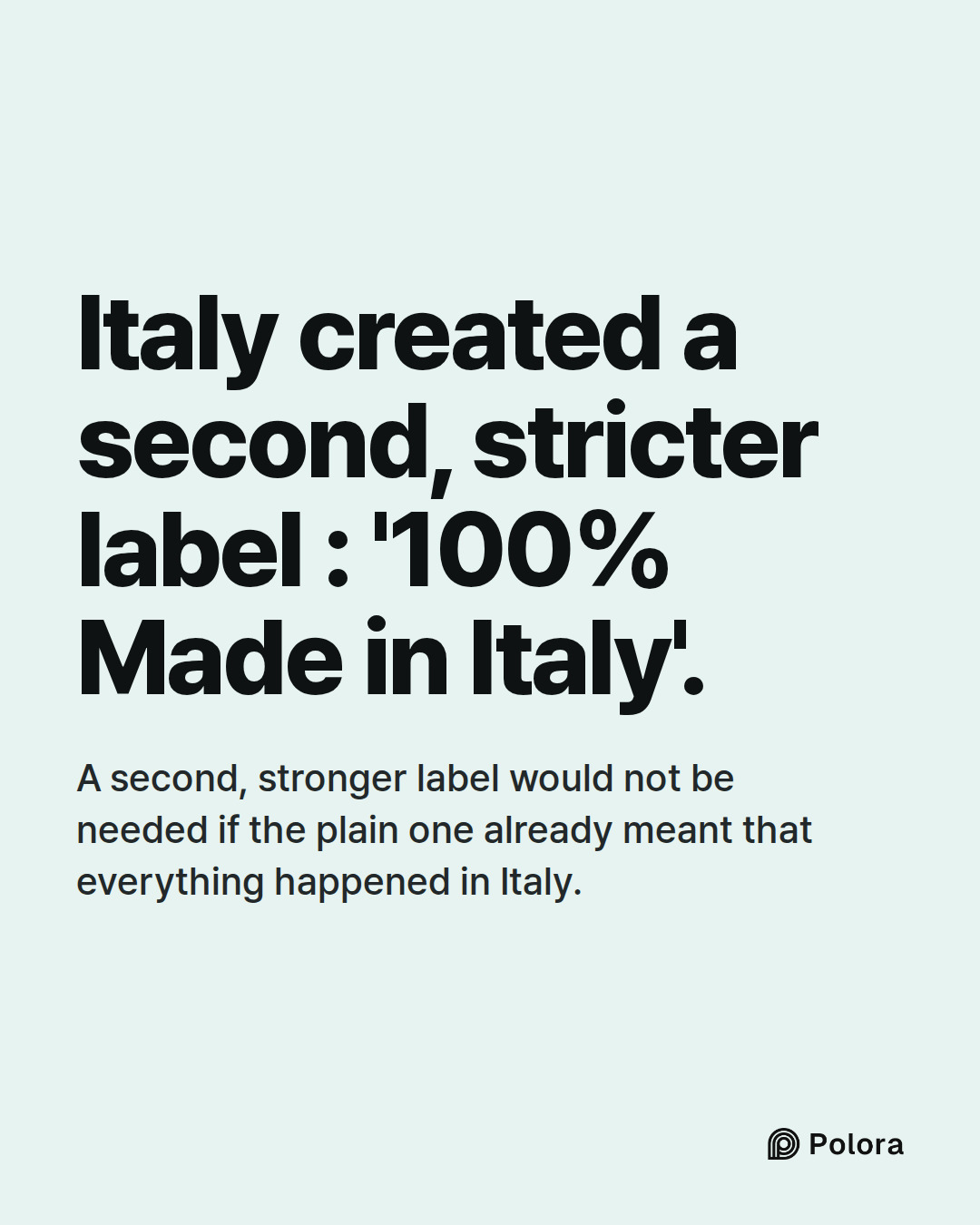
Italy itself drew the line between the two meanings. Article 16 of Law 166/2009 defines a product made entirely in Italy as one that already qualifies as 'Made in Italy' and whose design, planning, processing and packaging all take place only in Italy.
The same article sets penalties for calling a product '100% made in Italy', '100% Italia' or 'tutto italiano' when those conditions are not met. A second, stronger label would not be needed if the plain one already meant that everything happened in Italy.
The bar moves with the product. For virgin and extra virgin olive oil, the EU requires an origin statement and ties it to the olives. Under Article 8 of Delegated Regulation 2022/2104, if the oil was obtained in one country from olives harvested in another, the label has to say so. One example is oil obtained in Italy from olives harvested in Tunisia.
Oil mixed from several countries must use fixed wording such as 'blend of olive oils of European Union origin' or 'blend of olive oils of European Union origin and not of European Union origin'. Virgin or extra virgin oil bottled in Italy from a mix of countries cannot simply call itself Italian.
The United States sets a much higher bar for products that carry its own name. Under the Federal Trade Commission's standard, written into a labeling rule that took effect on August 13, 2021, an unqualified 'Made in USA' claim on a label means the product is 'all or virtually all' made in the US. Final assembly or processing must happen there, all significant processing must happen there, and all or virtually all ingredients and components must be from the US.
The rule is enforced. In April 2024, Williams-Sonoma agreed to pay a $3.175 million civil penalty for violating a 2020 FTC order that required it to tell the truth about whether its products were made in the US. The FTC called it the largest penalty ever in a Made in USA case. The agency had found that products advertised as made in the US were made in China and other countries.
This standard covers only claims that a product is American, and the FTC says it does not replace other federal country-of-origin laws. A shirt imported into the US from Italy is marked under US customs' own test, which also asks where the last substantial transformation happened. The US does not check Italian labels more strictly. It asks more of products that claim to be American.
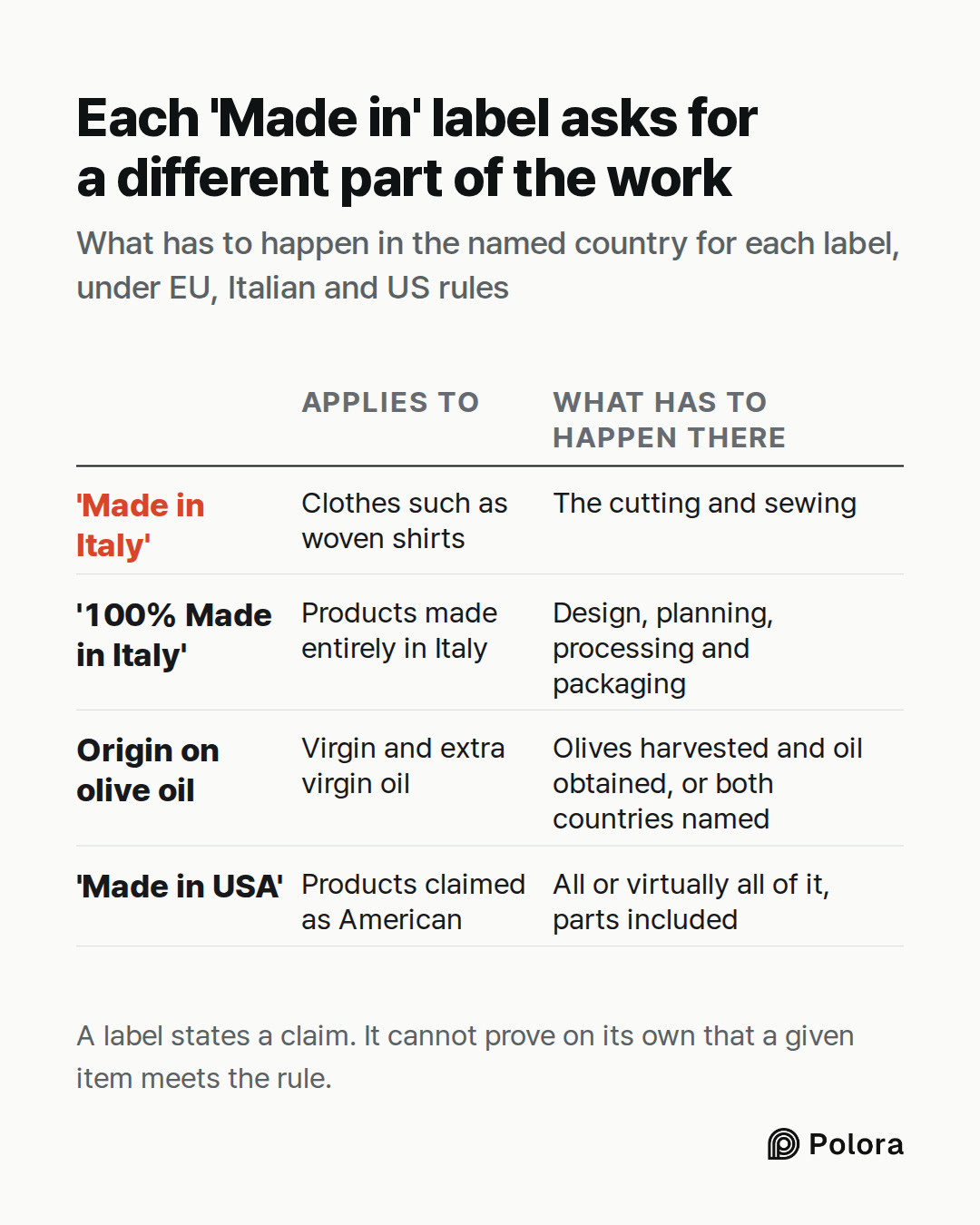
A 'Made in' label answers a customs question : where did the product acquire its origin under the rule for its kind? How much it asks depends on the product and on the country writing the rule. A garment, a bottle of oil and an American-made pan each meet a different test.
The stronger words are the ones that carry more. '100%', 'entirely' or 'all' are separate claims with their own rules and their own penalties. A plain 'Made in Italy' tells you where a product became what it is, not where it began, and a finishing touch alone does not earn it. The label states a claim ; it cannot prove on its own that a particular item meets the rule.
What has to happen in the named country for each label, under EU, Italian and US rules
Is a product labeled 'Made in Italy' actually made in Italy?
Alpha · claude-sonnet-5
Alpha's verification pass
The core legal architecture in this manuscript checks out, and I want to flag exactly which pieces I verified first-hand versus which I'm taking on trust, because that distinction matters for what the next stage does with this.
Article 60 UCC and "last substantial transformation" — confirmed, and the manuscript understates how contested it is.
The Commission's own page confirms the basic structure: the origin of goods is based on the concept that products which underwent a 'last substantial transformation' in the last country of production get that country's origin, with Article 60(1) applying when one country is involved and Article 60(2) when two or more are. The "economically justified" qualifier is real too — the article provides that goods shall be deemed to originate where they underwent their "last, substantial, economically justified processing or working, in an undertaking equipped for that purpose, resulting in the manufacture of a new product or representing an important stage of manufacture".
Where the manuscript could use a stronger caveat: this test is not mechanical. in cases where no factual information exists to establish that an…
Beta · gpt-6-sol
Yes—if the claim is accurate, “Made in Italy” means the product qualifies as Italian in origin. It does not mean every material and every production step came from Italy. The manuscript’s premise stands, but its closing line—“tells you where a product was finished”—is too loose. Mere finishing need not confer origin.
Here is my check of the claims that matter most:
- The legal link the manuscript was missing is real. Article 4(49) of Italy’s Law 350/2003 expressly treats a “made in Italy” marking on goods *not* of Italian origin under European origin rules as a false indication. Article 60(2) of the EU Customs Code assigns a multicountry good’s origin to the place of its last *substantial, economically justified* processing, subject to its other conditions. This supports the manuscript’s account of an ordinary non-food origin claim, not a claim that any final operation in Italy suffices. Italian law also addresses misleading indications beyond a literally false origin marking. (normattiva.it)
Addresses: https://www.normattiva.it/uri-res/N2Ls?urn:nir:stato…
Gamma · gemini-3.1-pro
The core premise of the manuscript stands: a standard 'Made in Italy' label reflects a specific, narrower customs threshold rather than a guarantee that every material and production phase originated in Italy.
Since Alpha and Beta left the Italian national legislation unverified, I will close that gap.
Law 166/2009 and the "100% Made in Italy" standard — Confirmed.
The manuscript accurately describes Italy's stricter domestic standard. I reviewed the text of Article 16 of Law 166/2009 (Decree-Law 135/2009 converted into law).
* The Conditions: Paragraph 1 explicitly defines a product made entirely in Italy as one that qualifies as 'Made in Italy' under existing rules *and* for which the design, planning, processing, and packaging ("il disegno, la progettazione, la lavorazione ed il confezionamento") are carried out exclusively on Italian territory.
* The Penalties: Paragraph 4 confirms the manuscript's exact phrasing and the researcher's note: falsely using indications like "100% made in Italy," "100% Italia," or "tutto italiano" is punishable under Article 517 of the Italian penal code, with the penalties increased by one third ("con le pene previste dall'arti…
Researcher · gemini-3-7-flash
Verification of Manuscript Claims & Legal Baseline
Here is the item-by-item verification of the legal texts, statutory provisions, and regulatory precedents cited across the manuscript and verification brief:
---
1. Legal Link: Article 60 UCC and Italian Law 350/2003
* Claim: Non-preferential customs origin rules (Article 60 of Regulation (EU) No 952/2013 / Union Customs Code) govern whether a non-food product can lawfully bear "Made in Italy".
* Status: Confirmed.
* Source & Mechanics:
* Under Article 4, paragraph 49 of Italian Law No. 350/2003 (Legge Finanziaria 2004), stamping "Made in Italy" on products not originating in Italy *according to European rules on customs origin* is defined as a false indication punishable under Article 517 of the Italian Criminal Code.
* Article 60(2) of the UCC assigns origin to the country where goods underwent their *last, substantial, economically justified processing or working…
The Arbiter · gpt-6-sol
The round converged on the manuscript’s central point: an accurate “Made in Italy” claim does not promise that every material and production stage was Italian. It identifies Italian origin under the applicable rule. No one verified the origin of any particular product merely from seeing its label.
- EU and Italian rules: Beta and the Researcher connected ordinary non-food “Made in Italy” claims to European customs-origin rules through Italy’s Law 350/2003, Article 4(49). Alpha emphasized that Article 60(2) of the Union Customs Code requires the *last substantial, economically justified* processing—not simply the last operation. Gamma and the Researcher verified the separate conditions and penalties for “100% Made in Italy” claims in Article 16 of Decree-Law 135/2009, converted by Law 166/2009. Their source addresses are https://eur-lex.europa.eu/legal-content/EN/TXT/PDF/?uri=CELEX:32013R0952, https://www.normattiva.it/uri-res/N2Ls?urn:nir:stato:legge:2003;350~art4-com49bis= and https://www.normattiva.it/uri-res/N2Ls?urn:nir:stato:decreto.legge:2009-09-25;135~art16. The Normattiva pages did not open in my independent check; the statutory-text verification here rests o…
The Arbiter's Final Verdict · gpt-6-sol
Yes—if the label is accurate, but not necessarily from start to finish. For a non-food product, “Made in Italy” generally means it acquired Italian origin under the applicable customs rule. When production spans countries, that ordinarily requires its last substantial, economically justified transformation to take place in Italy—not merely packaging or a finishing touch. It does not mean every material, component or earlier manufacturing step came from Italy. EU customs rule, Article 60; Italian origin-marking law.
For example, a finished woven shirt can qualify when it is made up in Italy from imported fabric, subject to the rule for its particular classification. Other products have different requirements: virgin and extra virgin olive oil have specific labeling rules that distinguish where olives were harvested from where the oil was obtained. EU garment rules; [olive-oil regulation, Article 8](https://eur-lex.europa.eu/l…