In 2022 the economy shrank for two quarters, and no recession was called
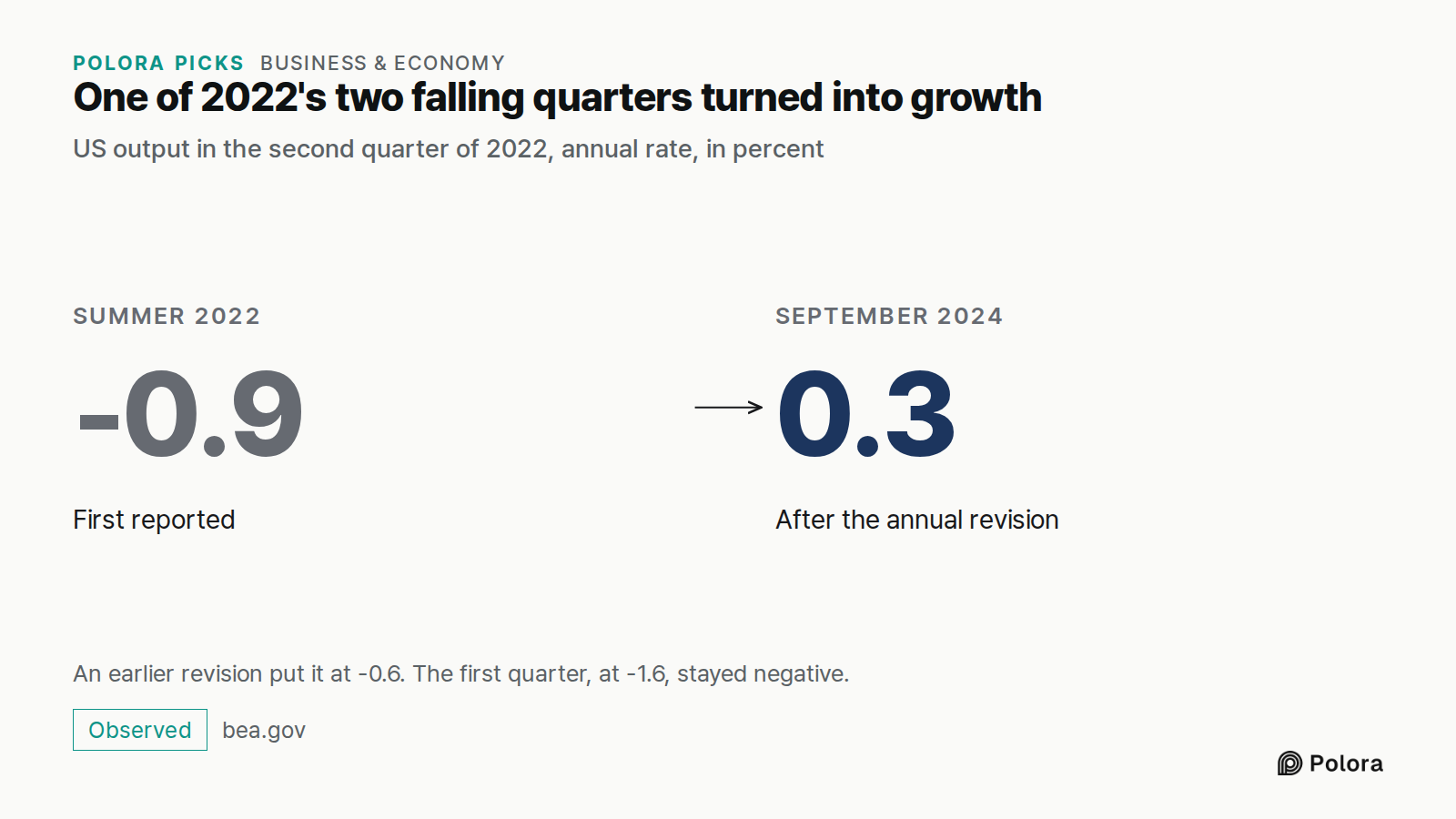
In the summer of 2022, the US government reported that the economy had shrunk two quarters in a row. Output fell at an annual rate of 1.6 percent in the first quarter and 0.9 percent in the second, a figure later revised to 0.6. Many people believe that is what a recession is, and the headlines said so.
The body whose verdict on US recessions counts did not declare one. It issued no statement on the question at all. Meanwhile, the monthly measures it watches, jobs among them, were still rising. Two years later, in September 2024, the government's statisticians finished their regular annual revision of the numbers. The second quarter of 2022 now showed growth of 0.3 percent instead of a decline, while the first quarter stayed negative. One of the two falling quarters had disappeared.
So the rule most people would quote with confidence is not the rule. Two falling quarters are a quick signal that is available early, not the test that dates a recession. To see what the test is, you have to know who makes the call.
- BEA : Gross Domestic Product, Second Quarter 2022 (Advance Estimate)
- BEA : GDP (Third Estimate), GDP by Industry, and Corporate Profits (Revised), Second Quarter 2022
- BEA : 2024 Annual Update of the National Economic Accounts, Summary of Results
- Jeffrey Frankel : BEA revision confirms no recession in 2022
- TKer : Q2 2022 GDP revised up, no recession
Eight economists at a private nonprofit, not a government agency
The official dates of US recessions come from the National Bureau of Economic Research, a private, nonprofit research organization. Inside it, a small group called the Business Cycle Dating Committee decides the month the economy peaked and the month it hit bottom. The span between those two months is what counts as a recession.
The committee in its current form was set up in 1978. It has eight members, all academic economists, from Stanford, MIT, Northwestern, UC Berkeley, Harvard and Princeton. One of them, Robert Gordon, has been on it since the start. Robert Hall chaired it for 46 years, until Valerie Ramey took over in 2024.
No law gives the committee this job, and the US government publishes no rival set of dates of its own. The committee's dates count because, over decades, the government, the press and researchers have chosen to rely on them. 'Official' here means widely accepted, not legally binding.
What the committee looks at instead of a single GDP number
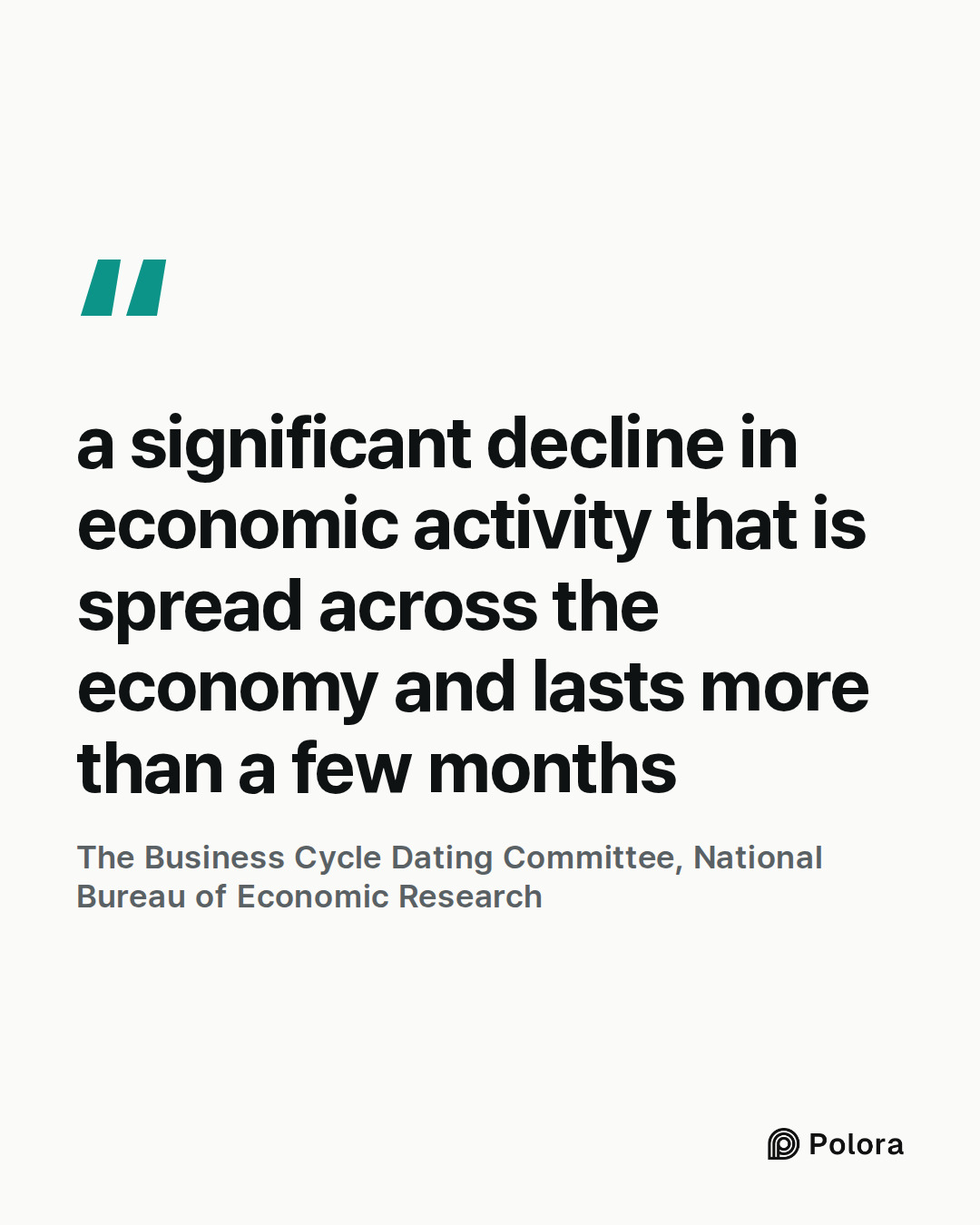
The committee defines a recession as 'a significant decline in economic activity that is spread across the economy and lasts more than a few months.' That definition has three tests : how deep the fall is, how widely it spreads, and how long it lasts. The tests can offset one another, so an extremely sharp fall can count even if it is brief.
It does not lean on one quarterly figure. Among the measures it watches most closely are six monthly ones : income after removing government transfers and adjusting for prices, jobs counted from employers' payrolls, jobs counted from a household survey, consumer spending, sales by manufacturers and traders, and factory output. These are not a fixed checklist, and they are not weighted equally. What the committee does weigh equally is a pair of measures of the whole economy's output that should match in theory but often don't, one built from what is spent and one from what is earned.
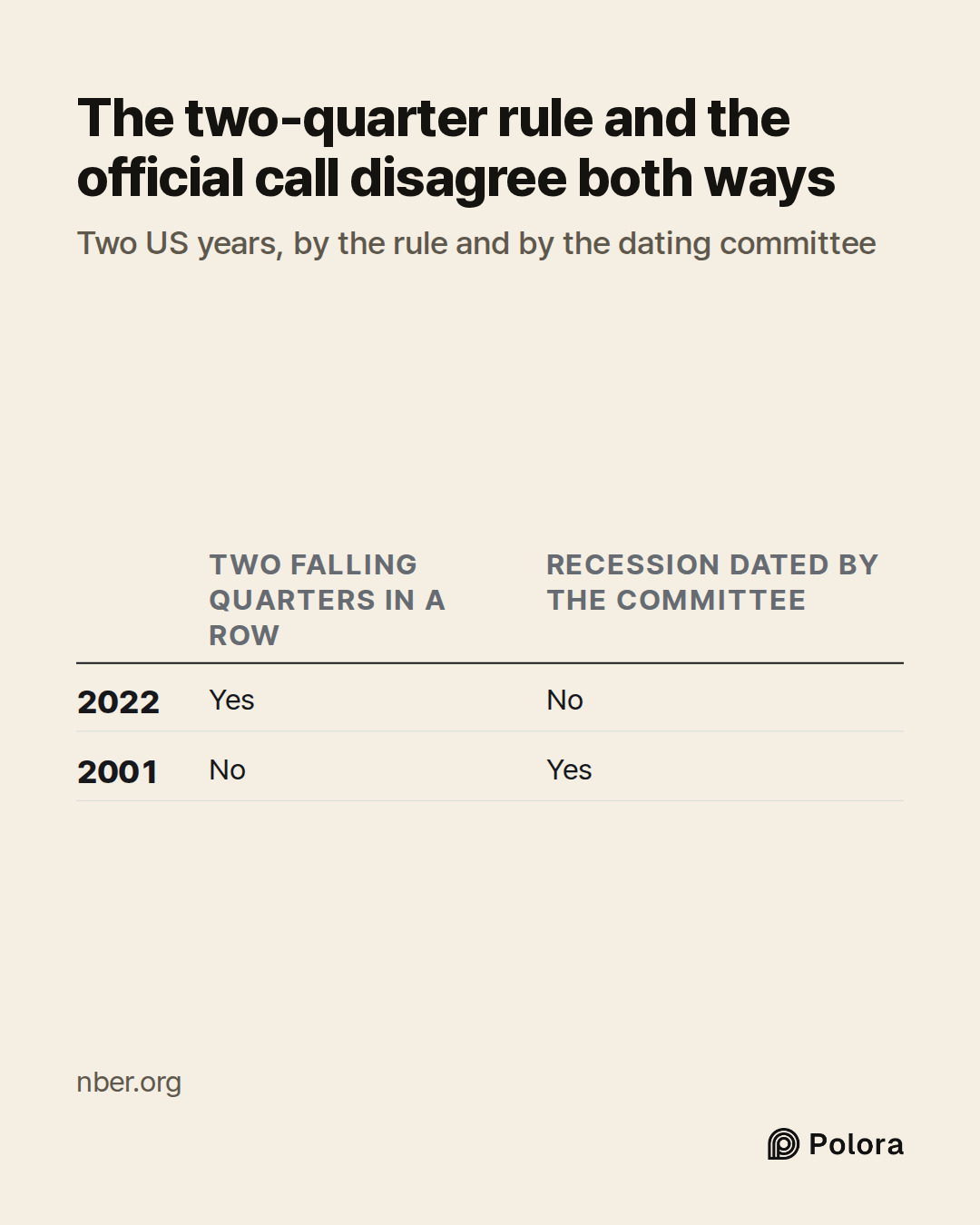
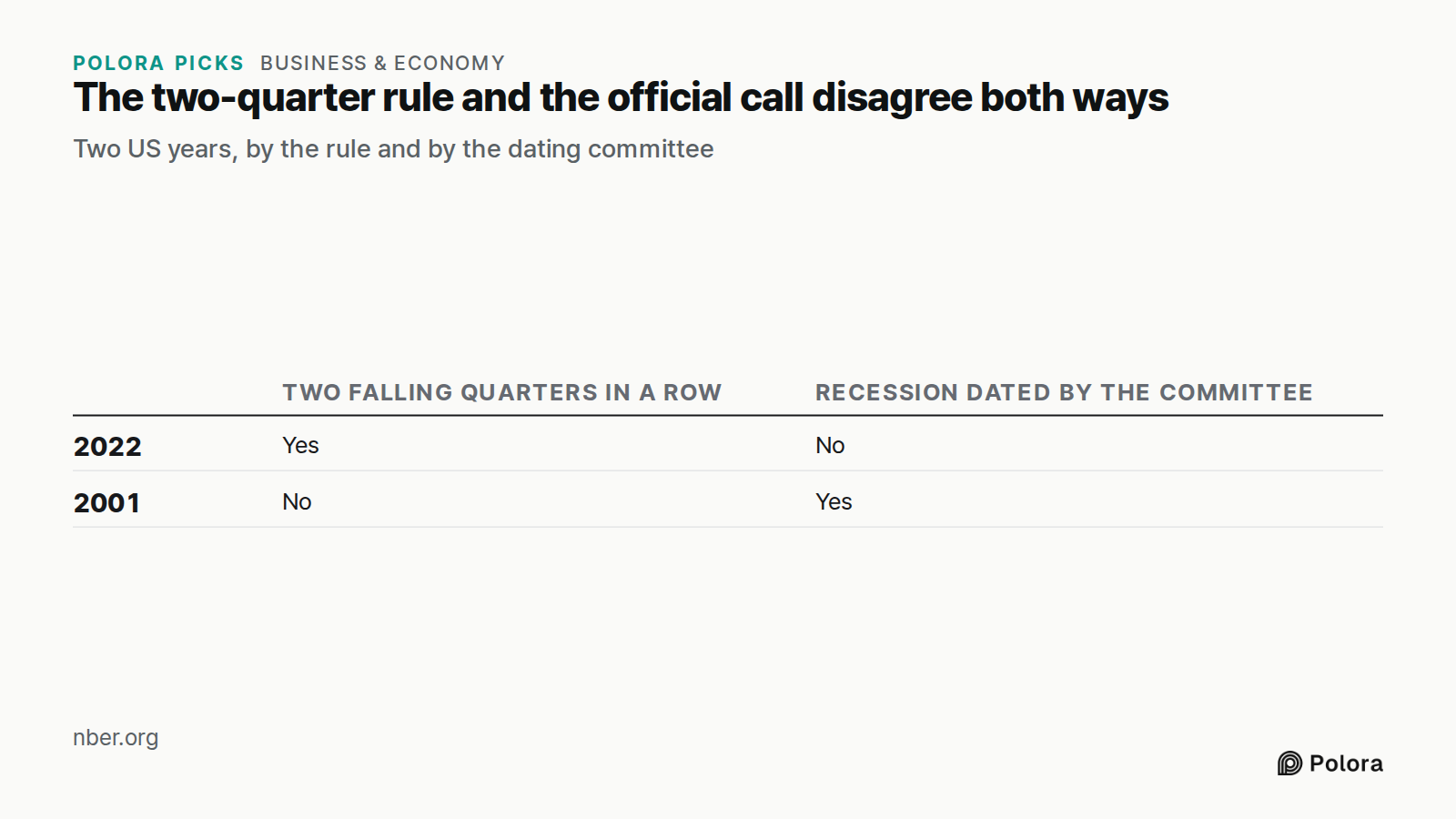
Because of this, the committee's calls and the two-quarter rule can disagree in either direction. In 2022 there were two falling quarters and no recession. In 2001 there was a recession, yet output never fell for two quarters in a row.
Why the official dates can come more than a year late
The committee waits until there is enough evidence that the economy turned, and it allows time for the standard revisions to the main statistics. As 2022 showed, early figures can change sign. Calling a turn too early risks having to take it back.
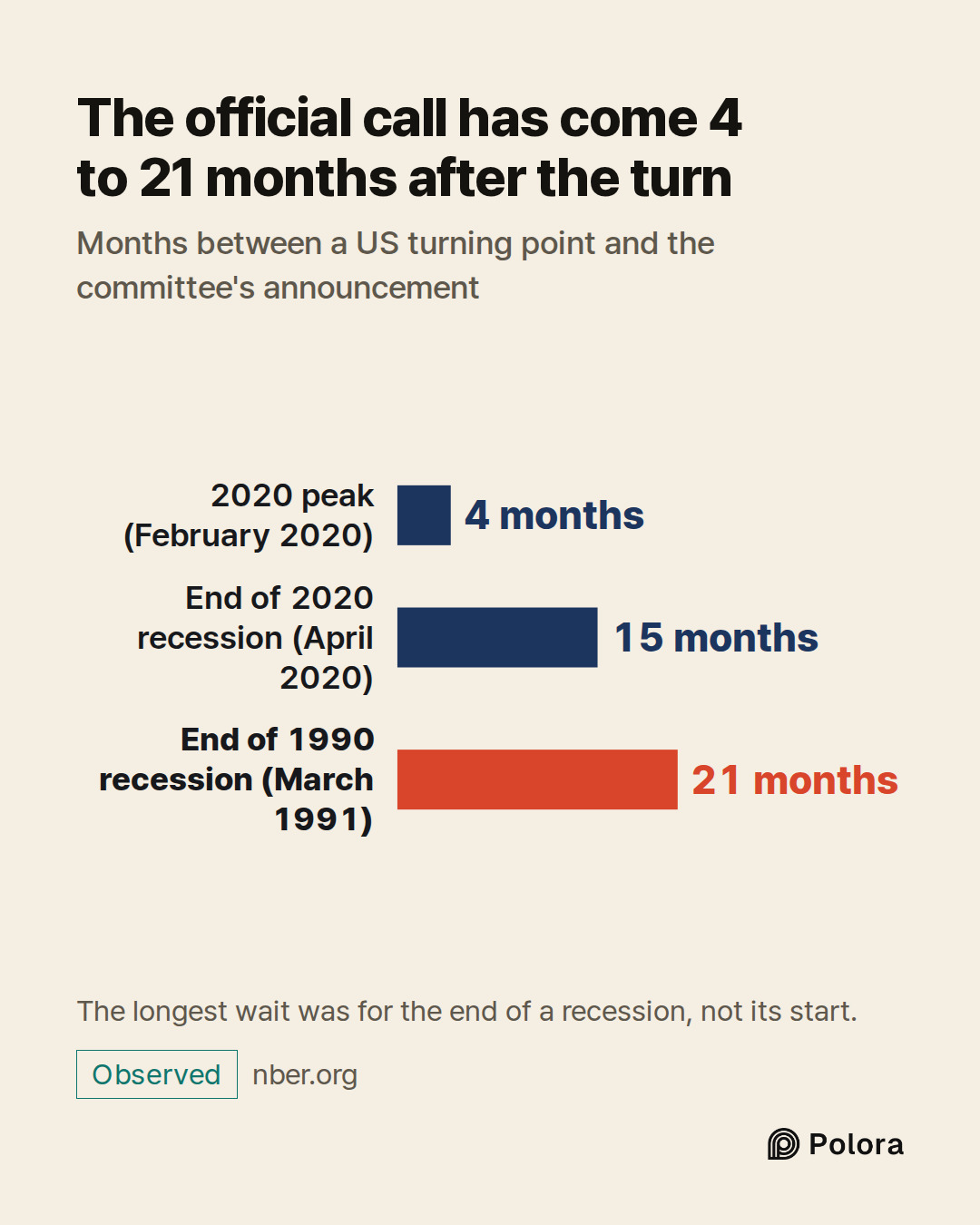
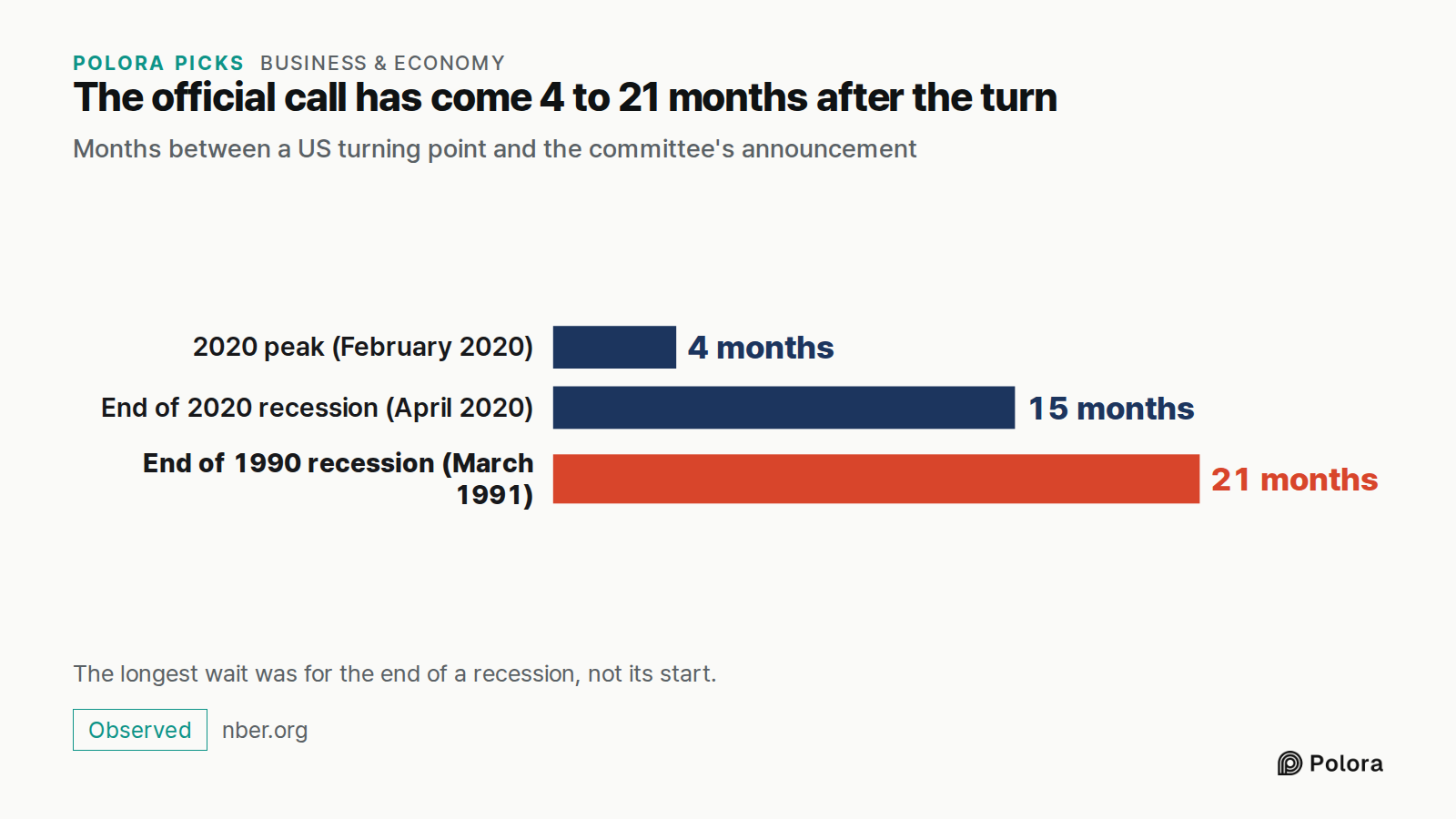
In the past, the gap between a turning point and its announcement has run from 4 to 21 months. The quickest call came in June 2020, when the committee said the economy had peaked in February 2020. The slowest was for the end of a recession, not its start : in December 1992, the committee said the recession that began in 1990 had ended in March 1991. The end of the short 2020 recession, in April 2020, was announced only in July 2021, 15 months later.
So by the time a US recession has an official start date, people have usually been living through it for months, and sometimes it is already over.
Japan and Korea leave the call to the government, and wait even longer
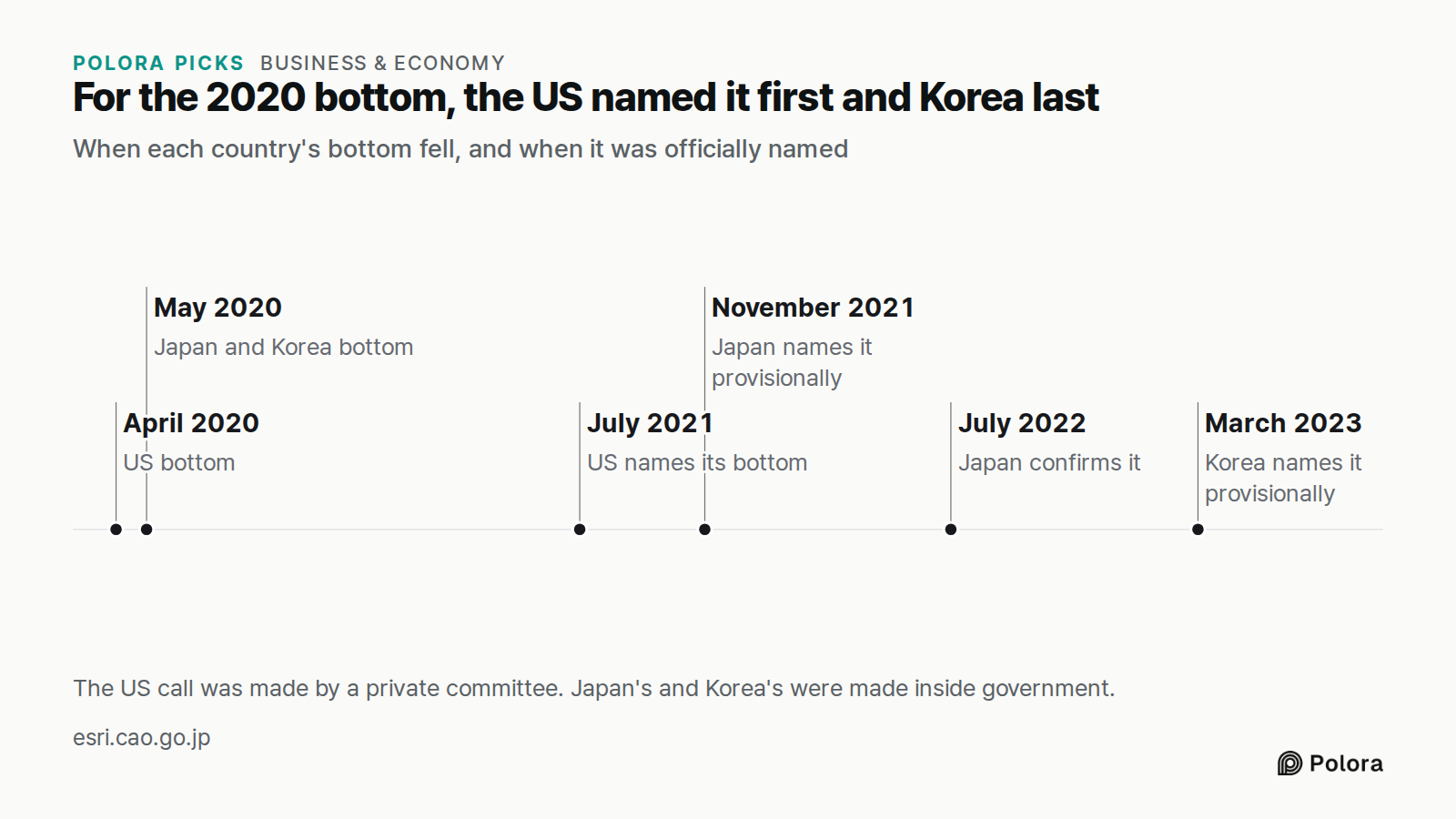
In Japan, the official dates are set by the head of a research institute inside the Cabinet Office, after a panel of outside experts discusses them. Its three tests are close to the American ones : how widely the change spreads, how large it is, and how long it lasts. Japan's last full cycle peaked in October 2018 and hit bottom in May 2020. The peak was set provisionally in July 2020 and the bottom in November 2021. Both dates were confirmed in July 2022, more than two years after the bottom.
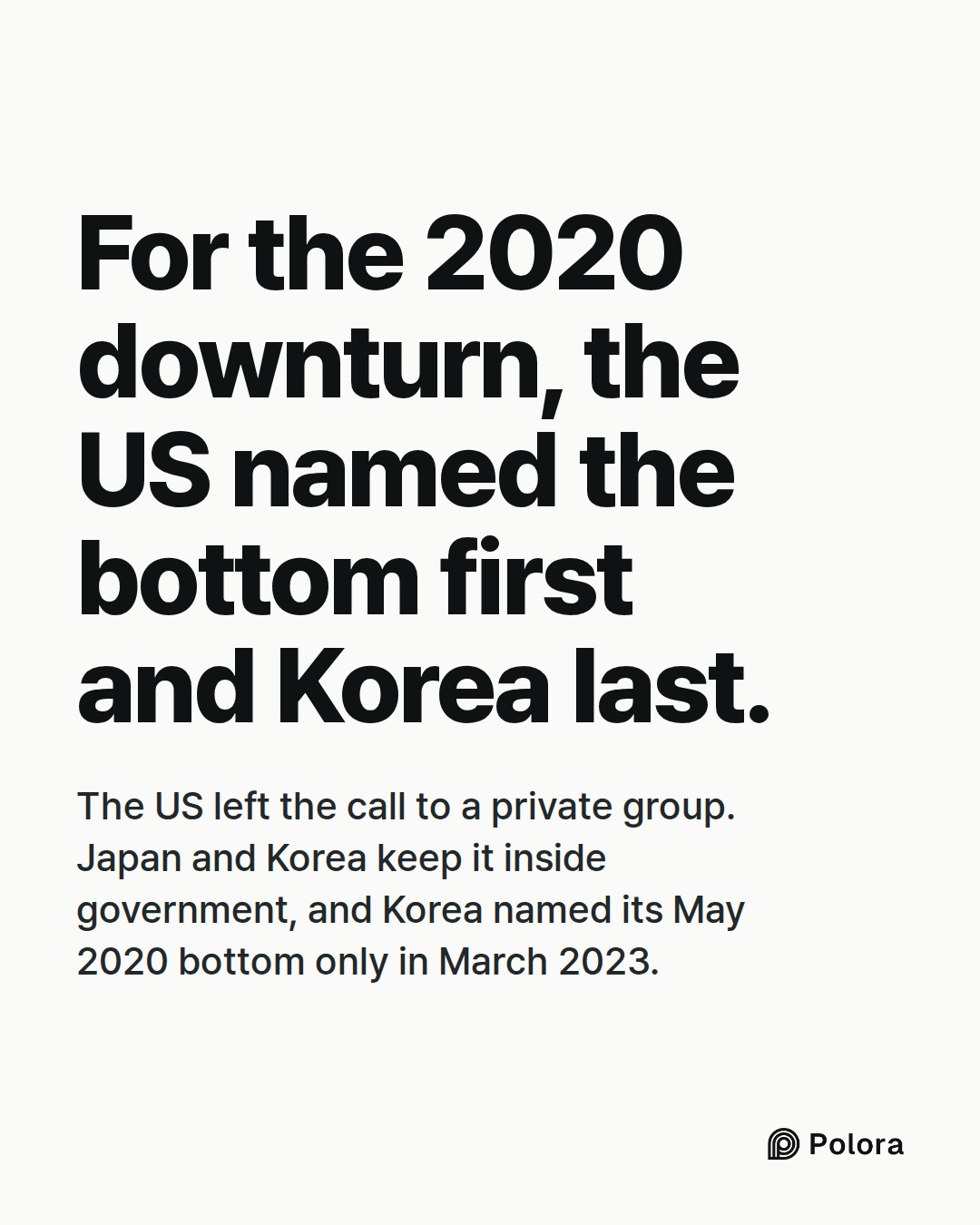
In Korea, the national statistics agency, now called the National Data Office, sets the dates through a committee of the national statistics council. It looks at an index of current activity, production, consumption, GDP and the wider economic situation, and tests whether a turn is clear, widespread and lasting. The bottom of May 2020 was set provisionally only in March 2023, almost three years later. At the time, the agency said more evidence was needed before naming the next peak, and it has not been named yet. According to a May 2026 news report, the agency plans to announce it after a council review at the end of 2026, a plan the agency has not yet confirmed in an official release.
The contrast runs against what many would guess. For the same 2020 downturn, the US handed the call to a private group and got it sooner. Japan and Korea keep it inside government, use very similar tests, and took longer.
- Cabinet Office ESRI : Business cycle reference dates
- Cabinet Office ESRI : Materials on the provisional trough, November 2021
- Cabinet Office ESRI : Materials confirming the 16th cycle peak and trough, July 2022
- Cabinet Office ESRI : Research panel on business cycle indicators
- Statistics Korea : Press release on the provisional trough of the 12th cycle, March 2023
- Newsis : Report on Korea's provisional trough, March 2023
- Korea.kr : Government press release on the reference dates
- Daum News : Report on the planned peak announcement, May 2026
In the euro area, the two-quarter rule lives mostly in the headlines
The euro area has no official body that applies the two-quarter rule. Its recession dates come from a committee of five researchers at the Centre for Economic Policy Research, a private network of economists, which follows the American model. Unlike the US committee, it dates turns by quarter rather than by month.
That committee says a recession is usually visible in two or more quarters of falling output, jobs and other measures, but that this is not a fixed rule. In June 2023, euro area output had dipped slightly for two quarters in a row in revised data. Employment kept growing and unemployment hit a record low, and the committee did not call a recession.
The two-quarter rule is quick and easy to apply, and it is available long before any committee decides, which is why news reports and commentators use it widely. It is a useful early signal, not the official measure.
An official recession date is a label for history, not an alarm
Everywhere this is done carefully, the official start of a recession is decided by looking back, once the data has settled. It records what happened. It is not a warning of what is happening now.
As of October 2026, the US committee has not dated a new peak since the bottom of April 2020. A widely used data series kept by the St. Louis Fed and based on its dates shows no recession in any month through September 2026. That only means no recession has been dated yet. If one has begun, its start date would come later.