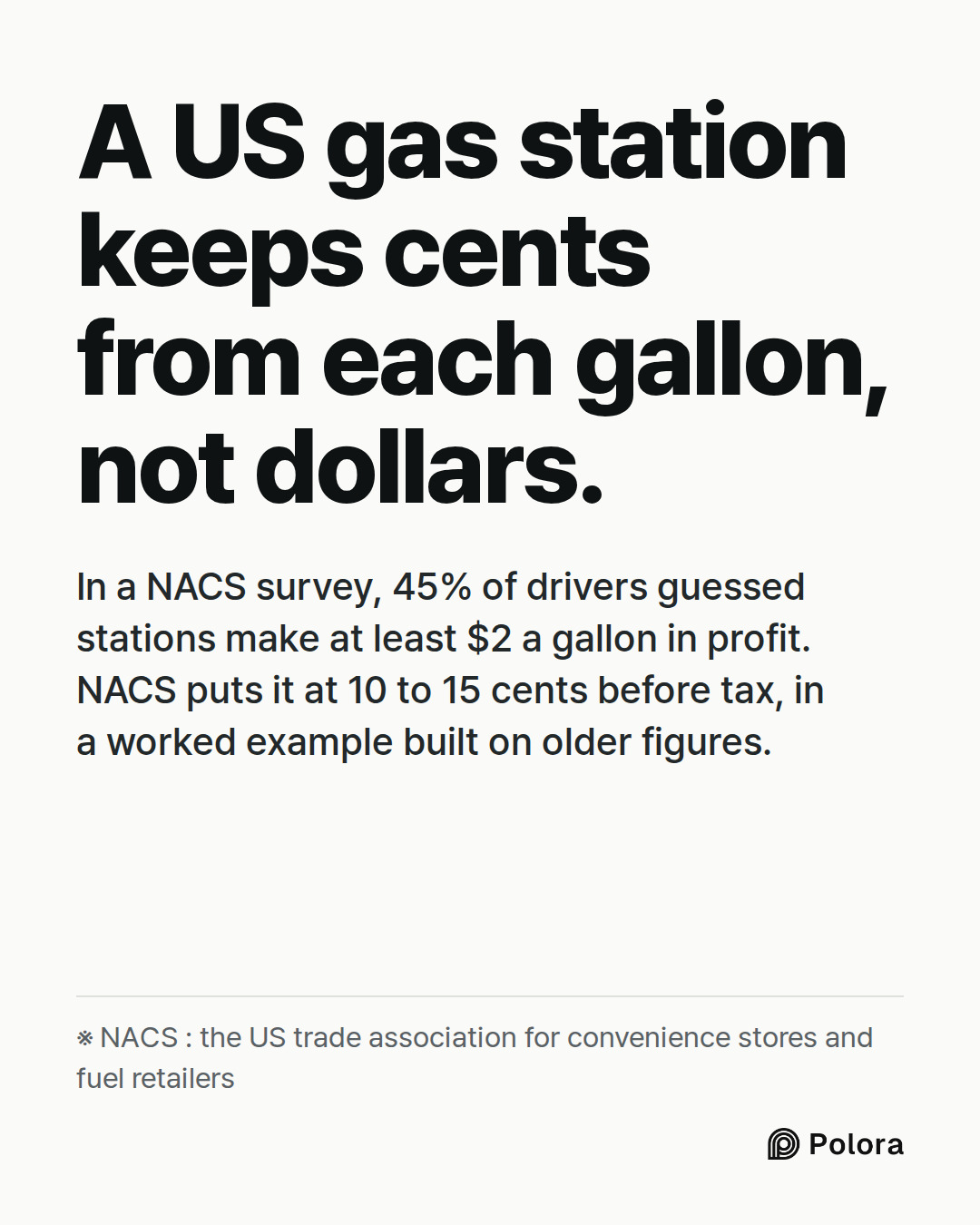
A US gas station keeps about a dime from each gallon
Ask American drivers how much a gas station makes on a gallon and many guess high. In a consumer survey by NACS, the US trade association for convenience stores and fuel retailers, 45% of drivers said they thought retailers make at least $2 a gallon in profit. NACS has cited that survey since 2021. The real figure is measured in cents.
NACS shows the arithmetic with a worked example that mixes figures from different years. It starts from a gross margin of 35 cents a gallon, the association's average for 2020. The gross margin is the gap between what the station paid for the fuel and what it sold it for, before any of the station's own costs. Out of it come about 6 cents to deliver the fuel from the terminal, 8.4 cents in card fees (based on 2023 data), 6 cents to run the store, 2 cents to pay off the pumps, canopy and underground tanks, and 1 cent for swings in inventory and theft. Those five costs add up to 23.4 cents and leave about 11.6 cents before income tax, though the same page gives the total cost as about 22 cents. NACS sums it up as 10 to 15 cents a gallon before tax.
The example's margin was close to the real one in early 2025, when gas sold for about $3.11 a gallon and the gross margin stood at 35.7 cents. Over the past five years, NACS says, the gross margin averaged about 38 cents a gallon, and in stable periods the profit before tax sits around 15 cents. The order of magnitude is old : in 2006, NPR reported a station owner's share at 12 to 14 cents a gallon. Everything here describes the United States. Who owns stations, how fuel is taxed and how much a station keeps all differ a lot from country to country.
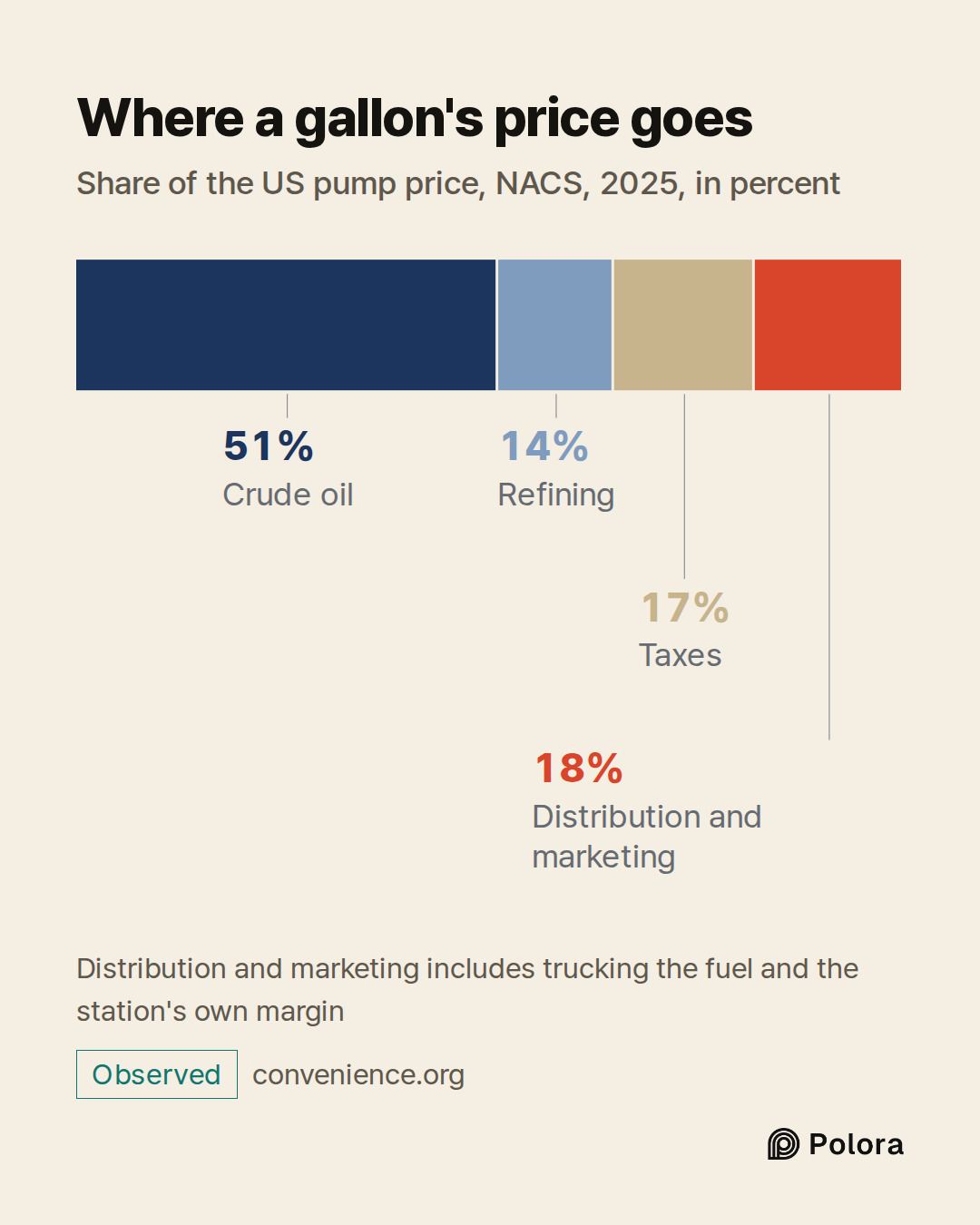
Where the rest of the money for a gallon goes
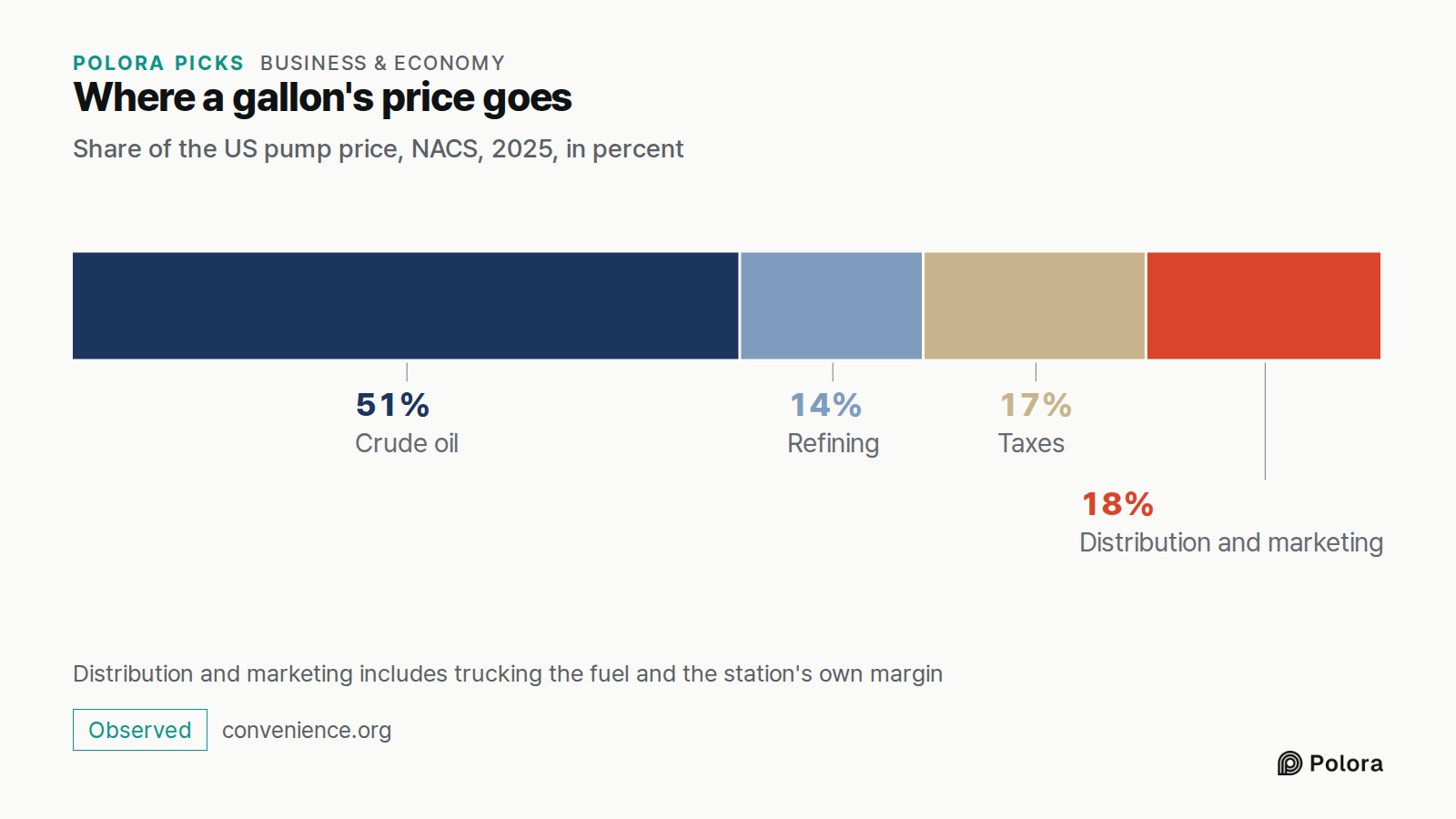
Most of the price passes through the station. By NACS's breakdown for 2025, about 51% of the pump price paid for crude oil, 14% for refining and 17% for taxes. The last 18% covered distribution and marketing, a share that includes trucking the fuel to the station and the station's own margin. The pump price moves about 2.4 cents a gallon for every $1 change in the price of a barrel of crude.
Card fees are the cost drivers rarely notice. They are charged as a percentage of the whole sale, taxes included. In 2025 the US convenience industry paid a record $21.3 billion in card fees, and about $4.6 billion of that was charged on fuel and sales taxes, money that stores only collect and pass on to governments.
The oil brand on the sign usually doesn't own the station
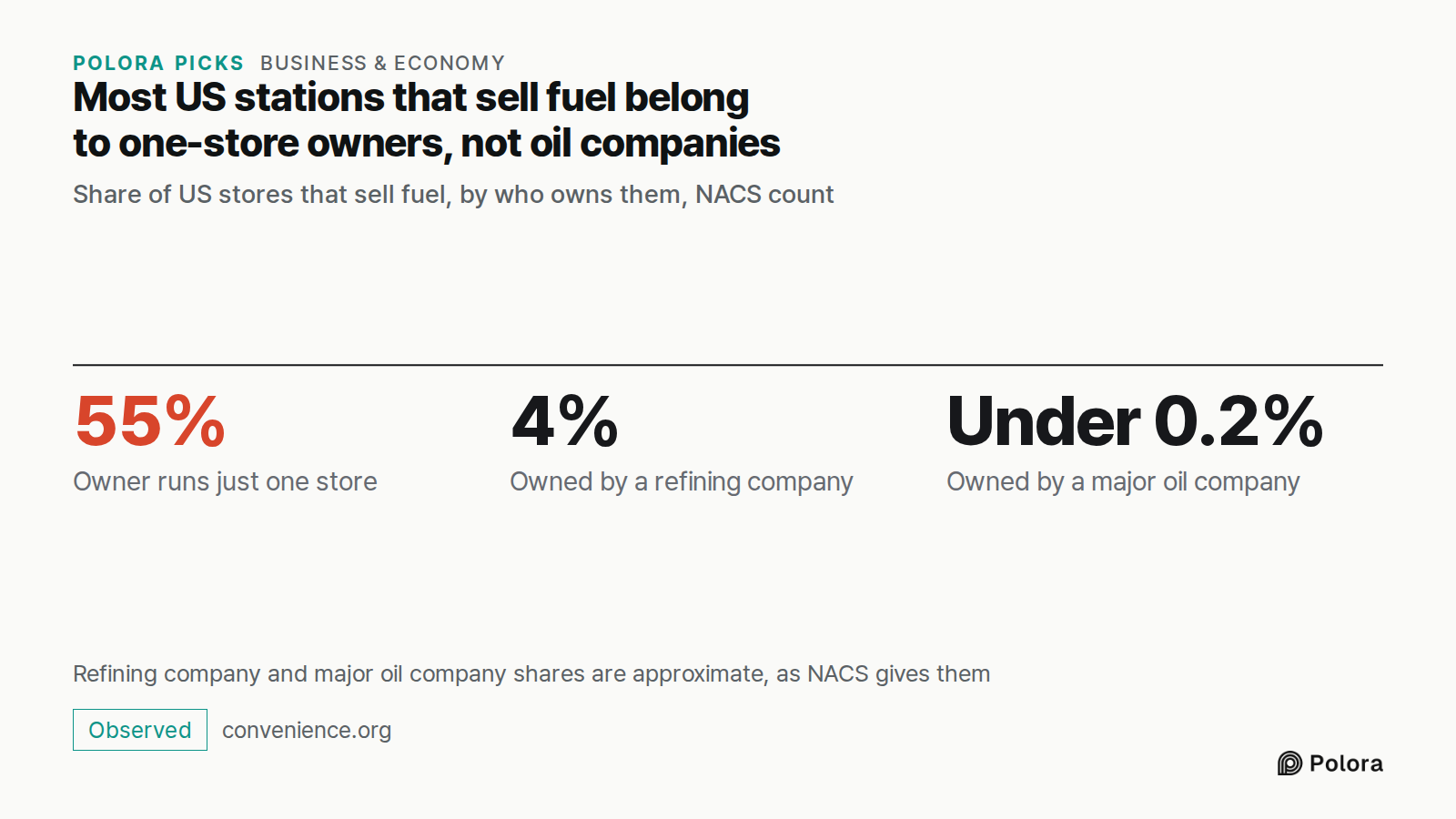
More than 120,000 stores sell fuel in the US, and convenience stores sell about 80% of the fuel Americans buy. About 55% of the stores that sell fuel belong to someone who runs just one store. NACS counts fewer than 0.2% as owned by a major oil company, and about 4% as owned by a refining company.
So what does a Shell or Chevron sign over the pumps mean? Usually it marks a supply contract. The owner agrees to buy that company's fuel, sometimes for ten years or longer, and to display its name. The five largest oil brands together have more than 15,000 stores that operate as franchises. Many small owners cannot afford to build a brand of their own, so the oil company's name is the one drivers see, and that is why so many assume the oil company runs the place.
Who decides the price on the sign
The station owner does, within the limits of what the fuel costs them and of the supply contract they signed. The owner either collects fuel at a regional terminal, known in the trade as the rack, or has a supplier deliver it, which usually costs more. Fuel sold under a big oil brand also tends to cost the station more, because the supplier provides other services along with the name. Volume, contract terms and location all count, and NACS says two retailers can pay wholesale prices 10 to 20 cents a gallon apart.
Then the owner looks at the stations nearby. In NACS's 2025 survey, 72% of drivers said price was the most important thing in choosing where to fill up, and 69% said they would drive 5 minutes out of their way to save 5 cents a gallon. When profit is around a dime a gallon, a station priced a nickel above its neighbors can lose much of its traffic.
Why stations tend to earn less just when gas prices climb
That competition explains a pattern that looks backwards from the driver's seat. When wholesale prices rise, the first station to raise its sign risks losing customers to the rest, so many owners hold back and absorb part of the increase. NACS compares it to a game of chicken. For several days, the station's margin tends to shrink.
When wholesale prices fall, the order tends to reverse. Owners can let the sign come down more slowly than their own cost and win back what they gave up. Drivers notice that prices seem to shoot up and drift down, which economists, among them researchers at the Federal Reserve Bank of St. Louis, call "rockets and feathers." NACS cautions that the saying does not describe every price move. What the phrase leaves out is the station's side : its margin is often thinnest while prices are climbing, which is exactly when drivers are surest the station is cashing in.
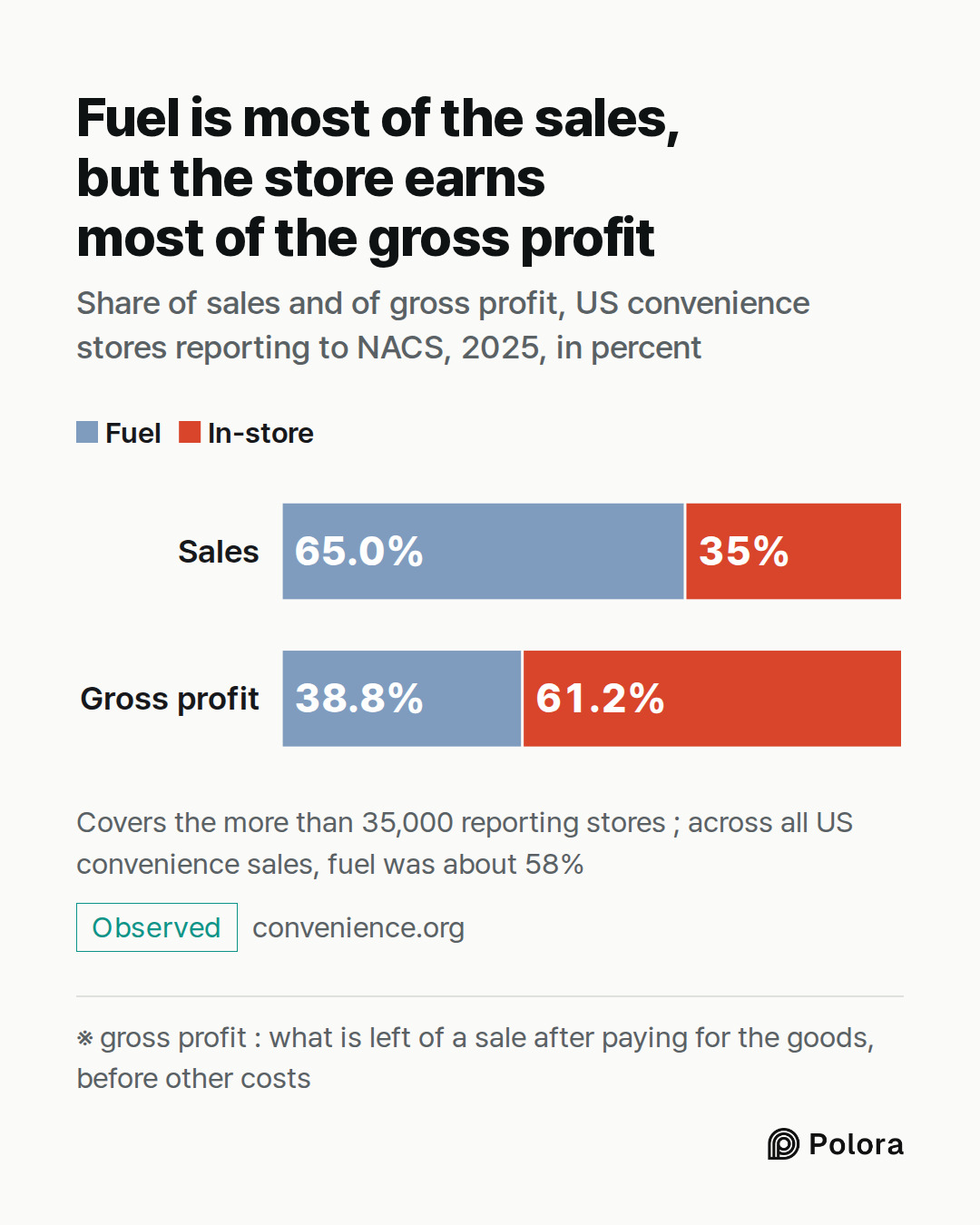
Fuel brings in most of the sales, the store most of the gross profit
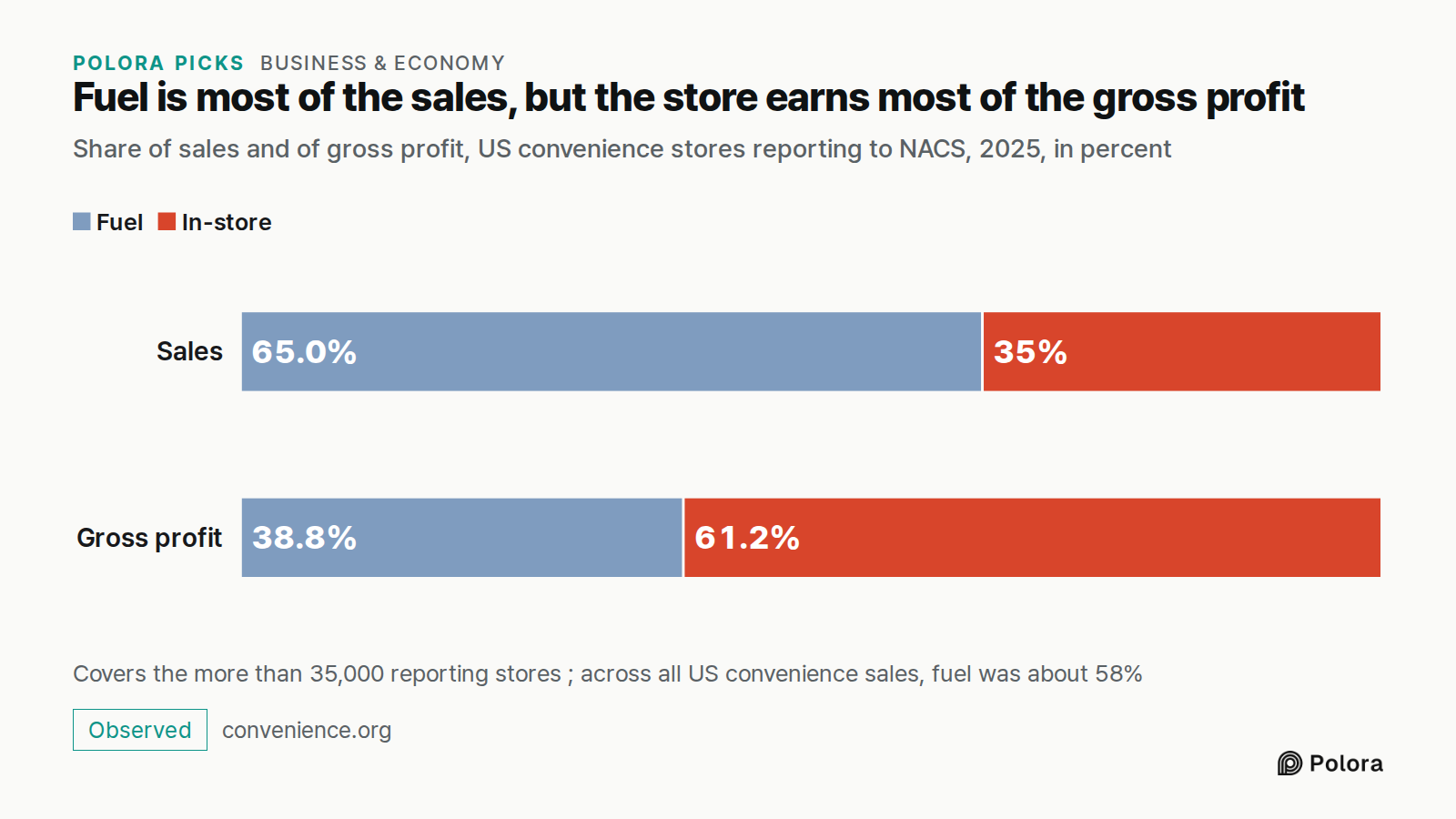
Across the more than 35,000 stores whose 2025 figures NACS collected, fuel made up 65.0% of sales but only 38.8% of gross profit. Everything inside, from drinks and snacks to prepared food, made up the other 35% of sales and produced 61.2% of gross profit. The 65% describes those reporting stores, not the industry as a whole : counting every US convenience sale, fuel was $476.3 billion of $817.5 billion, about 58%.
The reason is the markup. A gallon sells for cents above its cost, while a fountain drink or a sandwich carries a much bigger share of its price as margin. So the pump is how a station gets cars to stop, and the store is where it has earned most of its gross profit.
Lately, the pump has been paying the bills
Gross profit is not the whole story. The fuel margin has climbed a long way : NACS put it at 21.73 cents a gallon in 2017 and 23.35 cents in 2018, and at over 40 cents in 2025. Costs climbed too. Store operating expenses rose 23.3% between 2021 and 2025, and wages and benefits went from about $80,000 to about $104,000 per store per month over five years. With margins and costs both this far from NACS's worked example, its 10 to 15 cents should not be read as what a station kept on a gallon in 2025.
In 2025 that squeeze reached the store itself. After all expenses, NACS found that the typical purchase inside the store lost 7 cents, and concluded that fuel margins were the reason stores were profitable that year. The store still produced most of the gross profit, but once costs were taken out, the pump kept stores in the black.
Averages also hide large differences between chains. Murphy USA, a chain built around low fuel prices, reported a retail fuel margin of 28.1 cents a gallon for 2025. Its fuel business contributed $1,488.7 million against $869.0 million from merchandise, but that fuel figure also includes the company's own supply and wholesale business and sales of renewable fuel credits, so it is not a measure of what the pumps alone earned.
What stays true about gas stations whatever this year's numbers say
The figures move every year, and a single year's margin says little about the next. The shape of the business holds. A gallon of gas is mostly crude oil, refining, distribution and tax, and the station keeps cents of it. The name on the canopy usually belongs to a fuel supplier, not the owner. The owner sets the price while watching the station across the road, and tends to earn least while wholesale prices are rising. And the store usually brings in most of the gross profit, while the pump brings in the people, and in a year like 2025 it also paid the bills.