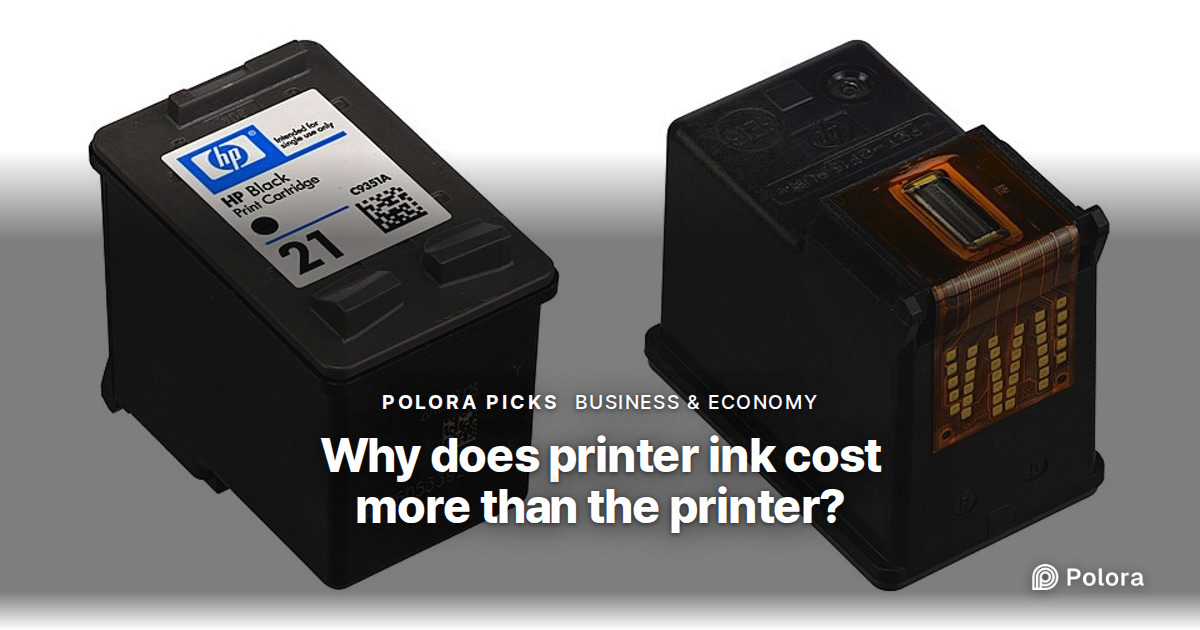
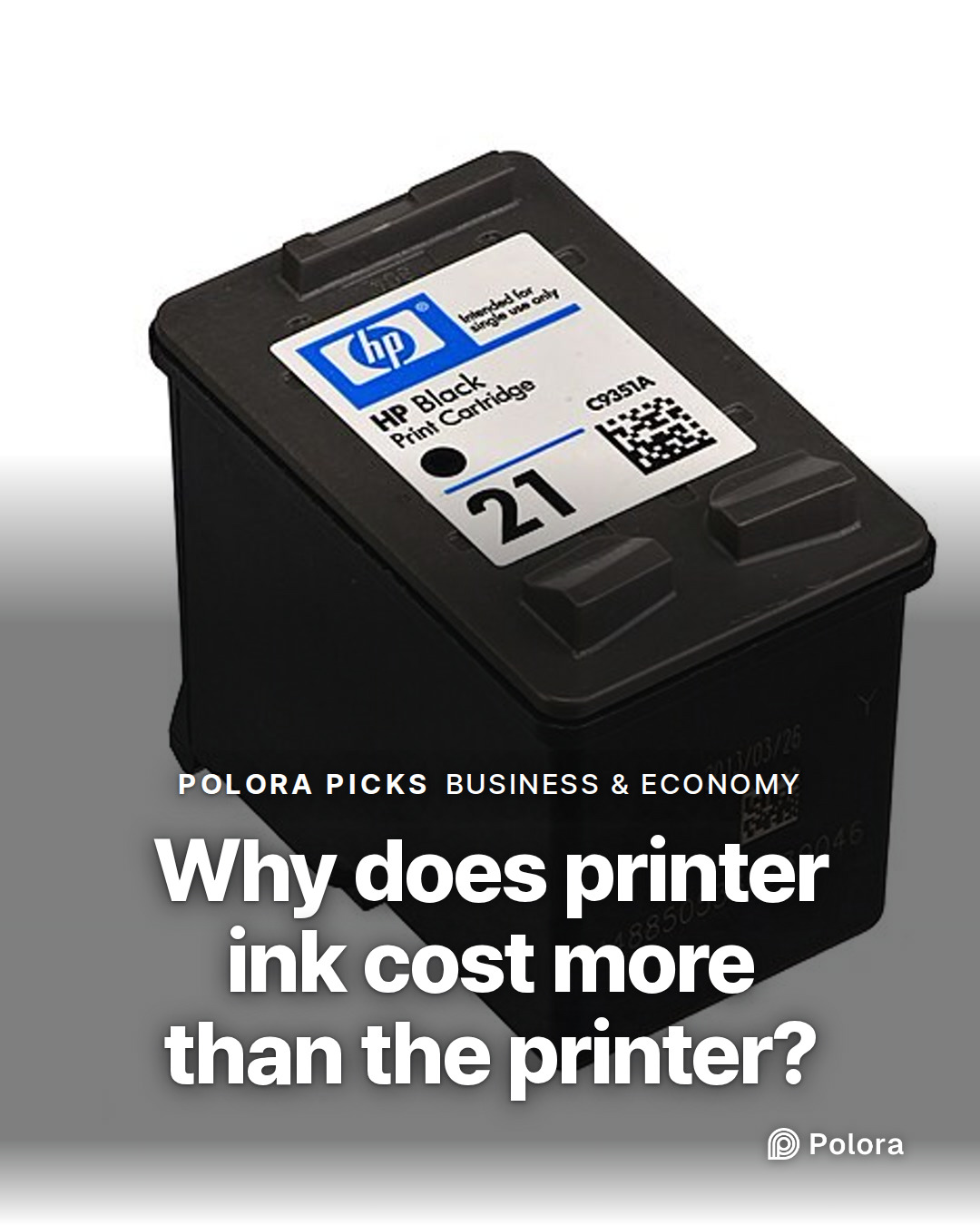
Why does printer ink cost more than the printer?

For HP, the money is in the refills. Its then chief executive said it loses money on printers and earns it on supplies such as ink and toner, which bring in about two thirds of its printing revenue.

Business & Economy · 2026-10-10

A cheap printer is priced to sell you the ink

Most people who own a home printer know the moment. The ink runs out, you look up a new set of cartridges, and the total feels out of all proportion to what you paid for the printer itself. It feels like a pricing mistake. For HP's cheap cartridge printers, at least, it is not.

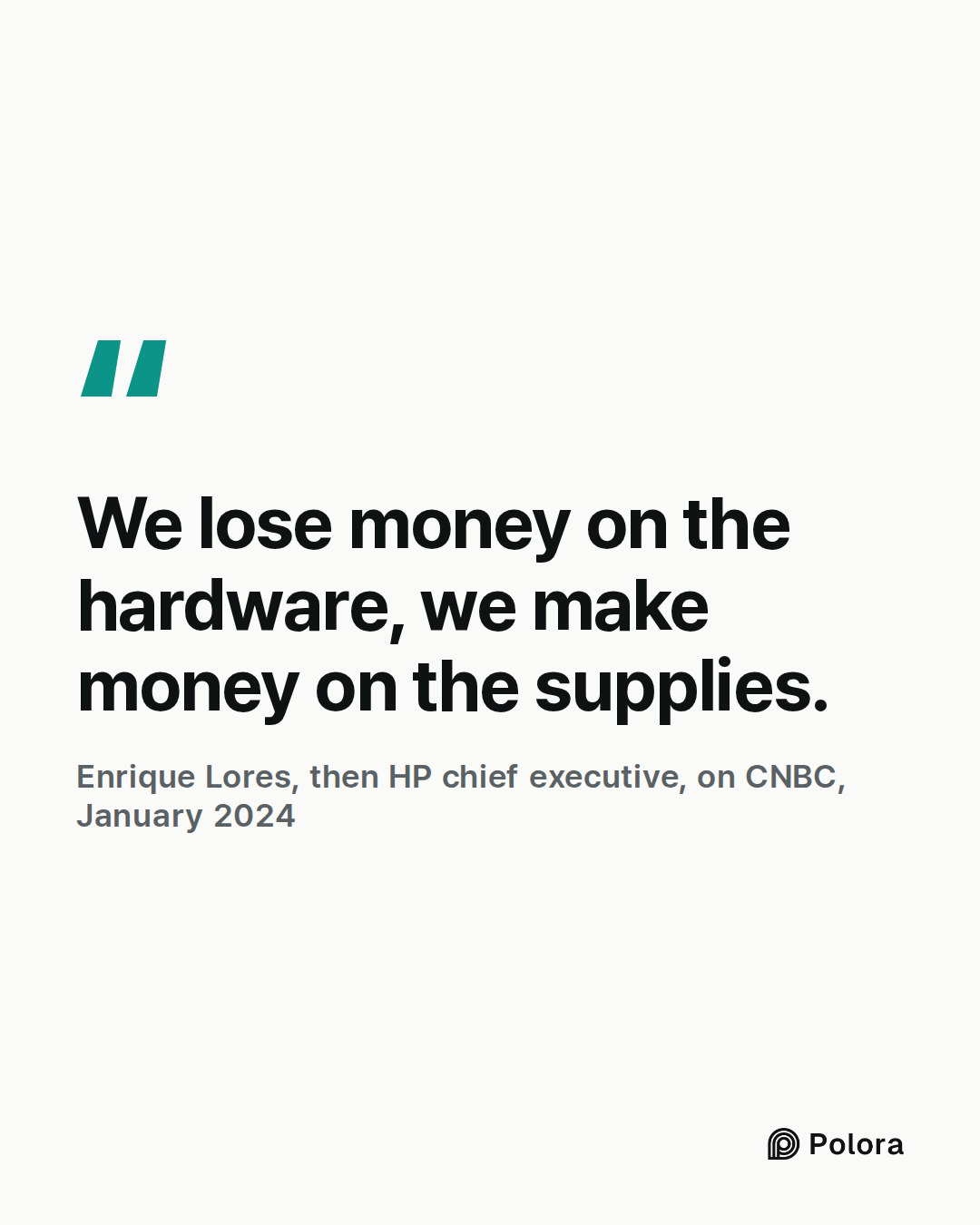
In January 2024, on the US business channel CNBC, Enrique Lores, then chief executive of HP, the American printer and PC maker, said it plainly : "We lose money on the hardware, we make money on the supplies." He went further. "Every time a customer buys a printer, it's an investment for us," he said, and if that customer "doesn't print enough or doesn't use our supplies, it's a bad investment." Asked whether printers follow the old razor and blades model, where the handle is cheap and the blades pay, he answered that it is "part of the business model that has been developed over time." Lores has since left HP. In February 2026 the payments company PayPal named him its chief executive.

So, in HP's own telling, a cheap cartridge printer works less like a product you buy and more like a sign-up. The machine is the entry fee. The cartridges play the part of a subscription, even though most owners have signed no contract and simply buy them when the ink runs out.

Where HP's printing money comes from

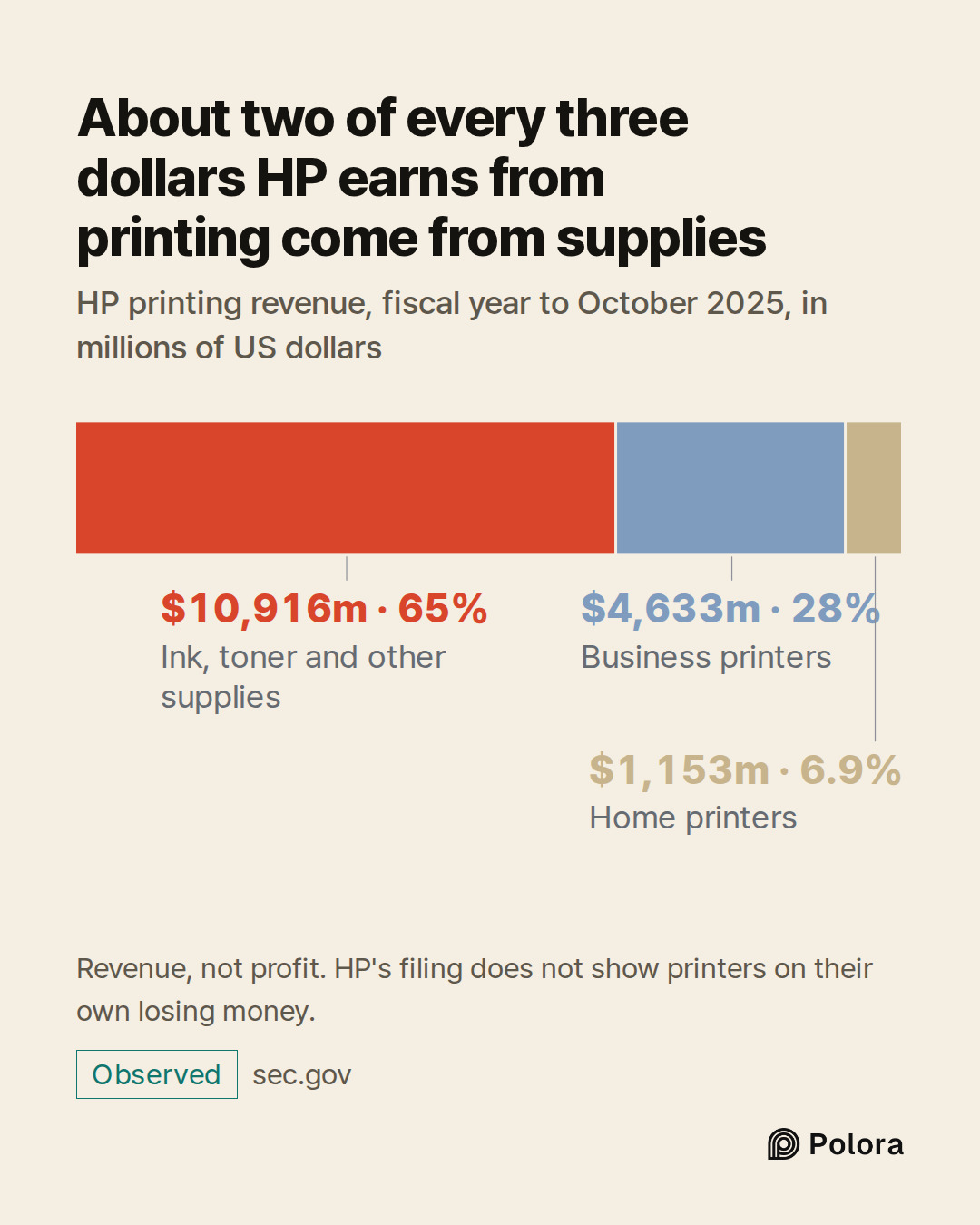
HP's annual report for the year to October 2025, filed with the US securities regulator, shows where the money comes from. Its printing business brought in $16,702 million. Of that, $10,916 million came from supplies : ink and toner, along with paper and other supplies. Printer hardware for businesses, which HP calls commercial printing, brought in $4,633 million, and printer hardware for consumers $1,153 million. Roughly two dollars of every three came from what goes into the machine, not the machine.

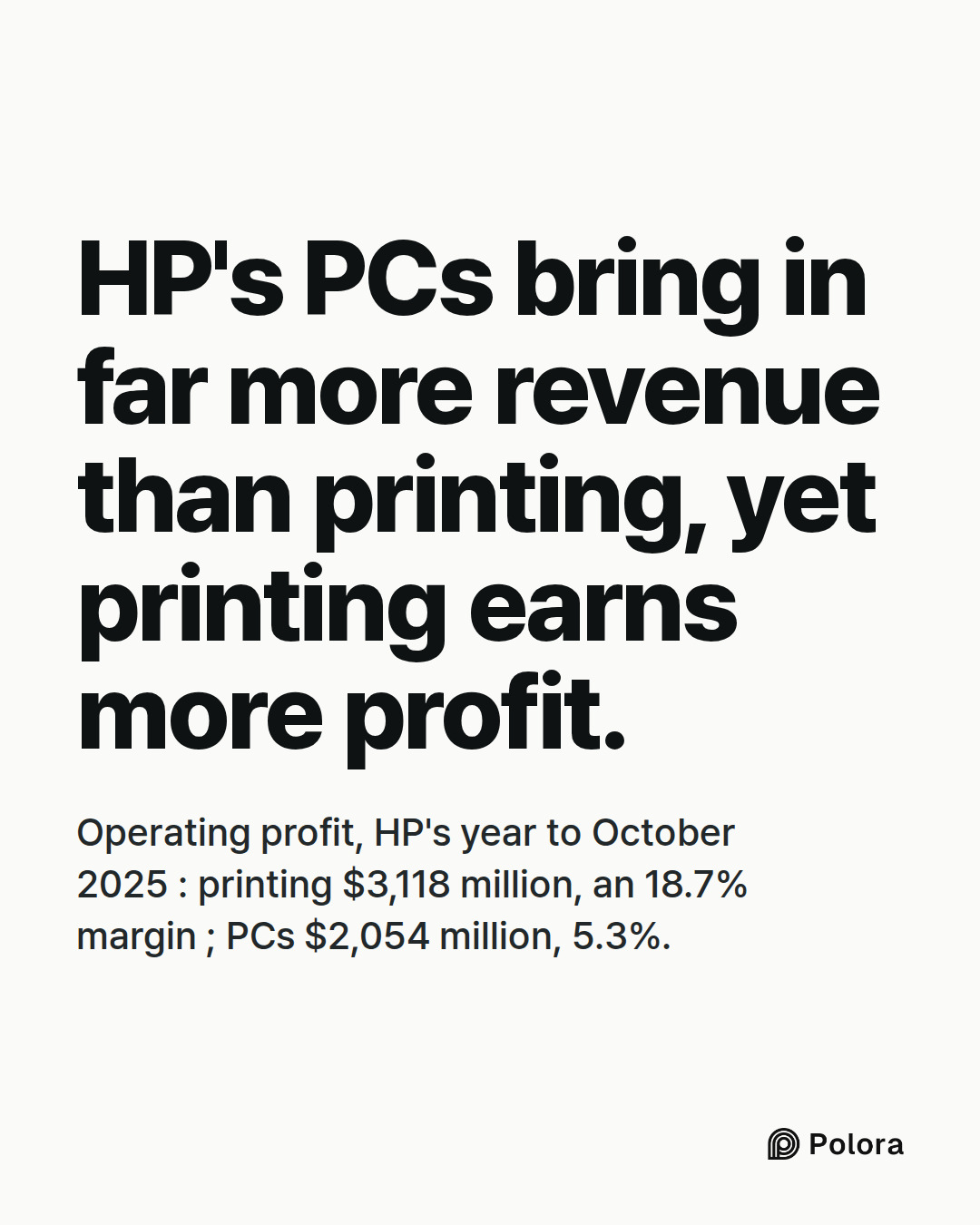
The same report shows why that matters. HP's PC sales bring in far more revenue than printing, $38,532 million against $16,702 million, yet printing earned more : $3,118 million in operating profit, an 18.7% margin, against $2,054 million and 5.3% for PCs.

One limit should be said clearly. HP reports printing as a single business, so its filings do not show printers on their own losing money. That part rests on the chief executive's own words, not on audited figures.
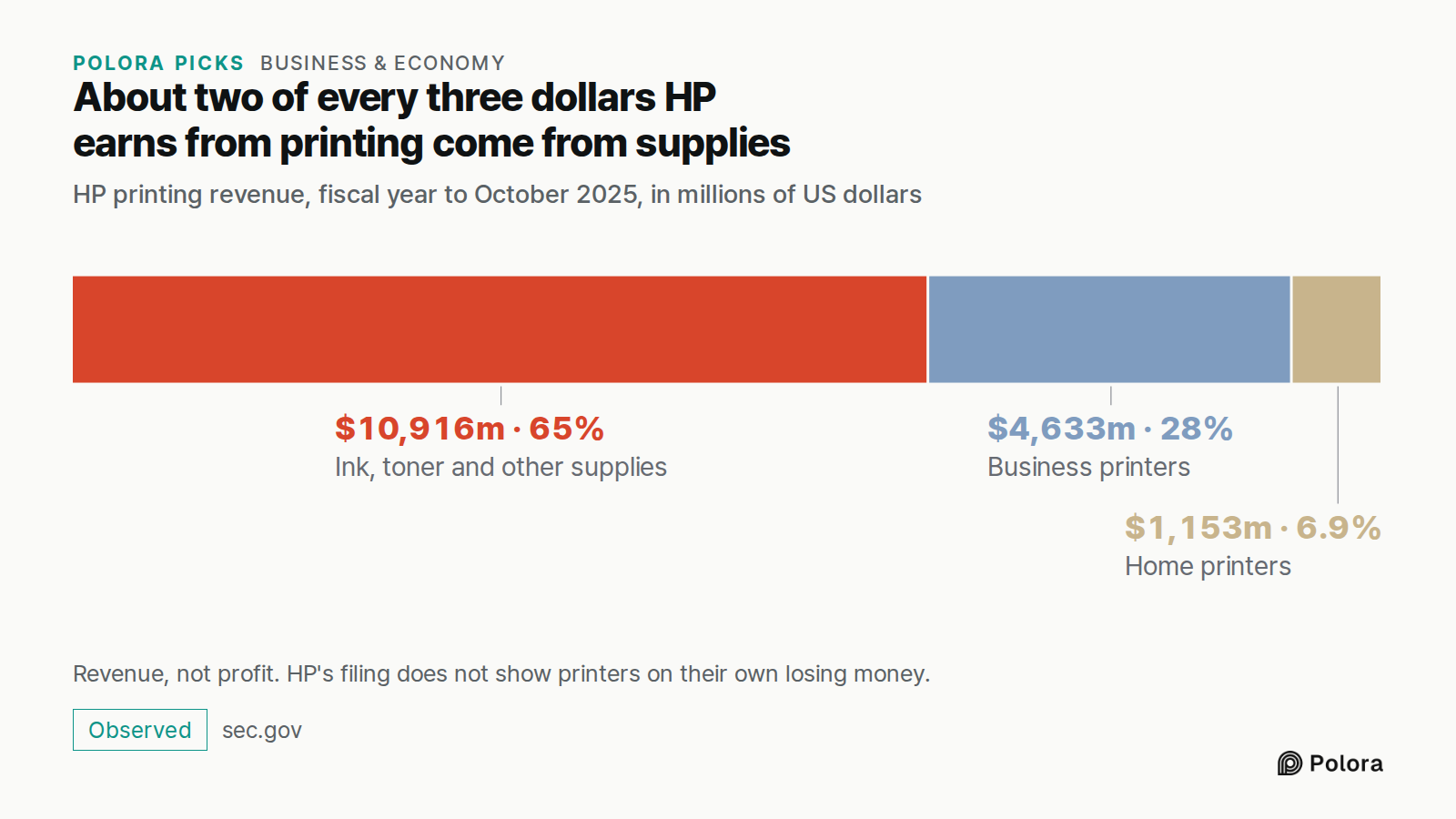
About two of every three dollars HP earns from printing come from supplies · HP printing revenue, fiscal year to October 2025, in millions of US dollars · Ink, toner and other supplies · Business printers · Home printers · $10,916m · $4,633m · $1,153m · Revenue, not profit. HP's filing does not show
HP printing revenue, fiscal year to October 2025, in millions of US dollars

Why an ink cartridge carries a chip

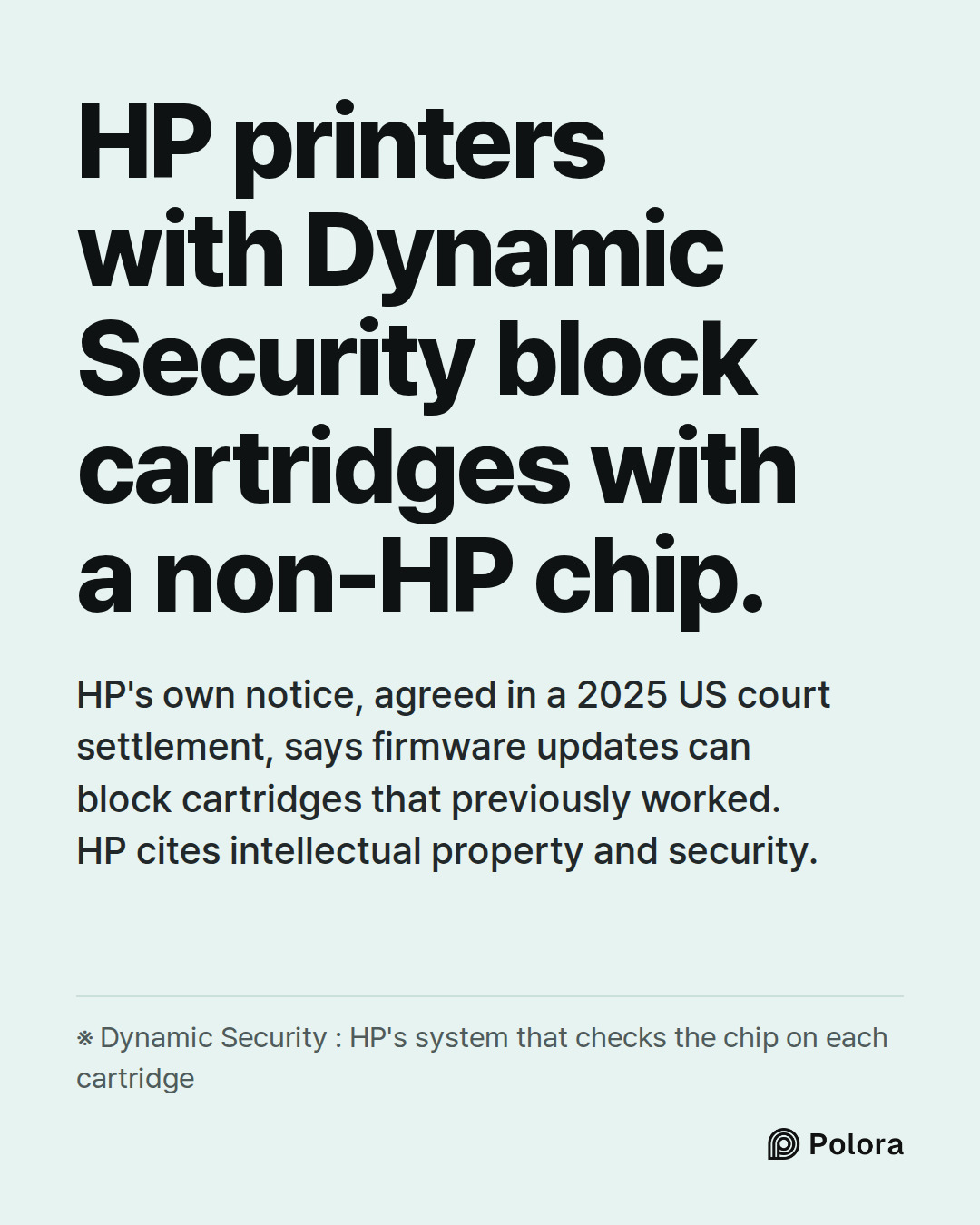
If the profit is in the cartridge, a cheaper cartridge from another company is a direct threat. HP's answer is a chip on each cartridge and a system it calls Dynamic Security : the printer checks the chip, and firmware updates sent to the printer over time can change what it accepts.

HP's own wording, agreed in a 2025 US court settlement, describes it without hedging. The notice it shows on affected printers says the printer "is intended to work only with new or reused cartridges that have a new or reused HP chip, and it uses dynamic security measures to block cartridges using a non-HP chip. Periodic firmware updates like this one will maintain the effectiveness of these measures and block cartridges that previously worked."

HP presents this as protection. Lores said in the same 2024 interview that HP stops printers working with cartridges that violate its intellectual property, and that cartridges could in principle carry malicious code into a network. Those are HP's stated reasons ; HP offers no finding with them that cartridges from other makers generally pose such a risk. HP also ties some printers more tightly to its own supplies. A printer set up under HP's HP+ scheme must use original HP ink for as long as it runs. HP's ink subscription, Instant Ink, is by contrast optional and billed separately ; a customer can cancel it and go back to buying original HP cartridges.

What courts and regulators decided about ink lockouts

Italy's competition authority fined HP €10 million in December 2020. It found that HP had not told buyers, at the time of purchase, that its printers limited non-original cartridges, had renewed those limits through firmware updates without explaining the consequences, and had refused warranty help on printers that had used other cartridges. It called the practices misleading and aggressive. Trade press later reported that an Italian administrative court had rejected HP's appeal. HP's own annual report, though, describes the Italian matter as concluded except for an appeal it still lists as pending, so the public record does not show a settled final outcome.

In the United States, a 2019 settlement over a 2016 update to HP OfficeJet printers set up a $1.5 million fund for affected owners. Reports of the settlement also say HP agreed not to reactivate the feature on those models. In 2025 a federal court in California approved a second settlement, covering 21 HP LaserJet models. HP admitted no wrongdoing and paid no money to owners beyond awards to the named plaintiffs and lawyers' fees. It agreed to keep disclosing Dynamic Security and to let owners decline updates that carry it.

Not every court has gone against HP. In the Netherlands, an appeal court ruled in November 2024 that HP's use of Dynamic Security is not unlawful. According to HP's filing for the quarter to July 2026, the Dutch Supreme Court then decided the case on June 5, 2026, rejecting the claims and likewise holding that the practice was not unlawful. A class action filed in Illinois in January 2024 was dismissed in September 2025, with permission for the plaintiffs to file again. HP's annual report says it has faced such cases since 2016 in the United States, Italy, Israel, the Netherlands, Australia and New Zealand.
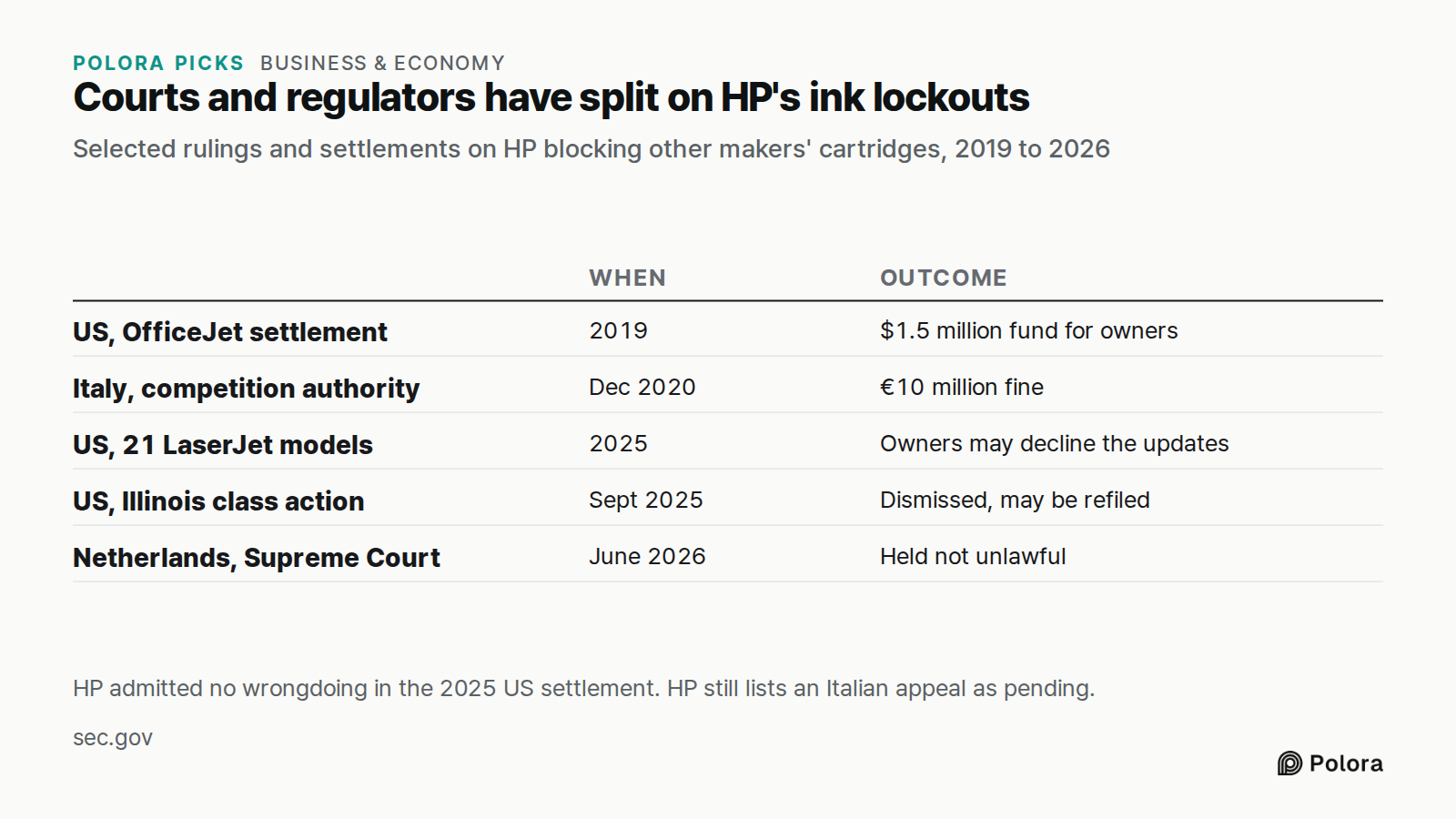
Courts and regulators have split on HP's ink lockouts · Selected rulings and settlements on HP blocking other makers' cartridges, 2019 to 2026 · When · Outcome · US, OfficeJet settlement · Italy, competition authority · US, 21 LaserJet models · US, Illinois class action · Netherlands, Supreme Court
Selected rulings and settlements on HP blocking other makers' cartridges, 2019 to 2026

HP's own filing says its tank printers may earn it less

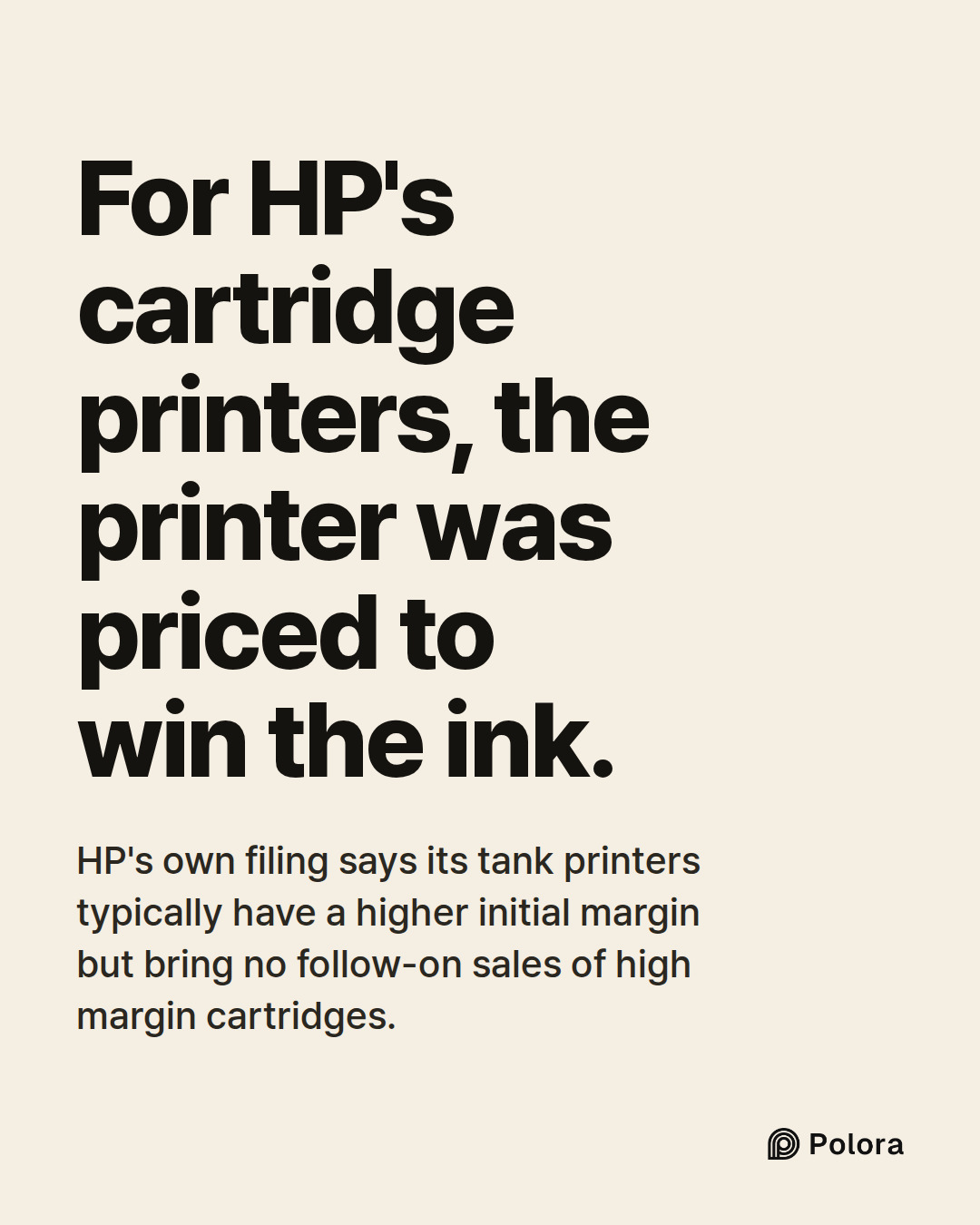
The model is a choice, and HP's report says so in its own words. HP also sells printers with large ink tanks that are refilled from bottles rather than cartridges. HP writes that these tank printers "typically have a higher initial margin" than cartridge printers, but "do not result in follow-on sales of high margin traditional ink cartridges" and so may earn less over the life of the device. That describes the trade-off in HP's business, not the lifetime cost of every printer to every buyer.

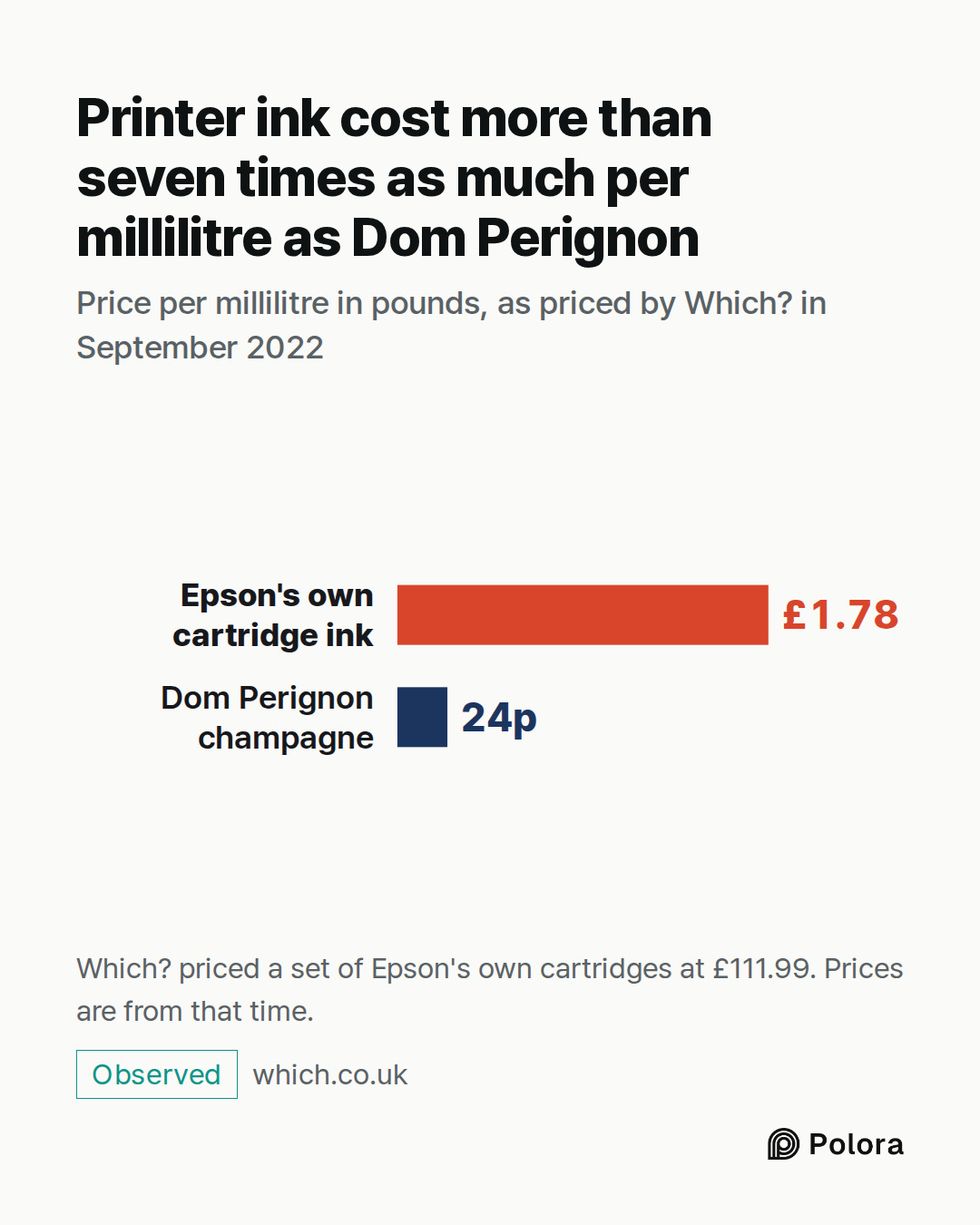
High cartridge prices are not HP's alone. In September 2022 the British consumer group Which? priced a set of Epson's own cartridges at £111.99, which worked out at the time to £1.78 per millilitre, more than seven times the 24p per millilitre of Dom Perignon champagne. Lockouts, though, differ by maker. In the same report, Brother told Which? that its printers accepted other makers' ink, and Epson said it did not use firmware to block third-party cartridges.

The model also has a ceiling. HP's supplies revenue fell 3.4% in its 2025 fiscal year, which it put down mainly to fewer printers in use, less printing and currency effects, partly offset by higher prices. The same filing describes a push toward subscriptions. But for HP's cartridge printers, the logic on the desk has not changed : the printer was priced to win the ink.
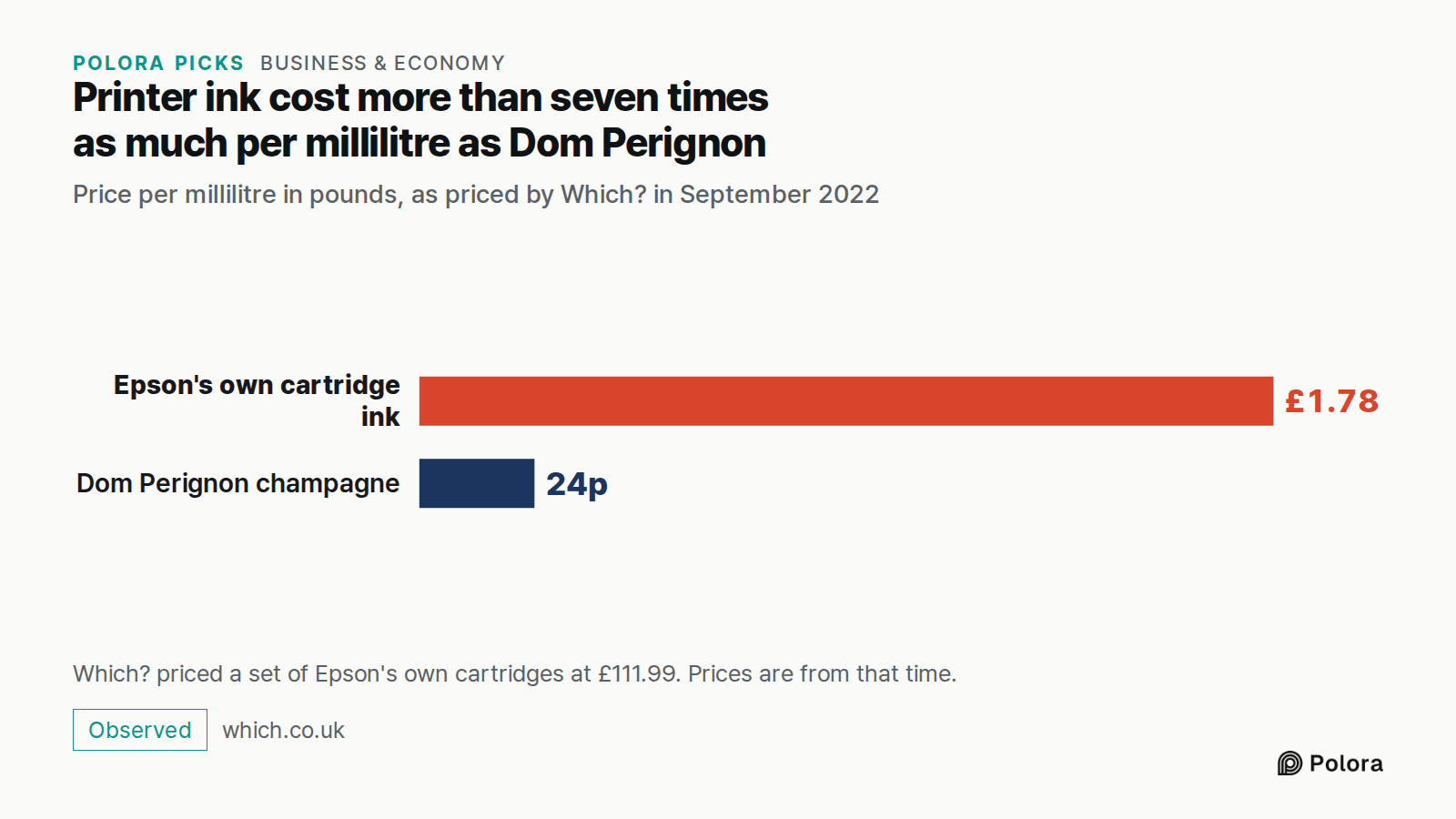
Printer ink cost more than seven times as much per millilitre as Dom Perignon · Price per millilitre in pounds, as priced by Which? in September 2022 · Epson's own cartridge ink · Dom Perignon champagne · £1.78 · 24p · Which? priced a set of Epson's own cartridges at £111.99. Prices are from that ti
Price per millilitre in pounds, as priced by Which? in September 2022
Why does printer ink cost more than the printer?Why does printer ink cost more than the printer?We lose money on the hardware, we make money on the supplies. · Enrique Lores, then HP chief executive, on CNBC, January 2024Ink, toner and other supplies · Business printers · Home printers · $10,916m · $4,633m · $1,153m · About two of every three dollars HP earns from printing come from supplies · HP printing revenue, fiscal year to October 2025, in millions of US dollars · Revenue, not profit. HP's filing does not showHP's PCs bring in far more revenue than printing, yet printing earns more profit. · Operating profit, HP's year to October 2025 : printing $3,118 million, an 18.7% margin ; PCs $2,054 million, 5.3%.HP printers with Dynamic Security block cartridges with a non-HP chip. · HP's own notice, agreed in a 2025 US court settlement, says firmware updates can block cartridges that previously worked. HP cites intellectual property and security. · ※ Dynamic Security : HP's system that checks the chip on eEpson's own cartridge ink · Dom Perignon champagne · £1.78 · 24p · Printer ink cost more than seven times as much per millilitre as Dom Perignon · Price per millilitre in pounds, as priced by Which? in September 2022 · Which? priced a set of Epson's own cartridges at £111.99. Prices are from that tiFor HP's cartridge printers, the printer was priced to win the ink. · HP's own filing says its tank printers typically have a higher initial margin but bring no follow-on sales of high margin cartridges.Sources 13 : theregister.com · HP CEO spells it out : You're a 'bad investment' if you don't buy HP supplies, entrepreneur.com · HP wants you to never own a printer again, launches rental, cnbc.com · CNBC : HP CEO Enrique Lores on PC market trends + 10Read the full story at · polora.ai
Why does printer ink cost more than the printer?

Alpha · claude-sonnet-5

I can confirm two of the items the editor flagged for checking. The CNBC quote and departure timing both check out. A trade report of the actual broadcast confirms HP CEO Enrique Lores appeared on CNBC's Squawk Box on January 18, 2024, to answer questions about lawsuits over firmware updates, and in that same appearance Lores admitted HP loses money on each printer it sells, saying "We lose money on the hardware. We make money on the supplies." So the quote, date, and venue in the manuscript are solid — and notably, it came in the same interview as the "bad investment" lines, which resolves the editor's doubt about whether both quotes were from one sitting. On Lores leaving HP: this is now confirmed and dated more precisely than the manuscript's checks file suggested. He served as CEO of HP Inc. between November 2019 and February 2026, and in February 2026 was announced as CEO of PayPal. PayPal's own SEC filing is explicit: on February 2, 2026, the Board appointed Enrique Lores as President and CEO, effective as of March 1, 2026. The manuscript should update the "then chief executive" framing to make clear he departed for PayPal, not just "since left." On the substance of…

Beta · gpt-6-sol

The manuscript’s central explanation stands for HP’s low-priced cartridge printers, but it needs narrower wording. The printer can be priced to attract a customer whose later purchases of ink or toner generate much of the revenue. HP’s fiscal-2025 filing reports $10.916 billion in supplies revenue out of $16.702 billion in printing revenue—about 65%. That supports “roughly two-thirds,” not a claim that ink alone supplies two-thirds: HP’s supplies category also includes toner, media and industrial supplies. Nor does the filing show that every printer is sold at a loss; it does not report hardware profit separately. (sec.gov) A few specific corrections and qualifications matter before publication: - “Office printers” and “home printers” mislabel the filing’s categories. The $4.633 billion and $1.153 billion figures are *Commercial Printing* and *Consumer Printing* revenue, respectively, excluding supplies—not counts or sales of office and home machines alone. The PC-versus-printing revenue and operating-profit figures in the draft do match the filing. ([sec.gov](https:…

Gamma · gemini-3.1-pro

I will pick up the remaining checks regarding the legal and regulatory outcomes. The 2025 US Settlement is confirmed. Court dockets for *Mobile Emergency Housing Corp. et al. v. HP Inc.* (Case No. 5:20-cv-09157-SVK, Northern District of California) show that Judge Susan van Keulen signed the order granting Final Approval of the Class Action Settlement and entering Final Judgment on March 18, 2025. Preliminary approval documents confirm it covered 21 LaserJet models and involved injunctive relief regarding Dynamic Security disclosures, with HP admitting no wrongdoing. The editor's summary of this case is accurate and can now be supported by the final approval order. The 2019 US Settlement is also supported. Secondary legal directories confirm that *In re: HP Printer Firmware Update Litigation* (Case No. 5:16-cv-05820, N.D. Cal.) resulted in a $1.5 million settlement regarding printer firmware. The Italian TAR Lazio appeal remains unverified. My searches did not surface a primary court document or official Italian Competition Authority (AGCM) statement confirming that the TAR Lazio rejected HP's appeal of the €10 million fine. As the editor noted, HP's own 10-K filin…

Researcher · gemini-3-7-flash

Here is the verification of the specific claims flagged by the editor and raised during this turn: 1. Enrique Lores's CNBC Quote & Executive Role * CNBC Quote & Venue: Verified. Enrique Lores made the exact remarks (*"We lose money on the hardware, we make money on the supplies"* and the *"bad investment"* statements) on CNBC's *Squawk Box* around the World Economic Forum in January 2024. * Departure Timing: Verified via PayPal's official announcement. On February 3, 2026, PayPal Holdings Inc. announced the appointment of Enrique Lores as President and CEO, effective March 1, 2026. * Source: PayPal Investor Relations Press Release (Feb 3, 2026) --- 2. Legal and Regulatory Orders * 2025 California Settlement (*Mobile Emergency Housing Corp. et al. v. HP Inc.*, Case No. 5:20-cv-09157-SVK): Verified. Judge Susan van Keulen granted Final Approval on March 18, 2025, covering 21 LaserJet models for injunctive relief (Dynamic Security disclosure requirements and the option to decline updates) with HP admitting n…

The Arbiter · gpt-6-sol

Round mediation — what the evidence establishes and what remains open The voices agree that HP’s fiscal-2025 figures support the manuscript’s central *revenue* point: supplies contributed $10.916 billion of $16.702 billion in printing revenue. But “supplies” is broader than ink, and those segment figures do not establish the profit or loss on an individual printer. The manuscript should call the $4.633 billion and $1.153 billion categories Commercial Printing and Consumer Printing, rather than “office printers” and “home printers.” The filing is the source for those distinctions: https://www.sec.gov/Archives/edgar/data/47217/000004721725000071/hpq-20251031.htm (sec.gov) There are two points the final verification needs to treat carefully: - The Dutch case needs a date correction. The manuscript says the case is *now before* the Dutch Supreme Court. HP’s July 2026 filing instead says that court decided it on June 5, 2026, rejecting the competition claims and holding that HP’s use of Dynamic Security was not unlawful. That is a material counterpoint to a o…

The Arbiter's Final Verdict · gpt-6-sol

Verdict: the manuscript’s central explanation stands for HP’s low-priced cartridge-printer model, but its opening claim is broader than the evidence. HP has said it loses money on printer hardware and makes money on supplies. Its fiscal-2025 report shows why repeat purchases matter: supplies brought in $10.916 billion of its $16.702 billion printing revenue. That does not mean ink alone supplied two-thirds, that every printer was sold below cost, or that a replacement set always costs more than the printer. HP 2025 Form 10-K For publication, the claims sort out as follows: | Manuscript claim | What the record supports or requires | |---|---| | Lores described losing money on hardware and earning it on supplies. | The January 2024 CNBC appearance and quotation are supported by reporting of the interview, but no one here established the exact words from an accessible CNBC transcript. Attribute the quotation to the interview, rather than calling it independently transcript-checked. “Then chief executive” is correct: [PayPal announced his appointment on February 3, 2026](https://www.paypa…