Pressing play does not start a meter
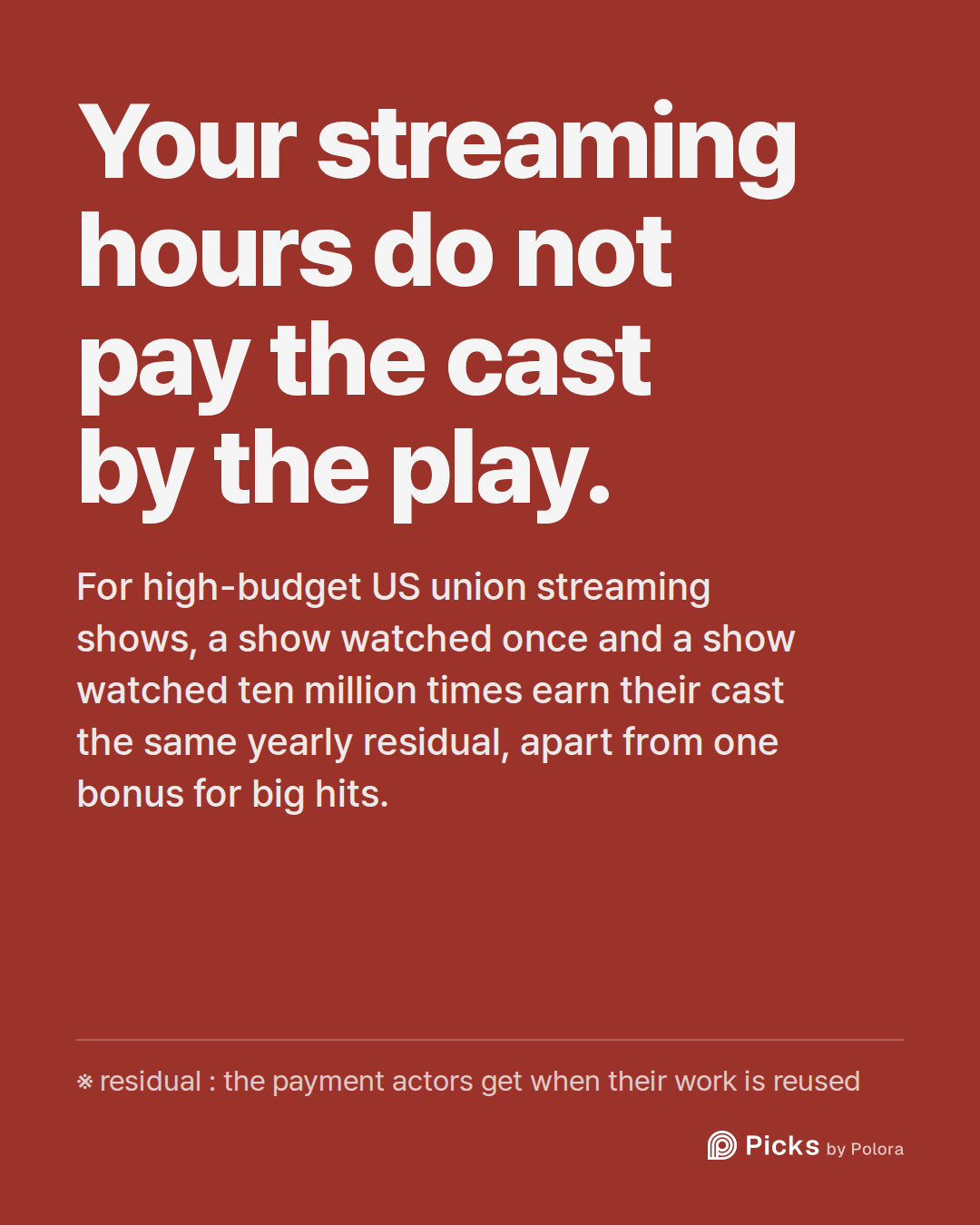
Most people picture it this way : every time you start an episode, a few cents travel to the people on screen. For a series or film made for a subscription streaming service in the United States, on a budget large enough to come under the actors' union rules for high-budget streaming productions, that is not how it works.
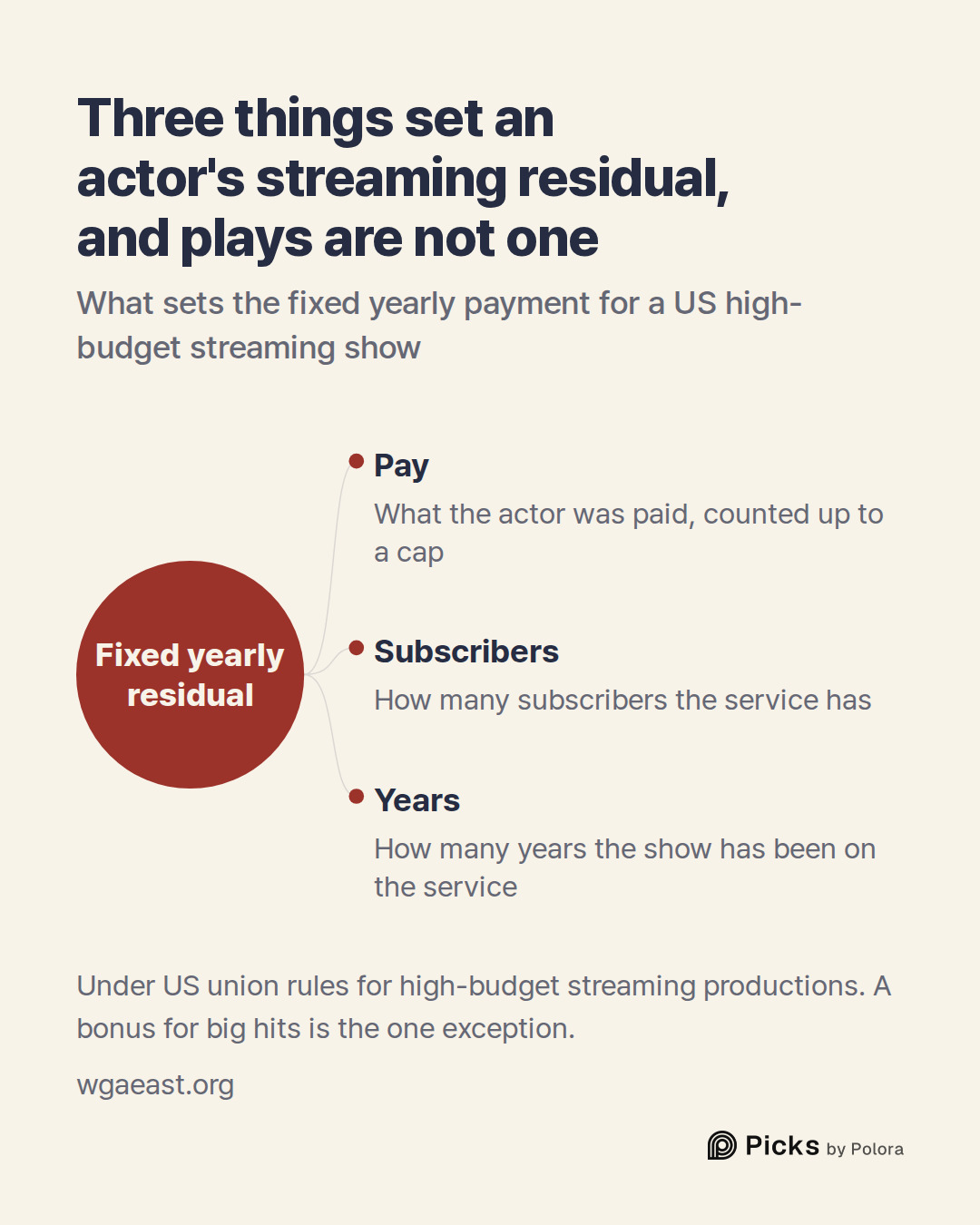
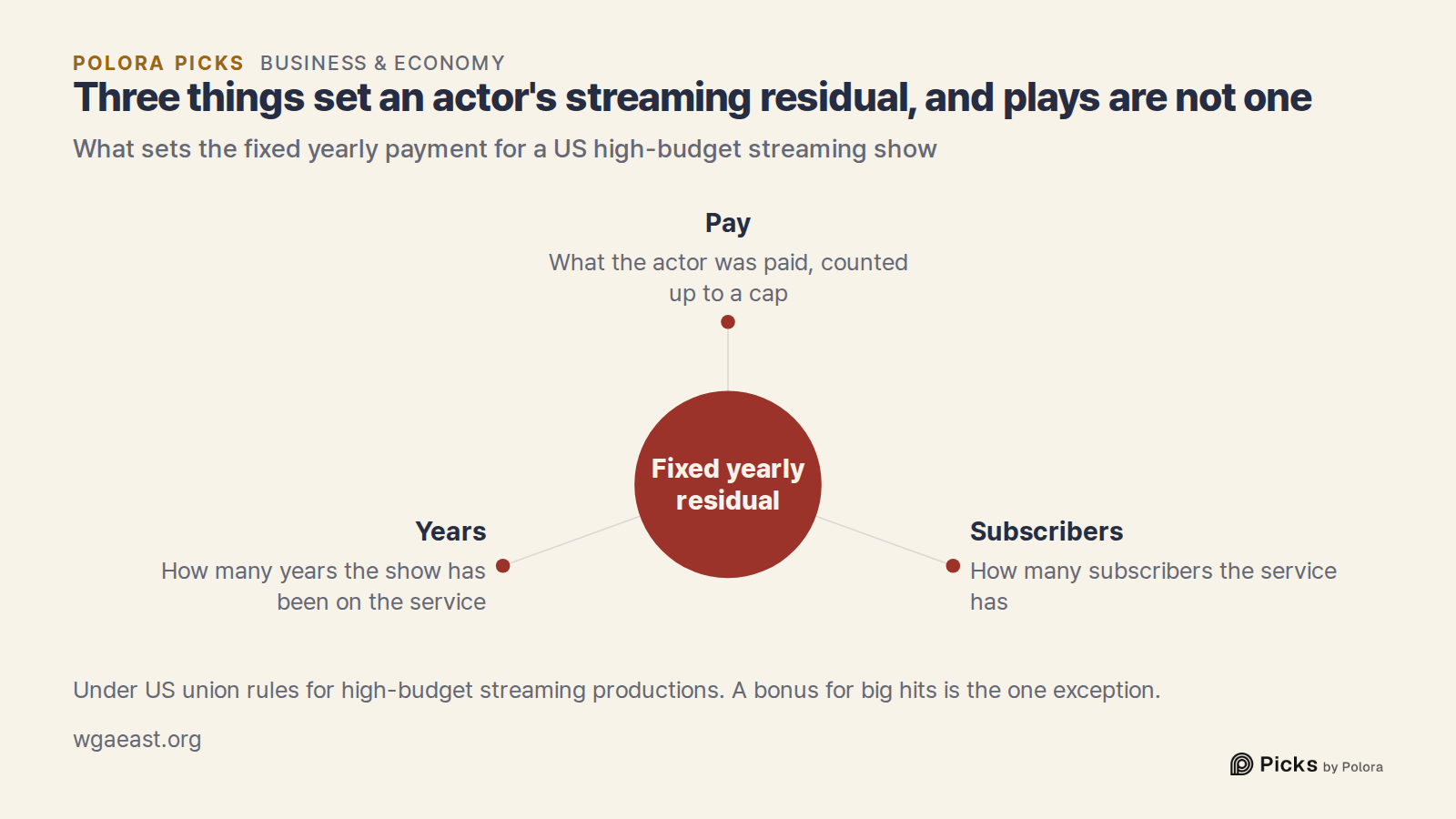
The payment actors get for reuse of their work, called a residual, is a fixed sum for each year the show stays on the service. It is worked out from three things : what the actor was paid, up to a cap; how many subscribers the service has; and how many years the show has been up. A show watched once and a show watched ten million times earn their cast the same residual, apart from one bonus explained below.
The contracts say it plainly. The Writers Guild, whose writers are paid on the same model, describes these as fixed residuals set as specified dollar amounts, like a network rerun, rather than a share of the money the show brings in.
The three numbers that set the check
The first number is the actor's pay for that episode, counted only up to a ceiling. For an episode of 36 to 65 minutes, the ceiling in the current tables is $4,562, rising to $4,676 in July 2027.
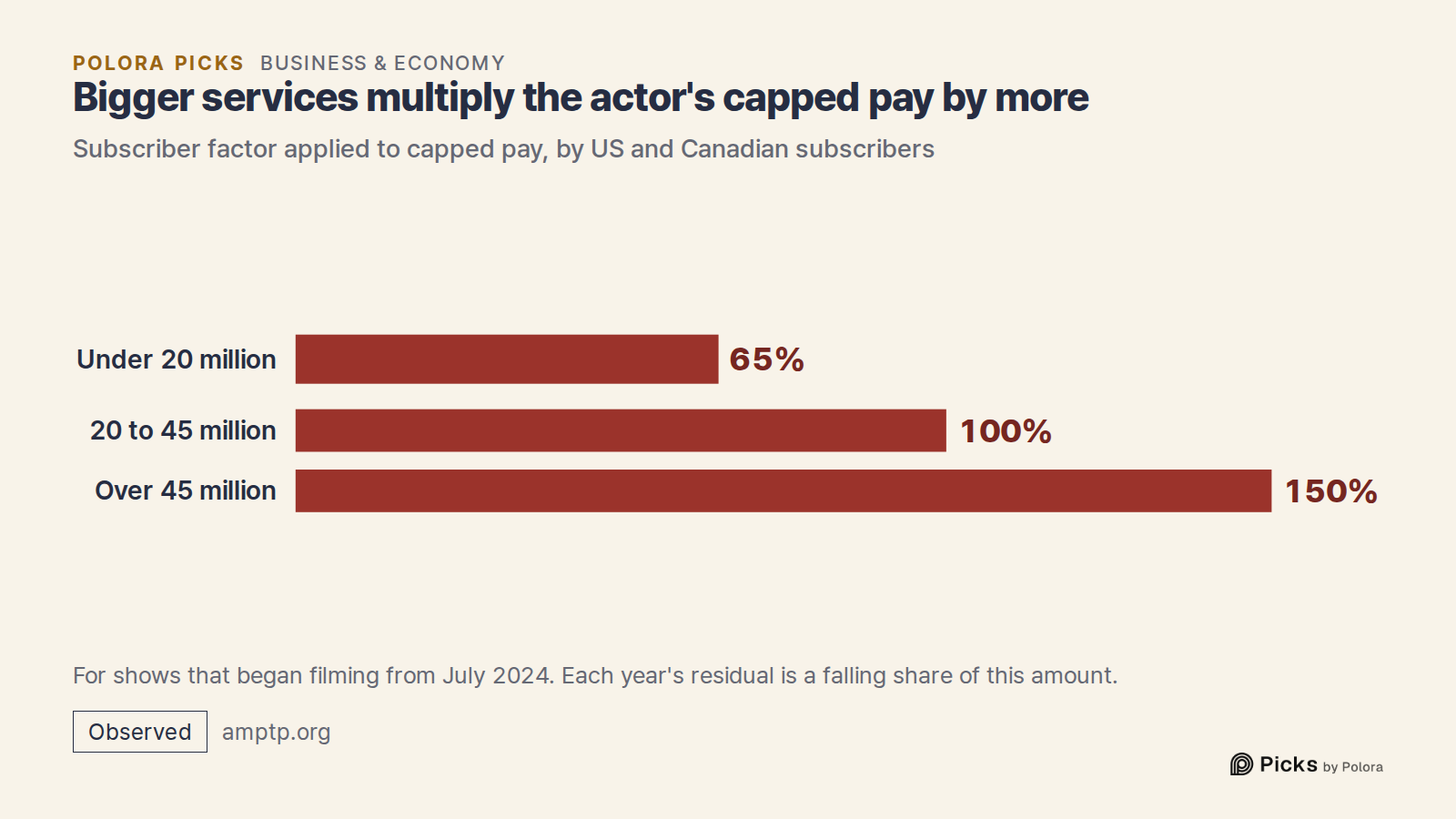
The second is the size of the service in the US and Canada. On services with fewer than 20 million subscribers there, the capped pay is multiplied by 65%; on those with 20 to 45 million, by 100%; and on those with more than 45 million, by 150%. This three-step scale applies to shows that began filming from July 2024. Before that, two smaller steps of 20% and 40% existed for very small services.
The third is time. The first year after release pays 45% of the capped pay times the subscriber factor, the second 40%, the third 35%, and the share keeps falling after that.
Viewing outside the US and Canada is paid separately, by the same method, using the service's foreign subscriber count. For the biggest services, with 75 million or more foreign subscribers, that factor is 95% from July 2026.
These figures belong to the high-budget streaming rules. What a given actor receives also depends on their performer category, the length of the episode and the dates involved.
Why a star's streaming residual is smaller than you think
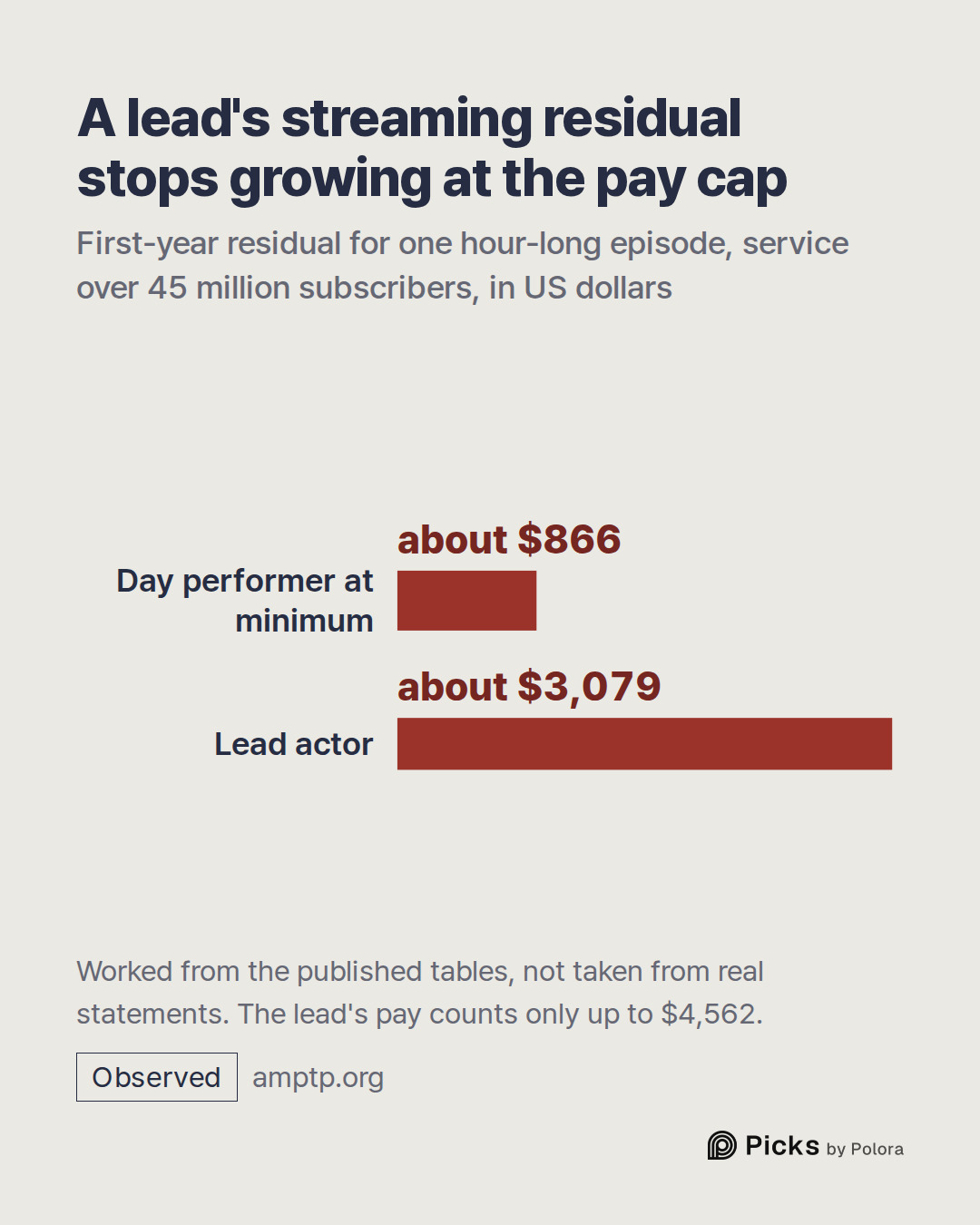
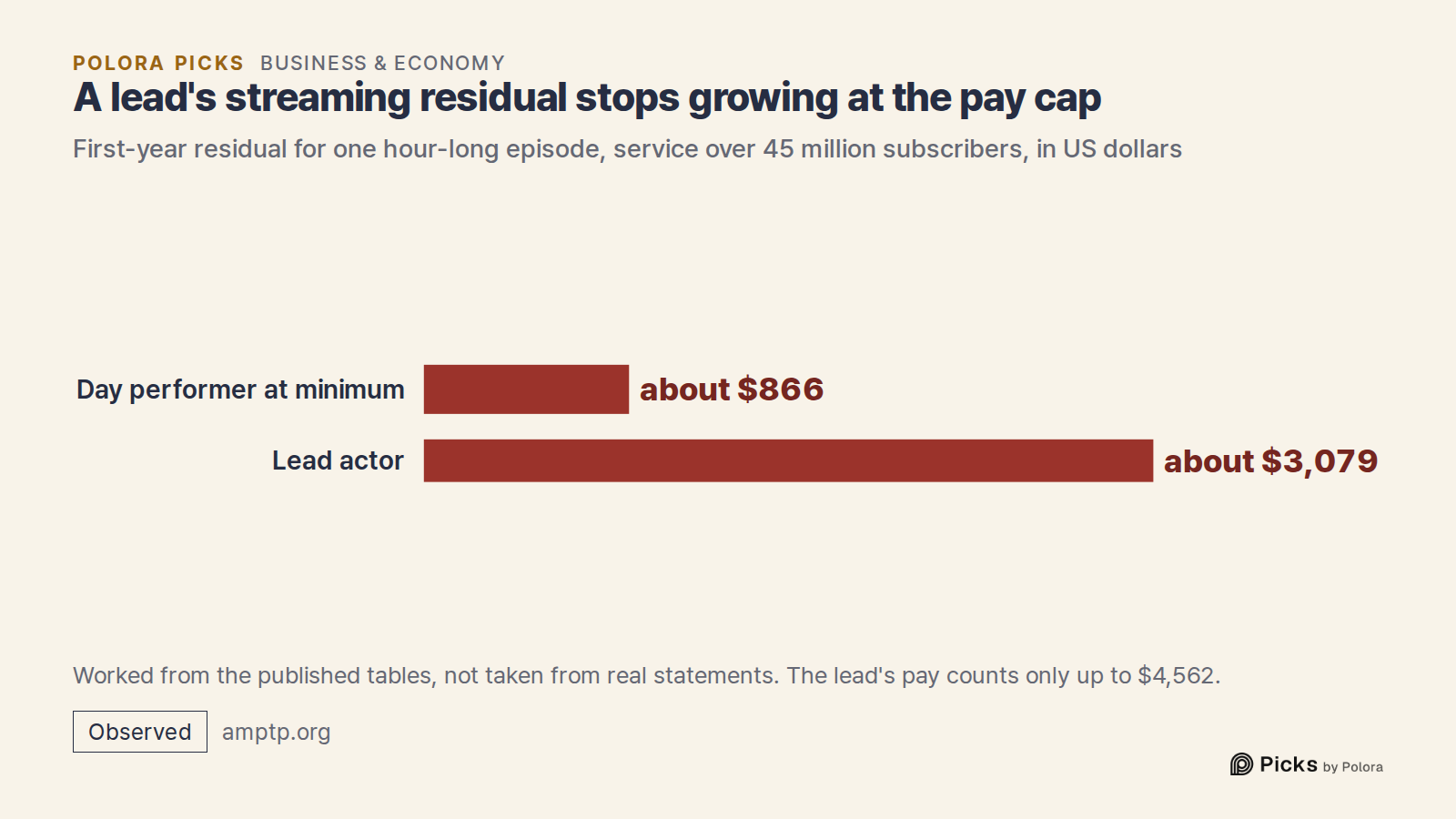
Take a one-hour episode on a service with more than 45 million US and Canadian subscribers. An actor hired for a single day at the union minimum of $1,283 has a first-year residual of about $866 for that episode, which is $1,283 × 150% × 45%.
Now take the show's lead, paid many times that. Their pay counts only up to the $4,562 ceiling, so their first-year residual is about $3,079 for the episode, whatever the headline salary. The cap is why a star's streaming residual from a hit is far smaller than most people would guess.
Both figures are worked from the published tables, not taken from real statements, and a real day performer's pay for an episode can include more than one day's minimum.
Leading actors can negotiate bigger fees up front, and the residual is a floor the contract sets, not a limit on what anyone can bargain for.
Why the regular formula ignores views
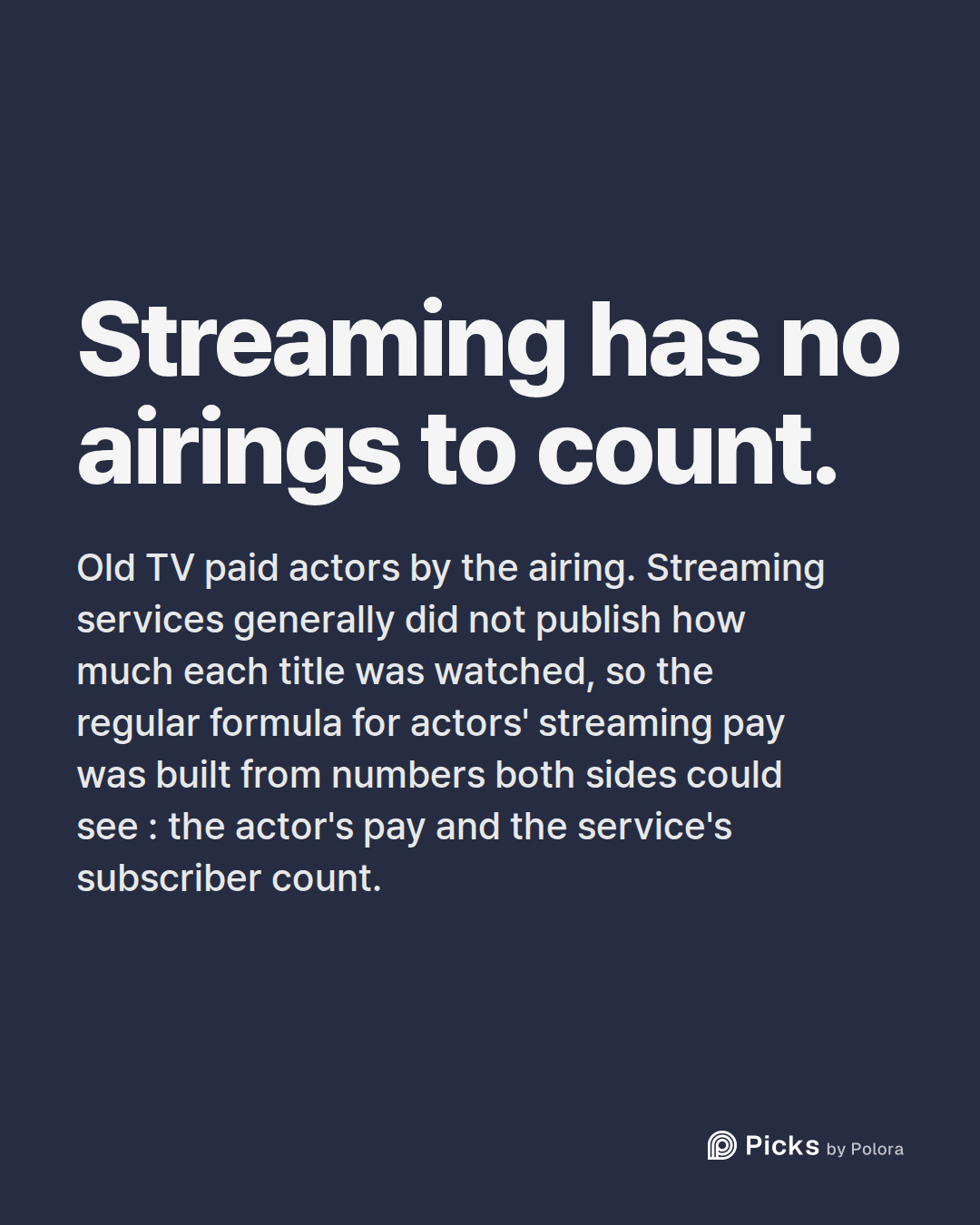
Old network television paid by the airing. Writers still get their full residual base each time a show reruns in network prime time. Under the rules in place before 2014, as one law firm's overview describes them, actors in syndication were paid per rerun on a falling scale : 40% of their minimum for the first rerun, 30% for the second, down to 5% from the thirteenth on. Every airing was public, so every airing could be counted.
Streaming has no airings, and services generally did not publish how much each title was watched. Netflix released its first report of hours viewed for nearly every title only in December 2023, and promised one twice a year.
So the regular residual formula was built from numbers both sides could see : the actor's pay, written in the contract, and the service's subscriber count. Viewing figures still sit with the services. Under the 2023 deal they are shared with the union in confidence, and if the union disputes whether a show met the bonus test below, an outside auditor reports back only yes or no.
The one place viewing counts
The 2023 contract, agreed after that year's strike, added a success bonus for shows first released from January 2024. A season or film qualifies when its views in the first 90 days reach 20% of the service's US and Canadian subscribers.
A view is not a press of play. It is the total hours watched divided by the show's running time, so two people each watching half a season count as one view.
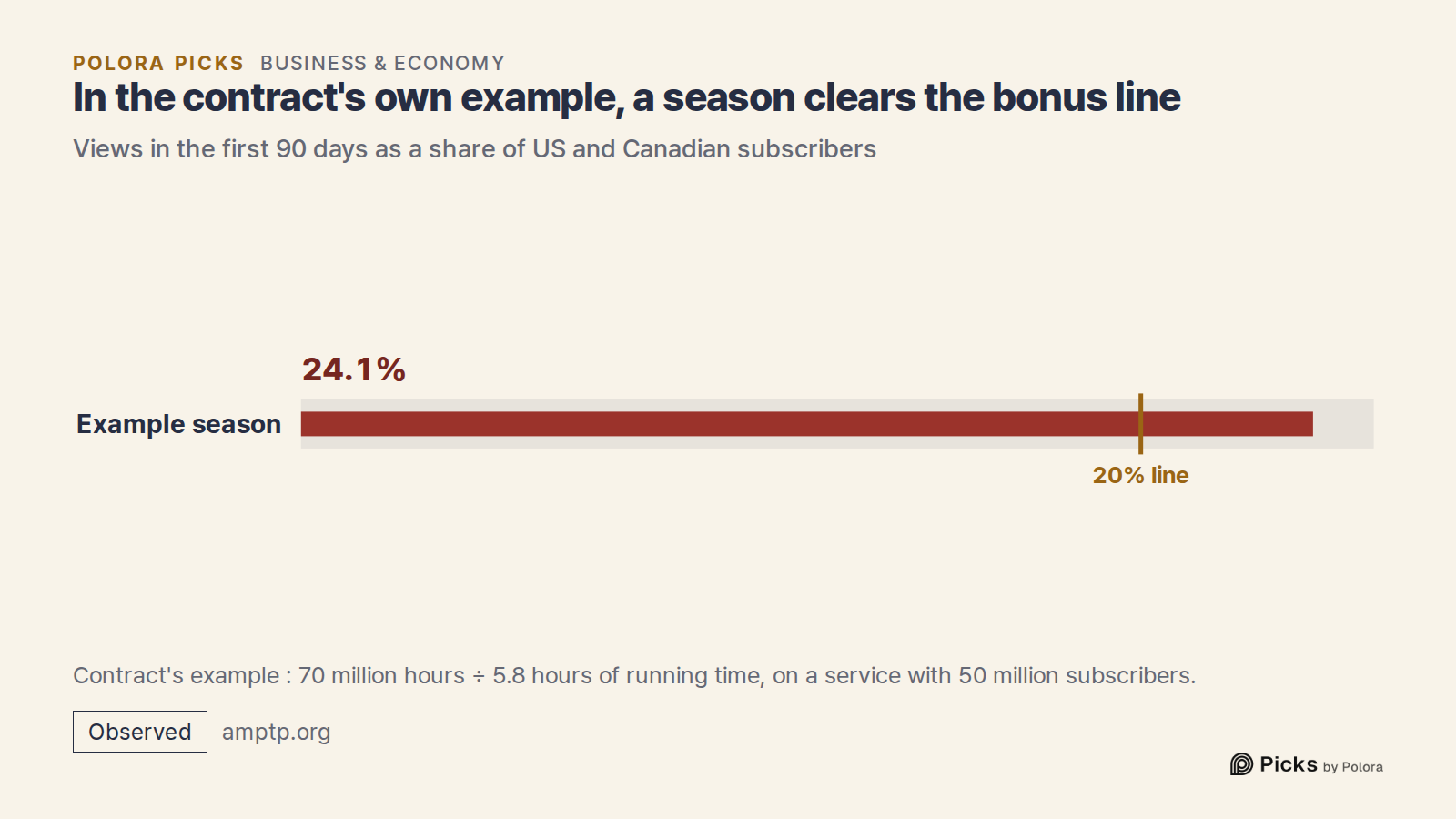
The contract gives its own example. A ten-episode season of 35-minute episodes runs 5.8 hours. If it is watched for 70 million hours in its first 90 days on a service with 50 million subscribers, that is about 12 million views, or 24.1% of subscribers, above the 20% line.
A show can also qualify in a later year, judged on the first 90 days of that year. Whether a show passed is decided on the service's own figures.
Where the bonus goes, and what it paid
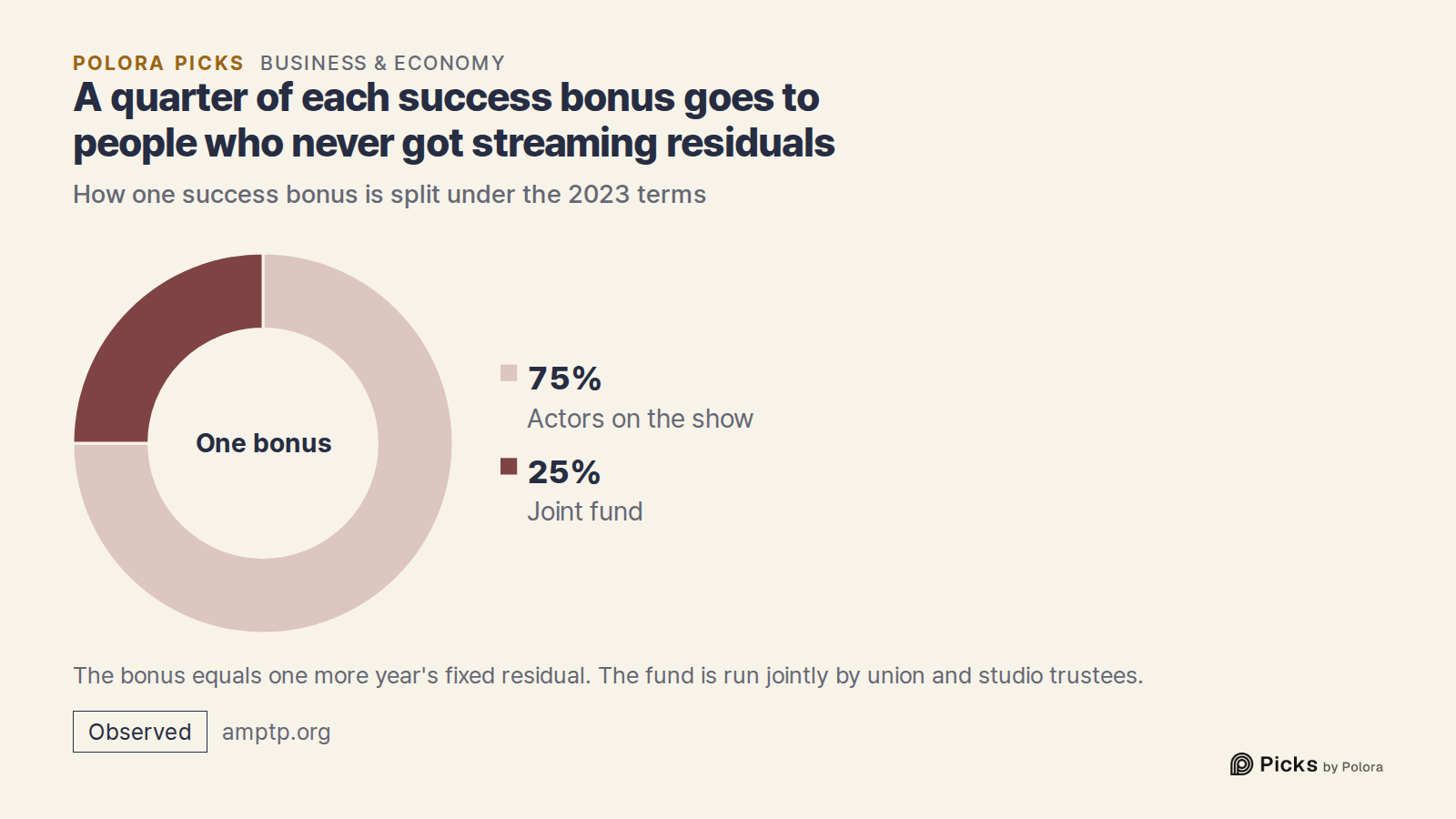
Under the 2023 terms the bonus equals one more year's fixed residual. The actors who earn residuals on the show receive 75% of it. The other 25% goes to a fund run jointly by union and studio trustees.
That fund pays people who never got streaming residuals before. Under the trustees' rules, stand-ins, background actors and off-camera stunt performers who worked at least 25 days on a qualifying show can receive a share, and so can the casts of shows that came close to the line without crossing it.
In October 2026, Deadline and TheWrap reported the union's first payout from the fund, for shows released in 2024 : about $1.5 million going to about 700 performers, under 1% of a union of more than 160,000 members. Those figures cover the fund alone, not the actors who received the direct 75% share of a bonus. Which shows qualified rests on viewing data the services report.
What the 2026 contract changes
Union members approved a new contract in June 2026, with 91.42% voting yes. It runs from July 2026 to June 2030.
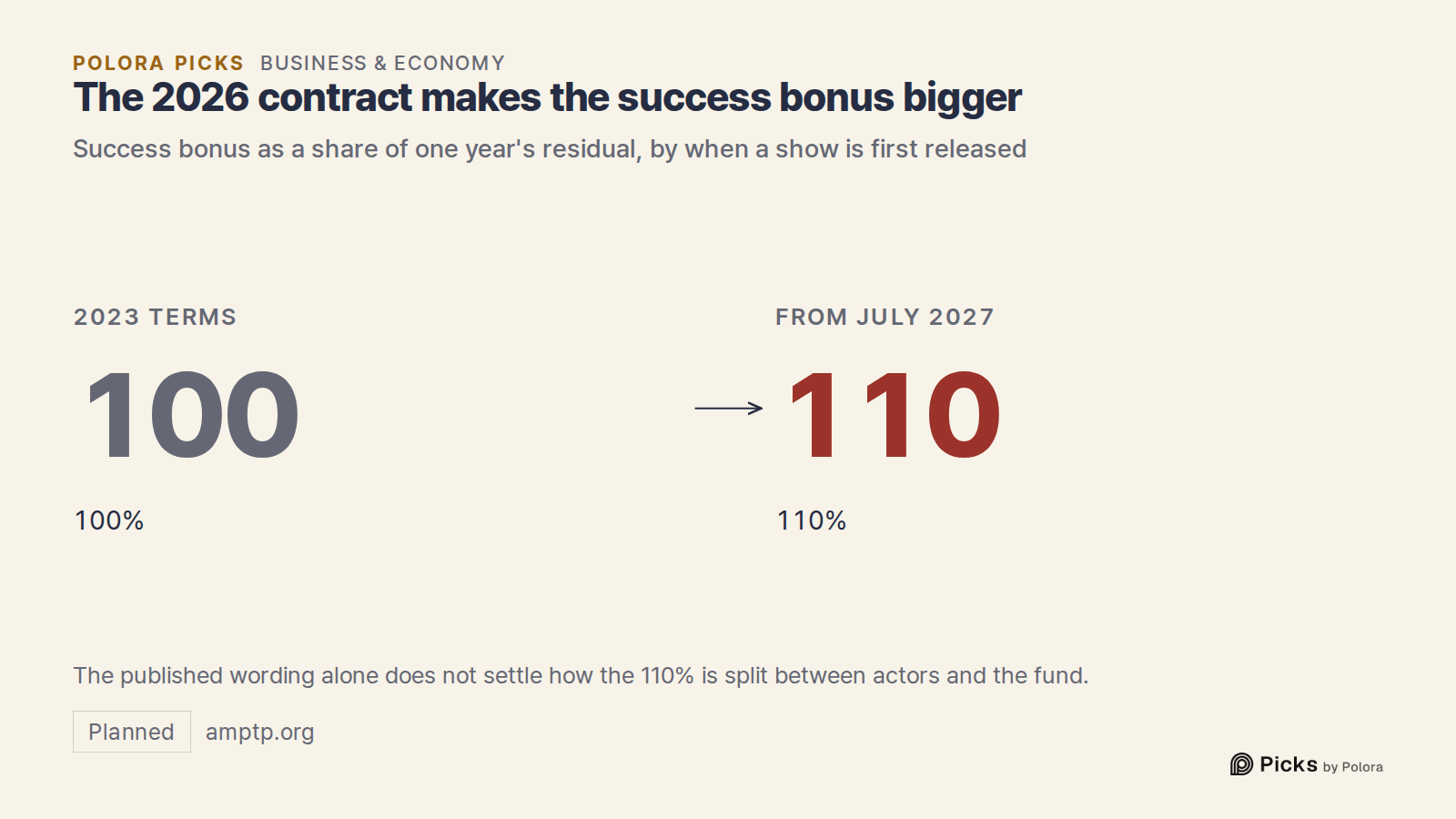
For shows first released from July 2027, the success bonus grows from 100% to 110% of a year's residual. The union's own guide says the fund's share rises from 25% to 35% of a year's residual, and the agreement gives the actors on the show 75%. Together those make the 110%. But the signed text also keeps an older sentence capping the studio's total at 100% of the bonus, so the published wording alone does not settle how the split works. Studios also may no longer count the bonus as paid in advance inside an actor's fee, for contracts signed under the new deal.
The pay ceiling rises 2.5% in July 2027 and another 2.5% in July 2029, and the foreign factor for the largest services rises from 90% to 95%.
Writers have a parallel rule under their own, separate contract. Their bonus for the same 20% test rises from 50% to 75% of the domestic and foreign residual for projects released after January 1, 2027.
- AMPTP : 2026 SAG-AFTRA memorandum of agreement, fully executed
- SAG-AFTRA : Members approve 2026 TV/Theatrical contracts tentative agreement
- SAG-AFTRA : 2026 TV/Theatrical contracts
- SAG-AFTRA : 2026 TV/Theatrical contracts summary of tentative agreement
- GreenSlate : SAG-AFTRA TV/Theatrical agreement
- WGA East : Summary of the 2026 WGA MBA
Why so many residual checks look tiny
The base is pay for that episode, so a day or two of work makes a small base. The yearly percentage keeps falling. Foreign payments are paid separately and can be smaller still. And producers may count part of a performer's fee as residuals paid in advance. For performers guaranteed under $75,000 a week or episode on contracts signed from December 2024, the contract limits this to 15% of their pay, and that line rises to $80,000 for contracts signed from July 2027.
Shows made first for cinemas or broadcast television that later move to streaming are paid differently : 3.6% of the distributor's gross, a share of the license money, divided across the cast. In the 2026 contract's own example, $3,152.78 of gross leaves a $100 pool after plan contributions, split $16.67, $33.33 and $50 among three actors.
One actor's story shows what this can look like. Kimiko Glenn, from the Netflix series Orange Is the New Black, posted a foreign residual statement for $27.30 from December 2020 and argued she deserved to be paid for the streams. It is one statement from one actor, not a typical payment, and which residual terms covered that early Netflix series was not checked.
This is the US union rulebook only
Everything here covers productions made under US union contracts with the major studios. Shows made in other countries follow their own unions and laws, and non-union work has no residual rules unless a contract adds them.
When a show was made matters too. The subscriber scale depends on when filming began, the bonus on when a show was released, and the 2026 terms on dates in 2026 and 2027. Two hits on the same service can pay their casts on different rules.
So the answer to the question is no. Your streaming hours do not pay the cast by the play. Added up with everyone else's, they matter only at a 20% line, checked in a show's first 90 days and again at the start of each later year, and the rest is set by pay, subscribers and the calendar.