From 2nd to 12th, one country at a time
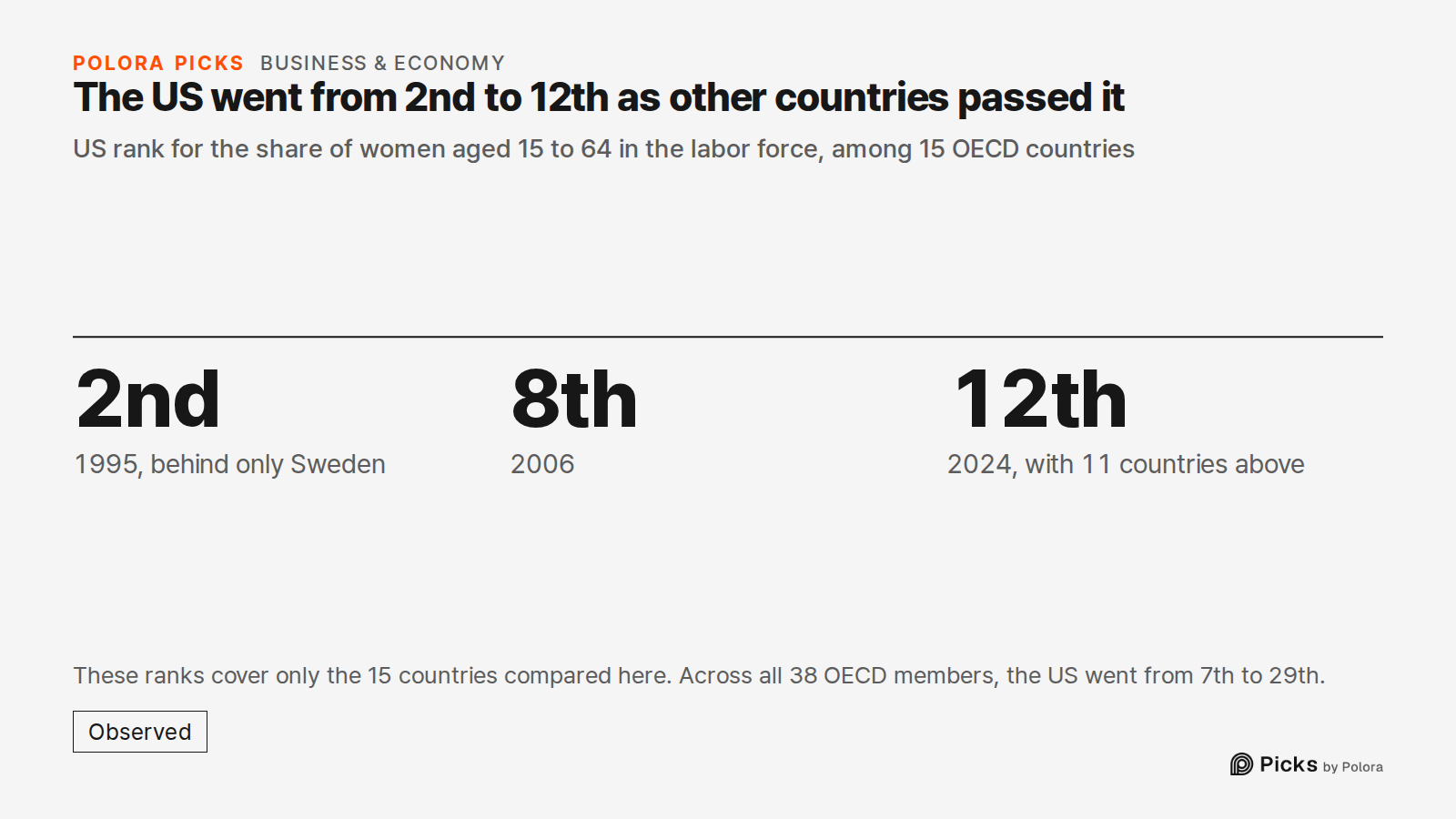
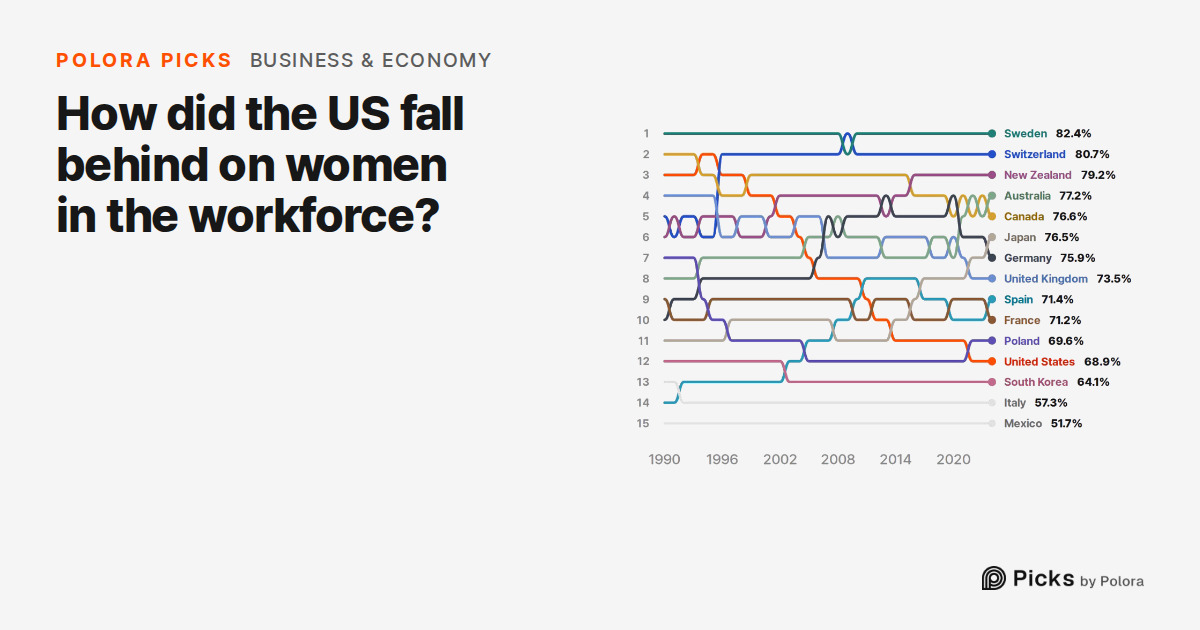
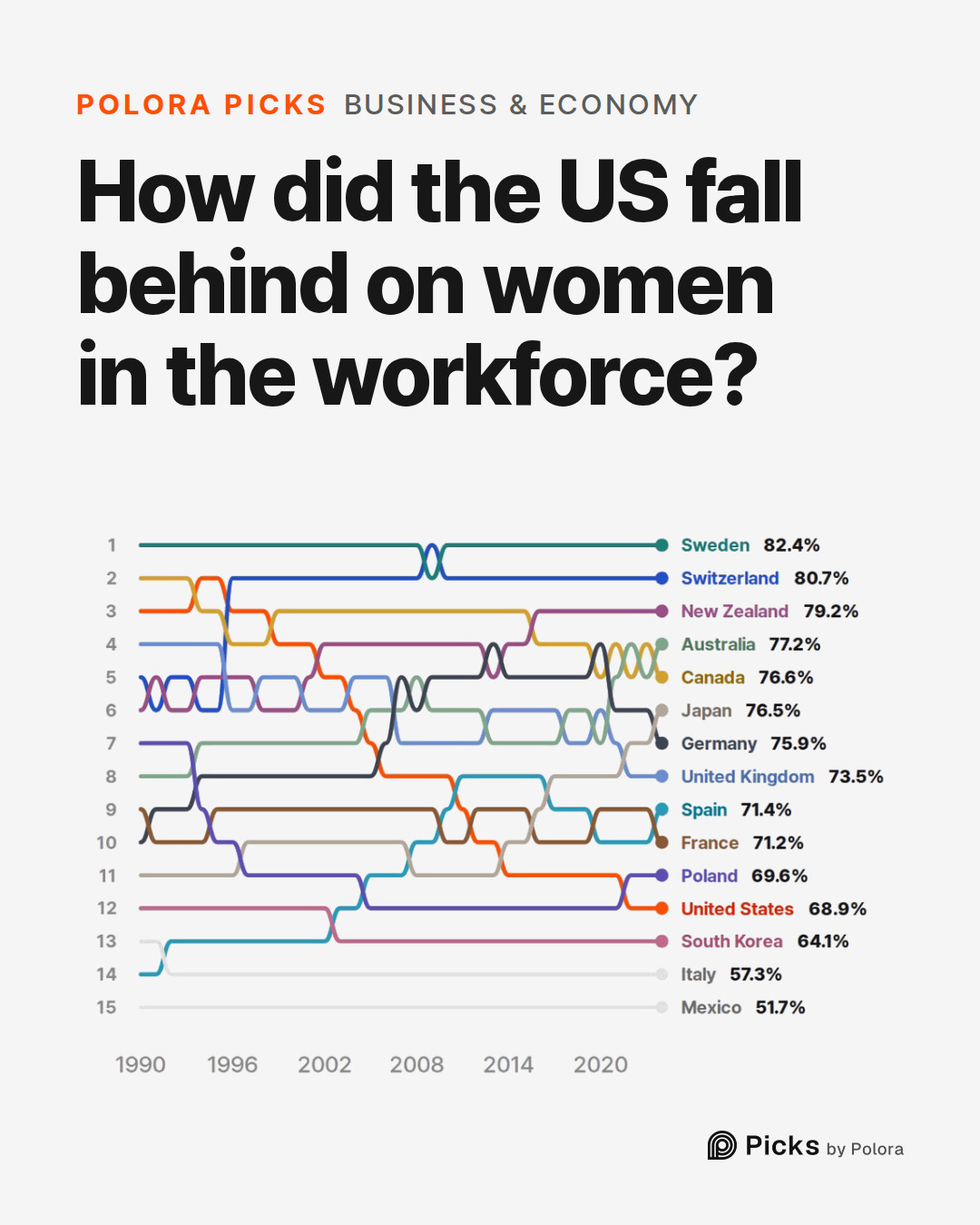
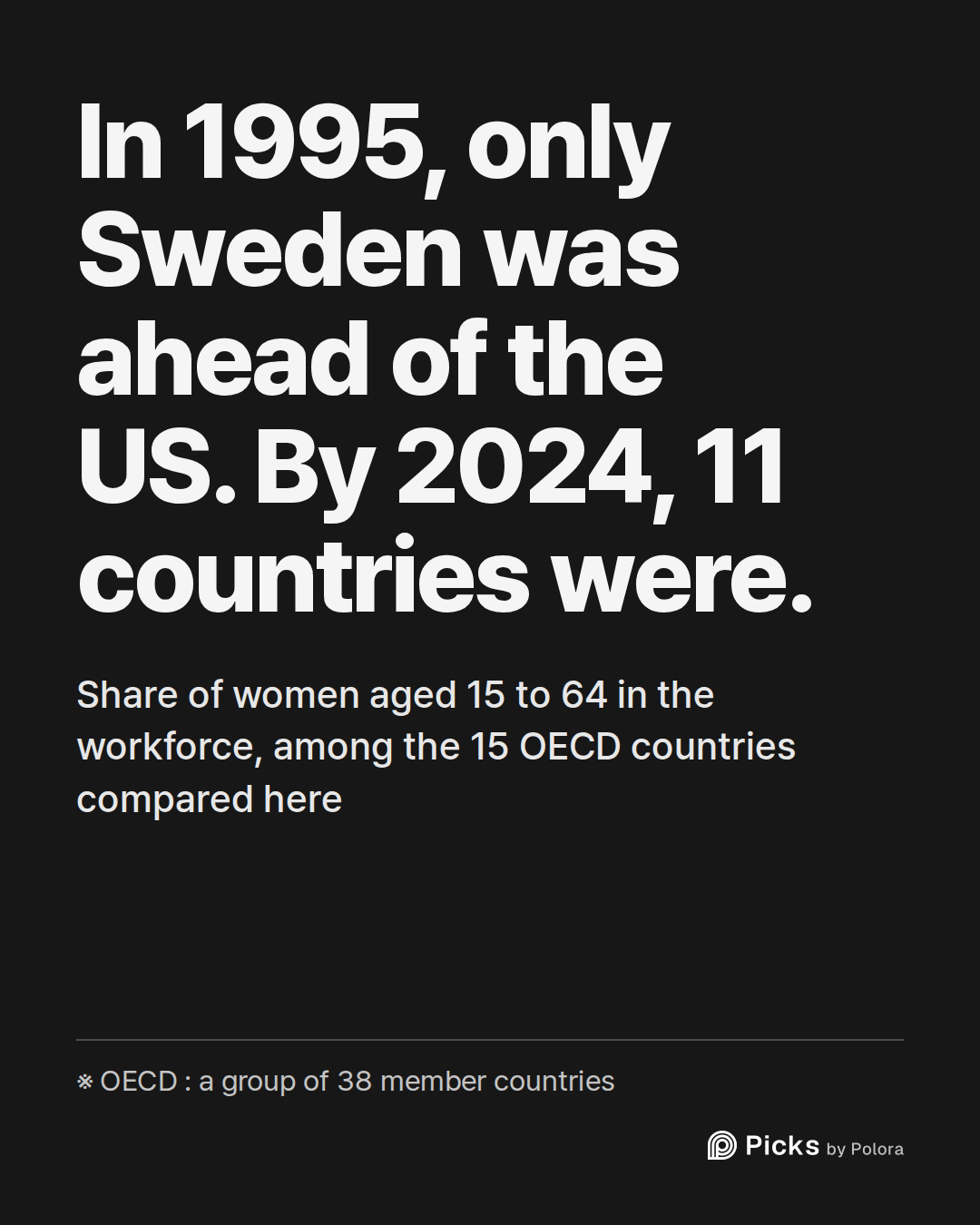
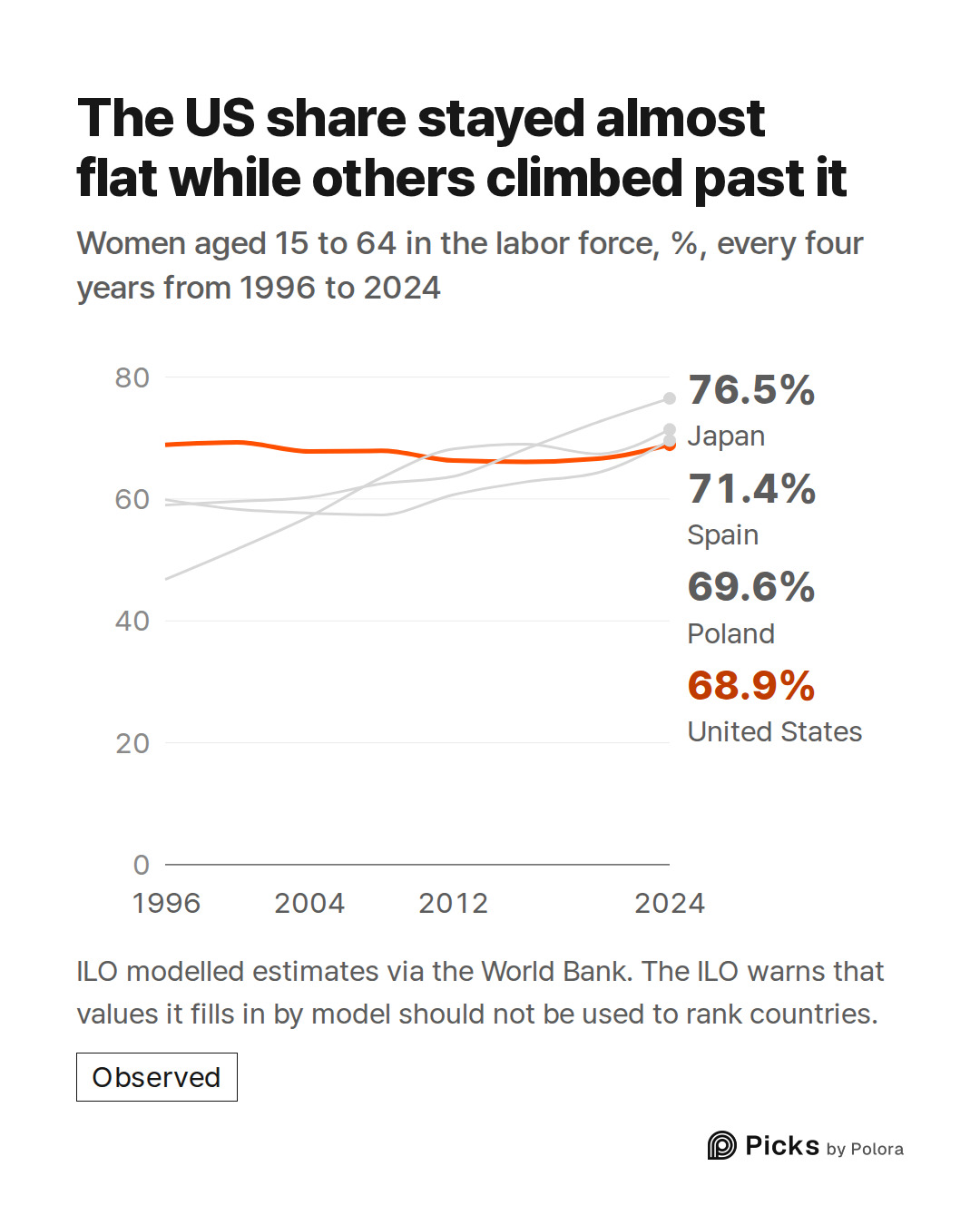
The measure is the labor force participation rate : the share of women aged 15 to 64 who have a job or are looking for one. In 1995 the US figure was 68.5%. That put it 2nd among the 15 countries compared here, behind only Sweden.
Then the others started to pass it. Switzerland went ahead in 1996. Canada had been ahead at the start of the 1990s, slipped below, and passed the US again in 1999. New Zealand passed in 2002, Britain in 2004, Australia in 2005 and Germany in 2006. By 2006 the US was 8th.
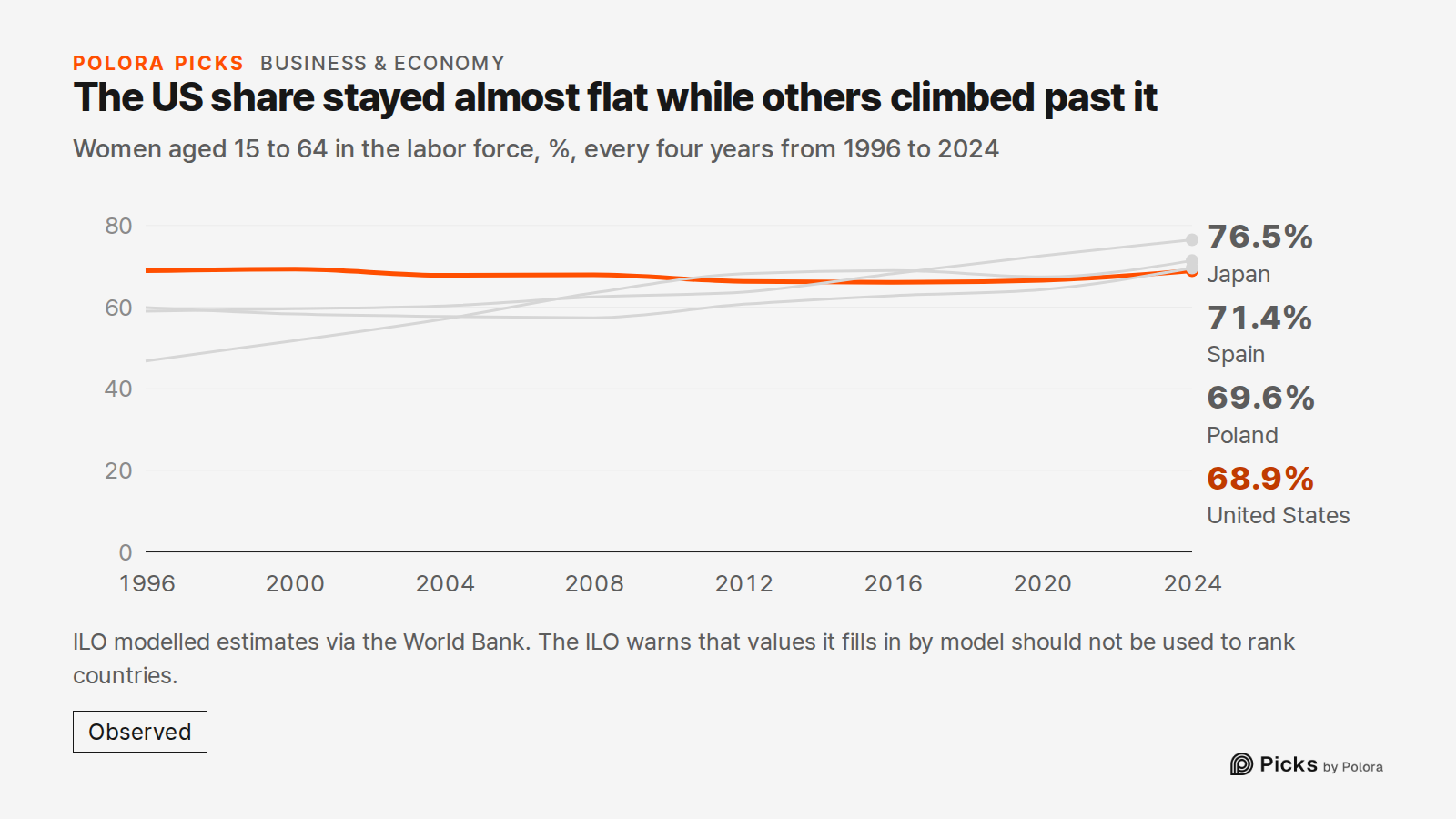
The next wave was slower to arrive but came from further back. Spain passed in 2011, France in 2012 and Japan in 2014. Japan started at 57.2% in 1990 and reached 76.5% in 2024. Spain went from 45.9% in 1995 to 71.4%. Poland was the last to pass, in 2022. In 2024 the US ranked 12th, with 11 of these countries above it.
The US barely moved; the others rose
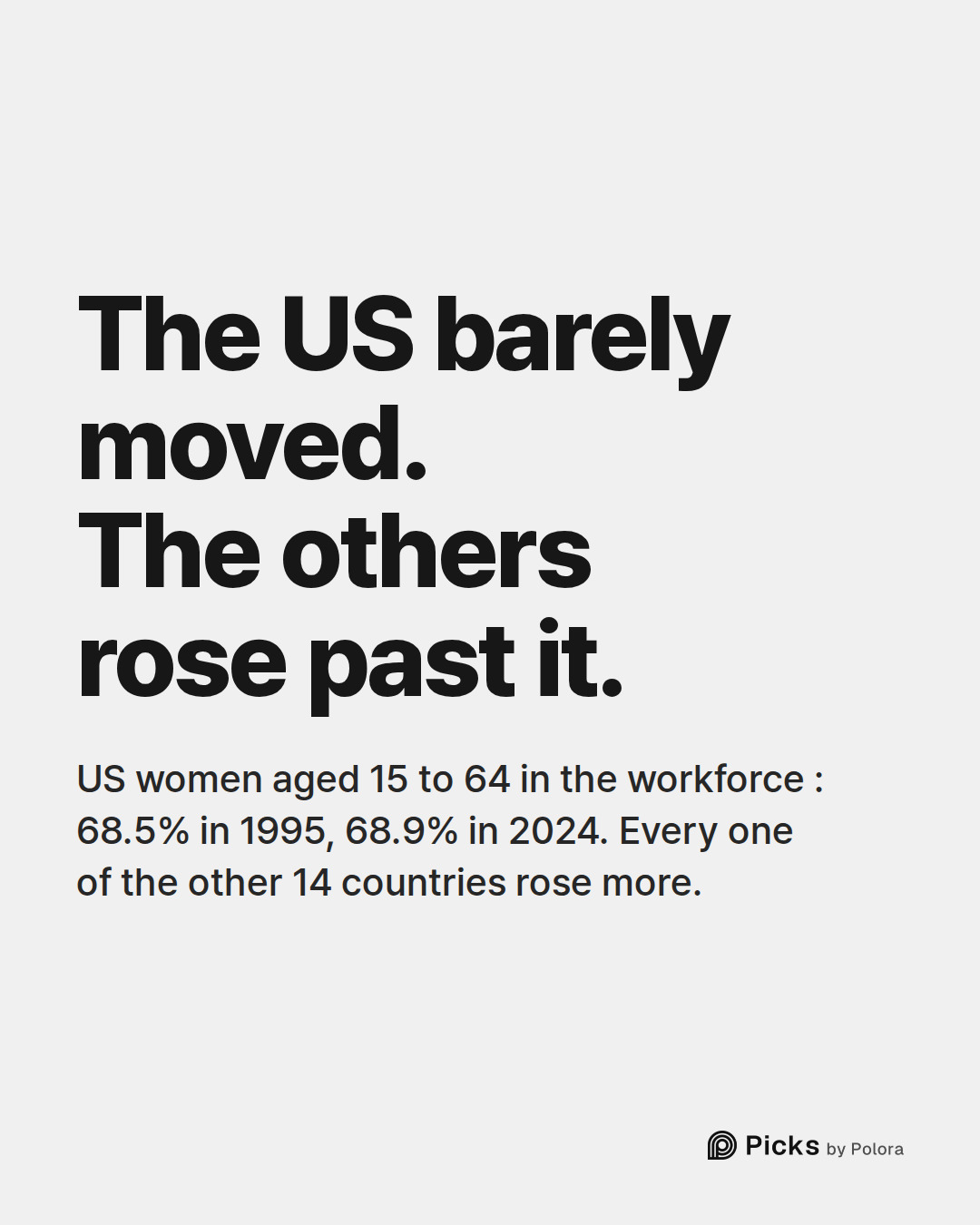
The US rank fell a long way, but the US share did not. It peaked at 69.5% in 1997 and slid to a low of 65.7% in 2015, then recovered. In 2024 it was 68.9%, about where it was in 1995. Every one of the other 14 countries rose more than the US over those years.
The dip did matter at the edges : had the US share simply stayed at its 1995 level, some countries would have passed it later. But by 2024 each of the 10 countries that passed the US stood above that 1995 level, and Sweden had been ahead all along. The main story is the others catching up and moving on.
Why? Policy explains only part of it
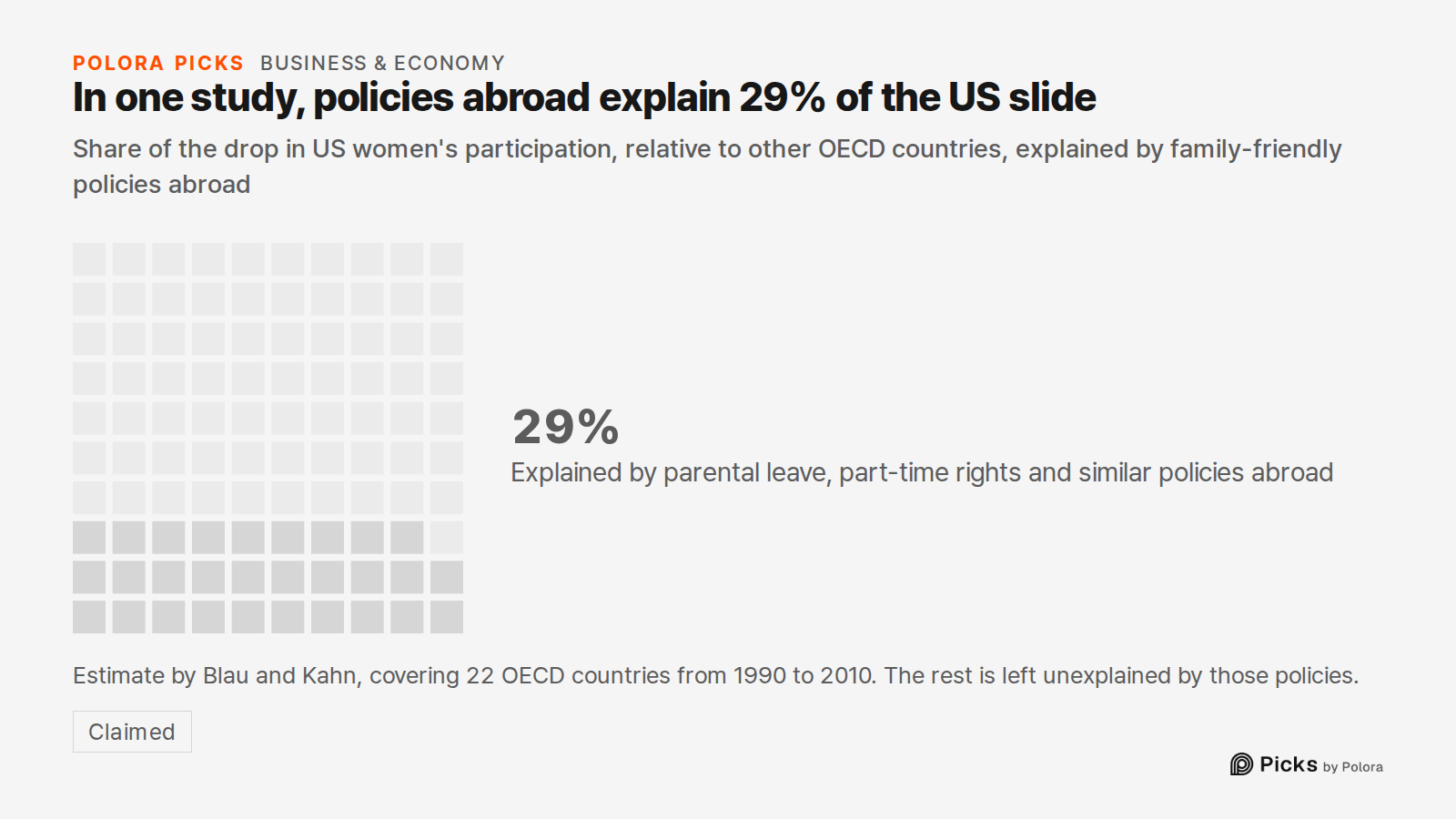
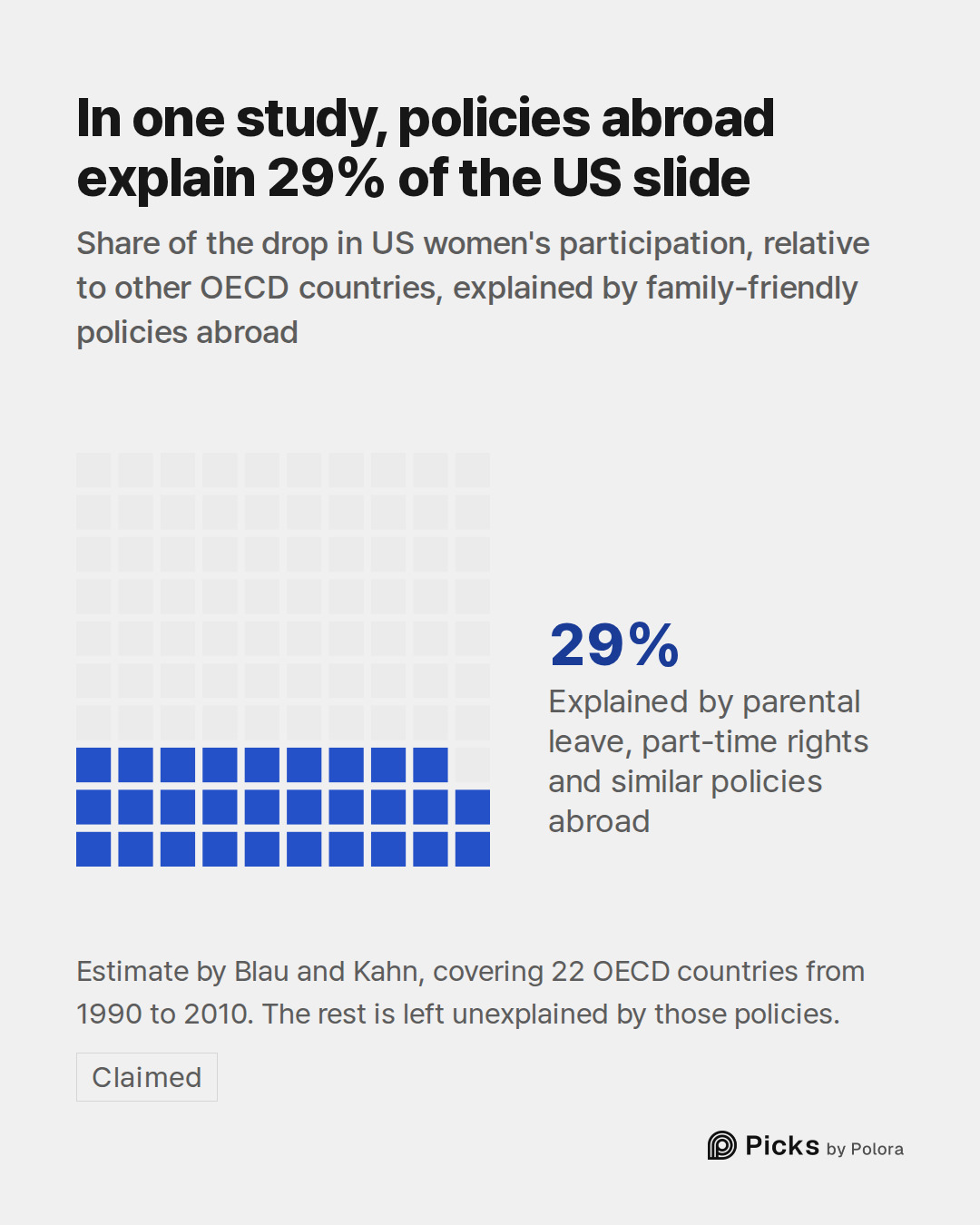
Economists Francine Blau and Lawrence Kahn studied an earlier stretch of the same slide, in the American Economic Review. In their data, the US had the 6th highest rate of women in the workforce among 22 OECD countries in 1990, and was 17th by 2010. They found that the spread of "family-friendly" policies in other countries, including parental leave and the right to work part time, explains 29% of the drop in US women's participation relative to those countries. In their estimates, most of the slide is left unexplained by those policies.
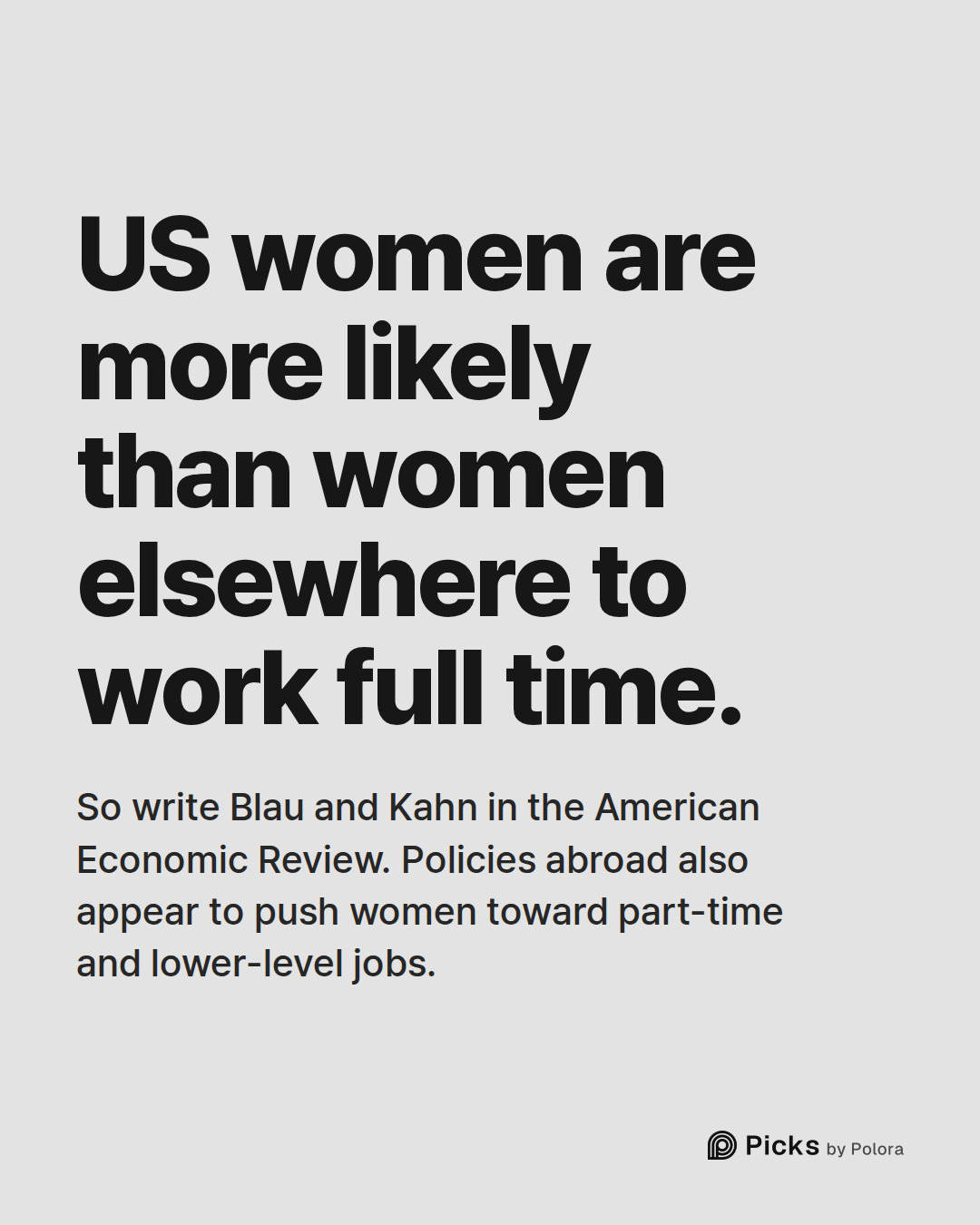
The same study points to a trade-off. Those policies also appear to push women abroad toward part-time work and lower-level jobs. US women, the authors write, are more likely than women elsewhere to work full time and to work as managers or professionals.
For context on US policy : the main federal law, the Family and Medical Leave Act of 1993, gives eligible workers up to 12 workweeks of job-protected leave in a 12-month period, for reasons such as caring for a new child or for a spouse, child or parent with a serious health condition. That leave is unpaid. Some states add more. The study's period ends in 2010, so it does not cover the later passes by Spain, France, Japan and Poland. Nothing here shows why those happened.
What the comparison leaves out
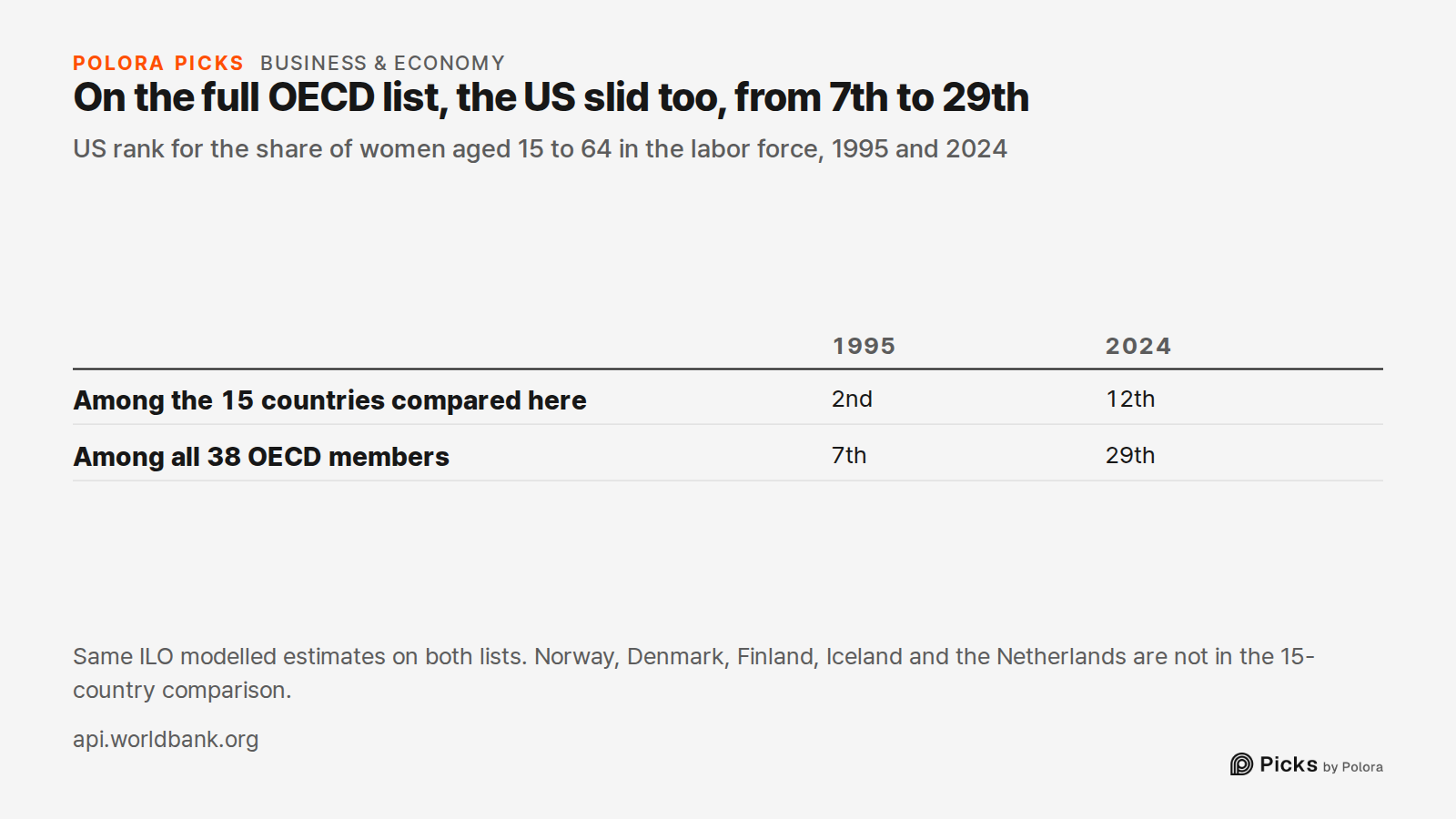
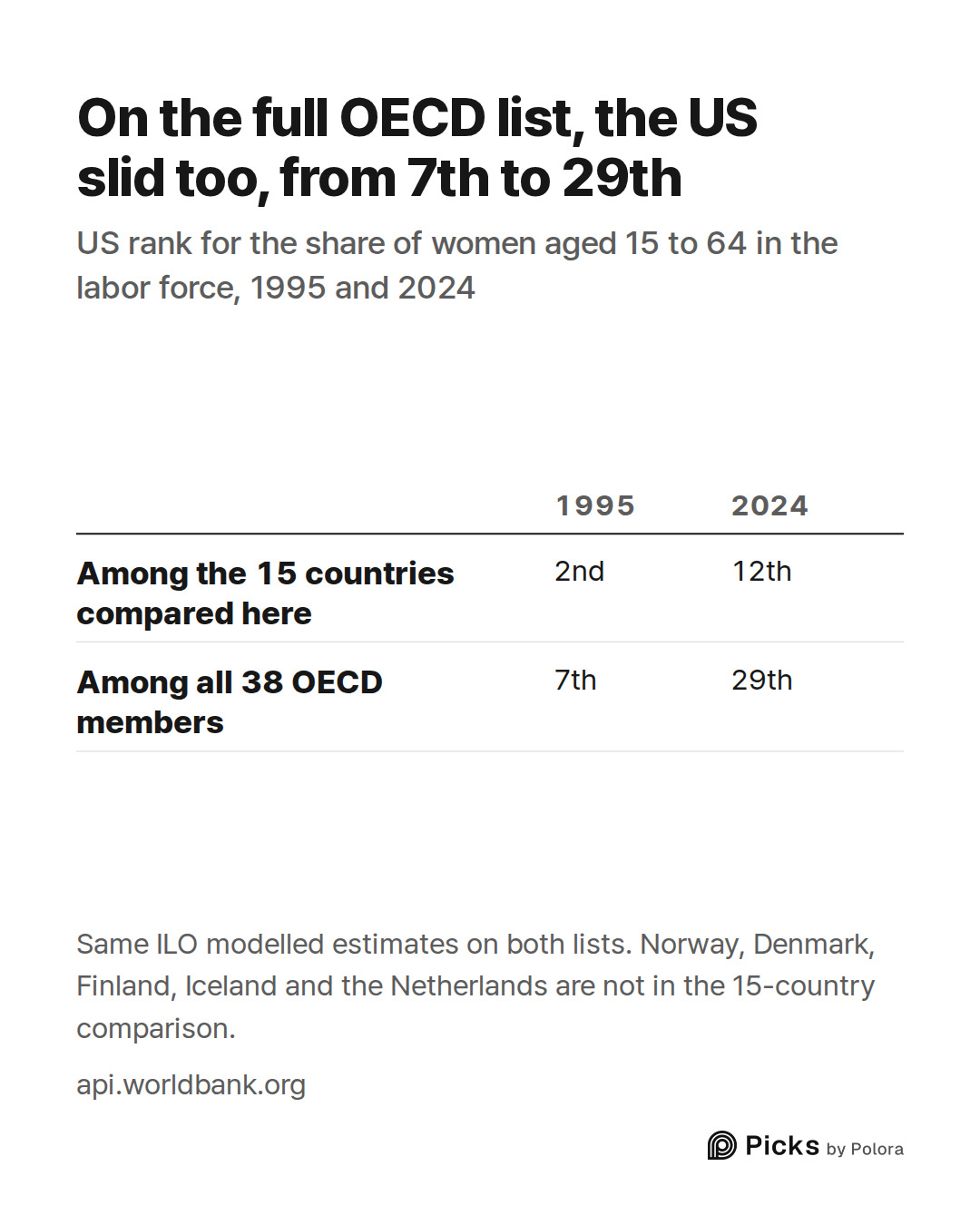
The comparison covers 15 countries, and that choice matters for the start of the story. Norway, Denmark, Finland and Iceland were all ahead of the US in 1995 and are not included. The Netherlands is left out too, because the ILO's figures for it before 2021 run well above the Dutch survey's own figures. Across all 38 of today's OECD members, using the same ILO estimates, the US was 7th in 1995 and 29th in 2024. So "2nd" holds only among the countries compared here, while the slide holds on the full list too.
The figures are the International Labour Organization's modelled estimates, published by the World Bank. They are built mainly from each country's own labor force survey, adjusted so that countries can be compared. One adjustment matters here. The US survey counts women from age 16, not 15, and the ILO's figure puts the US on the same 15-to-64 basis as everyone else. The ILO's US figure ends up a bit more than a point below the US survey's own figure in every year; the sources used here do not show the exact steps of that adjustment. Measured against the US survey's own figure, every country's lasting pass comes later, and Poland stays just below the US. Even on the ILO figures, Poland's lead in 2024 is only 0.7 points, so it is the closest call of all.
For Sweden from 1995 to 2000, the comparison uses Eurostat's survey figures, because the ILO's modelled values for those years sit above both survey sources for no reason the data shows. Sweden stays ahead of the US either way. The ILO also uses models to fill gaps and project recent years, and warns that values filled in that way should not be used to rank countries. The data files behind the comparison do not mark which values those are. The comparison stops at 2024 rather than 2025.
- World Bank, Labor force participation rate, female (% of female population ages 15-64) (modeled ILO estimate), the 15 countries shown and the Netherlands]
- World Bank, the same indicator for the other OECD members]
- World Bank, notes on the indicator (source, method, limits)]
- ILO, modelled estimates of women's labor force participation, ages 15-64]
- ILO, modelled estimates for the other OECD members]
- ILO, national labor force survey figures, ages 15-64]
- ILO, national labor force survey figures for the other OECD members]
- Eurostat, activity rates by sex and age (lfsa_argan), women 15-64]
![Sources 8 : api.worldbank.org · World Bank, Labor force participation rate, female (% of female population ages 15-64) (modeled ILO estimate), the 15 countries shown and the Netherlands], api.worldbank.org · World Bank, the same indicator for the other OECD members], api.worldbank.org · World Bank,](https://media.cdn.polora.ai/picks/2026/11/pickrun_98924c10fa53490b/IZZ8ldMO0pC6nZrG-slide-08--how-did-the-us.jpg)