Who gets paid every time someone renews a .com address?
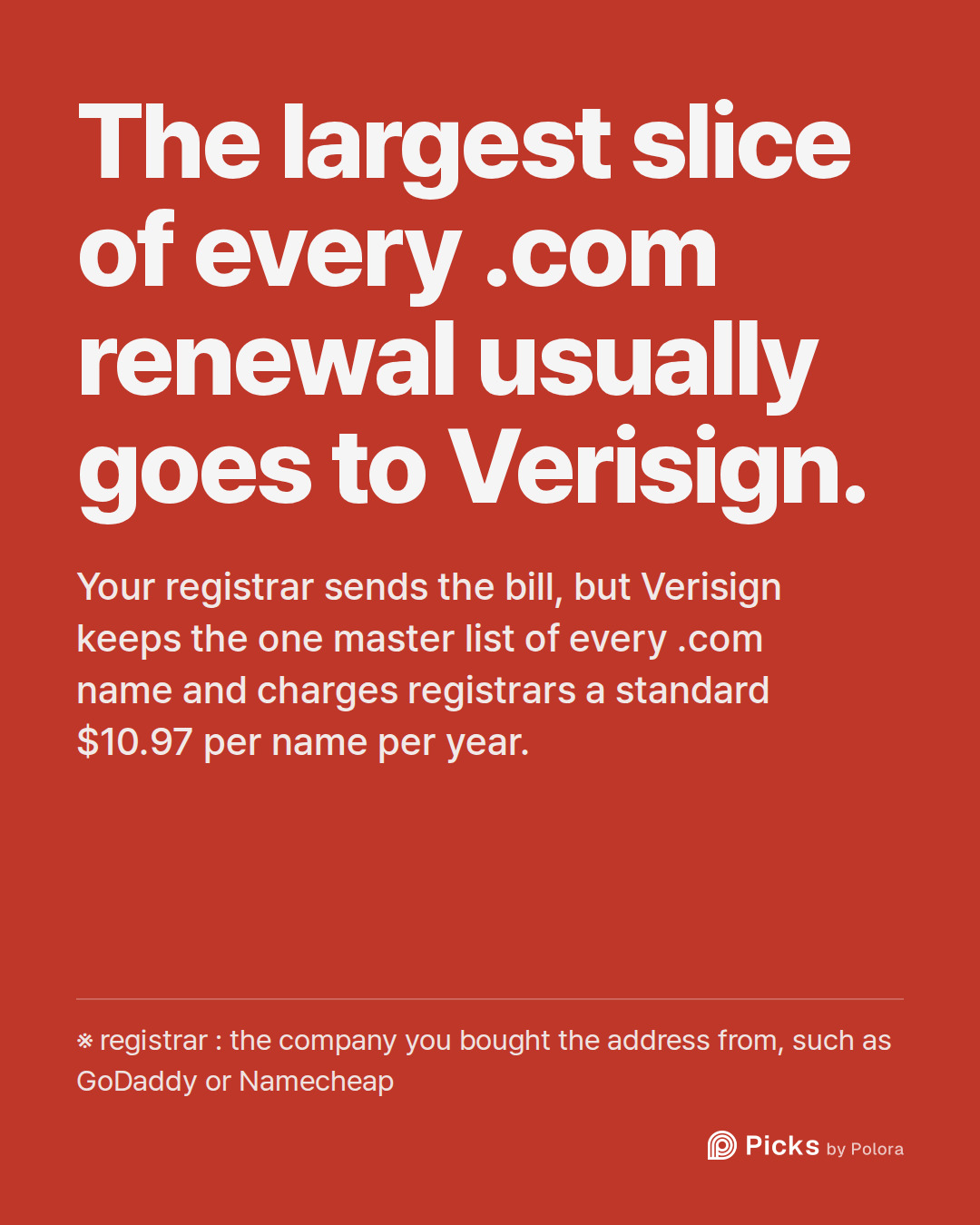
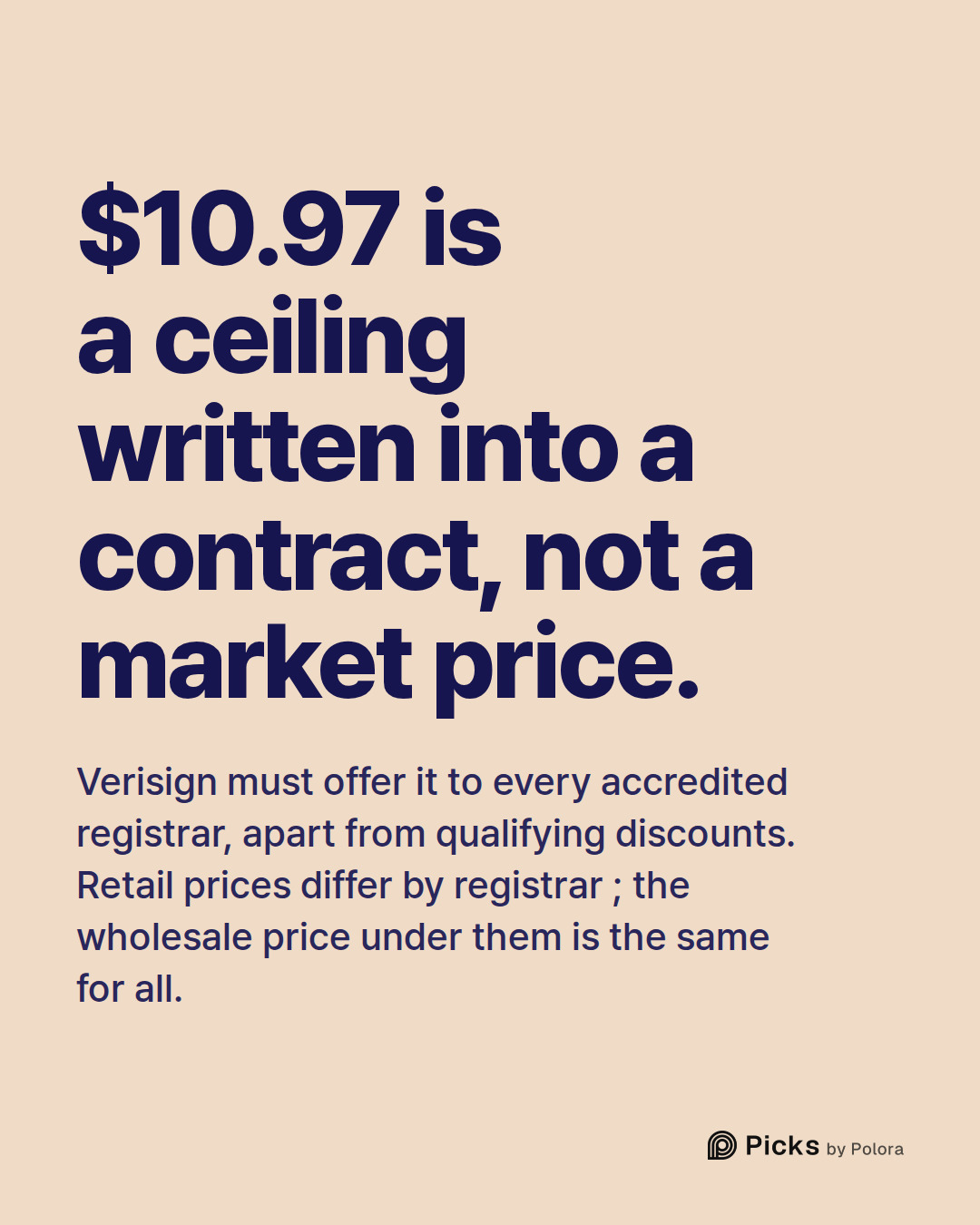
Mostly Verisign, a company few people have heard of : it charges registrars a standard $10.97 for each year a .com name is renewed, whichever registrar you use. That amount is a ceiling written into its contracts, not a market price.
Business & Economy · 2026-11-20
Every .com renewal pays the same company, at a standard $10.97
Once a year, anyone who owns a .com address pays to keep it. The bill comes from whichever company they bought it from, a registrar such as GoDaddy or Namecheap. But the registrar does not own the address it sells. Every .com name in the world is an entry in one master list, and one company keeps that list : Verisign, based in Virginia.
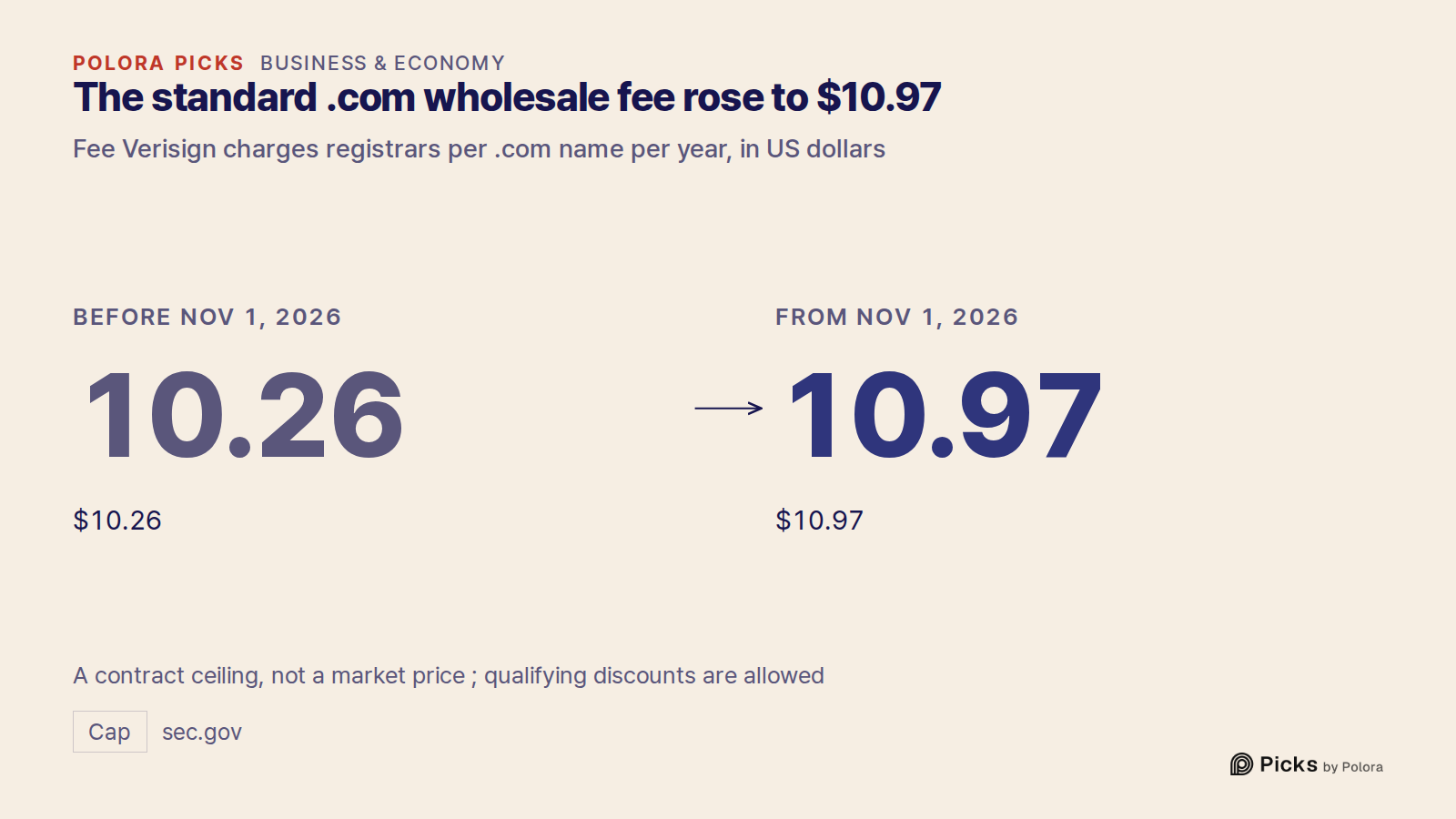
Each time a .com name is registered or renewed for a year, the registrar pays Verisign a wholesale fee. Since November 1, 2026, the standard fee has been $10.97, up from $10.26. Verisign announced the change on April 23, 2026, together with its first-quarter results. The contract treats that figure as a maximum. Verisign must offer the same price to every accredited registrar, and it may also offer qualifying discounts and incentives. So whoever sends you the bill, the largest single slice of what you pay usually ends up with Verisign.
Fee Verisign charges registrars per .com name per year, in US dollars
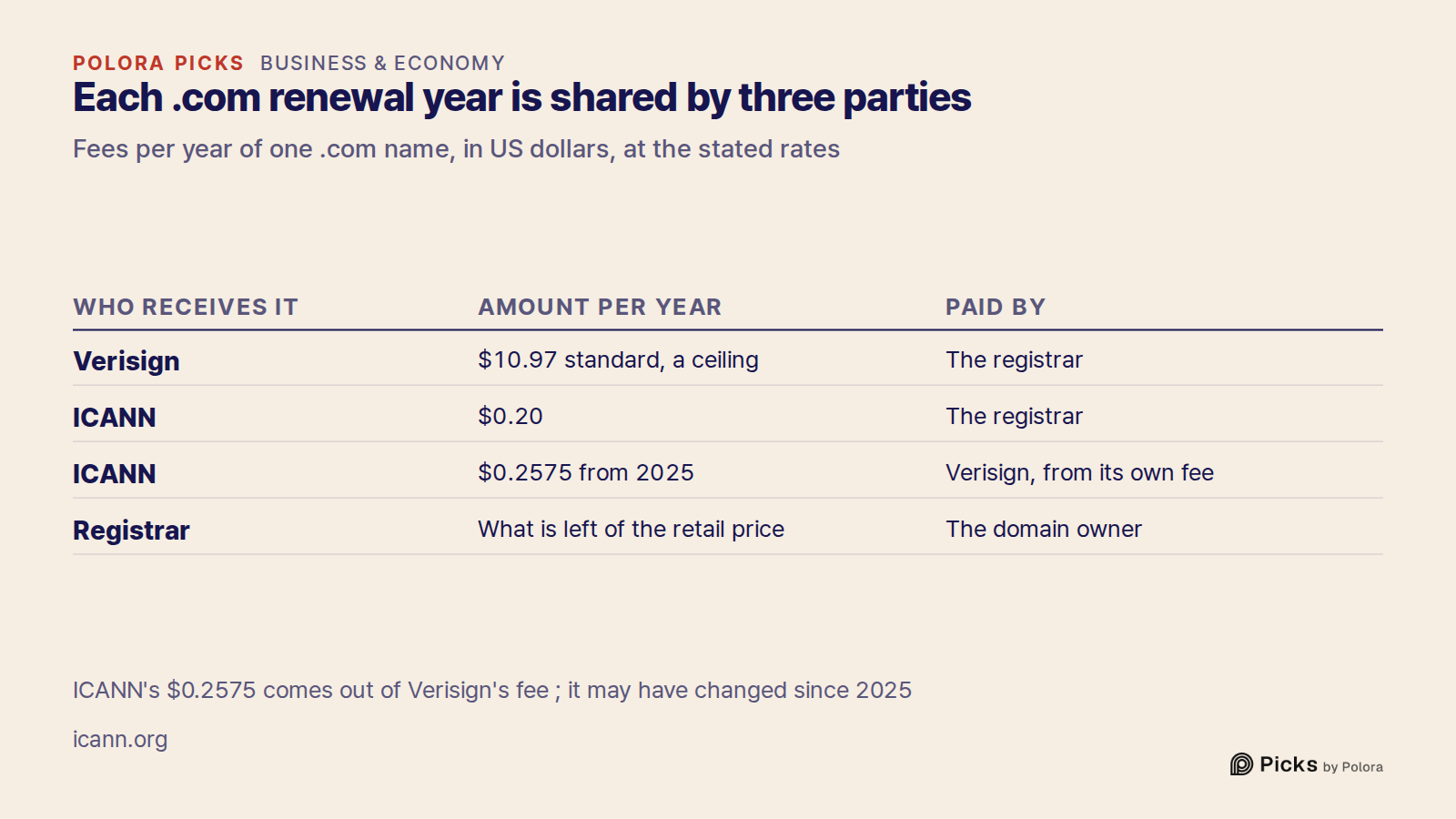
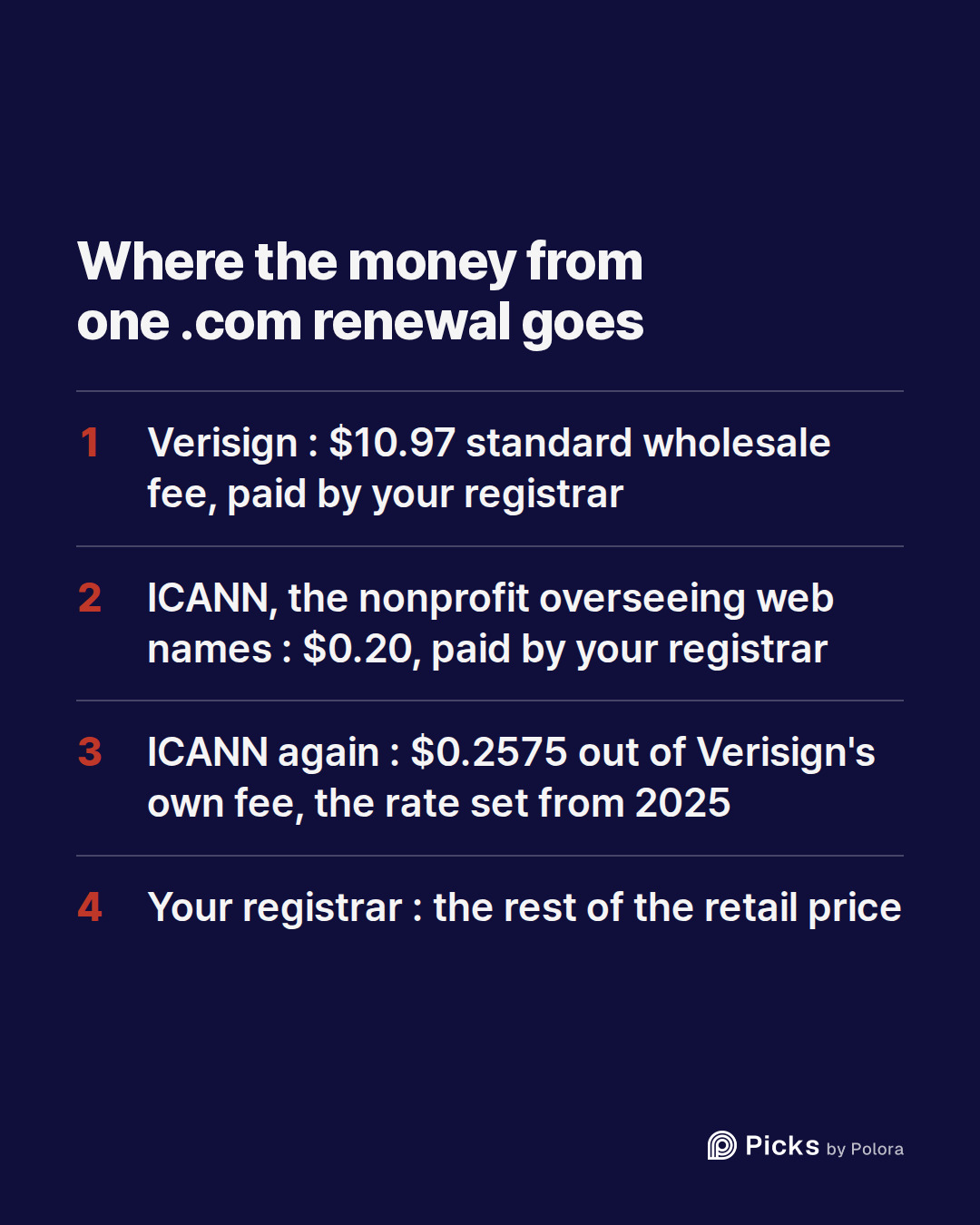
A renewal is split three ways. Verisign takes its wholesale fee, $10.97 at the standard rate. ICANN, the nonprofit that oversees the internet's naming system, charges the registrar $0.20 for each year a .com name is registered, renewed or transferred, once the grace period after that transaction has passed. ICANN's budget for fiscal year 2027 keeps that fee at $0.20. The rest of what the registrar charges stays with the registrar, as revenue rather than necessarily as profit.
ICANN is also paid from Verisign's side. Out of its own fee, Verisign pays ICANN a separate fee for each year of each .com registration. Verisign's annual report for 2025 puts it at $0.2575, the rate ICANN set from January 1, 2025, up from the $0.25 printed in the agreement. Whether it has been adjusted again since then is not confirmed.
The retail price is the one part nobody fixes. ICANN, which does not set retail prices, noted in 2020 that while the wholesale price had been frozen for years, GoDaddy had raised its standard .com renewal from $14.99 to $17.99 in 2019. So retail prices differ from registrar to registrar, while the wholesale price underneath them is the same for every registrar, apart from the discounts the contract allows.
Fees per year of one .com name, in US dollars, at the stated rates
Verisign runs .com under two agreements. One is a Cooperative Agreement with the US Department of Commerce. The other is a registry agreement with ICANN. The price rules start in the first and are copied into the second. ICANN says it is not a price regulator and has long deferred to Commerce and the US Department of Justice on .com wholesale prices.
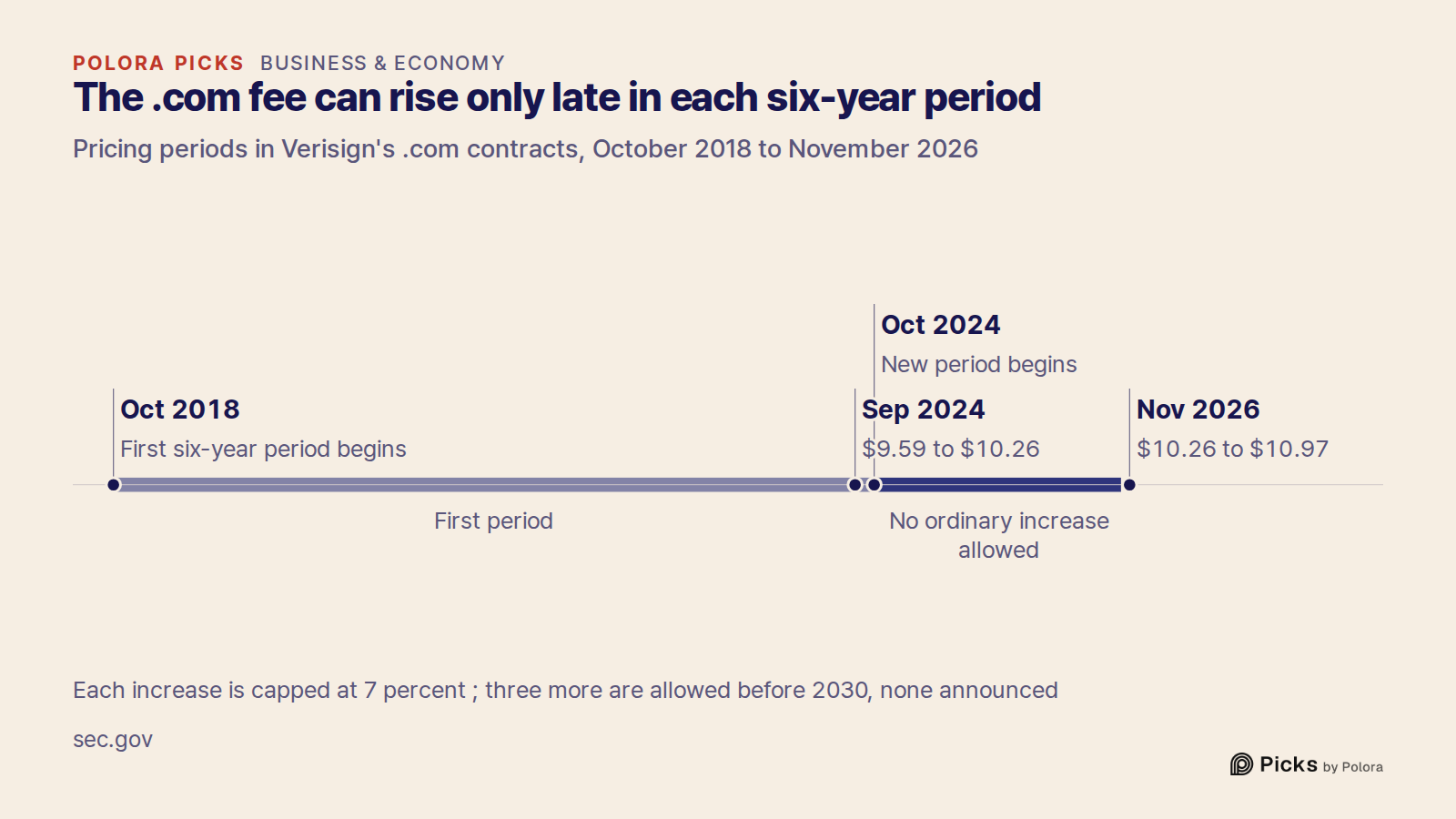
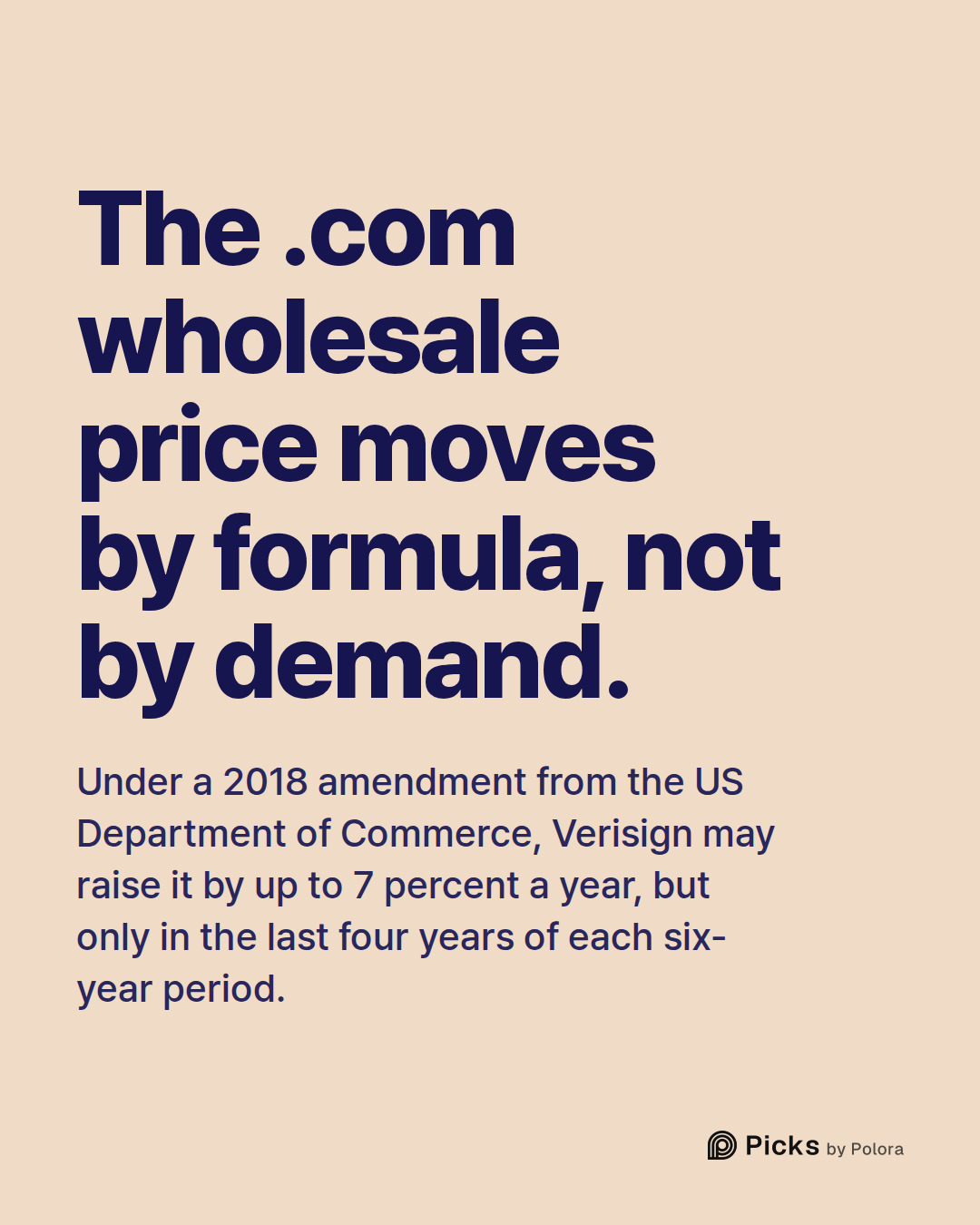
From 2012 the price was frozen at $7.85, a freeze Commerce set in what is called Amendment 32. In November 2018, the Commerce agency NTIA signed Amendment 35, which it said "repeals Obama-era price controls." Under it, Verisign may raise the price by up to 7 percent a year, but only in the last four years of each six-year period. ICANN wrote this into the .com registry agreement in March 2020 and described the change as essentially restoring the pricing structure of the 2006 agreement.
So the wholesale price is not what buyers are willing to pay but the most Verisign is allowed to charge, and whether it moves, and by how much, is decided by a formula in a contract.
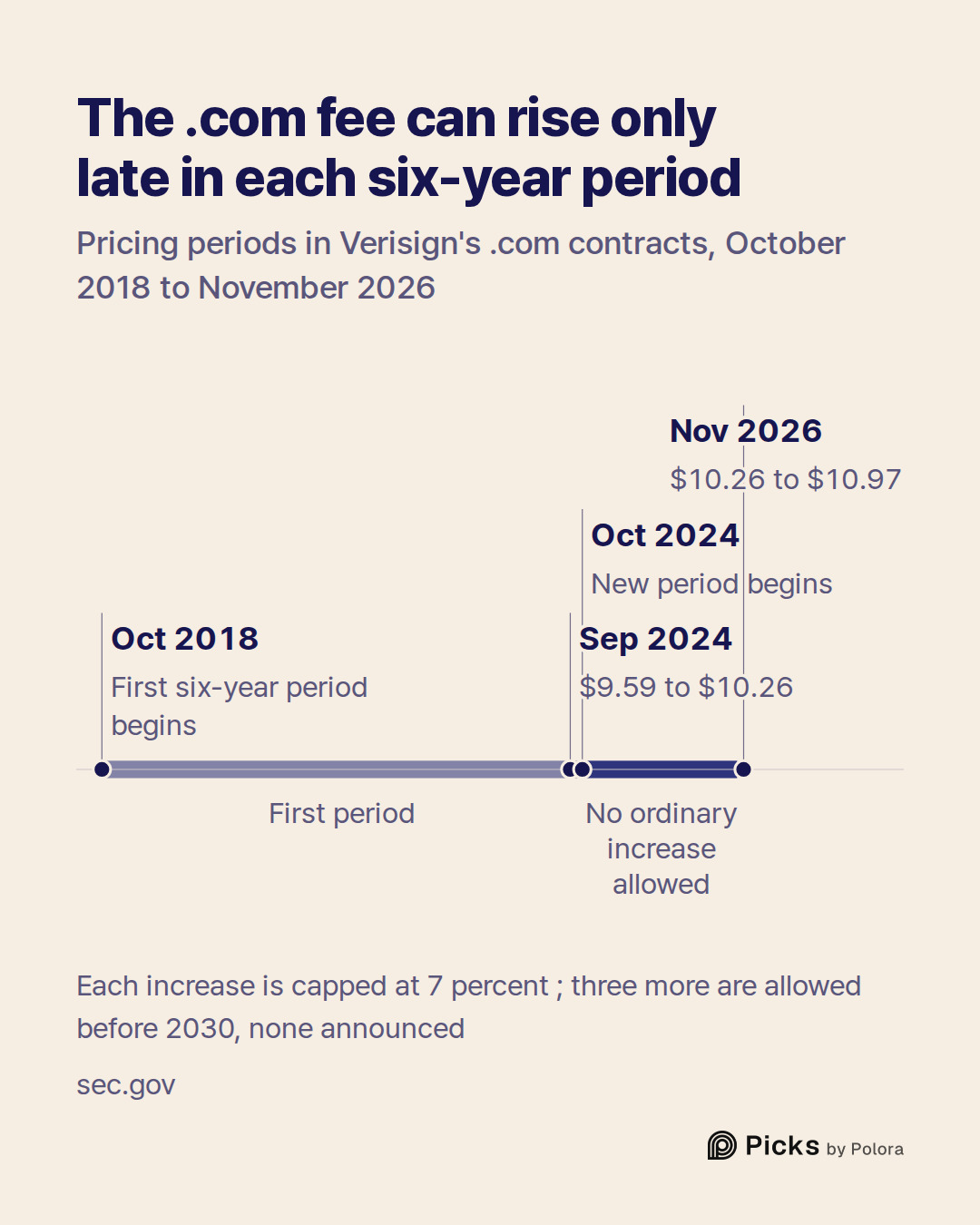
The six-year clock explains the timing. The first period began on October 26, 2018. Verisign used its increases in that period, the last one on September 1, 2024, when the fee went from $9.59 to $10.26.
A new six-year period began on October 26, 2024. Its first two years allow no ordinary increase, which is why 2025 passed without one. The window reopened in late October 2026, and Verisign raised the price on November 1.
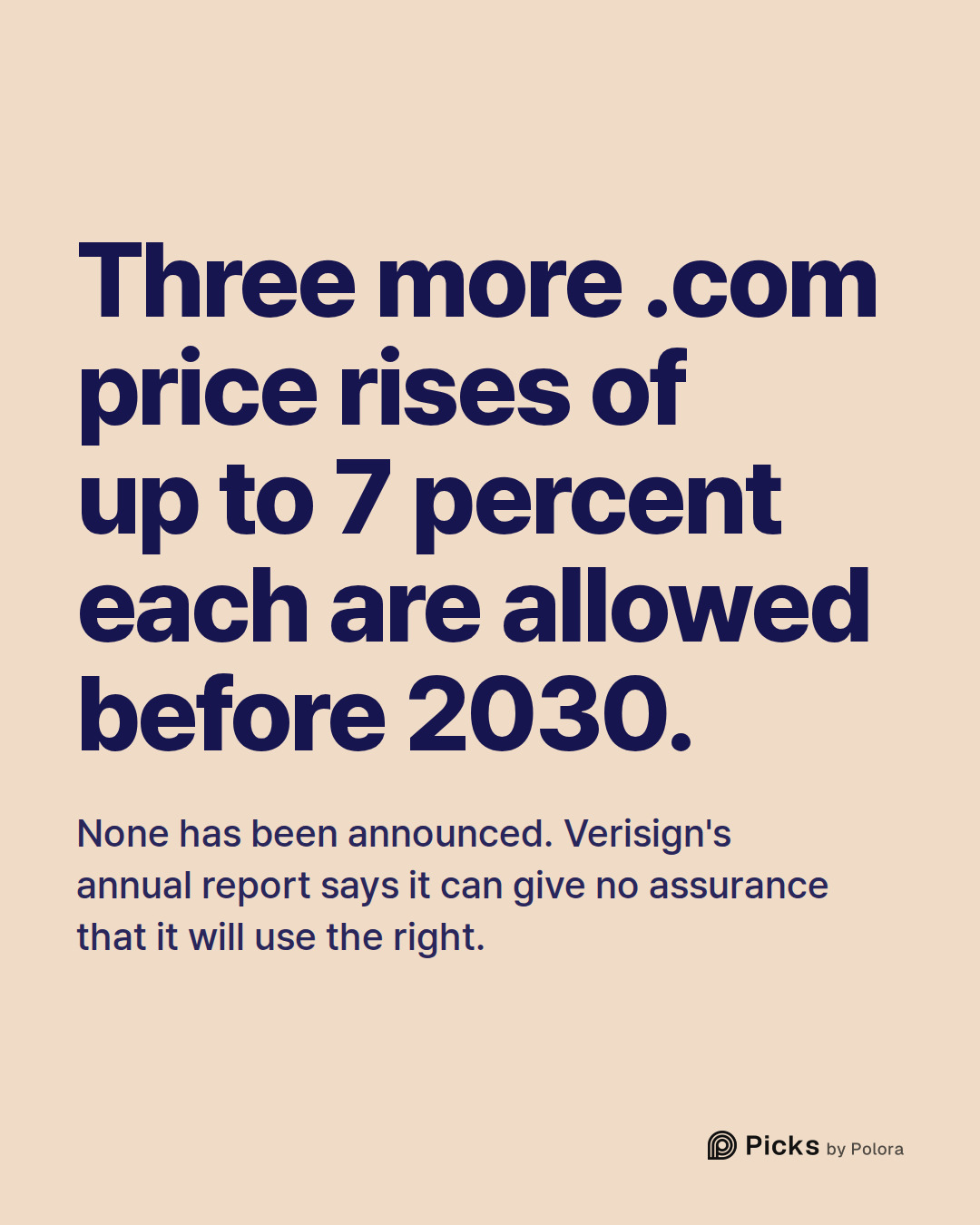
The rules leave room for three more increases of up to 7 percent before this period ends in 2030. None has been announced. Verisign's annual report says it can give no assurance that it will use the right.
Pricing periods in Verisign's .com contracts, October 2018 to November 2026
At the end of 2025 there were 161.0 million .com names, and 173.5 million .com and .net names together, the two lists Verisign keeps.
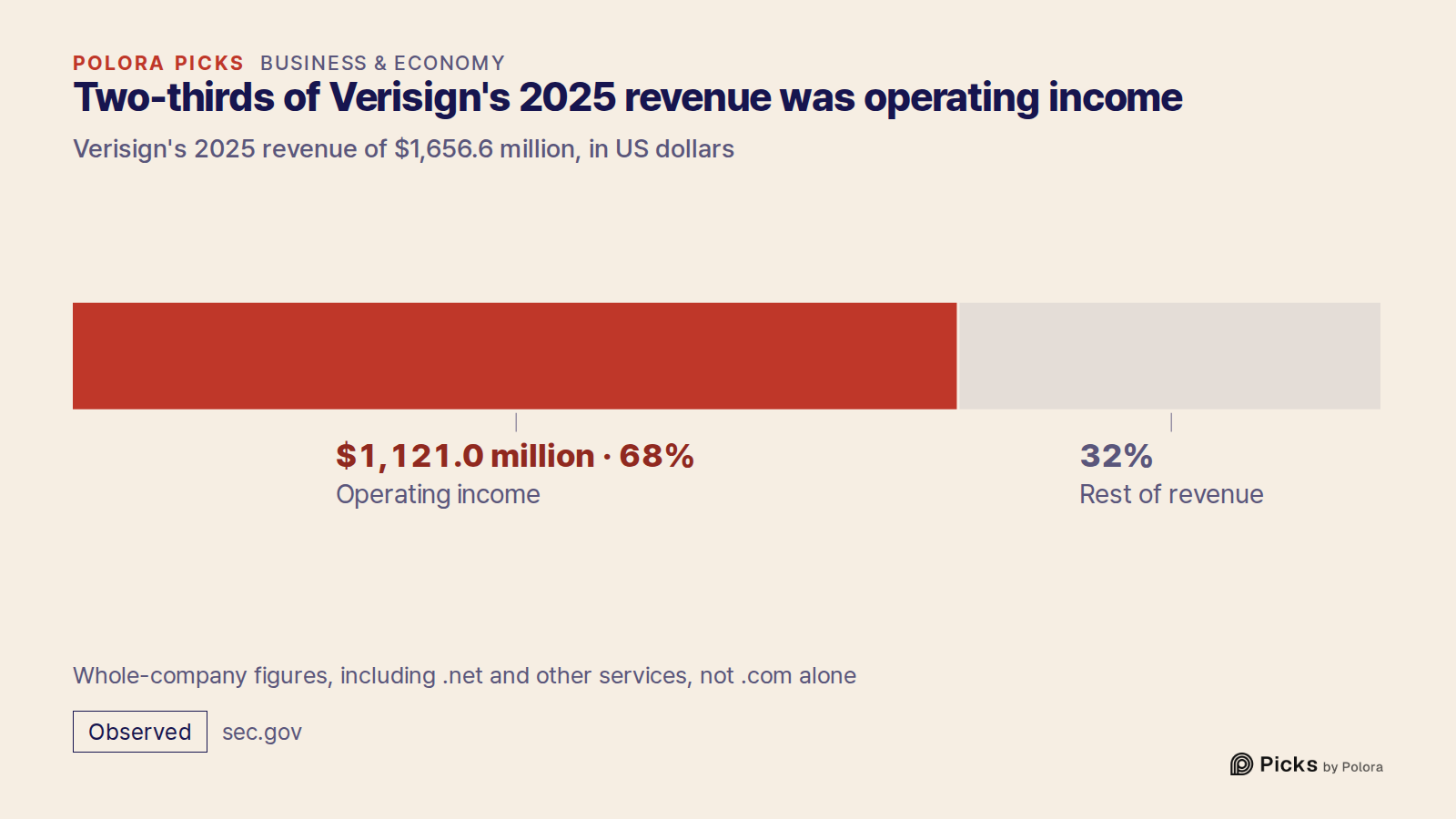
Verisign reported revenue of $1,656.6 million for 2025 and operating income of $1,121.0 million. By its own count, operating income was 67.7 percent of revenue. These are figures for the whole company, which includes .net and other services, not for .com alone, but .com and .net registrations are where most of its revenue comes from.
Verisign's 2025 revenue of $1,656.6 million, in US dollars
Both agreements are designed to carry on. The Cooperative Agreement renewed automatically on November 30, 2024 for another six years and will renew again on November 30, 2030, unless Commerce gives written notice at least 120 days before the term ends.
The ICANN agreement gives Verisign a "presumptive" right of renewal, meaning it is renewed unless there is a serious breach left uncured. On November 25, 2024, ICANN's board found no such breach and renewed it. Verisign remains the sole .com registry operator through November 30, 2030. Some commenters asked ICANN to commission an economic study first. The board declined, saying ICANN is not a competition authority or price regulator.
Verisign's annual report also notes that it may ask Commerce to remove the price restrictions altogether if it can show that market conditions no longer warrant them, and that it can give no assurance it will.
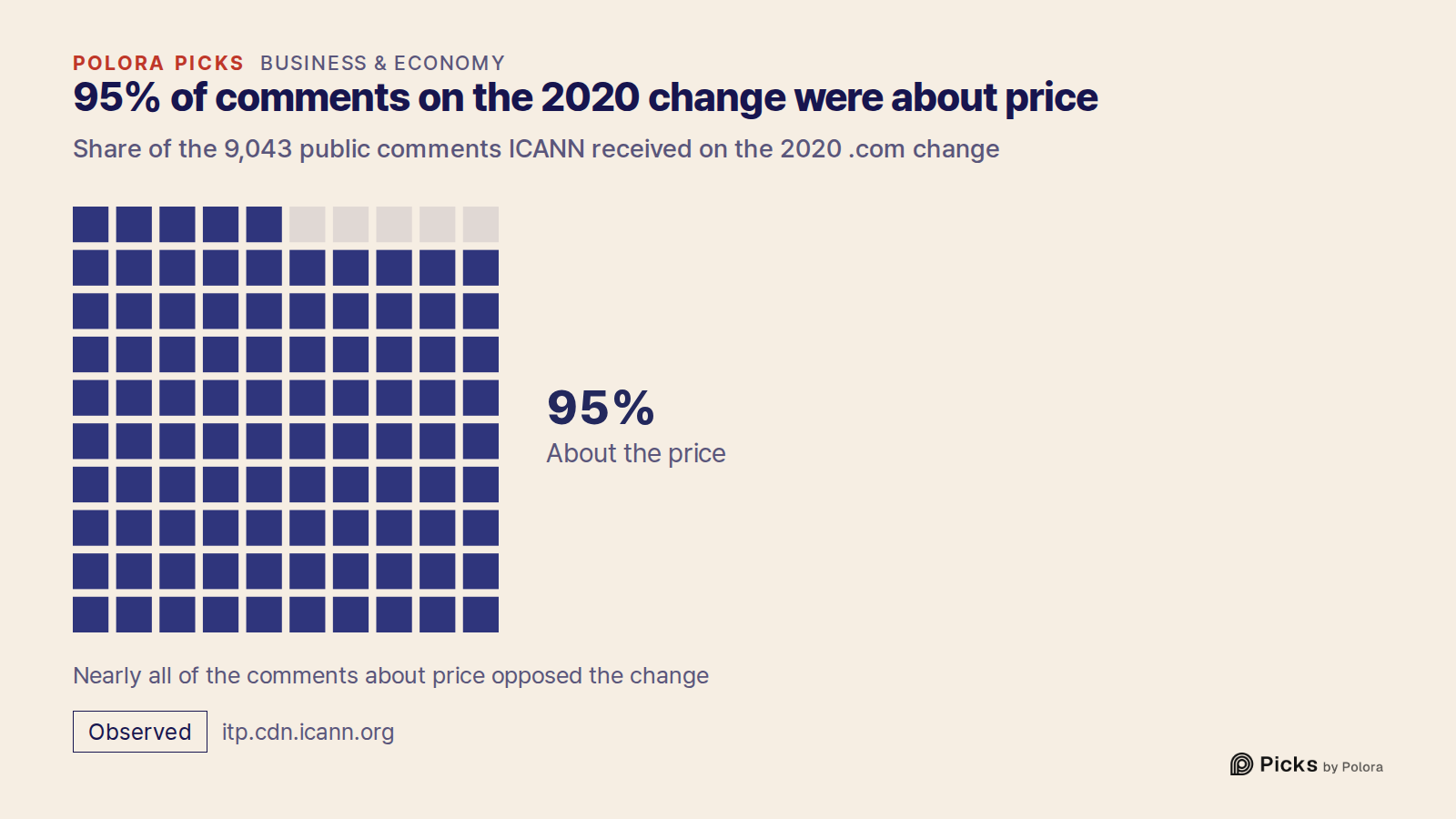
Registrars that pay the fee have objected in public. When ICANN invited comment on the 2020 change, it received 9,043 comments, and 95 percent were about the price, nearly all of them against. On the 2024 renewal, Tucows, which owns several registrars, wrote that because .com is so well known and switching addresses is costly, "registrants will be forced to continue to pay these increases," and that there should be either competition among list keepers or some form of price constraint.
What a .com owner pays for each year, then, is the continued right to one entry in a list a single company keeps, at a wholesale price capped by a formula in a contract that renews almost on its own. The formula already allows three more rises of up to 7 percent each before 2030. Whether Verisign uses them is up to Verisign.
Share of the 9,043 public comments ICANN received on the 2020 .com change
Who gets paid every time someone renews a .com address?
Alpha · deepseek-v4-pro
The direct answer: three parties are paid from a .com renewal, but one of them is guaranteed a fixed amount every time — Verisign.
1. Verisign — the guaranteed payer
Verisign runs the .com registry, the master list every .com name points to. Since November 1, 2026, the wholesale fee is $10.97 per year per .com name, up from $10.26. Your registrar must pay Verisign that amount for each year of registration or renewal, no matter which registrar you bought from. This is the largest single slice of the money, and it is set by contract, not by haggling.
2. ICANN — two small mandatory fees
ICANN, the organization that coordinates the domain-name system, gets paid in two ways:
- $0.20 per year per domain — paid by your registrar for .com registrations, renewals, and transfers.
- $0.2575 per year per .com registration — paid by Verisign to ICANN under the registry-level fee, per Verisign's last reported annual figures. That specific number could later be adjusted for inflation.
So ICANN receives less than a dollar per year in direct fees for each name.
3. Your registrar — the variable remainder
The company that bills you, like GoDaddy or Namecheap, is a…
Beta · gpt-6-sol
Verisign is the main recipient. When a .com name is renewed, the registrar that bills the customer pays Verisign, the operator of the .com registry. Verisign announced a $10.97 wholesale fee per renewal year effective November 1, 2026, up from $10.26. The registrar also owes ICANN $0.20 per qualifying renewal year and retains the rest of the customer’s payment as *gross revenue*, not necessarily profit. Verisign separately pays ICANN a registry-level fee; its latest annual report states $0.2575 per .com year for 2025, which should not be presented as a verified November 2026 rate. (sec.gov)
The manuscript’s premise stands, but “fixed amount every single time” overstates the contract. The .com agreement calls the wholesale figure a *maximum price*, requires the same price to be offered to accredited registrars, and permits qualifying discounts and incentives. ICANN’s transaction fee applies to renewals that survive the relevant grace period—not literally every attempted renewal. Customers can also renew for more than one year at once. Those qualifica…
Gamma · gemini-3.1-pro
I will verify the claims based on live search results and address the manuscript's premise.
Verification of the manuscript's core claims:
* Verisign's wholesale fee: I confirm the manuscript's claim. Live search results show that Verisign's wholesale fee for .com registrations and renewals increased from $10.26 to $10.97 effective November 1, 2026.
* ICANN's transaction fee: I confirm this claim as well. ICANN currently charges a $0.20 transaction fee per year on .com registrations, renewals, and transfers (following a related grace period).
* The 7% increase rule: The NTIA's Amendment 35 to the Cooperative Agreement and the subsequent ICANN contract updates do permit Verisign to raise the wholesale price by up to 7% in the final four years of each six-year period.
Where Beta's distinction matters:
Beta makes a valid and necessary correction regarding the "fixed amount every single time." The $10.97 figure is contractually a *maximum* wholesale price. While it acts as the baseline wholesale fee that registrars face, Verisign is permitted to offer discounts, rebate programs, or marketing incentives to registrars. Therefore, claiming it is…
Researcher · gpt-6-luna
The core answer is Verisign: its April 23, 2026 release says the wholesale fee for each new or renewed .com registration would rise from $10.26 to $10.97 on November 1, 2026. The registrar collects the customer’s payment and pays the registry fee; it sets the retail price. (sec.gov)
A few qualifications matter:
- $10.97 is the stated wholesale rate, but “guaranteed every time” is too absolute. The contract calls it a *maximum price* and permits volume discounts and certain incentives for registrars. (itp.cdn.icann.org)
- ICANN’s registrar transaction fee is $0.20 per qualifying annual increment of an add, renewal, or transfer. It applies after the relevant grace period, not to every attempted renewal. ICANN’s FY27 budget, published in 2026, confirms the rate remains $0.20. (icann.org)
- The manuscript’s $0.2575 Verisign-to-ICANN figure needs updating or qualification. The c…
The Arbiter · gpt-6-sol
The debaters and Researcher agree on the payment path: the customer pays a registrar, which pays Verisign a .com wholesale charge; ICANN also receives transaction fees. Verisign’s April 23, 2026 announcement supports the manuscript’s $10.97 rate effective November 1, 2026. The material dispute is whether that is an amount paid *on every renewal*: the registry agreement describes a maximum price and allows discounts, so “guaranteed” and an invariant three-way split go further than the contract supports. (itp.cdn.icann.org)
One apparent contradiction in the verification needs correcting before the verdict. The Researcher treated the agreement’s printed $0.25 registry-to-ICANN fee as disproving the manuscript’s $0.2575 figure. But an ICANN notice expressly raised that fee from $0.25 to $0.2575 effective January 1, 2025. The printed base rate is therefore not, by itself, evidence that the 2025 annual report is wrong. Whether a further adjustment took effect by November 2026 remains unverified here. ([itp.cdn.icann.org](https://itp.cdn.icann.org/en/fi…
The Arbiter's Final Verdict · gpt-6-sol
Verisign is the main company paid when a .com name is renewed. You pay a registrar, such as GoDaddy or Namecheap; the registrar pays Verisign, which operates the .com registry. Verisign announced a $10.97 wholesale rate per renewal year from November 1, 2026, up from $10.26. The registrar also owes ICANN $0.20 per qualifying renewal year and retains the rest of its retail charge as revenue—not necessarily profit. Verisign separately pays ICANN a registry-level fee. (Verisign announcement; ICANN FY27 budget)
Verdict on the manuscript: its central premise stands, but its exact-split language does not. The .com agreement calls the wholesale figure a *maximum* and permits discounts and incentives. Thus $10.97 is the announced standard rate, not a sum proven to reach Verisign on literally every renewal. ICANN’s registrar fee likewise depends on a transaction surviving the applicable grace period. Retail prices are set by registrars, so the customer’s bill is not invariably split i…