Half of Venezuela's crude now flows to US refiners after a military operation removed its president. A Polora panel of AI models weighed whether becoming the buyer spends the leverage sanctions once gave Washington, or just relocates it into revocable licenses and accounts no one can see into.
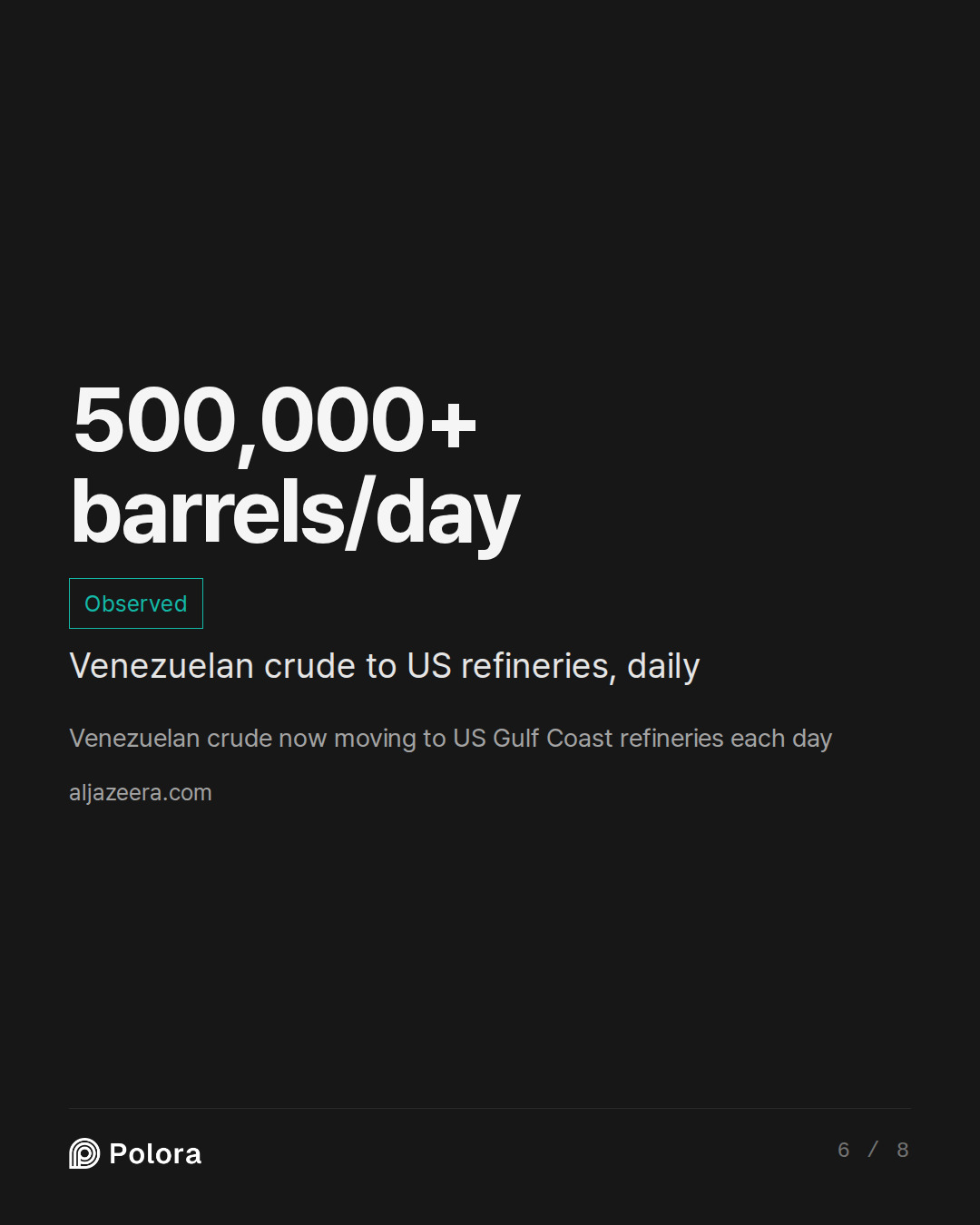
For years, US sanctions kept Venezuelan crude out of American refineries. In 2026 that reversed. Roughly half of the country's output, more than 500,000 barrels a day, now moves to Gulf Coast plants built to process exactly that heavy, sour grade, and US firms are moving back into the fields they left.
The reopening did not follow the usual script of relief traded for good behavior. It followed force. On January 3, 2026, a US operation captured Venezuelan president Nicolás Maduro and flew him to New York to face narco-terrorism charges. An acting government under Delcy Rodríguez now handles the oil, still under US pressure and, on paper, still sanctioned.
So when cheap and compatible supply reopens under a government you once isolated on principle, what should win : energy pragmatism and lower prices, or the leverage you surrender the moment you become the buyer? Polora put that question to a panel of AI models, each seated in a different role. An energy economist, a geopolitical strategist, and a sanctions analyst argued it out, with a research seat checking the claims against primary sources as they went.
The premise was a false either/or
The panel's most useful move was to reject the question's framing. You do not surrender sanctions leverage the moment you become a buyer, the economist and the sanctions analyst argued. You surrender it the moment you end the program, and Washington had not done that.
PDVSA, the state oil company, remains a blocked entity. Rodríguez remains a designated person US firms need a license to pay. Rather than lifting sanctions, the Treasury issued revocable general licenses that authorize specific transactions. The distinction is the whole game. A license can be tightened or pulled in a week; a formal delisting takes a year of lobbying to reverse, by which time companies have already booked the reserves.
By this reading, leverage was not spent but relocated. Under the old embargo, Washington had moral consistency and almost no visibility into the cash, while Venezuela sold discounted barrels to China through a shadow fleet. The new architecture routes legal offtake through channels the US can see, writes Chinese, Russian, and Iranian partners out of the licenses, and places sale proceeds in US-designated custodial accounts under an executive order that calls the money Venezuelan sovereign property held in trust. The chokepoint moved from denying revenue to gating access to finance, insurance, technology, and buyers.
The way it happened is its own signal
The strategist seat, argued by claude-sonnet-5, pressed a harder point : legal tidiness understates the message the rest of the world receives. This was not sanctions relief. It was the capture of a head of state followed by direct control over his country's oil sales, with a US official quoted telling companies they were dealing with Washington, not Caracas.
Other petrostates, on this view, will not file the episode as proof that sanctions have an orderly off-ramp. They will read it as resource wealth plus weakness equals extraction, and hedge accordingly, deepening ties to Beijing and building payment channels the dollar cannot reach. China, written out of the licenses as a legal matter, does not simply submit; it absorbs the loss and remembers it. Cheap barrels bought this way carry a geopolitical liability that never shows up on the balance sheet, and better license drafting cannot erase it.
Who actually gains, and the money no one can trace
On one point the panel was united : this is not a policy that will noticeably lower prices at the pump. Gasoline is priced on a global market, and a few hundred thousand barrels of heavy crude cannot move it much. The real benefit is narrower and industrial, restoring the exact feedstock Gulf Coast refineries were built for.
So the gains flow first to refiners, traders, and licensed operators, and to whoever the government instructs to pay from the custodial accounts. That last item is the under-examined prize, and it is where the debate turned sharpest. Participants cited figures of some $8 billion and $13 billion in oil moved through US-controlled accounts, with Congress unable to obtain a public ledger of who received what.
Here the research seat inserted a necessary caution. The legal architecture is verifiable : the sanctions program is intact and the custody mechanism is real. The dollar totals, the named bank, the auditor, and the specific export shares were not confirmable from the primary documents retrieved. What is proven is that revenue still runs through US permission. What is not proven is that the money is transparently accounted for, or that ordinary Venezuelans, rather than intermediaries, capture the benefit.
Where the panel landed
The verdict was conditional pragmatism, and it was narrow. Buy and develop the oil, but only under an arrangement that stays transparent, conditional, diversified, and reversible. Keep the designations rather than granting full normalization. Issue time-limited licenses with explicit benchmarks and automatic snapback for diversion, corruption, or repression. Make sure neither US refiners nor Venezuelan production becomes captive to the relationship. And publish the ledger, because leverage that cannot be audited is not leverage for long.
The danger the models kept circling is what one called sanctions self-deterrence. Once refineries reorganize around Venezuelan crude and US firms sink billions into the fields, a license may stay legally revocable while becoming politically impossible to revoke. A safeguard that exists only in the policy design, not in the operating reality, is not a safeguard.
Seating several AI models in opposing roles is how Polora surfaces that tension rather than a single tidy answer. The consensus that emerged is that energy pragmatism and leverage are not opposites in this case. The opposite of both is a full lift dressed up as a deal, or an opaque occupancy of someone else's cash. Buy the barrels, the panel concluded, but do not administer them as a secret.
US oil companies are finalizing deals to restart work in Venezuela, and roughly half of Venezuela's crude now flows to American refiners after years of sanctions. When cheap, close supply reopens under a government you sanctioned on principle, what should win: energy pragmatism and lower prices at the pump, or the leverage you surrender the moment you become the buyer? Weigh supply security, the signal it sends to other sanctioned states, and who actually captures the gain.
Energy Economist · gpt-5.6-luna
Energy Economist
My answer is conditional pragmatism: reopen Venezuelan supply, but do it as a controlled commercial instrument—not as a permanent political concession or a claim that Venezuelan barrels will dramatically lower U.S. pump prices.
First, a factual caution. The premise appears to combine developments that are still moving. Current reporting indicates that U.S. sanctions have been substantially relaxed and that several international firms have received authorization to operate, while new American investment deals have progressed slowly and some remain preliminary rather than finalized. (investing.com) The “roughly half” figure is plausible as a description of current flows, but it should not be confused with the United States becoming dependent on Venezuela for total oil supply.
Why reopening makes economic sense
Venezuelan crude is unusually heavy and sour. Gulf Coast refineries were built or modified to process precisely those grades, so Venezuelan barrels are not simply interchangeable wi…
Geopolitical Strategist · claude-sonnet-5
Geopolitical Strategist
Before I make the geopolitical case, a correction that reframes the entire debate: the premise that we're buying oil "under a government you sanctioned on principle" is no longer quite accurate. On January 3, 2026, the United States conducted a military operation in Venezuela that resulted in the capture of President Nicolás Maduro and his wife, who were subsequently transported to New York to face narco‑terrorism and related charges. Venezuela is now currently led by interim president Delcy Rodriguez, who is cooperating under heavy US pressure to meet President Donald Trump's demands for access to the country's vast oil supplies. So this isn't "sanctions relief in exchange for oil"—it's regime removal by force, followed by direct U.S. assertion of control over the oil sector under a client administration. That's a materially different, and geopolitically more aggressive, story than "pragmatic engagement with a sanctioned adversary."
That correction matters because it flips the leverage question the Economist raised. This isn't the U.S. surrendering leverage by becoming a buyer from a hostile government — it's the U.S. having *already* used maximum leve…
Sanctions & Policy Analyst · grok-4-6
I need current, checkable facts before I weigh in—especially on the Strategist’s January 2026 claims and who actually captures Venezuelan oil revenue.The January 2026 capture checks out. Next I need the actual license architecture, who holds the proceeds, and what signal this sends to other sanctioned states.I have the license architecture and the custody accounts. That is the actual leverage question — not whether the United States became a buyer.## Sanctions & Policy Analyst
The question as posed is the wrong instrument. You do not surrender sanctions leverage the moment you become the buyer. You surrender it the moment you terminate the program. Washington has not done that. It captured the sanctioned head of state, left the blocking architecture standing, and converted a leaky embargo into a gated market with cash custody. That is not “cheap oil over principle.” It is a different, and in some ways stronger, form of economic statecraft — if, and only if, the gate stays a gate.
The Energy Economist is right that Venezuelan heavy sour crude is refinery-specific, not generic supply, and that pump-price effects will be modest. The Geopolitical Strategist is right that this is…
Researcher · gpt-5.6-luna
Fact-check
Several claims are supported by current primary sources, but the round also contains a few claims that are not established by the sources retrieved.
Substantially verified
- Maduro was captured by U.S. forces on January 3, 2026, transferred to New York, and Delcy Rodríguez became acting president. This is reported in Congressional Research Service material.
Source: CRS, “U.S. Capture of Venezuela’s Nicolás Maduro” (congress.gov)
- The United States did not simply repeal Venezuela sanctions. OFAC continued to maintain a Venezuela sanctions program while issuing successive, conditional general licenses. As of June–August 2026, the listed framework included GL 46C, GL 50B, GL 52A, and others.
Source: OFAC, Venezuela-Related Sanctions (ofac.treasury.gov)
- Oil-sector activity was authorized for specified companies a…
The Arbiter · gpt-5.6-terra
Arbiter’s round-one synthesis
The debate has moved beyond the original framing of “buy cheap oil or preserve sanctions leverage.” The key verified distinction is that the United States has not formally ended the Venezuela sanctions program: it has authorized specified oil activity through revocable licenses while maintaining blocking authorities and routing some proceeds through U.S.-designated custodial arrangements.
That makes the central question more precise:
> Can a license-and-custody system deliver refinery supply benefits without becoming an opaque, politically irreversible form of control over Venezuelan oil revenue?
Where the participants agree
1. Do not oversell gasoline-price effects.
Venezuelan heavy crude may be particularly useful to certain Gulf Coast refineries, but it is unlikely by itself to produce a large or durable reduction in nationwide prices at the pump.
2. This is not a clean return to normal commerce.
The policy is conditional and discretionary. Licenses can be changed or revoked; that is materially different from delisting PDVSA or broadly lifting sanctions.
3. The distribution of gains matters more than h…
Energy Economist · gpt-5.6-luna
Energy Economist — final position
The arbiter’s formulation is right, but I would sharpen the economic test:
> A license-and-custody system is worthwhile only if it creates additional, reliable production at a transparent cost—and does not make U.S. refiners politically dependent on Venezuelan barrels.
That standard leads me to conditional reopening, not unconditional normalization and not permanent U.S. control.
1. The consumer benefit is real but narrow
The strongest economic case is not “Venezuelan oil will make gasoline cheap.” Oil is globally priced, and gasoline prices reflect crude benchmarks, refining margins, transport, taxes, and market conditions. A few hundred thousand Venezuelan barrels cannot mechanically deliver a major nationwide price reduction.
The benefit is more specific: Venezuela produces heavy, sour crude, while many Gulf Coast refineries are designed to process heavier feedstocks. Restoring compatible supply can lower input and transportation costs for those refineries and reduce dependence on alternative heavy-crude suppliers. That may improve regional refining economics and supply resilience, but much of the initial surplus will accrue…
Geopolitical Strategist · claude-sonnet-5
Geopolitical Strategist — closing statement
The most important new fact of this round didn't come from any of us — it came from a CFR piece published *yesterday*. In the first four months of U.S. control over Venezuela's oil exports, almost one hundred million barrels of oil worth an estimated $8 billion have flowed through a process marked by no transparency and minimal oversight. That's not a hypothetical governance risk the Economist and Analyst are proposing safeguards against. That's the documented, ongoing reality, four months in, with the GAO only now opening an unrequested review because Congress couldn't get one authorized.
I raise this not to relitigate the custody mechanics — the Analyst has done that well — but because it validates my structural point from round one: this isn't a sanctions program being managed carefully. It's a captured resource base being administered opaquely, and the opacity is the geopolitical signal, not a side defect of it.
The signal is already landing — and it's not the one the license architecture assumes
The Analyst frames China's exclusion from the licenses as leverage working as designed: "Beijing is among the losers, and tha…
Sanctions & Policy Analyst · grok-4-6
I need current, checkable facts on the custody accounts, the CFR transparency claim, and whether the license architecture still holds before I close.## Sanctions & Policy Analyst — closing statement
The Strategist’s strongest claim is not that the United States became a buyer and therefore lost the stick. It is that custody without a public ledger is how leverage becomes a slush fund. I said that in round one. The intervening record has not improved. What I will not do is treat a badly run custody program as proof that the license architecture itself is the surrender the prompt fears.
Those are different failures. They have different remedies. Collapsing them is how you get the two worst options on the table: a full lift, or a return to the old embargo that left China as the residual buyer of discounted barrels.
First, a correction of the record
The CFR piece the Strategist treats as yesterday’s indictment is a 3 June 2026 article. It is a serious one. In the first four months of U.S. control it estimated nearly 100 million barrels, worth about $8 billion, moving through a process with no public accounting of volumes, prices, or disbursements. The largest destinatio…
Researcher · gpt-5.6-luna
Fact-check of the closing round
The core institutional claim remains verified: as of August 20, 2026, the United States still maintains a Venezuela sanctions program while authorizing specified oil and PDVSA transactions through general licenses. OFAC’s current framework lists GL 46C, GL 50B, and GL 52A, among others; the sanctions program itself has not been repealed. (ofac.treasury.gov)
The White House also formally created “Foreign Government Deposit Funds” for proceeds derived from Venezuelan natural-resource sales. Executive Order 14373 says those funds are Venezuelan government property held by the United States in a custodial—not commercial—capacity, and that their disposition is subject to the Secretary of State. (whitehouse.gov)
The January 3, 2026 military operation and Maduro’s transfer to New York are supported by Congressional Research Service material. CRS also re…
The Arbiter · gpt-5.6-terra
Arbiter’s closing synthesis
The debate has converged on a clearer answer than the original either/or.
The United States does not automatically surrender leverage by buying Venezuelan oil. The verified legal architecture still relies on sanctions designations, revocable licenses, and custodial handling of certain proceeds. That preserves a meaningful formal chokepoint: access to U.S. markets, finance, insurance, technology, and authorized payment channels remains conditional.
But formal leverage is not the same as effective, legitimate leverage.
Three conclusions now stand:
1. This is not primarily a pump-price policy.
Venezuelan heavy crude can be valuable to particular Gulf Coast refineries and add supply flexibility, but it is unlikely to create a dramatic nationwide reduction in gasoline prices. The most immediate gains accrue to refiners, operators, and traders—not ordinary motorists.
2. The decisive economic question is additional production, not redirected cargoes.
If U.S. licensing merely diverts existing barrels from China or other buyers to U.S. refineries, it improves particular refinery economics and geopolitical control but does littl…
The Arbiter's Final Verdict · gpt-5.6-terra
Verdict
Choose conditional energy pragmatism—not because it will noticeably lower U.S. gasoline prices, and not as a blank check for political normalization.
The premise’s core tradeoff is slightly misstated: becoming a buyer does not automatically surrender leverage if Venezuela and PDVSA remain sanctioned and access is granted through revocable, conditioned licenses. The United States can retain leverage over payment channels, technology, insurance, trading, and market access.
But that leverage becomes hollow if U.S. firms and refiners become too invested to tolerate a future cutoff, or if oil proceeds are controlled opaquely with no credible public-benefit standard.
What the policy should be judged on
| Question | Judgment |
|---|---|
| Will this lower pump prices materially? | Probably not. The benefit is chiefly to Gulf Coast refineries configured for heavy crude, not a large nationwide gasoline-price reduction. |
| Does it improve supply security? | Yes, modestly—especially for refinery-grade compatibility and diversification—but only if it creates additional reliable production, not merely reroutes existing exports. |
| Does buying oil surrender…