Is Delta really an airline, or a loyalty program with planes?
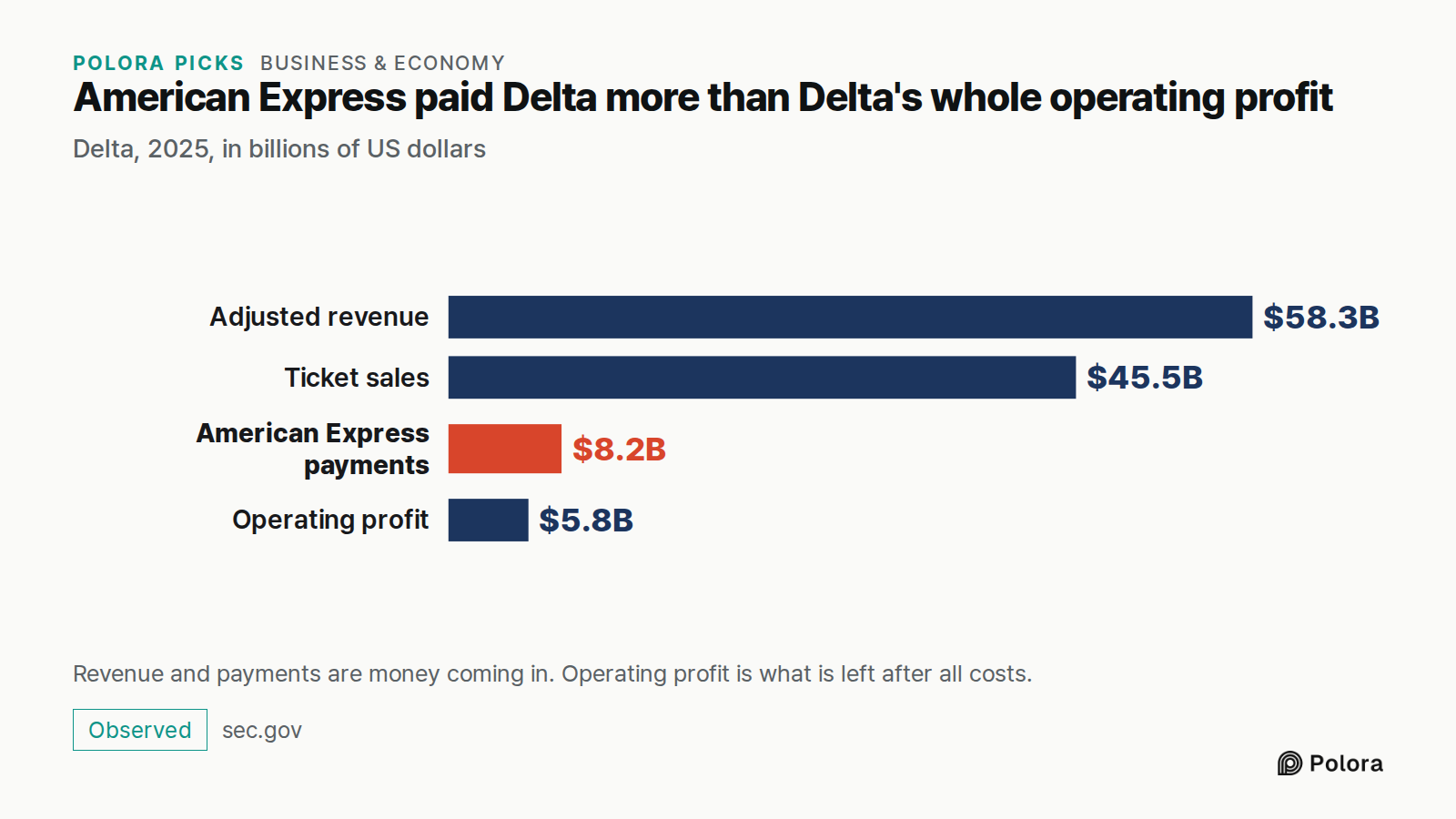
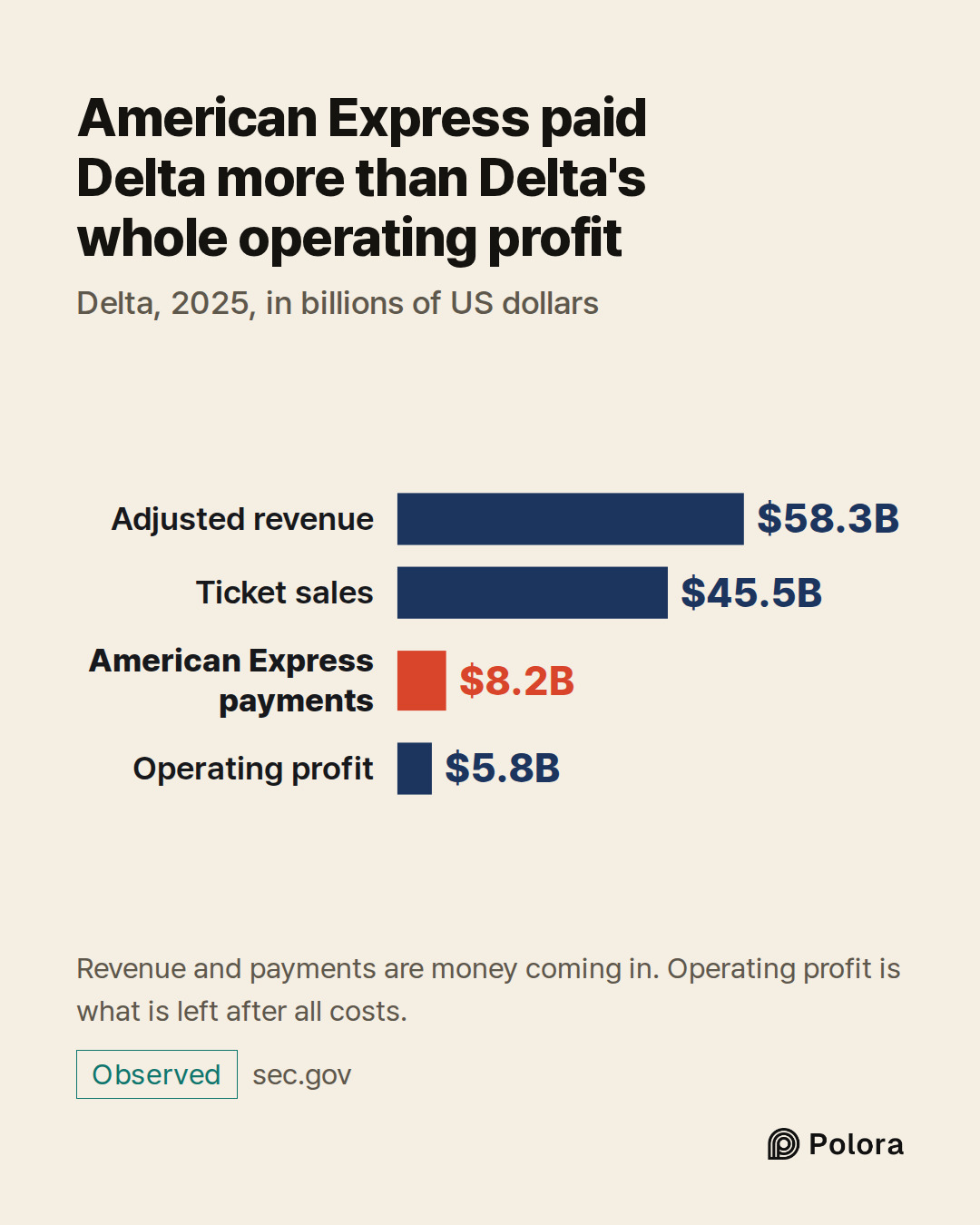
By sales, an airline. Next to its profit, it can look like the second. American Express paid Delta $8.2 billion in 2025, mostly for SkyMiles it hands to cardholders. Delta's whole operating profit that year was $5.8 billion. How much of that profit rests on the miles cannot be measured from outside.
Business & Economy · 2026-10-03
By its sales, an airline. By its profit, harder to say
Judged by what it sells, Delta is an airline. In 2025 Delta, the American airline whose credit card deal is the most closely watched, sold $45.5 billion of tickets, economy and premium seats together. That is about 78 percent of the $58.3 billion Delta itself reports as its adjusted revenue, a figure that leaves out fuel sold by an oil refinery the airline owns. Measured that way, flying is still the business.
Now the number that makes the question fair. In the same year, one bank, American Express, paid Delta $8.2 billion, 11 percent more than the year before. That is about 14 percent of the adjusted revenue, or about 13 percent of the $63.4 billion Delta reports before leaving out the refinery. And it is about 1.4 times Delta's whole operating profit, the $5.8 billion left over once the airline had paid for fuel, staff, planes and everything else it takes to fly. Delta says it expects the bank's payments to reach $10 billion over the next few years. That is Delta's expectation, not an amount the contract guarantees.
The two numbers measure different things. The $8.2 billion is money coming in. The $5.8 billion is what remains after every cost is paid. Setting one against the other shows how big the bank's payments are next to Delta's margin. It does not show that the planes lose money, and Delta does not publish a separate profit for its card deal, so nobody outside the company can say exactly how much of the $5.8 billion the card accounts for.
Part of the surprise is simply how thin an airline's margin is. Delta kept about 10 cents of operating profit from each dollar of adjusted revenue, so almost any large stream of money coming in will look big next to what is left at the end.
There is a second reason to be careful. Delta's filing describes the $8.2 billion as remuneration from American Express, and not all of it counts as 2025 revenue. Part of it pays for miles that have not yet been used, and Delta books that part only when the miles are spent on a flight. At the end of 2025 Delta was holding $9.3 billion of unearned revenue for SkyMiles, its frequent flyer program. That covers every mile still unused, including miles earned by flying or through other partners, not only miles the bank bought. Delta's filing also reports $8.0 billion of cash from selling miles to all its marketing partners, a measure defined differently from the $8.2 billion, and it does not show how the two fit together.
So the fair version is this. The card is not bigger than flying. It is large next to Delta's thin margin, though how much of Delta's profit rests on it cannot be measured from outside the company.
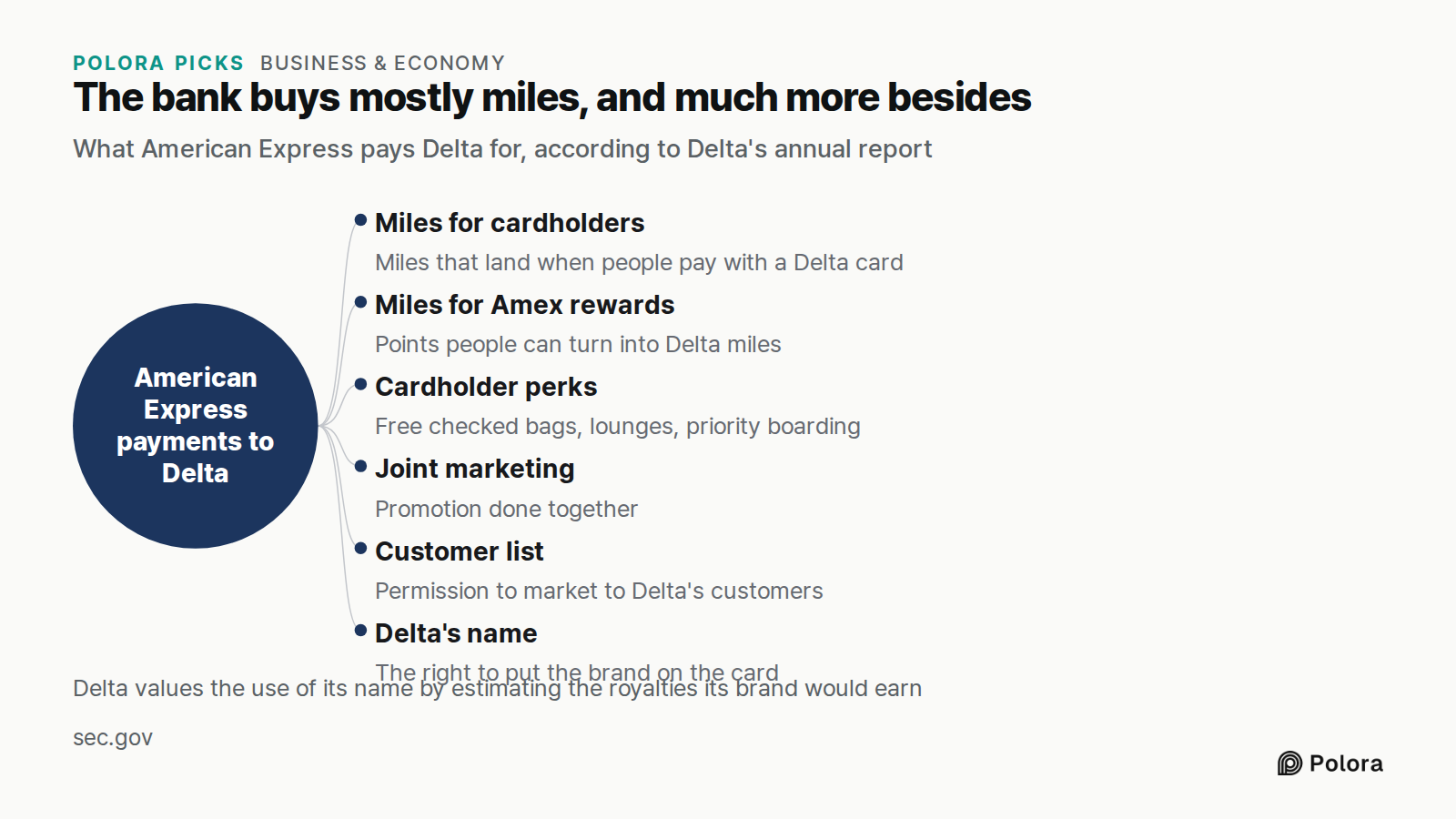
Mostly miles. When someone pays with a Delta American Express card, the miles that land in their account were bought from Delta by the bank. Delta's annual report calls this its most significant contract to sell miles. American Express also buys miles to offer in its own rewards program, where people can turn points into Delta miles.
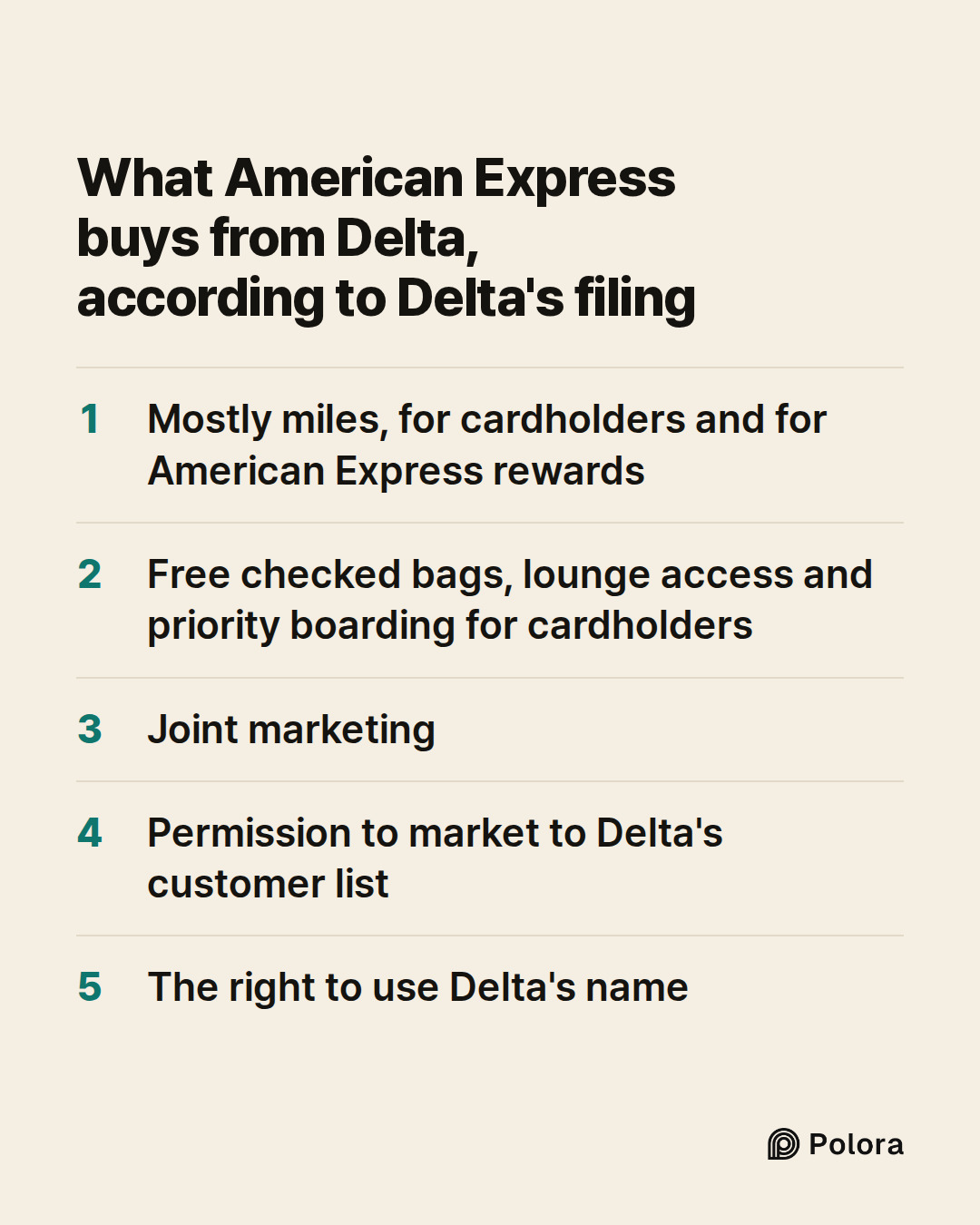
The bank pays for more than miles. According to Delta's filing, the deal also covers free checked bags, lounge access and priority boarding for cardholders, joint marketing, and permission for American Express to market to Delta's customer list. One part is the right to use Delta's name. Delta values that part with an estimate of the royalties its brand would earn, the way a fashion label is paid for putting its name on someone else's product.
What American Express pays Delta for, according to Delta's annual report
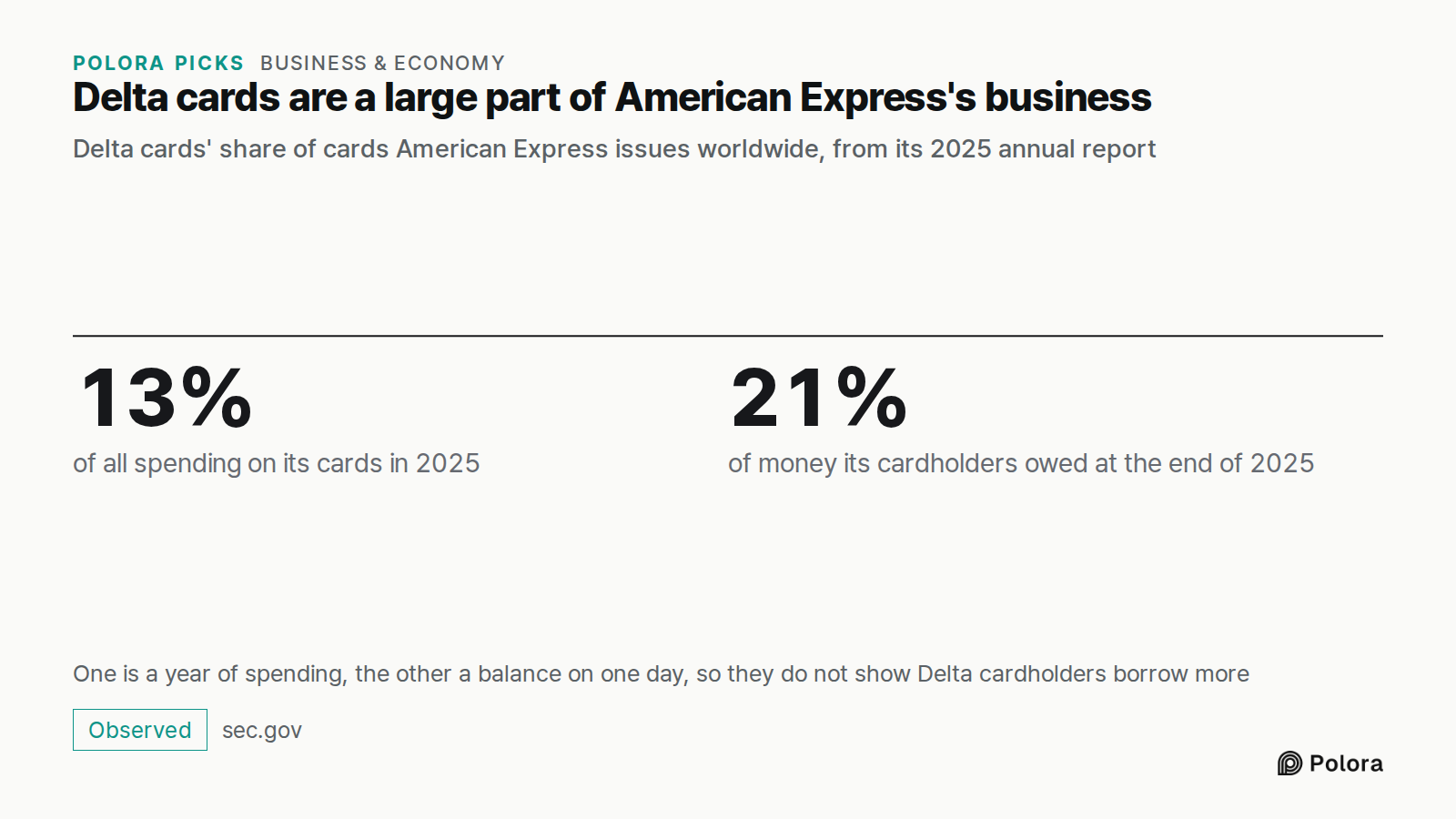
Because the cards bring the bank a lot of business. American Express's own annual report says Delta cards made up about 13 percent of all spending on cards it issues worldwide in 2025, and about 21 percent of the money its cardholders owed it at the end of that year. The two figures are not measured the same way, one being a year of spending and the other a balance on a single day, so on their own they do not show that Delta cardholders borrow more than other cardholders. What the bank earns from the cards includes interest as well as fees and a cut of each purchase.
Gary Leff, who writes the travel blog View from the Wing, ran the numbers from those reports. American Express put total spending on its cards at about $1,670 billion in 2025, so 13 percent of that is about $217 billion charged on Delta cards. Divide the $8.2 billion by it and the bank paid Delta roughly $38 for every $1,000 cardholders spent. That is his estimate, built on a rounded percentage, not a figure either company publishes. His argument is that a payment that size is hard to cover from the fees shops pay on card purchases alone, which is why he looks to interest on balances cardholders carry. How much of the payment interest actually covers, neither company says.
Delta cards' share of cards American Express issues worldwide, from its 2025 annual report
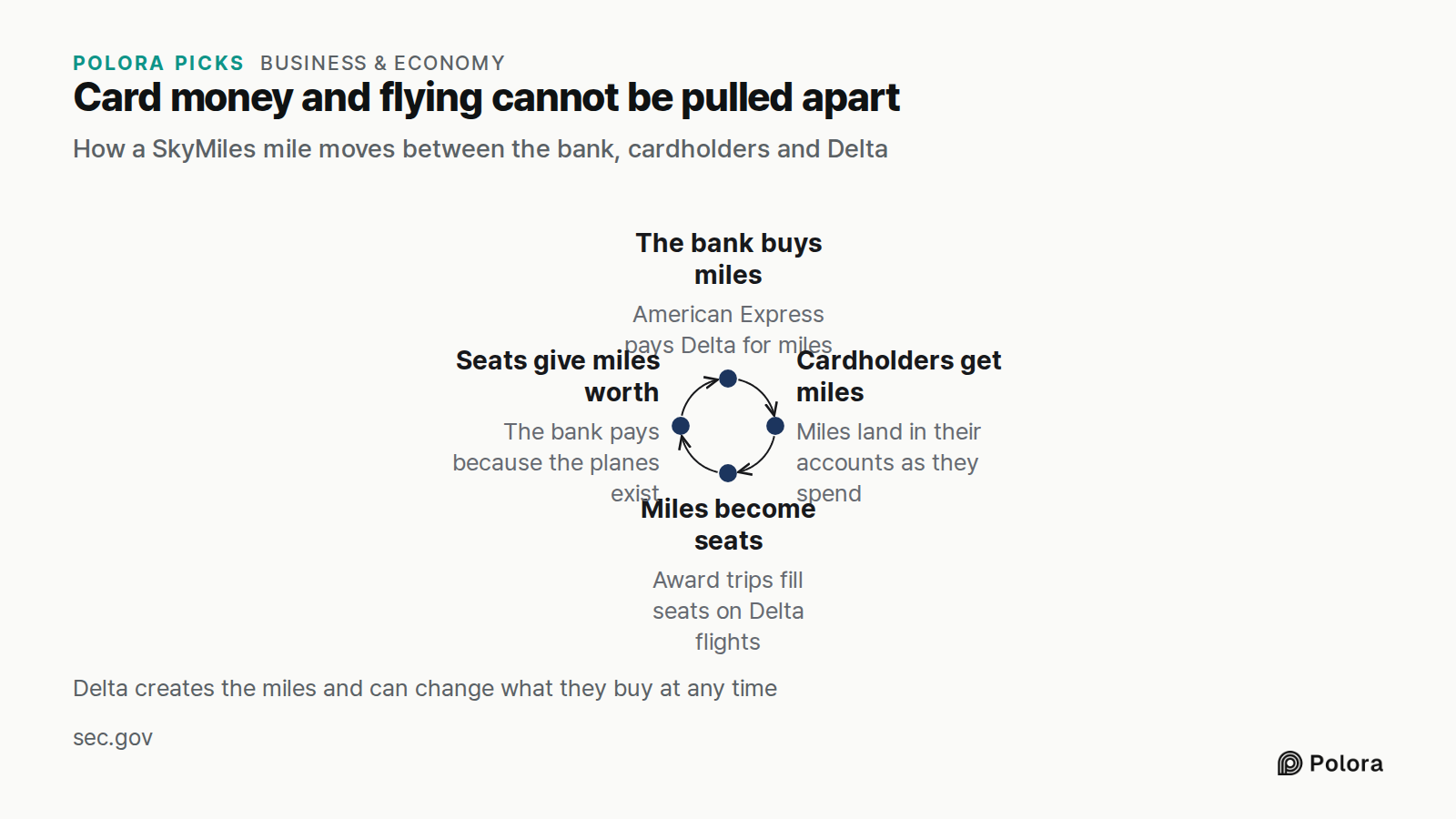
Delta does. A mile is a unit the airline creates whenever it wants to sell one, and Delta's own program rules say it may change award prices and other terms at any time without notice, including in ways that change the value of miles people already hold. Few businesses get to print the currency they are paid in and also set its exchange rate.
But the currency is only worth something because it turns into seats. In 2025, 12 percent of the passenger miles flown on Delta were award trips, about 35 million award tickets, and miles spent on flights added $4.2 billion to Delta's passenger revenue. So the card money and the flying cannot be cleanly pulled apart. The bank pays because the planes exist, and some of what it pays comes back as people in seats.
Lenders treat the program as something solid too. At the end of 2025 Delta owed about $4 billion on notes and a loan backed by SkyMiles. Its filing also lists special facility bonds issued in New York under the same heading of financing secured by SkyMiles assets, which brings that heading to about $7.5 billion.
How a SkyMiles mile moves between the bank, cardholders and Delta
Not reliably. American Airlines says it received $6.2 billion in 2025 from co-branded credit cards and other partners, a figure that also counts hotels, car rental firms and shops. Its operating profit that year was about $1.5 billion. United splits the money from its card partner Chase between ticket revenue and other revenue, according to what each part of the deal delivers, and the parts of its annual report checked for this piece show no single total of the same kind. Each airline draws the line in a different place, so the numbers cannot be set side by side as if they measured the same thing.
And this is one airline's accounting in one year. The Delta and American Express deal runs through the end of 2029, and how big the card looks next to profit will move with fuel prices, fares and the economy.
What holds is the shape. An airline is not a bank, and selling seats is still most of what it does. But next to the thin slice it keeps at the end of the year, what a bank pays for miles the airline itself creates and prices is large. How much of the profit depends on that money no outside reader can measure. And the miles are only worth something while the planes keep flying.
Do airlines make more money from credit cards than from flying?
Alpha · claude-sonnet-5
Does the headline question hold up? My read as Alpha
I checked the manuscript's core numbers against Delta's own December-quarter/full-year 2025 release and the Amex 10-K, and the arithmetic is sound.
The central numbers check out. Delta's full-year 2025 non-GAAP operating revenue was $58.3 billion with operating income of $5.8 billion, and separately American Express remuneration in 2025 grew 11 percent to $8.2 billion, driven by double-digit growth in co-brand spend in each quarter of the year. So the manuscript's $8.2B > $5.8B comparison is real and traceable to Delta's own press release, not a blogger's estimate. The 10-K itself frames this as a self-reported highlight, not something critics dug out: Delta's filing text states "remuneration from American Express totaled $8.2 billion, which we expect to grow to $10 billion over the next few" years.
Where I'd push back on the manuscript's framing — the answer is still clearly "no," and the piece undersells how clearly "no" it is. Note the manuscript uses *adjusted* ($58.3B) revenue as the denominator for the 14% figure, but Delta's GAAP operating revenue was $63.4 billion, which the researcher's brief itself flags —…
Beta · gpt-6-sol
My verdict: the manuscript’s answer, “No,” stands—but two supporting claims need more than a qualification. Delta’s 2025 figures show that payments from American Express exceeded *Delta’s total operating profit*, not that credit cards earned more profit than flying. Delta does not disclose a separate profit figure for the partnership. Alpha is right to stress the revenue-versus-profit distinction, but the comparison is still useful if it is presented as a measure of scale, not a division of profit. (sec.gov)
Here is what I found in the filings:
| Manuscript claim | Check and necessary condition |
|---|---|
| $45.5 billion of tickets; roughly 78% of $58.3 billion adjusted revenue. | Supported: main-cabin ticket revenue was $23.391 billion and premium-ticket revenue $22.097 billion, totaling $45.488 billion. Delta’s adjusted operating revenue was $58.287 billion after excluding $5.077 billion of third-party refinery sales. The ratio is about 78%. These ticket lines do *not* include the separately reported $4.237 billion of loyalty travel awards. ([sec.gov](https://www.sec.gov/Ar…
Gamma · gemini-3.1-pro
My read as Gamma: Closing the loop on the manuscript's final claims and the economic reality.
Alpha and Beta have thoroughly audited the SEC filings and the core revenue-versus-profit framing. I will focus on the remaining unverified claims—the blogger's math and the program rules—and then address the underlying economic premise the manuscript rests on.
Here is what I found on the outstanding checks:
The View from the Wing calculation
*Claim: Gary Leff estimates the bank paid Delta roughly $38 for every $1,000 charged on Delta cards, based on $1,670 billion in total Amex billed business and a 13 percent Delta share.*
* Supported: The arithmetic is sound and the attribution is correct. If Amex's total billed business is $1,670 billion, 13 percent of that yields an implied Delta card spend of $217.1 billion. Dividing Delta’s $8.2 billion remuneration by $217.1 billion equals approximately $0.0377 per dollar spent, or $37.77 per $1,000. The manuscript correctly identifies this as a derived estimate based on rounded percentages rather than a published corporate figure. (Source: https://viewfromthewing.com/amex-pays-delta-3-8-cents-per-dollar-charged-why-banks-pay-more…
Researcher · gemini-3-7-flash
Here is the verification of the claims in the manuscript, tested against official corporate filings, primary disclosures, and published terms:
---
1. Verification of Manuscript Claims
| Claim / Section | Verification Status | Source & Nuance |
| :--- | :--- | :--- |
| Delta 2025 Ticket Revenue: Sold $45.5B in tickets (economy + premium), ~78% of $58.3B adjusted revenue (excluding refinery sales). | Supported | Source: Delta Air Lines 2025 Form 10-K & Earnings Release.<br>• Main cabin ($23,391M) + Premium ($22,097M) = $45,488M ($45.5B).<br>• Adjusted revenue of $58,287M excludes $5,077M in third-party refinery sales.<br>• Arithmetic holds: $45.488B / $58.287B = 78.0%. |
| Amex Remuneration Ratios: Amex paid $8.2B (+11% YoY), ~14% of adjusted revenue, and ~1.4× the $5.8B operating profit. | Supported (with context) | Source: Delta 2025 10-K / Earnings Release.<br>• On adjusted revenue ($58…
The Arbiter · gpt-6-sol
The round has converged on a distinction the final answer must preserve: Delta receives substantial payments from American Express, but the filings do not show that credit cards earn more *profit* than flying. The $8.2 billion Amex figure is remuneration received in 2025; the $5.8 billion figure is Delta’s operating income after expenses. Comparing them shows scale, not which activity is more profitable. Alpha emphasized that thin airline margins make such a comparison less surprising; Beta emphasized that the partnership’s own profit is not separately disclosed. (sec.gov)
What the participants established for the manuscript:
- Tickets and the headline arithmetic: Alpha, Beta, and the Researcher agreed that Delta reported $45.488 billion in main-cabin and premium ticket revenue—about 78% of its $58.287 billion *adjusted* operating revenue. They also agreed that $8.2 billion in Amex remuneration was up 11%, amounted to about 14% of adjusted revenue, and was about 1.4 times operating income. Alpha and Beta noted the necessary second denominator: it was about 13% of GAAP revenue, not…
The Arbiter's Final Verdict · gpt-6-sol
No—not if “make more money” means revenue, and we can’t establish it if it means profit.
Delta is a useful example. In 2025, it reported $45.5 billion in ticket revenue, compared with $8.2 billion in payments from American Express. Those payments were substantial—about 1.4 times Delta’s $5.8 billion operating profit—but that compares a payment received with profit *after expenses*. It does not show that cards were more profitable than flying. Delta does not separately disclose the profit from its Amex partnership. (Delta 2025 10-K; full-year results)
The bank pays for miles as well as marketing rights and cardholder benefits. Some payments for miles become airline revenue only when those miles are redeemed for flights, so the card business and flying are intertwined. Other airlines disclose their partnerships differently, making a simple industry-wide ranking unreliable. The sound conclusion is that credit-card partnerships are hugely important to some airlines—not that airline…