Does Coca-Cola actually make the Coke you drink?

Usually not, for a can or bottle. In most countries a separate bottler mixes, fills and delivers it with Coca-Cola's concentrate, and Coca-Cola keeps the more profitable part.

Business & Economy · 2026-10-04

The company that filled your can is usually not Coca-Cola

Ask almost anyone who made the can of Coke in their hand and they will say Coca-Cola. In most of the world that is not quite right. The Coca-Cola Company's own annual report for 2025 says that most of its drinks are "prepared, packaged, distributed and sold by independent bottling partners."

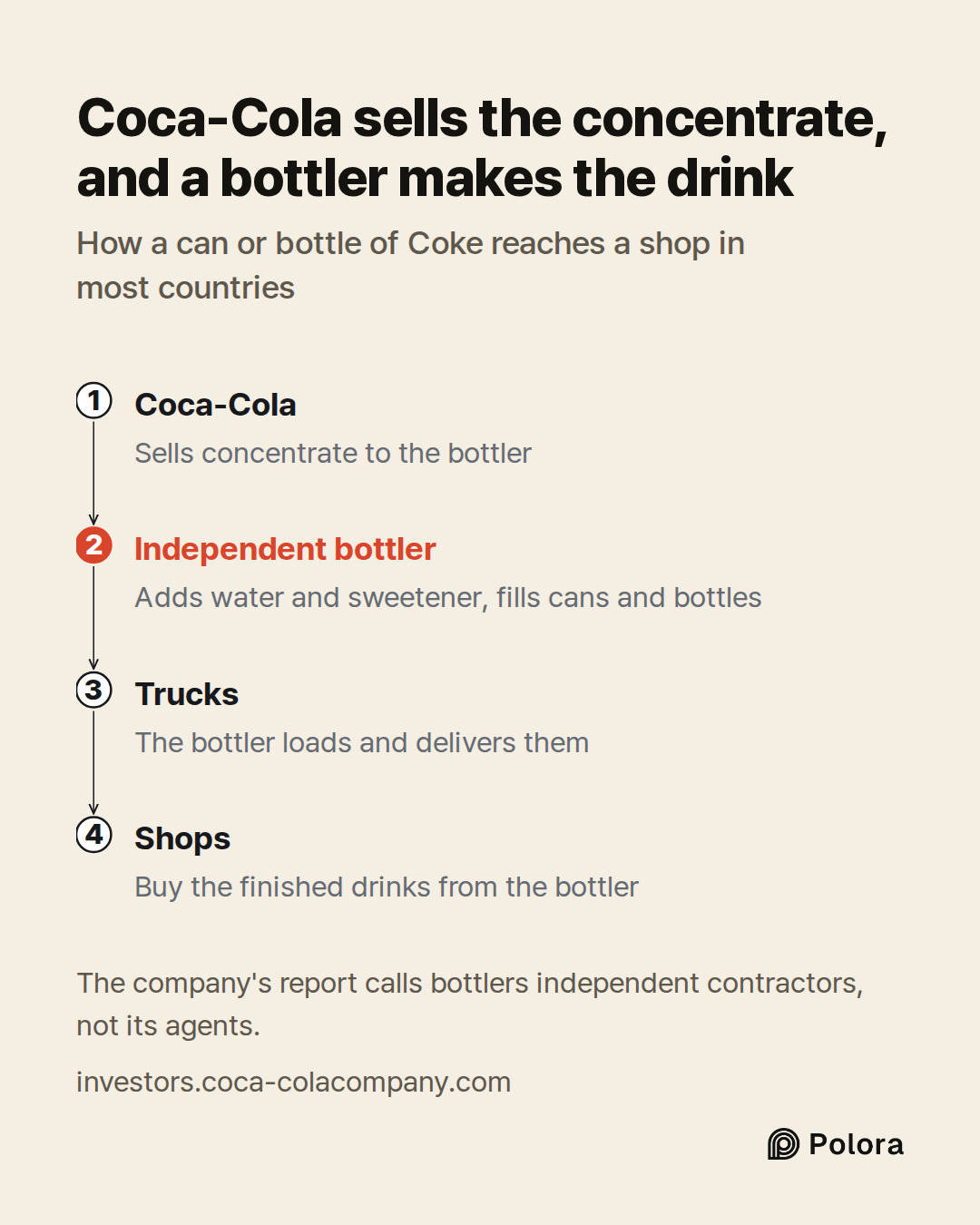
The company sells those partners a concentrate. The bottler adds water, sparkling or still, and sweetener. It fills the cans and bottles, loads the trucks and sells to shops. The report also says that a bottler is not a partner in the legal sense : bottlers are "independent contractors and are not our agents."

Some of these bottlers are large listed companies that most people have never heard of. Coca-Cola FEMSA covers much of Mexico, Brazil and Colombia. Coca-Cola Europacific Partners covers Britain, Germany, Spain, mainland France and Australia, among others. Coca-Cola HBC covers Italy, Poland, Switzerland, Nigeria and much of Central and Eastern Europe. These three and two more, Arca Continental and Swire, handled 44 percent of all the drinks sold worldwide under the company's brands in 2025. That figure covers every brand the company owns, Sprite and Fanta as well as Coke, and not Coke alone.
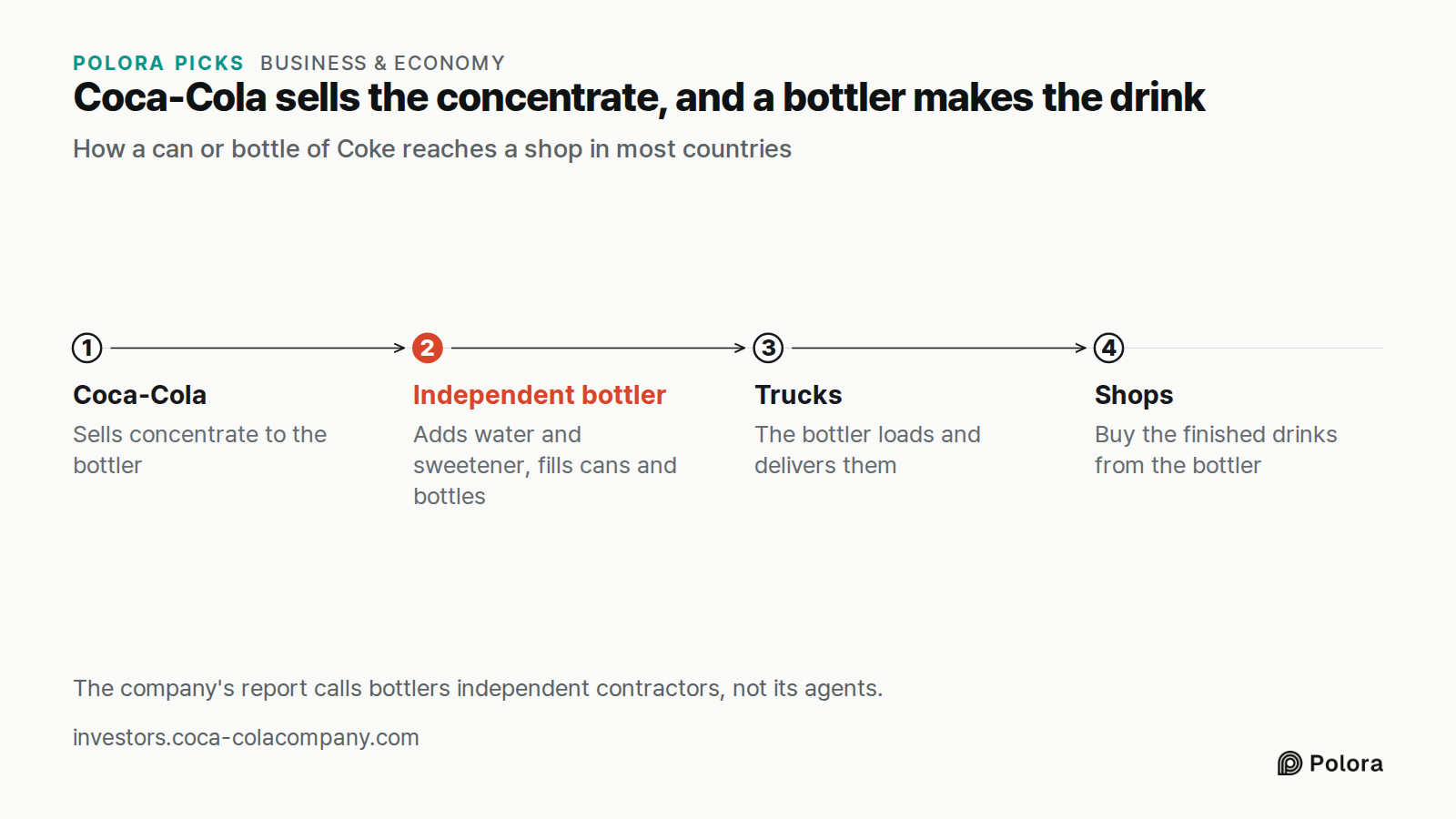
Coca-Cola sells the concentrate, and a bottler makes the drink · How a can or bottle of Coke reaches a shop in most countries · Coca-Cola · Independent bottler · Trucks · Shops · Sells concentrate to the bottler · Adds water and sweetener, fills cans and bottles · The bottler loads and delivers them
How a can or bottle of Coke reaches a shop in most countries

What Coca-Cola actually sells

What the company mainly sells is the concentrate. Each bottler signs an agreement that lets it make and sell the company's drinks, under its brands, in a defined territory and in approved containers. In most markets the price of the concentrate is influenced by what the bottler charges for the finished drink, along with where it sells and in which packages. When the bottler sells more, or at a higher price, Coca-Cola generally earns more too.

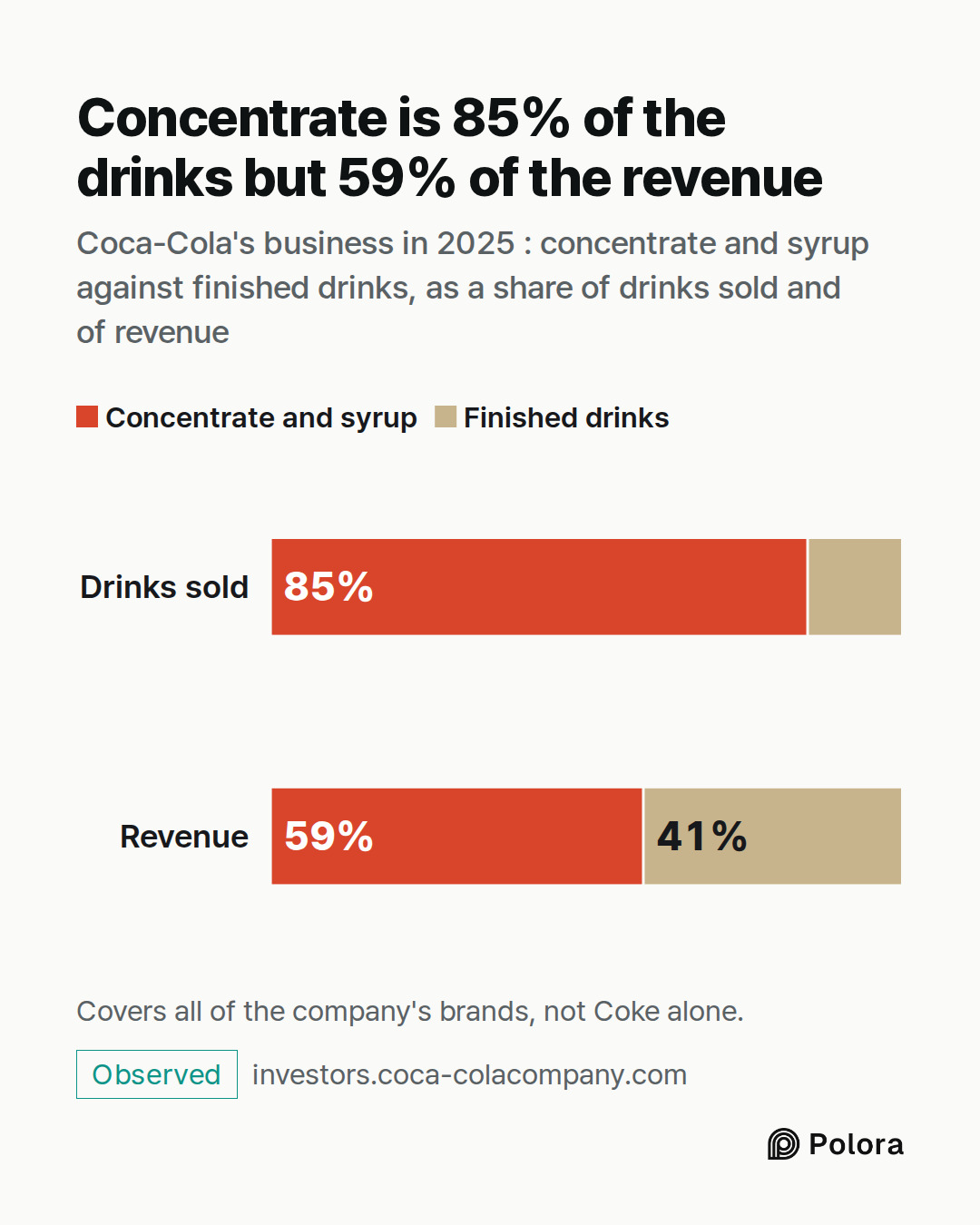
The company's report divides its business in two. In 2025, sales of concentrate and syrup accounted for 85 percent of the drinks sold under all its brands, but only 59 percent of its revenue. The other 41 percent of revenue came from the remaining 15 percent of drinks, which it made and sold as finished products itself. Here too the figures cover the company's whole range, not Coke alone. Concentrate is light, cheap to ship and sold in volume. A finished drink is mostly water in a heavy container, and moving it costs money.
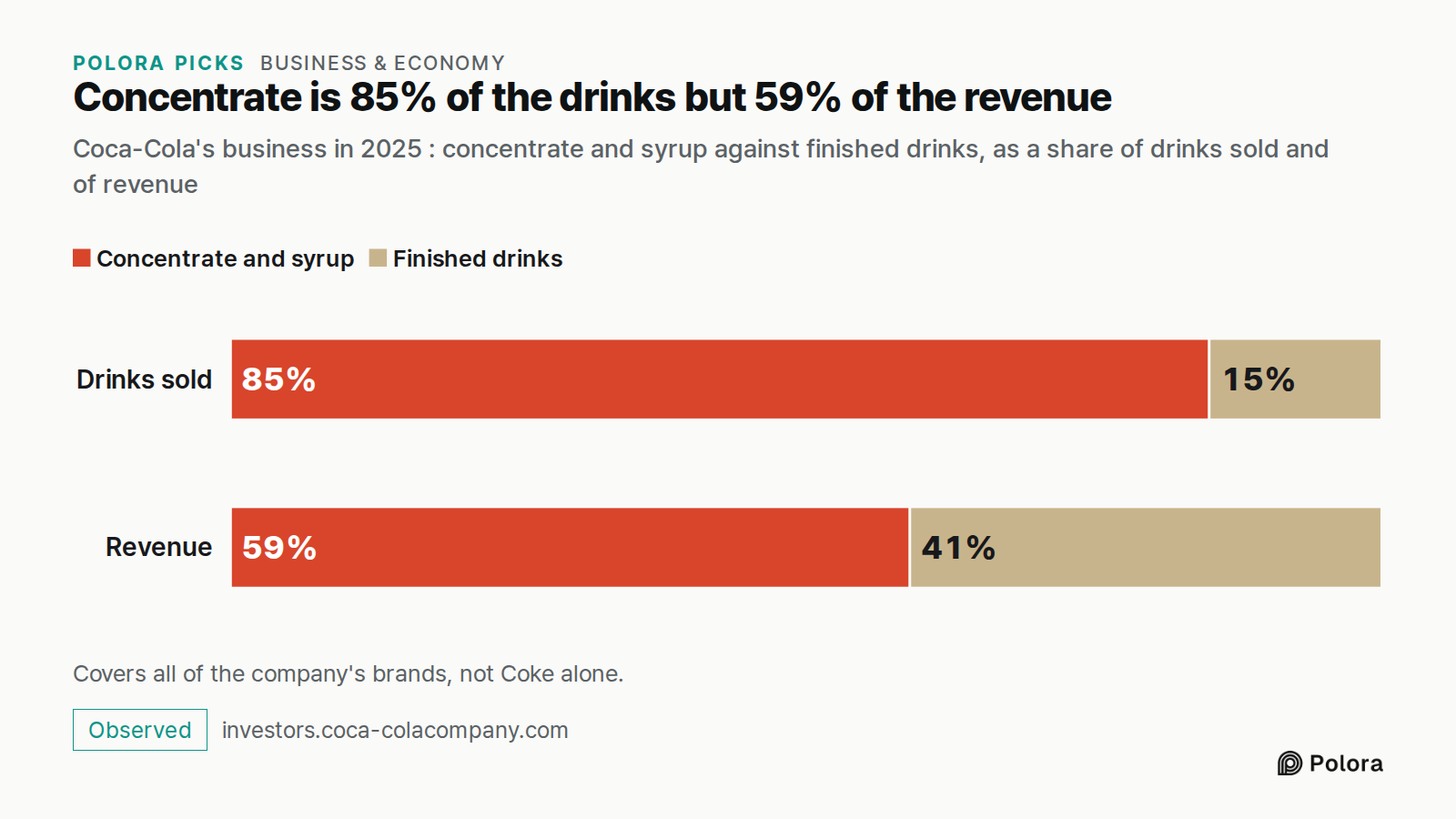
Concentrate is 85% of the drinks but 59% of the revenue · Coca-Cola's business in 2025 : concentrate and syrup against finished drinks, as a share of drinks sold and of revenue · Drinks sold · Revenue · Concentrate and syrup · Finished drinks · 85% · 15% · 59% · 41% · Covers all of the company's bra
Coca-Cola's business in 2025 : concentrate and syrup against finished drinks, as a share of drinks sold and of revenue

Bottling brings in revenue, concentrate brings in profit

The bottlers Coca-Cola still owns are grouped in its accounts as one unit, called Bottling Investments. In 2025 that unit brought in 5,735 million dollars, which was 12.0 percent of the company's revenue. It produced 3.1 percent of the company's operating profit.

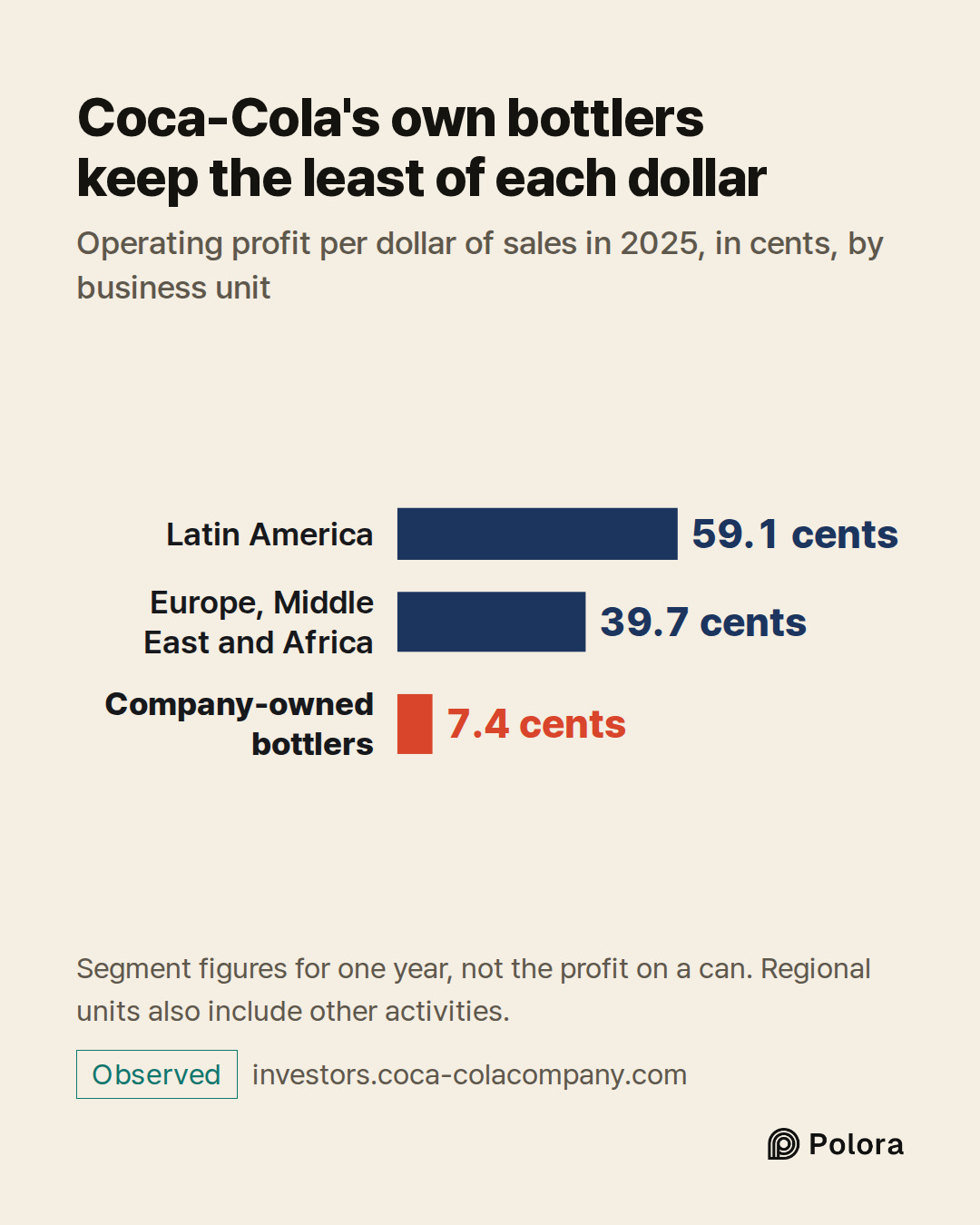
The difference shows in the margins, meaning the share of each sales dollar left over as operating profit. In 2025 the bottling unit kept 7.4 cents of every dollar it sold. The Latin American business, where bottlers such as FEMSA make the finished drinks, kept 59.1 cents. The business covering Europe, the Middle East and Africa kept 39.7 cents.

The company gives the reason in a single sentence : making and selling finished drinks generally brings "higher net operating revenues but lower gross profit margins than concentrate operations." These are segment figures for one year, not the profit on a single can. The regional units also include activities other than selling concentrate, and each carries its own costs and currency effects. But the direction of the gap is the one the company itself describes.
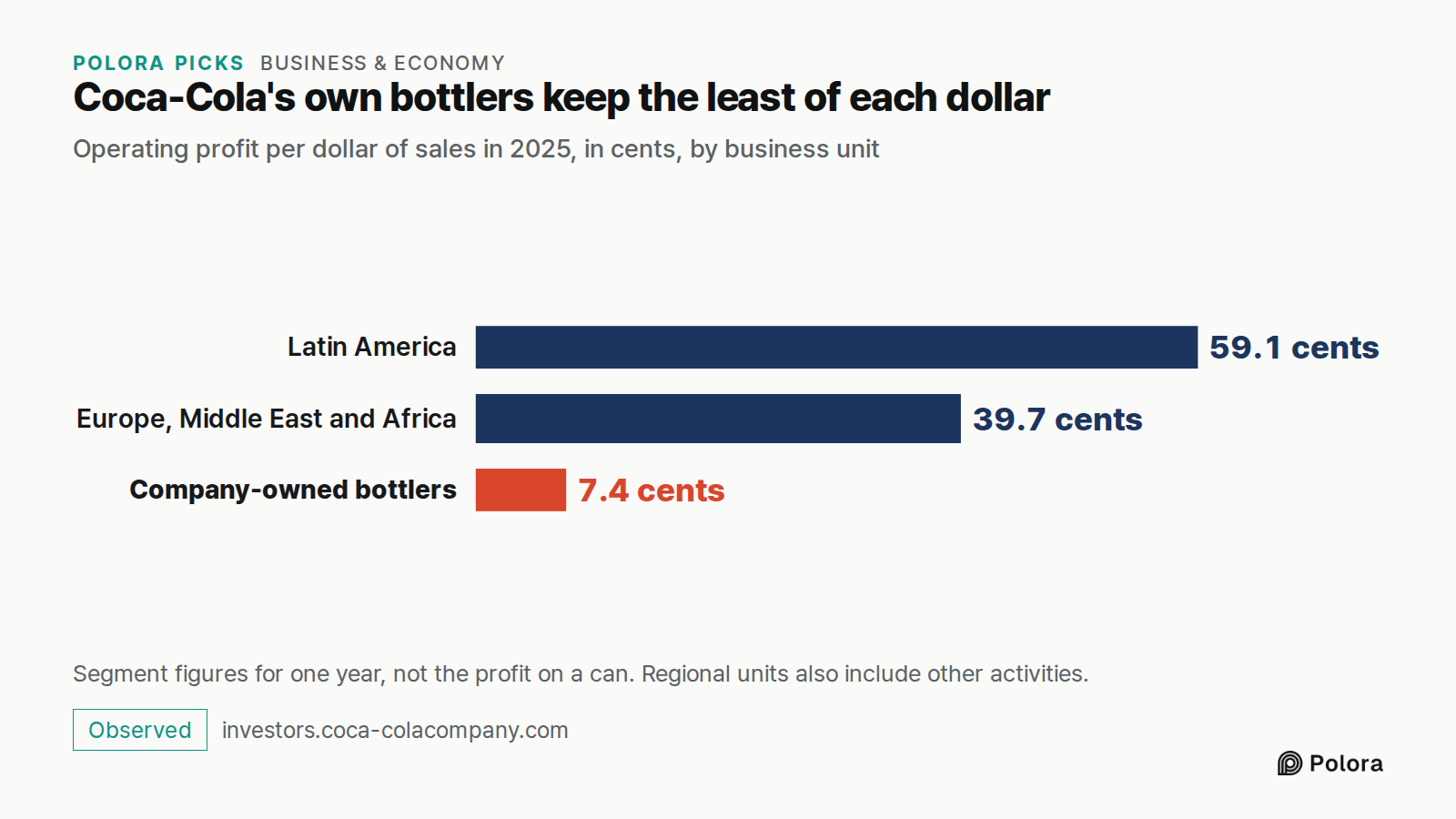
Coca-Cola's own bottlers keep the least of each dollar · Operating profit per dollar of sales in 2025, in cents, by business unit · Latin America · Europe, Middle East and Africa · Company-owned bottlers · 59.1 cents · 39.7 cents · 7.4 cents · Segment figures for one year, not the profit on a can. R
Operating profit per dollar of sales in 2025, in cents, by business unit

Coca-Cola has been selling its own bottlers for years

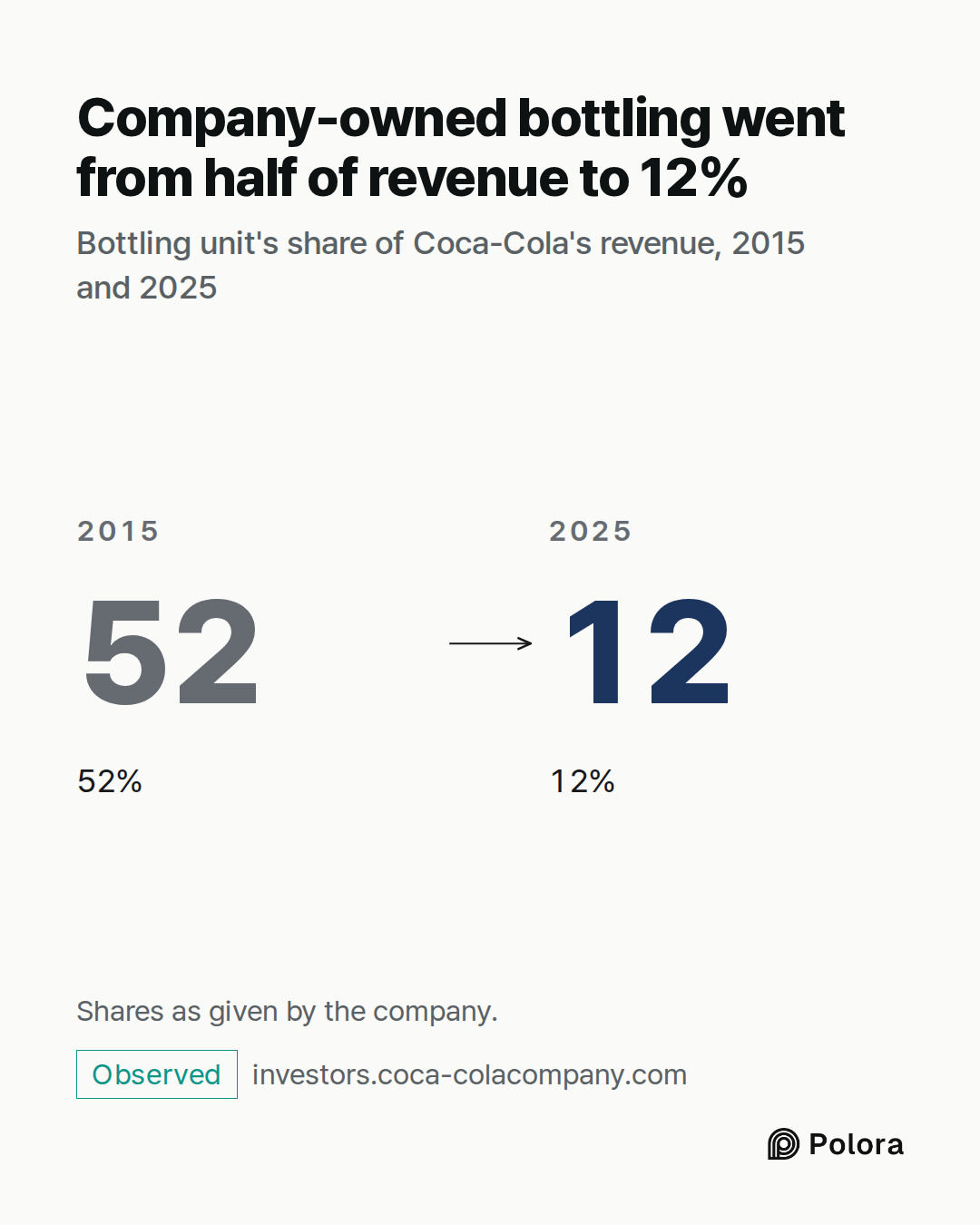
This is a choice the company keeps making. Ten years ago, bottlers it owned brought in about half its revenue : the company puts the bottling unit's share at 52 percent in 2015, against 12 percent in 2025. The company calls these sales refranchising, meaning it hands a territory back to an independent bottler.

The United States went first. In October 2017 Coca-Cola announced that it had handed all of its American bottling to nearly 70 independent bottlers. It took 60 separate transfers, which moved more than 55,000 employees and more than 50 production plants. Its remaining North American territories, in Canada and the US Virgin Islands, were set to follow in 2018.

The selling has continued since. In 2024 the company sold its bottling in the Philippines and Bangladesh, and territories in India. In May 2025 it sold more Indian territories, and in October 2025 it sold its operations making finished drinks in Nigeria. Its report says the 2024 sales in the Philippines, Bangladesh and India were one reason its gross margin rose from 61.1 percent in 2024 to 61.6 percent in 2025.

It still runs bottling itself in a shorter list of places : parts of Africa, India, Malaysia, Myanmar, Nepal, Oman, Singapore and Sri Lanka. So in those countries, the answer to the headline can still be yes.
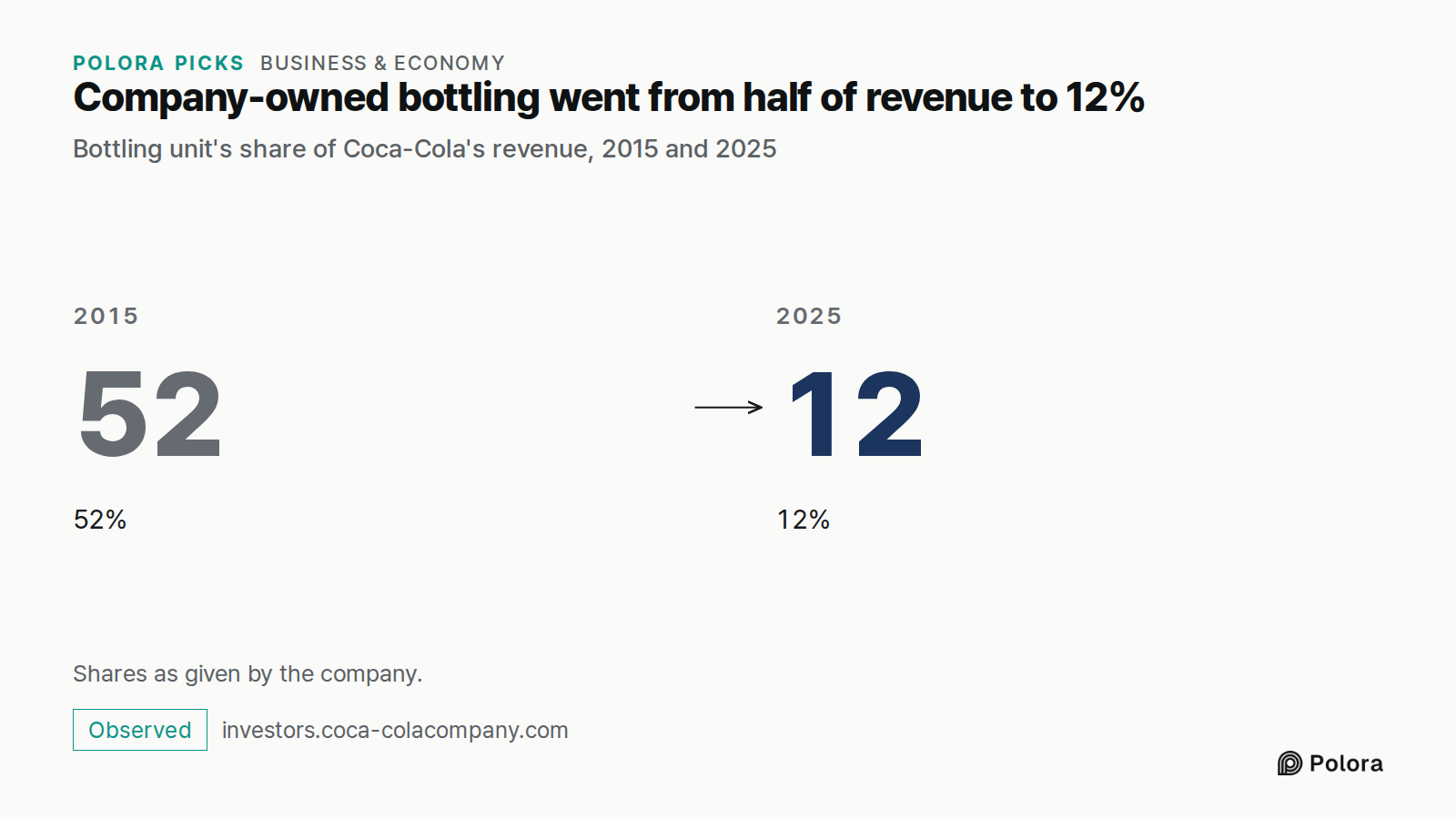
Company-owned bottling went from half of revenue to 12% · Bottling unit's share of Coca-Cola's revenue, 2015 and 2025 · 2015 · 52 · 52% · 2025 · 12 · 12% · Shares as given by the company.
Bottling unit's share of Coca-Cola's revenue, 2015 and 2025

The biggest sale, in Africa, is not finished yet

The largest bottler Coca-Cola still controls is Coca-Cola Beverages Africa, which operates in 14 countries in eastern and southern Africa, including South Africa. Coca-Cola owns 66.52 percent of it. In October 2025 the company agreed to sell 41.52 percent of the business to Coca-Cola HBC. HBC is also buying a family investor's stake, which would give it 75 percent, in a deal that values the whole bottler at 3.4 billion dollars. HBC also has an option to buy the remaining 25 percent within six years. The deal would make HBC the second-largest Coca-Cola bottler in the world by volume.

In July 2026 South Africa's Competition Commission recommended approval, with conditions including a pause on job cuts and investment in local distribution. The Competition Tribunal approved the deal with conditions in an order dated 8 September, made public on 11 September. Approval is a step toward closing, not the closing itself. When the deal was announced, it also needed approval from regulators beyond South Africa, among them the regional body COMESA and authorities in Kenya and Ethiopia. As of early October 2026 no completion had been announced, and the companies have said they expect to complete the deal by the end of 2026, once the remaining requirements are met.
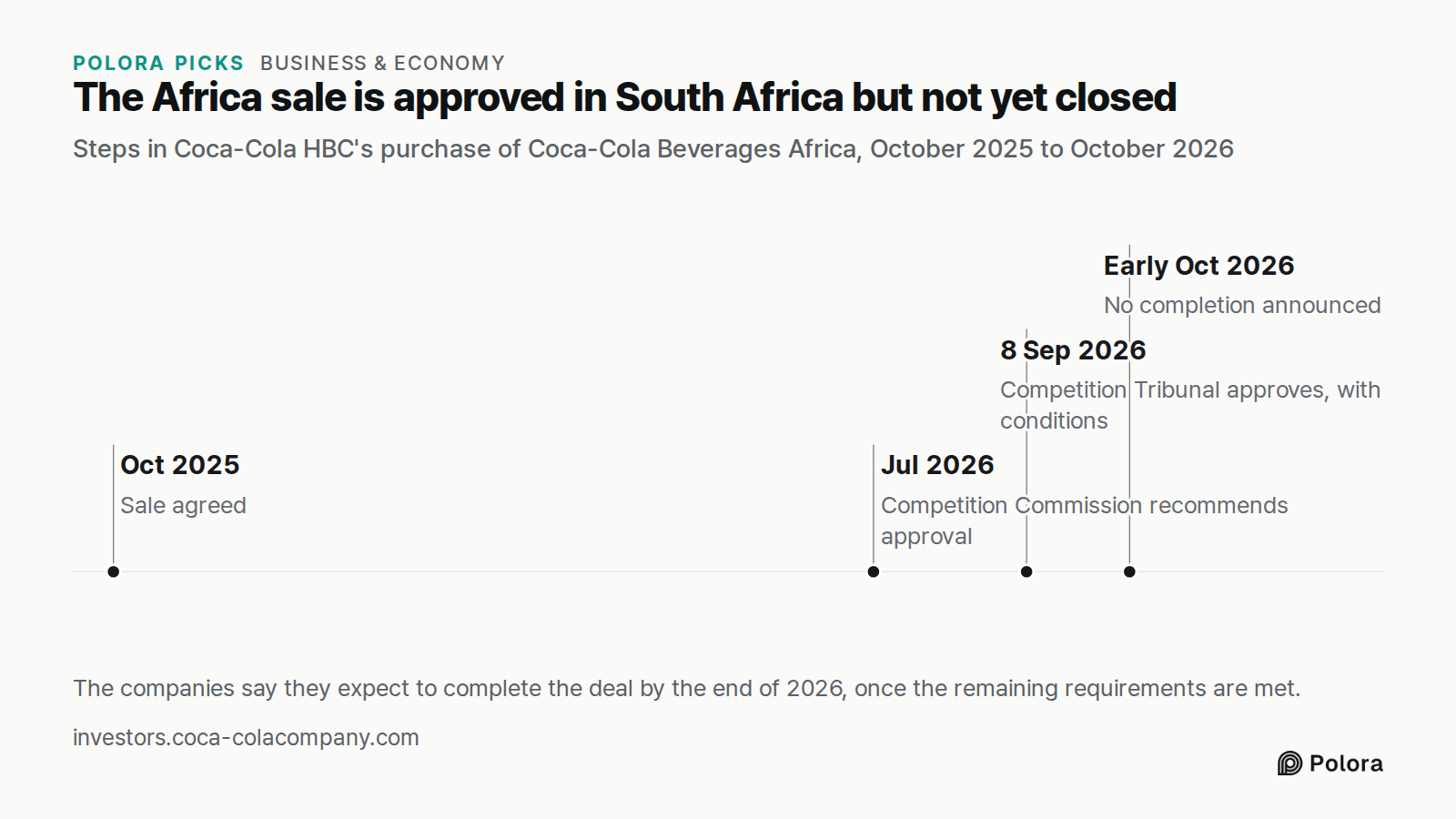
The Africa sale is approved in South Africa but not yet closed · Steps in Coca-Cola HBC's purchase of Coca-Cola Beverages Africa, October 2025 to October 2026 · Oct 2025 · Jul 2026 · 8 Sep 2026 · Early Oct 2026 · Sale agreed · Competition Commission recommends approval · Competition Tribunal approve
Steps in Coca-Cola HBC's purchase of Coca-Cola Beverages Africa, October 2025 to October 2026

Selling the bottlers does not mean letting go of them

Coca-Cola keeps a slice of many bottlers it does not run. At the end of 2025 it owned 18 percent of Coca-Cola Europacific Partners, 28 percent of Coca-Cola FEMSA, 22 percent of Coca-Cola HBC and 24 percent of Coca-Cola Bottlers Japan. Through those stakes it takes a share of the bottlers' profits on top of what it earns from concentrate.

It can also sell those stakes. In March 2025 it sold part of its stake in Coca-Cola Europacific Partners and booked a gain of 331 million dollars. In November 2025 it sold its whole stake in Coke Consolidated, the largest Coca-Cola bottler in the United States, back to that company.
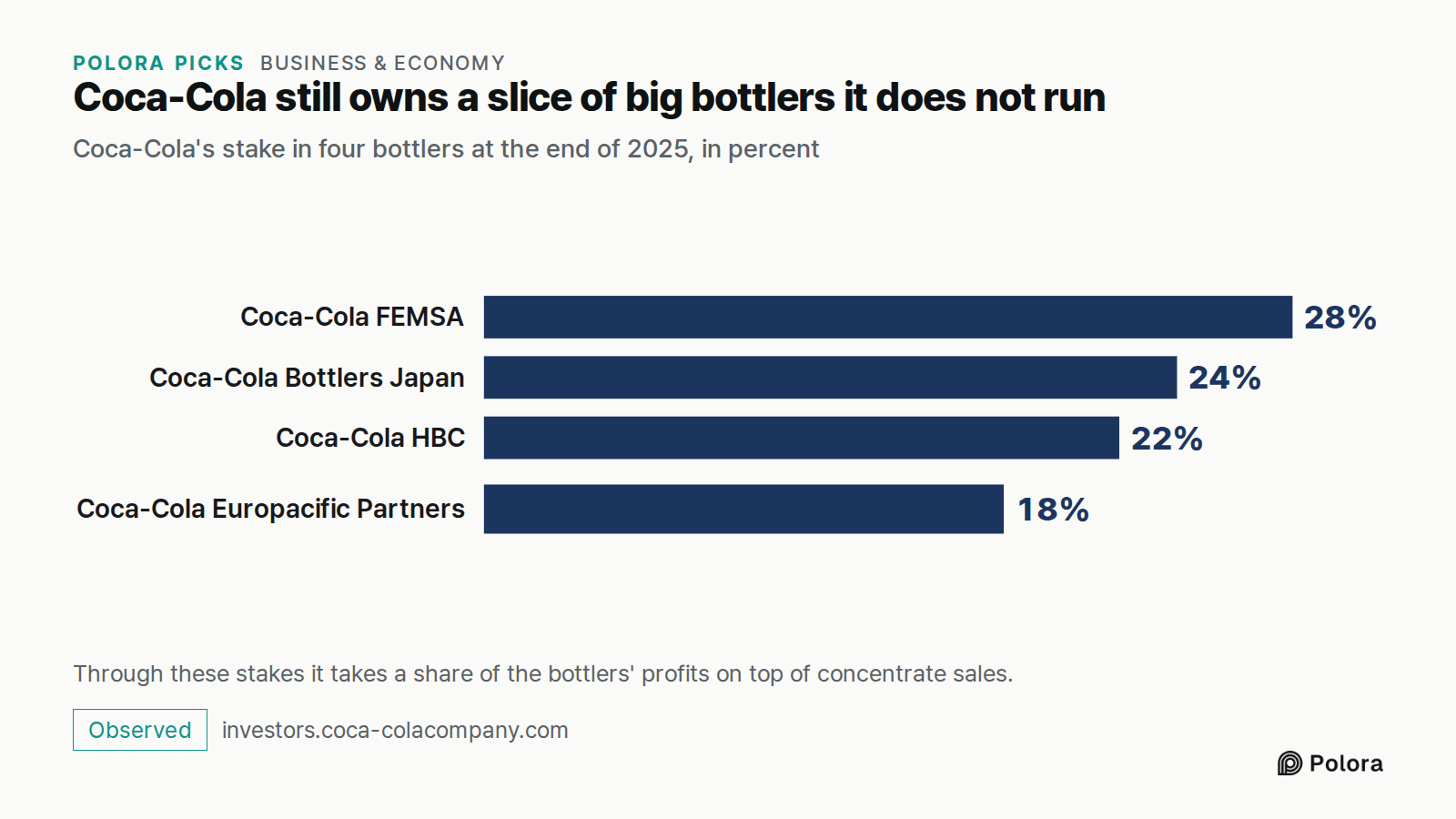
Coca-Cola still owns a slice of big bottlers it does not run · Coca-Cola's stake in four bottlers at the end of 2025, in percent · Coca-Cola FEMSA · Coca-Cola Bottlers Japan · Coca-Cola HBC · Coca-Cola Europacific Partners · 28% · 24% · 22% · 18% · Through these stakes it takes a share of the bottle
Coca-Cola's stake in four bottlers at the end of 2025, in percent

Restaurant Coke in America is the exception

There is one familiar case where the usual assumption comes closer to the truth, though not all the way. In the United States, the Coke poured from a restaurant or cinema fountain is mixed on the spot by the restaurant's machine. The syrup it mixes is made by Coca-Cola itself and sold to restaurants, or to wholesalers who supply them.

The report says that outside the United States, bottlers are usually allowed to make fountain syrup too, from the company's concentrate. The company also sells some finished drinks itself in certain markets, and runs the Costa coffee shops. These are real exceptions, but they do not change who fills most cans and bottles.

Pepsi chose the other model, and is now reviewing it

PepsiCo shows this is a choice, not a law of the drinks business. In North America it owns much of its own bottling and delivery. In September 2025 the investment firm Elliott, which said it held a 4 billion dollar stake, wrote to PepsiCo's board. It described an "underperforming vertically integrated bottling structure" and asked the company to evaluate refranchising it, "as its closest peer has and as PepsiCo itself has done in years past."

PepsiCo did not agree to sell. In December 2025 it set out a plan that Elliott said it supported. In it, PepsiCo said it was "carefully evaluating an integrated model" and would look at return on investment, scale and market share state by state in the United States. It promised a full update on its North American supply chain in late 2026. Which model serves PepsiCo better is still an open question, and the answer may differ from one state to the next.

The name on the can and the company that made it

So the short answer, for a can or bottle in most countries, is no. In one sense Coca-Cola does make your Coke : the concentrate that gives the drink its taste comes from Coca-Cola. But the finished drink was mixed, filled and delivered by a bottling company that buys that concentrate under an agreement letting it sell the drink under Coca-Cola's name. The heavy, costly part of the work belongs to the bottler. The part that earns the most on each dollar, the formula and the brand, stays with the company whose name is on the can.
Does Coca-Cola actually make the Coke you drink?Does Coca-Cola actually make the Coke you drink?The company that filled your can is usually not Coca-Cola. · The finished drink was mixed, filled and delivered by a bottling company that buys Coca-Cola's concentrate. · ※ concentrate : the base that gives the drink its taste, before water and sweetener are addedCoca-Cola · Independent bottler · Trucks · Shops · Sells concentrate to the bottler · Adds water and sweetener, fills cans and bottles · The bottler loads and delivers them · Buy the finished drinks from the bottler · Coca-Cola sells the concentrate, and a bottler makes the drink · How a can or bottDrinks sold · Revenue · Concentrate and syrup · Finished drinks · Concentrate and syrup · Finished drinks · 85% · 15% · 59% · 41% · Concentrate is 85% of the drinks but 59% of the revenue · Coca-Cola's business in 2025 : concentrate and syrup against finished drinks, as a share of drinks sold and ofLatin America · Europe, Middle East and Africa · Company-owned bottlers · 59.1 cents · 39.7 cents · 7.4 cents · Coca-Cola's own bottlers keep the least of each dollar · Operating profit per dollar of sales in 2025, in cents, by business unit · Segment figures for one year, not the profit on a can. R2015 · 52 · 52% · 2025 · 12 · 12% · Company-owned bottling went from half of revenue to 12% · Bottling unit's share of Coca-Cola's revenue, 2015 and 2025 · Shares as given by the company.The heavy, costly part of the work belongs to the bottler. · The part that earns the most on each dollar, the formula and the brand, stays with the company whose name is on the can.Sources 11 : investors.coca-colacompany.com · The Coca-Cola Company 2025 Form 10-K (PDF), investors.coca-colacompany.com · The Coca-Cola Company 2025 Form 10-K, investors.coca-colacompany.com · The Coca-Cola Company : operating segments + 8Read the full story at · polora.ai

Does Coca-Cola actually make the Coke you drink?

Alpha · claude-sonnet-5

I've checked two of the manuscript's weaker spots directly. Here's my assessment as debater number one. The core premise stands, and stands well. The manuscript's central claim — that in most countries a bottling partner, not Coca-Cola itself, makes the physical drink, and that Coca-Cola's structurally higher-margin business is concentrate — is well-grounded and matches everything in the public record. No one in this debate should contest that framing. What I verified and confirmed: 1. CCBA/HBC deal status. The manuscript's account checks out precisely. South Africa's Competition Tribunal approved the transaction on 11 September 2026, subject to conditions dealing with public-interest issues. And as of the most recent reporting, the transaction is still subject to the remaining regulatory requirements, with completion targeted for the end of 2026. So the manuscript's "not yet closed as of early October 2026" is accurate and current. One nuance the manuscript doesn't mention: this isn't just a South African approval story — completion is subject to regulatory and antitrust approvals from authorities including the Competition Commission of South Africa, COMESA, and nat…

Beta · gpt-6-sol

Usually, Coca-Cola makes the concentrate, not the finished can or bottle. A bottling company generally combines it with water and, where needed, sweetener, then packages and distributes the drink. That is a sound answer to the reader’s question—but the manuscript sometimes treats figures for *all Coca-Cola Company beverages* as though they measure Coke specifically. The 2025 filing does not provide a Coke-only version of its 85% figure. (investors.coca-colacompany.com) My checks against the editor’s claims: - Who makes it, and where: The 2025 Form 10-K supports the account of independently contracted bottlers, defined territories and approved containers. Its territory descriptions support the shortened FEMSA, Europacific Partners and HBC examples; those three plus Arca Continental and Swire represented 44% of worldwide unit-case volume across the company’s products, not 44% of Coke alone. The filing also supports the qualification that some Coca-Cola-owned operations make finished drinks. ([investors.coca-colacompany.com](https://investors.coca-colaco…

Gamma · gemini-3.1-pro

The core premise of the manuscript holds up perfectly: The Coca-Cola Company is fundamentally a concentrate and brand-licensing business, while a vast network of independent (or partially owned) bottlers handles the heavy, capital-intensive work of mixing, packaging, and distributing the finished drinks. Building on what Alpha and Beta have already verified, here is what I found regarding the remaining claims: 1. PepsiCo’s contrasting model: The manuscript correctly notes that PepsiCo chose a different path. PepsiCo’s filings (such as its annual 10-K reports) confirm that its PepsiCo Beverages North America (PBNA) division operates a vertically integrated model, meaning it manufactures, bottles, and distributes the vast majority of its own beverages in the US and Canada. The reference to the Elliott Management letter pushing PepsiCo to evaluate refranchising "as its closest peer has" accurately reflects the ongoing structural debate in the beverage industry. 2. The 2015 revenue comparison: The claim that the Bottling Investments Group (BIG) accounted for about 52% of the company's net revenues in 2015 is accurate. This figure vividly illustrates the massive shift in Co…

Researcher · gemini-3-7-flash

Ground Truth Verification Below is the verified evidence for each claim and check requested by the manuscript: --- 1. Bottler Concentration and Territories * Claim: The top five bottlers (FEMSA, Europacific Partners, HBC, Arca Continental, Swire) handled 44% of worldwide unit case volume in 2025. * Finding: Verified. The Coca-Cola Company's 2025 Form 10-K (Item 1, *Distribution System*) lists these five bottlers and confirms they accounted for 44% of worldwide unit case volume across company brands in 2025. * Source: The Coca-Cola Company 2025 Form 10-K --- 2. Volume vs. Revenue Split (Concentrate vs. Finished Product) * Claim: Concentrate operations accounted for 85% of volume and 59% of net operating revenues, while finished products accounted for 15% of volume and 41% of revenue. * Finding: Verified. The 2025 10-K (*Item 7, Our Business: General*) explicitly breaks down: * Concentrate operations: 85% of unit case volume, 59% of net operating revenue. * Finished product operations: 15% of unit case volume, 41%…

The Arbiter · gpt-6-sol

Round record: Alpha, Beta, Gamma and the Researcher agree on the central answer: Coca-Cola usually supplies concentrate, while a bottler mixes, packages and distributes the finished canned or bottled drink. The company’s 2025 filing describes those bottlers as independent contractors, though Coca-Cola also owns some bottling operations and stakes in other bottlers. The premise therefore stands for who makes the finished drink, not for who makes every ingredient in it. (investors.coca-colacompany.com) The Researcher confirmed the manuscript’s principal company-wide figures: five named bottlers handled 44% of worldwide unit-case volume; concentrate operations represented 85% of volume and 59% of revenue; Bottling Investments recorded $5.735 billion in revenue and a 7.4% operating margin, versus 59.1% for Latin America and 39.7% for EMEA. Beta’s essential qualification is that these are figures for Coca-Cola’s *whole beverage portfolio*, not Coke alone, and the segment margins are not a calculation of profit on an ind…

The Arbiter's Final Verdict · gpt-6-sol

Usually, Coca-Cola makes the concentrate, but another company makes the finished Coke you drink. An authorized bottler typically adds water and sweetener, fills the can or bottle, and distributes it. The Coca-Cola Company owns the brand and formula and supplies the concentrate; it also owns some bottling operations and stakes in others. That makes the answer depend on what you mean by *make*. If you mean “who makes the finished drink in this can?”, it is usually a bottler rather than The Coca-Cola Company. If you mean “who makes the ingredient that gives it its identity?”, Coca-Cola does. Its 2025 annual filing supports that distinction, although its volume figures cover all Coca-Cola Company beverages, not Coke alone. So “usually not” is a sound answer for a packaged Coke—not an absolute rule for every drink or every country.