What is the white crust on old batteries, and why do dead or unused ones leak?

On an ordinary alkaline AA it isn't acid. It is leaked alkaline liquid that the air has turned into a salt. Dead cells can leak when current is forced through them, and heat and age can make unused ones leak too.

Science & Health · 2026-10-19

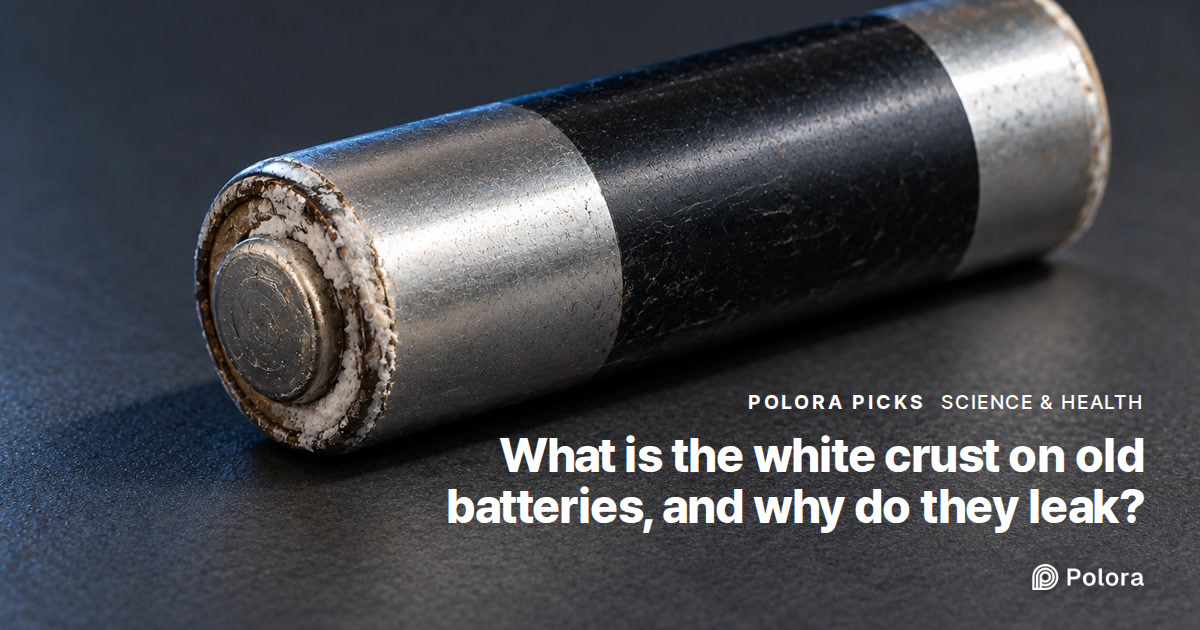
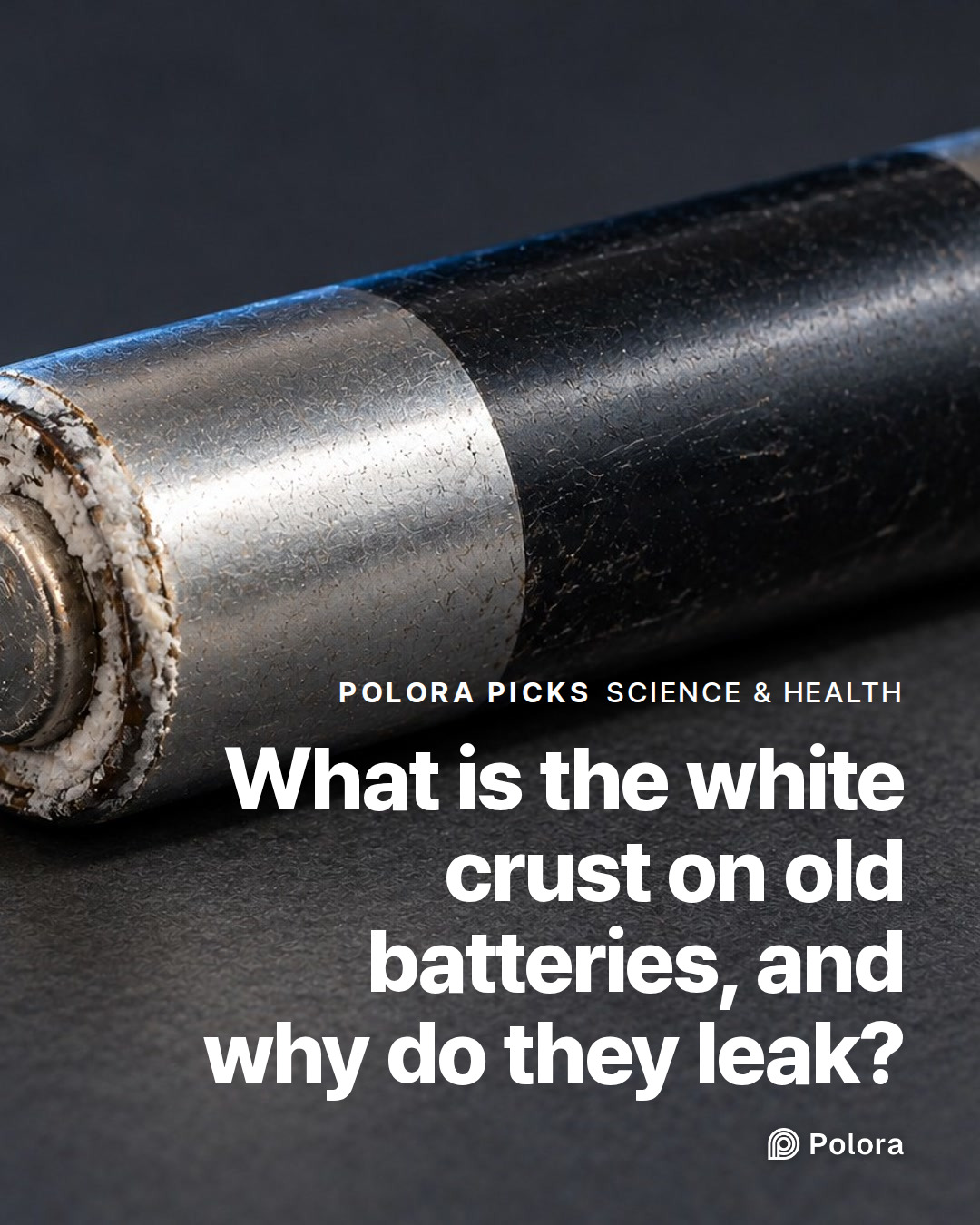
The white crust on an old AA battery is not acid

Open the back of a remote that has sat unused for a while and you may find it. A white, sometimes bluish crust has grown around one end of a battery. Almost everyone calls it battery acid.

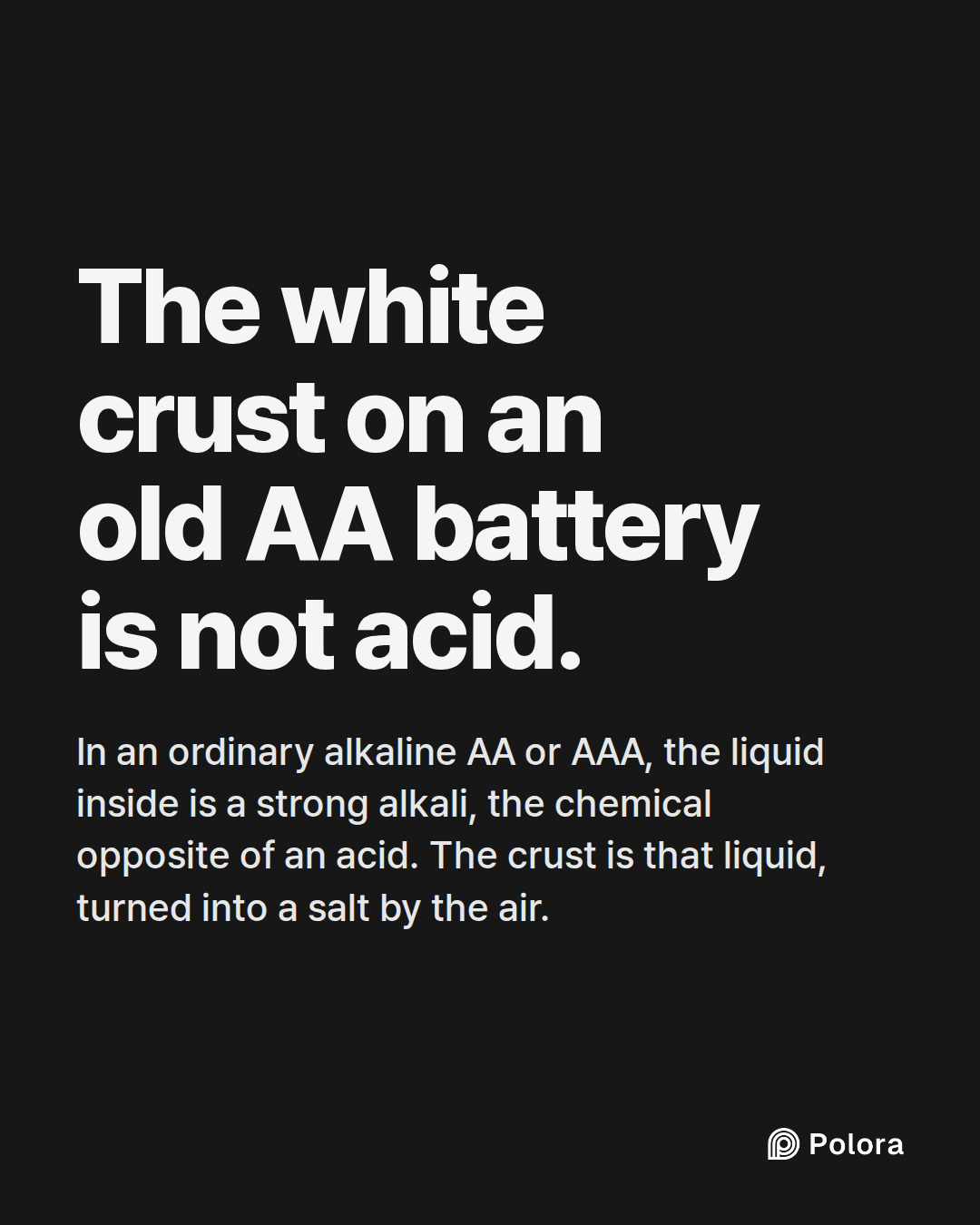
In an ordinary alkaline AA or AAA, it is closer to the opposite. The liquid inside an alkaline battery is potassium hydroxide. This liquid, the electrolyte, is what lets current flow between the battery's two halves. Potassium hydroxide is a strong alkali, the chemical opposite of an acid. Energizer's technical handbook for its alkaline cells lists it as the electrolyte, and Panasonic describes it as a strongly alkaline solution.

The crust is the leaked liquid, turned into a salt by the air

When that liquid escapes, it meets the air, and the air contains carbon dioxide. The two react and form potassium carbonate, a white crystalline salt. Panasonic's battery FAQ names exactly this as the white crystals and powder on a leaking alkaline battery. The science explainer The Naked Scientists gives the same account.

The salt is still alkaline. Panasonic calls it a potent water-soluble alkaline substance that can cause chemical burns on skin. PowerStream, a battery company, takes a milder view and describes the converted residue as safe. The manufacturers' own safety pages are the more cautious of the two, and they treat the crust as something to handle with care.
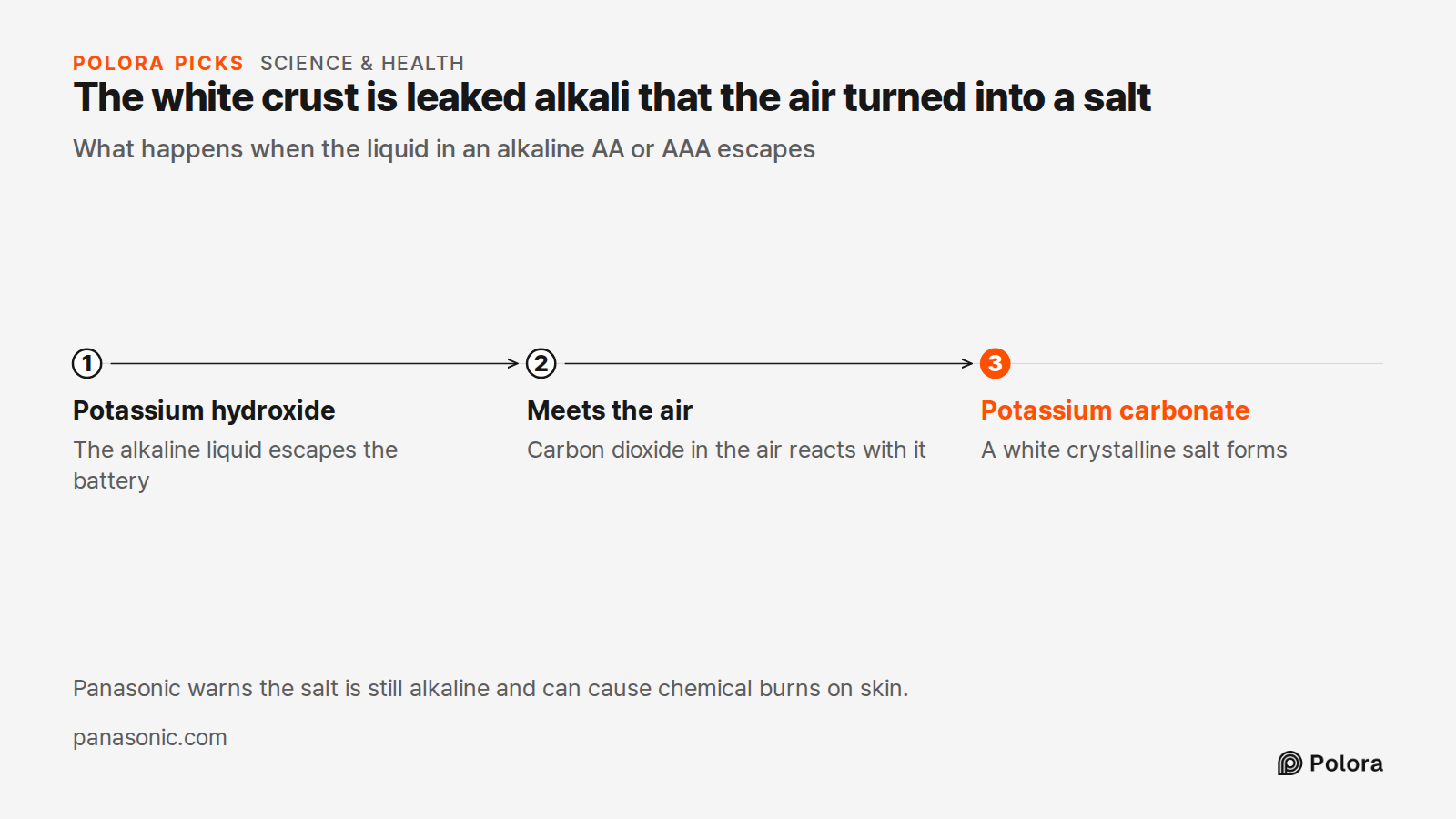
The white crust is leaked alkali that the air turned into a salt · What happens when the liquid in an alkaline AA or AAA escapes · Potassium hydroxide · Meets the air · Potassium carbonate · The alkaline liquid escapes the battery · Carbon dioxide in the air reacts with it · A white crystalline salt
What happens when the liquid in an alkaline AA or AAA escapes

A battery can leak after it is already dead

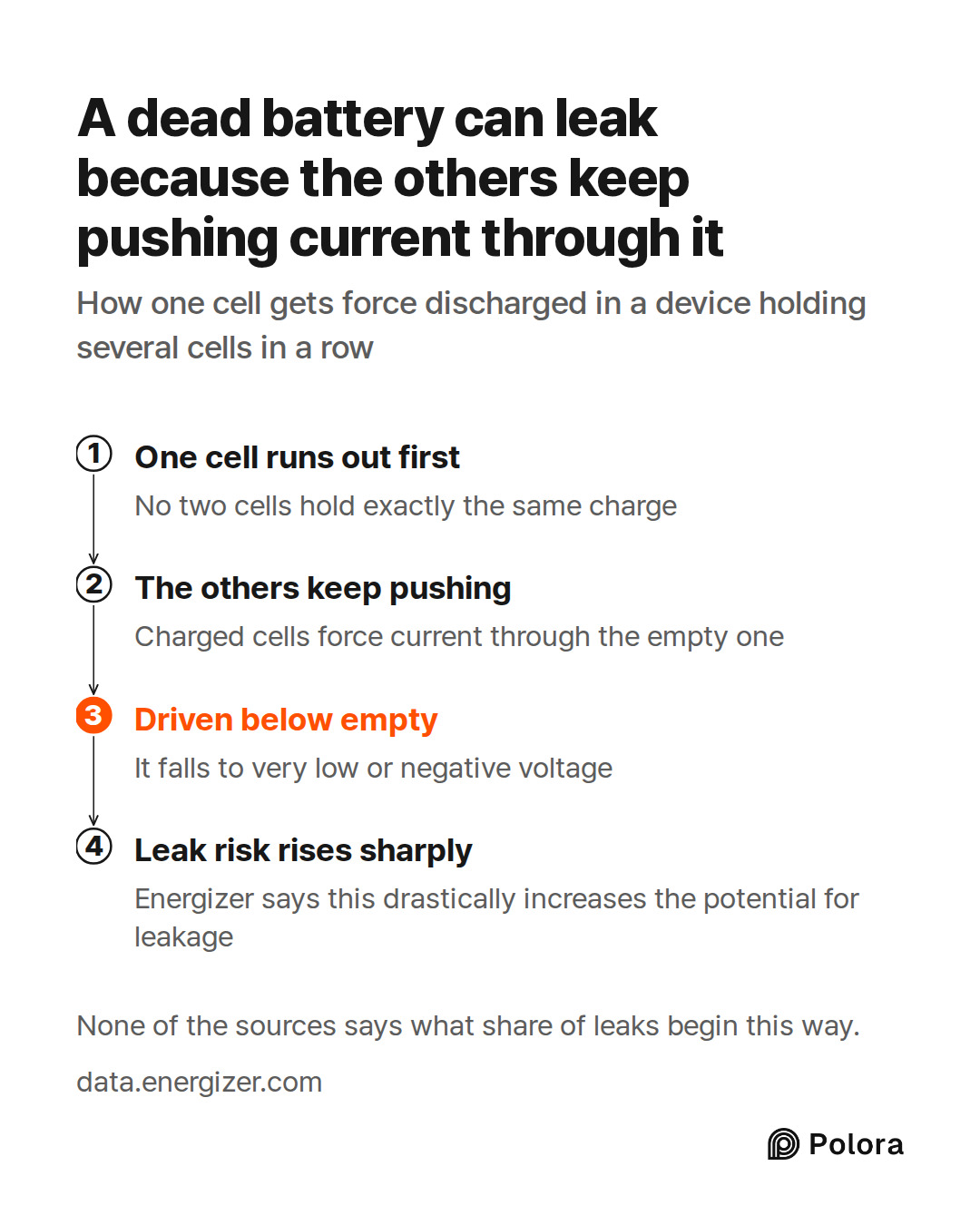
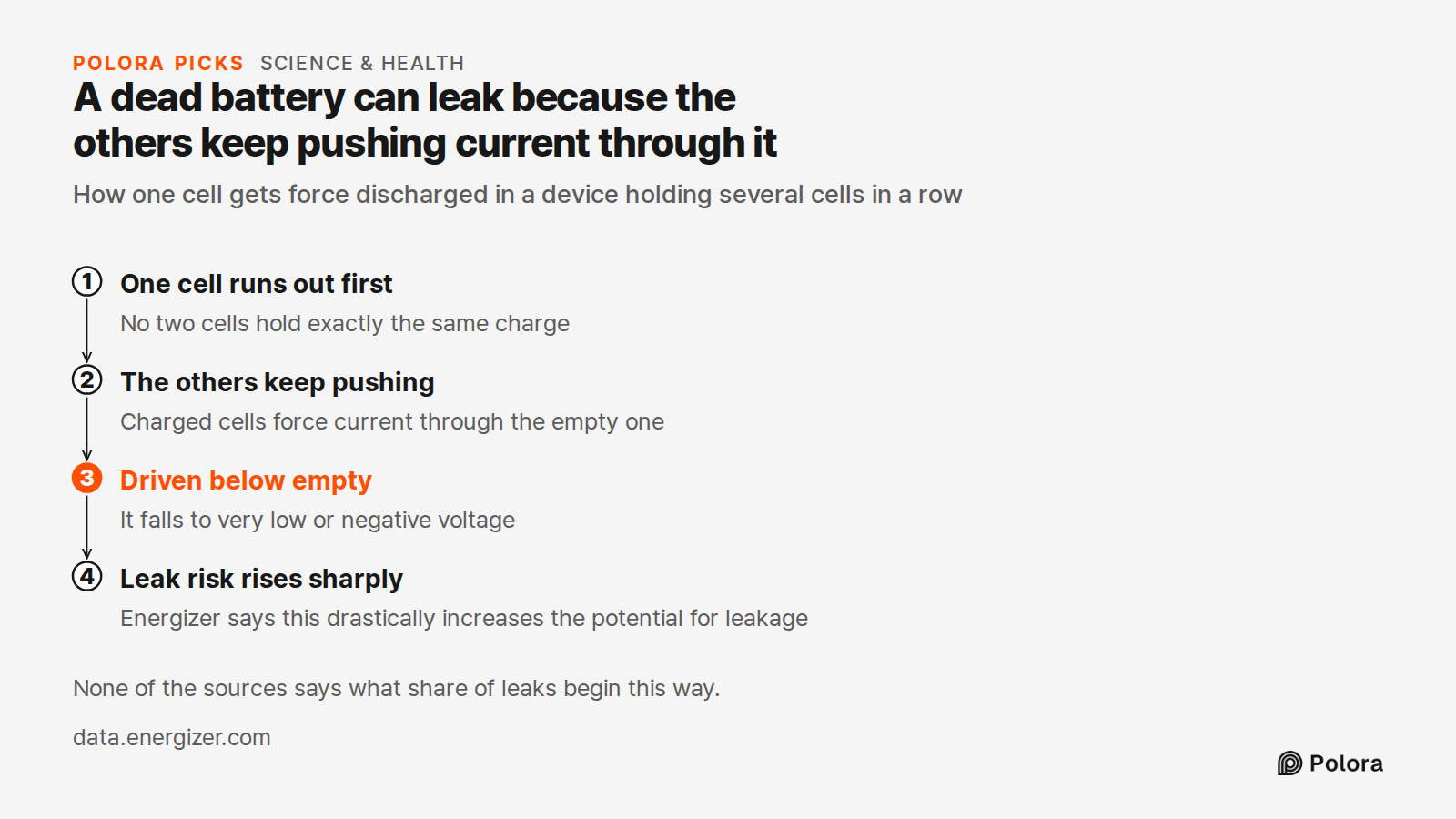
Most devices hold two or more batteries in a row, so the current passes through each one in turn. No two cells hold exactly the same charge, so one always runs out first.

The device does not stop the moment that happens. The cells that still have charge keep pushing current through the empty one. Energizer's alkaline FAQ puts it this way : as the weakest battery becomes exhausted, it is 'force discharged by the stronger batteries to very low or negative voltage levels which drastically increases the potential for leakage.'

So the usual picture can run backwards. It is not always the leak that killed the battery. Sometimes the battery leaked because it was driven on after it was empty. Manufacturers describe this route more directly than almost any other, though none of the sources says what share of leaks begin this way.

A single battery can be driven too far as well. Duracell notes that some devices keep drawing power from exhausted batteries, which may cause them to leak. Panasonic warns about batteries left for long periods in equipment that is not fully switched off and still draws a small current. They can run down and over-discharge, and that can cause leakage.
A dead battery can leak because the others keep pushing current through it · How one cell gets force discharged in a device holding several cells in a row · One cell runs out first · The others keep pushing · Driven below empty · Leak risk rises sharply · No two cells hold exactly the same charge ·
How one cell gets force discharged in a device holding several cells in a row

Mixing old and new batteries makes the gap worse

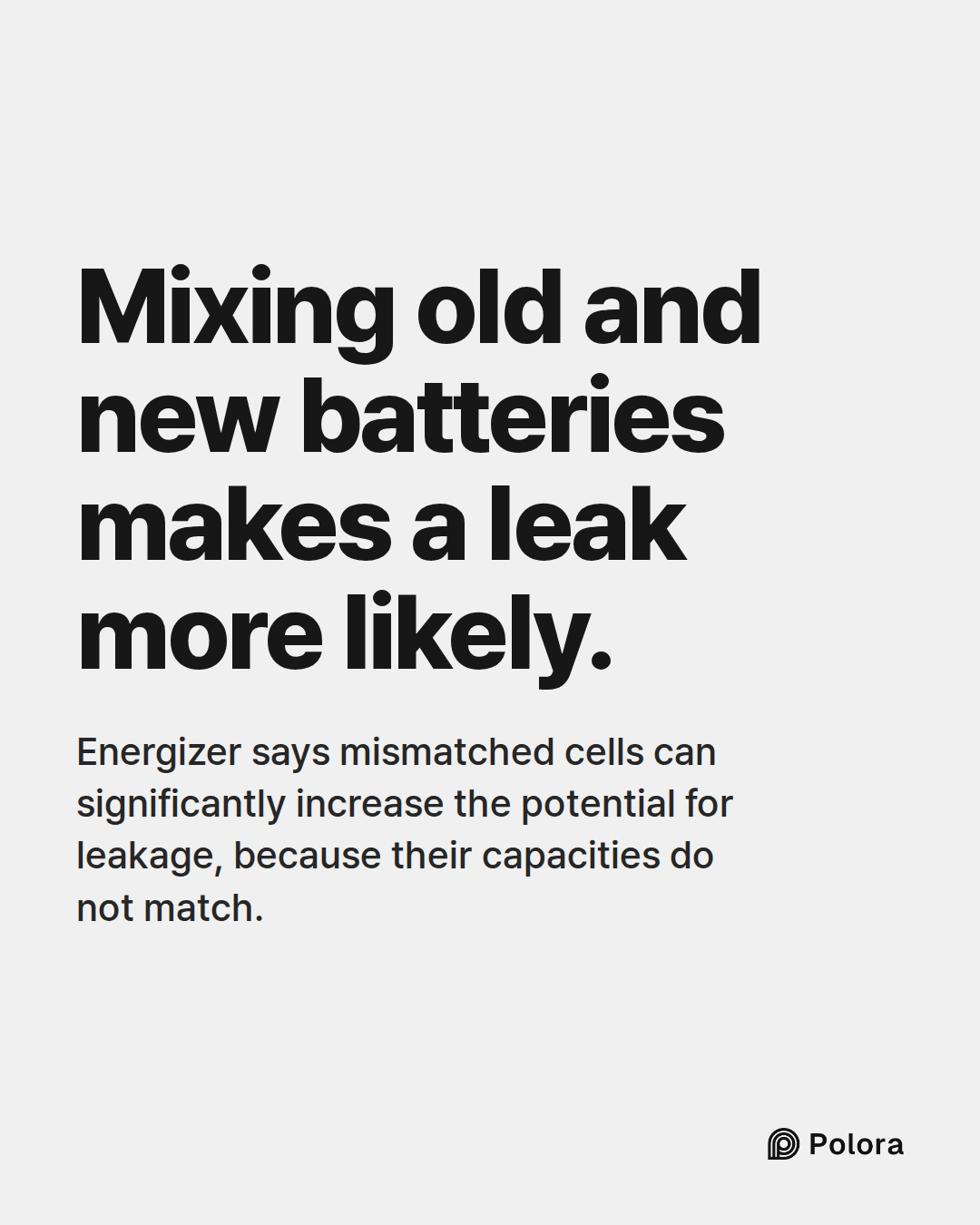
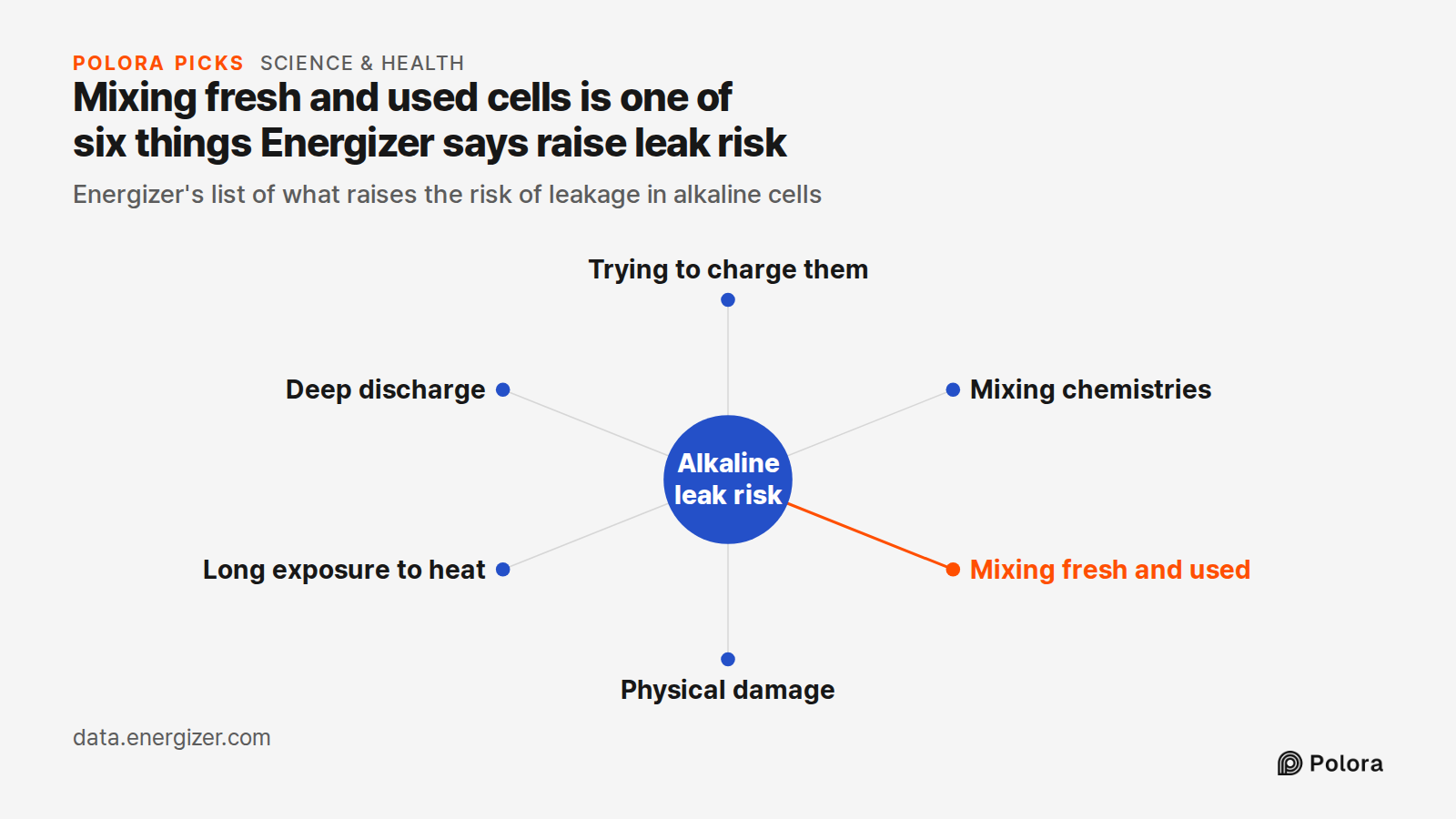
Anything that makes the cells in one device unequal makes it more likely that one of them is pushed past empty. Energizer says that mixing fresh and used batteries, different brands or different chemistries can significantly increase the potential for leakage, because their capacities do not match. Panasonic says the difference between a used and an unused battery grows during use, which leads to over-discharge and leakage. Duracell's FAQ says not to mix old and new batteries, different brands, or different types.

Energizer's list of what raises the risk for alkaline cells is short and specific : trying to charge them, mixing chemistries, mixing fresh and used cells, physical damage, long exposure to high temperature, and deep discharge.
Mixing fresh and used cells is one of six things Energizer says raise leak risk · Energizer's list of what raises the risk of leakage in alkaline cells · Alkaline leak risk · Trying to charge them · Mixing chemistries · Mixing fresh and used · Physical damage · Long exposure to heat · Deep discharge
Energizer's list of what raises the risk of leakage in alkaline cells

Inside, the battery is slowly making gas

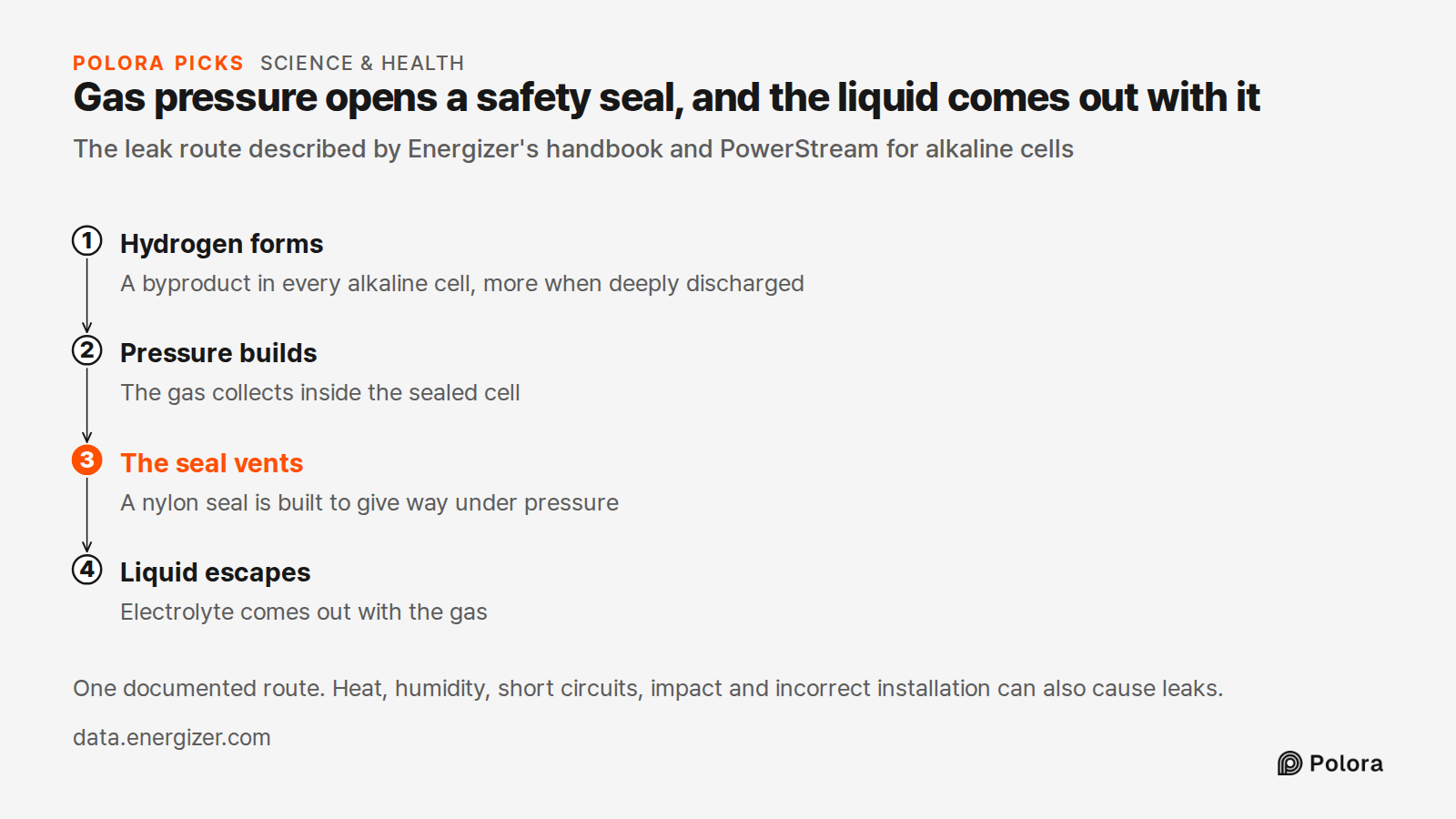
Why would draining a battery make it spill? Energizer's handbook says hydrogen gas is a byproduct of the chemical reaction in all alkaline batteries. Under normal use the amount is very low. Charging or short circuits produce much more.

Deep discharge matters here too. The same handbook advises device makers to cut off at 0.8 volts per cell, by which point about 95 percent of the usable capacity is gone. The reason it gives is the increased chance of excessive internal gassing when alkaline batteries are deeply discharged. This is Energizer's design guidance for its own cells, not a voltage at which a battery is known to leak.

Gas needs somewhere to go. Energizer's handbook describes a nylon seal that provides a safety venting mechanism. When pressure opens it, the liquid inside can come out with the gas. PowerStream describes the same sequence. Zinc inside the cell slowly breaks down water, the hydrogen builds pressure, and the vent opens and pushes electrolyte out.

This is one documented route, not the story of every leak. Panasonic also names heat, humidity, short circuits, impact and incorrect installation as things that can make a battery leak.
Gas pressure opens a safety seal, and the liquid comes out with it · The leak route described by Energizer's handbook and PowerStream for alkaline cells · Hydrogen forms · Pressure builds · The seal vents · Liquid escapes · A byproduct in every alkaline cell, more when deeply discharged · The gas co
The leak route described by Energizer's handbook and PowerStream for alkaline cells

Batteries that were never used can leak too, but less often

Manufacturers describe leaks in normal storage as uncommon. Energizer's alkaline FAQ says alkaline batteries typically will not leak under normal storage and usage conditions.

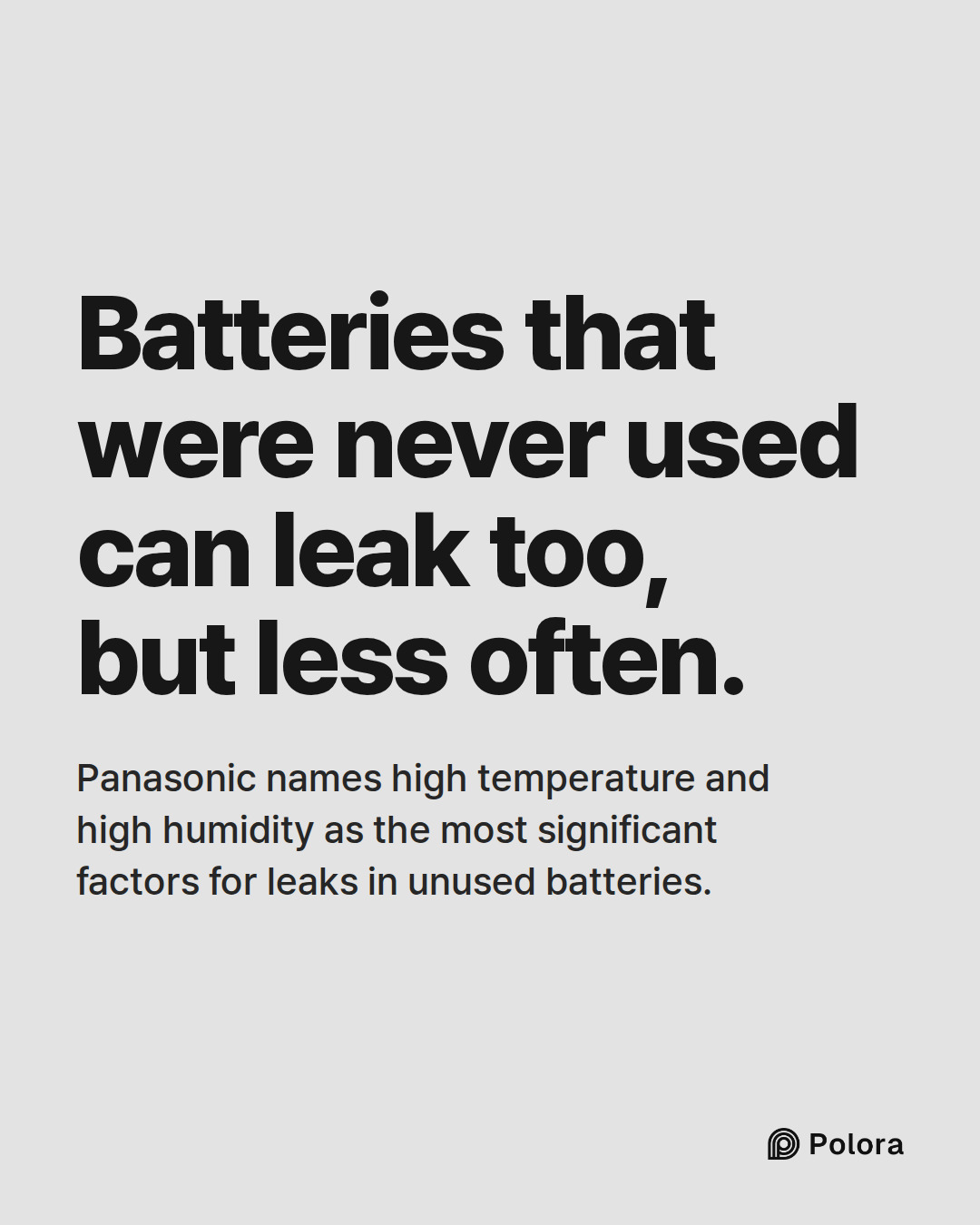
In their accounts, the things that change this are heat, damp and time. Panasonic names high temperature and high humidity as the most significant factors for leaks in unused batteries, and also lists accidental short circuits and impact. Energizer's handbook adds that repeated swings between extreme heat and cold make the parts expand and contract and, over time, can break the seal. Panasonic also notes that a battery that was over-discharged and then left unused for a long time may leak later.

The chemistry never fully stops. Panasonic says a battery's chemicals change gradually even when it is not used. The Naked Scientists says that batteries keep reacting slowly even when nothing is connected, and that side reactions can eventually make them pop open. None of the sources says that every stored battery that leaks has followed one particular sequence. Energizer recommends storing batteries at room temperature with moderate humidity, and says the refrigerator is neither needed nor recommended.

Not every battery leaks the same thing

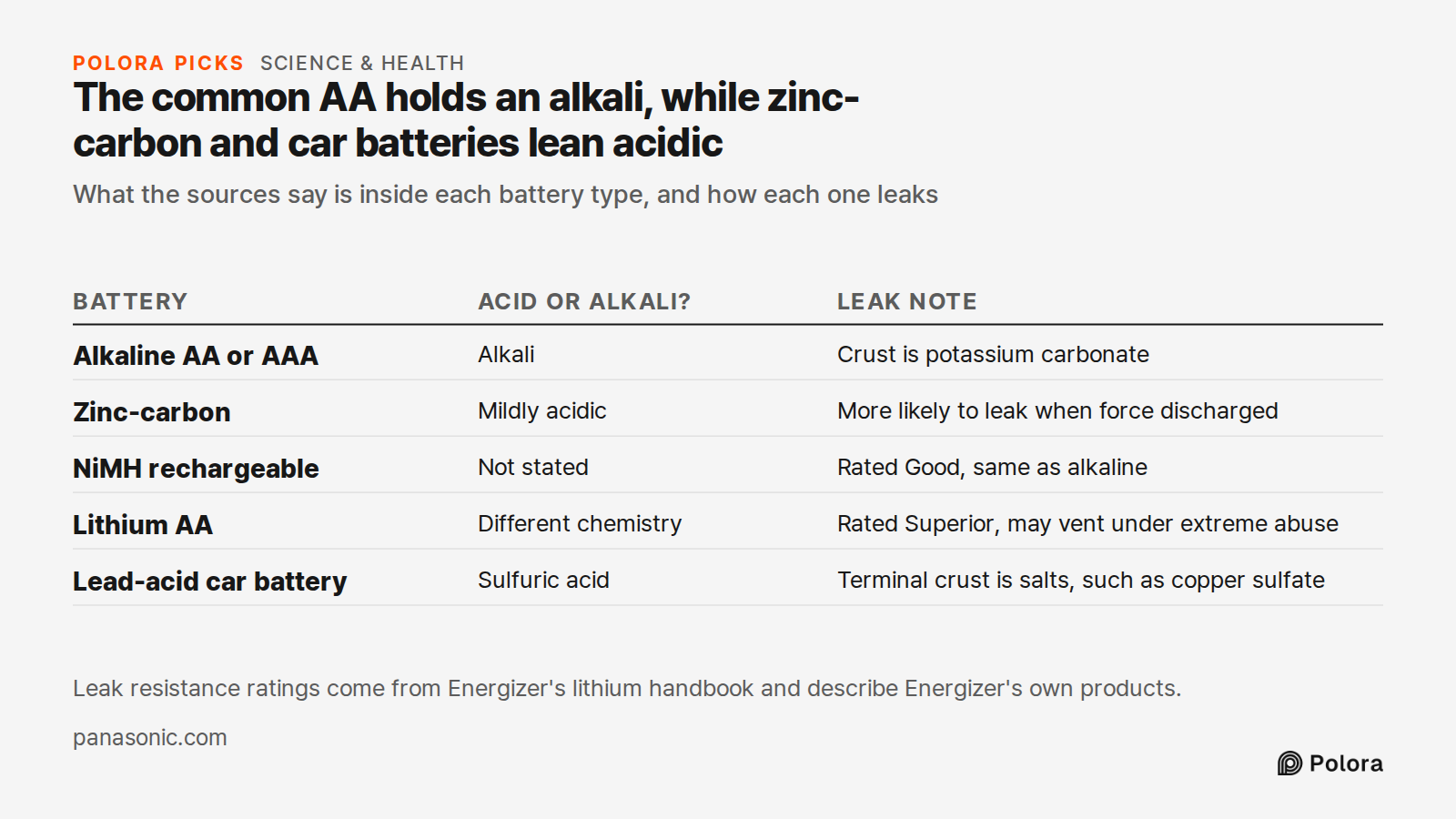
Alkaline cells, the common AA and AAA, hold potassium hydroxide, and their crust is potassium carbonate.

Zinc-carbon cells, often sold as heavy duty or general purpose, are different. Panasonic describes their electrolyte as a mildly acidic solution of zinc chloride or ammonium chloride, so here the leaked liquid really does lean acidic. Energizer says these cells also become more likely to leak when they are force discharged.

Rechargeable NiMH cells are not leak-free. Energizer's lithium handbook rates their leakage resistance 'Good', the same rating it gives alkaline cells. Panasonic warns that an over-discharged NiMH battery releases hydrogen gas. Duracell's cleanup advice groups NiMH leaks with alkaline ones.

Lithium AA cells use a different chemistry. Energizer's lithium FAQ says its lithium cells 'do not leak as alkaline batteries do', and its handbook rates their leakage resistance 'Superior'. The same FAQ says cells that have seen extreme abuse may vent and discolor the top cap. These are a manufacturer's statements about its own products.

Car batteries are where the old word fits. A lead-acid battery holds sulfuric acid. Even so, the crust on its terminals is not liquid acid but salts formed with the help of that acid. Jalopnik, a car news site, describes the bluish-green deposit on the positive terminal as copper sulfate.
The common AA holds an alkali, while zinc-carbon and car batteries lean acidic · What the sources say is inside each battery type, and how each one leaks · Battery · Acid or alkali? · Leak note · Alkaline AA or AAA · Zinc-carbon · NiMH rechargeable · Lithium AA · Lead-acid car battery · Alkali · Cru
What the sources say is inside each battery type, and how each one leaks

Why vinegar works on AA leaks and baking soda does not

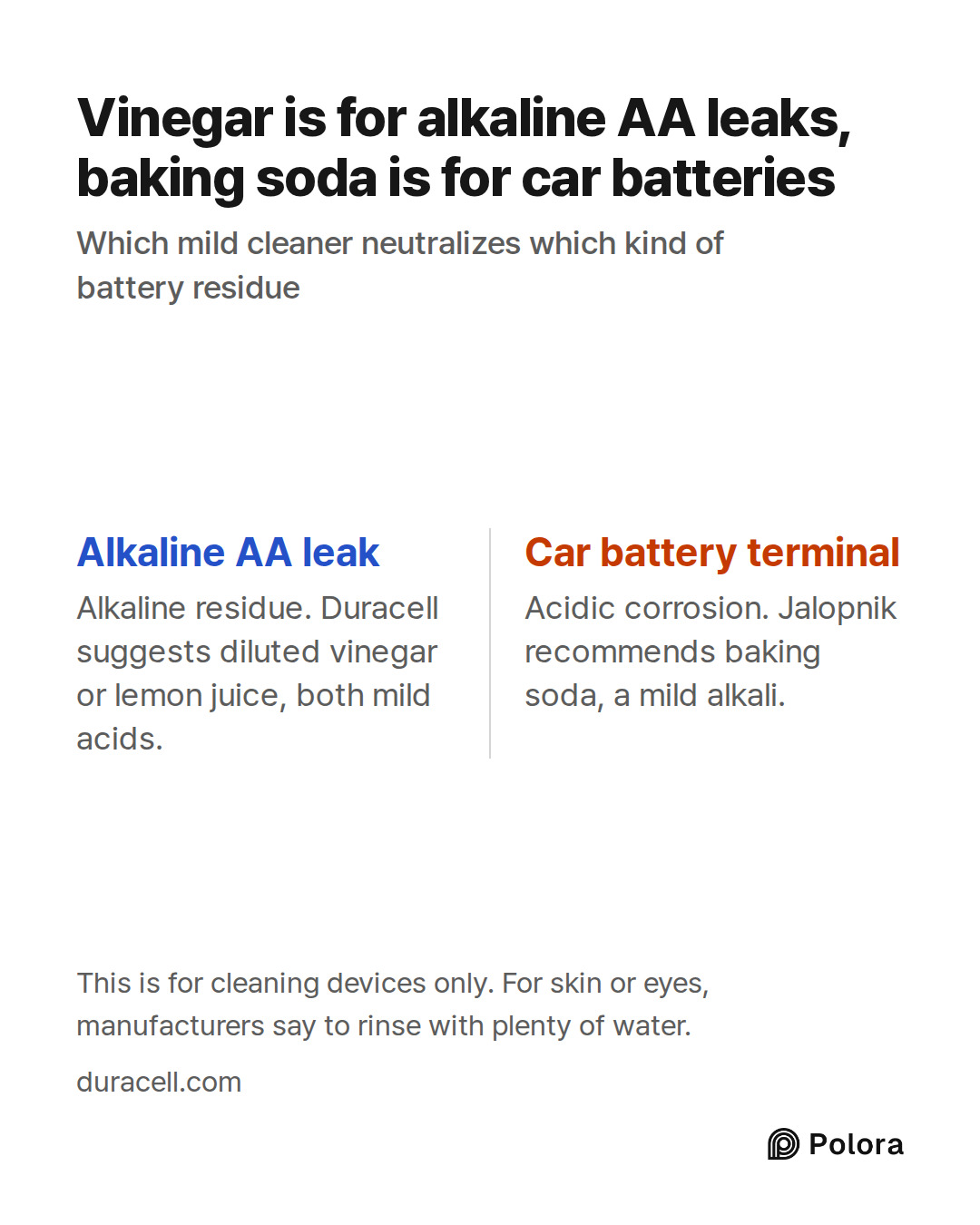
The chemistry decides the cleanup. A mild acid neutralizes something alkaline. To clean alkaline, NiCd and NiMH leaks off a device's contacts, Duracell's FAQ suggests vinegar or lemon juice diluted half and half with water, or boric acid in water, applied with a toothbrush or cotton swab. It says to wear household gloves and glasses, work in a well-ventilated area, and let the device dry completely before new batteries go in. This advice is for the device only, not for skin or eyes.

The familiar baking soda advice belongs to car batteries. Baking soda is a mild alkali, which is why Jalopnik recommends it for acidic terminal corrosion. Against an alkaline leak it has nothing to neutralize.

The manufacturers are direct about safety, and for skin and eyes their answer is plain water. Energizer calls alkaline battery leakage extremely caustic and says contact with bare skin should be avoided. If it touches skin, Energizer says to flush the area with plenty of water for 15 minutes. If the liquid gets into the eyes, Panasonic says not to rub them, to rinse with plenty of clean water and to get medical advice promptly, and it warns of the risk of chemical burns or blindness. Duracell says to contact a physician if battery chemicals reach the eyes.
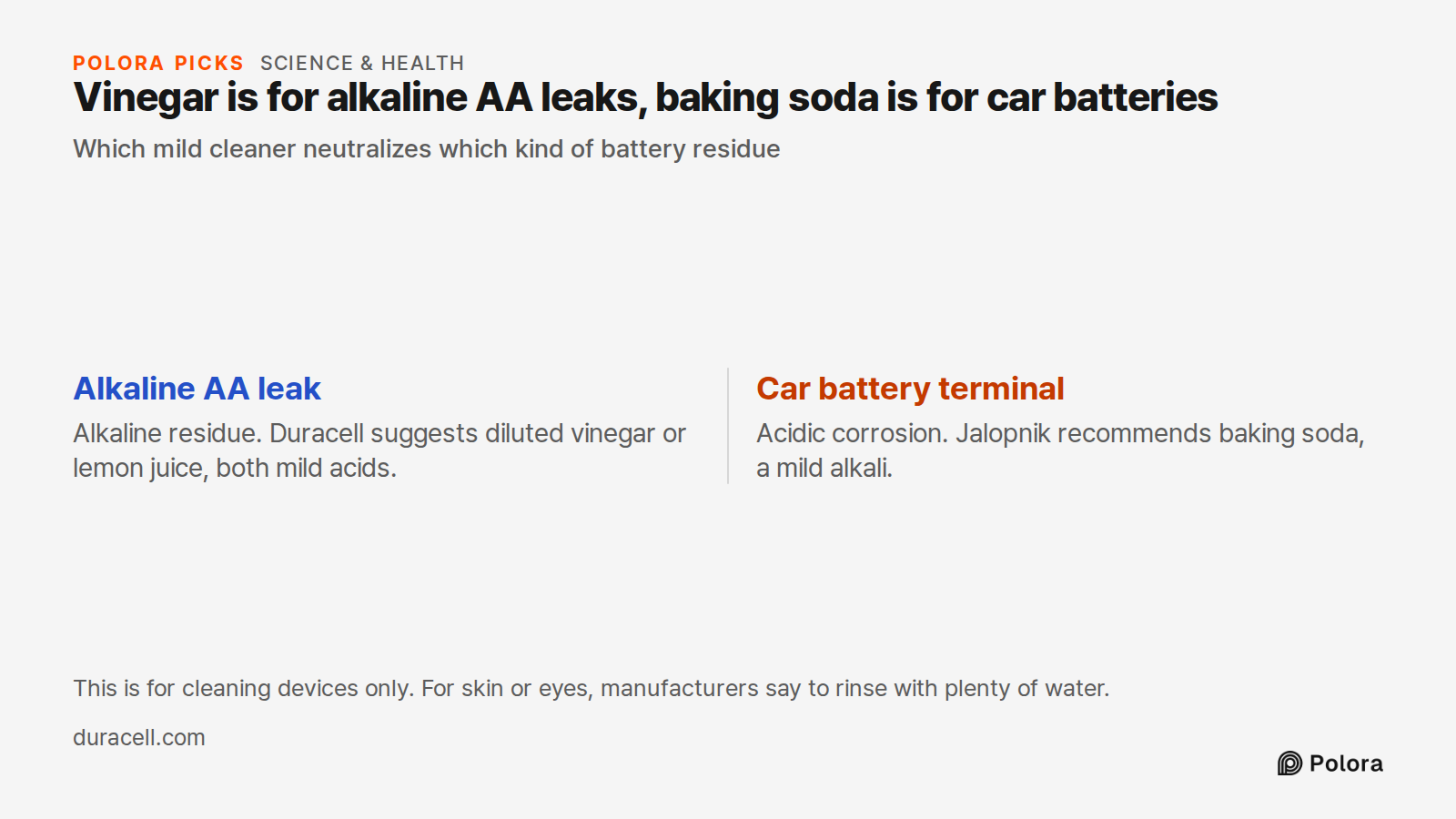
Vinegar is for alkaline AA leaks, baking soda is for car batteries · Which mild cleaner neutralizes which kind of battery residue · Alkaline AA leak · Car battery terminal · Alkaline residue. Duracell suggests diluted vinegar or lemon juice, both mild acids. · Acidic corrosion. Jalopnik recommends b
Which mild cleaner neutralizes which kind of battery residue

The crust tells you what leaked, not always why

So the white crust in the back of the remote tells part of its story clearly. If the battery was alkaline, the liquid inside was an alkali, not an acid, and the air turned it into a salt. How the liquid got out is harder to read from the crust. One well-documented route is a leak after the battery died. Its neighbors or the device kept pulling current through it, gas built up, and a seal built to give way under pressure did just that. Heat, damp, age, a short circuit or damage can also start a leak, and the crust alone does not show which of these happened.

That is also why the manufacturers' advice is so plain. Duracell says to remove batteries as soon as they are depleted, and Energizer, Panasonic and Duracell all warn against mixing old and new.
What is the white crust on old batteries, and why do dead or unused ones leak?What is the white crust on old batteries, and why do they leak?The white crust on an old AA battery is not acid. · In an ordinary alkaline AA or AAA, the liquid inside is a strong alkali, the chemical opposite of an acid. The crust is that liquid, turned into a salt by the air.One cell runs out first · The others keep pushing · Driven below empty · Leak risk rises sharply · No two cells hold exactly the same charge · Charged cells force current through the empty one · It falls to very low or negative voltage · Energizer says this drastically increases the potential for leMixing old and new batteries makes a leak more likely. · Energizer says mismatched cells can significantly increase the potential for leakage, because their capacities do not match.Batteries that were never used can leak too, but less often. · Panasonic names high temperature and high humidity as the most significant factors for leaks in unused batteries.Alkaline AA leak · Car battery terminal · Alkaline residue. Duracell suggests diluted vinegar or lemon juice, both mild acids. · Acidic corrosion. Jalopnik recommends baking soda, a mild alkali. · Vinegar is for alkaline AA leaks, baking soda is for car batteries · Which mild cleaner neutralizes whiThe crust tells you what leaked, not always why. · Duracell says to remove batteries as soon as they are depleted, and Energizer, Panasonic and Duracell all warn against mixing old and new.Sources 11 : data.energizer.com · Energizer alkaline handbook and application manual, panasonic.com · Panasonic dry batteries FAQ, thenakedscientists.com · The Naked Scientists : What chemical leaks from batteries? + 8Read the full story at · polora.ai

What is the white crust on old batteries, and why do batteries leak even when they're dead or never used?

Alpha · deepseek-v4-pro

The crust is not battery acid — at least not on the ordinary alkaline AA or AAA. Inside those cells the electrolyte is potassium hydroxide (KOH), a strong *base*. When it leaks out and meets carbon dioxide in the air, it reacts to form potassium carbonate (K₂CO₃). That is the white, crystalline crust people find. A bluish tint usually means the leaked alkali has also corroded copper or brass contacts nearby, adding copper corrosion products. Why a dead battery still leaks “Dead” does not mean chemically inert. In a device holding several cells in series, the current path goes through all of them. One cell always runs down first, but the stronger cells keep driving current through the exhausted one — manufacturers call this force discharge. The cell is pushed below its normal endpoint, and the chemistry that should have stopped keeps being driven. A byproduct of that abnormal operation is hydrogen gas. The cell has a seal or vent designed to relieve pressure before the metal can bursts; when pressure rises enough, gas escapes, and electrolyte comes with it. Mixing old and new cells, different brands, or different chemistries makes the imbalance worse, so ma…

Beta · gpt-6-sol

The manuscript’s central correction stands: for an ordinary *alkaline* AA or AAA, the white powder is generally potassium carbonate, formed when leaked potassium-hydroxide electrolyte reacts with carbon dioxide in air. It is not “battery acid,” but it is not harmless: Panasonic warns that the residue remains alkaline and can burn skin. Its FAQ also confirms the important exception: zinc-carbon cells use a mildly acidic electrolyte, so the explanation must not be applied to every AA-shaped battery. (panasonic.com) The strongest objection is to the manuscript’s single, confident story of how a leak happens. Energizer confirms that stronger cells can force-discharge an exhausted cell, increasing leakage risk, and its handbook links deep discharge to excessive internal gassing and identifies a safety vent. But those sources do not establish that *most* leaks occur after a cell dies, that every such leak follows the exact gas-then-vent sequence, or that a leak rarely causes a battery to stop working. Panasonic also names heat, humidity, shorts, impact and incorrect installation as possibl…

Gamma · gemini-3.1-pro

The manuscript’s foundational premise is solid: the white crust on a standard alkaline battery is a salt (potassium carbonate), not an acid, and the chemistry dictates how you clean the device. However, as Beta rightly points out, the manuscript turns a few specific mechanisms into a single, universal narrative that outpaces the cited evidence. Here is my assessment of the claims and where the manuscript needs adjustment: 1. The "Battery Acid" Myth and Chemistry The correction of "battery acid" to "potassium carbonate" is entirely accurate for alkaline cells. Potassium hydroxide (KOH) reacts with atmospheric carbon dioxide to form potassium carbonate. Panasonic and Energizer technical documents confirm this. The manuscript is also correct to distinguish zinc-carbon cells (which *do* use a mildly acidic electrolyte like ammonium chloride or zinc chloride) and lead-acid car batteries. *Source confirmed:* https://www.panasonic.com/global/energy/products/battery/dry_batteries_faq.html 2. The "Usually Leaks After It's Dead" Narrative The manuscript claims, *"The leak is rarely what killed the battery. Being driven on after it was empty is what makes a leak likely."* While…

Researcher · gpt-6-luna

The live check largely supports the debaters’ main point, but it also confirms that battery leaks have more than one possible cause. - White crust on an alkaline AA/AAA: Panasonic’s current FAQ identifies it as potassium carbonate, formed when leaked potassium-hydroxide electrolyte reacts with carbon dioxide. Panasonic says the residue remains alkaline and can cause chemical burns. The same FAQ distinguishes “manganese” (zinc-carbon) cells, whose electrolyte is mildly acidic. Panasonic Dry Batteries FAQ (panasonic.com) - Dead or over-discharged cells: Panasonic says over-discharge can lead to leakage, including when cells remain in equipment that draws a small current while switched off; it also warns that mixing cells with different capacities, types, brands, ages, or conditions can lead to over-discharge. Energizer’s FAQ likewise lists deep discharge and mixing fresh and used cells among factors that increase leakage risk. Neither source measures what share of leaks follow this route, so “usually” or “rarely…

The Arbiter · gpt-6-sol

The debaters and Researcher agree on the central chemistry for alkaline AA and AAA cells: the white residue is generally potassium carbonate formed from leaked potassium-hydroxide electrolyte, not “battery acid.” Panasonic’s live FAQ confirms both the reaction and the warning that the residue can still burn skin. That answer does not automatically apply to zinc-carbon or car batteries. (panasonic.com) The live sources also support over-discharge as one route to leakage, including batteries left in a device that continues to draw power. They do not establish the manuscript’s stronger timeline—that a battery *usually* leaks only after it dies, or that leakage *rarely* caused it to fail. Panasonic lists other routes, including heat, humidity, short circuits, and impact, particularly for unused cells. Thus a crusty battery does not, by itself, reveal which event started the leak. (panasonic.com) The main distinction still to preserve in the verdict is between a documented mec…

The Arbiter's Final Verdict · gpt-6-sol

Verdict For an ordinary alkaline AA or AAA, the white crust is generally potassium carbonate: potassium-hydroxide electrolyte has escaped and reacted with carbon dioxide in the air. It is not battery acid, but it remains alkaline and can irritate or burn skin. Panasonic confirms both the identification and the caution. Panasonic battery FAQ A battery can be “dead” without being chemically inert. In a device with several cells, stronger cells can keep driving current through an exhausted one; even a device that appears off may continue drawing a small current. Over-discharge increases the risk of leakage. Internal gas and pressure venting are documented parts of alkaline-cell design, but the evidence here does not show that *every* leak follows that exact sequence. Nor does it establish the manuscript’s claims that batteries *usually* leak after dying or *rarely* die because they leaked. Energizer alkaline FAQ · Energizer alkaline handbook · [Panasonic battery FAQ](https://ww…